How to Lock an Electric Trike and Prevent Theft: Practical Security Tips
Last Updated on October 23, 2026 by Kristina

An electric trike can be a significant investment, and protecting it from theft deserves just as much consideration as choosing the right model.
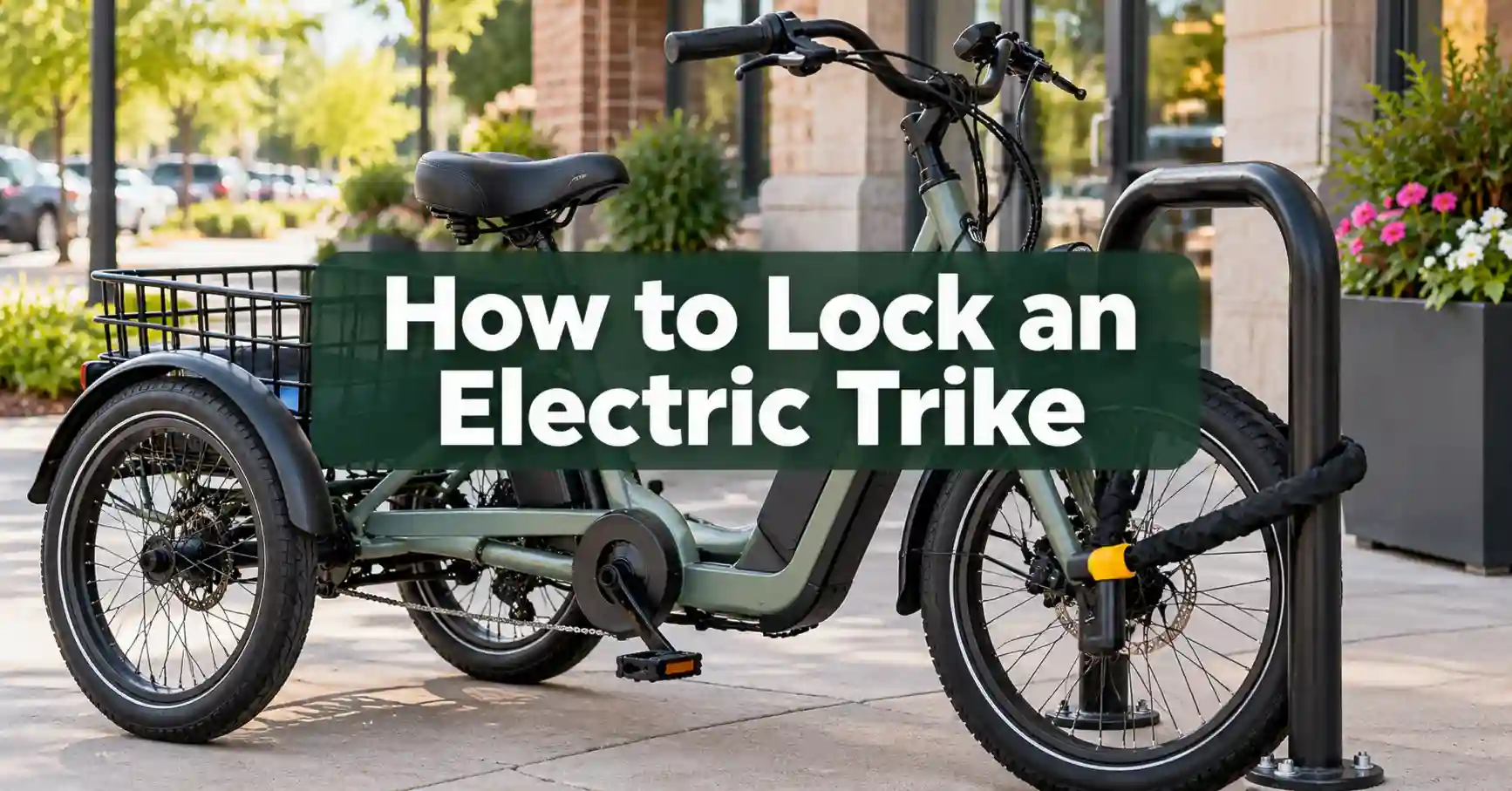
But how do you lock an electric trike securely? Unlike a conventional bicycle, a trike has three wheels, a wider frame, and often large cargo baskets. That can make finding a suitable bike rack or using a standard U-lock more challenging.
The most important step is securing a solid, non-removable part of the trike’s main frame to a firmly anchored object using a high-quality lock. Additional locks can help protect the wheels and removable accessories.
This guide covers where to attach a lock, how to measure for the right size, security options for folding trikes, and practical ways to protect your trike while shopping, traveling, or storing it at home.
If you’re still comparing models, my best electric tricycles buying guide can help you choose a trike that fits your riding and ownership needs.
How to Lock an Electric Trike
For most adult electric trikes, I’d follow these steps:
- Find a secure anchor. Choose a properly installed bicycle rack or another sturdy, fixed object where locking is permitted.
- Identify a structural frame section. Avoid removable baskets, seats, racks, and other accessories.
- Use a strong primary lock. A high-security U-lock or hardened chain should connect the main frame to the anchor.
- Check the locking arrangement. Make sure the lock cannot simply slide off the frame or fixed object.
- Add secondary security. Protect wheels and removable components as appropriate.
- Secure the battery and accessories. Engage the battery lock or remove the battery if practical and permitted by the manufacturer.
- Check everything before leaving. Confirm the trike is stable, the locks are fully engaged, and the parking arrangement doesn’t obstruct access.
A parking brake or wheel lock alone doesn’t prevent someone from lifting or carrying away a trike.
No lock makes a trike theft-proof, but securing the main frame to a suitable anchor is the foundation of a better security setup.
Electric Trike Security Options Compared
| Security method | Best use | Important limitation |
|---|---|---|
| High-security U-lock | Securing the frame to a nearby anchor | May be too small to reach around a wide trike frame |
| Hardened chain lock | Connecting the frame to an anchor when additional reach is necessary | Longer security chains can be heavy |
| Secondary wheel lock | Protecting a compatible wheel | Doesn’t secure the whole trike by itself |
| Cable lock | Securing inexpensive accessories as secondary protection | Generally unsuitable as the primary lock |
| Ground or wall anchor | Permanent home-storage security | Must be correctly installed in a suitable structure |
| Motion alarm | Alerting people when the trike is disturbed | Doesn’t physically prevent removal |
| GPS tracker | Helping locate a stolen trike | Coverage, subscriptions, and recovery limitations vary |
For most riders, I’d prioritize the primary frame lock before spending money on electronic accessories.
1. Find the Right Place to Attach the Lock
The first challenge is identifying where to attach a lock without damaging the trike or relying on a part that can easily be removed.
Different frame designs require different approaches.
Locking a traditional upright electric trike
Most conventional upright electric trikes use one front wheel and two rear wheels. This arrangement is commonly called a delta trike.
Depending on the model, there may be a suitable main frame tube that can be secured to a bicycle rack or another approved anchor.
Look for a structural section that:
- Is part of the main frame.
- Cannot easily be detached from the rest of the trike.
- Is accessible without interfering with cables or moving components.
- Allows the lock to connect securely to a fixed object.
- Doesn’t create a risk of damaging the frame or accessories.
If the frame design makes the correct locking point unclear, consult the manufacturer or a qualified bike shop.
What about recumbent electric trikes?
Some recumbent trikes have two front wheels and one rear wheel, a configuration often called a tadpole trike.
Their lower frames and different steering systems can make conventional bike racks difficult to use.
A recumbent trike may require a different anchor location or longer lock, depending on its frame.
Avoid placing a lock around steering rods, suspension linkages, brake hoses, or other components that aren’t intended to carry security loads.
What not to use as your only locking point
Don’t rely solely on:
- A removable cargo basket.
- A seat or removable seatpost.
- A detachable rear rack.
- A fender or support bracket.
- A wheel without securing the frame.
- A component that can be separated from the main frame.
- An exposed folding mechanism or removable frame connection.
The lock should secure the trike’s structure, not just an accessory.
For additional general techniques, see my guide to locking an e-bike effectively.
2. How to Secure a Folding Electric Trike
Folding electric trikes introduce another detail worth considering.
Some models fold at a central frame hinge, while others have different folding arrangements.
A folding design can make storage and transportation easier, but it can also affect where a security lock should go.
Don’t assume the folding joint is a secure locking point
A hinge, latch, or quick-release mechanism isn’t necessarily designed to resist theft attempts.
Depending on the design, securing only one frame section may leave another section vulnerable to removal or separation.
Before attaching a lock, check how the frame folds and whether any major parts can be detached.
Choose a secure structural locking point and follow the manufacturer’s guidance for your exact trike.
Never modify a folding latch, drill the frame, or interfere with the mechanism to create a locking point.
Example: Mooncool TK2
The Mooncool TK2 is one example of an adult electric trike with a folding frame.
In my Mooncool TK2 hands-on review, I discuss its folding design and the accessories included with the trike.
That makes it a useful example of why owners should examine their trike’s frame layout before choosing a locking setup.
However, I haven’t independently tested specific theft-resistant locking points on the TK2, so I wouldn’t recommend attaching a chain to a particular hinge or frame component without confirming it is suitable.
Should you lock a folding trike while it’s folded?
That depends on the manufacturer’s instructions, the parking arrangement, and whether folding changes the security of the frame connection.
The folded position should not interfere with cables, brakes, battery components, or the safe operation of the folding mechanism.
If you cannot identify a secure locking arrangement, ask the manufacturer rather than improvising one.
3. Choose a High-Security Lock That Fits Your Trike
A lock needs to provide meaningful security, but it also has to fit the trike and the places where you plan to park.
A standard U-lock that works well on a two-wheel commuter bike may not have enough reach for a wider electric trike.
Hardened chain locks
A hardened chain can be practical because it provides flexibility when the frame is farther from the anchor.
A suitable chain may reach a frame section that would be inaccessible with a smaller U-lock.
When comparing chains, consider:
- Independent security certification.
- Construction and resistance to common theft tools.
- The security of the locking mechanism.
- Usable length.
- Weight and portability.
- Compatibility with your frame and parking location.
Remember that the chain and the padlock or integrated locking mechanism must both provide appropriate protection.
A strong chain paired with a weak lock can undermine the security of the setup.
U-locks
A high-security U-lock can be a good choice when the trike’s frame can be positioned close to a suitable rack.
A correctly sized U-lock may also allow less unused space around the frame and anchor.
However, some electric trikes have frame geometry that makes this difficult.
Measure before purchasing rather than assuming a particular lock will fit.
For existing lock comparisons, see my guide to e-bike locks for commuters. Check dimensions and certifications carefully because a lock recommended for a two-wheel bike isn’t automatically a suitable fit for every trike.
Understanding Sold Secure ratings
Sold Secure independently tests locks and other security products.
Its categories include Pedal Cycle and Powered Cycle ratings, and it recommends powered-cycle-rated security products for e-bikes.
An important distinction:
- Powered Cycle Diamond is the highest level within Sold Secure’s Powered Cycle ratings.
- Powered Cycle Gold is the other current Powered Cycle grade.
- Pedal Cycle Diamond is equivalent to Powered Cycle Gold under Sold Secure’s published test comparison.
These ratings shouldn’t be treated as interchangeable just because two products display the word “Diamond.”
Check the exact product and classification in Sold Secure’s official database.
For an expensive electric trike, I would prioritize a strong independently rated lock that meets any relevant insurance requirements and actually fits the intended parking setup.
4. How to Measure an Electric Trike for the Right Lock
This is something I’d do before ordering a new chain or U-lock.
There is no universal lock length that works for every electric trike.
The correct length depends on the frame, the fixed object, and the route the lock needs to follow.
Step 1: Identify the frame locking point
Find a suitable structural section of the trike’s main frame.
Avoid choosing a part solely because it’s easy to reach.
Step 2: Identify the anchor
If possible, inspect the type of bicycle rack or anchor you normally use.
A thick rack tube or an anchor positioned farther away from the trike may require a larger lock.
Step 3: Measure the actual locking path
For a chain, use a flexible measuring tape or piece of string to estimate the path the chain must follow around the frame and anchor.
The path should reflect how the chain will actually be routed, not simply the straight-line distance between the bike and the rack.
Allow for the lock’s joining or fastening arrangement.
Different chain-and-lock systems use different mechanisms, so the stated overall chain length isn’t always the same as the usable locked reach.
Step 4: Check the lock’s usable dimensions
For a U-lock, compare its internal width and height with the frame and anchor.
For a chain, check the manufacturer’s usable length and whether its locking mechanism affects the final fit.
Avoid buying a lock that must be forced around frame tubes or other components.
Step 5: Aim for a practical, close-fitting setup
A lock needs enough reach to engage fully, but excessive slack may make the arrangement less convenient and potentially more vulnerable to certain attacks.
Where practical, keep the lock clear of the ground and avoid positioning it where thieves could easily use surrounding objects for leverage.
Don’t sacrifice a secure locking point merely to obtain a tighter fit.
Practical tip: If you’re unsure about the measurements, take photos and the relevant dimensions to a bike shop or security-lock retailer. That may be easier than repeatedly ordering locks that don’t fit.
🎥 Watch: How to Properly Secure a Bike With a Chain Lock
Not sure how to position a security chain around your trike and a fixed anchor? This video from Kryptonite demonstrates proper chain-locking techniques, including keeping the chain secure and away from the ground.
Although the demonstration uses a regular bicycle, the same general principles can help electric trike owners. Just remember to choose a suitable structural locking point for your particular trike.
🔒 Recommended Locks for Electric Trikes
Not sure which lock to choose? Electric trikes often need more reach than regular bicycles, especially when the frame sits farther away from a bike rack.
Here are three high-security options worth considering.
1. ABUS GRANIT Extreme XPlus 59/12HKS170 – Best for Extra Chain Length
This heavy-duty security chain offers 170 cm (approximately 5.6 feet) of length, 12 mm hardened steel links, and a Sold Secure Powered Cycle Gold rating.
It’s worth considering for wider trikes or garage storage where additional reach is important. However, at approximately 12.6 pounds, it’s heavy to carry regularly.
View the ABUS GRANIT Extreme XPlus 59
2. Kryptonite New York Cinch Ring Chain 1213 – Best Flexible Chain Option
This 130 cm chain uses 12 mm hardened steel links and a cinch-loop design that can provide more effective locking reach than a conventional chain of the same length.
It’s another option for connecting a trike frame to a secure anchor, although it still weighs approximately 10.6 pounds.
View the Kryptonite New York Cinch Ring Chain
3. Hiplok DX1000 – Best Premium D-Lock for Close-Fitting Anchors
The Hiplok DX1000 is designed to resist angle-grinder attacks and carries a Sold Secure Powered Cycle Diamond rating.
It has an internal locking area of approximately 205 × 112 mm and weighs 5.7 pounds.
It’s worth considering for high-value trikes when the frame can be positioned close enough to a suitable anchor. It won’t fit every trike or bicycle rack, so checking the dimensions is essential.
Before You Buy: Measure the distance around your trike’s intended structural locking point and the anchor you plan to use. Confirm that the lock fits, check any insurance requirements, and remember that even a premium lock doesn’t make a trike theft-proof.
5. Do You Need to Lock All Three Wheels?
This is a common question for electric trike owners.
The short answer is not necessarily.
Your first priority should be securing the main frame to a fixed anchor.
Why wheel-only locking isn’t enough
A wheel lock may stop a trike from rolling normally, but it doesn’t prevent someone from carrying it away.
Some wheels can also be removed separately from the frame.
Adding protection for rear wheels
Depending on your trike’s design, a second suitable lock may protect one or more wheels.
However, the wide spacing between rear wheels can make it impractical to secure both using one lock.
Don’t force a chain or U-lock against a brake rotor, electrical connection, delicate wheel component, or other part that could be damaged.
If you use wheel security, choose a compatible locking arrangement that does not depend on a vulnerable component as the primary security point.
What should you prioritize?
I’d use this order:
- Main frame secured to a suitable fixed anchor.
- Additional protection for removable or vulnerable wheels where practical.
- Protection for the battery and other valuable accessories.
You don’t automatically need three separate wheel locks just because the trike has three wheels.
6. How to Lock an Electric Trike Outside a Store
Many riders purchase electric trikes because they make shopping and errands more convenient.
Unfortunately, grocery-store bicycle racks aren’t always designed for wider three-wheel vehicles.
Choose an appropriate parking location
Look for a securely installed rack with enough space for the trike.
Check whether:
- The anchor is firmly attached.
- There is enough space for the trike’s full width.
- Your lock can reach the main frame.
- The lock cannot slide off the anchor.
- The trike can be parked without obstructing accessible routes, entrances, or other bicycle parking.
Choose a visible, well-lit area when possible.
Park the trike safely before locking it
Apply the parking brake according to the manufacturer’s instructions.
Make sure the trike is stationary and stable before reaching for locks or removing belongings.
A parking brake helps prevent movement, but it isn’t an anti-theft lock.
If you’re new to three-wheel riding, my beginner’s electric trike riding guide covers stopping, parking, and safely maneuvering a trike.
What if the bicycle rack doesn’t fit?
Don’t try to force the trike into a rack that could damage its wheels or other components.
If there isn’t a suitable anchor, look for another permitted parking location or ask the property owner about secure bicycle parking.
Avoid relying on removable signs, unsecured posts, weak fences, or other questionable fixtures.
Don’t assume a heavy trike is theft-proof
Electric trikes can be substantial vehicles, but weight alone isn’t reliable security.
A trike may still be moved, lifted, or loaded into a vehicle by someone determined to steal it.
Use a suitable physical lock even during relatively short stops.
7. Three Practical Electric Trike Locking Setups
Here are examples of how your security approach might change depending on where the trike is parked.
| Parking situation | Practical security approach | Important consideration |
|---|---|---|
| Grocery store or shopping center | Secure the main frame to an appropriate rack with a high-security lock; protect removable valuables | Rack dimensions and trike width |
| Garage or shed overnight | Use a suitable frame lock and, where practical, a properly installed security anchor inside the storage area | Strength of the doors, structure, and anchor |
| RV, trailer, or campground stop | Use separate transport restraints and an appropriate theft-resistant locking system when parked | Vehicle, rack, carrier, and anchor compatibility |
Grocery-shopping setup
For everyday errands, I’d prioritize a primary lock that’s practical enough to use every time.
A suitable hardened chain may provide the reach needed when the trike can’t sit close to a rack.
If you have removable valuables, take them with you when practical.
Home-storage setup
A securely installed ground or wall anchor can provide a consistent locking location.
If you choose an anchor, verify that the building material and installation method are appropriate.
A strong lock connected to a weak or improperly installed anchor may offer less protection than expected.
RV or campground setup
This is where I’d be particularly careful about confusing transportation security with theft prevention.
Transport straps and carrier restraints are designed to prevent movement while traveling.
A theft-resistant lock serves a different purpose.
You may need both, but the correct arrangement depends on the vehicle, carrier, trike, and manufacturer’s instructions.
8. Securing an Electric Trike During Transportation
If you transport your electric trike in a pickup truck, trailer, RV setup, or on a compatible carrier, make sure the trike is properly restrained for travel.
A security chain or U-lock is not a substitute for transport restraints.
Likewise, tie-down straps aren’t automatically theft-resistant.
When the vehicle is parked
If the trike remains on a carrier or trailer while unattended, assess whether a compatible security lock can connect a suitable frame section to a properly secured anchor.
Not every carrier provides an approved theft-resistant locking point.
Don’t attach locks in ways that interfere with the carrier’s operation, damage vehicle components, or compromise transport restraints.
For detailed information about trike carriers, weight limits, loading, and proper restraint, read my guide to transporting an electric trike safely.
9. How to Protect an Electric Trike at Home
A locked garage or shed provides one layer of protection, but additional security may still be worthwhile.
Garage storage
If appropriate for the building and your trike, a properly installed ground or wall anchor can provide a dedicated locking location.
Use a security product intended for that application.
Don’t assume every wall, floor, or mounting surface can safely support a security anchor.
Shed storage
Pay attention to the overall structure.
The strength of the door, hinges, frame, and locking hardware can matter just as much as the lock attached to the trike.
Shared garages and apartments
Some apartment buildings have designated bicycle storage rooms or shared parking areas.
Check whether electric trikes are permitted and whether a suitable anchor is available.
Don’t install permanent hardware without property-owner approval.
Also make sure the trike doesn’t block common walkways, entrances, or emergency access.
For longer-term storage, follow the battery manufacturer’s instructions concerning temperature, charging, and battery handling.
10. Protect the Battery and Other Removable Accessories
A removable battery can be one of the more valuable components on an electric trike.
Other accessories, such as displays, baskets, mirrors, bags, and seats, may also attract theft.
Should you remove the battery?
If the battery is designed to be removed and carried separately, doing so may reduce the risk of battery theft during certain stops.
However, some batteries are heavy, and removal isn’t practical for every rider.
If you leave the battery installed, engage any manufacturer-provided retention lock.
Don’t rely on the battery lock as a replacement for securing the trike’s frame.
Displays and cargo accessories
Remove valuable detachable accessories when practical.
Avoid leaving wallets, keys, phones, or other valuables inside an unattended cargo basket.
Even an enclosed or lockable basket may offer limited protection against determined theft.
11. Do GPS Trackers and Alarms Help Prevent Theft?
Electronic security can provide another layer of protection, but it’s important to understand what these systems actually do.
GPS trackers
A GPS tracker may help locate a stolen trike.
However, available features vary. Some systems require cellular service, subscriptions, compatible hardware, or regular charging.
Tracking information doesn’t guarantee recovery.
If your tracker shows a stolen trike at an unfamiliar location, contact law enforcement rather than trying to recover it yourself.
My guide to e-bikes with GPS tracking explains the different types of connected security features.
Motion alarms
A motion-sensitive alarm may discourage someone from interfering with a parked trike.
However, alarms can produce false alerts, and some require separate batteries or maintenance.
Digital battery and motor locks
Some e-bike systems offer digital security functions.
For example, Bosch provides compatible e-bikes with functions that can disable motor assistance, provide battery-use protection, or support theft alerts and location tracking.
These capabilities depend on the particular Bosch system and compatible hardware or services.
Bosch also makes clear that digital theft protection supplements rather than replaces a mechanical lock.
Don’t assume a digital lock prevents the physical removal of an entire trike.
12. Check Your Insurance Requirements Before Buying a Lock
This is especially important if you’ve purchased an expensive electric trike.
Different insurance policies may have different theft-protection requirements.
Some policies specify how a bicycle must be secured when left unattended. Others may distinguish between indoor storage, outdoor parking, and transportation.
Questions to ask your insurer
Before purchasing a lock, confirm:
- Does the policy cover my exact electric trike?
- Is the trike’s speed, power, or vehicle classification relevant to coverage?
- Does the insurer require a particular lock rating?
- Must the trike be secured to an immovable object?
- Are there different rules for garage or shared-storage locations?
- Is overnight outdoor parking covered?
- Is the trike covered while attached to an RV or vehicle carrier?
- Do I need photographs, receipts, or proof that the lock was used?
- Are the battery and removable accessories covered separately?
Don’t assume any Diamond-rated lock qualifies
Sold Secure uses more than one security-rating category.
A policy may identify a particular category, grade, or approved-lock standard.
Verify the exact product’s certification and compare it with your insurer’s written requirements.
Some insurers also have specific conditions for unattended bikes and how they are anchored.
The safest approach is to get the requirements for your particular policy in writing before relying on a specific locking setup.
For additional background, see my guide to renters insurance and e-bike theft.
Insurance coverage for an electric trike should never be assumed without checking the policy.
13. Register Your Electric Trike Before It Gets Stolen
Even the best locking setup can’t guarantee that theft won’t occur.
That’s why I’d also recommend documenting the trike before there’s a problem.
Keep a record of:
- Manufacturer and model.
- Frame serial number.
- Purchase receipt.
- Photographs from several angles.
- A photograph of the serial number.
- Distinctive accessories or modifications.
- Relevant battery and key identification information, stored securely.
You can register eligible bicycles through Bike Index, which provides a free registration and stolen-bike reporting service.
Registration doesn’t physically prevent theft, but it can help establish ownership and make a recovered vehicle easier to identify.
If your trike is stolen, report it to the police and retain the report number.
My step-by-step stolen e-bike recovery guide covers what to do next.
14. Common Electric Trike Locking Mistakes
There are several mistakes I’d try to avoid.
Locking only a wheel: The main frame may still be removed.
Locking through a cargo basket: Removable baskets aren’t reliable primary security points.
Relying on the parking brake: A parking brake doesn’t stop someone from carrying the trike away.
Using a lightweight cable as the primary lock: Cables generally offer less protection than suitable high-security chains or U-locks.
Buying a lock without measuring: The lock may not reach around the trike’s frame and the intended anchor.
Ignoring folding-frame components: A detachable or inappropriate frame section may compromise the security arrangement.
Using an unsuitable anchor: A weak or removable object can undermine an otherwise good lock.
Leaving the battery or accessories unsecured: Some valuable components can be removed separately.
Assuming indoor storage eliminates theft risk: Garages, sheds, and shared storage areas can also be targeted.
Forgetting to check the lock: Make sure the locking mechanism is fully engaged before walking away.
Electric Trike Security Checklist
Before leaving your trike unattended, run through these checks:
- ☐ My main lock secures a suitable structural section of the frame.
- ☐ The anchor is firmly installed and appropriate for locking.
- ☐ The lock cannot simply be slipped off the frame or anchor.
- ☐ The parking location accommodates the trike’s full width.
- ☐ The trike is stable and not obstructing access.
- ☐ Additional wheel security is installed where appropriate.
- ☐ The battery and other removable valuables are secured or removed.
- ☐ The parking brake is applied according to the manufacturer’s instructions.
- ☐ Every security lock is fully engaged.
- ☐ My insurance requirements have been checked.
- ☐ I have recorded the trike’s serial number and proof of ownership.
Frequently Asked Questions
What’s the best way to lock an electric trike?
Secure a suitable structural section of the main frame to a sturdy, firmly anchored object using a high-security lock. Additional wheel and accessory protection can help.
Can I use a regular bicycle U-lock?
Possibly. It depends on the lock’s internal dimensions, your trike’s frame design, and how close you can position the trike to the anchor.
Are electric trikes harder to steal because they’re heavier?
Weight alone doesn’t prevent theft. A heavy trike can still be moved or loaded into a vehicle.
Do I need to lock all three wheels?
Not necessarily. The priority is securing the main frame to a fixed object. Additional wheel protection depends on the design and security risks.
Is a chain better than a U-lock for an electric trike?
Neither is automatically better in every situation. A properly rated chain may provide greater reach, while a high-security U-lock may be practical when the frame can be positioned close to an anchor.
Can I lock an electric trike by the rear basket?
I wouldn’t use a removable basket as the primary locking point. Use an appropriate structural frame section instead.
Should I remove the battery whenever I park?
It depends on the manufacturer’s instructions and whether removal is practical. If the battery remains installed, engage its retention lock and secure the trike’s main frame separately.
Can I leave an electric trike locked outside overnight?
Outdoor overnight parking increases exposure to theft and weather. Secure indoor storage is generally preferable when available. If outdoor storage is unavoidable, use appropriate security measures and follow the trike manufacturer’s storage guidance.
Does insurance cover electric trike theft?
It depends on the insurer and policy. Some policies have restrictions concerning motorized vehicles, vehicle classification, lock requirements, storage locations, and theft circumstances.
What if my electric trike is stolen?
Report the theft to police, preserve evidence, gather identifying information, update any relevant registry, and contact your insurer if you have applicable coverage. Avoid confronting suspected thieves.
Why You Can Trust Electric Bike Explorer
Electric Bike Explorer provides practical, independent guidance for people researching, buying, riding, and maintaining electric bikes and trikes.
This guide was researched using published bicycle-security recommendations, independent lock-rating information, manufacturer theft-protection documentation, and theft-recovery resources.
Specific frame-locking locations, lock compatibility, and security requirements vary by trike. I haven’t independently tested every locking arrangement discussed here, and no lock should be considered theft-proof.
My Take
I think electric trike security is something more people should consider before buying, particularly if they plan to use their trike for groceries or regular errands.
A trike can be extremely convenient for carrying things, but its wider frame means you may not be able to secure it exactly like a conventional bicycle.
The first thing I’d concentrate on is finding a strong lock that fits the frame and reaches a suitable anchor.
I wouldn’t automatically spend money on multiple electronic security accessories before getting that basic setup right.
Once the main frame is properly secured, then I’d consider secondary wheel protection, battery security, and possibly a GPS tracker, depending on where the trike will be parked.
I’d also check insurance requirements before purchasing a lock, especially for a higher-value trike.
And if you’re still comparing electric trikes, think beyond battery range and motor power. Consider the frame layout, folded dimensions, storage requirements, and whether you have a suitable place to lock it.
Planning for security before it becomes a problem can make ownership much easier.
Disclosure: As an Amazon Associate, I earn from qualifying purchases. This comes at no extra cost to you and helps support the content on this site.
Find Electric Bike Explorer helpful? Consider adding EBE as a preferred source in Google Search for more practical e-bike guides.
Sources and Further Reading
- ABUS – Locking Your Bicycle Correctly
- Sold Secure – Powered Cycle and E-Bike Lock Ratings
- Bosch eBike Systems – Digital Theft Protection
- Bike Index – Bicycle Registration and Theft Recovery

Kristina is not just an enthusiast but a true authority on electric bikes. Nestled in the coastal beauty of Virginia, Kristina has found the perfect backdrop for her passion for electric biking. As a dedicated wife and homeschooling mom, her life revolves around family, faith, and the thrill of adventure.
Originally hailing from Ohio, Kristina's journey with electric bikes began as a curiosity and quickly evolved into a deep expertise. Her blog is a testament to her love for electric biking, combining her fascination for eco-friendly transportation with her coastal lifestyle.
When she's not cruising the beach on her electric bike, you'll find Kristina indulging in her other loves: long walks along the shore, getting lost in a good book, and cherishing moments with her loved ones. With a heart as big as her love for animals, especially cats, Kristina brings a unique perspective to the electric bike world, grounded in her strong faith in God and her dedication to a sustainable lifestyle.
Through her blog, Kristina shares her extensive knowledge of electric bikes, offering valuable insights, tips, and recommendations to fellow enthusiasts. Whether you're a seasoned rider or a newcomer to the electric bike scene, Kristina's blog is your go-to source for all things electric biking, fueled by her passion, expertise, and the scenic beauty of coastal Virginia.