Electric Trike Parking Brake Not Working? Causes and Safe Fixes
Last Updated on October 27, 2026 by Kristina
Is your electric trike parking brake not holding, refusing to engage, or staying locked when you’re ready to ride?
A parking brake problem can be frustrating, especially if you rely on your trike for grocery shopping, errands, or getting around town. More importantly, a trike that unexpectedly rolls or won’t release its brakes can become a safety concern.
If your electric trike’s parking brake isn’t working, start by checking the manufacturer’s engagement and release instructions, inspecting the locking mechanism for visible damage, and determining whether the regular brake still works properly.
Don’t try to compensate for a faulty parking brake by overtightening unfamiliar adjustments or forcing the mechanism.
This guide explains what to check, what might be causing the problem, and when it’s safer to have a qualified mechanic inspect the trike. I’ll also explain what to do if your parking brake fails while you’re away from home.
If you’re new to three-wheel riding, my guide to riding an electric trike for beginners covers stopping, parking, and getting comfortable with three-wheel handling.
Quick Troubleshooting: What’s Wrong With Your Electric Trike Parking Brake?
Start by identifying the symptom.
| Problem | Possible causes | What to do first |
|---|---|---|
| Parking brake won’t hold | Lock isn’t fully engaged, weak service brake, worn parts, or adjustment problem | Check the correct procedure and inspect the regular brake |
| Parking brake won’t engage | Incorrect procedure, obstructed control, damaged locking mechanism | Inspect the lever and consult the owner’s manual |
| Parking brake won’t release | Lock hasn’t disengaged, brake isn’t returning, mechanical resistance | Follow the manufacturer’s release procedure without forcing anything |
| Parking lock engages, but trike rolls | Insufficient braking force or a brake-system problem | Stop relying on the parking brake and arrange inspection |
| Trike won’t roll after releasing the brake | Brake drag, sticking caliper, or another mechanical fault | Keep motor power off and check for abnormal resistance |
| Trike rolls, but motor won’t assist | Brake-cutoff signal or another electrical problem | Check lever position and display warnings |
| Parking brake fails on a new trike | Incorrect setup, incomplete assembly, or defective component | Stop using the trike and contact the seller or manufacturer |
These are possible explanations, not confirmed diagnoses. Different electric trikes use different brake systems, so the same symptom can have more than one cause.
Safety first: If your trike’s parking brake cannot reliably hold it, don’t rely on that brake when mounting, dismounting, loading cargo, or parking on a slope. If the service brakes are also affected, don’t ride until the problem is corrected.
How Electric Trike Parking Brakes Work
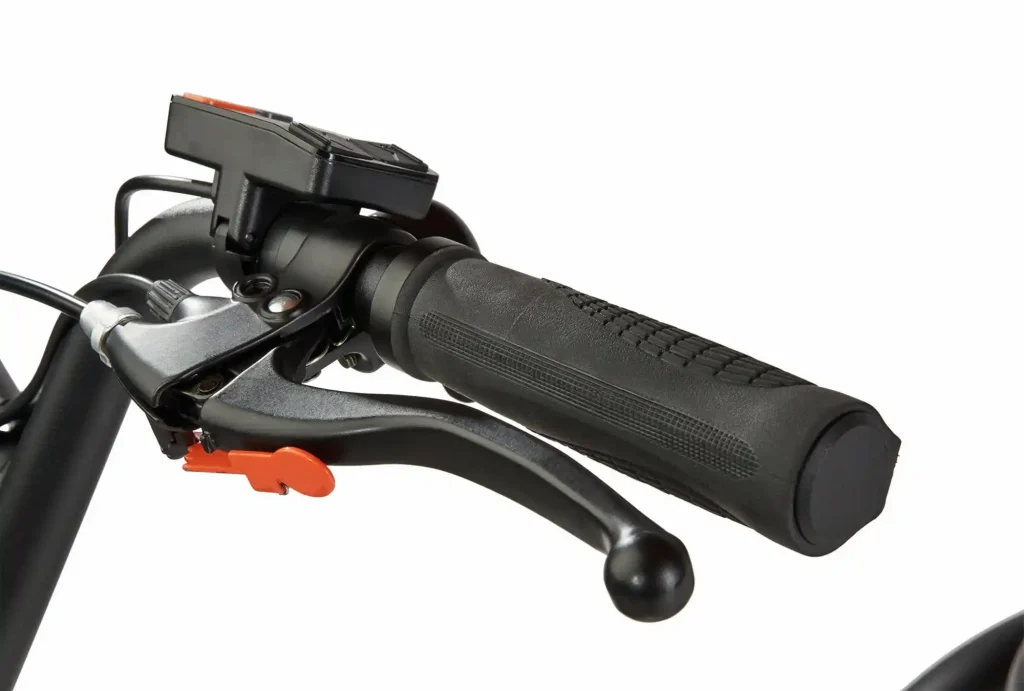
Unlike a regular two-wheel bicycle, an upright electric trike usually doesn’t need a kickstand.
However, three wheels don’t prevent it from rolling.
The parking brake is intended to help keep the trike stationary while parked.
There isn’t one universal parking-brake design.
Electric trike parking brake comparison
Here’s how several documented systems differ.
| Trike or system | Parking-brake design | Important difference |
|---|---|---|
| Original Rad Power Bikes RadTrike | Orange locking lever associated with the front brake | Locks the front brake; rear coaster brake is separate |
| Lectric XP Trike2 | Blue parking controls on both handlebars | Front and rear parking brakes with a model-specific release procedure |
| Pedego Trike, as documented in its 2023 manual | Silver locking pins integrated into the brake levers | Both front and rear levers have parking locks |
| E-BikeKit SINET conversion system | Integrated locking mechanical brake levers | Combines mechanical braking, motor cutoff, and parking lock |
These details apply to the documented models and configurations. They shouldn’t be assumed to apply to newer generations or differently equipped trikes.
Original RadTrike parking brake
The original RadTrike uses a cable-operated front disc brake and a separate rear coaster brake.
The parking brake operates through the front brake lever.
According to the owner’s manual, the rider should:
- Bring the trike to a complete stop.
- Squeeze the front brake lever.
- Pull the orange parking-brake lever until it clicks into place.
- Release it by squeezing the regular brake lever again.
The orange locking control is designed to hold the front brake in its applied position.
It does not mean that all three wheels have separate parking locks.
Lectric XP Trike2 parking brake
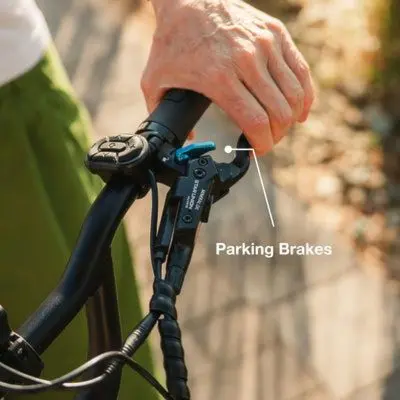
The Lectric XP Trike2 has parking-brake controls on both handlebars.
The manual describes blue levers that can be moved between locked and unlocked positions.
To engage the parking brakes, the rider moves the blue controls into the locked position and pulls the corresponding brake levers.
To release them, Lectric instructs owners to move the blue controls into the unlocked position and then squeeze the brake levers again until the locks release.
This is an important difference from systems that release simply by squeezing a brake lever.
If you own a Lectric trike, use the instructions for your exact generation.
The company’s official user manual library provides separate documentation for the XP Trike1 and XP Trike2.
Pedego Trike parking brake
The Pedego Trike configuration documented in the company’s 2023 owner’s manual uses silver parking-lock pins integrated into the front and rear brake levers.
The instructions describe pulling the brake lever firmly, pressing the locking pin, and releasing the lever.
Pulling the brake lever toward the grip again disengages the pin.
However, other Pedego trike configurations, including the Fat Tire Trike described in later documentation, may use a different locking-lever arrangement.
Don’t assume the silver-pin procedure is correct for every Pedego model.
E-BikeKit SINET locking brake levers
E-BikeKit offers locking e-brake levers for its SINET conversion systems.
These combine three functions:
- Mechanical braking.
- Parking-brake locking.
- Electrical motor cutoff.
When the brake lever is operated, its electrical switch sends a cutoff signal to the compatible controller.
The parking-lock mechanism holds the lever in the applied position while the trike is parked.
These levers are specifically designed for compatible long-pull mechanical braking systems and current SINET electronics.
They are not universal replacements for hydraulic brake levers or other manufacturers’ electrical controls.
The takeaway: Identify your exact parking-brake mechanism before attempting troubleshooting or replacing parts.
🎬 Watch: How an Electric Trike Parking Brake Works
Not sure how an electric trike parking brake engages and releases? This demonstration from sixthreezero shows how a locking brake lever works and why it’s useful when parking or getting on and off a trike.
Keep in mind that parking-brake designs vary between manufacturers. The mechanism shown may differ from the one on your trike, so always follow your owner’s manual.
Electric Trike Parking Brake Won’t Hold: What to Check
One of the more concerning problems is when you engage the parking brake but the trike still rolls.
Don’t test a questionable parking brake on a driveway, hill, ramp, or other sloped surface.
1. Make sure the locking mechanism is fully engaged
Start with the owner’s manual.
On some trikes, the parking lock won’t engage unless the regular brake lever is squeezed firmly enough.
Other systems require a separate control to be moved into position first.
If the lock isn’t being engaged correctly, it may not hold the brake with sufficient force.
The Trike Bike CHILL owner’s manual specifically warns that engaging a locking mechanism without sufficient brake-lever pressure may leave the trike able to roll.
Follow the instructions for your own model.
2. Check the regular brake lever
A parking lock that holds a brake lever in position depends on the underlying service brake providing adequate braking force.
With the trike stationary and powered off, inspect the lever.
Look for:
- Unusual looseness.
- Excessive lever travel.
- A lever that touches or nearly touches the handlebar.
- Visible cracks or damage.
- A locking control that won’t stay in position.
- Abnormal resistance when squeezing or releasing.
If the regular brake feels weak, that issue needs attention before relying on the parking lock.
My guide to weak e-bike brakes explains additional warning signs.
3. Look for visible brake damage
Depending on the model, the braking system may include cables, hydraulic hoses, calipers, pads, and rotors.
Without disassembling anything, check for:
- Frayed or damaged cables.
- Loose or broken components.
- Hydraulic-fluid leaks.
- Damaged hoses.
- Severely worn brake pads.
- Contamination on braking surfaces.
- Visibly damaged rotors.
Some problems won’t be obvious from a visual inspection.
Never apply oil or general-purpose lubricant to brake pads or rotors.
4. Consider adjustment or component wear
Cable-operated brakes can lose effectiveness because of worn components or incorrect adjustment.
Hydraulic brakes can develop their own problems involving pads, fluid, seals, or other parts.
The appropriate repair depends on the actual brake system.
I wouldn’t recommend randomly tightening adjusters or changing hydraulic settings without identifying the brake and following its specific service instructions.
If the parking control locks but the trike still rolls, don’t assume replacing the locking lever will solve the problem. The underlying brake may need repair.
Electric Trike Parking Brake Won’t Engage
What if the parking-brake button or lever won’t lock at all?
Start with the manufacturer’s procedure.
Some controls require the regular brake lever to be squeezed before the lock can catch.
Check the locking mechanism
With motor power off and the trike safely secured, look for:
- Visible damage.
- Dirt or debris obstructing the control.
- A bent or broken locking pin.
- A lever that won’t move normally.
- A main brake lever that isn’t returning to its resting position.
A visual inspection is reasonable.
However, don’t pry the mechanism apart or force a jammed control.
Check whether the regular brake is functioning normally
If the brake lever isn’t moving through its normal range, the parking lock may not be able to engage correctly.
This can indicate damage, maladjustment, or another problem within the brake system.
If the cause isn’t obvious and safely correctable under the manufacturer’s instructions, arrange service.
Don’t use a cable tie, clamp, or improvised device to hold a defective brake lever closed as a substitute for repairing the parking lock.
Electric Trike Parking Brake Won’t Release
A stuck parking brake can leave a wheel partially or completely restricted.
If this happens, don’t try to overcome the brake using the throttle or pedal assistance.
Step 1: Switch off motor power
Park or secure the trike on level ground.
Keep it from rolling unexpectedly while you inspect the controls.
Step 2: Follow the correct release procedure
For example, the original RadTrike parking lock releases when the regular front brake lever is squeezed again.
On the Lectric XP Trike2, the blue locking controls must first be returned to the unlocked position before the brake levers are pulled to release the locks.
For the Pedego Trike silver-pin system documented in its 2023 manual, squeezing the relevant brake lever releases the locking pin.
These procedures aren’t interchangeable.
If the control doesn’t release as the manufacturer describes, don’t force it.
Step 3: Check whether the brake lever returns normally
After releasing the parking lock, look at the main brake lever.
If it stays partly applied, returns slowly, or feels stuck, the brake itself may still be engaging.
Possible causes include a sticking mechanism, damaged cable, or another brake-system fault.
Step 4: Don’t force a stuck wheel
If the trike continues resisting movement, stop.
Don’t repeatedly drag the tire, push aggressively against the brake, or try to ride until the cause has been identified.
What to Do if Your Electric Trike Parking Brake Fails Away From Home
Imagine riding to the grocery store and discovering that the parking brake won’t hold when you stop.
This is where having a simple plan matters.
First, find a safe place to stop
If you can move the trike safely, choose level ground away from traffic, drop-offs, or places where it could roll into pedestrians.
Don’t try to test the parking brake on a slope.
Switch off motor assistance.
Keep the trike from moving
Maintain control of the trike while arranging assistance.
If you have suitable wheel chocks and can position them safely, they may provide an additional restraint for a stationary trike.
However, chocks don’t repair the parking brake or guarantee that an unsafe trike can be ridden.
If you cannot reliably immobilize the trike, don’t leave it unattended.
Avoid unnecessary cargo loading
Adding or removing heavy grocery bags can cause a trike to shift or roll.
If the parking brake isn’t holding, avoid loading or unloading cargo unless the trike is safely stabilized.
Decide whether the trike needs transportation
If the regular service brakes are weak, sticking, damaged, or otherwise unreliable, don’t ride home.
If the parking brake alone has failed, the trike still needs proper assessment because its failure may indicate an underlying brake problem.
The safest choice is to arrange assistance or suitable transportation until the condition has been evaluated.
For a heavy electric trike, an appropriate trailer or other compatible transportation arrangement may be needed.
My guide to transporting an electric trike safely explains the considerations for moving a large three-wheel vehicle.
A small preparation tip
Before you need assistance, keep your manufacturer’s support details and a local repair-shop contact somewhere accessible.
That may save time if a brake problem occurs away from home.
Electric Trike Won’t Move After Releasing the Parking Brake
This symptom can point to two different problems.
Problem A: The trike physically resists rolling
If the trike is powered off and still resists rolling, you may have a mechanical problem.
Possible causes include:
- Parking lock not fully released.
- Brake pads dragging against a rotor.
- A sticking caliper.
- A damaged mechanical cable.
- Another source of wheel or drivetrain resistance.
Some properly adjusted disc brakes can produce minor intermittent contact sounds. That isn’t the same as a wheel that is difficult to turn or a brake that overheats.
Pronounced dragging, overheating, or a wheel that won’t turn should be investigated before riding.
Problem B: The wheels roll, but the motor won’t assist
This can indicate an electrical issue rather than a physically stuck brake.
Some electric trikes have motor-cutoff sensors integrated into their brake levers.
If the sensor continues indicating that a brake is applied, the controller may prevent motor assistance.
But other electrical faults can produce similar symptoms, so this isn’t a definitive diagnosis.
Safe preliminary checks
- Confirm that the parking brake is fully released.
- Check that the normal brake lever has returned to its resting position.
- Inspect the display for warnings or error codes.
- Look for obvious external damage to the lever or wiring.
- Record the symptoms before contacting the manufacturer.
Don’t bypass or disconnect a safety-related brake-cutoff sensor to make the motor operate.
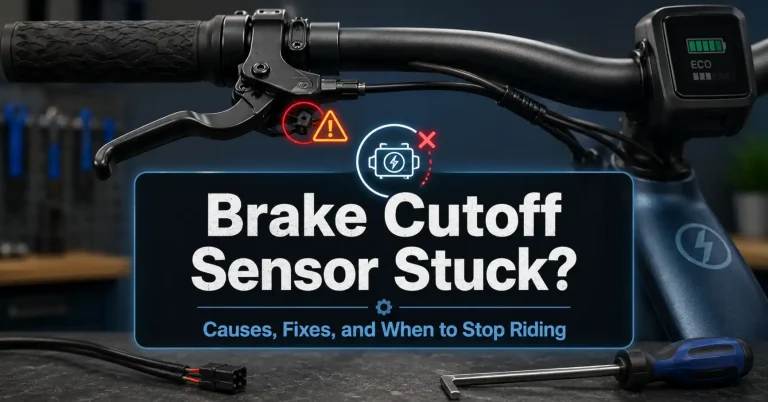
For further help, see my e-bike brake-cutoff sensor troubleshooting guide.
Why Does the Motor Stop When I Engage the Parking Brake?
On some electric trikes, this is normal.
The original RadTrike provides a useful example.
Rad Power Bikes explains that its parking brake cuts motor power even when the trike remains switched on.
The owner’s manual also confirms that squeezing its front brake lever activates a motor-cutoff sensor.
On this model, the parking brake operates through that front brake.
So if motor assistance stops while the parking brake is engaged, that behavior is expected.
Three situations to understand
| What happens | What it may mean |
|---|---|
| Motor stops when parking brake is engaged | Normal operation on systems with integrated motor cutoff |
| Motor doesn’t resume after the brake is properly released | Possible stuck cutoff signal or another electrical issue |
| A wheel remains physically restricted after release | Possible mechanical brake or wheel problem |
This distinction can save readers from chasing the wrong problem.
A motor-cutoff sensor doesn’t physically lock the wheel.
Likewise, releasing a parking lock doesn’t automatically prove that the electrical cutoff signal has cleared.
Don’t test the motor by applying throttle against an engaged or dragging brake.
If the trike still won’t provide assistance after the parking brake is correctly released, follow the manufacturer’s diagnostics or have it inspected.
Does the Parking Brake Lock All Three Wheels?
Not necessarily.
This is a common point of confusion when moving from a regular bicycle to an electric trike.
Because a trike has three wheels, you might assume its parking brake should lock all three.
But the number of wheels isn’t what determines how the parking brake works.
It depends on the actual brake arrangement
The original RadTrike parking lock operates through its front brake.
That doesn’t mean the separate rear coaster brake is also locked.
The Lectric XP Trike2, by comparison, has front and rear parking-brake controls.
Other electric trikes may use different arrangements.
The important question is whether the parking brake holds the trike in the manner specified by its manufacturer, not whether every wheel has an individual lock.
If your trike moves when the parking brake is engaged, check the manufacturer’s procedure rather than assuming that every wheel should be immobilized independently.
Mechanical vs. Hydraulic Brakes: Why the Difference Matters
The type of service brake can affect both diagnosis and repair.
| Brake system | Possible warning signs | Recommended approach |
|---|---|---|
| Cable-operated mechanical disc brakes | Frayed cable, unusual lever travel, weak braking, sticking components | Inspect externally and use model-specific service guidance |
| Hydraulic disc brakes | Fluid leakage, soft lever, persistent drag, reduced braking force | Arrange qualified inspection and service |
| Coaster brakes | Unexpected resistance, abnormal braking when backpedaling, loss of braking | Follow the drivetrain and brake manufacturer’s procedures |
| Integrated parking-lock levers | Lock won’t catch, release, or hold adequate force | Inspect the specific lock and underlying service brake |
A critical distinction is that the parking-lock mechanism and the underlying brake aren’t necessarily the same function.
The lock may engage normally while the brake itself is unable to provide enough force.
Likewise, the normal brake may work while the parking-lock mechanism is damaged.
Both need to be functioning correctly.
How to Check Your Electric Trike Parking Brake Safely
If the parking brake appears to work normally and you want to perform a routine check, choose a controlled setting.
Do not perform a rolling or holding test if you already suspect a serious brake failure or cannot safely restrain the trike.
Basic parking-brake check
- Choose a level, clear location away from traffic.
- Switch off motor power.
- Stand beside the trike where you can maintain control.
- Inspect the locking mechanism for obvious damage.
- Follow the manufacturer’s instructions to engage the parking brake.
- If the manual permits and the trike can be safely controlled, apply a gentle stationary holding check.
- Release the parking brake using the correct procedure.
- Confirm the brake lever and locking control return to their normal positions.
For example, the original RadTrike manual includes a stationary brake check in which the owner squeezes the front brake and gently attempts to push the trike forward.
That doesn’t mean this exact procedure applies to every electric trike.
Follow the instructions for your own model.
If the parking brake doesn’t hold or release reliably, stop using it and arrange inspection.
Helpful Tools & Accessories for Electric Trike Owners
You don’t need a collection of specialized tools to perform basic parking-brake checks. However, a few accessories can make it easier to inspect your trike and keep it safely positioned while you assess a problem.
- Rubber wheel chocks – Can provide an additional restraint for a stationary trike when appropriately sized and positioned.
- Compact rechargeable flashlight – Helps you inspect brake levers, cables, and other components for visible damage.
- Folding hex wrench set – Handy for basic maintenance and manufacturer-approved adjustments.
Important: These accessories won’t repair a defective parking brake. If the brake doesn’t hold, won’t release, or affects normal braking, have the problem properly diagnosed before riding.
What if the Parking Brake Doesn’t Work on a Brand-New Electric Trike?
A parking-brake problem discovered shortly after delivery deserves attention.
It doesn’t automatically mean the product is defective, but it shouldn’t be ignored.
The cause could involve incorrect setup, incomplete assembly, an adjustment problem, or a faulty component.
Check the correct setup instructions
Some electric trikes arrive requiring assembly or final adjustments.
Review the manufacturer’s instructions for the exact model and make sure the parking-brake controls are being used correctly.
However, don’t assume an incorrectly functioning brake merely needs additional tightening.
Document the problem
Before making changes, record:
- The exact trike model and version.
- When the problem first appeared.
- Whether the parking lock won’t engage, hold, or release.
- Whether the regular brakes appear affected.
- Any visible damage.
- Relevant display errors.
Clear photographs or a short video of the stationary controls may help the manufacturer understand the issue.
Don’t perform unsafe testing just to record the problem.
Contact the manufacturer or seller
Explain the symptoms and ask for the correct troubleshooting or authorized service procedure.
If the trike is new or recently repaired, check its applicable warranty and service terms before modifying or replacing components.
Avoid disassembling an unfamiliar parking-brake mechanism or installing incompatible parts without authorization.
A brand-new trike with unreliable braking should not be treated as ready for normal riding.
Can You Adjust an Electric Trike Parking Brake Yourself?
Some manufacturers provide owner-accessible adjustments for particular parking-brake designs.
Other systems may require technician servicing.
Whether an adjustment is appropriate depends on the brake assembly and the manufacturer’s instructions.
Reasonable preliminary checks
For many owners, these include:
- Reading the correct engagement and release procedure.
- Identifying the type of parking lock.
- Checking for visible damage.
- Observing the lever’s movement.
- Looking for obvious cable or hose problems.
- Checking for display warnings.
Repairs that may require professional service
Depending on the model:
- Brake cable replacement or adjustment.
- Brake-pad replacement.
- Hydraulic brake bleeding.
- Caliper repair.
- Damaged parking-lock mechanism replacement.
- Electrical brake-cutoff sensor diagnosis.
- Brake-lever replacement.
- Persistent brake-drag diagnosis.
I wouldn’t recommend buying a replacement parking-brake lever until the fault has been identified.
For example, E-BikeKit specifies that its SINET locking brake levers are designed for compatible current-generation SINET systems.
They aren’t interchangeable with older E-BikeKit wiring or third-party electrical systems.
A component that fits the handlebar isn’t necessarily electrically or mechanically compatible.
Is It Safe to Park an Electric Trike on a Hill?
A functioning parking brake helps keep the trike stationary, but parking on a slope requires additional caution.
Electric trikes can be heavy, and loaded baskets add more weight.
Whenever practical, choose level ground.
If you must park on a slope, follow the manufacturer’s instructions and carefully evaluate the conditions.
Consider:
- Slope steepness.
- Surface traction.
- Cargo weight.
- Whether the trike could roll into traffic.
- Whether the parking brake is functioning correctly.
- Any manufacturer-approved additional restraint.
Suitable wheel chocks may provide additional protection in appropriate circumstances, but they aren’t a substitute for safe parking practices or a functioning brake.
If your parking brake is malfunctioning, don’t leave the trike unattended on a slope or use a hill to test whether the lock will hold.
What about loading groceries?
Always secure the trike before loading or unloading.
The original RadTrike manual specifically warns that loading cargo can cause unexpected rolling or tipping.
A defective parking brake can make that situation more difficult.
If the trike cannot be safely stabilized, avoid loading or unloading until you have suitable assistance.
Does a Parking Brake Prevent Electric Trike Theft?
No.
A parking brake helps prevent rolling.
It doesn’t secure the frame to a fixed object or prevent someone from carrying the trike away.
You still need an appropriate security lock and anchor.
My electric trike locking and theft-prevention guide explains how to secure the frame, wheels, battery, and accessories.
What About Parking Brakes During Long-Term Storage?
The normal parking instructions and long-term storage instructions aren’t always identical.
Some mechanical parking-brake designs have specific recommendations for extended storage.
That means leaving every electric trike’s parking brake engaged for months isn’t automatically the right approach.
Likewise, releasing a parking brake without properly immobilizing the trike creates a rolling hazard.
Follow the specific instructions for your model, especially if it will be stored for several weeks or months.
For extended storage, also check tire pressure, protect the trike from unsuitable conditions, and follow the manufacturer’s battery-storage recommendations.
When to Stop Riding and Get Professional Help
Don’t keep using an electric trike with a braking problem that could affect safe operation.
Stop riding and arrange service if:
- The regular brakes cannot stop the trike reliably.
- The parking brake won’t hold as specified.
- The parking brake won’t release properly.
- A wheel remains significantly restricted after release.
- A brake lever is damaged or doesn’t return normally.
- Brake cables are frayed or damaged.
- A hydraulic brake is leaking.
- The lever feels unusually soft or travels excessively.
- The brakes overheat or produce a burning smell.
- Motor assistance continues when a brake-cutoff system should interrupt it.
- Brake performance remains abnormal after a repair.
- You cannot determine why the braking system behaves differently than usual.
If the trike cannot be moved safely, arrange suitable transportation rather than attempting to ride it to a repair shop.
How to Prevent Electric Trike Parking Brake Problems
Regular inspections can help you notice problems before they become serious.
I’d include the parking brake in your normal maintenance routine.
Before riding
- Check the brake levers for normal movement.
- Confirm the parking lock releases completely.
- Check service-brake operation as directed by the manual.
- Look for obvious damage or leaks.
- Check for unexpected brake-related display warnings.
Periodically
- Inspect visible brake components for wear.
- Follow the manufacturer’s service intervals.
- Investigate sticking, weak braking, or unusual noises promptly.
- Keep braking surfaces free of oil and other contamination.
- Arrange service if parking-lock engagement becomes unreliable.
Don’t apply lubricant to brake pads or rotor friction surfaces.
Information to Give a Bike Shop or Manufacturer
When contacting a manufacturer or repair shop, record the following information.
| Information | What to note |
|---|---|
| Trike brand and model | Complete model name and version |
| Brake system | Mechanical, hydraulic, coaster, or unknown |
| Main symptom | Won’t hold, engage, release, or provide motor assistance |
| When it started | Suddenly, after storage, after delivery, or gradually |
| Recent maintenance | Brake adjustment, tire change, or other repair |
| Visible problems | Lever, cable, hose, caliper, or rotor damage |
| Display warning | Exact error code or message |
| Warranty status | Purchase date and whether service coverage may apply |
You can take photographs of the controls and visible components to help explain the problem.
Don’t disassemble the braking system simply to obtain photographs.
Frequently Asked Questions
Why won’t my electric trike parking brake hold?
Possible causes include an incompletely engaged locking mechanism, weak underlying brake performance, worn components, or an adjustment problem. Follow the manufacturer-approved procedure and arrange service if the brake doesn’t hold reliably.
Why is my electric trike parking brake stuck?
The locking control may not have fully released, or the underlying brake may be sticking. Keep motor power off, use your model’s release procedure, and don’t force the mechanism.
Does an electric trike parking brake lock all three wheels?
Not necessarily. The original RadTrike’s parking lock operates through its front brake, while some other trikes have front and rear parking controls. Follow the manufacturer’s description of your system.
Why does my electric trike motor stop when the parking brake is engaged?
On systems with integrated motor-cutoff switches, stopping motor power is expected behavior. The original RadTrike is one documented example.
Can a faulty parking brake prevent pedal assistance?
Potentially. If a brake-cutoff signal remains active, the controller may prevent motor assistance. Other electrical faults can cause similar symptoms, so further diagnosis may be needed.
Can I ride if my parking brake doesn’t work?
A malfunctioning parking brake can create risks while parking, mounting, dismounting, and loading cargo. It may also indicate a service-brake problem. I recommend having the cause identified and corrected before returning to normal use.
What if my parking brake fails while I’m shopping?
Move the trike to level ground only if safe, switch off motor power, and keep it securely controlled. Avoid slopes and cargo movement. Arrange assistance or transportation if you can’t reliably secure it or its service brakes are affected.
How do I release a Lectric XP Trike2 parking brake?
Lectric’s manual instructs owners to move the blue parking-brake controls to the unlocked position and then squeeze the brake levers again until the locks release.
Why does my parking brake lock engage, but the trike still rolls?
The locking mechanism may be engaged without the underlying brake providing enough holding force. That can indicate a brake adjustment or component problem. Don’t rely on the parking brake until it has been inspected.
Can I replace an electric trike parking-brake lever myself?
Only with a confirmed compatible replacement and appropriate service instructions. Mechanical brake compatibility and electrical connections both matter on systems with motor cutoffs.
What if the parking brake doesn’t work on a new electric trike?
Stop using the trike, check the model-specific instructions, document the symptoms, and contact the seller or manufacturer for authorized support.
Is a parking brake the same as a wheel lock?
Not necessarily. A parking brake may hold the regular service brake in its applied position. A separate wheel lock or security lock can use a different mechanism and serve a different purpose.
Explore More Electric Trike Guides
Whether you’re shopping for your first electric trike or already own one, these guides can help you choose, ride, maintain, and protect your trike.
Ownership & Maintenance
- How to Ride an Electric Trike for Beginners – Learn to turn, brake, and ride comfortably on three wheels.
- How to Transport an Electric Trike Safely – Car racks, trailers, ramps, and loading tips.
- How to Lock an Electric Trike and Prevent Theft – Practical security advice for protecting your trike.
- Electric Trike Tire Pressure Guide – Find the correct PSI and check all three tires.
Electric Trike Buying Guides
- Best Electric Tricycles – Compare electric trikes for comfort, stability, and everyday riding.
- Best Electric Trikes for Heavy Riders – Explore high-capacity trikes with attention to weight limits, comfort, and practicality.
Why You Can Trust Electric Bike Explorer
Electric Bike Explorer focuses on practical, independent guidance for electric bike and trike owners.
This article draws on manufacturer documentation from Rad Power Bikes, Lectric, Pedego, and E-BikeKit, along with established mechanical troubleshooting principles.
The examples are based on documented equipment configurations. I haven’t independently tested or repaired every parking-brake system discussed here.
The goal is to help readers understand possible causes, perform appropriate preliminary checks, and recognize when professional service is necessary.
You can read more about how Electric Bike Explorer researches and evaluates e-bikes.
My Take
One thing I’d emphasize about electric trike parking brakes is that the small locking button or lever isn’t the whole braking system.
A parking lock might work exactly as designed while the underlying brake doesn’t provide enough force to hold the trike.
That’s why I wouldn’t automatically recommend replacing the parking-brake lever whenever a trike starts rolling.
I’d first identify the brake system, check the owner’s manual, and look for obvious problems.
If the issue isn’t straightforward, I’d have a qualified mechanic inspect it rather than guessing at adjustments.
I also think it’s worth understanding how the parking brake works before you actually need it.
Something as simple as knowing the correct release procedure could prevent confusion when you’re parked at a store or preparing to ride.
For people who rely on electric trikes for everyday errands, a dependable parking brake is particularly important when getting on and off the trike or loading groceries.
It’s a relatively small part of the vehicle, but not something I’d overlook.
Disclosure: As an Amazon Associate, I earn from qualifying purchases. This comes at no extra cost to you and helps support the content on this site.
Sources and Further Reading
- Rad Power Bikes – Original RadTrike Owner’s Manual
- Lectric – Official User Manuals, Including XP Trike2
- Pedego – 2023 Owner’s Manual, Trike Parking-Brake Instructions
- E-BikeKit – SINET Locking E-Brake Levers
- Rad Power Bikes – RadTrike Technical Overview and Motor Cutoff

Kristina is not just an enthusiast but a true authority on electric bikes. Nestled in the coastal beauty of Virginia, Kristina has found the perfect backdrop for her passion for electric biking. As a dedicated wife and homeschooling mom, her life revolves around family, faith, and the thrill of adventure.
Originally hailing from Ohio, Kristina's journey with electric bikes began as a curiosity and quickly evolved into a deep expertise. Her blog is a testament to her love for electric biking, combining her fascination for eco-friendly transportation with her coastal lifestyle.
When she's not cruising the beach on her electric bike, you'll find Kristina indulging in her other loves: long walks along the shore, getting lost in a good book, and cherishing moments with her loved ones. With a heart as big as her love for animals, especially cats, Kristina brings a unique perspective to the electric bike world, grounded in her strong faith in God and her dedication to a sustainable lifestyle.
Through her blog, Kristina shares her extensive knowledge of electric bikes, offering valuable insights, tips, and recommendations to fellow enthusiasts. Whether you're a seasoned rider or a newcomer to the electric bike scene, Kristina's blog is your go-to source for all things electric biking, fueled by her passion, expertise, and the scenic beauty of coastal Virginia.