U.S. Fire Administration Warns Families About E-Bikes vs. E-Motorcycles
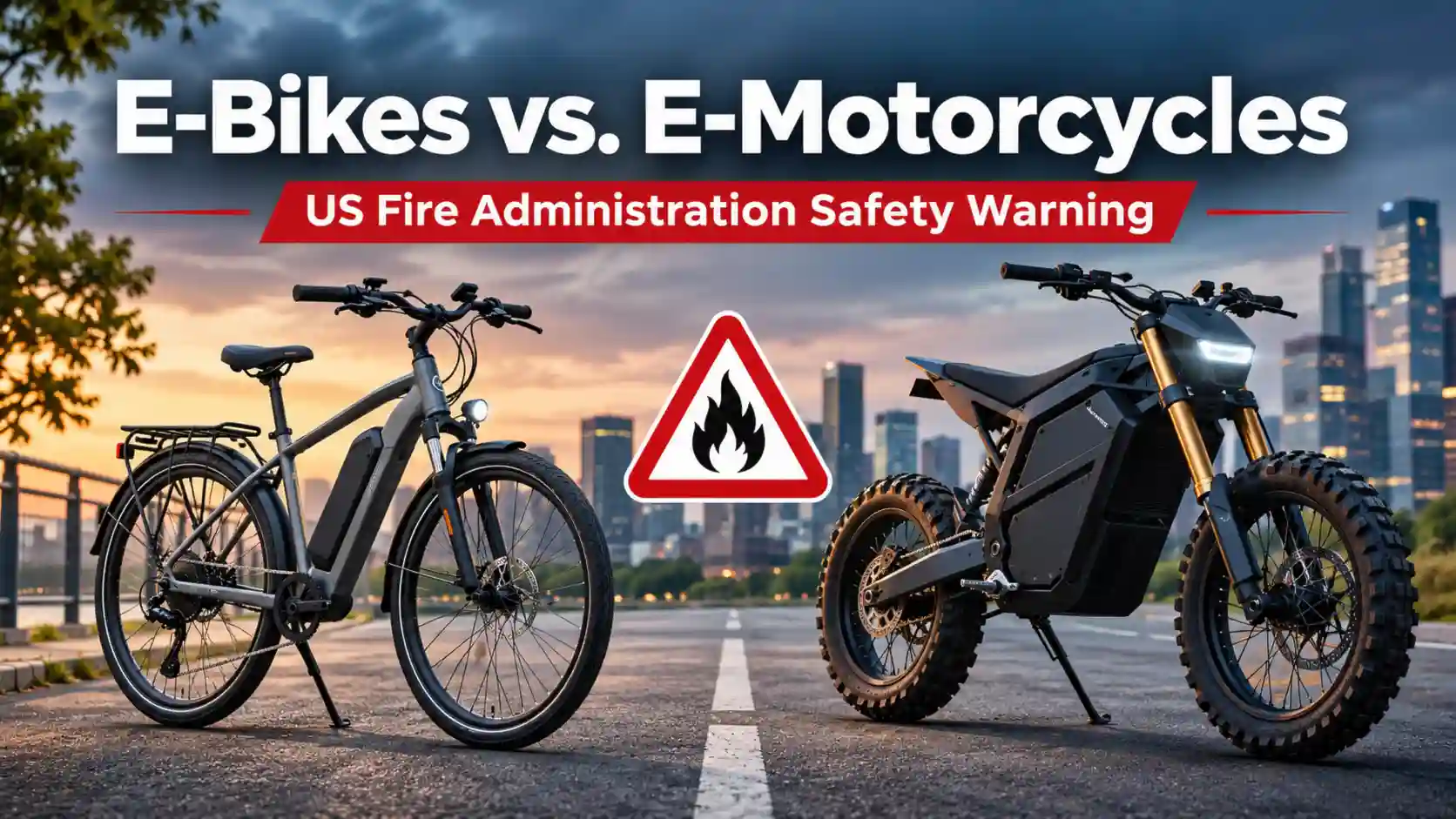
November 5, 2026 — United States. A vehicle may look like a bicycle, have a saddle and even come with pedals, but that does not necessarily make it a legal electric bicycle. The U.S. Fire Administration (USFA) is urging parents, buyers and emergency responders to pay closer attention to the difference between ordinary e-bikes and higher-powered electric motorcycles, often called e-motos.
In guidance published November 3, 2026, the federal agency highlights the potential consequences of confusing these vehicles: different speeds and weights, different road-use rules and additional risks at serious crash scenes.
Important: This is a public safety advisory, not a newly enacted federal e-bike law, a nationwide ban or a product recall. The laws that apply to a particular bike still depend on the vehicle and where it is used.
Why the Fire Administration Issued This Warning
The concern is not that every e-bike is unsafe. It is that some much faster electric two-wheelers are advertised in ways that make them seem interchangeable with Class 1, 2 or 3 electric bicycles. Some have bicycle-style frames or pedals, even though their speed and power may put them in a different vehicle category.
That distinction matters before a family buys one for a teenager, before a rider heads onto a bike path and when first responders arrive after a crash. A vehicle that is not legally an e-bike may require a license, registration, appropriate roadway equipment or other conditions to operate on public streets. Some off-road e-motos cannot legally be ridden on public roads at all.
The Three Common E-Bike Classes, Explained
Many U.S. states use a three-class framework for qualifying electric bicycles. The basic distinctions are:
- Class 1: The motor assists only while you pedal and stops providing assistance at 20 mph.
- Class 2: A throttle can power the bike without pedaling, with motor assistance limited to 20 mph.
- Class 3: The motor generally assists while you pedal and stops assisting at 28 mph. The precise treatment of throttles and other features differs by jurisdiction.
In states using the common three-class framework, qualifying e-bikes generally must have fully operable pedals and a motor rated at no more than 750 watts. Separately, federal consumer-product law (15 U.S.C. § 2085) defines a low-speed electric bicycle as having fully operable pedals, a motor of less than 750 watts and a speed of less than 20 mph when powered by the motor alone under specified test conditions. This federal product-safety definition is distinct from state rules about e-bike classes and where riders may operate them. A Class 3 pedal-assist cutoff at 28 mph does not give someone permission to ride at that speed on every trail or sidewalk.
For differences in licensing requirements, see our Class 3 e-bike license guide. Our state-by-state e-bike laws guide is a starting point for checking rules where you ride.
How to Tell Whether a Bike Might Actually Be an E-Moto
The USFA emphasizes checking motor power, speed, functional pedals and operating rules rather than relying on a product’s marketing label. Building on that federal guidance, here is an Electric Bike Explorer checklist to review before buying or riding:
- Motor rating: Find the manufacturer’s rated motor output, not just an eye-catching peak-power number. Check whether it fits your state’s legal e-bike definition.
- Motor-assisted speed: Find the actual pedal-assist and throttle limits. A machine marketed for speeds well beyond ordinary e-bike limits needs closer legal scrutiny.
- Functional pedals: A qualifying e-bike needs pedals that can propel it. Decorative or nonfunctional pedals do not make a motorcycle into a bicycle.
- Vehicle label and documentation: Look for the class label where required, the manufacturer’s specifications and the owner’s manual. Do not assume a seller’s use of the term “e-bike” settles its legal status.
- Intended use: Confirm whether the product is a street-legal vehicle, an off-road-only motorcycle or a qualifying electric bicycle.
- Local rules: Verify age limits, helmet requirements, registration, licensing and restrictions on roads, sidewalks, bike lanes and trails.
One detail worth remembering: a Class 3 e-bike’s motor may stop helping at 28 mph, but that does not mean the bicycle physically cannot go faster downhill. Legal classifications focus on how the motor operates, not merely a speed displayed during a descent.
What Parents Should Know Before Buying for a Teen
A young rider may be comfortable on an ordinary bicycle without being ready for a heavier, quicker motorized machine. Check the product’s true capabilities and the rules in your state before giving a minor access to it. The presence of pedals is not enough.
The USFA points to serious crashes involving high-powered devices and warns that parents can face legal consequences in some circumstances when minors operate them unlawfully. This does not mean every parent whose child rides a legal e-bike is breaking the law; the facts and local requirements matter.
A properly fitted helmet is important for all e-bike riders. Riders of actual motorcycles or e-motos may need motorcycle-rated protective equipment and may be subject to different licensing and age rules. Make sure a child understands braking, turning, yielding and speed control before riding in traffic.
Battery Safety Is Part of the Warning, Too
The advisory also asks fire departments to prepare for damaged electric drivetrains and lithium-ion batteries after serious crashes. Larger high-performance e-motos can carry substantial battery packs, but ordinary e-bike batteries also deserve careful handling, especially after a collision or if they show signs of damage.
For everyday use, the USFA advisory and Consumer Product Safety Commission’s micromobility safety guidance recommend these precautions:
- Use only the charger supplied or approved by the vehicle or battery manufacturer.
- Stay present during charging; do not charge while sleeping or away from home.
- Keep batteries and charging equipment out of doorways, hallways and other escape routes.
- Do not charge or ride with a battery that is damaged, swollen, leaking, overheating or behaving abnormally.
- Do not use an improvised replacement battery, modified pack or unqualified battery repair.
If your battery feels unusually hot or shows other warning signs, our guide to why an e-bike battery gets hot explains when to stop using it. If a battery is smoking, hissing, venting or catching fire, move away, warn others and call emergency services rather than trying to handle it.
Why the Guidance Also Matters to Firefighters
The USFA’s audience includes emergency medical personnel and fire departments. Compared with many conventional e-bikes, powerful e-motos may be substantially heavier, travel at much higher speeds and contain larger battery systems. After a severe crash, responders need to identify the vehicle correctly, avoid damaged electrical components and consider the possibility of battery ignition or reignition.
This is one reason the agency wants communities to distinguish e-bikes from electric motorcycles before incidents happen, rather than treating every pedal-equipped electric vehicle as the same thing.
Does This Mean Class 1, 2 or 3 E-Bikes Are Now Illegal?
No. The November 3 USFA publication does not change the law or create a blanket restriction on properly classified e-bikes. Its message is to verify what you own, understand what the motor can do and follow the existing rules where you ride.
If you’re unsure whether your bike belongs on a particular road or trail, start with the EBE state law directory and confirm any city, park or trail-specific policies. You can also read our complete e-bike safety guide for riding, maintenance and charging tips.
The Bottom Line for E-Bike Buyers
An electric bicycle can be a practical, enjoyable way to commute or explore. The important thing is knowing exactly what you’re buying. Before you rely on a sales listing that says “e-bike,” check the motor rating, assisted speed, operable pedals, model documentation and legal classification. Those few steps can prevent an expensive purchasing mistake—and, more importantly, help keep riders and the people around them safer.
More Electric Bike News
Want to stay up to date on recalls, regulations, new electric bikes, and other developments? Read more electric bike news on Electric Bike Explorer.
Why You Can Trust This Report
This article is based on the U.S. Fire Administration’s November 3, 2026 advisory, federal consumer-safety guidance from the CPSC, and the low-speed electric bicycle definition in 15 U.S.C. § 2085. Electric Bike Explorer distinguishes safety recommendations, federal product-safety definitions and state or local operating laws, with links to existing legal and safety resources for additional context.
Sources
- U.S. Fire Administration — Preventing Tragedy: Knowing the Critical Differences Between E-Bikes and E-Motorcycles (November 3, 2026)
- U.S. Consumer Product Safety Commission — Micromobility: E-Bikes, E-Scooters and Hoverboards
- 15 U.S.C. § 2085 — Federal low-speed electric bicycle consumer-product definition

Kristina is not just an enthusiast but a true authority on electric bikes. Nestled in the coastal beauty of Virginia, Kristina has found the perfect backdrop for her passion for electric biking. As a dedicated wife and homeschooling mom, her life revolves around family, faith, and the thrill of adventure.
Originally hailing from Ohio, Kristina's journey with electric bikes began as a curiosity and quickly evolved into a deep expertise. Her blog is a testament to her love for electric biking, combining her fascination for eco-friendly transportation with her coastal lifestyle.
When she's not cruising the beach on her electric bike, you'll find Kristina indulging in her other loves: long walks along the shore, getting lost in a good book, and cherishing moments with her loved ones. With a heart as big as her love for animals, especially cats, Kristina brings a unique perspective to the electric bike world, grounded in her strong faith in God and her dedication to a sustainable lifestyle.
Through her blog, Kristina shares her extensive knowledge of electric bikes, offering valuable insights, tips, and recommendations to fellow enthusiasts. Whether you're a seasoned rider or a newcomer to the electric bike scene, Kristina's blog is your go-to source for all things electric biking, fueled by her passion, expertise, and the scenic beauty of coastal Virginia.