Best Full-Suspension Commuter E-Bikes for Rough Roads
📚 Research-based buying guide: I have not personally tested every bike in this guide. These recommendations are based on current manufacturer specifications, safety documentation, warranty and return policies, independent testing, service information, and available rider feedback.
Manufacturer pages and listed prices checked October 31, 2026. Displayed pricing does not establish stock or delivery availability. Confirm the exact model, frame size, equipment, and current price before ordering.

Introduction
Broken pavement can make an otherwise reasonable commute tiring. A bike with a suspension fork and rear shock is worth considering if rough surfaces are a regular part of your route, especially when you want one bike for work, errands, and recreational paths.
But I would not buy full suspension simply because it sounds more comfortable. It adds equipment to service, can increase weight and cost, and will not fix a poor fit. For many commuters, a good front-suspension bike with suitable tires remains the more practical choice.
This shortlist compares seven full-suspension options, including full-size commuters, a folding bike, and rough-road alternatives. Equipment and cargo readiness differ, so I have stated those limits in each entry. I have kept the two Himiway models separate because their drive systems, weight, and load ratings differ. I have also clearly labeled the Specialized as an older dealer-stock alternative rather than implying it is widely available online.
If you are still deciding what kind of bike to buy, start with my complete e-bike buying guide. For a broader selection, see my best commuter e-bikes.
⭐ Quick Picks: Full-Suspension Commuter E-Bikes
- Himiway A7: Lower-Priced Step-Through
- Himiway A7 Pro: Step-Through Mid-Drive Option
- BULLS Iconic EVO TR 2 Speed: Class 3 Commuting Option
- Specialized Turbo Tero X 5.0: Dealer-Stock Mixed-Surface Alternative
- Velotric Nomad 2X: Equipped Fat-Tire Option
- Heybike Ranger 3.0 Pro: Folding Full-Suspension Option (via Heybike offers)
- Mokwheel Obsidian ST 2.0: Rough-Road Alternative
👉 Short on time? Check current e-bike deals, then compare the equipment and tradeoffs below.
Full-Suspension Commuter E-Bike Comparison Chart
Click a bike name to jump to its section below. Travel figures refer to front and rear suspension. Load ratings use each manufacturer’s wording and should not be treated as interchangeable rider-only limits.
Mobile view shows bike, price, weight, and key tradeoff. Swipe sideways if needed, or tap a bike name for the full specifications below.
| Bike / recommendation | Listed price | Bike weight | Motor / battery | Suspension | Fit / published load | Key tradeoff |
|---|---|---|---|---|---|---|
| Himiway A7 Lower-Priced Step-Through |
$1,999 listed | 84 lb listed | Rear-hub drive: Regular lists 750W/70Nm; Large lists 500W/60Nm. Confirm selected version. Battery: 720Wh |
120mm front / 90mm rear | Step-through; Regular and Large have different published fit guidance. Confirm size and reach.
Conflicting official limits: product page 400 lb payload / 120 lb rack; Regular/A7 2.0 manual 330 lb rider+cargo / 55 lb rack. Obtain written clarification; do not assume the higher limits. |
Very heavy; version-specific specifications need confirmation |
| Himiway A7 Pro Step-Through Mid-Drive Option |
$2,499 listed | 77 lb with battery, listed | 500W Ananda M100 mid-drive; 130Nm manufacturer claim Battery: 720Wh |
120mm front / 90mm rear, listed | Step-through; 5 ft 3 in–6 ft 5 in manufacturer guidance
300 lb maximum payload; rider/cargo split needs confirmation |
Heavy; mid-drive drivetrain needs sensible shifting and maintenance |
| BULLS Iconic EVO TR 2 Speed Class 3 Commuting Option |
$3,499 listed sale | 56.8 lb listed; battery inclusion and size not specified | Bosch Performance Speed; 85Nm; Class 3 pedal assist Battery: 625Wh |
120mm front / 120mm rear | High-step; 41, 44, 48 and 54cm; published chart spans about 5 ft 4 in–6 ft 6 in
Total load limit not verified; obtain model-specific documentation |
High-step access; verify complete weight and local stock |
| Specialized Turbo Tero X 5.0 Dealer-Stock Mixed-Surface Alternative |
$5,499.99 displayed; dealer pricing may differ | About 60 lb, size Medium, manufacturer-listed | Specialized 2.0 mid-drive; 70Nm; 250W nominal Battery: 710Wh |
130mm front / 120mm rear | Step-over; S–XL geometry; confirm actual dealer size availability
20kg / about 44 lb rear-rack limit; total load limit not verified |
2023 model listing; online availability limited |
| Velotric Nomad 2X Equipped Fat-Tire Option |
From $2,399 displayed; configuration may cost more | 80 lb listed | 750W rear hub; 1,400W peak and 105Nm manufacturer claims Battery: 801.6Wh (48V × 16.7Ah) |
120mm air fork / 80mm rear wheel travel | Step-Thru: 4 ft 11 in–5 ft 10 in; High-Step: 5 ft 10 in–6 ft 5 in, manufacturer guidance
560 lb published payload; 120 lb rear rack. Confirm separate rider limit and approved cargo setup. |
Heavy and bulky; 26 × 4-inch tires |
| Heybike Ranger 3.0 Pro Folding Full-Suspension Option |
$1,399 listed sale | 75 lb listed; measurement conditions unspecified | 750W sustained rear hub; 1,400W peak and 80Nm manufacturer claims Battery: 720Wh |
65mm front fork / rear air shock; rear wheel travel not clearly published | Step-through folding frame; verify saddle height, reach and fit with Heybike
440 lb combined rider and cargo; 100 lb rear rack, manufacturer-listed |
Folding does not make it light; confirm speed/throttle settings |
| Mokwheel Obsidian ST 2.0 Rough-Road Alternative |
$2,099.99 listed sale | 77 lb listed; measurement conditions unspecified | Rear hub. Page lists 750W rated, 1,000W continuous and 1,300W peak; rating needs clarification. Battery: Approx. 941Wh (48V × 19.6Ah) |
130mm front fork / rear shock; rear wheel travel not verified | Step-through; 5 ft 6 in–6 ft 8 in manufacturer guidance
560 lb advertised payload; separate rider and rear-rack limits not verified |
Cargo setup unconfirmed; conflicting motor-power labels |
Prices and configurations can change. BULLS does not clearly define the conditions behind its listed weight on the product page; do not treat it as a verified complete riding weight. Himiway’s regular A7 page contains different motor specifications within its size/version sections and conflicts with its linked manual on load limits. Mokwheel’s power labels and cargo setup need clarification. Rear shock dimensions or pressure are not rear wheel travel. A displayed price is not confirmation that your preferred configuration is available.
🔎 Why You Can Trust This Guide
I compared these bikes using manufacturer specifications, suspension details, commuting equipment, rider fit, and practical ownership considerations such as weight, cargo capacity, and service needs.
This is a research-based buying guide. Where published specifications conflict or important details are unclear, I explain those limitations so you can make a more informed decision.
Learn more about how Electric Bike Explorer researches and ranks e-bikes.
Who Should Consider Full Suspension?
Start here if damaged pavement, repeated surface transitions, or rough mixed-surface routes are part of your normal journey. Full suspension may be worth the ownership tradeoffs if you can park at ground level and have access to a shop that can maintain the bike.
I would think twice if your route is mostly smooth, you carry a bike upstairs, or your budget leaves little room for servicing. A suspension seatpost can improve saddle comfort, but it does not make a hardtail a full-suspension bike.
1. Himiway A7 – Lower-Priced Step-Through
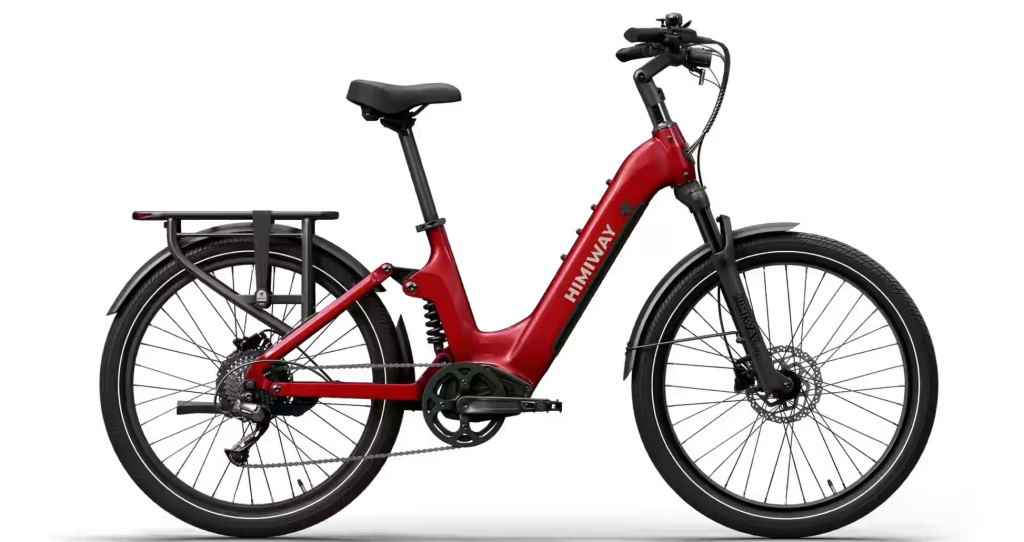
The regular A7 is a comfort-focused hub-drive option with a rack, fenders, lights, and switchable torque/cadence assistance. Its appeal is everyday equipment at a lower listed price than the A7 Pro and the premium mid-drive options here.
Key specifications
- Motor / battery: Rear-hub drive: Regular lists 750W/70Nm; Large lists 500W/60Nm. Confirm selected version. Battery: 720Wh
- Suspension: 120mm front / 90mm rear
- Fit / published load: Step-through; Regular and Large have different published fit guidance. Confirm size and reach. Conflicting official limits: product page 400 lb payload / 120 lb rack; Regular/A7 2.0 manual 330 lb rider+cargo / 55 lb rack. Obtain written clarification; do not assume the higher limits.
✅ Pros
- Accessible frame and commuting accessories.
- Hydraulic disc brakes.
- Switchable torque and cadence sensing.
❌ Cons
- A substantial lifting burden.
- Motor specifications differ within the product page.
- Fit and equipment require version-specific confirmation.
My buying advice: Ask Himiway to confirm the selected size’s motor, fit, shipping status, and load limits in writing. The product page advertises 400 lb payload and a 120 lb rack, but the linked Regular/A7 2.0 manual lists 330 lb rider-plus-cargo and a 55 lb rack. Do not plan loads around the higher figures until Himiway resolves which limits govern the exact bike. Do not transfer specifications from the A7 Pro.
2. Himiway A7 Pro – Step-Through Mid-Drive Option
The Pro offers a different proposition: a torque-sensing mid-drive with nine-speed gearing. I would compare it with the regular A7 for a hilly route where using the drivetrain’s gears matters.
Key specifications
- Motor / battery: 500W Ananda M100 mid-drive; 130Nm manufacturer claim Battery: 720Wh
- Suspension: 120mm front / 90mm rear, listed
- Fit / published load: Step-through; 5 ft 3 in–6 ft 5 in manufacturer guidance 300 lb maximum payload; rider/cargo split needs confirmation
✅ Pros
- Mid-drive layout and accessible frame.
- Hydraulic brakes and air rear shock.
- Commuting equipment included.
❌ Cons
- Still heavy despite weighing less than the A7.
- 300 lb published payload; confirm the approved rider/cargo combination.
- Mid-drive ownership makes sensible shifting and drivetrain care important.
My buying advice: Treat the torque figure as a manufacturer claim, not proof of better climbing than every competing motor. Confirm the exact build and delivery availability.
Compare the Himiway A7 and A7 Pro ·
3. BULLS Iconic EVO TR 2 Speed – Class 3 Commuting Option
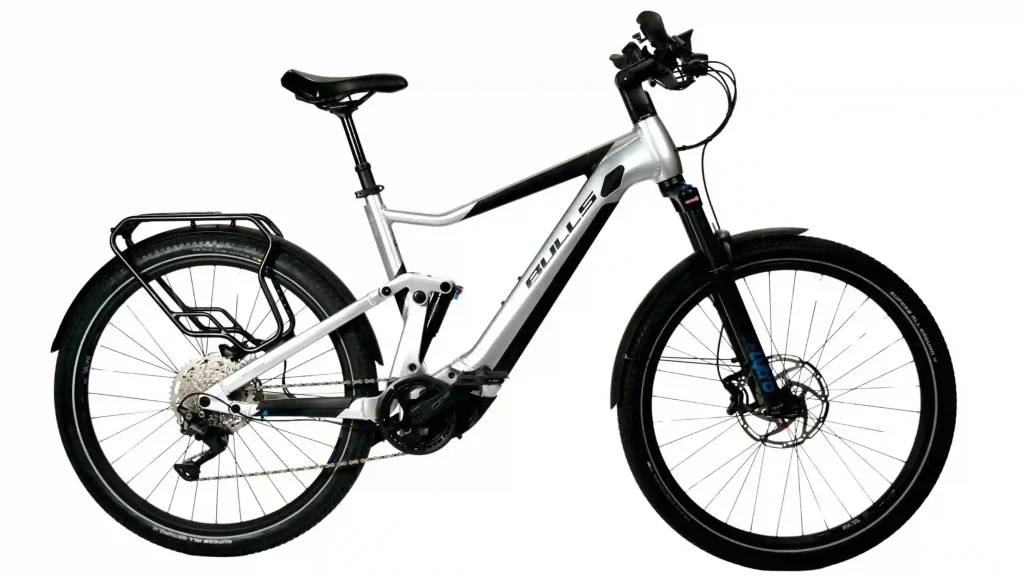
The BULLS is the clearer speed-focused commuter in this shortlist. Its U.S. listing identifies Class 3 assistance and includes fenders, a rack, lights, hydraulic brakes, and ten-speed gearing.
Key specifications
- Motor / battery: Bosch Performance Speed; 85Nm; Class 3 pedal assist Battery: 625Wh
- Suspension: 120mm front / 120mm rear
- Fit / published load: High-step; 41, 44, 48 and 54cm; published chart spans about 5 ft 4 in–6 ft 6 in Total load limit not verified; obtain model-specific documentation
✅ Pros
- Bosch drive system.
- Multiple frame sizes.
- Transport equipment rather than a bare trail-bike setup.
❌ Cons
- High-step access will not suit everyone.
- Complete weight and total load need confirmation.
- Size and dealer availability must be checked.
My buying advice: Ask a dealer to confirm the actual bike’s weight, load rating, and specification. Verify whether Class 3 bikes are permitted on your planned paths before choosing it for a mixed road-and-trail commute.
4. Specialized Turbo Tero X 5.0 – Dealer-Stock Mixed-Surface Alternative

The Tero X is relevant if your commute connects with rough recreational routes. The identified build includes a dropper post, fenders, lights, a pannier rack, and hydraulic brakes.
Key specifications
- Motor / battery: Specialized 2.0 mid-drive; 70Nm; 250W nominal Battery: 710Wh
- Suspension: 130mm front / 120mm rear
- Fit / published load: Step-over; S–XL geometry; confirm actual dealer size availability 20kg / about 44 lb rear-rack limit; total load limit not verified
✅ Pros
- Useful transport equipment on a full-suspension platform.
- Multiple sizes in the published geometry.
- A route to local fitting and support through dealers.
❌ Cons
- Older model with limited online availability.
- Step-over access.
- Display pricing may not reflect a dealer’s remaining stock.
My buying advice: This is a conditional option. Locate an actual bike in your size before making it a finalist. Confirm its battery condition, warranty eligibility, final price, and U.S. assistance settings. Do not mix specifications from the Tero hardtail or other X trims.
5. Velotric Nomad 2X – Equipped Fat-Tire Option
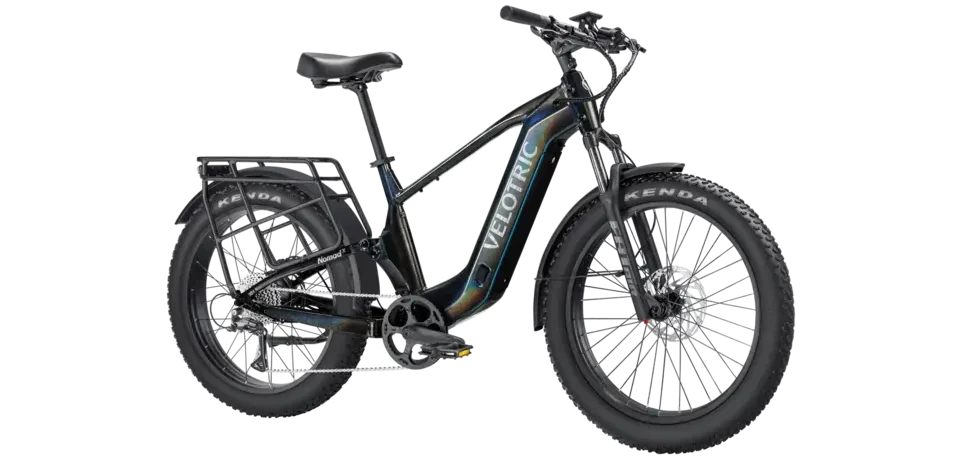
The Nomad 2X brings front and rear air suspension to a 26 × 4-inch fat-tire platform. Full fenders, lights, a rear rack, hydraulic disc brakes, and switchable torque/cadence sensing make it a useful candidate for commuting that also includes gravel or damaged pavement.
Key specifications
- Motor / battery: 750W rear hub; 1,400W peak and 105Nm manufacturer claims Battery: 801.6Wh (48V × 16.7Ah)
- Suspension: 120mm air fork / 80mm rear wheel travel
- Fit / published load: Step-Thru: 4 ft 11 in–5 ft 10 in; High-Step: 5 ft 10 in–6 ft 5 in, manufacturer guidance 560 lb published payload; 120 lb rear rack. Confirm separate rider limit and approved cargo setup.
✅ Pros
- 120mm front travel and 80mm rear wheel travel.
- Step-Thru and High-Step frames with different published fit ranges.
- Commuting equipment included and an 801.6Wh battery.
❌ Cons
- 80 lb listed weight and substantial tire width.
- Air suspension requires setup for the rider and luggage.
- Advertised total payload does not establish passenger approval or a separate rider limit.
My buying advice: The 2X is the model covered here; the standard Nomad 2 lacks rear suspension. Test low-speed handling and storage clearance before buying. Velotric describes a default 20-mph Class 2 configuration, with Class 1 and Class 3 settings that disable the throttle. Confirm settings and access rules for your route.
Read my Velotric Nomad 2X review ·
6. Heybike Ranger 3.0 Pro – Folding Full-Suspension Option
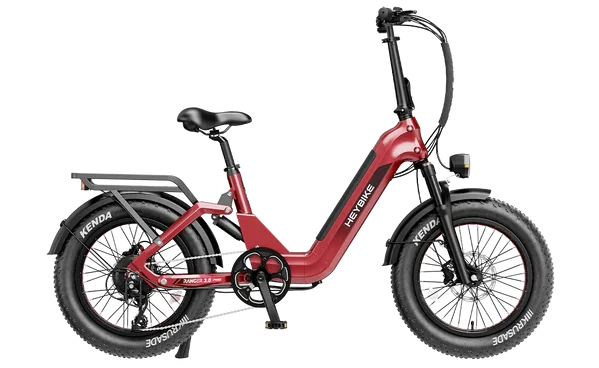
The Ranger 3.0 Pro adds a different storage option: a folding step-through frame with 20 × 4-inch tires, a 65mm suspension fork, and a rear air shock. Heybike lists a torque sensor, hydraulic disc brakes, a 720Wh battery, and included fenders and rear rack.
Key specifications
- Motor / battery: 750W sustained rear hub; 1,400W peak and 80Nm manufacturer claims Battery: 720Wh
- Suspension: 65mm front fork / rear air shock; rear wheel travel not clearly published
- Fit / published load: Step-through folding frame; verify saddle height, reach and fit with Heybike 440 lb combined rider and cargo; 100 lb rear rack, manufacturer-listed
✅ Pros
- Folding frame for smaller storage spaces.
- Torque-sensing assistance.
- Rack, fenders, front light, and rear brake/turn-signal lighting.
❌ Cons
- 75 lb listed weight remains a substantial lifting burden.
- Rear wheel travel is not clearly published.
- Fit and the selected speed/throttle configuration need confirmation.
My buying advice: Check the listed folded dimensions of 41.7 × 20.5 × 32.7 inches against your storage space. A folding bike may fit where a full-size bike will not, but that does not make it easy to carry upstairs. Heybike advertises up to 90 miles; this is a maximum claim, not an everyday commuting expectation. Ask how the throttle behaves at the intended speed setting before changing it.
Read my Heybike Ranger 3.0 Pro review ·
7. Mokwheel Obsidian ST 2.0 – Rough-Road Alternative

The Obsidian ST 2.0 is a step-through, full-suspension fat-tire option for riders combining daily trips with rougher surfaces. Its current listing identifies a 130mm fork, rear shock, torque/cadence sensing, hydraulic disc brakes, ten-speed gearing, and a 48V 19.6Ah battery. Full fenders are currently offered as a promotional accessory.
Key specifications
- Motor / battery: Rear hub. Page lists 750W rated, 1,000W continuous and 1,300W peak; rating needs clarification. Battery: Approx. 941Wh (48V × 19.6Ah)
- Suspension: 130mm front fork / rear shock; rear wheel travel not verified
- Fit / published load: Step-through; 5 ft 6 in–6 ft 8 in manufacturer guidance 560 lb advertised payload; separate rider and rear-rack limits not verified
✅ Pros
- True front and rear suspension.
- Step-through access and torque-sensing assistance.
- Approximately 941Wh nominal battery capacity.
❌ Cons
- 77 lb listed weight and a manufacturer height range starting at 5 ft 6 in.
- Included rear rack, rack capacity, and rear wheel travel are not confirmed.
- Motor-power labels are inconsistent on the manufacturer page.
My buying advice: Include this in a shortlist for rough routes, with extra checks before treating it as a ready-to-go commuter. Mokwheel lists 750W rated, 1,000W continuous, and 1,300W peak on the same page. It also advertises Class 2/3 operation; I cannot resolve the rating discrepancy or establish local compliance from that label alone. Obtain clarification for the exact delivered configuration. Confirm an approved rack and its capacity if you need panniers. Do not transfer specifications from the original Obsidian ST or the Onyx.
Read my review of the Mokwheel Obsidian ST
How Much Suspension Does a Commuter Need?
I would concentrate on how the bike feels on your route rather than selecting the longest travel figure. More travel can be useful on rougher terrain, but it is not a guarantee of better commuting comfort.
Test the bike over surfaces you actually encounter. Check whether the fork and rear shock can be set for your riding weight, including bags. Ask the shop to explain the recommended setup, controls, and service schedule for the exact components.
A bike that feels soft in a showroom may behave differently while pedaling, braking, or carrying panniers. Suspension setup is part of the purchase, not an optional detail after delivery.
When a Hardtail May Be the Better Buy
If you ride mainly on smooth pavement, begin by comparing fit, tire size and pressure, riding position, and a good suspension fork. Those may provide enough comfort without a rear shock and suspension pivots.
I would also favor a simpler commuter if it lets you keep the bike downstairs, comfortably lift it onto your rack, or retain money for a quality lock and professional setup. Rear suspension cannot compensate for a bike that is impractical to move or park.
Use my broader commuter buying guide to compare these bikes with simpler alternatives before deciding.
Battery and Realistic Commuting Range
Choose battery capacity around a round trip with reserve, not the longest advertised range. Hills, wind, rider and luggage weight, tire choice, temperature, speed, and assistance level can change the result.
Consider charging at work only if you have permission and a suitable place to follow the battery manufacturer’s charging instructions. Verify battery removal, replacement cost, and availability before buying.
Use the Electric Bike Explorer tools hub for range-planning tools. Treat estimates as planning aids rather than promises.
Weight, Fit, and Cargo: Check These Before Ordering
Can you handle the bike without assistance?
Try walking it, turning it in a tight space, parking it, and moving it with the motor switched off. If you transport it by car, compare the complete bike weight with your rack’s per-bike rating and compatibility requirements.
Does the frame fit your body?
A manufacturer height range is a starting point. Check standover clearance, minimum saddle height, reach, brake-lever access, and your ability to stop comfortably. Step-through access helps with mounting but does not establish a guaranteed fit.
What does the load rating include?
Ask whether the figure is payload or maximum gross vehicle weight, and whether it includes the bike itself. Rack capacity is a separate limit. A rear rack rating does not automatically authorize a passenger seat or child carrier.
Does your luggage work with the suspension?
Use the approved rack and mounting points. Confirm pannier clearance, heel clearance, tire and fender clearance, and compatibility throughout suspension movement. Avoid improvising a rack attachment around the moving rear end.
Maintenance, Warranty, and Service Support
Before buying, contact a nearby shop with the exact bike model. Ask whether it will work on both the electrical system and the suspension. A shop that can change a tire may not have the tools or authorization for every motor or shock.
Budget for normal bicycle maintenance plus the fork, rear shock, bearings, and pivots specified by the manufacturer. Follow the actual component service schedule; there is no single interval that applies to every full-suspension commuter.
Read warranty and return terms before assembling or riding the bike. Confirm labor coverage, freight charges, packaging requirements, restocking fees, mileage restrictions, and responsibility for diagnosis. A trial period is not necessarily a free return.
If you need local help, start with the EBE e-bike repair directory and confirm the shop supports your particular model.
Common Buying Mistakes
- Confusing a suspension seatpost with rear-wheel suspension. They serve different functions.
- Buying on watts alone. Drive layout, gearing, control, and route demands matter too.
- Assuming a high-step SUV bike fits like a step-through commuter. Test the actual frame.
- Treating a listed sale price as confirmed stock. Check the selected size and color.
- Forgetting the service plan. Know who can work on the suspension and electrical system.
Essential E-Bike Gear (Quick Picks)
Before you choose your e-bike, these are the accessories most riders end up needing for safety and everyday use:
Frequently Asked Questions
Is full suspension worth it for commuting?
It can be if rough surfaces are a frequent part of your journey and you accept the cost and maintenance. For smoother routes, I would compare a simpler commuter before paying for rear suspension.
Are these all suitable for mountain-bike trails?
No. Full suspension alone does not establish a bike’s intended use or permitted terrain. Follow the exact model’s manufacturer limits and local access rules.
Which one is best for hills?
The A7 Pro and the Bosch- and Specialized-powered options merit comparison because they use mid-drives. I would not rank their climbing performance from torque numbers alone without equivalent testing.
Can I carry a child seat or tow a trailer?
Only when the bicycle, rack, carrier or trailer, and mounting hardware are approved for that combination. Full-suspension movement and axle designs can affect compatibility.
Will full suspension eliminate back or joint discomfort?
No bike specification guarantees that. Fit, posture, setup, route, and individual needs still matter. Choose based on an appropriate test ride rather than a promise of pain relief.
My Take: Which Should You Choose?
For a lower-priced step-through, start by investigating the regular A7, with written confirmation of its exact specification. The A7 Pro is the more relevant Himiway comparison when you want a mid-drive.
The Nomad 2X adds an equipped fat-tire choice; the Ranger 3.0 Pro adds folding storage, with considerable weight still to lift. The Obsidian ST 2.0 is a qualified rough-road alternative once its power labels and your cargo setup are clarified.
The BULLS is worth investigating for a faster road-focused commute, provided the high-step frame fits and its assistance class suits your route. Treat the Tero X 5.0 as a dealer-stock alternative rather than assuming nationwide online availability.
There is no universal winner here. I would buy the bike that fits, can be serviced locally, and works with my parking and transport routine. If those checks favor a hardtail, I would choose the simpler bike without feeling that I had missed an essential feature.
Want to Compare More Electric Bikes?
Still deciding which e-bike is right for you? Try our free E-Bike Side-by-Side Comparison Tool to explore additional models and compare specifications, features, and more in one place.
📚 Read Me Next
- Best Commuter E-Bikes
- Himiway A7 vs A7 Pro
- Himiway A7 Review
- Complete E-Bike Buying Guide
- Find an E-Bike Repair Shop
- Side by Side Comparison E-bike Tool

Kristina is not just an enthusiast but a true authority on electric bikes. Nestled in the coastal beauty of Virginia, Kristina has found the perfect backdrop for her passion for electric biking. As a dedicated wife and homeschooling mom, her life revolves around family, faith, and the thrill of adventure.
Originally hailing from Ohio, Kristina's journey with electric bikes began as a curiosity and quickly evolved into a deep expertise. Her blog is a testament to her love for electric biking, combining her fascination for eco-friendly transportation with her coastal lifestyle.
When she's not cruising the beach on her electric bike, you'll find Kristina indulging in her other loves: long walks along the shore, getting lost in a good book, and cherishing moments with her loved ones. With a heart as big as her love for animals, especially cats, Kristina brings a unique perspective to the electric bike world, grounded in her strong faith in God and her dedication to a sustainable lifestyle.
Through her blog, Kristina shares her extensive knowledge of electric bikes, offering valuable insights, tips, and recommendations to fellow enthusiasts. Whether you're a seasoned rider or a newcomer to the electric bike scene, Kristina's blog is your go-to source for all things electric biking, fueled by her passion, expertise, and the scenic beauty of coastal Virginia.