Why Is My E-Bike Battery Getting Hot? Causes, Warning Signs, and When to Stop Riding
Last Updated on October 5, 2026 by Kristina
An e-bike battery can feel warm after a hard ride or while charging, but new, unusually strong, persistent, or localized heat deserves attention. The safest first step is to stop stressing the battery, compare what you are feeling with the bike manufacturer’s normal guidance, and watch for other warning signs before riding or charging again.
If your battery is swollen, leaking, hissing, smoking, sparking, giving off a strong chemical odor, changing shape, or becoming rapidly hotter, treat that as a serious lithium-ion battery warning. Do not open the pack or attempt a repair. Leave the area and call emergency services if there is smoke, fire, or an immediate fire risk.
For broader troubleshooting, start with my e-bike troubleshooting and maintenance guide. If you are trying to understand battery capacity, charging, and everyday battery behavior, my e-bike battery guide is also useful.
🔧 How This Guide Was Researched
This guide is based on manufacturer instructions, established safety guidance, technical references, and common rider experiences. Stop using or charging the bike if you notice smoke, swelling, unusual heat, damaged wiring, sparks, or a strong chemical odor.
Safety First
Do not ride or charge an e-bike battery that is swollen, leaking, deformed, hissing, smoking, sparking, producing a strong chemical odor, or rapidly heating. Do not open, puncture, rebuild, bypass, or rewire a lithium-ion battery pack.
If a battery is already very hot or showing signs of a possible thermal event, do not pick it up just to move it somewhere else. If there is smoke, fire, or an immediate fire threat, leave the area and call emergency services.
Why Is My E-Bike Battery Getting Hot?
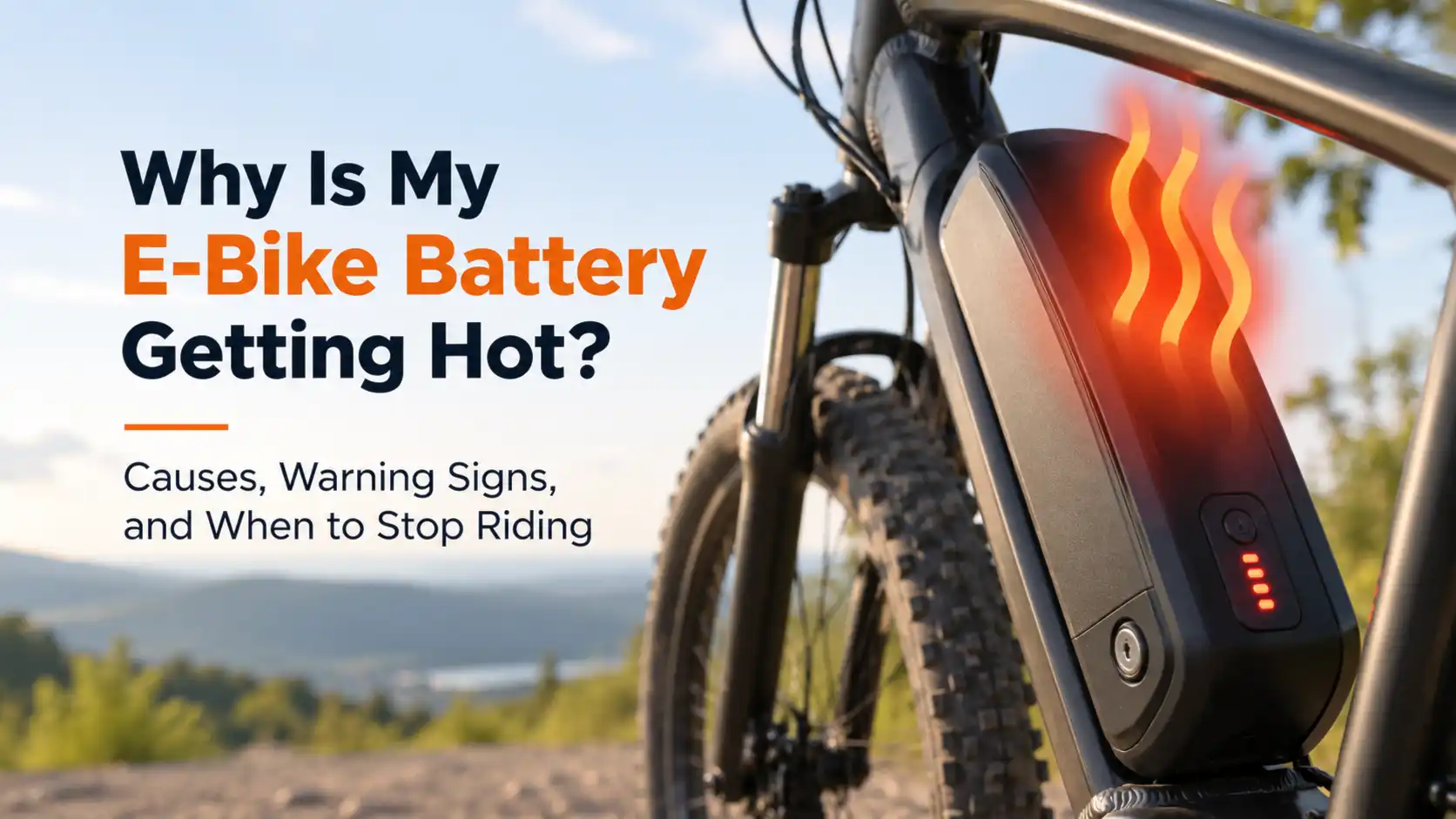
Common reasons include heavy motor demand, hot weather, charging outside the recommended temperature range, an incompatible charger, an aging battery, poor electrical connections, water or impact damage, internal cell problems, or a battery-management-system protection event.
A battery becoming somewhat warm after a demanding climb is not automatically evidence of failure. The bigger concern is heat that is new, much stronger than usual, persistent, concentrated in one spot, happens under light or no load, causes repeated shutdowns, or appears with physical warning signs.
E-Bike Battery Heat Decision Table
| What you notice | Concern level | What to do |
|---|---|---|
| Mild warmth after a hard ride, with no other symptoms | Monitor | Let the battery cool naturally and compare it with its normal behavior and manufacturer guidance. |
| Battery repeatedly becomes much hotter than it used to | Needs investigation | Stop riding or charging until you have checked the manual, charger compatibility, and manufacturer guidance. |
| Battery becomes hot during ordinary or light use | Concerning | Stop use and have the battery/system inspected before continuing. |
| Battery becomes hot while sitting unused | Abnormal | Do not charge or continue using it until the cause is evaluated. |
| One connector or one small area is much hotter than the rest | Concerning | Stop use. Do not probe or repair the connection yourself. Arrange professional inspection. |
| Heat plus swelling, leaking, odor, deformation, hissing, smoke, sparks, or rapid temperature rise | Serious safety warning | Stop using and charging it. Do not handle a battery already showing thermal-failure signs. Leave the area and call emergency services if there is smoke, fire, or immediate danger. |
How Hot Is Too Hot for an E-Bike Battery?
There is no single touch-based temperature rule that applies to every e-bike battery. Battery chemistry, pack design, sensors, charging system, ambient temperature, and manufacturer specifications all matter.
The safest comparison is usually the battery’s normal behavior on the same bike. If it suddenly feels much hotter than usual under similar conditions, stays hot much longer than normal, or repeatedly shuts the bike down, something has changed and deserves investigation.
Manufacturers may also build temperature protection into the system. Bosch, for example, documents high-battery-temperature faults that can reduce or stop support and instruct the rider to allow the battery to cool before restarting. Always follow the temperature limits and fault instructions for your exact battery system.
NFPA also publishes general lithium-ion micromobility charging guidance advising against charging below 32°F (0°C) or above 105°F (40°C). Those are general safety recommendations, not a substitute for your battery manufacturer’s own specified charging range.
⚠️ Critical Safety Warning: Know the Signs of Thermal Runaway
If an e-bike battery is smoking, hissing or popping, swelling, venting gas, leaking, rapidly becoming hotter, or giving off a strong chemical or burning odor, do not stand near it trying to diagnose the problem. These can be signs of a serious lithium-ion battery failure or thermal runaway.
Get everyone and all pets out of the building immediately. Close doors behind you as you leave if you can do so without delaying your escape, stay outside, and call 911 from a safe location.
Do not go back inside for the bike, battery, charger, or other belongings.
What Is Thermal Runaway?
Thermal runaway is an uncontrolled chain reaction inside a lithium-ion cell in which the cell generates heat faster than it can release it. Temperatures can rise extremely quickly. In an e-bike battery containing many individual cells, the failure of one cell can heat neighboring cells enough to make them fail as well.
The result can include:
- rapidly increasing temperature
- hissing, popping, or cracking sounds
- swelling or deformation
- venting of flammable gases
- heavy or unusual smoke
- fire
- explosions or the forceful ejection of hot battery material
The U.S. Fire Administration warns that lithium-ion batteries undergoing thermal runaway may release flammable gases and that the resulting chain reaction can lead to fire or explosion.
If the Battery Is Failing While It Is Plugged In
Your first priority is getting away from the battery – not unplugging it.
If the charger’s wall plug is well away from the battery and you can disconnect it without approaching the battery, smoke, heat, or venting gases, you may disconnect power at the wall.
However:
Do not walk toward a smoking, hissing, swelling, venting, or rapidly heating battery just to unplug it.
And do not reach toward the battery itself to disconnect the charging connector.
If the wall outlet is near the failing battery, leave everything exactly where it is and evacuate.
Will Unplugging It Stop Thermal Runaway?
Not necessarily.
Disconnecting the charger removes the external charging power, which can prevent additional electrical energy from being supplied to the battery.
But once a lithium-ion cell has entered thermal runaway, the failure is occurring inside the battery itself. Disconnecting the charger may not stop the chemical reactions already underway.
That means a battery can continue heating, venting gas, burning, or experiencing additional cell failures after it has been unplugged from the charger.
This is one reason you should never assume a failing battery is safe simply because it is no longer connected to electricity.
Do Not Try to Carry the Battery Outside
It may be tempting to grab a smoking battery or roll the e-bike outside to protect the house.
Do not do this.
A failing lithium-ion battery can deteriorate extremely quickly. Carrying it could put your hands, face, and body directly next to the battery if it suddenly vents hot gases, catches fire, or ruptures.
Leave the battery where it is and evacuate.
Do Not Try to Fight an E-Bike Battery Fire Yourself
If the battery has caught fire, leave the building and call 911.
The National Fire Protection Association specifically advises people to leave the building immediately and not attempt to fight an e-bike or e-scooter battery fire themselves.
Lithium-ion battery incidents can involve intense heat, flammable gases, toxic smoke, rapid fire growth, and the possibility of additional cells failing after the initial fire begins.
Even after a lithium-ion battery fire appears to be extinguished, damaged cells can retain enough energy to create a reignition risk.
Remember: Get Out, Stay Out, Call 911
If you see smoke or fire or a battery is rapidly heating, venting gas, swelling, or making hissing or popping sounds:
- Do not approach or handle the battery.
- Do not disconnect the plug at the battery.
- Only disconnect wall power if you can do so without approaching the failing battery or delaying your escape.
- Get everyone and all pets outside.
- Close doors behind you as you leave when it is safe to do so.
- Call 911 from outside and tell the dispatcher that an e-bike lithium-ion battery is involved.
- Stay outside and do not re-enter the building until firefighters say it is safe.
When Did the Battery Get Hot?
The timing of the heat is one of the best clues you can use without opening or electrically probing the battery.
Battery Gets Hot After Hills, High Assist, or Heavy Loads
Long climbs, repeated acceleration, high assist levels, cargo, strong headwinds, low tire pressure, and other conditions that demand high current can increase battery and motor-system heat.
If the battery is only mildly warm, has no warning signs, and returns to its normal temperature after the ride, that can be consistent with high-load use. If the heating is new, extreme, repeated, or accompanied by shutdowns, reduced range, odor, swelling, or connector heat, stop using the battery until it is checked.
Battery Gets Hot While Charging
Charging produces some heat, but the pack should behave within the manufacturer’s stated charging limits. A battery that suddenly becomes much hotter during charging than it has in the past deserves attention.
Unplug charging power if it is safe to do so and there are no signs of an active thermal event. Do not continue charging a battery that is unusually hot, swollen, leaking, deformed, hissing, smoking, or producing an unusual odor.
Battery Is Still Hot Immediately After Charging
A recently charged battery may be warmer than room temperature depending on the system and environment. The important questions are whether the temperature is within the manufacturer’s normal range, whether the heat is increasing, and whether the battery behaves differently from previous charging sessions.
If the battery is much hotter than normal after charging or repeatedly stays hot for an unusually long time, stop charging and contact the manufacturer or a qualified e-bike technician.
Battery Gets Hot While Sitting Unused
A battery that heats up while it is not charging and not powering the bike is not behaving normally. Do not ride or charge it just to see whether the problem clears.
If the pack is merely warmer than expected and shows no emergency signs, leave it undisturbed and contact the manufacturer for guidance. If the heat is rapidly increasing or there is odor, swelling, hissing, smoke, or fire, leave the area and call emergency services.
Battery Gets Hot After a Crash, Drop, or Impact
Mechanical damage can harm cells, internal connections, or protective structures even when the outside of the battery does not look badly damaged.
Do not keep using or charging an impacted battery that develops heat, swelling, odor, leaking, deformation, unusual noises, or other abnormal behavior. Contact the manufacturer or an experienced e-bike battery service provider rather than opening the case yourself.
Battery Gets Hot After Rain, Flooding, or Water Exposure
Normal rain exposure and submersion are very different events, and water-resistance ratings vary by battery system. A battery that has been submerged, flooded, or shows water intrusion should not be treated as safe just because the display still turns on.
If water exposure is followed by heat, odor, corrosion, electrical faults, or charging problems, stop using and charging the battery and contact the manufacturer.
Only One Connector or One Part of the Battery Is Hot
Localized heat can point to a connection, contact, wiring, or internal-pack issue rather than normal whole-pack warming. Do not stick tools into the connector, bend contacts, spray cleaners into the port, or attempt a high-current electrical test.
Turn the bike off and have the connection inspected by a qualified technician. Discoloration, melting, arcing marks, or damaged insulation are clear reasons to stop using the bike.
Common Causes of an E-Bike Battery Getting Hot
1. Heavy Electrical Load
High assist, steep hills, cargo, repeated acceleration, soft tires, strong wind, and high rider/bike weight can increase current demand. That can make a healthy pack warmer than it would be during easy riding.
2. Hot Ambient Conditions
A battery already sitting in a hot car, direct sun, or a very warm garage starts closer to its upper operating range before you even ride or charge it. Follow the storage and charging temperature limits in the owner’s manual.
3. Charging Before the Battery Has Cooled
After a hard ride, allow the battery to return to the manufacturer’s recommended charging-temperature range before plugging it in. Do not try to force-cool it with water, ice, a refrigerator, or a freezer.
4. Incompatible or Unapproved Charger
A plug fitting the charge port does not prove that the charger is electrically compatible. Voltage, charging profile, communication, connector polarity, and battery-management requirements can differ.
CPSC has specifically warned consumers not to use so-called universal micromobility chargers unless they are compatible with the exact device. Use the charger supplied by the manufacturer or a replacement the manufacturer specifically approves for that battery.
If the charger itself is the part getting unusually hot, read my guide to an e-bike charger getting hot.
5. Aging Cells or Increased Internal Resistance
Lithium-ion cells age with time and charge cycles. As a pack deteriorates, it may deliver less usable energy and can behave differently under high load. Heat by itself does not diagnose an old battery, but new heat combined with range loss, voltage sag, or shutdowns is a reason to investigate.
If the battery is also cutting out at a high indicated state of charge, see my guide to an e-bike battery dying at 50%.
6. Battery-Management-System Protection
The battery-management system, or BMS, monitors important battery conditions and may disconnect or limit the pack when it detects conditions outside its programmed limits. A shutdown can therefore be a protective response rather than proof that the BMS itself is defective.
My e-bike BMS guide explains what the system does and why repeated protection events should not simply be bypassed.
7. Loose, Damaged, or High-Resistance Connections
Poor battery contacts, damaged connectors, loose mounts, corrosion, or compromised wiring can create localized resistance and heat. Because e-bike batteries can deliver substantial current, this is not a good place for improvised repairs.
8. Internal Cell Imbalance, Short Circuit, or Other Battery Fault
Internal electrical faults can create heat and may progress quickly. You cannot safely diagnose cell-level faults by opening a sealed e-bike battery at home.
9. Impact, Water, Chemical Exposure, or Manufacturing Defect
UL Solutions identifies mechanical damage, environmental exposure, electrical abuse, manufacturing issues, and aging among conditions that can contribute to lithium-ion battery failure and thermal runaway. That is why a battery that starts heating after a crash, submersion, or other unusual event should be taken seriously.
Check the Charger Before Blaming the Battery
If the battery heats mainly during charging, verify the charger first.
- Confirm that the charger is the original unit or a replacement specifically approved by the battery or bike manufacturer.
- Check the label for the correct model and output specifications without opening the charger.
- Inspect the cord, plug, charge port, and connector for visible damage, melting, looseness, corrosion, or contamination.
- Stop charging if either the battery or connector becomes much hotter than normal, especially if you smell something unusual or see discoloration.
- If compatibility is uncertain, contact the manufacturer before charging again.
If the battery charges normally but the bike still has no power, use my battery-charges-but-has-no-power troubleshooting guide.
Battery Gets Hot and the Bike Shuts Off
A shutdown under load can happen when a battery-management system or another controller detects a condition outside its allowed limits. High temperature is one possible trigger, but low voltage, excessive current, a poor connection, or another electrical fault can also cause a shutdown.
Do not repeatedly restart the bike and continue climbing if the battery keeps shutting down while hot. Let the system cool naturally, note the conditions that caused the shutdown, and check the manufacturer’s fault code or support guidance.
Safe Step-by-Step Checks You Can Do
- Stop riding or charging if the heat is unusual. Do not keep stressing the battery to reproduce the problem.
- Check for emergency warning signs. Swelling, leaking, hissing, smoke, sparks, deformation, chemical odor, or rapidly increasing heat means stop and follow emergency guidance.
- Compare the situation with previous rides. Note outside temperature, hill grade, assist level, load, battery state of charge, and whether the behavior is new.
- Check the manufacturer’s manual. Look for the approved operating, storage, and charging temperature ranges and any temperature-related error codes.
- Verify the charger. Confirm that it is approved for the exact battery.
- Visually inspect accessible external connections. Look for looseness, melting, discoloration, corrosion, damage, or water intrusion. Do not probe live contacts.
- Check for recalls or safety notices. Search by the exact bike and battery model before paying for repairs or purchasing another pack.
- Contact the manufacturer or a qualified shop if the problem repeats. Repeated abnormal heat is not something to normalize.
What Not to Do With a Hot E-Bike Battery
- Do not open the battery case.
- Do not puncture, crush, drill, solder, weld, rebuild, or re-cell the pack yourself.
- Do not bypass the BMS or temperature protection.
- Do not use a random or universal charger just because the connector fits.
- Do not put a hot battery in a freezer or refrigerator.
- Do not place it in an ice bath or pour water over it as a cooling method.
- Do not keep restarting a bike that repeatedly shuts down because the battery is hot.
- Do not put a damaged or suspect lithium-ion e-bike battery in household trash or ordinary curbside recycling.
Do Not Cool a Hot Battery the Wrong Way
If the battery is merely warmer than usual and has no emergency warning signs, allow it to cool naturally in accordance with the manufacturer’s instructions. Avoid direct sun and additional heat sources.
Do not improvise cooling with ice, water, a freezer, or a refrigerator. Condensation, moisture exposure, thermal shock, and handling a potentially damaged battery can create additional problems.
If the pack is already extremely hot, swollen, hissing, smoking, or otherwise showing signs of an active failure, do not handle it just to relocate it. Leave the area and call emergency services if there is fire or an immediate fire threat.
What to Do With a Suspect Battery
A battery that repeatedly overheats, has been damaged, or shows other abnormal symptoms should be evaluated before reuse. Start with the bike or battery manufacturer because they may have model-specific diagnostic, warranty, recall, shipping, or disposal instructions.
Do not throw a lithium-ion e-bike battery in household trash. CPSC advises consumers to follow appropriate lithium-ion battery disposal guidance, and recalled batteries may have special handling instructions. Contact your local household hazardous-waste program or other approved battery-management facility before transporting a damaged battery, and follow any manufacturer or recall-specific instructions.
Check for Recalls and Safety Warnings
Before assuming the battery simply wore out, search the exact bike model, battery model, serial range, and manufacturer name for current recall or safety notices. A known defect may change what the manufacturer wants you to do with the battery.
Do not keep using a battery covered by a stop-use recall while waiting for visible damage to appear. Follow the official recall instructions.
What UL 2849 and UL 2271 Mean
Safety certification can help you evaluate an e-bike electrical system, but the wording matters.
- UL 2849 addresses the electrical system of an e-bike, including interactions among the battery, charger, drive system, and other electrical components.
- UL 2271 applies to batteries for use in light electric vehicle applications.
A marketing claim that something was “tested to” a UL standard is not automatically the same as third-party certification by an accredited certification organization. When certification matters, look for verifiable certification information for the exact model or system.
Two Real-World Battery Heat Scenarios
Scenario 1: The Battery Gets Warm on a Long Hill, Then Cools Normally
You ride a long steep climb using high assist. The battery feels warmer afterward, but there is no odor, swelling, leaking, fault code, shutdown, or localized connector heat. After the ride, it returns to its usual temperature.
That pattern can be consistent with a high-load ride. Reduce unnecessary load, make sure tire pressure and drivetrain condition are reasonable, let the battery return to the manufacturer’s charging range before charging, and watch for changes over time.
Scenario 2: The Battery Becomes Unusually Hot While Charging Indoors
You plug in the normal charger and notice the battery is much hotter than it has been during previous charging sessions.
If the battery is unusually hot but is not smoking, swelling, hissing, popping, leaking, deforming, giving off a strong chemical or burning smell, or rapidly becoming hotter, stop charging it if you can safely reach the charger. Disconnect the charger from the wall, allow the battery to cool in a safe location, and do not charge it again until you have identified the cause.
Check that you are using the charger approved for that specific battery and e-bike. Inspect the charger plug, battery connector, and charge port for visible damage, discoloration, looseness, melted plastic, or debris. If you cannot identify an obvious harmless cause, contact the bike or battery manufacturer before attempting to charge it again.
If the battery is swelling, smoking, hissing or popping, leaking, deforming, producing a strong burning or chemical odor, or rapidly heating, treat it as a potentially serious lithium-ion battery failure. Do not approach the battery to unplug it, do not touch it, and do not attempt to carry it outside. Get everyone out of the building and call 911 from a safe location. Tell the dispatcher that an e-bike lithium-ion battery may be involved.
Even if the battery cools down afterward, do not assume it is safe to use or recharge. A battery that has overheated abnormally should be inspected or evaluated according to the manufacturer’s guidance before it is put back into service.
When to Call the Manufacturer or a Qualified E-Bike Technician
Stop using the battery and get professional help when:
- It becomes much hotter than normal repeatedly.
- It heats during light use or while sitting unused.
- One connector or battery area becomes unusually hot.
- The bike repeatedly shuts down when the battery is hot.
- Range has dropped sharply at the same time the battery started heating.
- The pack has been dropped, crushed, punctured, flooded, or seriously impacted.
- You see melting, arcing marks, damaged insulation, or a deformed charge port.
- The charger is not confirmed compatible with the battery.
- A battery-related error code keeps returning.
If the issue involves repeated charging failures rather than heat alone, the E-Bike Won’t Charge Diagnostic Tool can help narrow whether the battery, charger, or connection is the likely starting point.
How to Reduce E-Bike Battery Heat Problems
- Use only the manufacturer-supplied or specifically approved charger.
- Follow the manufacturer’s charging, operating, and storage temperature ranges.
- Allow the battery to cool naturally after demanding rides before charging when required by the manufacturer.
- Avoid storing the bike or battery in a hot vehicle or prolonged direct sun.
- Keep battery contacts and charge ports dry and protected from contamination.
- Have damaged mounts, connectors, wiring, or charge ports repaired promptly.
- Do not continue riding a battery that repeatedly triggers thermal or protection shutdowns.
- Check for recalls and safety notices periodically, especially if the battery begins behaving differently.
- Replace a battery only with a compatible pack approved for the bike or system.
Frequently Asked Questions
Is it normal for an e-bike battery to get warm?
Some warming can occur during demanding riding or charging. What matters is whether the heat is within the manufacturer’s limits and consistent with the battery’s normal behavior. New, strong, persistent, or localized heat should be investigated.
Should I charge an e-bike battery while it is still hot from riding?
Follow the battery manufacturer’s charging-temperature guidance. After a demanding ride, allow the pack to return to the specified charging range before plugging it in. Do not force-cool it with ice, water, a refrigerator, or a freezer.
Can a bad charger make an e-bike battery hot?
Yes. An incompatible, defective, or incorrectly specified charger can create a serious charging problem. Use only a charger specifically approved for the exact battery system.
Why does my battery get hot and then the bike shuts off?
Temperature protection is one possible cause, but excessive current, low voltage, poor connections, or another system fault can also trigger shutdowns. Repeated hot shutdowns should be investigated rather than bypassed.
Can I put a hot e-bike battery in the refrigerator or freezer?
No. Do not use a refrigerator, freezer, ice bath, or water as an improvised cooling method. Allow a merely warm, otherwise normal battery to cool naturally according to manufacturer guidance. Do not handle a battery that is already showing signs of active thermal failure just to move it.
What should I do if my e-bike battery smells strange?
A strong chemical or unusual odor together with heat, swelling, leaking, hissing, smoke, or deformation is a serious warning. Stop using and charging the battery. If there is smoke, fire, or immediate danger, leave the area and call emergency services.
Can I open the battery to see which cell is hot?
No. Opening or probing a lithium-ion e-bike battery can expose high-current electrical connections and damaged cells. Cell-level diagnosis belongs with the manufacturer or a properly equipped battery professional.
Does a UL label mean the battery can never overheat?
No. Certification is an important safety signal, but no battery is immune to damage, misuse, aging, incompatible charging, manufacturing defects, or extreme conditions. It also matters whether the certification claim applies to the exact product and is independently verifiable.
My Take
The most useful question is not simply, “Is my battery warm?” It is, “Is this battery behaving differently from normal, and are there other warning signs?” Mild warmth after a hard climb and a battery that becomes hot while sitting unused are very different troubleshooting situations.
I would not keep riding or charging a pack that repeatedly becomes much hotter than normal, develops localized heat, or starts shutting the bike down. The cost of a professional check is small compared with the risk of treating an abnormal lithium-ion battery as something to experiment with.
Sources and Safety References
- U.S. Consumer Product Safety Commission – Micromobility Information Center
- CPSC warning about universal micromobility chargers
- UL Solutions – e-bike and micromobility product safety and certification
- NFPA – e-bike and e-scooter lithium-ion battery safety tips
- Bosch eBike Systems – high battery temperature error guidance

Kristina is not just an enthusiast but a true authority on electric bikes. Nestled in the coastal beauty of Virginia, Kristina has found the perfect backdrop for her passion for electric biking. As a dedicated wife and homeschooling mom, her life revolves around family, faith, and the thrill of adventure.
Originally hailing from Ohio, Kristina's journey with electric bikes began as a curiosity and quickly evolved into a deep expertise. Her blog is a testament to her love for electric biking, combining her fascination for eco-friendly transportation with her coastal lifestyle.
When she's not cruising the beach on her electric bike, you'll find Kristina indulging in her other loves: long walks along the shore, getting lost in a good book, and cherishing moments with her loved ones. With a heart as big as her love for animals, especially cats, Kristina brings a unique perspective to the electric bike world, grounded in her strong faith in God and her dedication to a sustainable lifestyle.
Through her blog, Kristina shares her extensive knowledge of electric bikes, offering valuable insights, tips, and recommendations to fellow enthusiasts. Whether you're a seasoned rider or a newcomer to the electric bike scene, Kristina's blog is your go-to source for all things electric biking, fueled by her passion, expertise, and the scenic beauty of coastal Virginia.