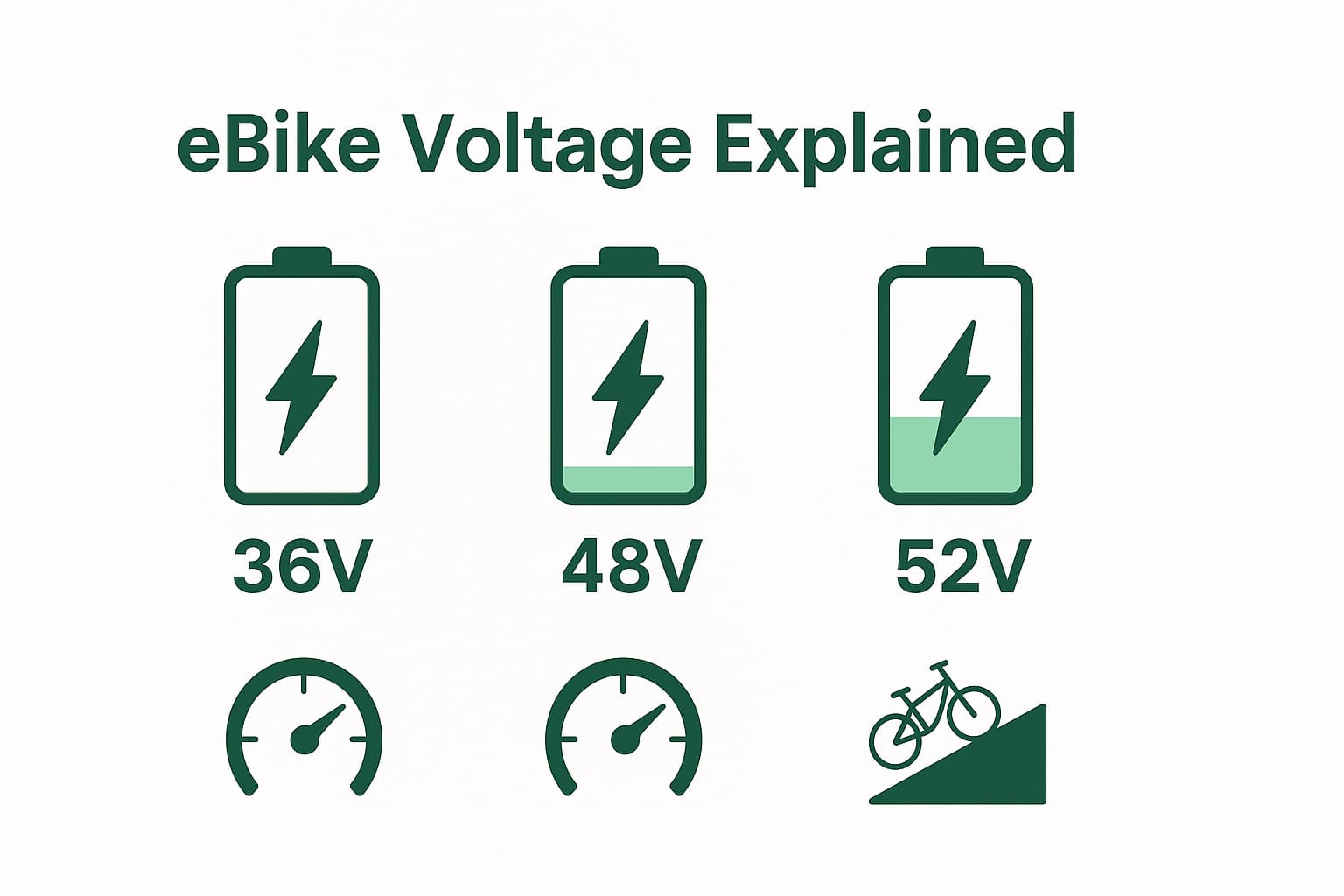
Understanding eBike Voltage: 36V vs 48V vs 52V – Which Is Right for You?
Last Updated on May 20, 2026 by Kristina
Choosing the right battery voltage is one of the biggest decisions you’ll make when buying an e-bike. Voltage affects your acceleration, hill-climbing ability, overall power, and even how efficiently your motor runs. But if you’re new to e-bikes, these numbers can feel confusing — especially when brands list 36V, 48V, and 52V without explaining what they actually mean for your ride.
If you’re still learning how to diagnose and care for your bike, you may also find our eBike troubleshooting guide helpful as a companion resource.
When you look at e-bike specs, you’ll often see numbers like 36V, 48V, or 52V. These numbers describe your bike’s battery voltage, and they directly impact how powerful, fast, and responsive your ride feels. Simply put, voltage measures the electrical force pushing power from your battery to your motor. Higher voltage usually means better acceleration and higher top speed — though your final performance also depends on your motor, controller, and battery capacity.
If you’re trying to understand how amp-hours (Ah) affect range, check out our guide to eBike battery capacity. It pairs perfectly with this post to give you the full picture of e-bike performance.
📖 Read Next
How to Choose the Best eBike Battery for Your Commute (With Top Picks)
Understanding E-Bike Battery Capacity: Amp Hours (Ah) Explained
5 Signs It’s Time to Replace Your E-Bike Battery
The Ultimate Guide to Electric Bike Chargers: Types, Features, and Recommendations
Why Your E-Bike Battery Loses Charge Overnight — and How to Fix It
How Long Do E-Bike Batteries Last?
E-Bike Battery Charging Mistakes
E-Bike Battery Health Checker
🔋What Is Voltage in an eBike?
Think of voltage like water pressure in a hose — more pressure makes water flow faster.
With eBikes, more voltage sends more energy to your motor, giving you stronger performance.
Here’s a quick breakdown:
- Voltage (V) → Determines potential speed and torque
- Amps (A) → The flow of electricity
- Watts (W) → Total power output (Volts × Amps)
- Watt-hours (Wh) → Total energy capacity (Volts × Amp-hours)
A 48V 15Ah battery equals 720 watt-hours (Wh), meaning it can deliver 720 watts for one hour or 360 watts for two hours — this number affects your range, not just your power.
⚡ Comparing eBike Voltages: 36V vs 48V vs 52V
Here’s how the most common eBike voltage systems compare in everyday riding.
| Voltage | Typical Use | Pros | Cons |
|---|---|---|---|
| 36V | Entry-level, commuter bikes | Efficient, lightweight, affordable | Less torque and slower acceleration |
| 48V | Mid-range & modern eBikes | Balanced speed, power, and range | Slightly heavier, higher cost |
| 52V | Performance, cargo, and DIY builds | More power and hill-climbing ability | May require upgraded controller/charger |
⚡ 36V Systems
Great for commuters and casual riders on flat terrain.
They’re smooth, quiet, and energy-efficient — ideal for city riding at moderate speeds.
⚡ 48V Systems
The most common choice for modern eBikes.
These offer the perfect balance of power, range, and affordability.
Expect faster acceleration, stronger hill climbing, and top speeds around 25–28 mph (depending on your setup).
⚡ 52V Systems
Perfect for power riders or steep terrain.
You’ll notice stronger takeoff, higher sustained speed, and better performance under heavy loads.
A 52V battery also suffers less voltage sag, meaning it keeps delivering power even as it drains.
Just make sure your motor controller and charger are rated for 52V before upgrading.
Real-World Differences: Speed, Power & Range
Here’s what you’ll actually feel on the road:
- Speed: A 52V system can deliver up to 10–15% more top speed than a 48V.
- Torque: Higher voltage equals quicker acceleration and stronger hill-climbing.
- Range: Determined by total watt-hours (Wh), not voltage alone.
- Efficiency: Higher voltage systems can run cooler and waste less energy as heat.
- Voltage Sag: 52V holds voltage more consistently under stress, making it ideal for heavy riders or cargo bikes.
👉 Want to learn how charging habits impact battery performance? Check out our guide on eBike battery chargers to keep your setup running safely.
Compatibility and Safety Tips
Mixing different voltages between your battery, controller, and motor can cause failure or overheating. Always ensure components match.
Quick safety checklist:
✅ Use a charger rated for your battery voltage (36V, 48V, or 52V).
✅ Never connect a higher-voltage battery to a lower-voltage controller.
✅ Avoid charging in extreme heat or cold.
✅ Store batteries at 50–70% charge if unused for long periods.
Which Voltage Is Right for You?
| Riding Style | Recommended Voltage | Why It Works |
|---|---|---|
| City commuting | 36V | Smooth, efficient, and lightweight |
| Mixed terrain | 48V | Balanced power and range |
| Steep hills or cargo riding | 52V | Extra torque and performance |
| DIY performance builds | 52V | Customizable, powerful setup |
If you’re unsure, stick with 48V — it’s the most versatile and widely supported system.
Final Thoughts
Choosing the right eBike voltage can transform your riding experience.
- 36V offers smooth efficiency,
- 48V balances speed and range,
- 52V delivers serious power and hill-climbing ability.
Before upgrading, check your bike’s compatibility — your controller and charger must match your chosen voltage.
And if your battery isn’t performing like it used to, you might be dealing with charge loss. Read our guide on why eBike batteries lose charge overnight to troubleshoot common issues.
✅ Key Takeaway:
Choose your eBike voltage based on your terrain, riding style, and performance goals.
For most riders, 48V is the perfect middle ground — offering reliable power, great range, and smooth control.

Kristina is not just an enthusiast but a true authority on electric bikes. Nestled in the coastal beauty of Virginia, Kristina has found the perfect backdrop for her passion for electric biking. As a dedicated wife and homeschooling mom, her life revolves around family, faith, and the thrill of adventure.
Originally hailing from Ohio, Kristina's journey with electric bikes began as a curiosity and quickly evolved into a deep expertise. Her blog is a testament to her love for electric biking, combining her fascination for eco-friendly transportation with her coastal lifestyle.
When she's not cruising the beach on her electric bike, you'll find Kristina indulging in her other loves: long walks along the shore, getting lost in a good book, and cherishing moments with her loved ones. With a heart as big as her love for animals, especially cats, Kristina brings a unique perspective to the electric bike world, grounded in her strong faith in God and her dedication to a sustainable lifestyle.
Through her blog, Kristina shares her extensive knowledge of electric bikes, offering valuable insights, tips, and recommendations to fellow enthusiasts. Whether you're a seasoned rider or a newcomer to the electric bike scene, Kristina's blog is your go-to source for all things electric biking, fueled by her passion, expertise, and the scenic beauty of coastal Virginia.