Colchester Revises E-Bike Proposal to Allow Class 3 E-Bikes on Sidewalks and Paths
Last Updated on July 31, 2026 by Kristina
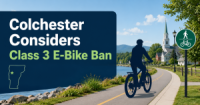
Colchester, Vermont, is considering new local electric bike rules that would prohibit Class 3 e-bikes from being ridden on town sidewalks and recreation paths.
The proposed ordinance would continue allowing legal Class 1 and Class 2 e-bikes in many of these locations. It would also clearly state that motor-assisted bicycles and motor-driven cycles, sometimes informally called e-motos, are prohibited on town sidewalks and recreation paths.
According to WCAX, the Colchester Selectboard is expected to consider the ordinance changes following a public hearing on July 14, 2026. As of the publication of this article, the proposal has not yet been adopted.
Before riding in another state or city, you can also review my State-by-State E-Bike Laws Guide to see how electric bicycle classifications, age requirements and access rules vary across the country.
Updated July 31, 2026: Following the July 14 public hearing, the Colchester Selectboard revised the proposed ordinance. The original version would have allowed Class 1 and Class 2 e-bikes on town sidewalks and multiuse paths while prohibiting Class 3 e-bikes. The revised proposal would now allow Class 1, Class 2 and Class 3 e-bikes in these locations.
The revised ordinance has not received final approval, and no new rule or effective date is in place yet. Another public hearing is scheduled for August 11, 2026, when the Selectboard may approve, amend or reject the proposal
🔎 Why You Can Trust Electric Bike Explorer
I reviewed current state statutes, transportation agency guidance, and available local rules when this guide was updated. When relevant, I also check city ordinances, park and trail policies, school or campus rules, and other official government sources.
E-bike laws can change, and local governments, parks, trails, and campuses may impose additional restrictions. Always confirm the latest requirements with the appropriate agency before riding.
Learn more about how Electric Bike Explorer researches law guides, buying guides, troubleshooting information, and e-bike recommendations.
Want to See More Electric Bike Explorer in Google Search?
Add Electric Bike Explorer as a preferred source to see more of our e-bike law guides, safety updates, reviews, buying guides, and troubleshooting posts when they are relevant to your searches.
Colchester E-Bike Proposal at a Glance
| Vehicle type | Proposed Colchester rule |
|---|---|
| Class 1 e-bike | Would remain permitted on town sidewalks and designated recreation paths |
| Class 2 e-bike | Would remain permitted on town sidewalks and designated recreation paths |
| Class 3 e-bike | Would be prohibited on town sidewalks and recreation paths |
| Motor-assisted bicycle | Would be explicitly prohibited on sidewalks and recreation paths |
| Motor-driven cycle or e-moto | Would be explicitly prohibited on sidewalks and recreation paths |
| Natural-surface park trails | Class 1 and Class 2 e-bikes would remain prohibited unless the trail is specifically designated for bicycle use |
| Effective date | 21 days after Selectboard approval, if adopted |
The biggest new restriction would apply to Class 3 electric bicycles. Town staff say the other ordinance edits are primarily intended to make existing state and local restrictions on motor-assisted bicycles and motor-driven cycles clearer.
Why Colchester Is Considering New E-Bike Rules
According to the Colchester Selectboard ordinance packet, the town has experienced an increase in electric bicycles, motor-assisted bicycles and motor-driven cycles being used on sidewalks and multiuse paths.
Town officials also noted that school-aged riders frequently use these vehicles. The proposed changes are intended to improve safety and reduce confusion between legal electric bicycles and motor vehicles that may resemble e-bikes.
The changes were developed by the Town Manager’s Office in cooperation with the Colchester Police Department, Department of Public Works and Department of Parks and Recreation.
The proposal follows a recent decision by the Colchester School District to prohibit e-motos on school property. The school district and police department have also been working to help families understand the difference between legal e-bikes and electric motor vehicles.
What Would Happen to Class 3 E-Bikes?
Under the proposed ordinance, Class 3 electric bicycles would no longer be permitted on:
- Town sidewalks
- Colchester recreation paths
- Concrete and asphalt paths within town parks
The proposed rule would not completely ban Class 3 e-bikes in Colchester. Riders could still use a compliant Class 3 electric bicycle on public roads and bicycle lanes where bicycles are permitted, subject to traffic laws and any location-specific restrictions.
Vermont law generally allows electric bicycles in places where conventional bicycles are permitted, including highways, bicycle lanes and bicycle or multiuse paths. However, municipalities and other authorities may prohibit Class 3 e-bikes from the paths under their jurisdiction.
Vermont defines a Class 3 electric bicycle as a bike that:
- Has fully operable pedals
- Has a saddle or seat
- Uses an electric motor of less than 750 watts
- Provides assistance only while the rider is pedaling
- Stops providing assistance at 28 mph
A Class 3 e-bike must also have a speedometer, and a rider must be at least 16 years old to operate one. A person younger than 16 may ride as a passenger on a Class 3 e-bike designed to carry passengers.
Town staff say the higher assisted-speed capability is why they recommend excluding Class 3 e-bikes from sidewalks and shared recreation paths.
A 28 mph assistance cutoff does not mean every Class 3 rider is traveling at 28 mph. However, the ordinance would regulate the bike according to its legal classification and motor-assisted speed capability rather than attempting to evaluate each rider individually.
Class 1 and Class 2 E-Bikes Would Remain Allowed
Colchester is not proposing a complete electric bike ban.
Under the draft ordinance, Class 1 and Class 2 electric bicycles would remain included in the town’s definition of a bicycle. Riders could continue using them on town sidewalks and designated recreation paths, provided they follow the applicable bicycle rules.
Vermont defines the two classes as follows:
Class 1 e-bike: Provides assistance only while the rider is pedaling and stops providing assistance at 20 mph.
Class 2 e-bike: May use a throttle or another motor-control system to propel the bike without pedaling, but cannot provide assistance at or above 20 mph.
Both classes must have fully operable pedals, a saddle or seat and an electric motor of less than 750 watts.
Riders using permitted bicycles on sidewalks and shared paths must:
- Yield the right of way to pedestrians
- Give an audible warning before passing
- Exercise due care
- Travel at a reasonable and safe speed
- Stop before crossing a street from a sidewalk
These requirements would continue to apply to Class 1 and Class 2 e-bike riders.
For a broader look at where electric bikes can be ridden near pedestrians, see my complete guide to e-bike sidewalk laws by state.
Class 1 and Class 2 E-Bikes Would Not Be Allowed on Every Park Trail
The fact that Class 1 and Class 2 e-bikes would remain permitted on recreation paths does not mean they would be allowed on every trail inside a Colchester park.
Under the proposed language, conventional bicycles and Class 1 and Class 2 e-bikes would be allowed on concrete or asphalt paths within town parks.
They would remain prohibited on natural-surface trails and in other park areas unless the location is expressly designated as a bicycle trail.
That distinction is important because e-bike trail access can vary according to:
- The e-bike’s class
- Whether the path is paved or natural surface
- Who manages the property
- Local ordinances
- Posted trail rules
Riders should check posted signs and official trail information before entering an unfamiliar path. My E-Bike Trail Access Checker can help riders identify the kinds of state, local and trail-management restrictions they may need to verify.
“E-Moto” Is Not a Vermont Legal Classification
The term e-moto is commonly used for electric dirt bikes, lightweight electric motorcycles and other high-powered electric two-wheelers.
However, Vermont law does not define “e-moto” as its own legal vehicle category.
The vehicle’s actual specifications determine whether it is legally considered:
- An electric bicycle
- A motor-assisted bicycle
- A motor-driven cycle
- A motorcycle
- Another type of motor vehicle
Colchester and local news reports have used the term e-moto informally when discussing electric motor-driven cycles. Some higher-powered electric motorcycles may not qualify as motor-driven cycles if they exceed the statutory power or speed limits.
This is why riders should not rely only on marketing terms such as “e-bike,” “e-moto” or “electric dirt bike.”
What Is a Motor-Driven Cycle in Vermont?
Vermont defines a motor-driven cycle as a two- or three-wheeled motor vehicle with:
- A power source producing no more than two brake horsepower
- A maximum unassisted speed of no more than 30 mph on a level road
- A direct or automatic drive system that does not require clutching or shifting after it is engaged
- A maximum displacement of 50 cubic centimeters when a combustion engine is used
Motor-assisted bicycles and legal Class 1, Class 2 and Class 3 electric bicycles are specifically excluded from the motor-driven-cycle category.
A faster or more powerful vehicle may instead fall under Vermont’s motorcycle or other motor-vehicle laws.
When operated on public roads, a qualifying motor-driven cycle must generally be:
- Registered
- Covered by the required insurance or financial responsibility
- Operated by a licensed driver
- Operated by someone who is at least 16 years old
Motor-driven cycles must also follow motor-vehicle traffic laws and are already prohibited from Colchester sidewalks and recreation paths. The proposed ordinance would place those restrictions more clearly into the relevant sections of the town code.
What Is a Motor-Assisted Bicycle?
Vermont also recognizes a separate category called a motor-assisted bicycle.
A motor-assisted bicycle may have:
- Two or three wheels
- Fully operable pedals
- A motor-powered top speed of no more than 20 mph
- An electric motor producing no more than 1,000 watts
An electric version falls into this category when it does not qualify as a Class 1, Class 2 or Class 3 electric bicycle.
For example, a bike with a 1,000-watt motor that stops providing motor power at 20 mph may qualify as a motor-assisted bicycle rather than a legal three-class electric bicycle.
Motor-assisted bicycles are generally treated like bicycles under Vermont law and do not require motor vehicle registration, inspection or an operator’s license. However, Vermont law specifically states that a person may not operate a motor-assisted bicycle on a sidewalk.
A person younger than 16 also may not operate a motor-assisted bicycle on a highway.
The proposed Colchester ordinance would explicitly prohibit motor-assisted bicycles from town recreation paths in addition to the existing statewide sidewalk prohibition.
Why the Vehicle’s Label Matters
Vermont requires manufacturers and distributors to place a permanent label on qualifying electric bicycles.
The label must show:
- The e-bike class
- The top assisted speed
- The motor wattage
Riders should check this label before assuming their bike qualifies as a Class 1, Class 2 or Class 3 electric bicycle.
However, a label is only reliable when the bike has not been modified. Vermont law says a person may not modify an e-bike in a way that changes its motor-powered speed or engagement without replacing the classification label.
A bike marketed online as an e-bike may not qualify as a legal electric bicycle if it:
- Has a motor rated at 750 watts or more
- Provides motor assistance beyond its class speed limit
- Lacks operable pedals
- Has been unlocked or modified to exceed legal limits
- Does not fit one of Vermont’s three e-bike classes
When Would the New Colchester Rules Begin?
The Colchester Selectboard is scheduled to consider the ordinance following a public hearing on July 14, 2026.
If approved, the amendments would become effective 21 days after Selectboard approval.
Until the ordinance is approved and reaches its effective date, riders should not describe the proposed Class 3 restriction as an active ban.
The distinction between a proposal and an adopted ordinance is especially important for news coverage. The current proposal may still be amended, approved or rejected during the Selectboard process.
What Colchester E-Bike Riders Should Do
Colchester riders should first determine which legal category applies to their vehicle.
Check the bike’s permanent classification label and confirm:
- Motor wattage
- Motor-assisted speed
- Whether the motor works only while pedaling
- Whether the bike has a throttle
- Whether it has fully operable pedals
- Whether it has been modified or unlocked
Class 1 and Class 2 riders should also remember that being allowed on a shared path does not mean they can ride at any speed. Riders must slow down around pedestrians, give an audible warning before passing and use a speed that is safe for current conditions.
Class 3 riders should begin planning alternative road or bike-lane routes in case the proposed ordinance is approved.
Owners of faster e-motos and electric motorcycles should not assume that adding pedals makes the vehicle a legal e-bike. Vehicle power, assisted speed and design all affect its legal classification.
My Take
I think Colchester is taking a more measured approach than communities that respond to safety complaints by banning every type of electric bicycle.
The proposal would continue allowing Class 1 and Class 2 e-bikes on many sidewalks and recreation paths while focusing the new restriction on Class 3 bikes, motor-assisted bicycles and motor-driven vehicles.
I also agree that towns need to clearly separate legal e-bikes from e-motos and electric motorcycles. A compliant 20 mph pedal-assist or throttle e-bike is not the same as a high-powered electric dirt bike capable of reaching 35 or 40 mph.
When all of these vehicles are described as e-bikes, responsible riders can end up facing restrictions because of machines that never legally qualified as electric bicycles.
I understand the concern about allowing Class 3 e-bikes on narrow or crowded shared paths. A bike that can continue receiving motor assistance up to 28 mph creates a greater potential speed difference around walkers, children and slower cyclists.
At the same time, classification does not always tell us whether someone is riding safely. A responsible Class 3 rider traveling at 10 or 12 mph may present less risk than a reckless rider on a conventional bicycle or Class 2 e-bike.
That is why enforcement should also focus on actual behavior. Clear signs, reasonable speed enforcement and education about yielding to pedestrians may do more to improve safety than relying on vehicle classifications alone.
Parents also need better information about the vehicles their children are riding. Many families may genuinely believe they purchased a legal e-bike when the vehicle is actually a motor-assisted bicycle, motor-driven cycle or electric motorcycle under Vermont law.
Overall, I believe the Colchester proposal does a better job than a blanket e-bike ban of recognizing that these vehicles are not all the same. The town would preserve access for lower-speed Class 1 and Class 2 riders while creating clearer limits for faster electric vehicles on pedestrian-heavy paths.
The success of the ordinance will depend on whether the town explains the rules clearly and enforces them consistently. Riders should be able to understand not only where they can ride, but also why a particular vehicle is treated as an e-bike, motor-assisted bicycle or motor vehicle.
For more news on electric bikes click here
External Sources
- WCAX – Vermont town considering new rules for e-bikes and e-motos
- Colchester Selectboard – Proposed ordinance amendment packet
- Town of Colchester – Electric bicycle and motor-driven-cycle information
- Vermont Statutes – Vehicle and electric bicycle definitions
- Vermont Statutes – Electric bicycle operation rules
- Vermont Statutes – Motor-assisted bicycle operation rules
- WCAX – Colchester School District bans e-motos on campuses

Kristina is not just an enthusiast but a true authority on electric bikes. Nestled in the coastal beauty of Virginia, Kristina has found the perfect backdrop for her passion for electric biking. As a dedicated wife and homeschooling mom, her life revolves around family, faith, and the thrill of adventure.
Originally hailing from Ohio, Kristina's journey with electric bikes began as a curiosity and quickly evolved into a deep expertise. Her blog is a testament to her love for electric biking, combining her fascination for eco-friendly transportation with her coastal lifestyle.
When she's not cruising the beach on her electric bike, you'll find Kristina indulging in her other loves: long walks along the shore, getting lost in a good book, and cherishing moments with her loved ones. With a heart as big as her love for animals, especially cats, Kristina brings a unique perspective to the electric bike world, grounded in her strong faith in God and her dedication to a sustainable lifestyle.
Through her blog, Kristina shares her extensive knowledge of electric bikes, offering valuable insights, tips, and recommendations to fellow enthusiasts. Whether you're a seasoned rider or a newcomer to the electric bike scene, Kristina's blog is your go-to source for all things electric biking, fueled by her passion, expertise, and the scenic beauty of coastal Virginia.