Why Some E-Bikes Feel More Powerful (Even With the Same Watt Motor)
Last Updated on February 26, 2026 by Kristina
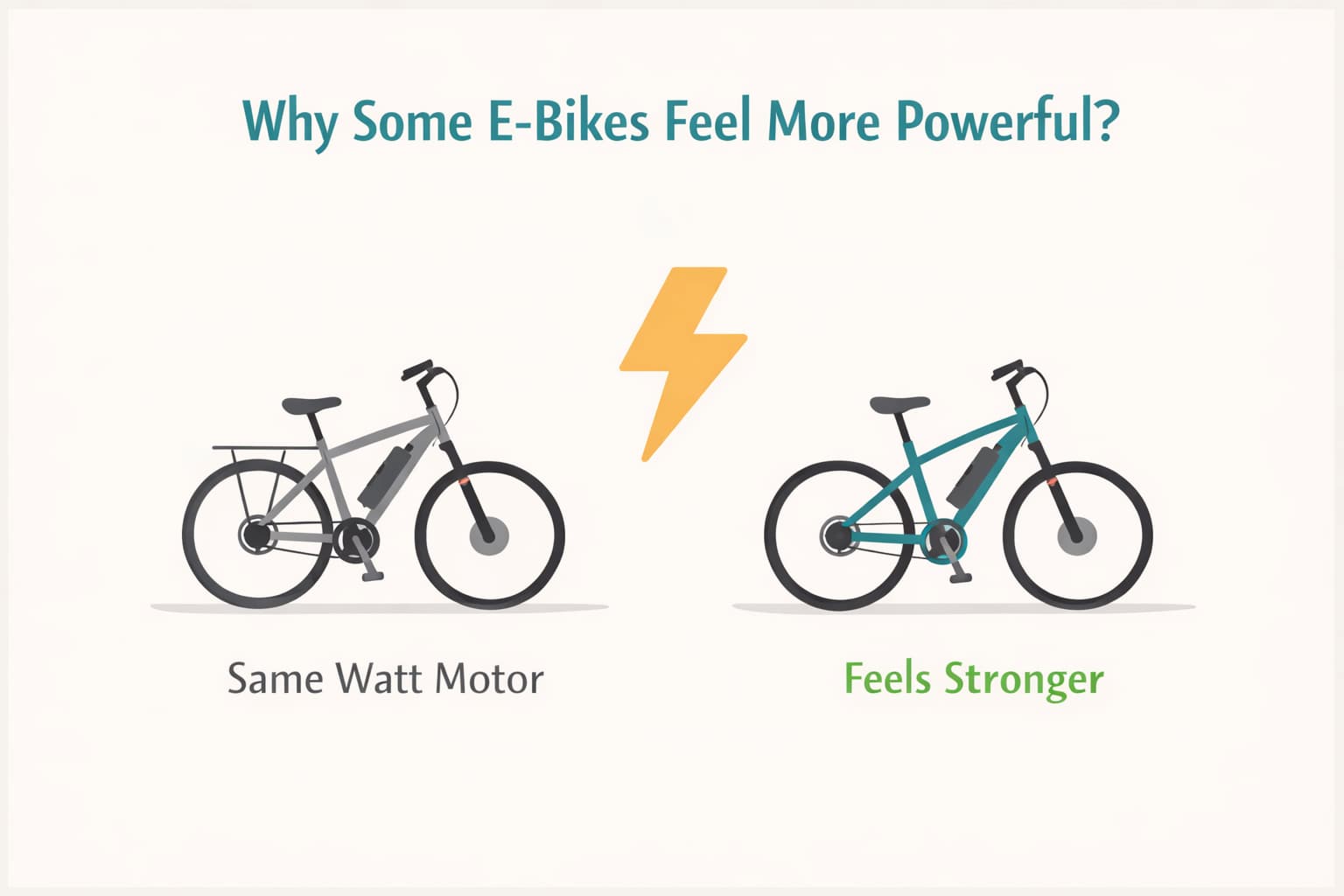
Two e-bikes can both say “500W” (or “750W”) on the spec sheet and still feel completely different on hills, at takeoff, and even at cruising speed. That’s because motor watts are only one piece of the power puzzle — and often the most misunderstood one.
Real e-bike performance depends on system design, not just motor rating.
If you’ve compared specs and wondered why two bikes with the same motor rating feel totally different to ride, the answer comes down to how power is delivered, not just how much power is listed.
If you’re still early in the process and want a complete overview of how motor specs fit into choosing the right bike, start with our e-bike buying guide.
Quick Answer
Two e-bikes with the same watt motor can feel different because of torque output, controller tuning, gearing, battery voltage, and motor type. Wattage alone does not determine real-world power.
How this guidance is evaluated: Recommendations are based on real-world riding performance, motor design differences, rider load impact, and engineering principles — not just manufacturer specs.
What Matters More Than Watts
- torque rating
- motor type (hub vs mid-drive)
- controller tuning
- gearing efficiency
- battery output
Wattage Is Only One Piece of Power
Wattage measures how much power a motor can produce over time. It helps indicate potential performance, especially at higher speeds.
But wattage does not tell you:
- how strong the bike feels at low speeds
- how smoothly it accelerates
- how well it climbs hills
- how it handles rider weight or cargo
If you want a deeper breakdown of how wattage compares to other specs, see our full torque vs wattage comparison guide.
The 5 Real Factors That Change How Powerful an E-Bike Feels
Two bikes with identical watt ratings can perform very differently because of these hidden factors:
1. Torque Output
Torque determines how strongly the motor pulls at low speeds. Higher torque means stronger acceleration, easier hill climbing, and better performance under load.
2. Controller Tuning
The controller is the brain of the motor. It determines:
- how quickly power engages
- how aggressively power ramps up
- how smoothly assist transitions
- how the motor responds to pedal pressure
Two motors with identical wattage and torque can feel completely different depending on controller programming.
Some bikes:
- surge forward aggressively
- lag before engaging
- feel jerky at low speeds
Others:
- ramp power smoothly
- respond proportionally
- feel natural and predictable
That’s why ride feel is often more about tuning than watt rating.
3. Gearing and Drivetrain Efficiency
Mid-drive motors use the bike’s gears, which multiplies force. That means a lower-watt motor can sometimes outperform a higher-watt hub motor on hills.
4. Battery Voltage and Current Output
Battery systems matter more than many buyers realize.
A 48V system can deliver power differently than a 36V system, even if both motors are rated at the same wattage.
Higher-voltage systems often:
- maintain speed better under load
- reduce strain on hills
- feel more consistent at higher assist levels
Battery quality and internal management systems also affect performance, meaning two bikes with identical watt motors can still feel very different.
5. Motor Type
Hub motors:
- simpler
- often higher wattage
- better for flat terrain
Mid-drives:
- use bike gearing
- climb better
- feel stronger under load
Real-World Example
A 500W hub motor and a 500W mid-drive may look identical on paper.
But in real riding:
- the hub motor may struggle on steep hills
- the mid-drive may climb easily
- the mid-drive may feel smoother
- the hub may feel stronger on throttle
That difference isn’t marketing — it’s physics and design.
Real-World Performance Comparison
| Scenario | 500W Hub Motor | 500W Mid-Drive |
|---|---|---|
| Hill climb | Slows down | Maintains speed |
| Heavy rider | Struggles | Performs well |
| Cargo load | Strains | Pulls smoothly |
| Stop-and-go | Jerky starts | Smooth starts |
| Battery efficiency | Lower | Higher |
Why Reviewers Sometimes Disagree About Power
You might see one review say a bike feels strong and another say it feels weak — and both can be correct.
Real-world performance varies because power perception changes with conditions such as:
- rider weight
- tire pressure
- incline angle
- battery charge level
- wind resistance
- road surface
Power isn’t fixed. It depends on real riding conditions, not just specs.
Why Spec Sheets Can Be Misleading
Manufacturers often highlight wattage because it’s simple and easy to compare. But wattage numbers don’t show:
- controller tuning
- torque curves
- motor efficiency
- heat handling
- gearing advantages
Two bikes with identical watt ratings can have completely different real-world performance.
What Actually Determines Real-World Power
Real performance comes from how the full system works together:
- torque + gearing
- controller + motor
- battery + load
- tuning + terrain
Think of wattage as engine size and torque as pulling strength — you need both, but they do different jobs.
Real performance comes from balance, not specs alone.
How To Compare Two E-Bikes Correctly
Instead of comparing only watts, compare:
- torque rating
- motor type
- rider weight capacity
- terrain performance reviews
- braking strength
- battery size
Those tell you far more than wattage alone.
Which Spec Should You Prioritize?
If your priority is:
- Hill climbing → prioritize torque + mid-drive motor
- Fast acceleration → prioritize battery voltage + controller output
- Natural ride feel → prioritize torque sensor systems
- Consistent power → prioritize battery quality and system tuning
⚡ Quick Power Estimator Tool
Not sure what motor range fits your weight and terrain? Use this simple estimator to narrow your shopping range before comparing models.
Quick E-Bike Power Feel Estimator
Signs an E-Bike Is Stronger Than Its Specs Suggest
Some bikes outperform their numbers. Signs include:
- climbs hills without slowing
- accelerates smoothly from stops
- maintains speed with cargo
- feels responsive instead of laggy
These real-world behaviors matter more than spec sheets.
Quick Checklist: Which “Same Watt” Bike Will Feel Stronger?
Choose the stronger-feeling bike if it has:
- higher torque rating
- higher voltage battery system
- torque sensor pedal assist
- mid-drive motor design
- lighter total weight
- climbing-focused tires
Real-world performance depends on system design, not just watt numbers.
The Biggest Mistake Buyers Make
Many buyers assume wattage equals power. It doesn’t.
Choosing a bike based only on watt rating can lead to:
- weak hill performance
- jerky acceleration
- shorter battery range
- poor ride feel
The strongest-feeling e-bikes are rarely the ones with the biggest numbers. They’re the ones with the best system design.
Why Mid-Drives Often Feel Stronger at Lower Watts
Mid-drive motors multiply torque through the bike’s gears.
That means:
- climbing in a low gear increases wheel torque
- motor efficiency improves
- heat buildup decreases
- power feels more usable
This is why a 250W mid-drive can outperform a 750W hub motor on steep climbs.
It’s not about motor size — it’s about mechanical advantage.
Local Laws Reminder
Before choosing a higher-power e-bike, check local class limits and speed regulations. Some bikes feel stronger simply because they are tuned more aggressively or exceed standard class limits.
Always confirm that your bike meets legal requirements where you ride.
FAQs
Why does one 500W e-bike feel stronger than another?
Because torque, motor tuning, gearing, and controller design affect performance more than watt rating alone.
Does higher wattage always mean more power?
No. Wattage measures potential output, but torque and efficiency determine how strong a bike actually feels.
Can a lower watt motor feel stronger?
Yes. A well-designed lower-watt motor with higher torque or better gearing can outperform a higher-watt motor.
Why does my e-bike feel weak even though it has a high watt motor?
A high watt rating doesn’t guarantee strong performance. Weak torque, poor tuning, low battery output, or inefficient gearing can make a powerful motor feel underwhelming.
Final Thoughts
Two e-bikes with the same watt motor can ride completely differently. That’s because wattage is only one part of the performance equation.
If you want stronger climbs, smoother starts, and better real-world riding, focus on how power is delivered — not just the number printed on the motor.
The best e-bikes balance torque, wattage, gearing, and tuning for how and where you actually ride.
Still Comparing Motor Specs?
Before choosing a bike, make sure you understand how torque and wattage actually work together.
See our full torque vs wattage comparison guide.
External Sources
Industry motor ratings and safety standards referenced in this guide follow established electrical and bicycle safety guidelines used across the e-bike industry.
Two e-bikes can both say “500W” (or “750W”) on the spec sheet and still feel completely different on hills, at takeoff, and even at cruising speed. That’s because motor watts are only one piece of the power puzzle – and often the most misunderstood one.
Quick Answer
Two e-bikes with the same watt motor can feel different because of torque output, motor tuning, controller programming, gearing, and sensor type. Wattage alone does not determine real-world power.
If you’re still deciding what type of e-bike fits your riding, start with the e-bike buying guide for the big-picture choices. And if you want the spec translation for what actually matters, see the torque vs wattage comparison guide explaining why watt ratings alone don’t tell the whole story.
🟢 How This Guide Was Created (Trust & Methodology)
This guide focuses on real-world performance factors riders can feel – acceleration, climbing strength, responsiveness, and consistency – not marketing specs. Technical explanations are based on motor physics, controller behavior, drivetrain mechanics, and real rider performance patterns.
The Truth Most Riders Don’t Realize
Two motors with the same watt rating can feel completely different because watt labels don’t show how power is delivered.
Watts describe potential output.
Torque, voltage, controller tuning, gearing, sensors, and efficiency determine how that power actually feels.
What Torque Actually Means on an E-Bike
Torque is the rotational force that turns the wheel and pushes you forward. It’s measured in Newton-meters (Nm), and it’s the spec that most directly affects how strong a bike feels when you:
- start from a stop
- climb hills
- carry cargo
- accelerate
Higher torque doesn’t always mean faster top speed, but it usually means stronger takeoff and better climbing power.
Simple rule:
Watts influence overall power.
Torque determines how strong that power feels.
Real-World Test Scenarios That Reveal Power Differences
When comparing bikes in person or watching reviews, these tests show the truth fast:
Hill start test – start halfway up a hill from a stop
Low-speed climb – crawl uphill slowly
Cargo test – ride with weight added
40% battery test – ride when battery isn’t full
Strong systems feel steady and confident. Weak ones hesitate, surge, or fade.
1. Peak vs Nominal Power (Marketing vs Reality)
Most motors list nominal watts – sustained output. But what you actually feel often comes from peak power bursts.
Two 500W bikes:
- One peaks high → feels punchy
- One limited → feels mild
Manufacturers don’t always publish peak numbers, which is why watt labels alone mislead buyers.
2. Controller Tuning Changes Everything
The controller determines:
- acceleration strength
- power ramp speed
- torque bursts
- heat protection limits
Same motor + different controller = totally different ride feel.
Think of it like two cars with identical engines but different tuning.
3. Voltage Matters More Than Most Riders Think
Higher voltage systems often feel stronger because they maintain power delivery more efficiently under load.
Typical pattern:
| Voltage | Typical Feel |
|---|---|
| 36V | fine on flats, weaker on hills |
| 48V | stronger acceleration and climbing |
| 52V | very responsive and consistent |
Higher voltage reduces strain and maintains power longer.
4. Torque Sensor vs Cadence Sensor Feel
This dramatically affects perceived strength.
Torque sensor
- instant response
- matches effort
- feels powerful and natural
Cadence sensor
- delayed activation
- on/off assist feel
- can feel less responsive on hills
Even with identical motors, torque sensor bikes almost always feel stronger.
5. Mid-Drive vs Hub Drive Leverage Advantage
Mid-drives can use bike gears. Hub motors cannot.
That means:
- mid-drives multiply torque using gears
- hubs push directly without leverage
Result: a lower-watt mid-drive can outperform a higher-watt hub motor on climbs.
6. Bike Weight, Tires, and Gearing Can Hide Power
Sometimes the motor isn’t weak – the bike is demanding more.
Power-reducing factors:
- fat tires
- heavy frames
- cargo racks
- poor gearing
- heavy rider weight
Two identical motors can feel totally different depending on bike design.
7. Battery Quality and Voltage Sag
A common rider complaint:
“My bike felt strong at first but weaker later.”
That’s usually voltage sag. Lower-quality batteries drop voltage under load, reducing real output. Higher-quality packs maintain power longer.
Spec Decoder Table – What Actually Predicts Strength
| Spec | What It Means | Why It Matters |
|---|---|---|
| Torque (Nm) | Push force | Biggest predictor of climbing ability |
| Voltage | Power delivery | Higher voltage = stronger feel |
| Controller amps | Burst power | Determines acceleration |
| Sensor type | Assist behavior | Controls responsiveness |
| Motor type | Mechanical advantage | Mid-drive climbs better |
| Weight | Load demand | Heavier bikes feel weaker |
| Tires | Resistance | Wider tires need more power |
Prefer a visual explanation? Here’s a great breakdown of how e-bike motor power and torque work in the real world:
⚡ Quick Power Estimator Tool
Wondering how strong an e-bike will actually feel before you ride it? This quick estimator uses torque, voltage, and bike weight to give a realistic prediction of real-world power feel. It’s not a lab measurement – it’s a practical comparison tool to help you judge which bike will feel stronger when specs look similar.
How to use it:
Enter the values from a bike’s spec sheet and compare results between models.
Quick E-Bike Power Feel Estimator
⚠️ Common Buying Mistakes That Cause “This Feels Weak”
Most riders who think their e-bike is underpowered didn’t buy the wrong watt rating. They bought a mismatched system.
Typical causes:
- choosing based only on watts
- ignoring torque specs
- buying heavy bikes for hills
- choosing cadence sensors when they wanted responsiveness
- underestimating terrain difficulty
- buying low-voltage systems for steep areas
Avoiding these mistakes instantly improves satisfaction.
Quick Decision Rules
If your priority is…
Hill climbing → prioritize torque + mid-drive
Fast acceleration → prioritize voltage + controller amps
Natural ride feel → prioritize torque sensor
Consistent power → prioritize battery quality
Why Reviewers Sometimes Disagree About Power
You might see one review say a bike feels strong and another say it feels weak. Both can be correct.
Variables that change results:
- rider weight
- tire pressure
- incline angle
- battery level
- wind resistance
- surface type
Power perception isn’t fixed – it changes with conditions.
Simple Checklist: Which “Same Watt” Bike Will Feel Stronger?
Choose the stronger-feeling bike if it has:
- higher torque rating
- higher voltage battery
- torque sensor
- mid-drive motor
- lighter frame
- narrower tires (if climbing is priority)
Local Laws Reminder
Before choosing a “more powerful” bike, check local class limits and speed laws. Some bikes feel stronger simply because they’re tuned aggressively.
FAQ
Do higher watts always mean stronger?
No. Watts show potential power, not delivery strength.
Is torque more important than watts?
For hills and acceleration, yes.
Why does my e-bike feel weaker later in rides?
Usually voltage sag or thermal protection.
Is 500W enough for hills?
Often yes with good torque and gearing.
📖 Read Next
Understanding Electric Bike Classes: A Comprehensive Guide
How to Size an E-Bike for Your Height
Best E-Bikes for Women – Comfortable, Easy-to-Ride Picks
Best E-Bikes for Tall Riders (6’0” and Up) – Top Picks & Fit Guide
Recommended Electric Bikes for Short People (Including Riders Down to 4′11″)
Electric Bike Battery Capacity: Amp Hours (Ah) Explained
Best Commuter E-Bikes Under 2000 Dollars
Final Takeaway
If you remember one thing, remember this:
Watts show potential. Torque, voltage, controller tuning, sensors, and bike design determine how powerful an e-bike actually feels.
Two bikes can have identical motor watt ratings yet feel completely different on the road. The strongest-feeling bike is usually the one with better torque delivery, higher voltage, smarter tuning, and more efficient design – not just a bigger watt number.
👉 Found this helpful?
Share this guide with someone comparing e-bikes, and drop a comment below if you’ve ever ridden two bikes with the same watt motor that felt totally different. Your experience helps other riders choose smarter.
Rider Question:
Have you ever tested two bikes with the same watt motor that felt totally different?
Comment what models they were and what felt different. Real rider comparisons help everyone make better decisions.
Not sure where to go next?
Some riders are brand new. Others are fixing a problem or thinking about a new bike. Choose what fits you.
Learn & Get Comfortable
Understand how e-bikes work and what to expect when riding.
Improve Your Current Ride
If your bike isn’t performing how you want, learn what affects speed, range, and power.
Compare Better Bikes
Looking for something that fits your riding style? Start here.
- Best Electric Bikes for Beginners
- Recommended Commuter Ebikes
- Most Comfortable City E-Bikes
- Best Fat Tire Ebikes
- Top Folding Ebikes
- Best Step Through Ebikes
- Top Cargo Electric Bikes
- Best Lightweight Ebikes
- Best Long Range Ebikes
- Top Moped Style E-Bikes
- E-bike Reviews
🛒 Ready to Buy?
Top picks and current availability from trusted brands.
👉 Still deciding?
Take our E-Bike Recommendation Quiz to get matched with the right riding style in under two minute
Authoritative Resources
- UL safety certification standard for e-bike electrical systems
- Explanation of power ratings vs real output behavior
- Example of published torque + performance specs from a major motor system manufacturer

Kristina is not just an enthusiast but a true authority on electric bikes. Nestled in the coastal beauty of Virginia, Kristina has found the perfect backdrop for her passion for electric biking. As a dedicated wife and homeschooling mom, her life revolves around family, faith, and the thrill of adventure.
Originally hailing from Ohio, Kristina's journey with electric bikes began as a curiosity and quickly evolved into a deep expertise. Her blog is a testament to her love for electric biking, combining her fascination for eco-friendly transportation with her coastal lifestyle.
When she's not cruising the beach on her electric bike, you'll find Kristina indulging in her other loves: long walks along the shore, getting lost in a good book, and cherishing moments with her loved ones. With a heart as big as her love for animals, especially cats, Kristina brings a unique perspective to the electric bike world, grounded in her strong faith in God and her dedication to a sustainable lifestyle.
Through her blog, Kristina shares her extensive knowledge of electric bikes, offering valuable insights, tips, and recommendations to fellow enthusiasts. Whether you're a seasoned rider or a newcomer to the electric bike scene, Kristina's blog is your go-to source for all things electric biking, fueled by her passion, expertise, and the scenic beauty of coastal Virginia.