What Motor Power Do You Need on an E-Bike? (250W vs 500W vs 750W Explained)
Last Updated on March 9, 2026 by Kristina
Choosing the right e-bike motor power is one of the most confusing parts of buying an electric bike.
Some electric bikes advertise 250W motors, others use 500W or 750W, and some go even higher. Many new riders assume that a larger number automatically means a better ride.
But motor wattage alone doesn’t tell the whole story.
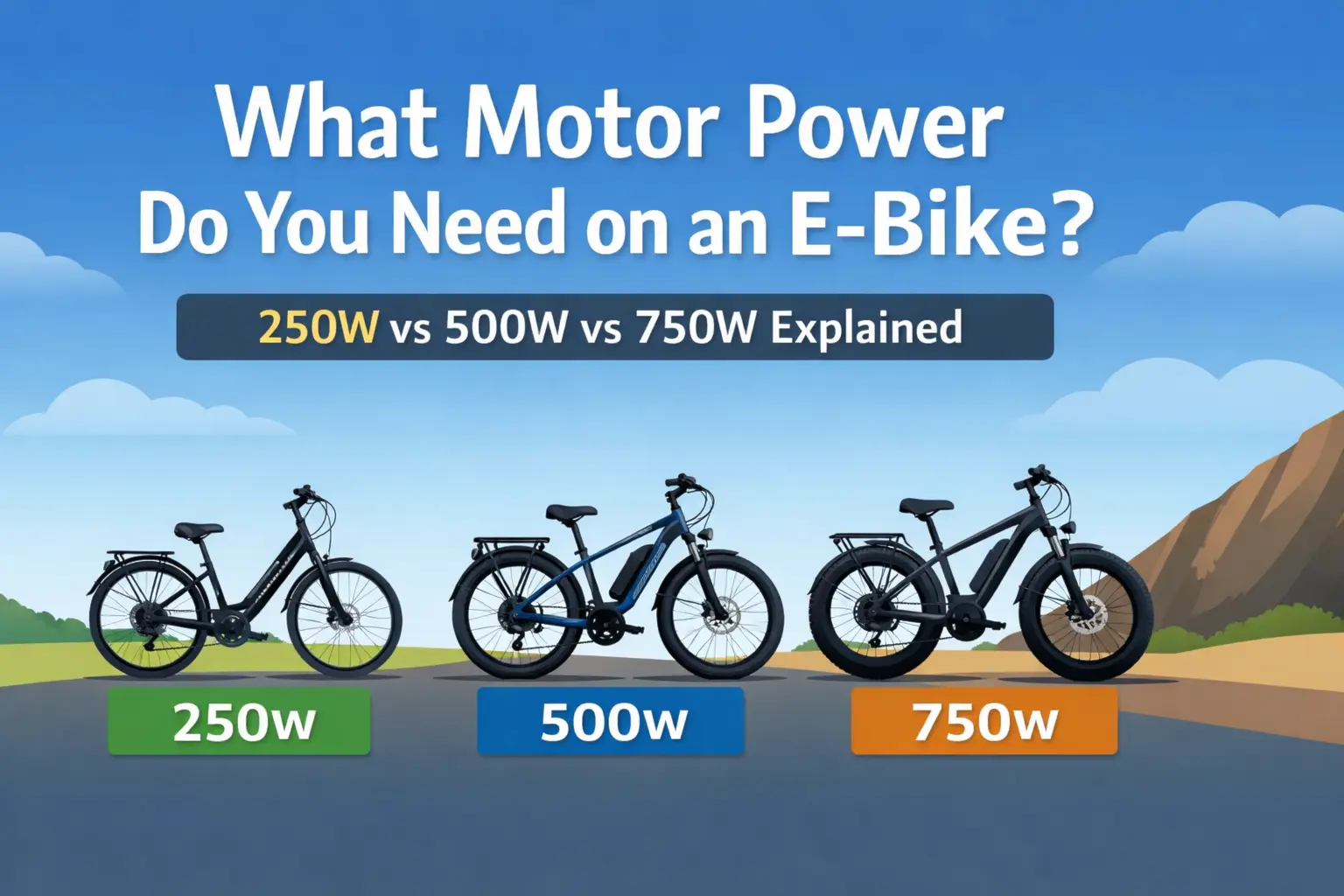
The best motor power for an e-bike depends on terrain, rider weight, cargo, and riding style. A commuter riding flat streets may be perfectly happy with 250W, while someone climbing steep hills or carrying cargo may benefit from 750W.
In this guide you’ll learn:
- what 250W, 500W, and 750W e-bike motors actually mean
- how motor wattage affects speed, acceleration, and hill climbing
- why torque often matters more than watts
- how to choose the right motor power for commuting, hills, or cargo
If you’re new to electric bikes, start with the full overview:
Who This Guide Is For (and Who It’s Not)
This guide is for
- riders buying their first electric bike
- commuters comparing 250W vs 500W vs 750W motors
- riders worried about hill climbing ability
- anyone confused by motor wattage marketing
This guide may not be for
- riders building DIY conversion bikes
- off-road riders seeking 1000W+ motors
If you’re considering building your own e-bike:
➡ DIY E-Bike Conversion Kits vs Buying an E-Bike
Motor Power Decision Tree
Start
 |
 |-- Mostly flat terrain?
 |        |
 |        YES → 250W–350W motor usually sufficient
 |        |
 |        NO
 |
 |-- Moderate hills?
 |        |
 |        YES → 500W motor recommended
 |        |
 |        NO
 |
 |-- Steep hills or cargo loads?
          |
          YES → 750W motor recommended
          |
          NO → 500W still likely best balance
Most riders end up happiest with 500W motors, which provide strong assistance without unnecessary battery drain.
What Motor Power Do You Need?
Terrain, rider weight, and cargo affect motor needs.
⚡ E-Bike Motor Power Estimator
Select your riding conditions to estimate what motor power you may need.
E-Bike Motor Power Comparison (250W vs 500W vs 750W)
| Motor Power | Best For | Hill Performance | Acceleration | Typical Rider |
|---|---|---|---|---|
| 250W | Flat commuting | Limited | Gentle | Lightweight riders |
| 500W | Mixed terrain | Good | Strong | Most commuters |
| 750W | Hills & cargo | Excellent | Very strong | Heavy riders |
For most riders, 500W motors provide the best balance of power, efficiency, and versatility, especially for commuting and moderate hills.
Motor Power vs Rider Weight
| Rider Weight | Recommended Motor |
|---|---|
| Under 160 lbs | 250W – 500W |
| 160 – 220 lbs | 500W |
| 220 – 260 lbs | 500W – 750W |
| Over 260 lbs | 750W |
Heavier riders benefit from higher torque motors.
Understanding E-Bike Motor Power
Motor power is measured in watts (W).
Higher wattage generally means:
- stronger acceleration
- better hill climbing
- more available assistance
But wattage alone does not determine performance.
Motor output also depends on:
- torque
- motor type
- battery voltage
- controller tuning
For example, a 250W mid-drive motor can outperform a 500W hub motor on steep hills.
➡ Torque vs Wattage: What Actually Matters More When Choosing an E-Bike?
According to the U.S. Consumer Product Safety Commission, most e-bikes are limited to 750W motors.
Watts vs Torque vs Voltage (Quick Explanation)
When comparing e-bike motors, you may see several specifications:
- Watts (W) – overall motor power
- Torque (Nm) – how strongly the motor turns the wheel
- Voltage (V) – electrical system strength
While wattage determines overall power, torque often has a bigger effect on hill climbing performance.
📺 Video: Understanding E-Bike Motor Power and Torque
This short video explains how wattage, torque, and motor design affect real-world e-bike performance.
How Different Motors Handle Hills
| Hill Grade | 250W | 500W | 750W |
|---|---|---|---|
| 3–5% mild hills | Easy | Easy | Easy |
| 6–8% moderate hills | Manageable | Comfortable | Easy |
| 10% steep hills | Difficult | Manageable | Comfortable |
Steep hills are where torque and mid-drive motors become especially valuable.
How Motor Power Affects Acceleration
Motor wattage affects how quickly an e-bike accelerates.
| Motor Power | Acceleration Feel |
|---|---|
| 250W | Smooth but gradual |
| 500W | Strong |
| 750W | Very quick |
Higher torque improves acceleration further.
Hub vs Mid-Drive Comparison
| Feature | Hub Motor | Mid-Drive |
|---|---|---|
| Cost | Lower | Higher |
| Maintenance | Minimal | Moderate |
| Hill climbing | Moderate | Excellent |
| Efficiency | Good | Very good |
| Ride feel | Basic assist | Natural pedaling |
Most budget commuter e-bikes use hub motors, while premium bikes often use mid-drives.
Real-World Motor Power Examples
| Bike Model | Motor | Torque | Best Use |
|---|---|---|---|
| Lectric XP 3.0 | 500W | 55Nm | Budget commuting |
| Aventon Level.2 | 500W | 60Nm | Daily commuting |
| Ride1Up Turris | 750W | 90Nm | Hills |
| Velotric Discover | 500W | 65Nm | Comfort commuting |
| Tenways CGO600 | 250W | 40Nm | Lightweight city riding |
Why Torque Often Matters More Than Watts
Torque determines how strongly the motor turns the wheel.
Higher torque improves:
- hill climbing
- acceleration
- cargo carrying
Typical ranges:
| Motor | Torque |
|---|---|
| 250W | 35–45 Nm |
| 500W | 50–65 Nm |
| 750W | 70–90 Nm |
Motor Power vs Battery Size
Motor wattage determines power, while battery capacity determines range.
| Motor | Battery | Result |
|---|---|---|
| 750W | 500Wh | strong power but shorter range |
| 500W | 700Wh | balanced power with longer range |
Signs You May Need More Motor Power
You may benefit from more power if:
- your bike struggles on hills
- acceleration feels weak
- you carry cargo regularly
- your speed drops dramatically on climbs
Common E-Bike Motor Power Mistakes
Motor wattage is one of the first specifications people notice when comparing electric bikes. But many riders misunderstand what those numbers actually mean. Avoiding a few common mistakes can help you choose the right motor without overspending or sacrificing efficiency.
Assuming Bigger Motors Are Always Better
It’s easy to assume that a 750W motor is automatically better than a 500W or 250W motor, but that’s not always true.
Higher wattage motors provide more available power, but they also come with trade-offs:
- slightly reduced battery range
- potentially heavier bikes
- sometimes higher cost
For many everyday riders, a 500W motor provides plenty of assistance for commuting and recreational riding without using as much battery energy as a higher-powered motor.
If your rides are mostly on flat roads or gentle hills, a 250W or 500W motor may deliver a smoother and more efficient riding experience.
Ignoring Torque Ratings
Many buyers focus only on motor wattage and overlook torque, which is often the better indicator of real-world performance.
Torque (measured in Newton meters or Nm) describes the rotational force applied to the wheel. Higher torque improves:
- hill climbing ability
- acceleration from a stop
- performance with cargo or heavier riders
For example, a 250W mid-drive motor with high torque can sometimes climb hills better than a 500W hub motor with lower torque.
Understanding torque is especially important if you live in a hilly area or plan to carry cargo regularly.
For a deeper explanation of how torque affects riding performance, see:
➡ What Is E-Bike Motor Torque?
Overestimating Hill Difficulty
Another common mistake is assuming that steep hills automatically require the most powerful motor available.
In reality, many riders discover that a 500W motor handles moderate hills surprisingly well, especially when paired with good gearing and pedal assistance.
Most commuter routes include hills in the 3–8% grade range, which many 500W motors can handle comfortably.
A 750W motor is often more beneficial for riders who:
- live in mountainous areas
- regularly climb long or steep hills
- carry cargo or ride with heavier loads
If you primarily ride in suburban or urban areas with rolling terrain, a 500W motor is often the best balance of power and efficiency.
If you’re specifically looking for bikes designed to handle steep terrain, see:
Not Considering Riding Style
Motor power should match how you actually ride.
For example:
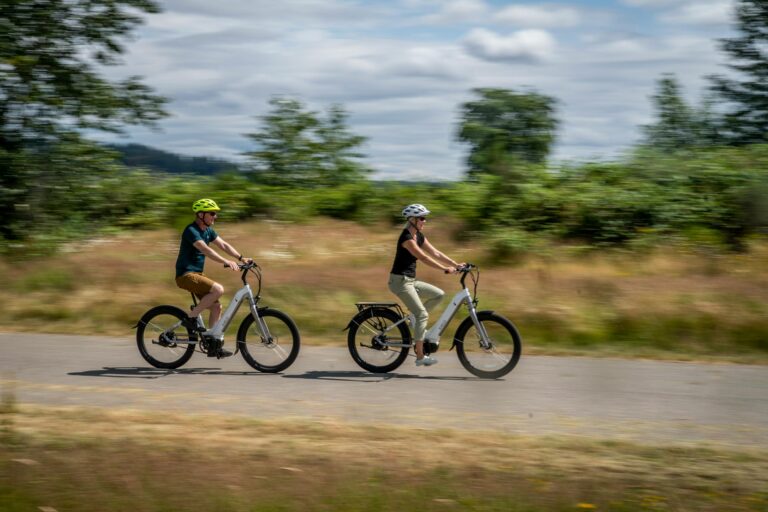
- A short city commute on flat roads may only require 250W.
- A daily commuter riding moderate hills may benefit from 500W.
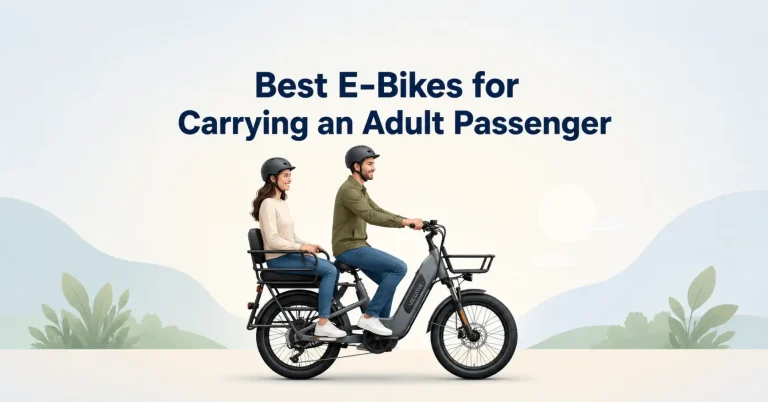
- A cargo rider carrying groceries or passengers may prefer 750W.
Thinking about terrain, distance, and cargo weight often leads to better decisions than simply choosing the highest wattage available.
If you're shopping for affordable commuter-friendly models, you may also want to explore:
Why This Matters
Choosing the right motor power isn’t about chasing the biggest number. Instead, the goal is finding the motor that provides enough assistance for your riding conditions while maintaining efficiency and range.
Understanding these common mistakes can help you select an e-bike that feels powerful, comfortable, and efficient for everyday riding.
Motor Power and Legal Limits
In the United States, most states regulate electric bikes using the three-class e-bike system. This system helps define how fast an e-bike can go and what type of motor assistance it uses.
Under this framework, electric bikes are generally limited to motors of 750 watts or less, which keeps them classified as bicycles rather than motor vehicles.
| E-Bike Class | Max Assisted Speed | Motor Power Limit |
|---|---|---|
| Class 1 | 20 mph | Up to 750W |
| Class 2 | 20 mph (with throttle) | Up to 750W |
| Class 3 | 28 mph | Up to 750W |
What the classes mean
Class 1 e-bikes
Pedal-assist only. The motor activates when you pedal and stops assisting at 20 mph.
Class 2 e-bikes
Include a throttle, allowing the bike to move without pedaling, but assistance still stops at 20 mph.
Class 3 e-bikes
Designed for commuting and faster riding, these provide pedal assistance up to 28 mph, but typically do not include throttles.
This classification system was developed with the help of PeopleForBikes, a national cycling advocacy organization that helped establish standardized e-bike regulations across many U.S. states.
Even though the three-class system is widely adopted, specific rules can still vary by state and city, especially regarding:
- where e-bikes are allowed to ride
- helmet requirements
- age restrictions for Class 3 bikes
For a detailed breakdown of local regulations, see:
➡ State-by-State E-Bike Laws Guide
Understanding legal limits is important because higher-powered electric bikes (1000W or more) may be classified as mopeds or motor vehicles in some areas.
How Motor Power Affects Battery Range
Motor wattage influences how much energy the bike uses while riding. In general, more powerful motors can consume more battery energy, especially when riding at higher assist levels or climbing hills.
| Motor Power | Typical Efficiency |
|---|---|
| 250W | Most energy efficient |
| 500W | Balanced performance and range |
| 750W | Higher power use, slightly reduced range |
However, real-world e-bike range depends on several factors beyond motor wattage.
Factors that affect e-bike battery range
Terrain
Climbing hills requires significantly more power than riding on flat ground.
Rider weight
Heavier riders require more motor assistance.
Assist level
Higher pedal-assist levels use more battery energy.
Wind resistance
Strong headwinds increase energy consumption.
Tire pressure and rolling resistance
Underinflated tires can reduce efficiency.
Because so many variables influence range, manufacturer estimates often assume ideal riding conditions.
To understand realistic riding distance, try using the:
For a technical overview of how electric vehicle efficiency works, the U.S. Department of Energy provides additional information on energy consumption and electric drivetrain efficiency:
Safety Note: Battery Certification Matters
Motor power gets a lot of attention when comparing electric bikes, but battery safety is actually one of the most important things to check before buying an e-bike.
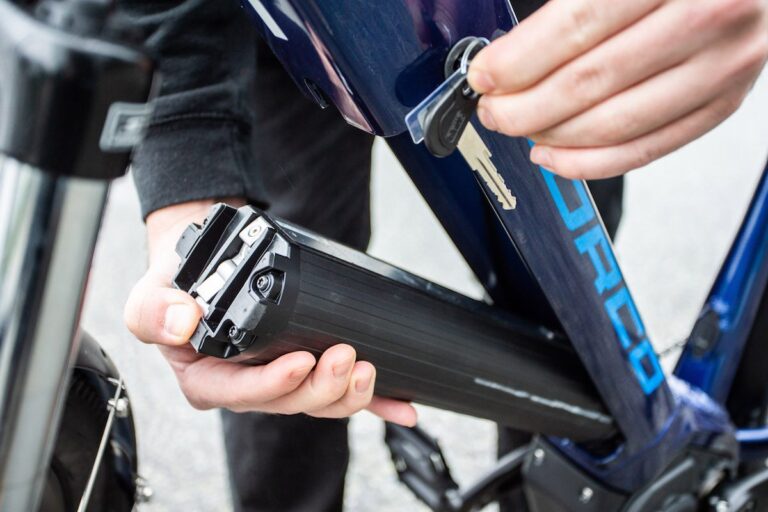
Most modern electric bikes use lithium-ion batteries, which provide excellent power and range but must be designed and tested properly to prevent overheating, electrical faults, or fire risks.
Two important safety standards to look for are:
UL 2849
This certification evaluates the entire e-bike electrical system, including the motor, battery, controller, and wiring.
UL 2271
This standard focuses specifically on lithium-ion battery pack safety, including testing for overheating, overcharging, vibration, and electrical faults.
These certifications are issued by UL Solutions, an independent global safety science company that tests products for electrical and fire safety.
Choosing an e-bike with certified components helps reduce the risk of battery failure or electrical system issues, which is why many cities and fire departments now recommend or require UL-certified e-bikes.
For example, several U.S. cities have introduced safety guidance encouraging riders to purchase UL-certified e-bikes and chargers due to concerns about low-quality battery packs.
If you want to understand how batteries affect performance, lifespan, and range, see:
➡ E-Bike Battery Guide: How They Work, Lifespan, and Charging Tips
This guide explains how battery capacity, charging habits, and storage conditions affect both safety and long-term battery performance.
Motor Lifespan and Reliability
Electric bike motors typically last 10,000–20,000 miles or more.
Motor longevity depends on:
- riding conditions
- maintenance
- heat management
Higher wattage motors do not necessarily wear out faster if they are well designed.
FAQs
Yes, especially for flat commuting.
For most hills, yes.
No, assist levels keep power manageable.
Throttle systems often benefit from 500W or 750W motors.
Generally yes.
Final Thoughts
Choosing the right e-bike motor power is about matching the motor to your riding conditions.
Most riders fall into these categories:
- 250W for flat riding
- 500W for commuting
- 750W for hills or cargo
If you're comparing bikes, these guides can help:
➡ E-Bike Buying Guide
➡ Best Budget Electric Bikes
➡ Best Commuter E-Bikes
Bookmark this guide if you're researching electric bike motor wattage.
External Sources
U.S. Consumer Product Safety Commission
PeopleForBikes
U.S. Department of Energy
UL Solutions

Kristina is not just an enthusiast but a true authority on electric bikes. Nestled in the coastal beauty of Virginia, Kristina has found the perfect backdrop for her passion for electric biking. As a dedicated wife and homeschooling mom, her life revolves around family, faith, and the thrill of adventure.
Originally hailing from Ohio, Kristina's journey with electric bikes began as a curiosity and quickly evolved into a deep expertise. Her blog is a testament to her love for electric biking, combining her fascination for eco-friendly transportation with her coastal lifestyle.
When she's not cruising the beach on her electric bike, you'll find Kristina indulging in her other loves: long walks along the shore, getting lost in a good book, and cherishing moments with her loved ones. With a heart as big as her love for animals, especially cats, Kristina brings a unique perspective to the electric bike world, grounded in her strong faith in God and her dedication to a sustainable lifestyle.
Through her blog, Kristina shares her extensive knowledge of electric bikes, offering valuable insights, tips, and recommendations to fellow enthusiasts. Whether you're a seasoned rider or a newcomer to the electric bike scene, Kristina's blog is your go-to source for all things electric biking, fueled by her passion, expertise, and the scenic beauty of coastal Virginia.