Why Bigger Motors Don’t Always Mean Better E-Bikes
Last Updated on June 1, 2026 by Kristina
(And What Actually Matters More When Choosing an E-Bike)
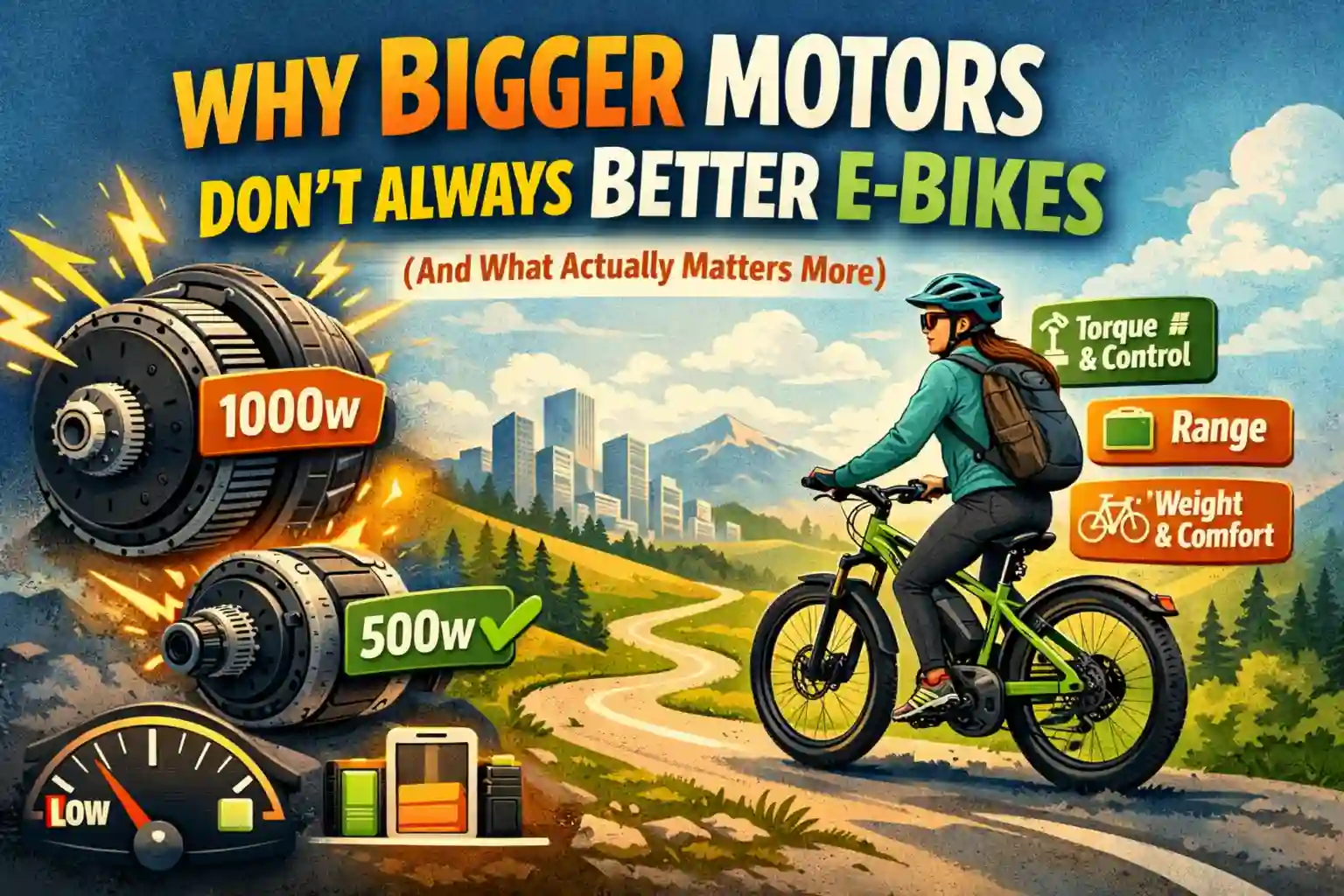
It is easy to assume that a bigger motor automatically means a better e-bike. Many listings highlight 750W, 1000W, or even 1500W motors as if wattage alone defines performance. But in real-world riding, power on paper does not always translate to a smoother, more comfortable, or more practical experience.
If you are just getting started, your best first stop is our E-Bike Buying Guide, which walks through the basics of choosing the right bike for your riding style, budget, and terrain. We also recommend understanding torque vs wattage when choosing an e-bike, since this single comparison often explains why some lower-wattage bikes outperform more powerful-looking models in everyday use.
In this guide, we will break down how motor power actually works, when bigger motors truly make sense, the hidden downsides of oversized systems, and what factors most riders should prioritize instead.
📌 Quick Answer for Most Riders
A well-matched motor, torque rating, battery size, and pedal assist system usually delivers a better ride than simply choosing the biggest wattage you can afford.
What Motor Wattage Really Means
Motor wattage measures how much electrical power the motor can draw and convert into mechanical output. Most e-bikes fall into three general ranges:
- 250W to 500W – Common on commuter, city, and lightweight bikes. Efficient, quiet, and well-suited for flat to moderate terrain.
- 750W – Popular in the US for Class 2 and Class 3 e-bikes. Strong enough for hills, heavier riders, and mixed terrain.
- 1000W and above – Typically found on off-road, hunting, and high-performance models.
What wattage does not tell you is how the power is delivered. Two bikes with the same wattage can feel completely different depending on torque output, controller tuning, and how the pedal assist system responds to your input.
Bigger Motor vs Smarter Power Delivery
One of the biggest misconceptions is that higher wattage automatically means better hill climbing and acceleration. In practice, torque and power delivery style often matter more.
Torque, measured in Newton-meters (Nm), reflects how strongly the motor can turn the wheel or drivetrain under load. This is especially important when starting from a stop, climbing hills, or riding with cargo.
When Bigger Motors Actually Make Sense
There are definitely situations where a higher-powered motor is the right tool for the job:
- Steep, sustained hill climbing in mountainous areas
- Heavier riders or frequent cargo loads such as child seats, panniers, or trailers
- Loose terrain like sand, snow, or mud
- Throttle-heavy riding styles
In these cases, a 750W or higher motor paired with strong torque and good braking can make riding safer and more enjoyable. The key is choosing power that matches your real riding conditions, not just the biggest number on the spec sheet.
Downsides of Oversized Motors
For many everyday riders, bigger motors come with trade-offs that are easy to overlook.
Reduced Range
More powerful motors tend to draw more energy, especially when used at high assist levels or with heavy throttle use. This can significantly shorten your real-world riding range.
Heavier Bikes
High-powered systems usually require larger batteries and reinforced frames. That added weight can make the bike harder to carry, store, or pedal without assistance.
Rougher Power Feel
Some high-wattage hub motors rely on cadence-based assist systems that deliver power in fixed bursts rather than smoothly. This can feel jumpy compared to torque-sensor setups.
Legal and Trail Access Issues
Motors above certain wattage or speed limits can push a bike outside Class 1–3 categories, limiting where you can legally ride in many cities and on multi-use trails.
Spec Sheet Traps to Watch For
Not all motor specs are presented equally. Here are common marketing tricks that can make a motor look better than it really is.
Peak vs Continuous Wattage
Some brands advertise “1000W peak” when the motor is actually rated for 750W continuous. Peak power is a short burst, not what the motor can sustain on long rides or steep climbs.
What to look for: Always check continuous wattage, not just the headline number.
Torque Without a Number
If a listing claims “high torque” but does not list a Nm rating, treat that as a red flag. Torque is measurable and should be disclosed.
Battery Size in Volts Only
A “48V battery” sounds impressive, but voltage alone does not tell you how far you can ride. Look for watt-hours (Wh) to estimate real-world range.
How Controllers Shape the Ride
The motor is only half the system. The controller decides how power is delivered to the wheel.
Why This Matters
Two bikes with the same motor can feel completely different depending on how the controller ramps power, limits current, and responds to pedal input.
Better-tuned controllers tend to provide:
- Smoother acceleration from a stop
- Less wheel spin on hills or wet pavement
- More predictable throttle response
- Improved battery efficiency
If a bike feels overly aggressive or jerky, the controller is often the reason – not the motor itself.
Mid-Drive vs Hub Motors
This is one of the biggest reasons smaller motors can outperform bigger ones in real-world riding.
If you are deciding between motor layouts, our guide on hub drive vs mid drive e-bikes walks through the real-world pros, cons, maintenance differences, and riding feel of each system.
Mid-Drive Motors
Mid-drives send power through the chain and gears, allowing the motor to take advantage of your drivetrain’s mechanical advantage.
Why this matters: On steep hills, a 500W mid-drive can sometimes outperform a 750W or even 1000W hub motor because it can shift into lower gears and stay in an efficient power range.
Hub Motors
Hub motors drive the wheel directly. They are simple, quiet, and reliable but do not benefit from your bike’s gears.
Trade-off: They often need more raw wattage to match the hill-climbing performance of a mid-drive system.
Real-World Range Math (Simple Example)
Here is a quick way to estimate how motor size and riding style affect battery life.
Let’s say you have:
- A 720Wh battery
- You ride at an average of 18Wh per mile
720Wh ÷ 18Wh per mile = about 40 miles of range
Now increase assist level or use a bigger motor more aggressively:
- Average draw becomes 28Wh per mile
720Wh ÷ 28Wh per mile = about 25 miles of range
Same battery. Very different experience.
If you want a deeper breakdown, our guide on understanding e-bike battery capacity walks through range calculations in more detail.
Maintenance and Wear Considerations
More power can also mean more long-term wear.
Drivetrain Wear
High-torque systems, especially mid-drives, can wear chains and cassettes faster if riders do not shift properly under load.
Tires and Brakes
Heavier, faster bikes often go through brake pads and tires more quickly.
Practical tip: If you choose a high-powered e-bike, budget for slightly higher maintenance over time.
Decision Shortcut: Motor Size by Rider Profile
Best choice for most commuters:
500W to 750W with a torque sensor and 500Wh+ battery
Best for hills and cargo:
750W+ with 80Nm or more of torque and strong hydraulic brakes
Best for lightweight and long range:
250W to 500W with an efficient mid-drive or torque-sensor hub system
Best for off-road and adventure:
750W to 1000W+ with suspension, fat tires, and reinforced frames
Questions to Ask Before You Buy
- What is the continuous motor wattage, not just peak?
- How much torque (Nm) does it produce?
- Is the pedal assist torque-based or cadence-based?
- What is the battery capacity in Wh?
- What e-bike class does this model fall under in my state or city?
- How much does the bike weigh, and can I lift or store it comfortably?
If you want to compare multiple bikes side-by-side using these exact criteria, our Electric Bike Buying Guide includes simple charts and real-world examples that make this process much faster.
Real-World Example Comparison
Imagine two commuter riders:
- Rider A chooses a 1000W hub motor bike with a cadence sensor and mid-size battery. It accelerates quickly but feels jumpy and only delivers about 25 miles of range at higher assist.
- Rider B chooses a 500W high-torque system with a torque sensor and efficient battery. It climbs hills smoothly and consistently delivers 40+ miles of usable range.
On paper, Rider A has more power. In daily use, Rider B often has the better overall experience.
How to Choose the Right Motor for Your Riding Style
Start with your real-world use case, not the spec sheet:
- Commuting and city riding – Look for 250W to 750W with a torque sensor and efficient battery.
- Hills and mixed terrain – Prioritize torque rating and drivetrain quality over pure wattage.
- Cargo and heavy loads – Choose 750W+ with strong frames and hydraulic brakes.
- Off-road and adventure – Bigger motors help, but traction, suspension, and tires matter just as much.
Final Thoughts
A bigger motor can be a powerful tool, but it is not automatically a better one. Most riders get the best experience from a balanced system where motor power, torque, battery capacity, and pedal assist are matched to how and where they actually ride.
If you focus on real-world performance instead of headline numbers, you will usually end up with a bike that feels smoother, rides farther, and fits your daily life better.
Not sure where to go next?
Some riders are brand new. Others are fixing a problem or thinking about a new bike. Choose what fits you.
Learn & Get Comfortable
Understand how e-bikes work and what to expect when riding.
Improve Your Current Ride
If your bike isn’t performing how you want, learn what affects speed, range, and power.
Compare Better Bikes
Looking for something that fits your riding style? Start here.
- Best Electric Bikes for Beginners
- Recommended Commuter Ebikes
- Most Comfortable City E-Bikes
- Best Fat Tire Ebikes
- Top Folding Ebikes
- Best Step Through Ebikes
- Top Cargo Electric Bikes
- Best Lightweight Ebikes
- Best Long Range Ebikes
- Top Moped Style E-Bikes
- E-bike Reviews
🛒 Ready to Buy?
Top picks and current availability from trusted brands.
👉 Still deciding?
Take our E-Bike Recommendation Quiz to get matched with the right riding style in under two minute
Sources & Further Reading
This guide is based on a combination of manufacturer technical documentation, industry explainers, and independent e-bike education resources:
- Evelo – Mid-Drive vs Hub Motors: Real-world performance and drivetrain efficiency comparisons
- Ebikes.ca (Grin Technologies) – Battery capacity, watt-hours, and range fundamentals
- Optibike – Electric bike motor basics, torque vs power explanations
- Electric Bike Review Forum – Technical discussions on watts, torque, and controller behavior
- Hovsco – How assist systems and power delivery affect range and ride feel
- SYI Motor – Hub motor wattage and torque characteristics
Note: Real-world performance varies based on rider weight, terrain, tire choice, assist level, and maintenance. Always check local e-bike class laws and manufacturer specifications before purchasing.

Kristina is not just an enthusiast but a true authority on electric bikes. Nestled in the coastal beauty of Virginia, Kristina has found the perfect backdrop for her passion for electric biking. As a dedicated wife and homeschooling mom, her life revolves around family, faith, and the thrill of adventure.
Originally hailing from Ohio, Kristina's journey with electric bikes began as a curiosity and quickly evolved into a deep expertise. Her blog is a testament to her love for electric biking, combining her fascination for eco-friendly transportation with her coastal lifestyle.
When she's not cruising the beach on her electric bike, you'll find Kristina indulging in her other loves: long walks along the shore, getting lost in a good book, and cherishing moments with her loved ones. With a heart as big as her love for animals, especially cats, Kristina brings a unique perspective to the electric bike world, grounded in her strong faith in God and her dedication to a sustainable lifestyle.
Through her blog, Kristina shares her extensive knowledge of electric bikes, offering valuable insights, tips, and recommendations to fellow enthusiasts. Whether you're a seasoned rider or a newcomer to the electric bike scene, Kristina's blog is your go-to source for all things electric biking, fueled by her passion, expertise, and the scenic beauty of coastal Virginia.