Hawaii Governor Signs Stricter E-Bike Law
Last Updated on July 17, 2026 by Hunter
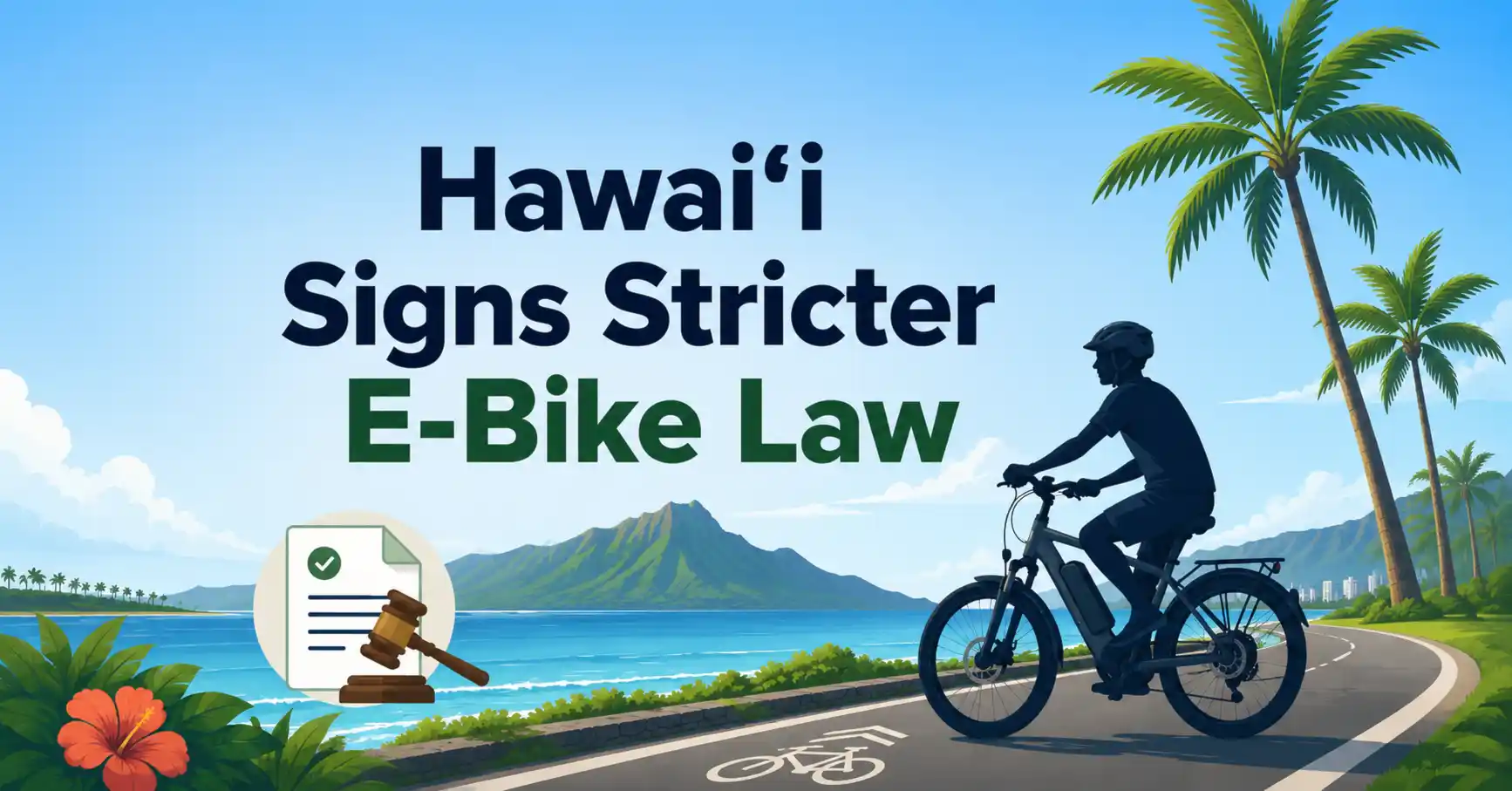
HONOLULU, Hawaii — July 15, 2026 – Hawaii Governor Josh Green has signed House Bill 2021 into law as Act 259, creating updated statewide regulations for electric bicycles, electric scooters, electric micro-mobility devices, mopeds, electric motorcycles, and high-powered electric devices.
The legislation is intended to close gaps in Hawaiʻi’s previous laws as electric bikes and other battery-powered transportation devices become more common. State officials said the growth of these devices created confusion over how they should be classified, where they could legally operate, and which safety rules applied to riders.
Governor Green said e-bikes can help residents save money, reduce emissions, and stay connected to their communities. He said the new legislation is designed to ensure Hawaiʻi’s roadway laws keep pace with changing transportation technology while encouraging the safe and responsible use of electric bikes.
E-bike rules can vary widely from one state to another.
E-bike rules can vary widely by state. Check our State E-Bike Law Guides to learn about classifications, speed limits, helmet requirements, sidewalk rules, trail access, and more.
What Does Hawaii Act 259 Change?
Act 259 makes several major changes to Hawaiʻi’s electric bike laws. It creates a three-class e-bike system, establishes rules for high-powered electric devices, expands helmet requirements, allows limited sidewalk riding, strengthens registration enforcement, and creates labeling and disclosure requirements for manufacturers and sellers.
The law also sets separate rules for electric scooters, electric skateboards, one-wheel devices, mopeds, and electric motorcycles.
Hawaii’s New Electric Bike Classification System
To qualify as an electric bicycle under Hawaiʻi law, a bike must have fully operable pedals and an electric motor rated at no more than 750 watts.
The law divides legal electric bikes into three classes:
| E-Bike Class | Motor Operation | Maximum Assisted Speed |
|---|---|---|
| Class 1 | Motor assists only while the rider is pedaling | 20 mph |
| Class 2 | Motor may propel the bike without pedaling, including through a throttle | 20 mph |
| Class 3 | Motor assists only while the rider is pedaling, and the bike must have a speedometer | 28 mph |
Motor assistance must stop once the bike reaches the maximum assisted speed for its class.
This means that a bike cannot legally qualify as a Class 1, Class 2, or Class 3 e-bike simply because it has pedals. Its motor wattage, assisted speed, throttle operation, and equipment must also fit the appropriate legal definition.
New Rules for High-Speed Electric Devices
Act 259 creates a separate category called a high-speed electric device.
Under the law, a high-speed electric device is a device that:
- Has a motor exceeding 750 watts; and
- Is capable of traveling faster than 28 mph.
A registered moped, motorcycle, or other motor vehicle that is legally authorized for public-road use is not automatically treated as a high-speed electric device under this definition.
High-speed electric devices may not be operated on public roadways, streets, highways, sidewalks, bicycle lanes, bicycle facilities, travel paths, or other public areas.
Violating this restriction is considered a traffic infraction. When the rider is under 18, enforcement may be directed toward the rider’s parent or legal guardian or handled through non-monetary corrective action.
It is also important to understand that a device does not automatically become a legal e-bike just because it falls outside this specific high-speed-device definition. For example, a bike with a motor over 750 watts cannot qualify as a legal Class 1, Class 2, or Class 3 electric bicycle even if its speed is limited to less than 28 mph.
Electric Bikes Must Be Registered
Electric bicycles in Hawaii must be properly registered.
Act 259 keeps the state’s permanent e-bike registration requirement and sets the registration fee at $30. A person may not operate an unregistered electric bicycle on a public roadway, sidewalk, or bicycle facility.
Failing to register an e-bike may result in a citation or temporary impoundment. The law also allows authorities to seize electric bikes and high-speed devices that are non-road-legal or do not comply with classification, labeling, equipment, or operating requirements.
Riders should keep proof of registration and make sure the required registration tag or decal is properly displayed.
Riders Under 18 Must Wear Helmets
The law raises Hawaii’s bicycle helmet requirement from riders under 16 to riders under 18.
Anyone under 18 operating a bicycle or electric bicycle on a street, bikeway, or other public property must wear a properly fitted and fastened bicycle helmet.
The helmet requirement also applies to passengers under 18 riding in an attached bicycle seat or in a trailer being pulled by a bicycle. Bicycle rental businesses may not rent a bike unless riders and passengers under 18 comply with the helmet requirement.
The under-18 helmet rule also applies to electric foot scooters and electric micro-mobility devices.
Restrictions for E-Bike Riders Under 16
A rider under 16 may not operate a Class 2 or Class 3 electric bicycle unless the rider is under direct adult supervision.
Direct supervision means that a parent, guardian, or supervising person who is at least 18 is physically present and close enough to observe and control the young rider’s operation of the e-bike.
The law does not apply this particular supervision requirement to Class 1 electric bicycles. However, riders under 18 must still comply with the helmet requirement.
E-Bikes May Be Used on Some Sidewalks
Act 259 allows Class 1, Class 2, and Class 3 electric bicycles to be operated on sidewalks at speeds of no more than 10 mph.
However, sidewalk riding is not allowed:
- In business districts;
- Where prohibited by county ordinance; or
- In locations where a county has established additional restrictions.
Counties may create additional reasonable limits for e-bike use on sidewalks. They may also post bicycle lanes and bicycle paths to prohibit motor-assisted bicycles from using them.
Riders should therefore check both statewide law and the rules adopted by the county where they plan to ride.
Wheelies, Stunts, and Reckless Riding Are Prohibited
Act 259 establishes specific safe-riding requirements for electric bicycles.
E-bike riders must normally:
- Keep all wheels on the ground;
- Face forward;
- Remain normally seated; and
- Operate the bike without endangering passengers, pedestrians, or other road users.
Wheelies, stunts, exhibition riding, standing or kneeling on the seat, riding on the handlebars, and other unsafe or reckless maneuvers are prohibited on public streets, alleys, and public rights-of-way.
An exception may apply to permitted parades, tournaments, or similar organized events. Riders are also not considered in violation when a wheel briefly leaves the ground because of road conditions or circumstances outside their control.
New Labels and Retailer Disclosures
Manufacturers and distributors will be required to permanently label electric bicycles sold in Hawaiʻi.
The label must show:
- The e-bike’s class number;
- Its maximum assisted speed; and
- Its motor wattage.
The required label cannot be removed, altered, or defaced.
Retail stores must also display a notice explaining that electric bike sales and operation are regulated under Hawaiʻi law. Buyers must receive information about the applicable state e-bike laws.
Online sellers and third-party marketplaces delivering e-bikes to Hawaiʻi must disclose in writing whether the bike is legal for use on public roads, sidewalks, or bike lanes. The disclosure must include applicable registration, equipment, helmet, and age requirements.
The Hawaiʻi Department of Transportation may impose administrative fines of up to $500 per violation against manufacturers, distributors, or sellers that fail to comply.
These labeling and seller-disclosure requirements take effect 120 days after the law’s effective date unless the state adopts implementing rules earlier. Most of the law’s other provisions took effect upon approval.
Electric Scooters and Micro-Mobility Devices
Act 259 also creates a definition for electric micro-mobility devices. These are fully or partially motorized personal transportation devices weighing no more than 75 pounds, including devices such as electric skateboards and one-wheel devices.
Electric bicycles and electric foot scooters are treated separately and are not included in this definition.
Under the updated rules:
- Riders must be at least 15 to operate an electric foot scooter or micro-mobility device on public property.
- Riders under 18 must wear a properly fastened helmet.
- The maximum operating speed is 15 mph.
- Carrying passengers is prohibited.
- Riders may not carry anything that prevents them from keeping both hands available to control the device.
- Lights are required when riding from 30 minutes after sunset until 30 minutes before sunrise.
- Counties may adopt additional operating, parking, insurance, and safety requirements.
Electric scooters and micro-mobility devices must also be stored or docked only in locations authorized by the counties.
Mopeds and Electric Motorcycles Are Banned From Bike Lanes and Paths
The law prohibits mopeds and electric motorcycles from operating on bicycle paths, bicycle lanes, and other paths or roadways designated for bicycle use.
For this section, an electric motorcycle is defined as a two- or three-wheeled electric vehicle capable of exceeding 28 mph that can legally be operated on public roads under the licensing, registration, and insurance requirements that apply to motorcycles.
This change also repeals Hawaiʻi’s previous rule requiring moped riders to use bicycle lanes where available.
Insurance Is Not Required for Legal E-Bikes
Act 259 specifically states that insurance is not required to operate a road-legal, properly classified, and permitted electric bicycle.
However, this insurance exemption does not apply to vehicles classified and registered as mopeds, motorcycles, or other motor vehicles. Those vehicles may remain subject to separate licensing, registration, equipment, and insurance laws.
What This Means for Hawaiʻi E-Bike Riders
For most owners of standard commuter, cruiser, cargo, and recreational e-bikes, the most important step is checking whether the bike fits one of Hawaiʻi’s three legal classes.
A legal e-bike must have:
- Fully operable pedals;
- A motor rated at no more than 750 watts;
- Motor assistance that stops at the speed established for its class;
- The required speedometer if it is a Class 3 bike; and
- Proper state registration.
Riders should not rely on the bike’s appearance, tire size, product name, or presence of pedals when deciding whether it is road legal.
Some moped-style bikes are sold online as “e-bikes” even though their motor power or maximum speed does not comply with Hawaiʻi’s electric bicycle definitions. Product descriptions may also advertise one speed while the bike can be unlocked or modified to travel significantly faster.
Owners of higher-powered fat-tire bikes, e-moto-style vehicles, and modified e-bikes should carefully check the motor’s rated wattage, assisted speed, throttle operation, registration category, and required equipment before riding in public.
⚠️ What You Need to Ride Legally
Depending on your e-bike class, certain safety equipment – like lights, helmets, and reflectors – may be required, especially for higher-speed bikes or road use.
Why Hawaiʻi Passed the New E-Bike Law
Hawaiʻi officials said rapid growth in e-bikes and other micro-mobility devices had exposed gaps in the state’s safety laws and created uncertainty about where different devices could legally operate.
The governor’s office connected the legislation to broader state efforts to protect vulnerable road users and respond to serious traffic safety concerns. Supporters said the law should help families continue using legal e-bikes for affordable transportation while giving law enforcement clearer authority to address illegal devices and dangerous riding.
Representative Darius Kila, who introduced HB 2021, described the law’s passage as an important safety milestone. The Hawaiʻi Bicycling League also supported the updated framework and said it plans to help educate riders, government officials, and enforcement agencies about the new rules.
Want to See More Electric Bike Explorer in Google Search?
Add Electric Bike Explorer as a preferred source to see more of our e-bike law guides, safety updates, reviews, buying guides, and troubleshooting posts when they are relevant to your searches.
My Take
I think Hawaiʻi’s new e-bike law is another sign of where electric bike regulation is heading across the country.
Electric bikes have changed dramatically over the past several years. A standard pedal-assist commuter bike and a motorcycle-style electric vehicle capable of very high speeds may both be sold with pedals, but they are not the same type of machine.
Many existing state laws were written before powerful e-moto-style vehicles became widely available online. That has made it difficult for buyers to know what is legal and for police officers to distinguish ordinary e-bike riders from people operating unregistered electric motorcycles.
Creating clear Class 1, Class 2, and Class 3 definitions makes sense. It also makes sense to require sellers to tell buyers whether a bike can legally be used on public roads and bike lanes. Too many people may purchase a high-powered bike online without realizing that adding pedals does not automatically make it a street-legal electric bicycle.
I also think Hawaiʻi’s 10 mph sidewalk limit is a reasonable compromise. It allows e-bike riders to use sidewalks outside business districts when local rules permit it, but it recognizes that pedestrians should not have to share narrow sidewalks with electric bikes moving at road speeds.
At the same time, enforcement will matter. The law should focus on genuinely dangerous behavior, illegal high-speed devices, reckless riding, and sellers that misrepresent their products. Responsible riders using legal and properly registered e-bikes for transportation should not be treated like people riding unregistered electric motorcycles.
E-bikes provide a lower-cost transportation option for people who cannot afford or do not want to rely on a car. Regulations should improve safety without creating unnecessary barriers for commuters, older adults, workers, students, and families using legal electric bikes.
Overall, Hawaiʻi’s new law creates one of the more detailed electric mobility frameworks in the country. Other states facing similar problems with high-powered e-bikes and e-motos may look closely at how Hawaiʻi handles rider education, retailer compliance, registration, and real-world enforcement.
For more Electric Bike News news click here
External Sources
Hawaiʻi Governor’s official announcement:
https://governor.hawaii.gov/newsroom/office-of-the-governor-news-release-gov-green-signs-legislation-to-modernize-our-transportation-system/
Official Hawaiʻi Legislature HB 2021 bill page:
https://www.capitol.hawaii.gov/session/measure_indiv.aspx?billnumber=2021&billtype=HB&year=2026
Final HB 2021 bill text through LegiScan:
https://legiscan.com/HI/text/HB2021/id/3427333
HB 2021 status and legislative history through LegiScan:
https://legiscan.com/HI/bill/HB2021/2026
This article is intended as a general news summary and is not legal advice. Riders should check current state and county rules before operating an electric bike or other electric mobility device.

Hunter is a contributor to Electric Bike Explorer with a growing interest in electric bikes, transportation, and emerging e-bike news. He enjoys learning about how electric bikes work, following new models and technology, and helping readers stay informed about developments that may affect riders.
Outside of electric bikes, Hunter has a strong interest in cars and enjoys spending time playing video games. His curiosity about vehicles and technology helps him bring an enthusiastic and practical perspective to the topics he covers.