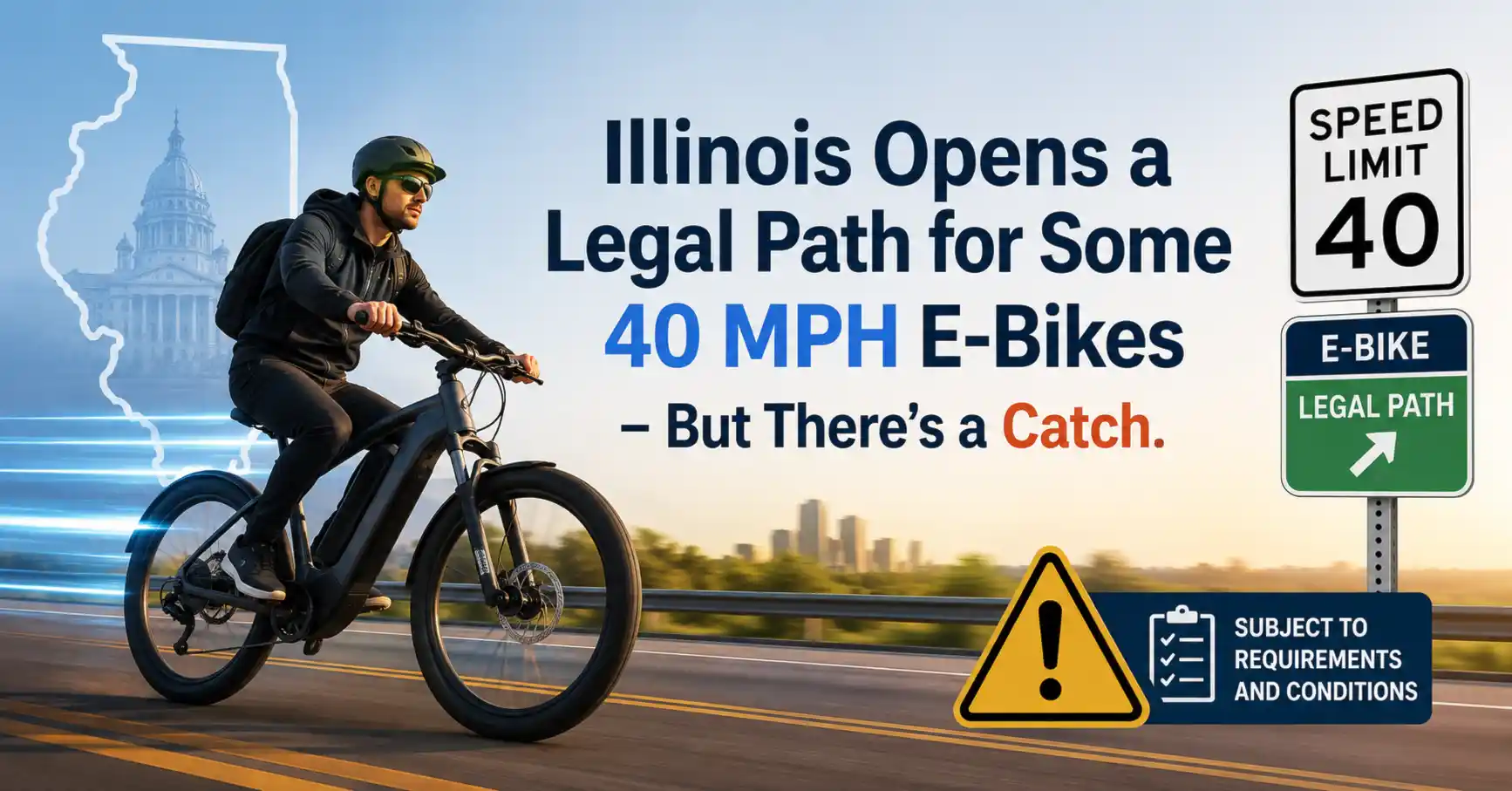
Illinois Opens a Legal Path for Some 40 MPH E-Bikes – But There’s a Catch
SPRINGFIELD, Illinois – August 31, 2026: Illinois has signed a sweeping new micromobility law that creates a legal path for some high-powered electric bikes capable of speeds around 35 or 40 mph to operate on public roads. But there is a major catch: these machines will not be treated as ordinary e-bikes.
Beginning January 1, 2027, electric bicycles that fall outside Illinois’ Class 1, Class 2, and Class 3 low-speed e-bike definition will be considered motor-driven cycles under the Illinois Vehicle Code. That is a major change from the framework explained in my Illinois e-bike laws guide. Legal road use can require a driver’s license, title, registration, insurance, and a vehicle that was actually manufactured and equipped for highway use.
You can also compare Illinois with the rest of the country in my state-by-state e-bike law guide.
For continuing coverage of changing laws, enforcement, recalls, and other developments, see the latest Electric Bike News reports.
Current Status: Signed, but Not Effective Yet
Governor JB Pritzker signed the legislation on August 26, 2026. The measure, originally Senate Bill 3484 and now Public Act 104-0854, takes effect on January 1, 2027.
That date is important. As of August 31, 2026, the new provisions have been signed into law but have not yet taken effect.
The Illinois Secretary of State describes the legislation as a new statewide framework addressing high-speed electric bicycles, e-motos, scooters, and other electric micromobility devices.
Does Illinois Really Make 40 MPH E-Bikes Street Legal?
Potentially, yes – but not as ordinary e-bikes.
That distinction is the key to understanding the new law.
Illinois’ low-speed electric bicycle system continues to cover bikes with fully operable pedals, motors rated at less than 750 watts, and operating characteristics that fit one of the state’s three e-bike classes:
- Class 1: Pedal assist that stops providing assistance at 20 mph.
- Class 2: A motor that can propel the bike without pedaling but stops providing assistance at 20 mph.
- Class 3: Pedal assist that stops providing assistance at 28 mph.
The new law says an electric bicycle that does not qualify as a low-speed electric bicycle shall be considered a motor-driven cycle.
The revised motor-driven-cycle definition also expressly covers electric motors with a nominal power rating of more than 750 watts but no more than 8,000 watts.
This means a bike can fall outside Illinois’ ordinary e-bike system because of its motor rating, its assisted speed, or another failure to meet the low-speed electric bicycle definition. A machine does not necessarily have to be both over 750 watts and faster than 28 mph before the distinction matters.
The practical result is that some electric two-wheelers marketed with speeds of 35 mph, 40 mph, or more may have a legal route to public-road operation.
But Illinois has not created a new “40 mph e-bike” class, and 40 mph is not a new statewide e-bike speed limit. Once a machine falls into the motor-driven-cycle category, it is regulated as a motor vehicle rather than as a normal Class 1, Class 2, or Class 3 electric bicycle.
The Big Catch: The Vehicle Has to Qualify for Road Use
A high-powered electric bike does not automatically become street legal just because it can reach 40 mph.
For a motor-driven cycle to be operated legally on Illinois public highways, the law imposes requirements that go well beyond pedals, lights, or a powerful motor.
Depending on the vehicle and how it is used, those requirements include:
- A valid driver’s license for the operator.
- A certificate of title.
- Vehicle registration for public-highway operation.
- Required liability insurance.
- A vehicle identification number, or VIN.
- A speedometer displaying speed in miles per hour.
- Compliance with applicable federal vehicle safety standards.
- Compliance with applicable Illinois vehicle-equipment requirements.
The law also says a motor-driven cycle that was not properly manufactured or equipped for general highway use is not eligible for registration.
That requirement could be the biggest obstacle for owners of many high-powered electric bikes currently sold online.
You Probably Can’t Just Add Mirrors to Any 40 MPH E-Bike
There are many powerful electric bikes on the market with large motors, motorcycle-style frames, throttles, and advertised speeds well above 28 mph.
Some owners may assume the new Illinois law means they can add mirrors, lights, turn signals, or a license-plate bracket and register the bike in 2027.
The statute does not support making that assumption.
For road registration, the vehicle must satisfy Illinois’ requirements for general highway use. The law specifically addresses a VIN, required equipment, a speedometer, and compliance with applicable federal vehicle safety standards.
Whether a particular 35 or 40 mph model can actually be titled and registered may therefore depend heavily on how the manufacturer designed, documented, and certified that specific vehicle.
A product manufactured only as an electric bicycle or off-road vehicle may not qualify for registration simply because its motor power or top speed places it within the new motor-driven-cycle framework.
What About High-Speed E-Bikes Bought Before 2027?
The law includes an important provision for electric-powered motor-driven cycles purchased before January 1, 2027.
A qualifying electric-powered motor-driven cycle purchased before that date is not automatically required to be titled merely because it is owned.
However, if the owner wants to operate that vehicle on a public highway, the law requires it to be titled and registered.
For owners of existing high-powered models that lack a VIN or the documentation necessary to satisfy Illinois’ registration requirements, that could create a practical obstacle.
The law establishes the road-use requirements, but whether a specific pre-2027 model can actually meet them may depend on the vehicle, its equipment, and the documentation available from the manufacturer.
Where Can a Registered High-Speed Electric Bike Be Ridden?
If a high-powered electric bicycle qualifies as a motor-driven cycle and satisfies the legal requirements for public-road operation, it can use public highways, streets, and roadways where that type of motor vehicle is permitted.
But it does not receive the access privileges of an ordinary bicycle or qualifying low-speed e-bike.
Motor-driven cycles are prohibited from bicycle-specific and pedestrian facilities including:
- Sidewalks.
- Bicycle lanes.
- Bicycle paths.
- Shared-use paths.
- Off-road bicycle trails.
- Natural-surface trails designated for bicycle use.
- Other bicycle-specific facilities.
- Interstate highways.
- Public land where the responsible government agency expressly prohibits them.
So the tradeoff is important: a qualifying high-speed electric two-wheeler may gain a legal path onto ordinary roads, but it does not become a faster version of a Class 3 e-bike with access to bike infrastructure.
Illinois Is Also Changing the Rules for Regular E-Bikes
The high-speed provision is attracting attention, but Public Act 104-0854 also makes important changes for riders of ordinary Class 1, Class 2, and Class 3 e-bikes.
Beginning January 1, 2027, Illinois law will prohibit low-speed electric bicycles from being operated on sidewalks.
That is a significant statewide change. My e-bike sidewalk laws guide explains why sidewalk access is often one of the most confusing parts of e-bike regulation.
The new Illinois law also establishes minimum rider ages:
- Class 1 and Class 2: The operator must be at least 15 years old.
- Class 3: The operator must be at least 16 years old.
The legislation also creates a more uniform statewide framework for low-speed electric bicycles and limits the ability of local governments to adopt conflicting rules. However, the Illinois Department of Natural Resources and certain park, forest preserve, conservation, and transit districts retain specific authority over bicycle-path access.
What the New Law Means for Buyers
If you are shopping for a high-powered electric bike in Illinois because you expect to register it for street use in 2027, I would look far beyond the advertised top speed.
Before buying, ask whether the manufacturer can document that the specific model has what may be needed for Illinois highway registration, including:
- A valid VIN.
- Documentation needed for titling and registration.
- Equipment required for highway operation.
- Applicable federal motor-vehicle safety compliance.
- A speedometer and required road equipment.
- Manufacturer documentation supporting registration as a motor vehicle.
A seller describing a product as “street legal” does not by itself establish that the Illinois Secretary of State will issue a title and registration for that particular model.
That distinction could become especially important as manufacturers and retailers begin marketing high-powered electric bikes around Illinois’ new law.
Who Is Affected?
The law affects much more than riders who own 40 mph electric bikes.
High-performance e-bike and e-moto riders will have a clearer legal classification, but public-road use comes with motor-vehicle requirements.
Parents and younger riders will need to pay attention to the new minimum ages for Class 1, Class 2, and Class 3 e-bikes.
Regular e-bike commuters will need to account for the statewide sidewalk prohibition beginning January 1, 2027.
Retailers and manufacturers may also have to be much clearer about whether a product is a legal low-speed e-bike, a potentially registrable motor-driven cycle, or a machine that does not satisfy the requirements for highway registration.
📰 How This Story Was Verified
This report is based on available official documents, agency statements, meeting records, court filings, or other primary sources, with reliable reporting used for additional context. I clearly distinguish proposals from rules that have been finally approved or taken effect.
For this report, I reviewed Illinois Public Act 104-0854, the Illinois General Assembly record for Senate Bill 3484, and the Illinois Secretary of State’s August 26 announcement and micromobility guidance. Independent reporting from Electrek was reviewed for additional context surrounding the 40 mph e-bike discussion.
My Take
I think the most important part of this law is that Illinois is drawing a clearer legal line between an electric bicycle and an electric motorcycle-style vehicle.
A 40 mph electric two-wheeler may look like an e-bike and may even have pedals, but it behaves very differently in traffic than a 20 mph Class 1 or Class 2 bike. Treating every electric two-wheeler as though it belongs in the same category has become increasingly difficult as motors and speeds have increased.
The new framework also acknowledges that these faster machines exist. Illinois is creating a potential route to legal road use, but only when the vehicle and rider satisfy the requirements applicable to a motor-driven cycle.
My concern is that the phrase “Illinois made 40 mph e-bikes street legal” can make the law sound much simpler than it really is. A rider cannot assume that any fast e-bike purchased online will qualify for a license plate. The VIN, manufacturing, safety, title, registration, insurance, and equipment requirements are the real story.
For ordinary e-bike riders, 28 mph remains the upper assisted-speed limit for Illinois’ Class 3 low-speed e-bike category. Beyond the state’s low-speed electric bicycle definition, riders enter the much more regulated motor-driven-cycle system.
Sources
- Illinois General Assembly – Public Act 104-0854
- Illinois General Assembly – Senate Bill 3484 legislative history
- Illinois Secretary of State – Micromobility safety legislation signed into law
- Illinois Secretary of State – Micromobility in Illinois
- Electrek – Illinois high-speed e-bike law coverage
This article is for general informational purposes and is not legal advice. Illinois’ new rules take effect January 1, 2027, and agencies may issue additional implementation guidance. Riders should confirm current requirements before operating or attempting to title and register a high-powered electric bicycle.

Kristina is not just an enthusiast but a true authority on electric bikes. Nestled in the coastal beauty of Virginia, Kristina has found the perfect backdrop for her passion for electric biking. As a dedicated wife and homeschooling mom, her life revolves around family, faith, and the thrill of adventure.
Originally hailing from Ohio, Kristina's journey with electric bikes began as a curiosity and quickly evolved into a deep expertise. Her blog is a testament to her love for electric biking, combining her fascination for eco-friendly transportation with her coastal lifestyle.
When she's not cruising the beach on her electric bike, you'll find Kristina indulging in her other loves: long walks along the shore, getting lost in a good book, and cherishing moments with her loved ones. With a heart as big as her love for animals, especially cats, Kristina brings a unique perspective to the electric bike world, grounded in her strong faith in God and her dedication to a sustainable lifestyle.
Through her blog, Kristina shares her extensive knowledge of electric bikes, offering valuable insights, tips, and recommendations to fellow enthusiasts. Whether you're a seasoned rider or a newcomer to the electric bike scene, Kristina's blog is your go-to source for all things electric biking, fueled by her passion, expertise, and the scenic beauty of coastal Virginia.