E-Bike Battery Management Systems Explained: What a BMS Does and Why It Matters
Last Updated on August 31, 2026 by Kristina
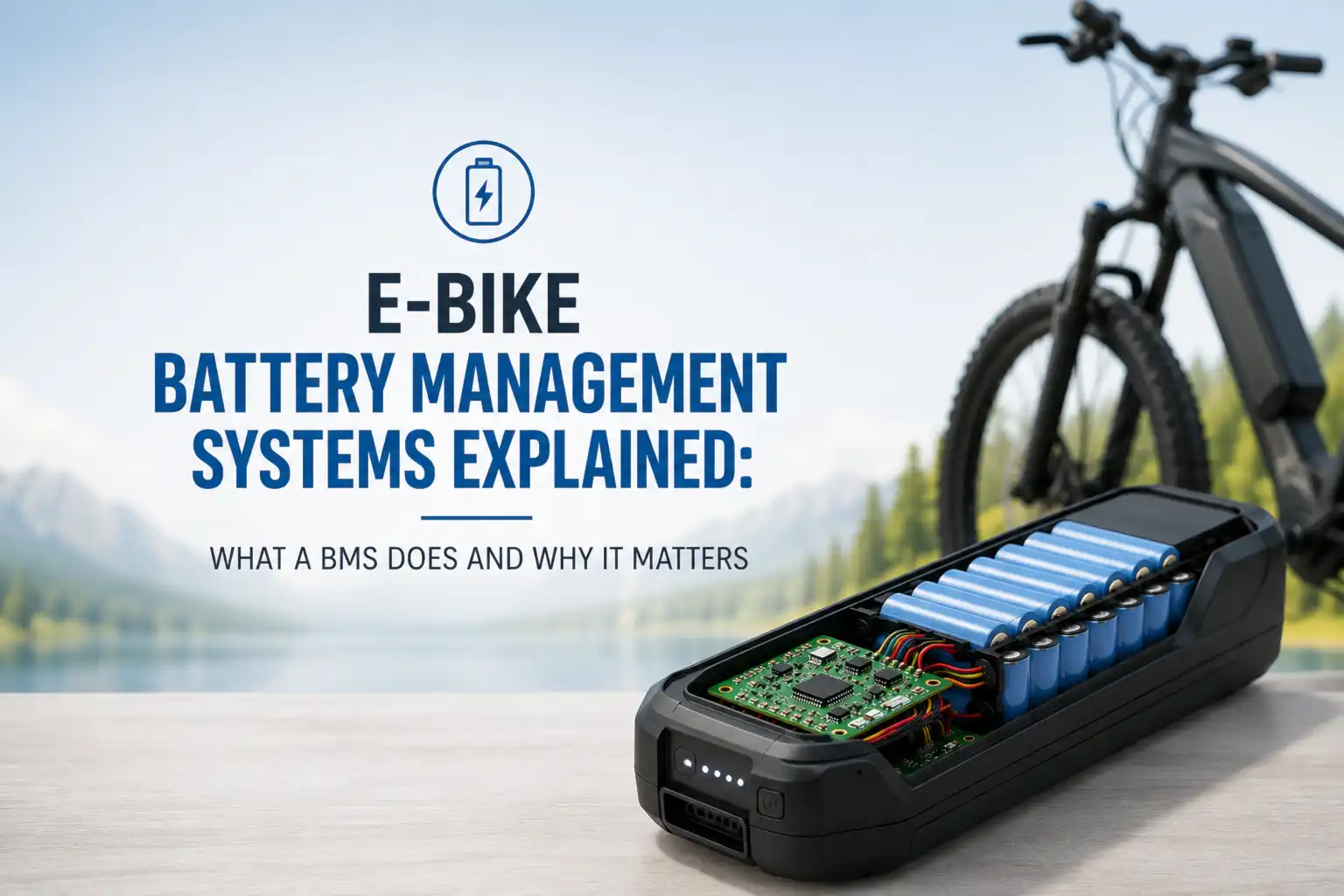
An e-bike battery management system, usually shortened to BMS, is the electronic protection and monitoring system built into or integrated with the battery pack. Its job is to watch important battery conditions and help keep the pack operating within the limits set by the battery designer.
If you are learning how e-bike batteries work, start with my complete E-Bike Battery Guide. You may also want my guide to e-bike battery capacity, amp-hours, and watt-hours, because battery voltage and capacity make the BMS easier to understand.
The most important thing to know is that the BMS is a safety and control layer, not a magic shield. It can monitor voltage, current, temperature, and other conditions in supported designs, and it may disconnect charging or discharging when a programmed limit is reached. But it cannot make a damaged, incompatible, poorly rebuilt, or unsafe battery automatically safe.
E-Bike BMS Explained in Plain English
Quick answer: Think of the BMS as the battery pack’s electronic safety manager. It watches what is happening inside the pack and can limit or interrupt charging or power delivery when conditions move outside the battery’s programmed operating limits.
A modern e-bike battery usually contains many lithium-ion cells. Those cells are arranged into groups so the pack can provide the voltage and capacity the bike needs. The BMS monitors the pack and, in many designs, the voltage of each series-connected cell group rather than measuring every individual cell separately.
That distinction matters. When people say the BMS is “watching every cell,” they often mean it is monitoring the electrical groups that make up the series stack. The exact architecture depends on the battery.
📖 Read Next
How to Choose the Best eBike Battery for Your Commute (With Top Picks)
Understanding E-Bike Battery Capacity: Amp Hours (Ah) Explained
5 Signs It’s Time to Replace Your E-Bike Battery
The Ultimate Guide to Electric Bike Chargers: Types, Features, and Recommendations
Why Your E-Bike Battery Loses Charge Overnight — and How to Fix It
How Long Do E-Bike Batteries Last?
E-Bike Battery Charging Mistakes
E-Bike Battery Health Checker
What Does an E-Bike Battery Management System Do?
The exact functions vary by design, but common BMS responsibilities include monitoring battery voltage, pack current, and temperature, detecting certain fault conditions, controlling charge and discharge paths, and supporting cell balancing in systems designed for it.
| BMS function | What it means for the rider |
|---|---|
| Voltage monitoring | Tracks pack and cell-group voltage so charging or discharging can be stopped if voltage moves outside configured limits. |
| Current monitoring | Helps detect excessive charge or discharge current and certain short-circuit conditions. |
| Temperature monitoring | In systems with temperature sensors and programmed limits, charging or discharge can be restricted when the battery is too hot or too cold. |
| Charge/discharge control | Many BMS designs control electronic switches that can connect or disconnect the battery’s charge or discharge path. |
| Cell balancing | Some BMS designs help reduce voltage differences between series cell groups, usually near higher states of charge. |
| Communication | Smart systems may exchange battery status, fault, temperature, or state-of-charge data with the bike, charger, service software, or app. |
BMS vs. E-Bike Controller: They Do Different Jobs
The BMS and motor controller are both electronic components, but they have different jobs.
The BMS manages and protects the battery pack. The motor controller manages motor power delivery based on inputs from the display, pedal-assist sensor, throttle, brake sensors, and other parts of the bike.
A BMS problem or protective shutdown can therefore look like a controller problem because the controller cannot run the motor if the battery stops supplying power. If you are not sure which component is involved, my controller vs. battery vs. motor troubleshooting guide can help you separate similar symptoms.
How BMS Protection Works
Overvoltage protection
During charging, the BMS can monitor the series cell groups and stop or restrict charging if a monitored voltage reaches its programmed upper limit. This is one reason battery and charger compatibility matters.
Undervoltage protection
During discharge, a BMS can disconnect the pack when one monitored cell group falls below its configured lower-voltage threshold. This helps prevent continued discharge beyond the pack’s intended operating range.
Overcurrent and short-circuit protection
Many BMS designs monitor current and can interrupt the battery output when current exceeds programmed limits or when a short-circuit condition is detected. The exact current thresholds and response times vary significantly between battery designs.
Temperature protection
Many e-bike battery systems include temperature sensing. Depending on the design, the BMS may block charging, reduce operation, or disconnect power when the battery is outside its allowable temperature range. Do not assume every e-bike battery uses the same temperature limits.
Electronic switching
In many BMS designs, the protection circuitry controls MOSFETs – electronic switches that allow or interrupt charging and discharging. Riders do not normally need to interact with these components directly, and they should not be bypassed.
What Is Cell Balancing?
Cells and cell groups do not remain perfectly matched forever. Small differences in capacity, internal resistance, temperature, and aging can cause some series groups to reach a higher or lower voltage than others.
Some BMS designs use passive cell balancing. In simple terms, the system allows a small amount of energy to be dissipated from higher-voltage groups so the series groups can stay closer together. Texas Instruments documents this type of voltage-based passive balancing in battery-monitor and protection systems.
Balancing should not be confused with repairing a damaged battery. A BMS may help manage modest voltage differences, but it cannot restore a cell group that has lost substantial capacity, developed high internal resistance, suffered physical damage, or reached the end of its useful life.
Why an E-Bike Battery May Shut Off on Hills or During Hard Acceleration
A battery can look normal while sitting still and behave very differently when the motor asks for high current. Under load, battery voltage temporarily drops. This is called voltage sag.
Voltage sag is normal to some degree, but it becomes more pronounced when a battery is low on charge, cold, aged, heavily loaded, or has a weak cell group. If one monitored series group drops below the BMS undervoltage limit during a climb or hard acceleration, the BMS may disconnect the battery output.
This can create a confusing pattern: the bike shuts off under load, then the battery appears to recover after the load is removed or after the bike sits for a while. That pattern is worth investigating, but it does not prove the BMS itself is defective.
If cutouts are your main symptom, see my guide to why an e-bike cuts out while riding.
Before You Blame the BMS
Important: Battery shutdown does not automatically mean the BMS has failed. A loose battery connection, weak cell group, excessive load, incompatible charger, low state of charge, temperature condition, controller fault, damaged wiring, or normal BMS protection can produce similar symptoms.
If the battery charges but the bike has no power, start with my guide to an e-bike battery that charges but has no power. For broader diagnosis, use the E-Bike Troubleshooting and Maintenance Guide.
Is It Really the BMS? Symptom Guide
| Symptom | Possible BMS-related explanation | Other things to check |
|---|---|---|
| Bike shuts off on a steep hill | Undervoltage or overcurrent protection may have been triggered. | Low charge, aged battery, weak cell group, loose battery mount, controller overload, wiring. |
| Bike shuts off during hard acceleration | Voltage sag or current protection may be involved. | Battery state of charge, battery age, connections, controller, wiring. |
| Battery works again after resting | A temporary protection condition may have cleared. | Voltage sag, heat, intermittent contacts, loose connectors. |
| Battery shows charge but bike has no power | Discharge output may be disabled in some protection states. | Battery seating, fuse if user-serviceable, display, controller, main wiring. |
| Battery will not charge | A charge-protection state may be involved. | Wrong or failed charger, charging port, temperature, battery damage, charger connection. |
| Charger turns green unusually quickly | The pack may not be accepting normal charge, but this alone does not identify a BMS fault. | Charger behavior, charge port, battery state, manufacturer diagnostics. |
| Range has dropped substantially | The BMS may be responding to a weak group under load. | Normal battery aging, cold weather, tire pressure, riding conditions, charger problems. |
If your bigger problem is reduced capacity or rapid discharge, see why an e-bike battery may not hold a charge or use the E-Bike Battery Health and Lifespan Checker as a starting point.
Normal BMS Protection vs. a Possible BMS Fault
A protective shutdown can be evidence that the BMS is doing its job. For example, if the battery is outside an allowed temperature range or a monitored cell group reaches a configured voltage limit, disconnecting power may be intentional.
A possible BMS or battery fault becomes more concerning when the problem repeatedly returns under ordinary conditions, the battery will not charge or discharge normally using the correct equipment, the battery reports persistent errors, or the manufacturer-specific recovery procedure does not restore normal operation.
Even then, symptoms alone may not tell you whether the failure is in the BMS electronics, cells, connections, temperature sensors, internal wiring, charger, battery mount, or another part of the bike. That is why I would avoid replacing a BMS based only on a symptom list.
Can You Reset an E-Bike BMS?
There is no universal BMS reset procedure for e-bike batteries.
Some battery systems recover automatically after a temporary fault condition clears. Some can wake when connected to the correct charger. Others have manufacturer-specific reset or recovery steps. For example, certain Bosch systems publish a battery recovery procedure for a nonresponsive pack, but that procedure applies to those Bosch products and should not be treated as a generic method for every battery.
Use only the reset or recovery procedure documented by your battery or e-bike manufacturer. Do not open the battery, bridge terminals, jump internal connections, bypass the BMS, or use internet “reset hacks” intended for a different battery.
Can You Replace Just the BMS?
Technically, a qualified battery repair specialist may be able to replace a BMS in some serviceable battery designs. For the average rider, however, this is not normal do-it-yourself maintenance.
A replacement BMS must be appropriate for the battery chemistry, series cell count, voltage, current requirements, temperature sensors, charge/discharge configuration, communication system, and other pack-specific design details. On smart or proprietary systems, pairing, firmware, authentication, or manufacturer diagnostics may also be involved.
Opening a lithium-ion battery also exposes high-energy electrical connections and can compromise insulation, sealing, thermal protection, or the pack enclosure. If you suspect an internal BMS fault, contact the battery manufacturer, e-bike brand, authorized dealer, or a qualified lithium-ion battery service specialist.
Smart BMS vs. Basic BMS
Not every e-bike battery communicates the same way.
A simpler BMS may mainly monitor and protect the battery without providing much rider-visible information. A smart BMS may communicate state of charge, temperature, fault information, cycle data, or other battery information to the e-bike controller, display, charger, diagnostic software, or phone app.
An app does not necessarily show everything the BMS can measure. Likewise, a battery without an app or detailed display can still contain a functioning BMS.
Cold Weather, Heat, and Storage
Temperature affects lithium-ion battery performance and may also affect when a BMS permits charging or discharge. Cold batteries can deliver less usable power, while excessive heat can accelerate battery aging and may trigger thermal protection in systems designed for it.
There is no single charging-temperature or storage rule that applies to every e-bike battery. Follow the limits in your battery manual. As one manufacturer-specific example, Bosch states that one of its battery systems only allows charging between 0°C and 40°C and recommends 30% to 60% charge for longer storage. Those numbers are useful examples, but they should not be applied automatically to every brand.
Why Charger Compatibility Still Matters Even With a BMS
One of the most dangerous misconceptions is that the BMS will make an incompatible charger safe. Do not rely on that assumption.
The U.S. Consumer Product Safety Commission warns that so-called universal micromobility chargers may physically fit a device and still be electrically incompatible. CPSC recommends using the charger supplied with the device or a replacement that has been tested and approved to work safely with that specific device.
Charging voltage, current, connector polarity, charging communication, and battery-system requirements all matter. A matching plug shape by itself proves very little.
Having a BMS Does Not Mean the Battery Is Safety Certified
A battery can contain a BMS without being certified to a recognized battery safety standard.
UL 2271 is a standard for batteries used in light electric vehicle applications. UL 2849 addresses the broader electrical system of an e-bike. UL’s e-bike safety materials specifically describe battery-pack functional safety and the battery management system as part of the larger system-level safety approach.
This is why a vague claim such as “protected by BMS” is not the same thing as verified third-party certification. If certification is important to you, look for the specific standard, the certification body, and evidence that applies to the exact bike or battery model. My guide to UL-certified e-bikes explains what to look for.
What a BMS Can and Cannot Protect You From
| Situation | Can the BMS help? | Important limit |
|---|---|---|
| Cell-group overvoltage | Often, if voltage monitoring and protection are built into the design. | Thresholds and protection behavior vary. |
| Cell-group undervoltage | Often. | A cutoff does not repair an aged or weak cell group. |
| Excessive current | Often. | Protection limits depend on pack design. |
| Short circuit | Many BMS designs include short-circuit protection. | Physical damage can still create serious hazards. |
| Battery temperature outside allowed limits | Often, when appropriate sensors and protection are present. | Not every pack has identical sensors or thresholds. |
| Cell imbalance | Some systems can reduce modest imbalance through balancing. | Balancing cannot restore a damaged or worn-out cell group. |
| Wrong charger | It may detect some resulting fault conditions. | Do not depend on the BMS to make an incompatible charger safe. |
| Crushed, punctured, flooded, or badly damaged pack | No protection system can make severe physical damage safe. | Stop using the battery and follow manufacturer/emergency guidance. |
| Poorly rebuilt or modified pack | A BMS cannot guarantee safe workmanship or compatible cells. | Avoid packs rebuilt or modified by unqualified personnel. |
Safety First
Stop using or charging the battery if you notice smoke, swelling, unusual heat, leaking, sparks, a strong chemical or burning odor, damaged wiring, serious impact damage, or significant water intrusion. Move away from immediate danger and contact emergency services when appropriate.
Do not open, puncture, bypass, rebuild, rewire, or improvise repairs to an e-bike lithium-ion battery pack. If the battery has been damaged or is behaving abnormally, contact the e-bike manufacturer, battery supplier, or a qualified battery specialist.
BMS Myths That Can Lead to Bad Decisions
Myth: If my battery has a BMS, it cannot catch fire
False. A BMS is an important safety layer, but battery safety also depends on cell quality, pack design, manufacturing, charger compatibility, mechanical protection, wiring, thermal management, correct use, and the condition of the pack.
Myth: Every shutdown means the BMS is bad
False. A shutdown may be a normal protective response, or the root cause may be a weak battery, loose connection, charger issue, controller problem, wiring fault, temperature condition, or another component.
Myth: A higher-current BMS is an easy performance upgrade
This is not a safe assumption. Battery current limits are part of a complete design that includes cells, interconnects, wiring, connectors, fuses or other protection, thermal limits, controller requirements, and enclosure design. Changing one protection component can create risks elsewhere.
Myth: If the charger plug fits, the BMS will handle it
False. Connector fit does not establish electrical compatibility.
Myth: Cell balancing can repair worn-out cells
False. Balancing can help manage voltage differences in supported designs, but it cannot restore lost cell capacity or reverse physical degradation.
What to Tell the Manufacturer or Repair Shop
Good symptom notes can make diagnosis much faster. Before contacting support, write down:
- Your e-bike make, model, and model year if known.
- The battery model, voltage, and capacity listed on the label.
- The charger’s model and output specifications.
- Approximate battery age and usage.
- Battery percentage or indicator level when the problem occurs.
- Whether the problem happens on hills, during acceleration, at high assist, or only after long rides.
- Outside temperature and whether the battery was unusually hot or cold.
- Any display error codes or flashing battery LEDs.
- Whether the charger light behaves differently than it used to.
- Any recent crash, drop, water exposure, shipping damage, repair, battery removal, or wiring work.
- Whether the battery, charger, controller, or wiring has ever been modified.
Photos of the battery label, charger label, connectors, and any visible damage can also help the manufacturer without requiring you to open the pack.
Check for Recalls Before Paying for a Battery Repair
If a battery suddenly develops unusual behavior, check the e-bike manufacturer’s support page and the CPSC recall database before paying for repair or replacement. A recall or safety notice may change what the manufacturer wants owners to do.
Do not put a damaged or unwanted lithium-ion e-bike battery in household trash or ordinary curbside recycling. Follow your local hazardous-waste or battery-recycling program and the battery manufacturer’s disposal guidance.
Common BMS Terms in Plain English
- Cell group
- A group of cells connected in parallel that acts as one voltage unit within the series battery stack.
- Pack voltage
- The combined voltage of the battery’s series-connected cell groups.
- Voltage sag
- A temporary drop in battery voltage when the battery is supplying current, especially under heavy load.
- Overcurrent
- Current above a programmed or designed limit.
- State of charge (SOC)
- An estimate of how much usable charge remains in the battery.
- State of health (SOH)
- An estimate of how the battery’s condition compares with its original condition, often considering capacity and other performance measures.
- Cell balancing
- A process used in some battery systems to reduce voltage differences among series cell groups.
- Sleep mode
- A low-power state used by some BMS designs to reduce battery drain while inactive.
- MOSFET
- An electronic switching device commonly used in battery protection circuits to control charge or discharge paths.
- Cutoff voltage
- A configured voltage limit at which the battery system may stop charging or discharging to protect the pack.
Helpful E-Bike Battery Care Accessories
E-Bike Battery Cover
Helps protect an external battery from dirt, road spray, scratches, and cold weather. Choose one that fits your battery securely without blocking the mount or lock.
Microfiber Cleaning Cloths
Useful for gently cleaning around the battery, mount, and frame. Avoid spraying cleaners directly into electrical contacts.
Compact Bicycle Multi-Tool
Handy for checking normal bike and battery-mount hardware. Use it for accessible fasteners only, not for opening the battery pack.
Battery Contact Cover
A compatible protective cap can help keep dirt and moisture away from exposed battery contacts when the battery is removed.
Safety reminder: Stop using or charging the battery if you notice swelling, unusual heat, leaking, smoke, sparks, or a strong chemical odor.
How This Guide Was Researched
This guide is based on manufacturer instructions, established safety guidance, technical references, and common rider experiences. Stop using or charging the bike if you notice smoke, swelling, unusual heat, damaged wiring, sparks, or a strong chemical odor.
Frequently Asked Questions
Does every e-bike battery have a BMS?
Modern lithium-ion e-bike batteries normally use battery-management and protection electronics, but the features and sophistication vary widely. Do not assume every pack has the same monitoring, balancing, communication, or fault-recovery capabilities.
Can a bad BMS make an e-bike battery look dead?
Yes, an internal BMS or protection-system problem can prevent normal output or charging. But the same symptom can come from cells, connectors, wiring, the charger, battery mount, controller, display, or other components. Diagnosis should not be based on the symptom alone.
Why does my e-bike battery shut off on hills?
Higher motor demand can increase current and voltage sag. A low, cold, aged, or weak battery may reach a protection threshold under load even though it appears normal at rest. Loose battery contacts, controller issues, wiring problems, and overheating can cause similar cutouts.
Why does the battery work again after I let it sit?
Removing the load allows battery voltage to recover, and some temporary protection conditions may clear after temperature, current, or voltage returns to an acceptable range. Repeated shutdowns still deserve investigation.
Does a BMS stop overcharging?
Overvoltage protection is a common BMS function, but you should still use only the correct charger. The battery system is designed around specific charging requirements, and the BMS should not be treated as permission to use an incompatible charger.
Does the BMS control motor power?
Not in the same way as the motor controller. The controller determines how the motor is driven. The BMS manages the battery and may limit or interrupt the battery’s ability to supply power if a protection condition occurs.
Can I bypass the BMS to test whether it is bad?
I do not recommend bypassing an e-bike battery BMS. Bypassing battery protection can expose the pack, wiring, charger, controller, and rider to serious electrical and fire hazards.
Can I install a bigger BMS for more power?
Do not treat BMS current rating as a simple performance modification. The safe current capability of a battery depends on the complete pack design, including the cells, interconnects, wiring, connectors, temperature limits, controller, and protection system.
Does UL certification mean the BMS cannot fail?
No. Certification is not a guarantee that a product can never fail. It indicates that the applicable product or system has been evaluated to the requirements of the stated safety standard. Safe charging, compatible components, proper use, and attention to damage still matter.
My Take
I think the BMS is one of the most important parts of an e-bike battery to understand because it explains a lot of behavior that otherwise looks mysterious. A battery that shuts off is not always “dead,” and a BMS cutoff is not automatically evidence of a defective BMS.
The practical rule I would use is simple: check the easy external causes first, use only the correct charger and replacement battery, follow the manufacturer’s documented recovery steps, and treat repeated cutouts as a reason to diagnose the battery rather than a reason to bypass its protection.
If the pack is swollen, unusually hot, leaking, smoking, sparking, badly damaged, or giving off a strong chemical or burning odor, troubleshooting stops there. Safety takes priority over saving the battery.
Disclosure: As an Amazon Associate, I earn from qualifying purchases. This comes at no extra cost to you and helps support the content on this site.
Sources and Safety References
- U.S. Consumer Product Safety Commission – Micromobility Safety Information
- U.S. CPSC – Warning About Universal Micromobility Chargers
- UL Solutions – Micromobility Device Testing and Certification
- Texas Instruments – BQ76952 Battery Monitor Technical Reference Manual
- Bosch eBike Systems – Battery Storage Guidance

Kristina is not just an enthusiast but a true authority on electric bikes. Nestled in the coastal beauty of Virginia, Kristina has found the perfect backdrop for her passion for electric biking. As a dedicated wife and homeschooling mom, her life revolves around family, faith, and the thrill of adventure.
Originally hailing from Ohio, Kristina's journey with electric bikes began as a curiosity and quickly evolved into a deep expertise. Her blog is a testament to her love for electric biking, combining her fascination for eco-friendly transportation with her coastal lifestyle.
When she's not cruising the beach on her electric bike, you'll find Kristina indulging in her other loves: long walks along the shore, getting lost in a good book, and cherishing moments with her loved ones. With a heart as big as her love for animals, especially cats, Kristina brings a unique perspective to the electric bike world, grounded in her strong faith in God and her dedication to a sustainable lifestyle.
Through her blog, Kristina shares her extensive knowledge of electric bikes, offering valuable insights, tips, and recommendations to fellow enthusiasts. Whether you're a seasoned rider or a newcomer to the electric bike scene, Kristina's blog is your go-to source for all things electric biking, fueled by her passion, expertise, and the scenic beauty of coastal Virginia.