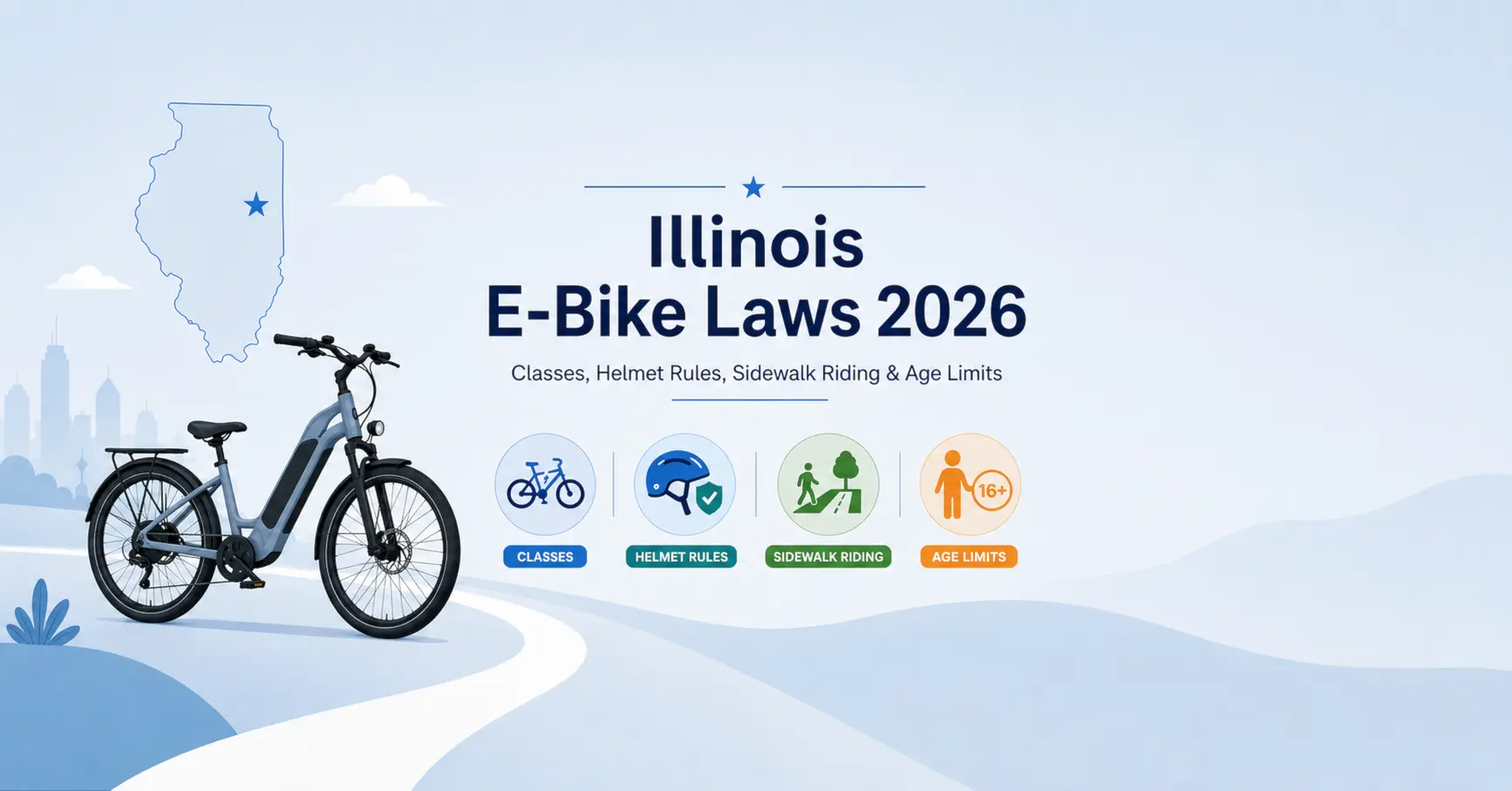
Illinois SB 3484 Signed Into Law: New E-Bike and E-Moto Rules Start Jan. 1, 2027
Last Updated on September 4, 2026 by Kristina
Update – September 4, 2026: Governor JB Pritzker signed Senate Bill 3484 on August 26, 2026. The measure is now Public Act 104-0854 and takes effect January 1, 2027. This article was originally published while the bill was awaiting the governor’s action and has been revised throughout to reflect the final signed law.
CHICAGO – September 4, 2026: Illinois has enacted a broad new micromobility law that adds statewide rules for high-powered electric bicycles, e-motos, electric scooters, electric skateboards, electric unicycles, and other electric devices. It also adds a new minimum age for Class 1 and Class 2 e-bike riders and sharply limits local governments’ ability to create separate rules for low-speed e-bikes.
One point needs to be clear from the start: Illinois already prohibits low-speed electric bicycles from being operated on sidewalks under current state law. Public Act 104-0854 does not create that low-speed e-bike sidewalk prohibition. Instead, its major changes include new age requirements, a statewide framework for electric micromobility devices, and much clearer treatment of electric bicycles that fall outside Illinois’ low-speed e-bike definition.
My complete Illinois e-bike law guide explains the rules currently in place. You can also compare regulations nationwide in the State-by-State E-Bike Law Guide and review how sidewalk rules differ around the country in my guide to e-bike sidewalk laws.
Current Status
Signed: Governor Pritzker approved SB 3484 on August 26, 2026. It is now Public Act 104-0854 and is scheduled to take effect January 1, 2027.
Until December 31, 2026, riders still need to follow the Illinois rules that are currently in force. The new age limits, high-powered electric bicycle framework, electric micromobility rules, and related statewide changes begin January 1, 2027.
How This Story Was Verified
This update is based primarily on the final text of Illinois Public Act 104-0854, the Illinois General Assembly’s bill-status record, current Illinois statutes, and the Illinois Secretary of State’s August 26 announcement confirming that the governor signed the legislation. I distinguish rules already in effect from changes that begin January 1, 2027.
What Illinois Public Act 104-0854 Changes
The law creates a more uniform statewide framework for low-speed e-bikes, electric micromobility devices, and faster electric bicycles that do not qualify as low-speed e-bikes.
| Vehicle or device | Rule beginning Jan. 1, 2027 | Important access point |
|---|---|---|
| Class 1 e-bike | Minimum rider age 15 | Sidewalk riding is already prohibited under current Illinois law |
| Class 2 e-bike | Minimum rider age 15 | Sidewalk riding is already prohibited under current Illinois law |
| Class 3 e-bike | Minimum rider age remains 16 | Sidewalk riding remains prohibited |
| Electric micromobility device | Minimum rider age 16, statewide equipment and operating rules | No sidewalk riding; additional roadway restrictions apply |
| Electric bicycle that is not a low-speed e-bike | Treated as a motor-driven cycle | No sidewalks, bike lanes, bicycle paths, shared-use paths, or bicycle-specific trails |
Illinois’ Low-Speed E-Bike Sidewalk Rule Is Not New
My original July article described a statewide low-speed e-bike sidewalk prohibition as a proposed change. After rechecking the controlling statute, that framing needed to be corrected.
Illinois Vehicle Code Section 11-1517 already states that a person may not operate a low-speed electric bicycle on a sidewalk. That restriction has been part of Illinois’ three-class e-bike law since 2018.
What Public Act 104-0854 adds is a separate statewide operating framework for newly defined electric micromobility devices, including qualifying electric scooters, electric skateboards, and electric unicycles. Beginning January 1, those devices also cannot be operated on sidewalks.
New Age Rules for Class 1 and Class 2 E-Bikes
Beginning January 1, 2027, a rider must be at least 15 years old to operate a Class 1 or Class 2 low-speed electric bicycle in Illinois.
The minimum age for a Class 3 e-bike remains 16. That requirement already exists under current Illinois law, so it should not be presented as a newly created Class 3 restriction.
The signed law also adds a passenger restriction. A low-speed e-bike manufactured to carry passengers generally may not be operated by someone under 18 with a passenger unless that passenger is the rider’s sibling, stepsibling, child, or stepchild.
New Statewide Rules for Electric Micromobility Devices
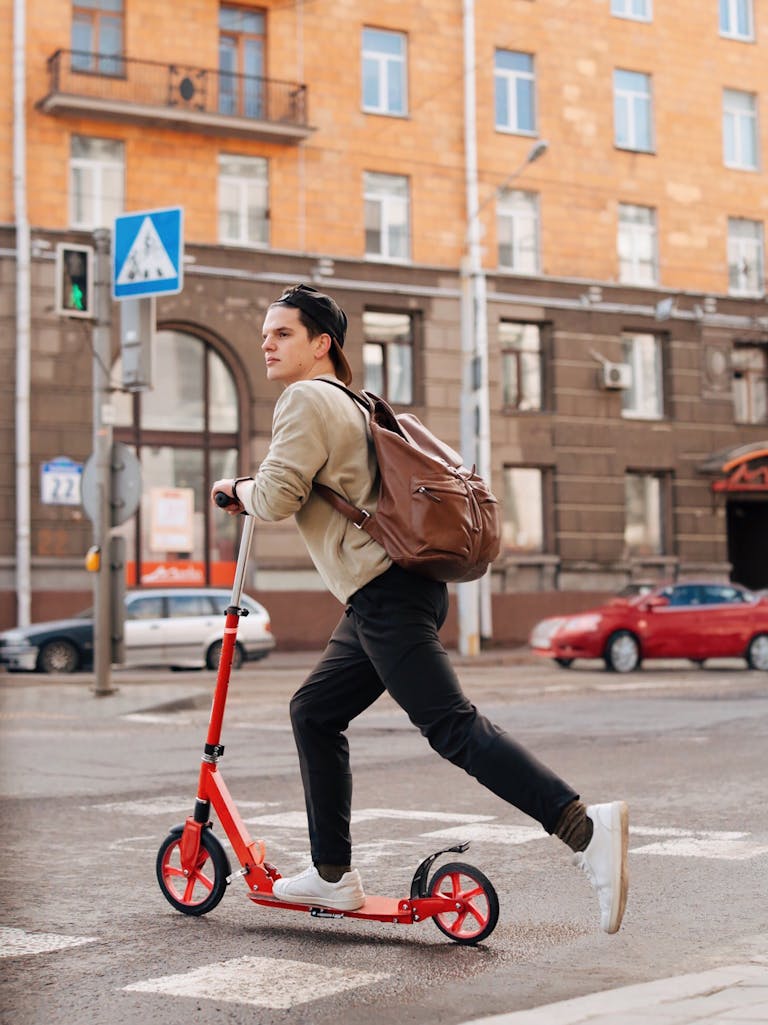
Public Act 104-0854 creates statewide operating rules for electric micromobility devices such as qualifying electric scooters, electric skateboards, and electric unicycles.
- Operators must be at least 16 years old.
- The devices may not be operated on sidewalks.
- They may not be operated on interstate highways.
- They are generally prohibited on roads with speed limits above 35 mph unless a designated bicycle lane is available.
- They must have a functioning brake or other mechanism capable of controlling and stopping the device.
- Nighttime lighting and reflector requirements apply.
The law also exempts electric micromobility devices from motor-vehicle title, registration, driver’s-license or permit, and liability-insurance requirements that apply to motor-driven cycles.
What Happens to High-Powered E-Bikes and E-Motos?
One of the most important parts of the new law is the line it draws between a legal low-speed e-bike and an electric vehicle that falls outside that definition.
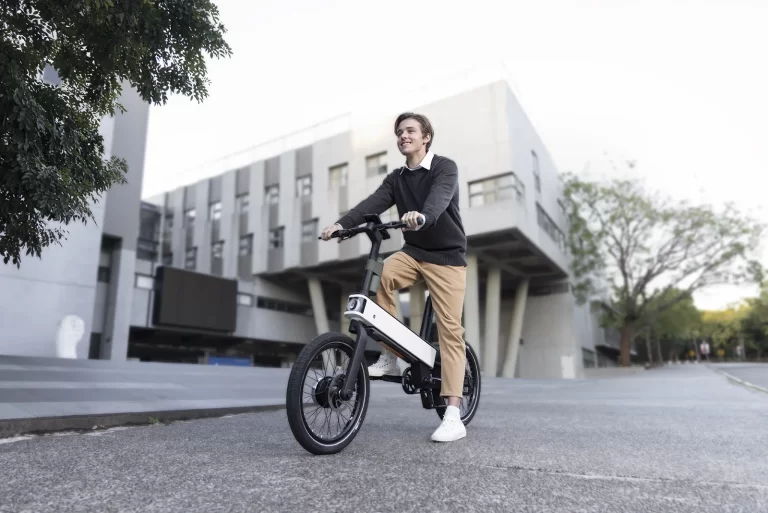
Under Public Act 104-0854, a low-speed electric bicycle must have fully operable pedals, an electric motor rated at less than 750W, and meet the requirements of one of Illinois’ three recognized e-bike classes. Class 1 assistance stops at 20 mph, Class 2 motor propulsion stops at 20 mph, and Class 3 pedal assistance stops at 28 mph.
The law then states that any electric bicycle that is not a low-speed electric bicycle is considered a motor-driven cycle for purposes of the Illinois Vehicle Code. The motor-driven-cycle definition specifically includes electric motors with a nominal power rating greater than 750W and up to 8,000W.
That distinction matters because motor-driven cycles face requirements that do not apply to ordinary Class 1, Class 2, and Class 3 e-bikes. A person operating a motor-driven cycle must have a valid driver’s license, and highway operation brings title, registration, insurance, and equipment requirements.
Not Every High-Powered Online ‘E-Bike’ Will Be Street Legal
The new law should not be interpreted as automatically making every fast or high-powered electric bike sold online legal for Illinois roads.
A motor-driven cycle must satisfy the requirements that apply to that vehicle category. The Act includes titling provisions, requires a vehicle identification number for covered title applications, and says a vehicle that is not properly manufactured or equipped for general highway use is not eligible for registration.
For buyers, that means a product’s marketing label is not enough. A vehicle advertised as an “e-bike” may fall into Illinois’ motor-driven-cycle category if it does not satisfy the statutory low-speed e-bike definition, and it still must meet the legal requirements necessary for road use.
Where Motor-Driven Cycles Cannot Be Ridden
Beginning January 1, motor-driven cycles covered by the new framework cannot be operated on sidewalks, bicycle lanes, bicycle paths, shared-use paths, off-road bicycle trails, natural-surface trails designated for bicycle use, or other bicycle-specific facilities established under state or local law.
They also cannot be operated on interstate highways or on public land where the responsible state agency expressly prohibits them.
Illinois Is Limiting Local E-Bike Rulemaking
Another major change is statewide preemption. Public Act 104-0854 says that, except where the statute specifically allows otherwise, units of local government – including home rule units – may not regulate low-speed electric bicycles.
The law still preserves specific authority for certain land managers. The Illinois Department of Natural Resources may regulate low-speed e-bikes on property it owns, manages, or leases. Park districts, forest preserve districts, conservation districts, and transit districts may also regulate low-speed e-bikes on bicycle paths under their jurisdiction through an ordinance or resolution.
That means statewide uniformity does not guarantee access to every park, forest preserve path, transit trail, or other managed property. Riders should continue checking signs and the rules of the agency responsible for the specific place they plan to ride.
Why Illinois Officials Backed the New Framework
Illinois Secretary of State Alexi Giannoulias promoted SB 3484 as a way to close regulatory gaps involving faster e-bikes, e-motos, scooters, and other electric devices while giving riders, parents, retailers, law enforcement, and pedestrians clearer statewide rules.
In announcing the governor’s signature on August 26, the Secretary of State’s office described the law as establishing statewide safety standards for high-speed e-bikes, e-motos, and other electric micromobility devices.
ABC7 Chicago reported in July that Chicago police had issued 57 citations through the end of June 2026 for bicycle and scooter sidewalk riding, including e-bikes and e-scooters. The enforcement data was part of the broader public debate over how fast electric devices should be regulated.
Accessibility Accommodations Remain Protected
The law states that its provisions cannot be interpreted to prohibit the use of, or reasonable accommodation for, personal mobility devices used by people with mobility disabilities under the Americans with Disabilities Act.
This is an important distinction. Restrictions on recreational and transportation devices should not be confused with the legal accommodation of qualifying mobility devices.
What Illinois Riders Should Do Before January 1, 2027
The law has been signed, but the new framework does not take effect until January 1, 2027. Until then, riders need to follow the Illinois rules currently in force along with any valid local, park, trail, campus, or property rules that still apply.
- Remember that current Illinois law already prohibits low-speed e-bikes on sidewalks.
- Check the permanent class, motor wattage, and assisted-speed label on your e-bike.
- If you own a high-powered device, determine whether it will fall outside the low-speed e-bike definition beginning January 1.
- Do not assume a vehicle marketed as an e-bike will qualify for title and registration as a motor-driven cycle.
- Parents should review the new Class 1 and Class 2 minimum age of 15 and the passenger restrictions for riders under 18.
- Check the rules for a specific park, forest preserve, trail, transit path, campus, or other managed property before riding.
Legal disclaimer: This article is for general informational purposes and is not legal advice. State and local rules can change, and separate requirements may apply on trails, campuses, public lands, and private property. Confirm current requirements with the agency responsible for the place where you plan to ride.
My Take
I think the most useful part of this law is the clearer distinction between a legal low-speed e-bike and an electric vehicle that behaves more like a motorcycle. Buyers should not discover only after a purchase that a vehicle marketed as an “e-bike” requires a driver’s license, registration, insurance, and equipment needed for highway use.
I also think the age rules and statewide definitions will be easier for families and retailers to understand than a patchwork of conflicting local standards. At the same time, consistent laws still need clear public education, good signage, and safe places to ride.
The sidewalk issue is a good example of why the details matter. Illinois low-speed e-bikes were already prohibited on sidewalks before SB 3484. The real story in Public Act 104-0854 is the broader framework for age limits, electric micromobility devices, high-powered electric bicycles, and statewide regulatory consistency.
Follow the Electric Bike News archive for additional e-bike law and safety updates.
External Sources
- Illinois General Assembly – Public Act 104-0854
- Illinois General Assembly – SB 3484 status and legislative history
- Illinois General Assembly – current low-speed electric bicycle statute
- Illinois Secretary of State – August 26, 2026 signed-law announcement
- ABC7 Chicago – July 2026 reporting on enforcement and sidewalk-riding concerns

Kristina is not just an enthusiast but a true authority on electric bikes. Nestled in the coastal beauty of Virginia, Kristina has found the perfect backdrop for her passion for electric biking. As a dedicated wife and homeschooling mom, her life revolves around family, faith, and the thrill of adventure.
Originally hailing from Ohio, Kristina's journey with electric bikes began as a curiosity and quickly evolved into a deep expertise. Her blog is a testament to her love for electric biking, combining her fascination for eco-friendly transportation with her coastal lifestyle.
When she's not cruising the beach on her electric bike, you'll find Kristina indulging in her other loves: long walks along the shore, getting lost in a good book, and cherishing moments with her loved ones. With a heart as big as her love for animals, especially cats, Kristina brings a unique perspective to the electric bike world, grounded in her strong faith in God and her dedication to a sustainable lifestyle.
Through her blog, Kristina shares her extensive knowledge of electric bikes, offering valuable insights, tips, and recommendations to fellow enthusiasts. Whether you're a seasoned rider or a newcomer to the electric bike scene, Kristina's blog is your go-to source for all things electric biking, fueled by her passion, expertise, and the scenic beauty of coastal Virginia.