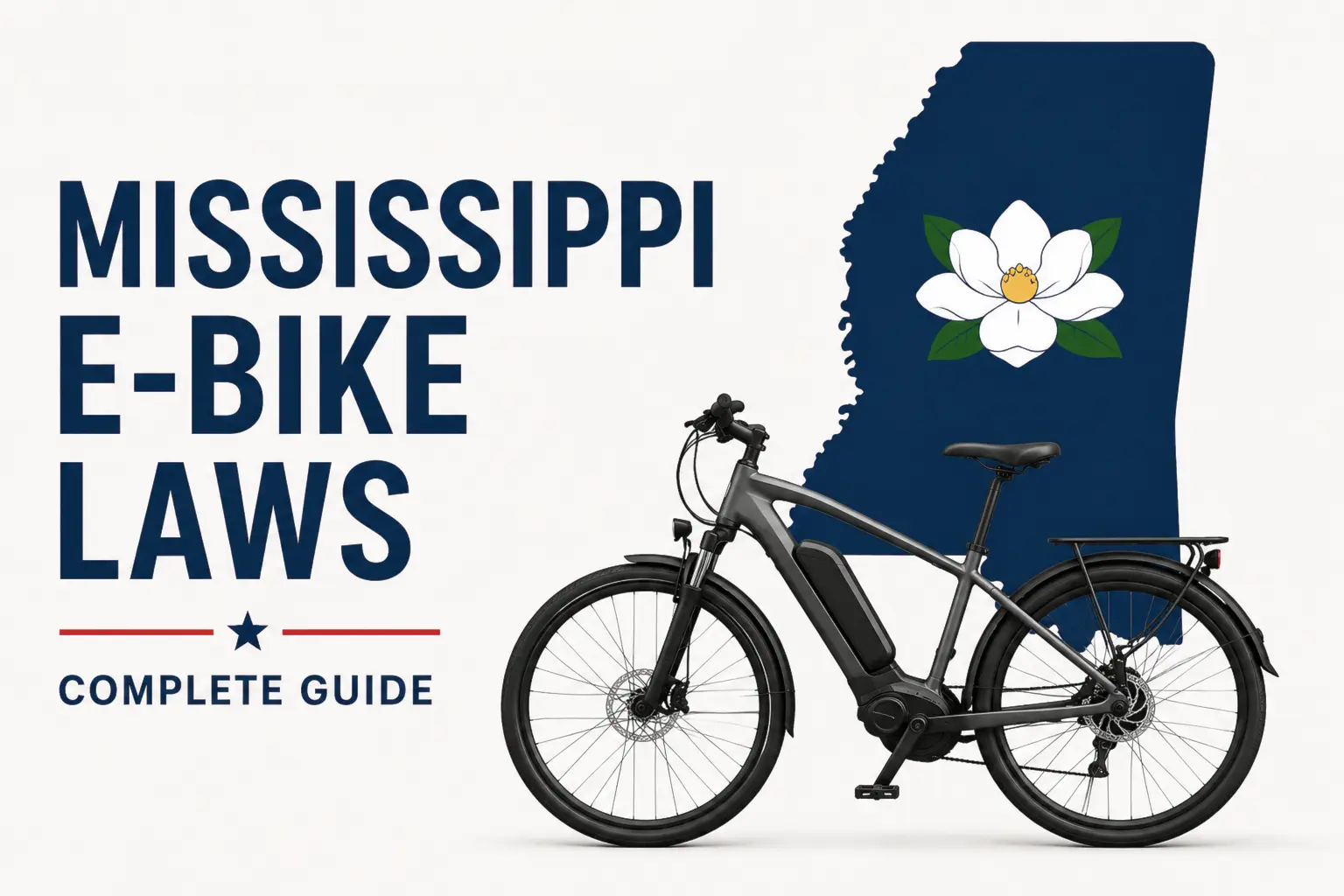
Mississippi E-Bike Laws (2026 Guide): Everything You Need to Know
Last Updated on June 25, 2026 by Kristina
If you’re planning to ride an electric bike in Mississippi, it’s important to understand the state’s e-bike laws before you head out. Knowing where you can ride, which types of electric bikes are legal, and what rules apply can help you ride safely and confidently.
The good news is that Mississippi has adopted the widely recognized three-class electric bike system used by many states across the country. For most riders, this makes the law relatively easy to understand. However, there are still important rules regarding Class 3 e-bikes, motor limits, equipment requirements, and where local governments can establish additional restrictions.
In this Mississippi e-bike law guide, I’ll explain the current laws in plain English so you don’t have to sort through complicated legal language yourself. Whether you’re commuting to work, riding around your neighborhood, exploring the Mississippi Gulf Coast, or enjoying one of the state’s scenic trails, this guide will help you understand what the law says.
If you’re planning to ride outside Mississippi, be sure to check out my State-by-State E-Bike Laws Guide, where I compare electric bike laws across the United States. You may also find these resources helpful:
- E-Bike Trail Access Checker to see where electric bikes are permitted.
- Can You Ride an E-Bike on the Sidewalk? for state and local sidewalk rules.
- Best Electric Bikes if you’re still shopping for the right e-bike.
While I do my best to keep every state law guide up to date, laws can change over time. Local cities, counties, parks, universities, and trail managers may also have additional rules beyond Mississippi state law, so I always recommend checking local regulations before riding somewhere new.
Mississippi E-Bike Laws at a Glance
Mississippi recognizes the standard three-class electric bike system.
In general:
- Class 1, Class 2, and Class 3 electric bikes are legal.
- Electric bikes must have fully operable pedals and a seat or saddle.
- The electric motor must produce less than 750 watts.
- Class 1 and Class 2 motor assistance is limited to 20 mph.
- Class 3 pedal-assist is limited to 28 mph.
- Riders must be at least 16 years old to operate a Class 3 e-bike.
- Class 3 e-bikes must be equipped with a speedometer.
- No driver’s license is required.
- No registration is required.
- No title is required.
- No motor vehicle insurance is required.
- Manufacturers must place a permanent label on the e-bike identifying its class, top assisted speed, and motor wattage.
- Local governments and state agencies may establish additional rules for bicycle paths, shared-use paths, and trails.
Why You Can Trust Electric Bike Explorer
I spend hundreds of hours researching electric bikes, rider safety, state laws, and industry developments to create practical, easy-to-understand guides for riders.
Unlike many websites that simply summarize information, I review the actual state statutes whenever possible and explain what they mean in plain language for everyday riders.
Because electric bike laws continue to evolve, I also review and update these guides whenever significant changes are made.
Although I am not an attorney and this guide should not be considered legal advice, my goal is to provide accurate, well-researched information that helps riders better understand Mississippi’s electric bike laws.
Mississippi E-Bike Laws at a Glance
| Topic | Mississippi Law |
|---|---|
| E-bike Classes | Class 1, Class 2, Class 3 |
| Maximum Motor Power | Less than 750 watts |
| Class 1 Top Assisted Speed | 20 mph |
| Class 2 Top Assisted Speed | 20 mph |
| Class 3 Top Assisted Speed | 28 mph |
| Fully Operable Pedals Required | Yes |
| Seat or Saddle Required | Yes |
| Driver’s License Required | No |
| Registration Required | No |
| Title Required | No |
| Insurance Required | No |
| Statewide Helmet Law | No |
| Class 3 Minimum Age | 16 |
| Class 3 Speedometer Required | Yes |
| Manufacturer Label Required | Yes |
How Mississippi Defines an Electric Bike
Under Mississippi law, an electric bicycle is a bicycle or tricycle that has:
- Fully operable pedals.
- A seat or saddle for the rider.
- An electric motor producing less than 750 watts.
- A system that falls within one of Mississippi’s three recognized electric bike classifications.
Electric bicycles meeting this definition are generally treated as bicycles rather than motorcycles or other motor vehicles under Mississippi law.
One thing I like about Mississippi’s law is that it follows the same three-class system used by many other states. If you travel with your electric bike, you’ll likely find similar classifications across much of the country, making it easier to understand the rules.
However, just because a vehicle has pedals doesn’t automatically make it a legal electric bike. If it’s modified beyond the legal speed limits or has a more powerful motor than allowed under state law, it may no longer qualify as an electric bicycle.
Mississippi Uses the Three-Class Electric Bike System
Like many states, Mississippi divides electric bicycles into three separate classes based on how the motor works and the maximum assisted speed.
Understanding these classes is important because some local governments and trail managers may regulate Class 3 electric bikes differently than Class 1 or Class 2 models.
Here’s how each class works.
Class 1 Electric Bikes
A Class 1 electric bike provides motor assistance only while you’re pedaling.
The motor stops assisting once the bike reaches 20 mph.
Because there is no throttle, Class 1 e-bikes offer the most traditional cycling experience while still making hills and longer rides much easier.
Many riders choose a Class 1 electric bike for:
- Commuting.
- Recreational rides.
- Fitness.
- Greenways.
- Shared-use paths.
- Rail trails.
Since Class 1 e-bikes are often viewed as the least disruptive type of electric bicycle, they generally receive the broadest trail access where e-bikes are permitted.
Class 2 Electric Bikes
A Class 2 electric bike includes a throttle that can propel the bicycle without pedaling.
Motor assistance is limited to 20 mph, just like a Class 1 e-bike.
Many riders appreciate having a throttle because it can make:
- Starting from intersections easier.
- Climbing hills less strenuous.
- Carrying cargo more manageable.
- Riding into strong headwinds more comfortable.
A throttle does not automatically make an electric bike illegal in Mississippi. As long as the bike stays within the state’s Class 2 definition, it is still considered a legal electric bicycle.
When riding on shared-use paths or around pedestrians, I always recommend using the throttle responsibly and reducing your speed in crowded areas.
Class 3 Electric Bikes
A Class 3 electric bike provides motor assistance only while you’re pedaling and stops assisting at 28 mph.
These are often the preferred choice for commuters who want to cover longer distances more quickly while still riding a bicycle.
Because Class 3 electric bikes travel at higher assisted speeds, Mississippi has a few additional requirements.
To operate a Class 3 e-bike:
- You must be at least 16 years old.
- Riders under 16 may ride as passengers if the bicycle is designed to carry passengers.
- The bicycle must be equipped with a speedometer that displays speed in miles per hour.
It’s also important to remember that local governments and state agencies may establish additional restrictions for Class 3 electric bikes on certain bicycle paths, shared-use paths, or recreational trails.
Whenever I’m visiting a new trail system, I always check the posted rules beforehand. While state law provides the overall framework, local trail managers often determine whether certain classes of electric bikes are permitted on specific facilities.
Maximum Motor Power Under Mississippi E-Bike Laws
Mississippi law defines an electric bicycle as having an electric motor that produces less than 750 watts.
This motor limit is one of the requirements that separates a legal electric bicycle from other types of motorized vehicles.
Most electric bikes sold by well-known manufacturers already comply with this requirement, making it easy for riders to purchase a bike that fits Mississippi’s legal definition.
If an electric bike exceeds the state’s motor limit or no longer fits one of the three e-bike classifications, it may be regulated differently under Mississippi law.
When shopping for a new electric bike, I always recommend looking for a reputable manufacturer that clearly lists:
- The e-bike class.
- The motor wattage.
- The top assisted speed.
- Whether the bike includes a throttle.
Doing a little research before buying can help ensure your e-bike complies with Mississippi law and is legal to ride on public roads and other areas where electric bicycles are permitted.
Mississippi E-Bike Label Requirement
Mississippi law requires manufacturers and distributors to place a permanent label on every electric bicycle sold in the state.
The label must clearly display:
- The electric bike classification (Class 1, Class 2, or Class 3).
- The top assisted speed.
- The motor wattage.
This requirement helps riders, retailers, trail managers, and law enforcement quickly identify the type of electric bike and the rules that apply to it.
For example, if a trail only allows Class 1 electric bikes, the permanent label makes it much easier to determine whether your bike qualifies.
Whenever I purchase a new electric bike, one of the first things I check is whether the manufacturer has included the required class label. It’s a simple detail that can be helpful if questions ever arise about your bike’s classification.
What Happens If You Modify Your Electric Bike?
Some riders choose to modify their electric bikes by increasing the assisted speed, installing a different controller, changing the motor, or altering throttle settings.
Mississippi law specifically addresses modifications that change an electric bicycle’s speed capability or how the motor engages.
If an electric bike is modified in a way that changes its classification, the original classification label must be replaced with one showing the bike’s new classification.
It’s important to understand that modifying an electric bike can affect more than just the label.
Depending on the modification, it may also affect:
- Whether the bike still qualifies as a legal electric bicycle.
- Where it may legally be ridden.
- Trail access.
- Manufacturer warranty coverage.
- Insurance coverage.
- Overall rider safety.
Personally, I think it’s usually better to purchase an electric bike that already meets your riding needs instead of modifying one beyond its intended design. It helps ensure the bike remains compliant with the law while preserving its reliability and warranty coverage.
Are Electric Bikes Considered Motor Vehicles in Mississippi?
No.
One of the biggest advantages of Mississippi’s electric bike law is that legal electric bicycles are not treated the same as motorcycles or other motor vehicles.
As long as an electric bike meets the state’s legal definition, riders are generally not subject to motor vehicle laws regarding:
- Driver’s licenses.
- Vehicle registration.
- Certificates of title.
- License plates.
- Motor vehicle financial responsibility requirements.
Instead, electric bike riders generally have the same rights and responsibilities as traditional bicycle riders unless another law specifically provides otherwise.
Do You Need a Driver’s License?
No.
Mississippi does not require a driver’s license to operate a legal electric bicycle.
You also do not need:
- A motorcycle endorsement.
- A learner’s permit.
- A special electric bike license.
This makes electric bikes an excellent transportation option for commuting, running errands, or simply enjoying recreational rides.
However, remember that this exemption only applies if your bike meets Mississippi’s legal definition of an electric bicycle.
Do You Have to Register an Electric Bike?
No.
Mississippi does not require electric bicycles to be registered with the state.
Unlike motorcycles and many other motor vehicles, legal electric bikes do not receive:
- Vehicle registration.
- License plates.
- Annual registration renewals.
For most riders, ownership is much simpler than owning a motor vehicle.
Do Electric Bikes Need a Title?
No.
A legal electric bicycle does not require a certificate of title in Mississippi.
When purchasing a used electric bike, I recommend asking the seller for:
- The original purchase receipt, if available.
- The bike’s serial number.
- The battery key, if one is included.
- The charger.
- The owner’s manual.
- Photos showing the manufacturer’s class label.
These items can help verify the bike’s history and confirm that it still meets Mississippi’s legal electric bicycle requirements.
Do You Need Insurance?
No.
Mississippi does not require motor vehicle liability insurance for legal electric bicycles.
Even though insurance isn’t required, it’s still worth thinking about protecting your investment.
Depending on your policy, your homeowners or renters insurance may provide limited coverage for theft or accidental damage. Some companies also offer bicycle-specific insurance that covers theft, crash damage, and liability.
Before assuming your electric bike is covered, I recommend contacting your insurance provider and asking specifically about electric bicycle coverage.
While Mississippi doesn’t require insurance for legal electric bikes, that doesn’t mean it’s a bad idea. If you’ve invested in a new e-bike, insurance may help protect you against theft, accidental damage, and liability, depending on the policy.
Read next – E-Bike Insurance Guide: Do You Need Coverage and Is It Worth It?
Are Helmets Required Under Mississippi E-Bike Laws?
One of the most common questions I receive is whether Mississippi requires electric bike riders to wear a helmet.
The answer is no. Mississippi does not have a statewide law requiring riders of Class 1, Class 2, or Class 3 electric bikes to wear a bicycle helmet.
While you won’t receive a citation simply for riding without one under Mississippi’s electric bike law, I strongly encourage wearing a properly fitted helmet every time you ride.
Even experienced riders can encounter unexpected hazards such as:
- Drivers who fail to see them.
- Loose gravel.
- Wet pavement.
- Railroad crossings.
- Potholes.
- Dogs running into the roadway.
- Mechanical failures.
A quality helmet is one of the simplest and most effective ways to reduce the risk of serious head injuries.
If you’re looking for one, you may also want to check out my Best E-Bike Helmets guide, where I compare several helmets designed specifically for electric bike riders.
Keep in mind that while Mississippi does not have a statewide helmet requirement, some organized rides, parks, schools, or trail systems may have their own helmet policies.
Age Requirements for Riding an Electric Bike in Mississippi
Mississippi’s age requirements are fairly simple.
For Class 1 and Class 2 electric bikes, state law does not establish a minimum operating age.
However, Mississippi does have an important rule for Class 3 electric bikes.
To operate a Class 3 electric bike, you must be at least 16 years old.
A person younger than 16 years old may still ride as a passenger on a Class 3 e-bike if the bicycle is specifically designed to carry passengers.
Because Class 3 electric bikes can provide pedal assistance up to 28 mph, Mississippi places additional operating requirements on these bicycles.
Even though there isn’t a statewide minimum age for Class 1 or Class 2 e-bikes, I always encourage parents to choose an electric bike that’s appropriate for their child’s age, experience, maturity, and the type of riding they’ll be doing.
Do Class 3 E-Bikes Need a Speedometer?
Yes.
Mississippi law requires every Class 3 electric bike to be equipped with a speedometer capable of displaying the bicycle’s speed in miles per hour.
Fortunately, this isn’t something most riders need to worry about. Nearly every Class 3 e-bike sold by major manufacturers already includes a digital display that shows:
- Current speed.
- Battery level.
- Pedal assist level.
- Trip distance.
- Odometer.
If you’re buying a new Class 3 electric bike from a reputable brand, it will almost certainly meet this requirement from the factory.
Where Can You Ride an Electric Bike in Mississippi?
Another question I hear quite often is:
“Where can I legally ride my electric bike in Mississippi?”
For most riders, the answer is fairly straightforward.
Electric bikes are generally allowed anywhere traditional bicycles are permitted unless another law or local regulation says otherwise.
This commonly includes:
- Public streets.
- Neighborhood roads.
- Bicycle lanes.
- Bike routes.
- Many shared-use paths.
However, Mississippi law also gives state agencies and local governments the authority to regulate or prohibit electric bikes on bicycle paths, shared-use paths, and recreational trails under their control.
Because of this, access can vary depending on who manages the property.
For example, one city may allow all three classes of electric bikes on its greenway, while another may prohibit Class 3 e-bikes on certain paths.
Whenever I’m planning to ride somewhere new, I always spend a few minutes checking the official website for the park, trail, or municipality. It’s a simple habit that can help prevent confusion and ensure you’re following local rules.
Riding an Electric Bike on Mississippi Roads
Electric bike riders generally have the same rights and responsibilities as traditional bicycle riders when traveling on public roads.
That means you should:
- Ride in the same direction as traffic.
- Obey traffic signals and stop signs.
- Yield when required.
- Use hand signals when practical.
- Follow the same traffic laws that apply to bicycles.
Like traditional bicycles, electric bikes are not permitted on interstate highways.
If you’re commuting by electric bike, I also recommend using bright front and rear lights whenever visibility is reduced—even during daylight hours. Improving your visibility to drivers is one of the easiest ways to increase your safety.
Can You Ride an Electric Bike in Bike Lanes?
Yes.
Electric bikes are generally permitted to use bike lanes anywhere traditional bicycles are allowed.
Bike lanes help provide additional separation from motor vehicle traffic and are often one of the safest places to ride on busy roads.
Even when using a bike lane, it’s important to:
- Watch for vehicles turning across the bike lane.
- Yield to pedestrians at crosswalks.
- Pass slower cyclists only when it’s safe to do so.
- Reduce your speed when approaching intersections.
If you’re riding a faster Class 3 electric bike, slowing down around other cyclists and pedestrians helps make shared facilities safer for everyone.
Can You Ride an Electric Bike on the Sidewalk in Mississippi?
Mississippi does not have a statewide law that either broadly allows or broadly prohibits riding an electric bike on sidewalks.
Instead, sidewalk riding is generally determined by local city or county ordinances.
That means the rules can vary depending on where you’re riding.
For example:
- One city may allow bicycles and electric bikes on sidewalks except in business districts.
- Another municipality may prohibit sidewalk riding in downtown areas.
- Some cities may prohibit sidewalk riding altogether.
Whenever I’m visiting a new city, I always recommend checking the local ordinance before assuming sidewalk riding is permitted.
Even where sidewalk riding is legal, riders should:
- Yield to pedestrians at all times.
- Travel at a safe speed.
- Give an audible warning before passing when appropriate.
- Slow down at driveways and intersections where drivers may not expect a bicycle.
If you’re unsure about sidewalk laws where you live, be sure to check out my Can You Ride an E-Bike on the Sidewalk? guide, where I explain how sidewalk rules vary from state to state.
Do Mississippi Electric Bike Laws Apply to Visitors?
Yes.
If you’re visiting Mississippi with an electric bike, the same statewide laws generally apply whether you’re a resident or just traveling through the state.
As long as your electric bike meets Mississippi’s legal definition of a Class 1, Class 2, or Class 3 electric bicycle, you generally do not need a driver’s license, registration, title, or motor vehicle insurance to ride it.
However, visitors should remember that local cities, counties, parks, universities, and trail systems may have their own rules regarding where electric bikes are permitted.
If I’m planning to ride in an unfamiliar area, I always check the local regulations before heading out. It’s an easy way to avoid misunderstandings and make sure I’m riding where electric bikes are allowed.
My Advice for Riding Around Traffic
While understanding Mississippi’s electric bike laws is important, riding safely is just as important.
Whenever I ride, I try to make myself as visible and predictable as possible.
Some habits I always recommend include:
- Wearing bright or reflective clothing.
- Using front and rear daytime running lights.
- Avoiding sudden movements between parked vehicles.
- Making eye contact with drivers whenever possible.
- Leaving extra room around larger vehicles.
- Slowing down in busy pedestrian areas.
- Staying alert for turning traffic at intersections.
Many crashes happen because motorists simply don’t see cyclists.
Practicing defensive riding and following Mississippi’s electric bike laws can go a long way toward making every ride safer.
Are Electric Bikes Allowed on Shared-Use Paths in Mississippi?
In many cases, yes.
Shared-use paths are designed to accommodate a variety of users, including people walking, running, cycling, and using mobility devices. Since Mississippi generally treats electric bicycles much like traditional bicycles, e-bikes are often allowed on these facilities.
However, there is one important exception.
Mississippi law gives state agencies and local governments the authority to regulate or prohibit electric bikes on bicycle paths, shared-use paths, and trails under their jurisdiction.
That means access can vary depending on who owns or manages the property.
For example:
- A city may allow all three classes of electric bikes on its greenway.
- Another municipality may allow only Class 1 and Class 2 e-bikes.
- A park authority may prohibit electric bikes on certain recreational trails while allowing them on paved paths.
Whenever I’m planning a ride on a new trail or greenway, I always check the official website or posted trail rules before I go. It’s one of the easiest ways to avoid surprises and ensure I’m following local regulations.
Can You Ride an Electric Bike on Natural-Surface Trails?
Natural-surface trails deserve special attention because they are often managed differently than paved bike paths.
Mississippi’s statewide electric bike law does not automatically grant access to dirt trails, mountain bike trails, hiking trails, or other natural-surface recreational trails.
Instead, access is determined by the agency responsible for managing the property.
Depending on the location, that may include:
- A city parks department.
- A county parks department.
- The Mississippi Department of Wildlife, Fisheries, and Parks.
- The U.S. Forest Service.
- The National Park Service.
- Other federal, state, or local land managers.
Some trail systems allow only Class 1 electric bikes, while others may also permit Class 2 or Class 3 models. In other locations, electric bikes may not be allowed at all.
Because policies can vary significantly, I always recommend checking the trail’s official website or contacting the managing agency before your visit.
Riding an Electric Bike in Mississippi State Parks
Mississippi State Parks offer many scenic opportunities for cycling, but individual parks may establish their own rules regarding electric bike use.
Generally speaking, electric bikes may be ridden on park roads anywhere traditional bicycles are allowed.
However, rules for:
- Hiking trails.
- Nature trails.
- Multi-use trails.
- Off-road recreation areas.
may differ from one park to another.
Before visiting a Mississippi State Park with your electric bike, I recommend:
- Reviewing the park’s website.
- Looking for posted trail signs.
- Staying on designated routes.
- Respecting any electric bike restrictions that may be in place.
Following these guidelines helps protect natural resources while ensuring everyone can safely enjoy Mississippi’s parks.
Can You Ride an Electric Bike in Mississippi’s National Forests?
Yes, in many areas.
Mississippi is home to four national forests:
- Bienville National Forest.
- De Soto National Forest.
- Holly Springs National Forest.
- Homochitto National Forest.
Electric bike access within these forests is governed by the U.S. Forest Service.
In general:
- Electric bikes are allowed on roads open to motor vehicles.
- Access on trails depends on how each trail is designated.
- Some non-motorized trails may prohibit electric bikes.
Because individual ranger districts can have different management plans, I always recommend checking with the appropriate ranger office before your ride.
Riding an Electric Bike on the Natchez Trace Parkway
The Natchez Trace Parkway is one of the most scenic cycling destinations in Mississippi and stretches through three states.
Traditional bicycles are welcome throughout much of the parkway, and electric bike use is governed by National Park Service (NPS) regulations.
Under current National Park Service policy, electric bikes are generally allowed where traditional bicycles are allowed unless a specific area is posted otherwise.
While riding the Natchez Trace Parkway, remember to:
- Follow posted speed limits.
- Yield to pedestrians.
- Stay on designated roads and trails.
- Obey all National Park Service regulations.
Because federal policies can change, it’s always a good idea to review the latest guidance before your visit.
Can You Ride an Electric Bike on the Longleaf Trace?
The Longleaf Trace is one of Mississippi’s most popular rail trails, stretching approximately 44 miles between Hattiesburg and Prentiss.
It attracts thousands of visitors each year for:
- Cycling.
- Walking.
- Running.
- Inline skating.
- Recreational riding.
The Longleaf Trace has its own operating rules established by the trail’s managing authority.
Before planning your ride, I recommend reviewing the current trail regulations to confirm:
- Whether electric bikes are permitted.
- Any class-specific restrictions.
- Temporary closures.
- Seasonal updates.
- Posted speed limits.
Even where electric bikes are permitted, I encourage riders to reduce their speed around pedestrians and other cyclists, especially on busy weekends.
Can You Ride an Electric Bike on the Tanglefoot Trail?
Yes, in many situations, but always verify the current trail rules before visiting.
The Tanglefoot Trail is another popular Mississippi rail trail, extending more than 40 miles through several small communities in northeastern Mississippi.
Like other shared-use trails, it welcomes a variety of users.
Before your visit, check for:
- Current operating rules.
- Posted speed limits.
- Construction or maintenance closures.
- Electric bike policies.
Being courteous to other trail users helps preserve access for everyone.
Electric Bikes on Wildlife Management Areas (WMAs)
Many hunters and outdoor enthusiasts ask whether electric bikes may be used on Mississippi Wildlife Management Areas.
Mississippi’s electric bicycle law does not include separate hunting-specific provisions.
However, electric bike access on Wildlife Management Areas (WMAs) is governed by the Mississippi Department of Wildlife, Fisheries, and Parks (MDWFP) and the regulations for each individual property.
Motorized vehicle rules can vary depending on:
- The WMA.
- The season.
- Wildlife management activities.
- Road closures.
Before using an electric bike on WMA property, always review the current regulations for the specific area you’re visiting.
Riding on Other Federal Lands
Mississippi also contains lands managed by several federal agencies.
These may include:
- National Park Service.
- U.S. Forest Service.
- U.S. Army Corps of Engineers.
- U.S. Fish and Wildlife Service.
Each agency may establish its own electric bike policies depending on the property.
Even though federal agencies have expanded electric bike access in recent years, that does not automatically mean every trail allows e-bikes.
Always review the rules for the specific federal property before your trip.
Before You Ride Somewhere New
One thing I’ve learned while researching electric bike laws across the country is that state law is only part of the picture.
Even when Mississippi law generally allows electric bikes, local governments, parks, universities, trail systems, and public land managers may adopt additional regulations.
Before riding somewhere you’ve never visited, I recommend taking a few minutes to:
- Check the official website.
- Review posted trail rules.
- Verify whether electric bikes are allowed.
- Confirm which e-bike classes are permitted.
- Look for seasonal restrictions or temporary closures.
- Review any posted speed limits.
A few minutes of preparation can help you avoid confusion, ride more safely, and respect the rules established by the property manager.
Mississippi City E-Bike Regulation Comparison
| City | Follows State E-Bike Law | Sidewalk Rules | Trail & Park Rules | Notes |
|---|---|---|---|---|
| Jackson | Yes | Local ordinances apply | Check city park rules | Largest city with multiple shared-use facilities |
| Gulfport | Yes | Local ordinances apply | Beachfront and park rules may apply | Heavy pedestrian traffic along the coast |
| Biloxi | Yes | Local ordinances apply | Local park regulations may apply | Slow down in tourist areas |
| Hattiesburg | Yes | Local ordinances apply | Longleaf Trace has separate rules | Popular cycling destination |
| Southaven | Yes | Local ordinances apply | Greenway rules may apply | Growing bicycle infrastructure |
| Oxford | Yes | Local ordinances apply | University policies may apply | Ole Miss campus has additional rules |
| Tupelo | Yes | Local ordinances apply | City park rules may apply | Check local trail regulations before riding |
Tip: Although these cities generally follow Mississippi’s statewide electric bike laws, local governments may establish additional rules for sidewalks, parks, greenways, and shared-use trails. Whenever I ride somewhere new, I always check the city’s official website or park regulations before heading out.
Mississippi City and Local Electric Bike Regulations
One of the most important things to understand about Mississippi electric bike laws is that state law is only part of the picture.
While Mississippi establishes the statewide rules for Class 1, Class 2, and Class 3 electric bikes, local governments have the authority to regulate electric bike use on property under their control. This can include:
- City parks
- Shared-use paths
- Greenways
- Recreational trails
- Sidewalks
- Certain public facilities
That means you could ride legally in one Mississippi city but encounter additional restrictions in another.
Whenever I’m planning to ride somewhere new, I always recommend checking the city’s official website or parks department before heading out. A quick review of the local rules can help avoid surprises and ensure you’re riding legally.
Jackson Electric Bike Laws
As Mississippi’s capital and largest city, Jackson generally follows the state’s electric bike laws.
Electric bikes are typically allowed on public streets and roads anywhere traditional bicycles are permitted.
When riding in Jackson, keep in mind that local parks or recreational facilities may establish their own rules regarding:
- Shared-use paths
- Park trails
- Operating speeds
- Hours of operation
If you’re exploring one of Jackson’s parks or greenways, look for posted signs regarding bicycle or electric bike use.
Gulfport Electric Bike Laws
Gulfport follows Mississippi’s statewide electric bike classifications.
Electric bikes are generally permitted on public streets and bicycle facilities where traditional bicycles are allowed.
Because Gulfport attracts many visitors throughout the year, riders should be especially cautious around:
- Beachfront areas
- Crosswalks
- Multi-use paths
- Tourist districts
Even when an electric bike is legal to ride, slowing down around pedestrians helps create a safer environment for everyone.
Biloxi Electric Bike Laws
Biloxi is another popular destination for recreational riding along Mississippi’s Gulf Coast.
Electric bikes generally follow the same rules as traditional bicycles on public roads.
If you’re riding near:
- The beachfront
- Casinos
- Parks
- Boardwalk areas
- Shared-use paths
be prepared for heavy pedestrian traffic, particularly during weekends and holidays.
I always recommend reducing your speed in busy areas and yielding to pedestrians whenever appropriate.
Hattiesburg Electric Bike Laws
Hattiesburg is well known among cyclists because it serves as one end of the Longleaf Trace.
Within the city itself, electric bikes generally follow Mississippi’s statewide laws.
However, riders planning to use the Longleaf Trace should remember that the trail operates under its own management and may establish additional operating rules.
Before visiting, check the official Longleaf Trace website for:
- Current operating rules
- Temporary closures
- Trail conditions
- Electric bike policies
Southaven Electric Bike Laws
Southaven has continued expanding its bicycle infrastructure in recent years.
Electric bikes are generally permitted anywhere bicycles are allowed unless local regulations provide otherwise.
When using city parks or greenways, remember that these facilities are shared with:
- Walkers
- Joggers
- Families
- Children
- Dog walkers
One of the easiest ways to help preserve electric bike access is simply by slowing down around other trail users.
Oxford Electric Bike Laws
Oxford is home to the University of Mississippi (Ole Miss) and has an active cycling community.
Electric bikes generally follow Mississippi’s statewide laws on public streets.
However, riders should be aware that the university may establish additional policies regarding:
- Bicycle parking
- Sidewalk riding
- Shared-use paths
- Campus roadways
- Pedestrian-only areas
If you’re riding on campus, take a few minutes to review the university’s current bicycle regulations before your visit.
Tupelo Electric Bike Laws
Tupelo generally follows Mississippi’s statewide electric bike laws.
Electric bikes are typically permitted on public streets and bicycle facilities where traditional bicycles are allowed.
As with other Mississippi communities, city parks and recreational trails may establish additional rules governing electric bike use.
Whenever I visit a new community, I make it a habit to look for posted trail signs before riding.
Other Mississippi Cities
Many smaller Mississippi communities follow the state’s electric bike laws without adopting extensive local regulations.
Even so, individual municipalities may establish rules for:
- Sidewalk riding
- Park trails
- Shared-use paths
- Greenways
- Recreational areas
If you don’t see information posted online, contacting the city’s parks department or public works office is often the quickest way to confirm the current rules.
Electric Bikes on College and University Campuses
Although Mississippi law governs electric bikes on public roads, colleges and universities often establish their own campus transportation policies.
These policies may include rules regarding:
- Bicycle registration
- Parking locations
- Sidewalk riding
- Pedestrian zones
- Speed limits
- Battery charging inside campus buildings
Some schools also restrict where electric bikes may be stored inside residence halls or academic buildings.
Before bringing your e-bike onto campus, I recommend reviewing the school’s transportation or parking website so you know what to expect.
Electric Bikes and Hunting in Mississippi
Many riders enjoy using electric bikes to access hunting areas because they can travel quietly while covering more ground than walking.
Mississippi’s electric bicycle law does not include separate hunting-specific provisions.
However, electric bike use on Wildlife Management Areas (WMAs) and other public hunting lands is governed by the regulations established by the Mississippi Department of Wildlife, Fisheries, and Parks (MDWFP) and the agency managing the property.
Depending on the location, rules may vary regarding:
- Motorized vehicle access
- Seasonal road closures
- Wildlife management activities
- Restricted areas
Before using your electric bike on a Wildlife Management Area, always review the current regulations for that specific property. Rules can differ from one WMA to another and may change throughout the year.
If you’re planning to use an electric bike to access hunting property or travel longer distances outdoors, choosing the right model can make a big difference. Features like fat tires, long battery range, high payload capacity, and strong climbing power are especially important for hunting applications.
Required Equipment for Electric Bikes in Mississippi
In addition to Mississippi’s electric bike laws, riders should make sure their bicycle is properly equipped for safe operation.
If you’re riding after dark, Mississippi bicycle law requires your bicycle to have:
- A white front light visible from at least 500 feet.
- A red rear reflector or red rear light visible from at least 500 feet.
Mississippi’s electric bicycle law also requires electric bikes to:
- Meet the bicycle manufacturing and equipment standards established by the U.S. Consumer Product Safety Commission (16 C.F.R. Part 1512).
- Be designed so the motor stops providing assistance when the rider stops pedaling or, for throttle-equipped electric bikes, when the brakes are applied.
Even when not specifically required by law, I also recommend adding:
- A properly fitted bicycle helmet.
- Front and rear daytime running lights.
- Reflective clothing.
- A bell or horn.
- Mirrors, especially for commuters.
These simple safety upgrades can significantly improve your visibility and help make every ride safer.
If you’re not sure what to buy, take a look at my Best E-Bike Accessories guide, where I compare some of my top recommendations for everyday riding, commuting, and recreational use.
Safety Tips for Riding an Electric Bike in Mississippi
Understanding Mississippi’s electric bike laws is important, but practicing safe riding habits is just as essential.
Whenever I ride, I try to make myself as visible and predictable as possible.
Some habits I always recommend include:
- Wear a properly fitted helmet, even though Mississippi doesn’t require one.
- Obey all traffic signs and signals.
- Ride with the flow of traffic.
- Use lights whenever visibility is reduced.
- Slow down around pedestrians.
- Leave plenty of space when passing others.
- Watch carefully for vehicles turning across your path.
- Avoid distractions while riding.
- Perform a quick safety inspection before every ride, including checking your brakes, tires, battery, and lights.
One thing I’ve learned over the years is that courteous riding goes a long way toward protecting electric bike access. Respecting pedestrians, following local rules, and riding responsibly helps create a positive image for the entire e-bike community.
🎥 Watch: E-Bike Safety Tips for Every Rider
Before you head out on your next ride, take a few minutes to watch this e-bike safety video. It covers practical riding tips, ways to stay visible around traffic, and habits that can help you ride more safely whether you’re commuting, exploring trails, or enjoying a recreational ride in Mississippi.
Nearby State Law Guides
Traveling outside Mississipi? Laws change quickly.Check other states:
Florida e-bike laws
Georgia e-bike laws
Alabama e-bike laws
South Carolina e-bike laws
👉 Compare all states in the state-by-state e-bike law guide
FAQs
Yes, but once you cross into another state, that state’s electric bike laws apply. While many states use the same three-class system as Mississippi, age requirements, trail access, and local regulations can vary.
If your bike no longer has fully operable pedals, exceeds the state’s motor limit, or has been modified beyond the legal e-bike classifications, it may no longer be considered an electric bicycle under Mississippi law. Different motor vehicle laws could then apply depending on how the bike has been modified.
Yes.
While Mississippi establishes the statewide framework for electric bike laws, local governments may regulate electric bike use on sidewalks, parks, bicycle paths, greenways, and other property they manage.
That’s why I always recommend checking local regulations before riding in a new city.
Yes.
Private property owners—including shopping centers, campgrounds, apartment communities, businesses, and private trails—may establish their own rules regarding electric bike use.
Always obey posted signs and respect private property policies.
Yes.
Whether you live in Mississippi or are simply visiting, the same statewide electric bike laws generally apply.
However, visitors should remember that local cities, parks, universities, and trail systems may have additional regulations.
Mississippi law does not require riders to carry paperwork proving their electric bike’s classification.
However, I recommend leaving the manufacturer’s class label intact and keeping your owner’s manual or purchase information at home. It can be helpful if questions ever arise about your bike’s specifications.
In many situations, yes.
Mississippi’s electric bike law does not prohibit towing a properly designed bicycle trailer. However, riders should always stay within the manufacturer’s weight limits and ride more cautiously because stopping distances and handling can change when towing extra weight.
No.
Mississippi’s electric bike law does not require mirrors, turn signals, or brake lights on legal electric bicycles.
That said, I think mirrors and bright rear lights are worthwhile upgrades, especially if you ride on busy roads or commute regularly.
Yes.
Most modern electric bikes are designed to handle normal rain and wet roads. However, riders should avoid riding through deep standing water, reduce their speed on wet pavement, and follow the manufacturer’s recommendations regarding water exposure and battery care.
Remain courteous and cooperate with the officer.
If questions arise about your electric bike, the manufacturer’s class label can help demonstrate that your bike meets Mississippi’s legal electric bicycle classification.
If you’ve modified your bike, make sure those modifications still comply with Mississippi law.
Helpful Electric Bike Resources
If you’d like to learn more about electric bikes, you may also find these guides helpful:
Final Thoughts
Mississippi has one of the more straightforward sets of electric bike laws in the country. I appreciate that the state uses the familiar three-class system, which makes it easier for both residents and visitors to understand the rules. The biggest thing to remember is that while state law establishes the foundation, local governments and land managers may have additional restrictions for trails, parks, and other public areas.
Before every ride, I encourage taking a few minutes to check local regulations, wear the appropriate safety gear, and ride courteously around others. Responsible riding helps keep trails enjoyable and supports continued access for the entire e-bike community.
I’ll continue updating this Mississippi Electric Bike Law Guide whenever Mississippi’s laws or major trail policies change so you can rely on this resource for the latest information.
Disclosure: As an Amazon Associate, I earn from qualifying purchases. This comes at no extra cost to you and helps support the content on this site.
Official Mississippi Electric Bike Law Resources
For readers who would like to review the law themselves, here are the primary sources I used while researching this guide:
Mississippi State Law
Mississippi Government Resources
- Mississippi Legislature
- Mississippi Department of Wildlife, Fisheries, and Parks
- Mississippi State Parks

Kristina is not just an enthusiast but a true authority on electric bikes. Nestled in the coastal beauty of Virginia, Kristina has found the perfect backdrop for her passion for electric biking. As a dedicated wife and homeschooling mom, her life revolves around family, faith, and the thrill of adventure.
Originally hailing from Ohio, Kristina's journey with electric bikes began as a curiosity and quickly evolved into a deep expertise. Her blog is a testament to her love for electric biking, combining her fascination for eco-friendly transportation with her coastal lifestyle.
When she's not cruising the beach on her electric bike, you'll find Kristina indulging in her other loves: long walks along the shore, getting lost in a good book, and cherishing moments with her loved ones. With a heart as big as her love for animals, especially cats, Kristina brings a unique perspective to the electric bike world, grounded in her strong faith in God and her dedication to a sustainable lifestyle.
Through her blog, Kristina shares her extensive knowledge of electric bikes, offering valuable insights, tips, and recommendations to fellow enthusiasts. Whether you're a seasoned rider or a newcomer to the electric bike scene, Kristina's blog is your go-to source for all things electric biking, fueled by her passion, expertise, and the scenic beauty of coastal Virginia.