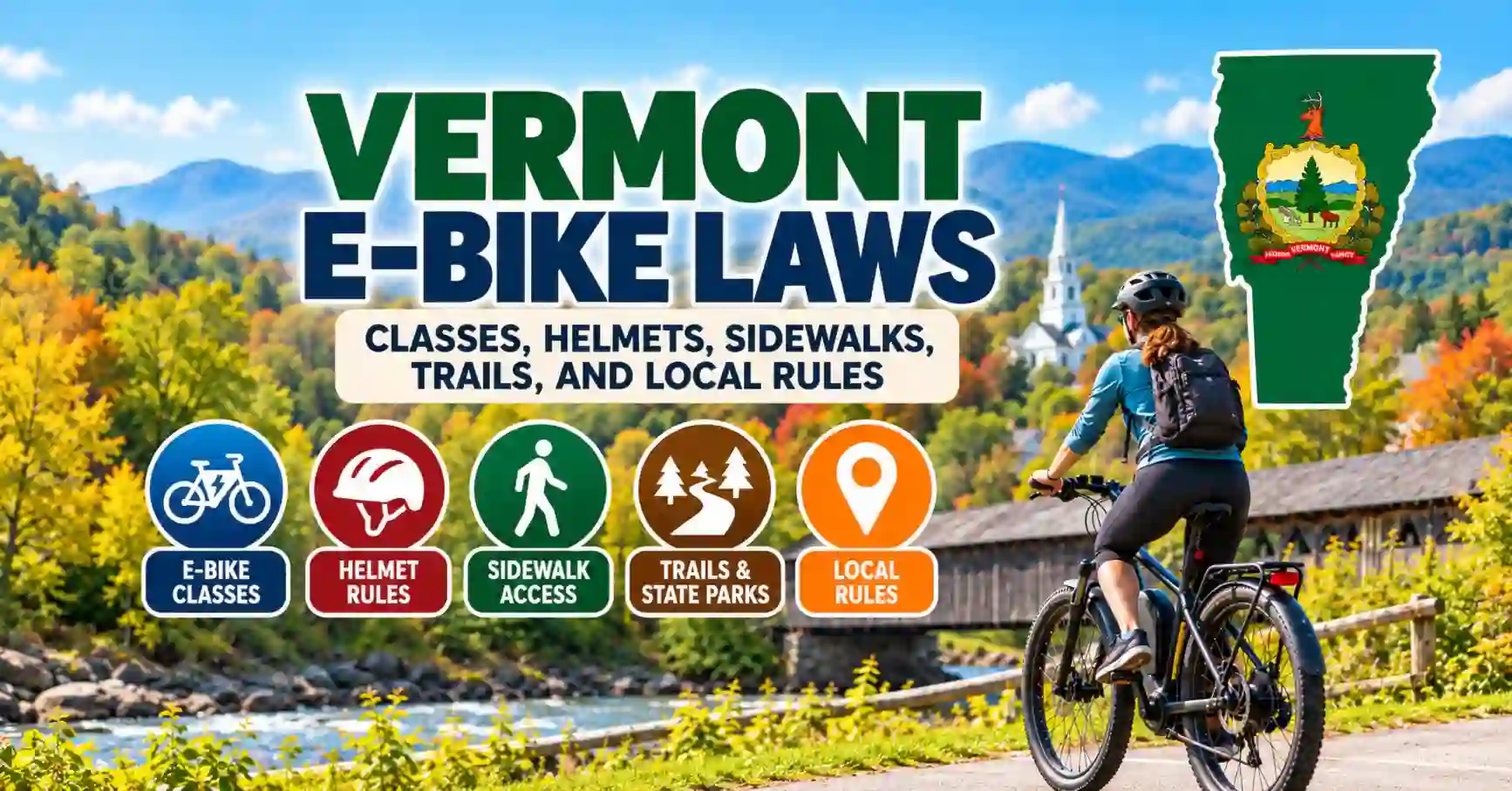
Vermont E-Bike Laws: Classes, Helmets, Sidewalks, Trails, and Local Rules
Last Updated on October 2, 2026 by Kristina
Last researched and verified: October 2026.
Vermont uses a three-class system for electric bicycles, but the statewide rules are only the starting point. A qualifying Vermont e-bike has fully operable pedals, a saddle or seat, an electric motor of less than 750W, and must fit the Class 1, Class 2, or Class 3 definition. Where you can ride can still change by city, trail manager, park, school, or campus.
If you are comparing Vermont with another state, start with my state-by-state e-bike law guide. If the class labels are confusing, my Class 1, Class 2, and Class 3 guide explains the basics. Sidewalk access can be especially local, so I also recommend checking my e-bike sidewalk law guide.
⚖️ Law Research Note
I reviewed current Vermont statutes, agency guidance, municipal rules, trail policies, and campus policies when this guide was updated. E-bike laws can change, and cities, parks, trails, campuses, and property managers may impose additional restrictions. Confirm current requirements and posted rules before riding.
Vermont E-Bike Laws: Key Takeaways
- Vermont recognizes Class 1, Class 2, and Class 3 electric bicycles.
- A qualifying electric bicycle must have fully operable pedals, a saddle or seat, and an electric motor of less than 750W.
- Class 1 and Class 2 motor assistance is limited to 20 mph. Class 3 pedal assistance is limited to 28 mph.
- Qualifying e-bikes do not need a Vermont motor-vehicle title, registration, inspection, operator’s license, or motor-vehicle financial-responsibility coverage.
- A rider must be at least 16 to operate a Class 3 e-bike. A younger person may ride as a passenger on a Class 3 e-bike designed to carry passengers.
- Class 3 e-bikes must have a speedometer.
- Vermont law generally allows qualifying e-bikes where bicycles are allowed, including highways, bicycle lanes, and bicycle or multiuse paths, but local authorities and land managers can restrict access.
- Natural-surface nonmotorized trails are controlled by the agency or authority that manages the trail.
- Vermont separately defines certain motor-assisted bicycles, including some electric bikes up to 1,000W that do not fit the three-class e-bike definition. Those vehicles have different rules.
Vermont E-Bike Law Quick Check
| Question | Statewide answer for a qualifying e-bike |
|---|---|
| Driver’s license required? | No |
| Registration required? | No |
| Title required? | No |
| Motor-vehicle inspection required? | No |
| State motor-vehicle financial-responsibility requirement? | No |
| Statewide helmet requirement? | I did not find one for qualifying Class 1, 2, or 3 e-bike riders in the current Vermont bicycle and e-bike statutes reviewed. Local or campus rules may differ. |
| Minimum age? | No statewide minimum age is stated for Class 1 or Class 2 in the e-bike statute. Riders must be 16 or older to operate Class 3. |
| Where can qualifying e-bikes ride? | Generally where bicycles are allowed, subject to class-specific and local restrictions. |
Who This Vermont E-Bike Guide Is For
This guide covers electric bicycles that meet Vermont’s legal definition. It does not assume that every electric two-wheeler with pedals is an e-bike. High-powered e-motos, motor-driven cycles, electric motorcycles, and some bikes in Vermont’s separate motor-assisted bicycle category can be regulated differently.
If you are unsure where your bike fits, check the motor wattage, assisted-speed settings, throttle behavior, pedals, and manufacturer’s class label before relying on ordinary e-bike rules.
Vermont’s Legal Definition and Three E-Bike Classes
Under Vermont law, an electric bicycle has fully operable pedals, a saddle or seat for the rider, an electric motor of less than 750W, and must fit one of three classes.
| Class | How the motor works | Assistance cutoff | Important Vermont rule |
|---|---|---|---|
| Class 1 | Pedal assist | 20 mph | Generally follows bicycle access rules, subject to local and trail restrictions. |
| Class 2 | Motor may propel the bike without pedaling | 20 mph | Generally follows bicycle access rules, subject to local and trail restrictions. |
| Class 3 | Pedal assist | 28 mph | Operator must be at least 16 and the bike must have a speedometer. |
Manufacturers and distributors must permanently label qualifying electric bicycles with the class number, top assisted speed, and motor wattage. Vermont also addresses modifications: if a person changes the motor-powered speed capability or motor engagement in a way that changes the bike’s classification information, the required class label must be replaced to match the modified bike.
Is My Bike Actually a Legal E-Bike in Vermont?
This is one of the most important Vermont-specific distinctions. Vermont has both an electric bicycle definition and a separate motor-assisted bicycle definition.
A qualifying three-class electric bicycle uses a motor of less than 750W. Vermont’s separate motor-assisted bicycle category can include an electric motor of up to 1,000W when the bike does not meet one of the three electric-bicycle classes and otherwise fits the motor-assisted-bicycle definition.
That distinction matters because the rules are not identical. For example, Vermont expressly prohibits a motor-assisted bicycle from being operated on a sidewalk, and a person under 16 may not operate a motor-assisted bicycle on a highway. Do not assume that a 750W, 1,000W, unlocked, modified, or e-moto-style vehicle automatically gets the same access as a legal Class 1, 2, or 3 e-bike.
Practical check: If your bike is advertised as 750W, read the actual legal motor rating and the bike’s class label carefully. Vermont’s Class 1-3 definition says the electric motor must be less than 750W.
License, Registration, Title, Inspection, and Insurance
For a qualifying Vermont electric bicycle, the state exempts the bike and rider from motor-vehicle registration, inspection, certificate-of-title, operator-license, and financial-responsibility requirements.
That does not mean insurance is useless. Homeowners, renters, bicycle, or specialty e-bike coverage can still matter for theft, damage, liability, or a higher-value bike. It simply means Vermont does not treat a qualifying e-bike like a motor vehicle for those state requirements.
Helmet and Age Rules
Vermont’s current electric-bicycle statute sets a specific age restriction for Class 3: an individual under 16 may not operate a Class 3 e-bike. The statute allows a younger person to ride as a passenger on a Class 3 e-bike that is designed to carry passengers.
I did not find a statewide helmet requirement for riders of qualifying Class 1, Class 2, or Class 3 e-bikes in the Vermont bicycle and e-bike provisions reviewed for this update. A city, school, campus, event, trail system, or private property owner can still impose additional safety requirements.
Even where a helmet is not legally required, I recommend wearing one, especially on Class 3 bikes, roads with faster traffic, and mixed-use paths where conflicts can happen quickly.
Parents, Passengers, and Cargo E-Bikes
Vermont’s bicycle rules say a bicycle cannot carry more people than it is designed and equipped to carry. That matters for cargo e-bikes, child seats, passenger pads, and long-tail bikes.
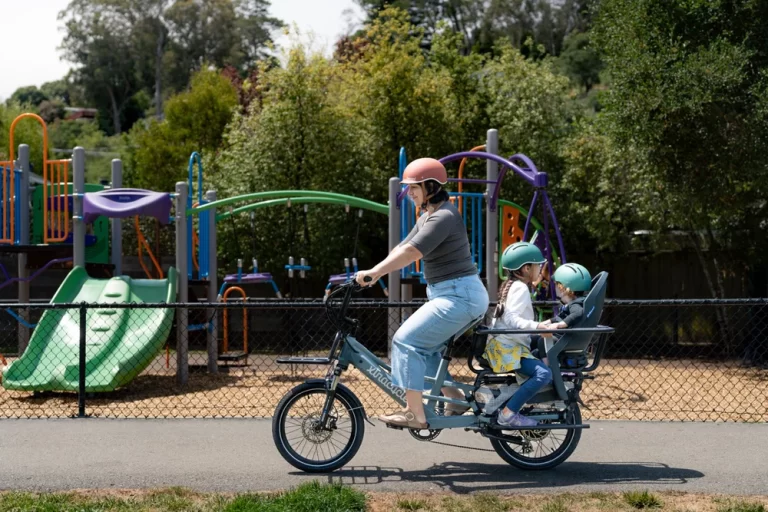
A child under 16 can be a passenger on a Class 3 e-bike if the bike is designed to accommodate passengers, but that same child cannot operate the Class 3 bike. If you use a cargo e-bike for family transportation, check the manufacturer’s passenger limits, approved seating, foot protection, and total payload in addition to the legal rules.
Roads, Bike Lanes, Sidewalks, and Multiuse Paths
Vermont’s statewide e-bike law generally allows qualifying electric bicycles in places where bicycles are allowed, including highways, bicycle lanes, and bicycle or multiuse paths. My broader e-bike rules of the road guide explains why the land manager and local ordinance still matter.
| Place | Vermont baseline | What to check |
|---|---|---|
| Public roads | Qualifying e-bikes generally follow bicycle rules. | Traffic-control signs, partially controlled-access highway restrictions, and local rules. |
| Bike lanes | Generally allowed where bicycles are allowed. | Posted restrictions and local ordinances. |
| Sidewalks | The electric-bicycle statute does not create a blanket statewide sidewalk permission or ban for qualifying e-bikes. Local bicycle rules matter. | City or town ordinance. Motor-assisted bicycles are expressly prohibited on sidewalks statewide. |
| Bicycle and multiuse paths | Generally allowed, but the authority controlling the path can impose class restrictions. | Class-specific bans and posted rules. |
| Natural-surface nonmotorized trails | No automatic statewide access rule. | The municipality, agency, or land manager controlling that trail. |
Why Local Rules Can Override the Statewide Baseline
Vermont gives municipalities, local authorities, and state agencies meaningful control over bicycle and multiuse paths. After notice and a public hearing, the authority responsible for a path can prohibit Class 1 or Class 2 e-bikes for specified safety or legal-compliance reasons. Class 3 e-bikes can also be prohibited from a bicycle or multiuse path.
Natural-surface trails have their own rule. If a trail is specifically designated nonmotorized and has a natural surface made from native soil without added surfacing material, the authority that manages it can regulate e-bike use directly.
Night Riding and Required Equipment
Because Vermont generally regulates qualifying e-bikes as bicycles, bicycle equipment rules are important.
- From one-half hour after sunset until one-half hour before sunrise, the bicycle or bicyclist must have a white front light visible from at least 500 feet.
- During those hours, the bicycle or rider must also have a red rear light visible from at least 300 feet or qualifying rear-facing reflective material or reflectors visible from at least 300 feet.
- A bicycle must have a brake capable of meeting Vermont’s statutory stopping-equipment standard.
- A Class 3 e-bike must have a speedometer showing speed in miles per hour.
Vermont Rail Trails
Vermont’s state rail-trail system is one of the clearest places where riders can find official e-bike guidance. Vermont Rail Trails says e-bikes are permitted on the state’s rail trails while motorbikes, motorized scooters, ATVs, and ORVs are not.
The four state rail trails are:
- Lamoille Valley Rail Trail
- Missisquoi Valley Rail Trail
- Delaware & Hudson Rail Trail
- Beebe Spur Rail Trail
Trail etiquette still matters. Riders should stay right except when passing, slow down before passing, communicate clearly, and yield appropriately to slower users, horses, and seasonal trail traffic. Posted signs at trail entrances remain important.
Vermont State Parks, State Forests, and Natural-Surface Trails
Do not assume the road rule follows you onto every trail. Vermont law specifically allows the manager of a natural-surface nonmotorized trail to regulate e-bike use.
Vermont’s Department of Forests, Parks and Recreation has been considering an updated e-bike policy for state lands. As of this October 2026 review, the department still describes the broader update as a draft proposal rather than a final statewide access rule. Until a final policy is adopted, check the current rule for the specific state park, state forest, road, or trail you plan to use.
Green Mountain National Forest and Other Federal Land
Federal land is a separate layer of regulation. Current U.S. Forest Service guidance for the Green Mountain and Finger Lakes National Forests says e-bikes, including pedal-assist e-bikes, are not allowed on Forest Service trails designated for nonmotorized use. E-bike access is available on motorized routes where the route designation and state law allow it.
That means a Vermont-legal Class 1 e-bike is not automatically legal on a nonmotorized Forest Service trail. Always check the current motor-vehicle-use map, trail designation, and posted signs before riding.
Vermont City and Town E-Bike Comparison
Local rules are one of the biggest reasons not to rely on a statewide summary alone. These examples show how access can change from one Vermont community to another.
| City or town | Current practical rule | What riders should know |
|---|---|---|
| Burlington | The Burlington Greenway rules expressly prohibit e-motos, motorcycles, and unauthorized vehicles. | Cyclists must obey signs and yield to pedestrians. Check posted Greenway rules before assuming a particular electric device is allowed. |
| South Burlington | On September 8, 2026, the City Council enacted e-mobility ordinance updates. | The updated rules prohibit e-moto devices with motors of 750W or higher on recreation paths, shared-use paths, and sidewalks. Legal Vermont e-bikes are distinct from those higher-powered e-moto devices. |
| Montpelier | Montpelier Parks has a restrictive e-bike trail policy. | Class 1 e-bikes are permitted on bike-legal park trails as a reasonable accommodation for people with a mobility disability. Class 2 and Class 3 e-bikes are not permitted on Montpelier Parks trails. |
| Colchester | Town guidance issued in June 2026 says legal e-bike riders using sidewalks, recreation paths, and public roads must yield to pedestrians, travel at safe speeds, and follow applicable traffic rules. | Colchester has also considered additional local e-bike restrictions in 2026. See my Colchester e-bike ordinance coverage and check the town’s current code before riding. |
| Middlebury | Middlebury College’s safety guidance reminds riders that bicycles are not permitted on sidewalks in downtown Middlebury. | Because qualifying e-bikes are generally treated as bicycles, riders should follow the current downtown bicycle ordinance and posted signs. |
Schools and Universities: Campus Rules Can Be Stricter
State law may let you ride an e-bike on a public road, but a college or university can impose separate rules for campus paths, buildings, storage, parking, registration, and charging.
| School | Current e-bike or micromobility rules checked | Why it matters |
|---|---|---|
| University of Vermont | UVM requires campus micromobility devices covered by its policy to be UL certified. Devices may not be stored or charged inside residential buildings. Charging is limited to sanctioned locations, and registered devices charged in an academic building must be supervised by the owner. | A bike that is legal under Vermont road law can still be barred from residence halls or from campus use if it does not meet UVM’s device requirements. |
| Middlebury College | Bicycles and micromobility devices must be registered with Public Safety. The college has designated parking rules and safety requirements, and its guidance points riders to the Town of Middlebury bicycle ordinance. | Students should check both campus policy and town rules, especially for downtown sidewalk riding, parking, and lithium-ion battery policies. |
| Vermont State University | VTSU says e-bikes, e-scooters, hoverboards, and other lithium-ion battery devices may not be stored or charged in campus buildings, including residence halls, academic buildings, and common areas. | Students need to use designated outdoor storage and charging areas and should confirm what is available at their specific campus. |
School rules can change between academic years. Students and parents should check the current transportation, residence-life, fire-safety, and student-handbook rules for the exact campus.
Helpful Gear for Riding
These items help you stay safe and follow the rules:
Real-World Vermont E-Bike Scenarios
Can a 15-year-old ride a Class 2 e-bike in Vermont?
The statewide electric-bicycle statute does not set a minimum operating age for Class 1 or Class 2. The specific under-16 restriction applies to operating Class 3. Local, school, trail, or property rules can still be stricter.
Can a 15-year-old ride a Class 3 e-bike?
No. Vermont law says an individual under 16 may not operate a Class 3 electric bicycle.
Can my child ride on the back of my Class 3 cargo e-bike?
Potentially, yes. Vermont allows a person under 16 to ride as a passenger on a Class 3 e-bike designed to accommodate passengers. The general bicycle rule also says you cannot carry more people than the bicycle is designed and equipped to carry.
Can I ride an e-bike on the Lamoille Valley Rail Trail?
Yes. Vermont Rail Trails currently says e-bikes are permitted on the state rail-trail system. Follow posted rules, ride at a reasonable speed, and yield appropriately.
Can I ride a Class 3 e-bike on every multiuse path?
No. Vermont allows the authority controlling a bicycle or multiuse path to prohibit Class 3 e-bikes. Always check the local rule and trail signage.
What if my bike has a 1,000W motor?
It does not meet Vermont’s Class 1-3 electric-bicycle definition, which requires a motor of less than 750W. Depending on its design and performance, it may fit Vermont’s separate motor-assisted bicycle definition or another vehicle category. That can change age, sidewalk, access, equipment, and other rules.
What if I unlock or modify my e-bike for more speed?
Changing the motor-powered speed capability or motor engagement can affect the bike’s legal classification. Vermont requires the class label to be replaced after a modification that changes those characteristics. More importantly, if the modified vehicle no longer fits a legal e-bike class, ordinary e-bike access rules may no longer apply.
Can Burlington or Montpelier restrict a bike Vermont law otherwise recognizes?
Yes, within the authority Vermont law gives local governments and land managers. A bike can meet the statewide e-bike definition and still be restricted on a particular city path, park trail, campus, or property.
Penalties and Enforcement
Vermont’s bicycle subchapter provides civil penalties for violations of sections 1136 through 1141. The general maximum is $25 per offense, while the statute provides a higher maximum for a specific roadway provision in section 1139(b). Local ordinances, campus policies, park rules, or a vehicle that falls outside the e-bike definition can involve different consequences.
The practical point is that the vehicle’s legal classification matters. A qualifying e-bike is treated differently from a motor-assisted bicycle, motor-driven cycle, motorcycle, or e-moto.
Nearby State Law Guides
Traveling outside Vermont? Laws change quickly. Check other states:
New Jersey e-bike laws
Rhode Island e-bike laws
Maine e-bike laws
Massachusetts e-bike laws
👉 Compare all states in the state-by-state e-bike law guide
Frequently Asked Questions About Vermont E-Bike Laws
Does Vermont require an e-bike license?
No. Operators of qualifying electric bicycles are exempt from Vermont’s motor-vehicle operator-license requirement.
Do I have to register or title an e-bike in Vermont?
No. Qualifying electric bicycles are exempt from motor-vehicle registration, inspection, and certificate-of-title requirements.
Does Vermont require e-bike insurance?
Qualifying electric bicycles are exempt from Vermont’s motor-vehicle financial-responsibility requirements. Optional bicycle, renters, homeowners, or specialty e-bike coverage is a separate question.
Are helmets required on Vermont e-bikes?
I did not find a statewide helmet mandate for riders of qualifying Class 1, 2, or 3 e-bikes in the current bicycle and e-bike statutes reviewed. A local authority, campus, event, or property manager can impose additional rules, and wearing a helmet is still a sensible safety practice.
Are e-bikes allowed on Vermont sidewalks?
For qualifying Class 1-3 e-bikes, Vermont’s electric-bicycle statute does not create a blanket statewide sidewalk permission or prohibition. Local bicycle ordinances matter. Vermont separately prohibits motor-assisted bicycles from sidewalks statewide.
Are e-bikes allowed on Vermont trails?
It depends on the trail. Vermont’s state rail trails expressly permit e-bikes, while natural-surface trail access can be regulated by the land manager. Green Mountain National Forest does not allow e-bikes on Forest Service trails designated for nonmotorized use.
Can a town ban Class 3 e-bikes from a path?
Yes. Vermont law allows a municipality, local authority, or state agency with jurisdiction over a bicycle or multiuse path to prohibit Class 3 e-bikes on that path.
Can a town restrict Class 1 or Class 2 e-bikes?
Yes, but the statewide statute describes a more specific process for a bicycle or multiuse path: following notice and a public hearing, the responsible authority may prohibit Class 1 or Class 2 operation when it finds the restriction is needed for safety reasons or compliance with other laws or legal obligations.
My Take
Vermont’s statewide e-bike structure is relatively easy to understand once you confirm that the bike actually fits the legal Class 1, 2, or 3 definition. The harder part is access. A bike that is legal on a state road or bike lane may face a different rule on a city path, natural-surface trail, state property, federal trail, or college campus.
The most useful habit is to check two things before riding somewhere unfamiliar: first, whether your bike is legally an electric bicycle under Vermont’s definition, and second, who manages the path or property. That prevents many of the common mistakes involving Class 3 bikes, 750W-or-higher devices, downtown sidewalks, and trail access.
Disclosure: As an Amazon Associate, I earn from qualifying purchases. This comes at no extra cost to you and helps support the content on this site.
Legal Disclaimer
This guide is for general informational purposes and is not legal advice. State, city, campus, park, trail, and property rules can change or differ. Confirm current requirements with the agency or authority responsible for the place where you plan to ride.
Official Sources
- Vermont Statutes – vehicle and electric bicycle definitions
- 23 V.S.A. § 1136a – electric bicycles
- Vermont Title 23, Chapter 13 – bicycle operation, equipment, and penalties
- Vermont Rail Trails – rules and permitted uses
- South Burlington – September 2026 e-mobility ordinance update
- University of Vermont – e-micromobility devices on campus
See something that may have changed? Please use the Electric Bike Explorer Report an Error page so I can review it.

Kristina is not just an enthusiast but a true authority on electric bikes. Nestled in the coastal beauty of Virginia, Kristina has found the perfect backdrop for her passion for electric biking. As a dedicated wife and homeschooling mom, her life revolves around family, faith, and the thrill of adventure.
Originally hailing from Ohio, Kristina's journey with electric bikes began as a curiosity and quickly evolved into a deep expertise. Her blog is a testament to her love for electric biking, combining her fascination for eco-friendly transportation with her coastal lifestyle.
When she's not cruising the beach on her electric bike, you'll find Kristina indulging in her other loves: long walks along the shore, getting lost in a good book, and cherishing moments with her loved ones. With a heart as big as her love for animals, especially cats, Kristina brings a unique perspective to the electric bike world, grounded in her strong faith in God and her dedication to a sustainable lifestyle.
Through her blog, Kristina shares her extensive knowledge of electric bikes, offering valuable insights, tips, and recommendations to fellow enthusiasts. Whether you're a seasoned rider or a newcomer to the electric bike scene, Kristina's blog is your go-to source for all things electric biking, fueled by her passion, expertise, and the scenic beauty of coastal Virginia.