Are Fat Tire E-Bikes Slower Than Regular E-Bikes? Real-World Answer
Last Updated on March 21, 2026 by Kristina
If you’re comparing fat tire e-bikes vs regular e-bikes, one of the most common questions is:
Are fat tire e-bikes actually slower, or do they just feel slower?
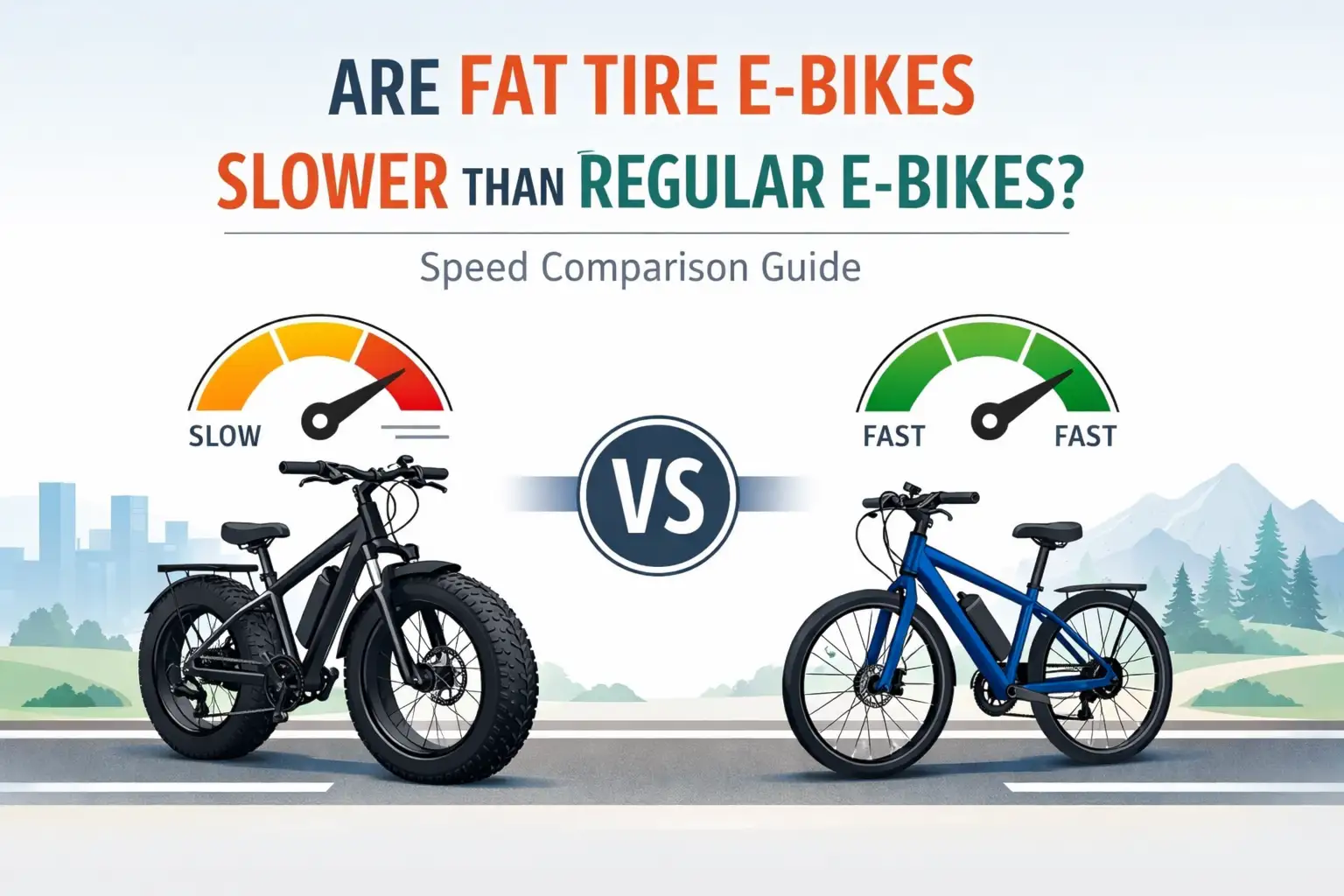
The short answer: Fat tire e-bikes are usually slightly slower on pavement, but not in every situation.
The real answer depends on how and where you ride. In some conditions, fat tire e-bikes can actually feel more efficient and more capable than regular e-bikes.
If you’re still figuring out what type of e-bike fits your riding style, start here:
➡️ E-Bike Buying Guide
And if speed is your main concern, you may also want to compare:
➡️ Fastest Legal E-Bikes
This guide breaks down the real-world differences in speed, efficiency, and performance so you can choose the right type of e-bike with confidence.
Who This Guide Is For (and Who It’s Not)
This guide is for you if:
- You’re deciding between a fat tire and regular e-bike
- You want real-world performance insights, not just specs
- You ride on mixed terrain (roads, gravel, trails, sand, or snow)
- You care about comfort, stability, and efficiency
This guide is not for you if:
- You’ve already decided on a lightweight commuter e-bike
- You’re comparing specific models instead of categories
If you mostly ride on pavement, a regular commuter e-bike will typically feel faster and more efficient.
Are Fat Tire E-Bikes Slower?
Yes – fat tire e-bikes are generally slower on pavement in terms of acceleration and efficiency.
However:
- They do not have a lower top speed
- Most e-bikes are limited to 20–28 mph based on class laws
What changes is how quickly and easily you reach and maintain that speed.
Most e-bikes in the U.S. are limited to Class 1, 2, or 3 speeds (20–28 mph), as defined by groups like PeopleForBikes, which means tire size does not affect legal top speed.
▶️ Watch: Are Fat Tire E-Bikes Really Slower?
If you want to see this explained visually, this quick video breaks it down in real-world terms:
How We Evaluate E-Bike Speed Differences
To make this guide accurate and practical, we focus on:
- Real rider feedback and riding experience
- Manufacturer specs (motor power, tire width, bike weight)
- Terrain-specific performance
- Battery usage and efficiency
This is not just about lab numbers – it’s about how the bike actually feels to ride.
What Actually Makes Fat Tire E-Bikes Slower?
Rolling Resistance (The Biggest Factor)
Fat tires are typically 4 inches wide or more, compared to 1.5–2.5 inches on standard e-bikes. That extra width creates more contact with the ground.
This leads to:
- Increased friction
- More energy required to maintain speed
- Reduced efficiency on smooth surfaces
According to the U.S. Department of Energy, rolling resistance is a major factor in how much energy a vehicle needs to move forward.
On pavement, this is the primary reason fat tire e-bikes feel slower.
Rotational Weight and Wheel Mass
Fat tire e-bikes don’t just weigh more overall – their wheels are heavier, especially at the outer edge.
This matters because:
- Rotational weight is harder to accelerate
- The motor has to work harder to spin the wheels
- Acceleration feels slower and less responsive
This is why fat tire e-bikes often feel “sluggish” compared to commuter models.
Tire Pressure and Energy Loss
Fat tires are designed to run at low pressure, usually between 5–20 PSI.
Lower pressure:
- Improves grip and comfort
- Increases surface contact
- Causes more energy loss as the tire deforms
This is beneficial off-road, but it reduces efficiency on pavement.
Motor Efficiency Under Load
Because of increased resistance and weight, fat tire e-bikes require more torque from the motor.
This can result in:
- Higher energy consumption
- Faster battery drain
- Slightly reduced sustained speed over long rides
How Fast Do Fat Tire E-Bikes Feel in Real Life?
Stop-and-Go City Riding
In urban environments with frequent stops:
- Fat tire e-bikes take longer to accelerate
- Regular e-bikes feel quicker and more responsive
This difference is most noticeable at intersections and traffic lights.
Long Commutes (10–20 Miles)
Over longer distances:
- Fat tire e-bikes feel heavier and require more effort
- Regular e-bikes maintain speed more easily
This makes commuter e-bikes a better choice for daily travel.
➡️ Related: Best E-Bike Battery Size for a 10–20 Mile Commute
Sand, Snow, and Loose Terrain
This is where fat tire e-bikes perform best.
- They maintain traction
- They avoid slipping
- They provide a smoother ride
In these conditions, they can actually feel faster overall because they keep moving consistently.
Mixed Terrain Riding
If your rides include both pavement and rough terrain:
- Fat tire e-bikes provide consistent performance across surfaces
- Regular e-bikes are faster on pavement but struggle off-road
Rider Fatigue Over Time
Fat tires absorb vibration and reduce impact.
This means:
- Less physical fatigue
- More comfortable long rides
- More consistent average speed
Even if peak speed is lower, comfort can improve overall riding performance.
Why Fat Tire E-Bikes Feel Slower (Even at the Same Speed)
Many riders report that fat tire e-bikes feel slower, even when traveling at the same speed.
This is due to:
- Increased rolling resistance feedback
- Less responsive acceleration
- A more stable, grounded riding feel
In contrast, regular e-bikes:
- Accelerate quickly
- Feel lighter and more agile
- Create a stronger sense of speed
This difference is largely psychological, not just mechanical.
Speed vs Comfort: What Matters More?
The difference between fat tire and regular e-bikes often comes down to trade-offs.
Fat tire e-bikes offer:
- Superior comfort
- Better shock absorption
- Increased stability
Regular e-bikes offer:
- Better efficiency
- Faster acceleration
- Longer range
In practical terms, the time difference over a 10-mile ride may only be a few minutes, but the riding experience can feel very different.
Speed vs Range Impact (Why Fat Tires Use More Battery)
Fat tire e-bikes typically use more battery because they require more energy to move.
Factors include:
- Increased rolling resistance
- Heavier weight
- Reduced coasting efficiency
Typical real-world comparison:
- Regular e-bike: ~40 miles
- Fat tire e-bike: ~30–35 miles
This difference becomes more noticeable over longer rides.
➡️ Learn more: Real-World E-Bike Range Explained
Interactive Tool: Estimate Your Range Impact
You can add this simple calculator to your page to help readers visualize the difference:
Estimate Your Fat Tire Range
Visual Explanation: Rolling Resistance
Think of it this way:
- A narrow tire concentrates force in a small area, allowing it to roll efficiently
- A fat tire spreads that force over a wider surface, increasing friction
The result:
- More grip and stability
- More energy required to maintain speed
This is the trade-off that defines fat tire performance.
How to Make a Fat Tire E-Bike Feel Faster
If you already own a fat tire e-bike, there are ways to improve performance:
- Increase tire pressure for pavement riding
- Reduce unnecessary weight
- Keep the drivetrain clean and lubricated
- Use pedal assist levels strategically
- Maintain a steady cadence
Small adjustments can noticeably improve how the bike feels.
When a Fat Tire E-Bike Is Not the Right Choice
A fat tire e-bike may not be ideal if:
- You ride exclusively on pavement
- You want maximum efficiency and range
- You need a lightweight bike for carrying or storage
- You prioritize speed over comfort
In these cases, a commuter e-bike is typically a better fit.
Fat Tire vs Commuter E-Bike (Quick Comparison)
| Feature | Fat Tire E-Bike | Commuter E-Bike |
|---|---|---|
| Speed Feel | Moderate | Faster |
| Comfort | High | Moderate |
| Efficiency | Lower | Higher |
| Stability | Very High | Moderate |
| Off-Road Use | Excellent | Limited |
For most road riders, commuter e-bikes will feel faster and more efficient.
Common Myths About Fat Tire E-Bikes
Myth: Fat tire e-bikes are slow
They are not slow – they are optimized for different conditions.
Myth: They have lower top speeds
Most e-bikes share the same legal speed limits.
Myth: They are only for off-road use
Many riders use them for daily commuting.
Safety and Riding Considerations
- Follow local e-bike laws
➡️ State-by-State E-Bike Laws Guide - Adjust tire pressure based on terrain
- Wear proper safety gear
For official safety recommendations and riding guidance, refer to the National Highway Traffic Safety Administration, which provides best practices for safe bicycle and e-bike operation.
Common Beginner Mistakes
- Choosing based on appearance instead of use
- Ignoring battery and efficiency differences
- Overestimating how often they will ride off-road
The best choice depends on how you actually plan to ride.
Which Should You Choose?
For most riders:
- Choose a regular e-bike for commuting and efficiency
- Choose a fat tire e-bike for comfort and mixed terrain
If you’re unsure, start here:
➡️ E-Bike Buying Guide
Final Thoughts
Fat tire e-bikes are not inherently slower – they are designed for a different purpose.
- On pavement, they are less efficient and feel slower
- On rough terrain, they are more stable and capable
The right choice depends on where you ride, not just how fast you want to go.
Read Me Next
Not sure where to go next?
If you’re still deciding, these links can help you narrow things down without starting over.
🔍 Learn the essentials (quick reads)
For riders who want confidence before buying.
🔄 Compare similar options
- Recommended Fat Tire E-Bikes
- Best Electric Bikes for Beginners
- Best Step-Through E-Bikes
- Best Budget E-bikes
- Most Comfortable City E-Bikes
- Top Commuter Ebikes
- Top Moped Style Ebikes
- Best Folding Ebikes
- Top Cargo Ebikes
🛒 Ready to buy?
See current availability from brands we trust.
External Sources

Kristina is not just an enthusiast but a true authority on electric bikes. Nestled in the coastal beauty of Virginia, Kristina has found the perfect backdrop for her passion for electric biking. As a dedicated wife and homeschooling mom, her life revolves around family, faith, and the thrill of adventure.
Originally hailing from Ohio, Kristina's journey with electric bikes began as a curiosity and quickly evolved into a deep expertise. Her blog is a testament to her love for electric biking, combining her fascination for eco-friendly transportation with her coastal lifestyle.
When she's not cruising the beach on her electric bike, you'll find Kristina indulging in her other loves: long walks along the shore, getting lost in a good book, and cherishing moments with her loved ones. With a heart as big as her love for animals, especially cats, Kristina brings a unique perspective to the electric bike world, grounded in her strong faith in God and her dedication to a sustainable lifestyle.
Through her blog, Kristina shares her extensive knowledge of electric bikes, offering valuable insights, tips, and recommendations to fellow enthusiasts. Whether you're a seasoned rider or a newcomer to the electric bike scene, Kristina's blog is your go-to source for all things electric biking, fueled by her passion, expertise, and the scenic beauty of coastal Virginia.