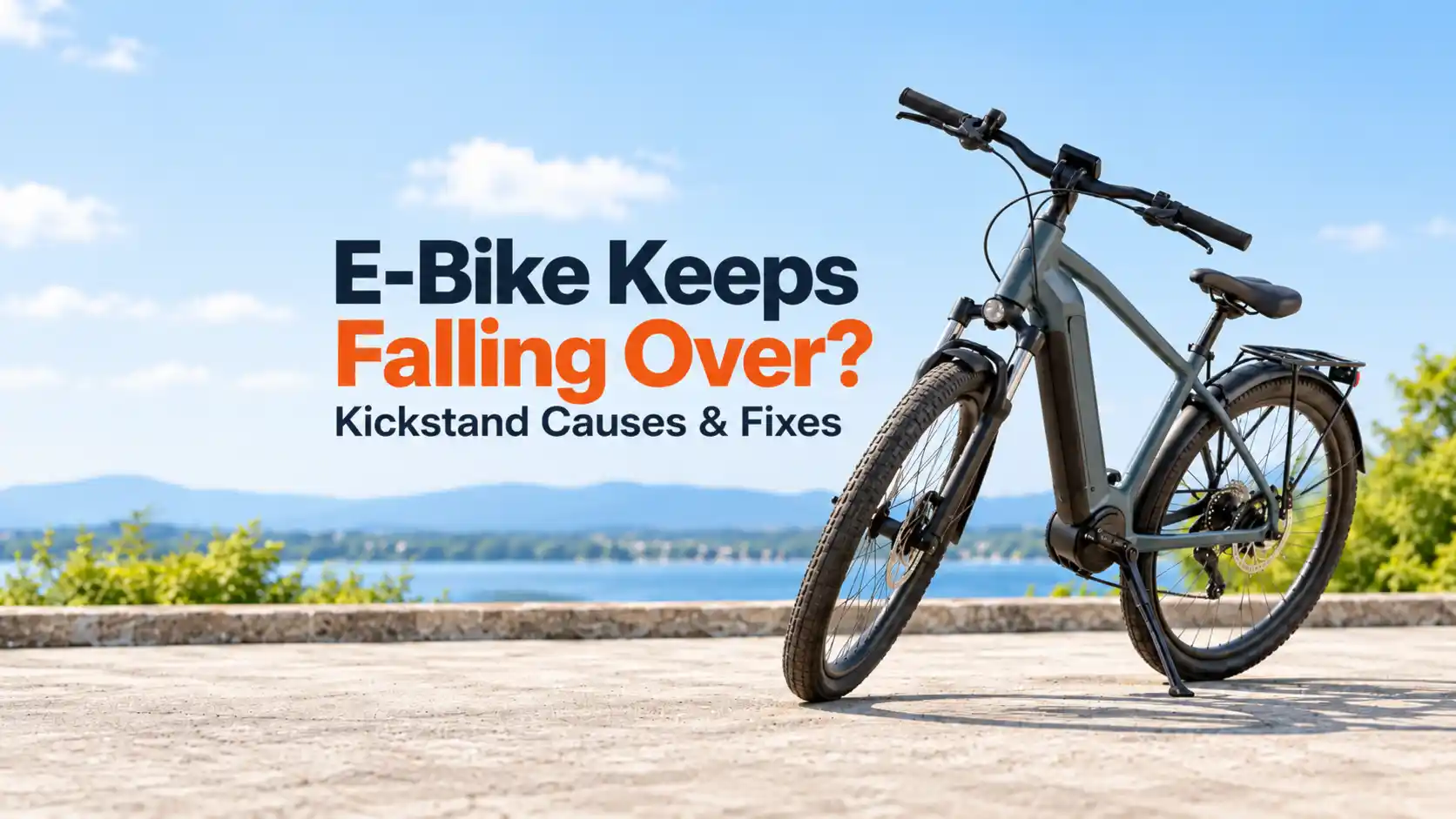
Why Does My E-Bike Keep Falling Over on Its Kickstand? Causes and Fixes
Last Updated on October 20, 2026 by Kristina

If your e-bike keeps falling over when you park it, the kickstand may be poorly adjusted, loose, damaged, or unsuitable for your bike. Uneven ground, heavy cargo, and changes in weight distribution can also cause problems.
Because electric bikes are often heavier than regular bicycles, a fall can damage expensive components, including the display, brake levers, handlebars, and battery housing.
The good news is that some kickstand problems can be corrected with a simple adjustment. Others require a compatible replacement or professional inspection.
This guide explains why your e-bike keeps tipping over, how to identify the cause, what you can safely check yourself, and when it’s time to replace the kickstand.
For help with other common problems, see my e-bike troubleshooting guide.
Why Does My E-Bike Keep Falling Over?
Common reasons include:
- Kickstand too long: The bike stands almost upright and can tip away from the supporting leg.
- Kickstand too short: The bike leans excessively, making parking awkward and potentially putting unsuitable loads on the stand.
- Loose mounting hardware: The stand moves or changes angle when the bike’s weight is applied.
- Soft or uneven ground: The foot sinks, slides, or loses reliable contact.
- Heavy or unbalanced cargo: Baskets, panniers, and other loads change the bike’s balance.
- Bent or worn kickstand: Damaged legs, pivots, adjustment mechanisms, or mounting components affect support.
- Incompatible kickstand: The stand may not suit the frame, mounting arrangement, or intended parking load.
Start here: With the bike powered off and securely supported, remove cargo and inspect the kickstand on firm, level ground. Look for visible damage, unintended movement, and an unusual lean angle.
If the bike cannot stand securely, don’t leave it unattended while troubleshooting.
Safety First: Protect Yourself and Your E-Bike
Before checking or adjusting the kickstand:
- Turn off the e-bike to prevent accidental motor activation.
- Remove heavy bags and other removable cargo.
- Keep the bike supported while examining the stand.
- Ask someone to help if the bike is too heavy to control safely.
- Keep fingers clear of folding stands, springs, pivots, and pinch points.
- Don’t sit on the bike while it rests on a conventional kickstand unless the manufacturer explicitly allows it.
- Never leave a child or passenger unattended on a parked e-bike.
Important: If the kickstand mount is cracked, bent, pulling away from the frame, or interfering with a wheel, chain, cable, or other component, stop and arrange an appropriate inspection. Don’t continue using a damaged support system.
A kickstand isn’t automatically designed to support a rider or passenger. Always follow the instructions for your particular bicycle.
E-Bike Kickstand Problems at a Glance
| What happens | Possible cause | First thing to check |
|---|---|---|
| Bike falls away from the kickstand | Stand too long or bike too upright | Kickstand length and parking angle |
| Bike leans excessively toward the stand | Stand too short, bent, or sinking | Stand condition and ground surface |
| Bike falls only with groceries loaded | Cargo changes the balance | Unloaded stability and weight distribution |
| Bike tips over on grass | Stand sinks into soft ground | Firm, level parking surface |
| Kickstand moves or rattles | Loose mounting hardware or worn pivot | Stand mount and adjustment mechanism |
| Bike tips when handlebars turn | Steering position changes the balance | Front-wheel position and attached accessories |
| Kickstand won’t remain extended | Damaged spring, pivot, or retention mechanism | Visible damage and normal operation |
| Bike suddenly started falling over | Recent adjustment, damage, or change in setup | What’s changed since it parked normally |
These symptoms provide clues, not a definite diagnosis.
Why Did My E-Bike Suddenly Start Falling Over?
If your e-bike parked normally for months and then started tipping over, something may have changed.
Before replacing the kickstand, think about when the problem began.
| Recent change | Why it might matter | What to inspect |
|---|---|---|
| Installed a basket or panniers | Added weight changes the bike’s balance | Cargo position and unloaded stability |
| Adjusted the kickstand | New length changes the lean angle | Adjustment mechanism and length |
| Bike recently fell over | Stand or mount may have been damaged | Leg, foot, pivot, bracket, and frame |
| Replaced tires or wheels | Wheel dimensions can affect the bike’s parked geometry | Tire size, fit, and stand adjustment |
| Bike now has a low tire | Tire height and bike lean can change | Tire condition and correct pressure |
| Started parking somewhere new | Ground may be softer or more sloped | Surface firmness and angle |
| Kickstand has become noisy | Hardware or pivot may be moving | Mounting bolts and worn components |
For example, if your bike used to stand securely but now tips over after you installed a rear basket, test it unloaded on level ground. If the problem disappears, the changed load is an important clue.
If the bike suddenly becomes unstable without any obvious change, inspect the kickstand and its mounting area for damage or movement before continuing to use it.
1. Your Kickstand Is Too Long or Too Short
Kickstand length affects how far an e-bike leans while parked.
Some e-bikes have adjustable kickstands, while others use a fixed-length design.
When the kickstand is too long
A long kickstand can leave the bike nearly upright.
That may look stable, but the bike can tip away from the supporting leg when the handlebars turn, the load shifts, or someone bumps it.
When the kickstand is too short
A shorter stand generally increases the bike’s lean toward the kickstand.
That can improve stability when a bike is otherwise standing too upright. However, excessive lean can make the bicycle awkward to park or lift, and may create unsuitable loading for some stands or mounting systems.
The goal isn’t to make the stand as short as possible. It’s to achieve the correct parking position for your particular bike.
How to adjust an e-bike kickstand
If your kickstand is designed to be adjustable:
- Put the bike on firm, level ground and support it securely.
- Locate the adjustment mechanism.
- Follow the manufacturer’s instructions to release the adjustment.
- Change the length slightly.
- Secure the adjustment according to the manufacturer’s procedure.
- Hold the bike while checking its new parking angle.
Repeat only as needed to achieve an appropriate position.
Ride1Up’s official kickstand adjustment and troubleshooting instructions explain how incorrect length can leave a bike too upright or leaning too far. The company also describes different adjustment mechanisms on certain models.
Don’t assume another brand’s adjustment instructions or tightening specifications apply to your bike.
2. Loose Kickstand Mounting Hardware
If the kickstand moves where it attaches to the frame, loose or damaged mounting hardware may be responsible.
You might notice:
- Rattling or clunking around the stand.
- Visible movement between the bracket and frame.
- Missing or partially backed-out fasteners.
- A stand that changes position when the bicycle’s weight rests on it.
- A gap where the mounting components should sit securely.
What to do
Support the bicycle before inspecting the mounting hardware.
If the manufacturer allows owner adjustment and the hardware is undamaged, follow its specified tightening procedure.
Use a torque wrench when a manufacturer-provided torque specification requires one.
Don’t assume that tightening a loose bolt as hard as possible is safe. Overtightening can damage threads, brackets, or the frame.
If the mount is cracked, the threads are stripped, or the hardware repeatedly becomes loose, have it inspected rather than continuing to retighten it.
3. You’re Parking on Soft, Slippery, or Uneven Ground
A perfectly good kickstand can become unreliable on the wrong surface.
Grass, dirt, and sand
A narrow kickstand foot may sink into soft ground. As it sinks, the supporting point moves and the bike’s lean changes.
Sloped pavement
Driveways, slanted sidewalks, and uneven surfaces can make the bike lean differently than it would on level pavement.
Slippery surfaces
A worn or damaged kickstand foot may have less grip on certain smooth or wet surfaces.
What helps
Choose firm, level ground whenever possible.
Avoid placing the foot in cracks, drains, loose gravel, or soft soil.
Inspect the foot for wear or missing parts. A compatible wider foot or parking pad may help distribute weight on suitable surfaces, but it won’t correct a damaged mount or an incorrectly adjusted stand.
Avoid improvised supports that could unexpectedly slide or collapse.
4. Heavy Baskets, Panniers, or Cargo Are Changing the Balance
An e-bike may park securely when empty and become unstable when loaded.
Cargo affects the bicycle’s center of gravity, particularly when weight is carried high or concentrated on one side.
A heavy rear basket, for example, can change how the bike rests on its stand.
The same can happen with a heavily loaded front basket or uneven panniers.
How to reduce the risk
Keep cargo within the bike’s approved weight limits and distribute it according to the manufacturer’s instructions.
Where possible, position heavier items low and avoid unbalanced loading.
When adding or removing cargo, hold the bike securely and follow its loading procedure.
A bike’s maximum payload rating is not the same as the weight its kickstand can safely support.
For example, Lectric’s XPedition 2.0 product and safety information warns owners to hold the bicycle while loading cargo or passengers and not to assume the kickstand alone will keep it stable.
Other cargo e-bikes use purpose-built stands with different instructions and limitations. Tern, for example, has model-specific passenger-loading requirements involving its double-leg stands.
Don’t assume every cargo-bike kickstand has the same capabilities.
For more information about the different weight limits on e-bikes, see my guide to how much weight an e-bike can carry.
5. Your Kickstand Is Bent, Damaged, or Worn Out
A kickstand can suffer damage from a fall, incorrect installation, excessive loading, or ordinary wear.
Look for:
- Bent supporting legs.
- Cracked mounting brackets.
- Missing bolts or adjustment pieces.
- Worn pivot components.
- Stripped adjustment threads.
- A foot that is damaged or missing.
- A folding mechanism that won’t stay in its intended position.
Should you straighten a bent kickstand?
I wouldn’t recommend trying to bend a damaged kickstand back into shape.
A visibly bent or cracked component may have lost strength, and straightening it may cause additional damage.
A compatible replacement is generally a better option when a stand is structurally damaged.
If your e-bike has already fallen over, don’t limit your inspection to the kickstand.
Check the brake levers, handlebars, controls, wheels, frame, battery housing, and other components that may have contacted the ground.
My e-bike post-crash inspection guide covers additional warning signs to look for before riding again.
6. The Kickstand Isn’t Compatible With Your E-Bike
Not every kickstand is suitable for every electric bike.
Compatibility depends on much more than whether the stand looks strong enough.
Some e-bikes have dedicated rear mounting points, while others use central brackets or manufacturer-specific systems.
A replacement may be the wrong length, use different mounting hardware, interfere with electrical cables, or place stress on an unsuitable section of the frame.
Don’t drill the frame or install a clamp-style stand in an unapproved location to make an incompatible product fit.
What to Check Before Buying a Replacement Kickstand
Use this checklist before ordering:
| What to verify | Why it matters |
|---|---|
| Bike make, model, and version | Similar-looking models may have different frames or mounts |
| Mounting type and location | Determines whether a stand can be installed as intended |
| Bolt-hole spacing | Replacement hardware must match the mounting design |
| Required stand length | Affects the parking angle |
| Weight and intended parking use | Determines whether the stand suits the bicycle and normal loads |
| Frame material and mounting restrictions | Some frames prohibit certain clamping methods |
| Motor-cable and drivetrain clearance | A stand must not pinch wiring or interfere with moving parts |
| Approved replacement parts | Manufacturer support may identify a suitable part |
Ride1Up’s kickstand support documentation is a useful example of why compatibility matters. The company identifies different mounting-bolt spacings on its bikes and warns owners about motor-cable positioning during replacement.
Those details should not be treated as universal dimensions for all e-bikes.
My recommendation: Start with an original replacement from your e-bike manufacturer. If it isn’t available, confirm compatibility with the stand manufacturer or a qualified bike shop.
A generic product advertised as a heavy-duty e-bike kickstand is not necessarily suitable for your frame.
7. The Front Wheel or Handlebars Are Changing the Bike’s Balance
Sometimes an e-bike becomes unstable only when its front wheel turns.
The steering position can change how the bike’s weight is distributed while parked.
A front basket, handlebar bag, or other accessory may make this more noticeable.
If your e-bike tends to fall after the handlebars swing to one side, pay attention to that pattern.
With the bicycle securely supported, compare its parked position with the front wheel straight and turned.
Don’t tighten the headset or steering bearings simply to stop the wheel from moving. Those components need correct adjustment for safe steering.
If an approved steering stabilizer or parking accessory is available for your bike, it may be worth considering.
Single-Leg vs. Double-Leg Kickstands: Which Is Better?
If the original kickstand is properly adjusted and undamaged but still doesn’t suit your parking needs, another design may be appropriate.
| Kickstand type | Potential advantage | Important limitation |
|---|---|---|
| Single-leg rear stand | Compact and convenient | Stability depends on lean, load, and surface |
| Single-leg center stand | Simple support for compatible frames | May be unsuitable for certain loading arrangements |
| Double-leg stand | Wider support arrangement on suitable bikes | Requires correct fit and approved loading |
| Purpose-built cargo stand | Designed for specific cargo-bike applications | Usually model-specific with its own restrictions |
Is a double-leg kickstand more stable?
On certain cargo and utility e-bikes, a compatible double-leg stand can provide better parking support.
However, double-leg designs aren’t automatically appropriate for every electric bike.
Tern’s HSD Gen 1 passenger safety guidance explains the role of its DuoStand as part of an approved passenger setup.
That doesn’t mean an aftermarket double-leg stand can safely support passengers on any bicycle.
Check the complete manufacturer’s instructions, including passenger-loading procedures and stand limitations.
A Simple 5-Minute Kickstand Troubleshooting Check
Before spending money on replacement parts, work through these steps:
- Remove cargo. Take off bags and other removable loads.
- Find level ground. Use a firm surface for the initial inspection.
- Power off the bike. Prevent unintended motor activation.
- Inspect for damage. Check the leg, foot, pivot, bracket, and adjustment mechanism.
- Look for loose hardware. Inspect the mounting area for unintended movement.
- Check the lean angle. Look for a bike that is nearly upright or leaning excessively.
- Adjust only if permitted. Follow the instructions for your exact kickstand.
- Retest while supporting the bike. Don’t let go until you have confirmed it can stand securely.
If the stand works when the bike is unloaded, consider whether cargo placement or your normal parking location is contributing to the problem.
Stop troubleshooting and seek assistance if you discover cracked components, damaged mounting points, stripped threads, or instability that can’t be corrected safely.
How to Park Your E-Bike Safely Until the Kickstand Is Fixed
What if you’ve identified the problem but need to wait for replacement parts?
The safest approach depends on the bike and the storage arrangement available to you.
Use an appropriate bicycle rack
A properly installed, fixed bicycle parking rack may offer an alternative way to support and secure the bike.
Make sure the bicycle can be positioned without falling, damaging its components, or obstructing a walkway.
Don’t assume a lock or cable alone will prevent the bike from tipping.
Consider a compatible freestanding floor stand
For home storage, some freestanding bicycle stands support the wheel or another designated part of the bike.
However, not all floor stands are suitable for heavy e-bikes, fat tires, cargo-bike dimensions, or bikes with unusual frame geometry.
Check compatibility, weight restrictions, and the manufacturer’s setup instructions.
Don’t improvise an unstable support
I wouldn’t rely on a loose chair, lightweight furniture, stacked blocks, or an unsecured object to keep a heavy e-bike upright.
A support that shifts unexpectedly can allow the bike to fall.
If you don’t have a safe storage arrangement, ask a bike shop about an appropriate temporary solution.
Keep the bike out of use if safety-critical damage is suspected
A damaged kickstand doesn’t always mean the e-bike itself is unsafe to ride. However, damage involving the frame mount, wheels, brakes, battery, or other safety-critical components needs proper assessment before riding.
For home storage alternatives, see my guide to vertical e-bike storage. Vertical storage is only appropriate when the bicycle and storage equipment are specifically suitable for it.
When to Replace the Kickstand
A replacement may be the appropriate solution when:
- The supporting leg or bracket is bent or cracked.
- The adjustment mechanism no longer holds securely.
- The pivot is excessively worn or damaged.
- Important parts are missing or cannot be replaced separately.
- The installed stand is incompatible with the bicycle.
- The manufacturer recommends replacement.
If the stand is undamaged and simply adjusted incorrectly, you may not need a new one.
If the frame’s mounting area is damaged, replacing the stand alone may not resolve the problem.
When to Contact the Manufacturer or a Bike Shop
If basic checks don’t identify the problem, manufacturer support or a qualified bicycle mechanic may be able to help.
Before contacting them, gather:
- Bike details: Make, model, and model year or version.
- Kickstand details: Whether it’s the original stand or an aftermarket replacement.
- Photographs: Show the entire bike while parked, the kickstand, mounting area, and any visible damage.
- Symptoms: Explain which direction the bike tips and when it happens.
- Parking conditions: Note whether the problem also occurs unloaded on level ground.
- Recent changes: Mention new accessories, adjustments, tire replacements, or falls.
If available, include a short video showing the issue without putting yourself or anyone else at risk.
Ask whether an approved replacement exists and whether the mounting system needs professional inspection.
If the bike is under warranty, check with the manufacturer before attempting repairs that could affect a warranty claim.
Helpful Accessories for a More Stable E-Bike
Depending on what’s causing the problem, several accessories may be useful.
A compatible replacement kickstand: Best when the existing stand is damaged or unsuitable. Confirm mounting compatibility and permitted loading before purchasing.
A wider kickstand foot or parking pad: May help distribute weight on appropriate surfaces. It won’t correct structural damage or poor adjustment.
Hex keys and a torque wrench: Useful for permitted owner maintenance when the manufacturer supplies the necessary fastener specifications.
A compatible freestanding parking stand: May be useful for home storage when the bicycle’s kickstand isn’t a suitable option.
For other practical ownership equipment, see my complete e-bike accessories guide.
What Not to Do
Avoid these common mistakes:
- Don’t bend a damaged kickstand back into shape.
- Don’t overtighten bolts or use incorrect mounting hardware.
- Don’t drill or modify the frame to fit an incompatible stand.
- Don’t attach a clamp-style stand to an unapproved frame section.
- Don’t assume an advertised heavy-duty kickstand is suitable for your bike.
- Don’t use unstable improvised supports to prevent falls.
- Don’t allow passengers to mount or remain unattended on a bike supported by its kickstand contrary to manufacturer instructions.
- Don’t repeatedly leave the bike in a position where it has already fallen over.
The objective is a reliable parking setup, not a temporary fix that works only under ideal conditions.
How to Prevent Future Kickstand Problems
Once the problem is fixed, a few habits can reduce the chance of another fall.
Choose a firm, level parking surface whenever possible.
Deploy the kickstand fully and check that it is supporting the bike properly before releasing your grip.
Keep cargo within approved limits and distribute loads appropriately.
Periodically inspect the stand for cracks, bending, loosening, and damaged components.
If the bike has fallen over or the kickstand has taken an unusual impact, inspect it before relying on it again.
You can also include a quick kickstand inspection in your regular routine using my e-bike maintenance checklist.
Frequently Asked Questions
Why does my e-bike fall over even though the kickstand looks fine?
An intact kickstand can still be incorrectly adjusted, loosely mounted, or unsuitable for the bicycle’s weight distribution. Ground conditions and cargo can also affect stability.
Should my e-bike lean a lot on its kickstand?
A single-leg kickstand normally requires the bicycle to lean toward the supporting leg. The appropriate angle varies by model. If the bike looks almost upright or leans excessively, check the manufacturer’s adjustment instructions.
Can I install a longer kickstand?
Possibly, if the replacement is compatible and provides the correct parking position. A stand that’s too long can leave the bike excessively upright and vulnerable to tipping away from the support.
Is a double-leg kickstand better for a heavy e-bike?
It can be a better choice for certain cargo or utility e-bikes, but only when the stand and mounting arrangement are approved for that use. A wider support design doesn’t eliminate load limits or loading precautions.
Can a kickstand damage an e-bike frame?
Yes. Incorrect installation, incompatible clamps, overtightened hardware, or a damaged mounting point can stress or damage the frame.
Is it safe to sit on an e-bike with the kickstand down?
Don’t assume it is. Conventional kickstands generally aren’t intended to support a seated rider. Some purpose-built cargo systems have specific loading procedures, but those instructions must be followed exactly.
What if the kickstand keeps loosening?
Check for damaged threads, incorrect hardware, worn components, or mounting-point problems. Repeated loosening deserves professional inspection rather than repeated tightening without identifying the cause.
Should I replace my kickstand after my e-bike falls over?
Not automatically. Inspect it for damage, movement, and proper operation. A bent, cracked, or otherwise compromised stand may need replacement. Also check the rest of the bike for impact damage before riding.
Why You Can Trust Electric Bike Explorer
Electric Bike Explorer focuses on practical ownership guidance that helps riders identify problems and make informed decisions.
This guide draws on manufacturer kickstand documentation, cargo e-bike safety instructions, and established maintenance principles. It does not claim firsthand testing of every kickstand design. Where adjustment methods, compatibility, and load limits vary, the manufacturer’s specific instructions take priority.
My Take
I think the kickstand is one of those e-bike components that’s easy to overlook until you have a problem with it.
When buying an electric bike, most of us naturally focus on the battery, motor, range, and brakes. But being able to park a heavy bike without worrying about it falling over is important too.
I wouldn’t automatically buy a replacement kickstand as the first step.
I’d start by checking the parking surface, the stand’s adjustment, and whether anything has changed recently. An added basket, loose fastener, or unsuitable parking angle may explain the problem.
On the other hand, if the stand is damaged, repeatedly becomes loose, or simply isn’t suitable for the bike, replacing it with an approved part makes more sense than trying to work around the issue.
The important thing is to find the actual cause and make sure the bike has a reliable parking arrangement.
If you’re dealing with other e-bike problems, my e-bike troubleshooting guide is a good place to continue.
Find Electric Bike Explorer helpful? Consider adding EBE as a preferred source in Google Search for more practical e-bike guides.
Sources and Further Reading
- Ride1Up – Kickstand Adjustment, Replacement, and Troubleshooting
- Lectric eBikes – XPedition 2.0 Product Information and Safety Guidance
- Tern Bicycles – Safely Carrying Passengers on the HSD Gen 1

Kristina is not just an enthusiast but a true authority on electric bikes. Nestled in the coastal beauty of Virginia, Kristina has found the perfect backdrop for her passion for electric biking. As a dedicated wife and homeschooling mom, her life revolves around family, faith, and the thrill of adventure.
Originally hailing from Ohio, Kristina's journey with electric bikes began as a curiosity and quickly evolved into a deep expertise. Her blog is a testament to her love for electric biking, combining her fascination for eco-friendly transportation with her coastal lifestyle.
When she's not cruising the beach on her electric bike, you'll find Kristina indulging in her other loves: long walks along the shore, getting lost in a good book, and cherishing moments with her loved ones. With a heart as big as her love for animals, especially cats, Kristina brings a unique perspective to the electric bike world, grounded in her strong faith in God and her dedication to a sustainable lifestyle.
Through her blog, Kristina shares her extensive knowledge of electric bikes, offering valuable insights, tips, and recommendations to fellow enthusiasts. Whether you're a seasoned rider or a newcomer to the electric bike scene, Kristina's blog is your go-to source for all things electric biking, fueled by her passion, expertise, and the scenic beauty of coastal Virginia.