How Fast Do Electric Scooters Go? Real-World Speeds and Legal Limits
Last Updated on September 9, 2026 by Kristina
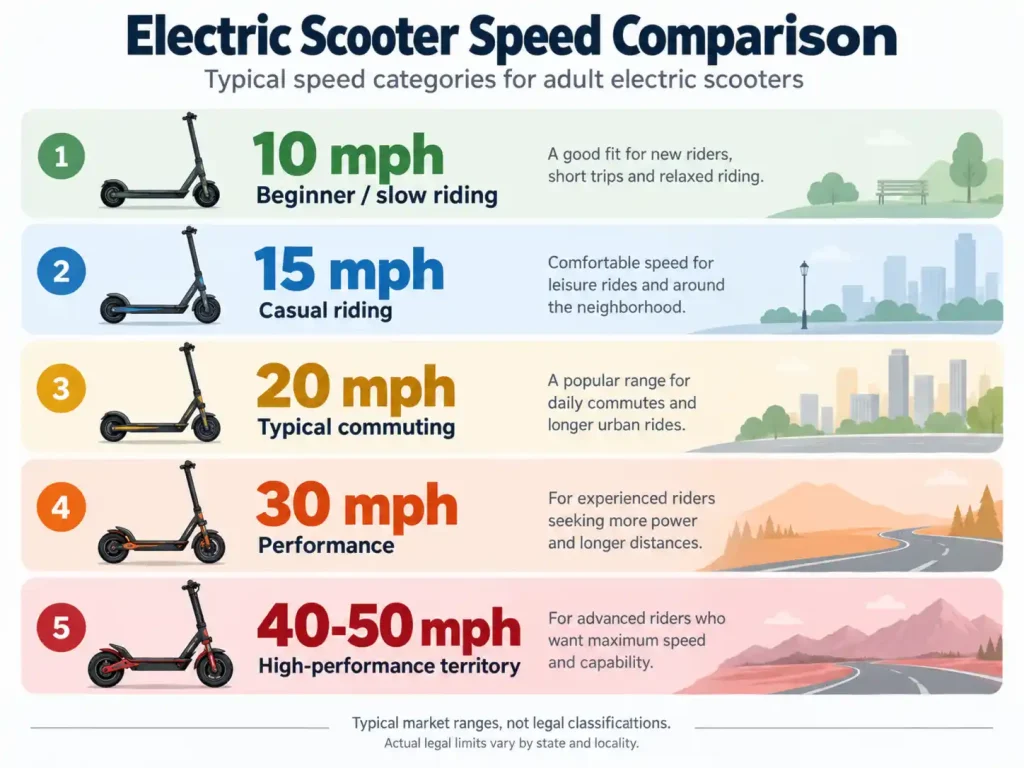
Electric scooters can be surprisingly fast. Many everyday commuter models are designed for speeds around 15 to 25 mph, while faster commuter and performance scooters can reach 30, 40, or even close to 50 mph.
But the number printed on a product page is only part of the story.
Your actual speed depends on the scooter, riding mode, rider weight, hills, wind, battery charge, tire condition, and other factors. Just as important, a scooter’s maximum capability may be much higher than the speed you can legally ride on public roads, bike lanes, or paths.
If you’re comparing speed with distance, my guide to how far an electric scooter can go explains why faster riding usually reduces range. Before buying a particularly fast model, I also recommend checking my Electric Scooter Laws by State guide because a scooter that can reach 30, 40, or 50 mph may not fit your state’s ordinary electric-scooter definition.
How Fast Do Electric Scooters Go?
Here is a useful general guide:
| Type of electric scooter | Typical advertised top-speed range |
|---|---|
| Lightweight or entry-level scooter | 15-18 mph |
| Everyday commuter scooter | 18-25 mph |
| Faster commuter scooter | 25-30 mph |
| Performance scooter | 30-40 mph |
| High-performance scooter | 40-50+ mph |
These are general market categories, not legal classifications.
Current manufacturer lineups show how wide the range has become. NIU lists models such as the KQi1 Sport at 15.5 mph, the KQi2 Pro at 17.4 mph, and several commuter models around 20 mph. At the faster end, Segway currently lists the MAX G3 at up to 28 mph, the GT3 at 31 mph, and the GT3 Pro at approximately 49.7 mph.
Those figures are manufacturer specifications. They should not be treated as a promise that every rider will achieve that speed under every condition.
What Electric Scooter Speed Is Right for You?
The fastest scooter is not automatically the best scooter.
I would start with the type of riding you actually plan to do:
| Riding situation | Practical speed category to consider | What matters besides speed |
|---|---|---|
| Learning or casual riding | Around 10-15 mph | Predictable controls, braking, stability |
| Neighborhood trips | Around 15-20 mph | Visibility, comfort, brakes |
| Everyday commuting | Around 18-25 mph | Range, tires, brakes, portability |
| Faster or longer commuting | Around 25-30 mph | Suspension, braking, stability, local laws |
| Performance riding | 30+ mph | Legal riding location, tires, chassis, brakes, protective equipment |
These are not safety ratings or legal recommendations. They are a practical way to think about how much performance you actually need.
A commuter carrying a scooter upstairs every day may be much happier with a 20 mph model weighing around 35 to 40 lb than with a 50 mph machine weighing more than 100 lb.
Segway’s current GT3 Pro is a good example. It is capable of approximately 49.7 mph, but it also weighs about 117 lb. Segway’s product page specifically says that model can only be used on private property and tells riders to follow local regulations.
How Fast Does 10, 15, 20, or 30 MPH Actually Feel?
Speed can be difficult to appreciate from an mph number alone.
One useful way to think about it is how much ground you cover every second:
| Speed | Distance traveled each second |
|---|---|
| 10 mph | About 15 feet |
| 15 mph | About 22 feet |
| 20 mph | About 29 feet |
| 25 mph | About 37 feet |
| 30 mph | About 44 feet |
| 40 mph | About 59 feet |
| 50 mph | About 73 feet |
That helps explain why even 15 or 20 mph deserves attention on a stand-up scooter.
At 20 mph, you are moving almost 30 feet every second. A pothole, opening car door, pedestrian, curb edge, patch of gravel, or vehicle entering your path can arrive very quickly.
The subjective experience also changes with speed. Rough pavement that seems minor at 10 mph can become much more important at 25 or 30 mph because scooters have relatively small wheels and a standing riding position.
The U.S. Consumer Product Safety Commission specifically warns riders to watch for obstacles and uneven surfaces because the small tires used by e-scooters can stop suddenly when they hit certain hazards.
Is 15 MPH Fast on an Electric Scooter?
Yes. 15 mph is enough speed for many scooter riders, especially beginners, casual riders, and people traveling in busy areas.
At 15 mph, you cover about 22 feet every second.
That may not sound fast when compared with driving a car, but the experience is different when you are standing on a relatively small platform with small wheels and no protective structure around you.
For a newer rider, I would value predictable controls, stable handling, good tires, and dependable brakes more than an unnecessarily high maximum speed.
Is 20 MPH Fast Enough for an Electric Scooter?
For many commuters, 20 mph is a very useful maximum speed.
A current commuter such as the Segway E3 Pro, for example, is rated at approximately 20 mph. NIU also sells several current commuter scooters around the 20 mph mark.
Twenty mph is fast enough to cover short urban trips efficiently without automatically moving into the much heavier performance-scooter category.
If you’re shopping for a daily-use model rather than chasing maximum speed, my Best Electric Scooters for Adults guide compares scooters based on range, comfort, weight, braking, and other ownership factors as well.
20 MPH vs. 30 MPH: How Much Time Do You Really Save?
One reason people buy faster scooters is to shorten a commute.
But the theoretical time savings may be smaller than expected.
For a 10-mile trip with no stops at all:
| Constant speed | Theoretical travel time |
|---|---|
| 15 mph | 40 minutes |
| 20 mph | 30 minutes |
| 25 mph | 24 minutes |
| 30 mph | 20 minutes |
Going from 20 to 30 mph would theoretically save 10 minutes over 10 miles.
Real-world city riding usually reduces that advantage because you still have traffic lights, intersections, turns, pedestrians, traffic, and places where slowing down is necessary.
For a 3- or 5-mile commute, a dramatically faster scooter may therefore save less time than the headline speed difference suggests.
Top Speed vs. Cruising Speed
A scooter’s top speed and the speed you actually want to maintain for most of a trip are not necessarily the same.
Top speed tells you approximately how fast the scooter can go under the manufacturer’s stated conditions.
Cruising speed is the speed at which you actually spend much of your ride.
A scooter capable of 25 or 28 mph may still be perfectly useful when ridden around 15 or 20 mph. In fact, slowing down can improve range and may make rough pavement, traffic, and unexpected hazards easier to manage.
Current scooters increasingly offer multiple speed modes for exactly this reason.
For example, Segway lists the MAX G3 at approximately 20 mph in its factory-default condition, with up to 28 mph available after enabling the higher-speed setting through the Segway Mobility App. NIU also provides riding modes and adjustable maximum-speed settings on some models.
Whether a higher mode is legal to use on public property is a separate question.
Acceleration and Top Speed Are Not the Same Thing
Another specification buyers often confuse is acceleration.
Top speed tells you the maximum speed the scooter can reach.
Acceleration tells you how quickly it gets there.
A scooter that reaches 20 mph quickly may feel much stronger in stop-and-go city riding than a scooter with a higher theoretical top speed but slower acceleration.
Acceleration also matters on hills and when starting with a heavier rider.
Manufacturers sometimes publish both figures. Segway, for example, currently lists the MAX G3 with a 28 mph maximum speed and a claimed 0-to-15 mph acceleration time of about 2.4 seconds in Boost Mode under its stated conditions.
That does not mean every rider needs aggressive acceleration. Smooth, predictable power delivery can be more useful for beginners and crowded riding environments.
Can Electric Scooters Go 30 MPH?
Yes. There are plenty of higher-performance scooters capable of reaching approximately 30 mph or more.
Segway currently rates the GT3 at 31 mph, while its MAX G3 can reach approximately 28 mph when its high-speed setting is enabled.
Once you reach this performance level, I think the buying decision needs to change.
Instead of asking only, “How fast does it go?” I would also ask whether it has suitable brakes, tires, suspension, lighting, steering stability, payload capacity, electrical safety documentation, and a legal place where you can actually use that performance.
Can Electric Scooters Go 40 or 50 MPH?
Yes.
High-performance electric scooters can reach speeds approaching 50 mph. Segway currently lists the GT3 Pro at approximately 49.7 mph, with dual motors rated for a combined maximum output of 7,000W.
But a scooter’s ability to reach 50 mph does not mean you can legally operate it at 50 mph on a public street, bike lane, sidewalk, trail, or shared-use path.
In some states, the bigger issue is that a scooter capable of those speeds may not fit the state’s legal definition of an electric scooter at all.
That distinction is extremely important when shopping for high-performance models.
What Determines How Fast an Electric Scooter Goes?
Motor Power
Motor power matters, but it does not tell you the whole story.
More available power can improve acceleration, climbing ability, and the scooter’s ability to maintain speed under load.
But two scooters with similar wattage ratings can still have different maximum speeds.
Battery Voltage and Power Delivery
Battery voltage, available current, motor design, and controller programming work together to determine how much electrical power reaches the motor.
A higher-voltage system can support higher performance when the rest of the scooter is designed around it, but voltage alone does not determine top speed.
Controller and Software
The controller determines how power is delivered to the motor, while software may set different limits for Eco, Drive, Sport, or other riding modes.
Manufacturers can therefore electronically restrict a scooter even when its hardware could potentially produce more performance.
Rider Weight
A heavier total load requires more energy to accelerate and climb.
On a speed-limited scooter riding on flat pavement, rider weight may not change the programmed maximum speed very much if the motor has enough power to reach it.
On hills or less powerful scooters, however, additional weight can make a much larger difference.
Always stay within the manufacturer’s stated payload limit.
Hills
Hills are where power differences become especially noticeable.
A scooter that reaches 20 mph on flat pavement may slow significantly on a steep climb.
For hilly routes, motor output, controller settings, battery performance, total weight, motor configuration, and heat management can matter more than the advertised flat-ground top speed.
Battery Charge
Some scooters cannot maintain their strongest performance as battery charge falls.
The exact behavior varies by model and battery-management system, so a top-speed test performed on a full battery may not represent the scooter’s performance near the end of a ride.
Wind
Headwinds increase the amount of work required to maintain speed.
The effect becomes more important as speed rises because aerodynamic drag increases substantially with velocity.
Tires and Tire Pressure
Tires affect rolling resistance, grip, comfort, and handling.
Low tire pressure can increase rolling resistance and reduce efficiency. Always use the pressure range recommended by the manufacturer instead of overinflating a tire in an attempt to make the scooter faster.
Does More Watts Mean a Faster Electric Scooter?
Not necessarily.
A 1,000W scooter is not automatically twice as fast as a 500W scooter.
Extra power may instead be used for stronger acceleration, better hill climbing, carrying heavier loads, maintaining speed, or powering multiple motors.
Top speed depends on the entire system – including the motor, controller, voltage, software, wheel size, vehicle weight, and design.
This is why comparing scooters only by motor wattage can be misleading.
Does Tire Size Affect Electric Scooter Speed?
Tire and wheel size can affect the way a scooter accelerates, handles obstacles, and feels at speed, but wheel diameter alone does not determine top speed.
Larger tires can offer useful advantages for stability and rolling over pavement imperfections. Smaller wheels can make a scooter more compact and may respond differently to acceleration.
But the final maximum speed still depends on the motor, controller, battery, software, gearing or motor characteristics, and overall design.
For most riders, I would pay at least as much attention to tire quality and condition as tire diameter.
CPSC specifically recommends inspecting scooter tires, brakes, handlebars, throttle, lights, cables, and frame before riding.
Why Electric Scooter Dashboard and GPS Speeds May Differ
Do not be surprised if a scooter dashboard and a phone or GPS device show slightly different numbers.
Neither reading should automatically be treated as a laboratory-grade measurement. GPS measurements can be affected by signal conditions, while the scooter’s own display depends on the way that particular model calculates and presents speed.
For normal riding, a small discrepancy is less important than understanding the manufacturer’s rated maximum speed and obeying the applicable speed limit.
For legal classification, I would not assume that a single GPS reading or dashboard setting changes what the vehicle legally is. Some state definitions look at what the device is capable of doing, not merely the speed selected at a particular moment.
Why Riding Faster Reduces Electric Scooter Range
One of the biggest reasons not to focus exclusively on top speed is battery consumption.
Higher speeds increase aerodynamic resistance, while hard acceleration also demands more power.
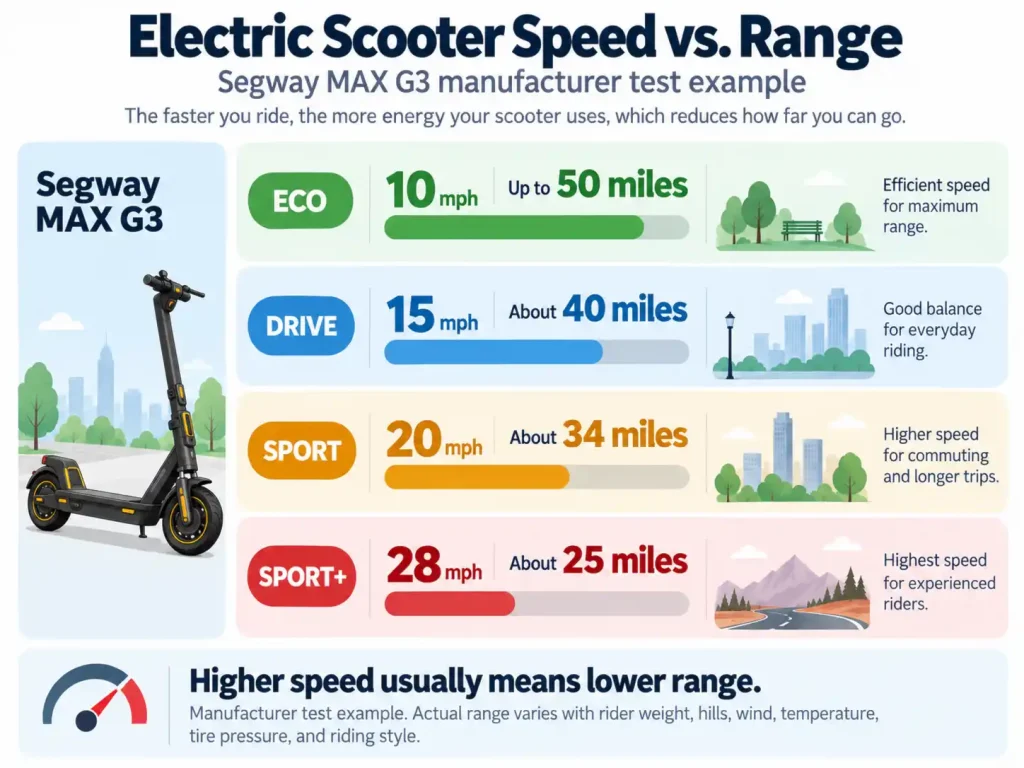
Current manufacturer testing gives us a particularly useful illustration.
Segway lists its MAX G3 with approximately:
| Riding speed/mode | Manufacturer-listed range |
|---|---|
| About 10 mph | Up to 50 miles |
| About 15 mph | About 40 miles |
| About 20 mph | About 34 miles |
| About 28 mph | About 25 miles |
Those figures come from Segway’s own controlled testing and are not guaranteed real-world results, but they clearly show how much speed can affect energy use on the same scooter.
The GT3 Pro shows the same pattern at the extreme end. Segway lists approximately 85.7 miles of maximum range at 15.5 mph but only about 34.2 miles at its approximately 49.7 mph maximum speed under its stated conditions.
So when you see a scooter advertised with both a very high top speed and a very long range, check the speed used for the range test.
You usually should not assume you can achieve maximum speed and maximum range at the same time.
My real-world electric scooter range guide goes deeper into battery capacity, hills, rider weight, temperature, and other factors.
How Riding Style Affects Range
| Riding behavior | Likely effect on range |
|---|---|
| Moderate, steady speed | Better efficiency |
| Frequent hard acceleration | Lower range |
| Sustained high speed | Lower range |
| Hills combined with high speed | Heavy battery demand |
| Low tire pressure | Lower efficiency |
| Strong headwind | Lower range |
The exact percentage will vary too much by scooter and riding conditions for one universal number to be useful.
Why Speed Makes Braking More Important
Speed changes crash and stopping dynamics much more than many riders realize.
Kinetic energy increases with the square of speed.
All else being equal, an object moving at 20 mph has about 78% more kinetic energy than the same object moving at 15 mph.
At 30 mph, it has about 2.25 times the kinetic energy it has at 20 mph.
Braking distance follows a similar physics problem under simplified constant-deceleration conditions: as speed rises, the distance required to stop after braking begins increases much faster than the speed number itself.
Real-world stopping distance is more complicated. It depends on brake performance, tire grip, pavement, weather, rider weight, technique, reaction time, suspension, and other factors.
Reaction time matters too.
At 20 mph you travel about 29 feet in one second.
At 30 mph you travel about 44 feet in one second.
That distance can pass before meaningful braking even starts if it takes the rider roughly a second to recognize and react to a hazard.
I would therefore never judge a 30 or 40 mph scooter only by how quickly it accelerates. How confidently it can slow down is just as important.
Brakes Matter as Much as Top Speed
Depending on the model, electric scooters may use:
- Drum brakes
- Mechanical disc brakes
- Hydraulic disc brakes
- Electronic or regenerative braking
- A combination of mechanical and electronic braking
Brake type alone does not tell you exactly how well a scooter stops, either. Rotor size, tire grip, weight distribution, setup, maintenance, and control tuning also matter.
CPSC recommends inspecting the brakes and other major components before riding.
As scooter performance rises, I would pay increasingly close attention to braking hardware, tire condition, steering stability, suspension, lighting, and the overall chassis.
How Fast Can You Legally Ride an Electric Scooter?
There is no single nationwide electric-scooter operating-speed rule that answers this question everywhere in the United States.
State definitions and operating rules vary, and cities or other local authorities may add additional restrictions.
Another complication is that maximum vehicle capability and legal operating speed can be two different numbers.
California
California DMV currently states that a motorized scooter cannot exceed 15 mph when operated.
That is an operating limit. Riders should also check the state’s other motorized-scooter rules and any applicable local restrictions before riding.
New York
New York is one of the clearest examples of why vehicle definition and riding speed should not be confused.
New York DMV says an electric scooter under state law has a motor-powered maximum speed of no more than 20 mph on a paved level surface.
But the state operating rule says it is illegal to ride an electric scooter over 15 mph. Municipalities may also regulate where and how scooters can be operated.
The New York Attorney General repeated that distinction in a July 31, 2026 consumer alert and warned that electric vehicles exceeding the state’s legal e-scooter limits may instead fall into categories such as e-motos, mopeds, or motorcycles.
Florida
Florida’s 2026 statutes define a motorized scooter as a motor-powered vehicle or micromobility device with no more than three wheels that is not capable of propelling the vehicle faster than 20 mph on level ground.
Florida law also gives local governments authority to regulate motorized scooters on streets, highways, sidewalks, and sidewalk areas under their jurisdiction.
The wording “not capable of” is important.
A scooter capable of 35 or 40 mph may not become a qualifying Florida motorized scooter simply because you personally promise to keep it under 20 mph.
This is why I recommend checking the Electric Scooter Laws by State guide before purchasing a high-speed scooter.
Does Using a Lower Speed Mode Make a Fast Scooter Legal?
Not necessarily.
Some scooters allow you to choose a lower maximum speed through an app or riding mode.
That can be very useful for learning, saving battery, or riding more comfortably.
But legal classification is a different issue.
If a state’s definition is based on the vehicle’s maximum capability, selecting a 15 or 20 mph riding mode may not transform a 40 mph performance vehicle into a legally defined low-speed electric scooter.
Florida’s current definition, for example, uses whether the vehicle is capable of exceeding 20 mph on level ground. New York’s definition similarly limits qualifying e-scooters to a maximum speed of no more than 20 mph.
Always check the exact wording of your state and local law.
How Fast Should a Beginner Ride?
You do not need to ride at the scooter’s maximum speed.
For a new rider, I would first become comfortable with smooth starts, progressive braking, turning, scanning the pavement, controlling downhill speed, looking behind safely, and responding to unexpected hazards.
Use a lower riding mode if your scooter provides one.
CPSC recommends wearing a bicycle helmet, following local traffic laws, checking the scooter before riding, slowing for obstacles, and keeping both hands on the handlebars.
A controlled 12 or 15 mph ride is much more useful than struggling to handle a scooter at 25 mph simply because the scooter can go that fast.
Before Buying a Scooter That Goes 30 MPH or Faster
If you are considering a high-performance scooter, I would check all of these before focusing on the headline speed:
- Braking system and brake maintenance requirements
- Tire size, construction, grip, and replacement availability
- Front and rear suspension
- Steering and chassis stability
- Scooter weight
- Maximum rider and cargo load
- Headlight, brake light, reflectors, and turn indicators
- Electrical safety certification documentation
- Battery and charger specifications
- Water-resistance ratings
- Replacement battery and parts availability
- Warranty and service support
- Whether your intended riding location legally permits that vehicle
Electrical safety deserves particular attention. CPSC advises consumers to use micromobility products that have been designed, manufactured, and certified for compliance with applicable voluntary safety standards. UL 2272 is the principal electrical-system standard CPSC identifies for personal e-mobility devices such as e-scooters.
Certification does not make riding risk-free, but it is an important buying consideration that has nothing to do with maximum speed.
Should You Remove an Electric Scooter’s Speed Limiter?
I do not recommend bypassing or modifying a scooter’s speed limiter.
A programmed limit may be connected to the scooter’s intended design, controller settings, battery protection, warranty, braking performance, or legal classification.
Making a scooter faster can also move it outside the legal vehicle category you thought you were buying.
If you genuinely need substantially more performance, I would rather buy a vehicle engineered for that level of use than try to force a lower-performance scooter beyond its intended setup.
What Top Speed Should You Look for When Buying?
Around 15-18 MPH
This can be enough for short neighborhood trips, casual recreation, beginners, and riders prioritizing portability over performance.
Around 18-25 MPH
This is a very practical range for many commuter scooters.
Current models in this category offer enough speed for many short-to-moderate trips without the extreme size and weight of high-performance machines.
If budget is important, my electric scooters under $500 guide includes several current scooters in approximately this speed range.
Around 25-30 MPH
Consider this level only when you actually need the additional performance and have a legal place to use it.
Braking, tires, suspension, stability, protective equipment, and local rules become increasingly important.
30 MPH and Above
I consider this specialized performance territory.
Do not choose a 40 or 50 mph scooter simply because the larger number looks impressive.
First decide where you can legally ride it and whether the chassis, tires, brakes, suspension, lighting, weight, electrical system, and overall design make sense for your intended use.
🔎 Why You Can Trust This Guide
I compared current manufacturer specifications, official state motor-vehicle guidance, current statutes, and federal micromobility safety guidance when checking this article.
Manufacturer top-speed and range figures are identified as claims or rated specifications rather than independent test results. Legal vehicle definitions are kept separate from operating-speed limits, and I do not assume that a scooter’s advertised capability makes that speed legal on public property.
Specifications and laws can change, so confirm current manufacturer information and the rules for the exact place where you plan to ride.
Frequently Asked Questions
What is the average speed of an electric scooter?
There is no single industry-wide average that applies to all scooters.
Many current everyday adult scooters are designed around approximately 15 to 25 mph, while performance models can go significantly faster.
Is 15 mph slow for an electric scooter?
No.
Fifteen mph can be very practical for neighborhood riding, beginners, and congested areas.
At that speed you are already covering about 22 feet every second.
Is 20 mph fast on an electric scooter?
Yes. Twenty mph is enough for efficient transportation on many short trips and is common among current commuter scooters.
Whether you can legally ride at 20 mph depends on your location.
Can an electric scooter go 25 mph?
Yes. Current commuter and performance models can reach approximately 25 mph or more.
For example, Segway currently lists its MAX G3 at up to 28 mph when its higher-speed setting is enabled.
Can an electric scooter go 30 mph?
Yes.
Current performance scooters can exceed 30 mph. Segway lists the GT3 at approximately 31 mph.
Can an electric scooter go 50 mph?
Some high-performance models can come very close.
Segway currently lists its GT3 Pro at approximately 49.7 mph.
A scooter capable of those speeds should not automatically be treated like an ordinary low-speed commuter scooter, especially for legal purposes.
Why won’t my scooter reach its advertised top speed?
Possible reasons include hills, rider weight, headwind, battery charge, temperature, tire condition, riding mode, controller programming, or the manufacturer’s test conditions.
Top-speed specifications should not be interpreted as guaranteed performance under every condition.
Does going slower make an electric scooter battery last longer?
Generally, moderate speeds require less energy than sustained high-speed riding.
Segway’s own MAX G3 testing illustrates this clearly: the company lists up to 50 miles at about 10 mph but around 25 miles at 28 mph under its specified test conditions.
Can you limit the speed of an electric scooter?
Many scooters provide lower riding modes, and some allow a maximum-speed setting through an app.
NIU, for example, lists app controls for maximum speed on models including the KQi Air, while Segway’s MAX G3 uses an app setting to enable its higher-speed mode.
Using a lower setting does not necessarily change the scooter’s legal classification.
Can police tell how fast an electric scooter can go?
Enforcement procedures vary by jurisdiction, so there is no single nationwide answer.
An officer may be concerned with how fast you were actually operating, whether you were riding somewhere scooters are prohibited, or whether the vehicle legally qualifies as an electric scooter in the first place.
Do not assume that temporarily selecting a low-speed riding mode makes a high-performance scooter legally equivalent to a scooter whose maximum capability falls within the state’s definition.
Are faster electric scooters automatically better?
No.
More speed often means more weight, higher cost, greater battery demand at high speeds, less portability, more demanding handling, and potentially more legal restrictions.
For many riders, a well-designed 20 mph commuter scooter is more useful than a 40 or 50 mph performance model.
My Take
Top speed is one of the easiest electric scooter specifications to compare, but I think it is also one of the easiest to overvalue.
For many riders, 15 to 25 mph is already enough for useful transportation.
Once scooters move into the 30, 40, and 50 mph range, I stop thinking of speed as simply another feature and start looking much more closely at braking, tires, suspension, stability, weight, electrical safety documentation, protective equipment, and legality.
The 20 mph versus 30 mph commute example is especially telling. Even under an unrealistic nonstop 10-mile ride, moving from 20 to 30 mph saves only 10 minutes. In actual city riding, stops and traffic reduce the benefit further.
I would choose the scooter that performs well at the speeds you actually need rather than the one with the largest number on the product page.
Before buying, check its current specifications, verify that the rider and payload limits fit you, look for appropriate safety documentation, and confirm where that particular scooter can legally be used.
A scooter capable of 50 mph is not automatically more useful than one capable of 20 mph – especially if you cannot legally, comfortably, or practically use the extra speed.
Last researched and verified: September 8, 2026
Legal note: Electric scooter definitions and operating rules vary by state and locality and can change. This guide is for general informational purposes and is not legal advice. Confirm current requirements with the government agency or authority responsible for the roads, paths, parks, campuses, or other property where you plan to ride.
External Sources
- California Department of Motor Vehicles – Motorcycles, Mopeds, and Scooters
- New York State Department of Motor Vehicles – Electric Scooters and Bicycles and Other Unregistered Vehicles
- New York Attorney General – July 31, 2026 consumer alert concerning e-bike and e-scooter safety requirements
- Florida Legislature – 2026 Florida Statutes § 316.003
- U.S. Consumer Product Safety Commission – Micromobility Information Center
- NIU – current KQi electric-scooter specifications
- Segway – MAX G3 specifications
- Segway – GT3 and GT3 Pro launch specifications

Kristina is not just an enthusiast but a true authority on electric bikes. Nestled in the coastal beauty of Virginia, Kristina has found the perfect backdrop for her passion for electric biking. As a dedicated wife and homeschooling mom, her life revolves around family, faith, and the thrill of adventure.
Originally hailing from Ohio, Kristina's journey with electric bikes began as a curiosity and quickly evolved into a deep expertise. Her blog is a testament to her love for electric biking, combining her fascination for eco-friendly transportation with her coastal lifestyle.
When she's not cruising the beach on her electric bike, you'll find Kristina indulging in her other loves: long walks along the shore, getting lost in a good book, and cherishing moments with her loved ones. With a heart as big as her love for animals, especially cats, Kristina brings a unique perspective to the electric bike world, grounded in her strong faith in God and her dedication to a sustainable lifestyle.
Through her blog, Kristina shares her extensive knowledge of electric bikes, offering valuable insights, tips, and recommendations to fellow enthusiasts. Whether you're a seasoned rider or a newcomer to the electric bike scene, Kristina's blog is your go-to source for all things electric biking, fueled by her passion, expertise, and the scenic beauty of coastal Virginia.