E-Bike Not Working After Rain or Washing? Causes, Fixes, and When to Stop Riding
Last Updated on September 14, 2026 by Kristina
Safety information checked: September 10, 2026.
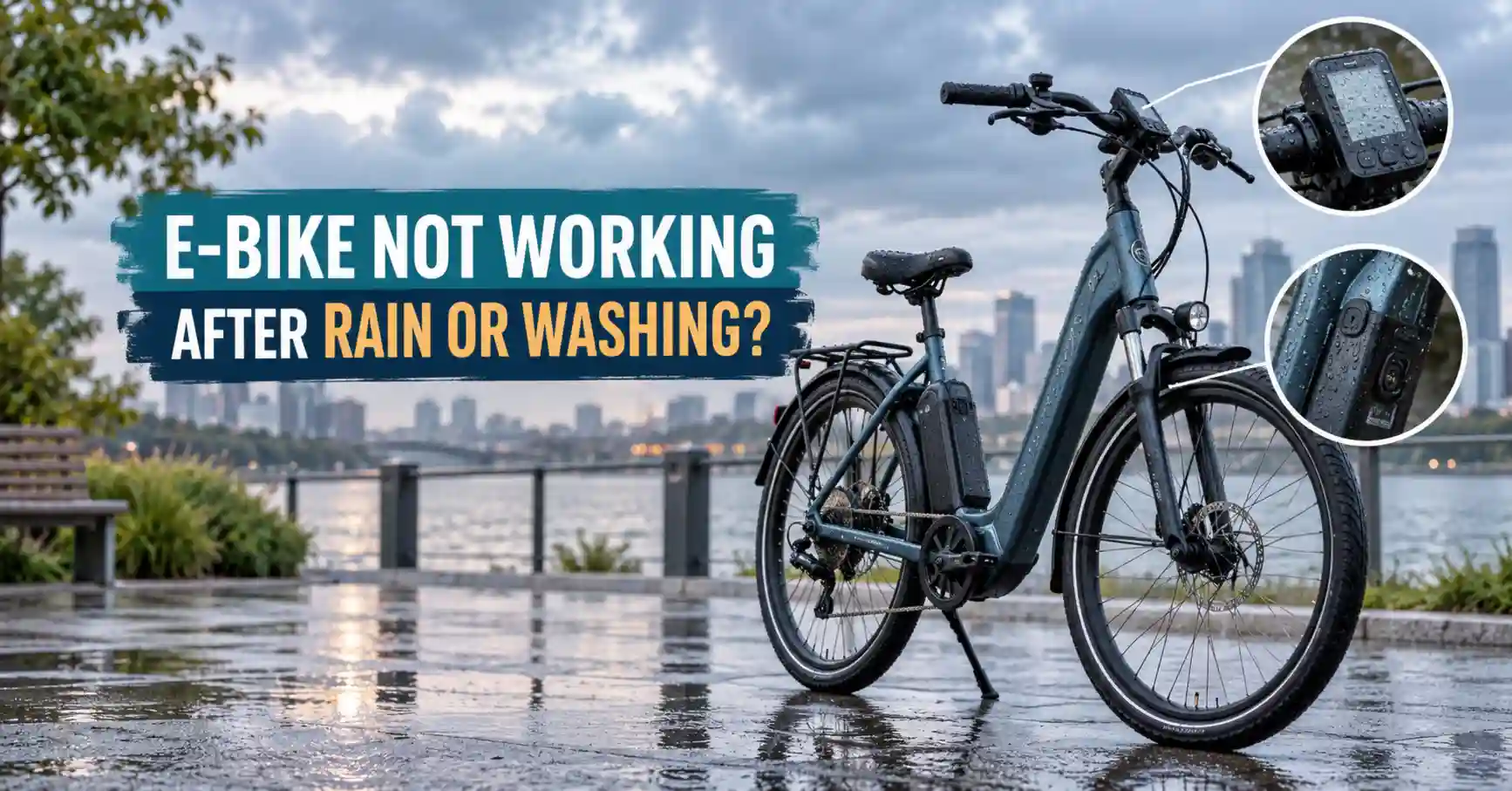
If your e-bike stopped working after rain or washing, do not assume the motor, controller, or battery has automatically failed. Moisture around an electrical connector, battery mount, display connection, sensor plug, charging area, or wiring harness can cause anything from a completely dead bike to intermittent motor assistance, flickering displays, and strange error codes.
When a bike stops working immediately after getting wet, I treat the timing as an important clue – but not proof that water damaged an expensive component. I would start with the safest visible checks before buying parts or taking anything apart. My E-Bike Troubleshooting and Maintenance Guide can help if the symptoms turn out to involve something other than moisture, while my e-bike display troubleshooting guide goes deeper if the screen is the main part that stopped responding.
This guide explains what rain and washing can affect, what you can safely inspect yourself, how the amount of water exposure changes the situation, what an IP water-resistance rating really tells you, and when you should stop troubleshooting and contact the manufacturer or a qualified e-bike technician.
🔧 How This Guide Was Researched
This guide is based on manufacturer instructions, established safety guidance, technical references, and common rider experiences. Stop using or charging the bike if you notice smoke, swelling, unusual heat, damaged wiring, sparks, or a strong chemical odor.
Because water resistance and cleaning instructions vary between manufacturers and individual components, the owner’s manual and official service guidance for your exact e-bike should take priority over general troubleshooting advice.
To learn more about how I research, verify, and update the information published on Electric Bike Explorer, read my Research and Review Policy.
Quick Answer: Why Did My E-Bike Stop Working After Getting Wet?
An e-bike that stops working after rain or washing may have moisture around a battery connection, display plug, controller connection, motor cable, brake sensor, pedal-assist sensor, throttle connection, charging port, or another part of the wiring harness. A connector may also have already been loose or damaged, allowing moisture or contamination to expose a problem that had not appeared during dry riding.
Rain exposure does not automatically mean an e-bike is ruined. Many e-bike systems are designed for normal wet-weather use, but water resistance varies by manufacturer, model, and individual component. Wet-weather resistance is also very different from deliberately submerging a component or blasting it with a pressure washer.
What I Would Do Right Now
If this were my bike, I would do these things first:
- Turn the e-bike off.
- Move it somewhere dry and well ventilated.
- Photograph any error code before restarting or disconnecting anything.
- Look at the battery, battery mount, charging port, display, and visible wiring for water, damage, corrosion, or heat marks.
- If the battery is designed for normal user removal, follow the manufacturer’s instructions for safely removing it.
- Do not connect the charger if the charging port, charger, battery terminals, or battery itself are visibly wet or damaged.
- Do not repeatedly turn the system on to see whether it has recovered.
- If there is smoke, swelling, unusual heat, leaking, sparks, melted wiring, or a strong chemical odor, stop there and get professional help.
I would rather spend a little extra time ruling out a moisture or connection problem than replace a controller, display, motor, or battery that was never the real problem.
Safety First
Stop using or charging the e-bike if you notice smoke, swelling, unusual heat, leaking, damaged wiring, sparks, melted connectors, a strong chemical odor, or evidence that water has entered the battery enclosure.
Do not open a lithium-ion battery pack. If a battery was submerged, seriously impacted, or shows signs of water entry, corrosion, deformation, or other damage, do not assume that drying the outside makes it safe to use or charge. Contact the manufacturer or a qualified e-bike technician for model-specific guidance.
How Wet Did the E-Bike Get?
The amount and type of water exposure matters. I would not treat a short ride through light rain the same way I would treat a bike that went through a pressure washer or was partially submerged.
| Water Exposure | How Concerned I Would Be | What to Do |
|---|---|---|
| Light rain or normal road spray | Lower concern if the bike is designed for wet-weather riding and works normally | Move the bike somewhere dry, wipe it down, inspect the battery area and exposed wiring, and follow the manufacturer’s wet-weather guidance. |
| Heavy rain or prolonged outdoor exposure | Moderate concern | Inspect the battery mount, display, controls, charging area, and visible connectors. Pay attention to condensation, intermittent faults, and error codes. |
| Gentle low-pressure cleaning | Depends on the bike and component | Follow the exact cleaning instructions for your bike. Some manufacturers permit low-pressure water around certain components while warning against spraying batteries, ports, or electronics directly. |
| Transported on an exterior car rack in heavy rain | Moderate to higher concern | Inspect carefully before powering up or charging. Sustained wind-driven water during highway transport can be different from ordinary riding rain. |
| Pressure washer or steam cleaner | Higher concern | Stop repeatedly powering the system. Inspect accessible connections and contact the manufacturer or a shop if problems appear. |
| Deep standing water, flooding, or submersion | High concern | Do not use or charge a battery that may have been submerged or taken on water. Contact the manufacturer or a qualified technician. |
Why Transporting an E-Bike in Rain Can Be Different
One situation riders may not think about is carrying an e-bike on a hitch rack or roof rack through heavy rain.
Bosch currently advises avoiding transporting an e-bike outside a vehicle in rain or wet conditions. Bosch also recommends removing a detachable display and, when possible, the battery and storing them inside the vehicle.
That does not mean every e-bike transported through rain will fail. But if your bike worked normally before a road trip and develops an electrical problem immediately afterward, I would include the transport conditions in the troubleshooting history.
Highway-speed airflow can expose the bike to sustained wind-driven water from directions it may not experience during ordinary riding.
What Does an IP Rating Mean on an E-Bike?
You may see ratings such as IPX5 or IP55 listed for an e-bike battery, display, motor system, or other component. These ratings describe tested resistance to particular types of dust or water exposure, but they should not be read as a blanket claim that an entire e-bike is waterproof.
The most important thing I would remember is that an IP rating normally applies to the specific component or product being rated. Do not assume the battery, charger, display, controller, and motor all have the same rating.
For example, Shimano’s current e-bike information says many of its batteries and chargers are IPX5 water-resistant, while also noting that some products are not IPX5 rated. Bosch lists IP55 protection for certain components, and Trek describes IP-rated e-bike components as suitable for wet-weather riding while still warning riders not to submerge the battery or use a power washer.
An IPX5 or IP55 rating is not permission to submerge the battery. Check the manual for the exact bike, battery, display, motor system, and charger you own.
Quick Component Location Map
Not every e-bike is wired the same way, but this is the basic path I use when thinking through a wet-weather electrical problem:
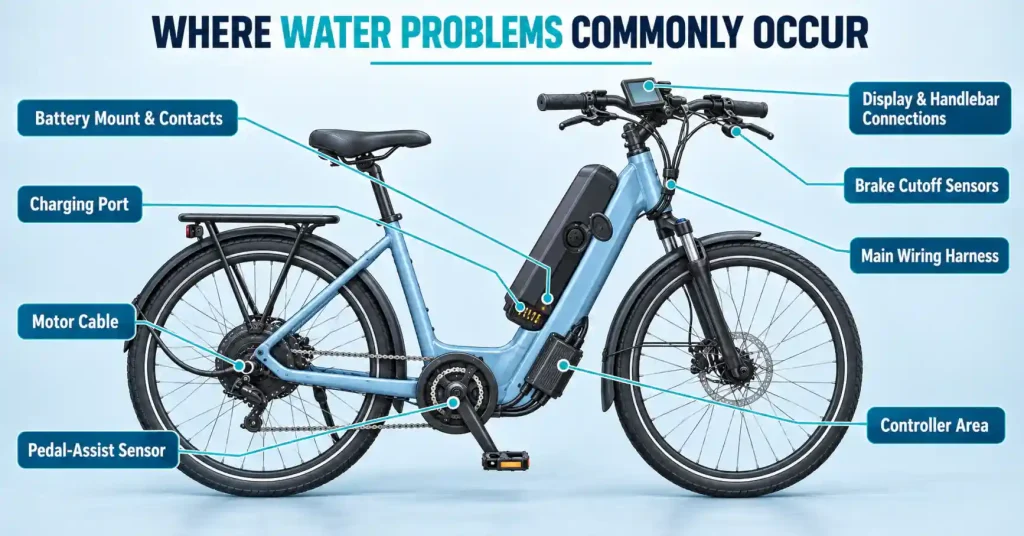
Battery → Battery Mount → Main Power Wiring → Controller or Drive Unit → Motor
Handlebars → Display or Remote → Main Wiring Harness → Controller or Drive Unit
Brake Levers → Brake Cutoff Sensors → Controller
Crank Area → Pedal-Assist Sensor → Controller
Throttle, if equipped → Wiring Harness → Controller
| Where to Look | Component | Possible Wet-Weather Symptom |
|---|---|---|
| Downtube, seat tube, or rear rack | Battery and battery mount | Whole bike dead, sudden shutdowns, intermittent power |
| Handlebars | Display, remote, control buttons | Blank screen, flickering, buttons not responding |
| Stem and head tube | Main wiring harness | Problem changes when handlebars turn |
| Brake levers | Brake cutoff sensors | Display works but motor will not assist |
| Crank or bottom-bracket area | Pedal-assist sensor | Pedal assist stops or behaves inconsistently |
| Handlebar grip area on equipped bikes | Throttle and throttle connector | Throttle stops working while PAS may still work |
| Rear or front hub on hub-drive bikes | Motor cable | Motor cuts out, jerks, or produces an error |
| Frame cavity or motor area | Controller or integrated drive electronics | Multiple electrical symptoms or motor-control problems |
Some mid-drive systems hide most electronics inside sealed assemblies, while many hub-drive bikes have more owner-accessible wiring. Do not remove covers or open sealed electronics simply to look for water.
Common E-Bike Problems After Rain or Washing
| What the Bike Is Doing | Area to Check First | What It May Point To |
|---|---|---|
| Bike is completely dead | Battery seating, battery mount, main power connections | Moisture, poor contact, battery protection, or another main power problem |
| Display is blank | Display connection and battery power | Wet or loose display connector, main wiring issue, or battery problem |
| Display works but motor does not | Brake sensors, motor cable, PAS, throttle | A motor-control or safety-cutoff signal may be interrupted |
| Motor cuts in and out | Accessible electrical connectors and battery mount | Intermittent connection, moisture, corrosion, or wiring problem |
| Bike jerks or surges | PAS, throttle, brake sensors, motor wiring | Intermittent control or communication signal |
| Error code appears | Record the code before disconnecting anything | The system may identify a sensor, communication, motor, battery, or controller fault |
| Problem changes when handlebars turn | Display and main harness near stem/head tube | Loose, pinched, damaged, or wet wiring |
| Problem began after pressure washing | Electrical system and manufacturer guidance | Pressurized water may have reached sensitive components |
Rain Is Not the Same as Pressure Washing or Submersion
This distinction matters. Many properly designed e-bike systems are intended to tolerate ordinary wet-weather riding, but that does not make every electrical component waterproof.
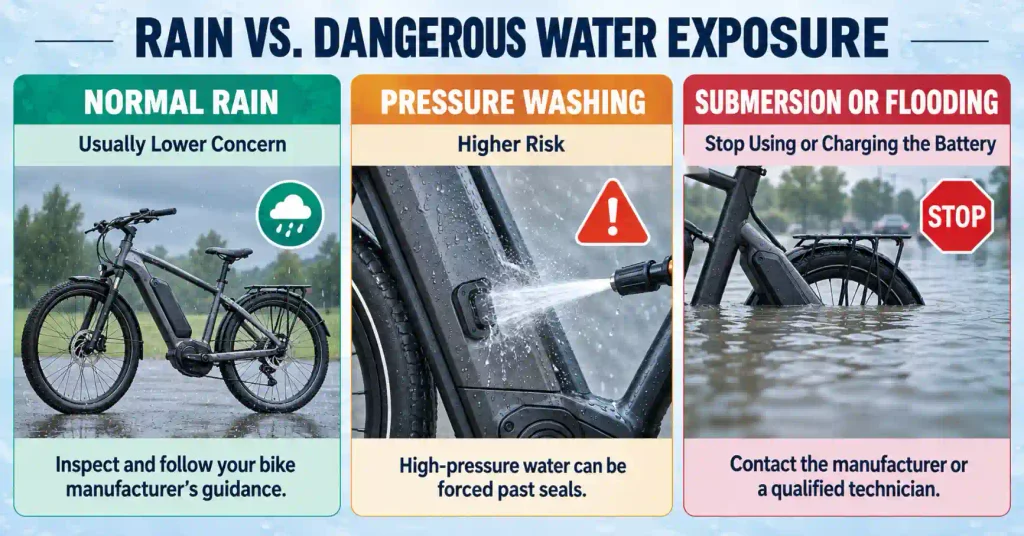
Bosch recommends removing the battery and removable display before cleaning and specifically warns against steam jets and high-pressure cleaners because water can penetrate sensitive components. Bosch also says the battery mount is designed so water can drain and contacts can dry when the area is kept clean.
Shimano likewise states that components designed for wet-weather riding should not be deliberately placed in water. Shimano documentation warns that high-pressure washing can allow water into components and lead to operating problems or corrosion.
Trek makes the same basic distinction: wet-weather riding is expected on its e-bikes, but it warns against power washing and battery submersion.
That is why I would take a failure after pressure washing or submersion more seriously than a bike that simply encountered normal rain.
Check for an E-Bike Recall or Battery Safety Warning
If the battery or electrical system behaves abnormally after getting wet, I would also check whether your exact bike or battery has an active recall or product safety warning.
This is particularly important because water exposure has been specifically identified in at least one current federal e-bike battery safety warning.
On November 24, 2025, the U.S. Consumer Product Safety Commission issued a product safety warning concerning certain Rad Power Bikes lithium-ion batteries with model numbers RP-1304, RAD-S1304Y, and HL-RP-S1304. CPSC said the affected batteries can unexpectedly ignite or explode, with the risk noted especially when the battery or harness has been exposed to water and debris.
This warning applies to those specific battery models. It does not mean every Rad battery or every wet e-bike battery has the same defect.
If you own one of the battery models named in that warning, follow the current CPSC instructions rather than using the general troubleshooting steps in this article.
You can search current federal notices through the CPSC recall and product safety warning database.
How to Troubleshoot an E-Bike That Stopped Working After Rain or Washing
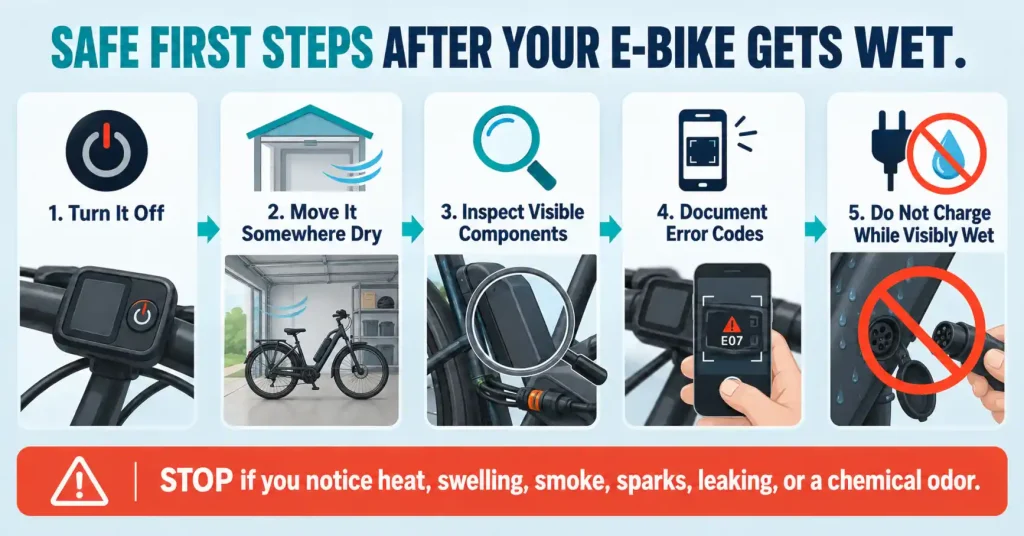
- Turn the e-bike off and move it somewhere dry.
Do not keep repeatedly switching the system on and off hoping it will suddenly recover.If the bike has a normally removable battery and the manufacturer allows the owner to remove it, follow the manufacturer’s shutdown and battery-removal instructions.If the battery, mount, or wiring is visibly damaged, unusually hot, swollen, sparking, smoking, leaking, or giving off a strong chemical smell, stop troubleshooting.
- Think about exactly how the bike got wet.
A normal ride in light rain is different from leaving the bike exposed during a storm, carrying it uncovered on a hitch rack through highway rain, riding through deep standing water, dropping it into water, or using a pressure washer.I would also note whether the problem started immediately, later that day, or after the next charging attempt. Those details can help narrow down the problem.
- Inspect the battery mount and accessible contacts.
With the system off, look for visible moisture, dirt, debris, discoloration, corrosion, bent contacts, burn marks, melted plastic, or a battery that does not seat correctly.Do not insert metal tools into battery terminals or scrape electrical contacts.If the battery charges but the rest of the bike remains dead after the system is safely dry and undamaged, my guide to an e-bike battery that charges but provides no power can help narrow down the next checks.
- Inspect owner-accessible electrical connectors.
Start with visible connectors around the handlebars, display, brake levers, frame wiring, pedal-assist sensor, throttle, and hub-motor cable if your bike uses one.Look for a plug that has partially separated, a damaged seal, corrosion, dirt, bent pins, damaged insulation, visible moisture, blackening, or melted plastic.Do not force waterproof connectors apart or together. Many use alignment marks, keyed shapes, seals, or locking collars that can be damaged if handled incorrectly.My step-by-step guide to finding loose e-bike electrical connections explains where these connection problems commonly hide.
- Let visibly wet areas dry naturally and follow the manufacturer’s instructions.
There is no universal drying time that applies to every e-bike.The correct approach depends on the amount of water exposure, component design, seals, charging port design, battery construction, temperature, ventilation, and manufacturer guidance.A display with condensation may take much longer to dry than a few drops on an external connector. Bosch, for example, says condensation inside some displays may take several days to clear.I would not use a heat gun, open flame, or other high-temperature shortcut around electrical components or a lithium-ion battery.
- Check the display and controls.
If the battery appears normal but the display stays blank, flickers, resets, or stops responding to buttons, concentrate on the display connection, remote or button pad, wiring near the handlebars, and main harness.If moving the handlebars changes the symptom, that is a clue I would take seriously because wiring near the stem and head tube moves as the bike is steered.Use my e-bike display not working guide before assuming the display itself needs replacement.
- Record any error code before restarting the system.
Take a photo of the display or write down the exact code.E-bike error codes are not standardized across every brand. The same number may mean different things on different systems.You can use the E-Bike Error Code Finder as a starting point, but compare the result with the manual or support documentation for your exact bike, motor system, or display.
- Only perform a function test when the system appears dry, undamaged, and safe to operate.
Before riding normally, confirm that the battery is secure, the display and controls behave normally, motor assistance engages predictably, brakes operate correctly, and no warning or error has returned.
If the bike still behaves unpredictably, cuts power, surges, produces recurring error codes, or shows signs of corrosion or heat damage, do not keep riding just because the motor occasionally works.
The Order I Would Check Things
When I am trying to narrow down a wet-weather electrical problem, this is the order I would generally follow:
- Battery and battery mount – Is the battery seated correctly? Is anything wet, dirty, corroded, burned, or damaged?
- Display and controls – Does the screen power up? Are the buttons responsive? Is there condensation or an error code?
- Visible wiring and connectors – Look for loose plugs, damaged insulation, moisture, or corrosion.
- Brake cutoff sensors – If the display works but the motor will not run, check whether an equipped brake cutoff may be keeping assistance disabled.
- Pedal-assist sensor and throttle – Compare what works and what does not.
- Motor cable – Especially on hub-drive bikes.
- Controller or integrated drive system – At this point I would be increasingly inclined to involve the manufacturer or a qualified technician rather than opening sealed electronics.
That order is not universal, but it helps me avoid jumping straight to the most expensive possible failure.
If the Display Works but the Motor Does Not
This symptom can make it look as though the motor was damaged by rain, but several other components can prevent motor assistance while the screen continues to work.
A brake cutoff sensor may be active, a pedal-assist sensor connection may be wet or loose, a throttle signal may be interrupted, or the motor cable may not be communicating correctly with the controller.
If you are trying to decide whether the problem is farther upstream, my controller vs. battery vs. motor diagnostic guide explains how those problems tend to differ.
If the Bike Jerks, Surges, or Cuts In and Out After Rain
Intermittent problems can be diagnostically useful because they suggest that power or a control signal may be coming and going rather than being completely absent.
Moisture can coincide with a marginal electrical connection, but so can road vibration, steering movement, battery movement, cable damage, or a partially seated connector.
I would avoid jumping straight to the conclusion that the controller is ruined.
For uneven motor behavior, see my guide to an e-bike that jerks or surges.
If the Bike Shows an Error Code After Getting Wet
Do not erase or dismiss the code before documenting it.
The code may help identify whether the system detected a battery communication problem, sensor problem, motor issue, controller fault, brake input, or another electrical problem.
A code that disappears after the system dries may have been temporary, but I would pay attention if it returns.
Give the manufacturer the exact code, bike model, drive-system model if known, and the circumstances leading up to the failure – including whether the bike was ridden in rain, washed, transported in wet weather, pressure washed, or exposed to standing water.
What Not to Do With a Wet E-Bike
| Avoid | Why |
|---|---|
| Pressure washing the bike | Manufacturers warn that high-pressure water can enter sensitive electrical components and mechanical areas. |
| Opening the battery pack | Lithium-ion battery packs contain hazardous electrical energy and sealed safety systems and are not a beginner repair. |
| Repeatedly powering a visibly wet or damaged system | Stop and assess the water exposure rather than repeatedly testing an abnormal electrical system. |
| Charging through a wet port or damaged battery connection | Follow the manufacturer’s charging instructions and do not charge a compromised battery or wet charger. |
| Using a random or “universal” charger | CPSC recommends using the charger supplied with or specifically recommended and approved for the device. |
| Bypassing a brake sensor or other safety system | Restoring motor power by disabling a safety cutoff can create a new hazard. |
| Using a heat gun or open flame to speed drying | High heat can damage wiring, plastics, seals, electronics, and lithium-ion battery components. |
| Opening a sealed controller or drive unit just to check for water | Integrated electrical systems may require manufacturer diagnostics, specialized tools, and replacement seals. |
When to Stop Troubleshooting and Call the Manufacturer or a Shop
Stop owner troubleshooting if:
- The battery was submerged or may have water inside it.
- You can see water inside a sealed electrical component.
- The battery is swollen, deformed, leaking, smoking, or unusually hot.
- You see sparks, burned terminals, or melted connectors.
- There is severe corrosion.
- Wire insulation is damaged or conductors are exposed.
- You smell a strong chemical or burning odor.
- The bike repeatedly shuts down after drying.
- An error code repeatedly returns.
- The motor activates unpredictably.
- The controller, battery, or wiring becomes abnormally hot.
- Diagnosis would require opening the battery, motor, controller, or another sealed electrical assembly.
I would much rather stop at this point than turn a repairable problem into a more expensive or less safe one.
What to Tell the Manufacturer or Bike Shop
A good troubleshooting history can save a lot of back-and-forth. Before contacting support, gather as much of this information as you can:
- Bike brand and exact model
- Approximate model year
- Battery model or part number
- Motor or drive-system brand
- Display model if known
- Exact error code
- Whether the display powers on
- Whether the lights work
- Whether pedal assist works
- Whether the throttle works, if equipped
- Whether the motor works intermittently
- Whether turning the handlebars changes the problem
- How the bike got wet – rain, washing, car-rack transport, pressure washer, standing water, or submersion
- When the problem first appeared
- Whether the battery or charger behaves differently than normal
- Photos of visible corrosion, water, damaged connectors, error messages, or battery labels
I would describe the symptoms as specifically as possible. “The display powers on but the motor stopped assisting immediately after the bike rode through heavy rain” is much more helpful than simply saying, “My bike does not work.”
How to Prevent Water-Related E-Bike Problems
Start with your own manufacturer’s cleaning and wet-weather instructions because water resistance varies from bike to bike and component to component.
🎬 Watch: How to Wash an E-Bike Safely
This short demonstration from Specialized shows a careful approach to cleaning an e-bike without unnecessarily exposing its electrical components to water. Your bike’s manual should always take priority because cleaning instructions vary by model.
Avoid pressure washers and steam cleaners. If your manufacturer permits gentle rinsing, avoid directing water into charging ports, battery connections, displays, open connectors, or other sensitive areas unless the manual specifically says that cleaning method is acceptable.
Keep the battery mount and connection areas clean. Inspect wiring periodically, particularly near the handlebars, frame entry points, battery, and motor cable.
If you transport an e-bike on an exterior vehicle rack, check your drive-system manufacturer’s instructions for wet-weather transportation. Bosch, for example, recommends avoiding exterior transport in rain and storing the detachable display and battery inside the vehicle when possible.
After a wet ride, I like the simple approach: get the bike out of the weather, wipe down accessible surfaces, look over the battery and wiring for anything unusual, and make sure the charging connection is in an appropriate condition before plugging the bike in.
If your e-bike develops an electrical problem and you still are not sure where to start, the free E-Bike Troubleshooting Tool can help narrow down which system deserves attention first.
🔧 Helpful Tools for Gentle E-Bike Cleaning and Inspection
These tools can help you clean and inspect accessible areas without spraying additional water near sensitive electrical components:
- Muc-Off High Performance Waterless Wash – Helps remove light dirt without rinsing the entire bike. Apply it to a cloth around sensitive areas rather than spraying it into ports or connectors.
- Muc-Off Premium Microfiber Polishing Cloth – A soft, absorbent cloth for wiping down and drying the frame, battery exterior, display, and other accessible surfaces.
- Park Tool BCB-4.2 Bike Cleaning Brush Set – Includes soft and detail brushes for removing dirt from the frame and hard-to-reach areas without using high-pressure water.
- COAST A9R Inspection Penlight – Provides focused light for inspecting the battery mount, visible connectors, wiring, charging port, and other dark areas without taking components apart.
Safety reminder: These products are intended for gentle exterior cleaning and visual inspection. Do not open the battery or other sealed electrical components, insert tools into battery terminals, or charge a battery that is visibly wet or damaged.
Frequently Asked Questions
Can an e-bike get wet in the rain?
Many e-bikes and drive systems are designed for normal wet-weather riding, but that does not mean every bike or component is waterproof. Check the manufacturer’s water-resistance information and owner’s manual for your specific bike. Avoid submersion and high-pressure washing.
Why did my e-bike stop working after I washed it?
The timing may point toward moisture around an electrical connector, battery mount, display connection, sensor circuit, motor connection, charging area, or wiring harness. Pressure washing is especially concerning because manufacturers warn that high-pressure water can penetrate sensitive components.
Can I wash my e-bike with a garden hose?
That depends on the manufacturer and the specific component. Bosch, for example, says certain displays may remain on the bike during cleaning with a garden hose, while its battery guidance says the battery should not be cleaned with a direct water jet. I would follow the exact cleaning instructions for your bike rather than assuming one rule applies to every component.
Should I charge my e-bike immediately after riding in heavy rain?
Follow the manufacturer’s instructions. Normal wet-weather riding does not automatically mean a battery cannot be charged, but if the charging port, charger, battery connection, or battery itself is visibly wet or shows evidence of water intrusion or damage, do not simply plug it in. Inspect the system and follow the manufacturer’s guidance first.
How long should I let an e-bike dry after rain?
There is no universal drying time that applies to every e-bike. The amount of water exposure, component design, seals, temperature, ventilation, and manufacturer instructions all matter. Visible condensation inside some components may take much longer to clear than surface moisture.
Can I use a hair dryer to dry wet e-bike connectors?
I would avoid using high heat around e-bike wiring, seals, electronics, charging ports, and especially lithium-ion batteries. Move the bike to a dry, ventilated location and follow the manufacturer’s instructions.
Does IPX5 mean my e-bike is waterproof?
No. Treat the rating as applying to the specific component that carries it, and check exactly what the manufacturer says that rating permits. An IPX5 or IP55 rating should not be interpreted as permission to submerge an e-bike battery.
Can rain damage an e-bike controller?
Water intrusion can cause electrical problems, but a failure after rain does not automatically prove that the controller is bad. Battery connections, display wiring, brake sensors, pedal-assist sensors, motor cables, charging areas, and other connectors can produce similar symptoms.
What if my e-bike works again after drying?
That is encouraging, but watch for recurrence. Before normal riding, check that the display, motor assistance, brakes, controls, and electrical system behave predictably. Repeated cutouts, error codes, unusual heat, corrosion, or erratic motor behavior deserve further diagnosis.
What if my e-bike was submerged in floodwater?
I would not treat that like ordinary rain exposure. Do not use or charge a battery that may have been submerged or taken on water. Contact the bike or battery manufacturer for model-specific instructions or have the system inspected by a qualified e-bike technician.
Can riding an e-bike on a car rack in rain cause problems?
It can create a different type of exposure from ordinary riding. Bosch currently recommends avoiding exterior vehicle transport in rain or wet conditions and, when possible, removing the detachable display and battery and storing them inside the vehicle.
My Take
When an e-bike quits immediately after rain or washing, I think one of the biggest mistakes is replacing expensive parts before figuring out what actually changed.
If this were my bike, I would work from the outside in: How wet did it get? Was pressure involved? Was it carried on a vehicle rack? Is the battery area dry and undamaged? What still powers on? Are the visible connectors secure? Is there an error code?
Those clues can help separate a simple connection problem from something that needs professional diagnosis.
I am much more cautious when the battery itself may have taken on water. A display or connector problem can be frustrating, but a questionable lithium-ion battery is not something I would experiment with.
If there is evidence of water intrusion, unusual heat, swelling, corrosion, sparks, smoke, a chemical odor, or physical battery damage, I would stop using and charging it and get the manufacturer or a qualified technician involved.
And before replacing a controller, motor, display, or battery, I would always check whether there is a current recall or product safety warning for the exact bike or battery model. That extra check only takes a few minutes and, in some cases, can completely change what you should do next.
Disclosure: As an Amazon Associate, I earn from qualifying purchases. This comes at no extra cost to you and helps support the content on this site.
Like Electric Bike Explorer?
Add Electric Bike Explorer as a Preferred Source on Google to make it easier to see more of our e-bike news, guides, reviews, and troubleshooting content in Google Search.
Sources and Safety References
U.S. Consumer Product Safety Commission – Micromobility Safety Information
U.S. Consumer Product Safety Commission – Universal Charger Safety Warning
U.S. Consumer Product Safety Commission – Rad Power Bikes Battery Safety Warning
U.S. Consumer Product Safety Commission – Recalls and Product Safety Warnings
Bosch eBike Systems – E-Bike Maintenance and Cleaning Guidance
Bosch eBike Systems – Battery Care and Moisture Guidance
Bosch eBike Systems – Transporting an E-Bike
Shimano – 2026 E-Bike Systems Battery and Water-Resistance Information
Shimano – E-Bike Battery and Water Safety Guidance
Trek – Electric Bike Battery and Wet-Weather Guidance
Trek – Electric Bike FAQ and Battery Water-Resistance Guidance

Kristina is not just an enthusiast but a true authority on electric bikes. Nestled in the coastal beauty of Virginia, Kristina has found the perfect backdrop for her passion for electric biking. As a dedicated wife and homeschooling mom, her life revolves around family, faith, and the thrill of adventure.
Originally hailing from Ohio, Kristina's journey with electric bikes began as a curiosity and quickly evolved into a deep expertise. Her blog is a testament to her love for electric biking, combining her fascination for eco-friendly transportation with her coastal lifestyle.
When she's not cruising the beach on her electric bike, you'll find Kristina indulging in her other loves: long walks along the shore, getting lost in a good book, and cherishing moments with her loved ones. With a heart as big as her love for animals, especially cats, Kristina brings a unique perspective to the electric bike world, grounded in her strong faith in God and her dedication to a sustainable lifestyle.
Through her blog, Kristina shares her extensive knowledge of electric bikes, offering valuable insights, tips, and recommendations to fellow enthusiasts. Whether you're a seasoned rider or a newcomer to the electric bike scene, Kristina's blog is your go-to source for all things electric biking, fueled by her passion, expertise, and the scenic beauty of coastal Virginia.