Can You Charge an E-Bike With a Portable Power Station?
Last Updated on September 14, 2026 by Kristina
Yes, you can charge many e-bikes with a portable power station, and it can be a very useful setup for camping, RV travel, road trips, power outages, or riding somewhere without a convenient electrical outlet.
The important part is choosing a power station with enough AC output to operate your e-bike charger and enough watt-hour capacity to put a useful amount of energy back into the battery.
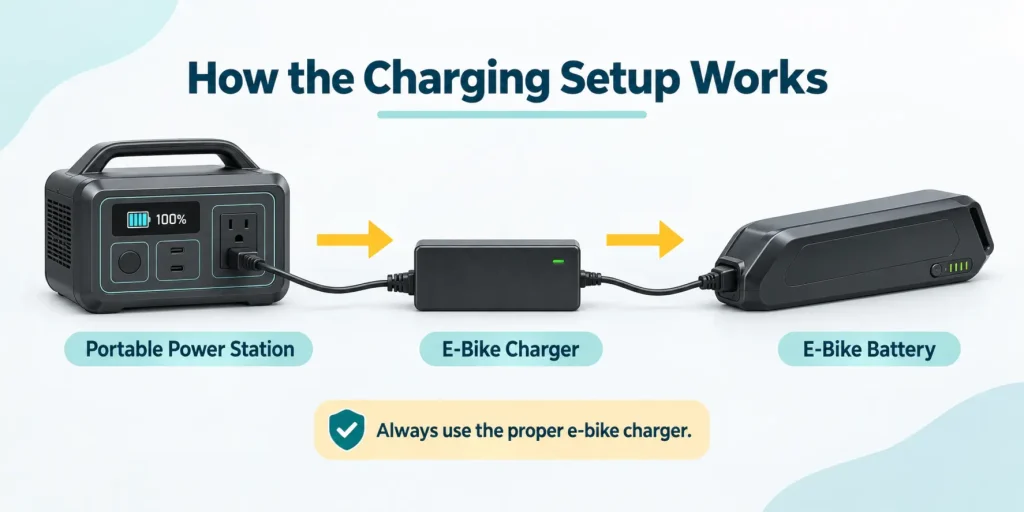
I like to think of the power station as a portable wall outlet. It supplies the electricity, but I still use the charger supplied with or specifically approved for my e-bike battery. I would not bypass that charger just because a portable power station has DC outputs that appear compatible.
If watt-hours are still confusing, my guide to e-bike battery capacity, Ah, and Wh explains how battery capacity is calculated. You can also explore the Electric Bike Explorer tools and calculators for more help with battery, range, charging, and other e-bike questions.
Quick Answer: Can You Charge an E-Bike With a Portable Power Station?
Usually, yes. If the power station has a compatible AC outlet, enough continuous AC output for your charger, and enough stored energy, you can normally plug the e-bike’s approved charger into the station much as you would plug it into a household outlet.
Before charging, I would check these 5 things:
- The power station’s AC voltage and frequency are compatible with the charger’s input requirements.
- The station’s continuous AC output can comfortably handle the charger.
- The station has enough watt-hours remaining for the amount of charging you need.
- You are using the charger supplied with or approved for that exact e-bike battery system.
- The battery, charger, station, cables, and connectors are undamaged and within their permitted operating temperatures.
If all 5 checks pass, a portable power station can be a practical way to recharge an e-bike away from the electrical grid.
Will My Portable Power Station Charge My E-Bike?
Here is the quick decision test I would use.
| Question | What to Check |
|---|---|
| Does it have a usable AC outlet? | The outlet must provide voltage and frequency compatible with your e-bike charger. |
| Can it run the charger? | The station’s continuous AC output needs to exceed the charger’s power requirement with reasonable headroom. |
| Is the station large enough? | Compare the station’s Wh rating with the amount of battery energy you need to replace. |
| Are you using the correct charger? | Use the charger supplied with or approved for your specific e-bike battery. |
| Are conditions safe? | Check battery condition, temperature, moisture, cables, and the manufacturer’s charging instructions. |
If one of those answers is no or uncertain, I would resolve that issue before plugging the bike in.
How Big of a Portable Power Station Do You Need for an E-Bike?
This is where watt-hours matter.
Your e-bike battery may be labeled something like:
- 36V 10Ah = approximately 360Wh
- 48V 10Ah = approximately 480Wh
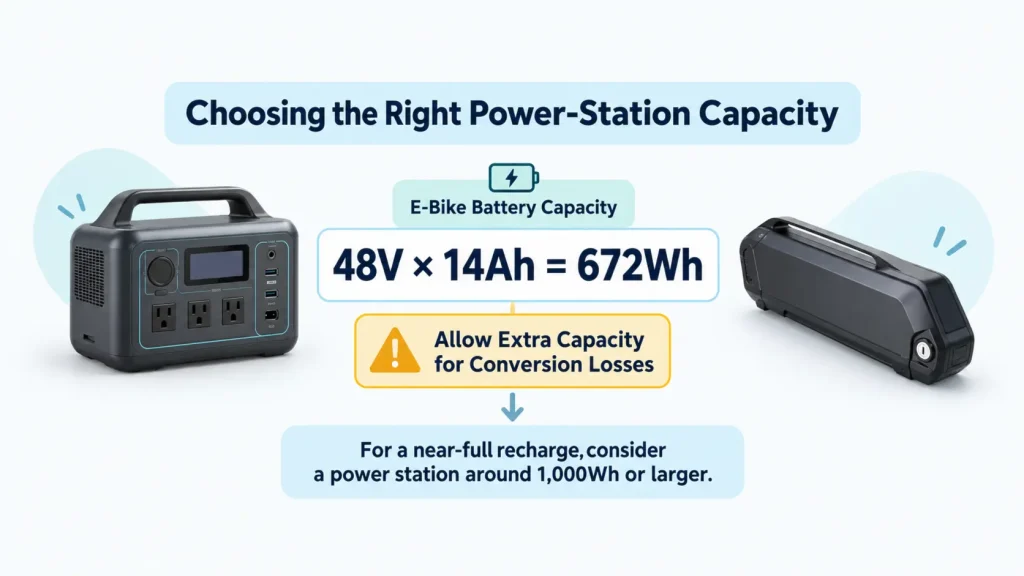
- 48V 14Ah = approximately 672Wh
- 48V 15Ah = approximately 720Wh
- 52V 20Ah = approximately 1,040Wh
You can calculate nominal battery watt-hours with:
Battery voltage × amp-hours = watt-hours
For example:
48V × 14Ah = 672Wh
A 672Wh battery does not mean I would buy a 672Wh power station and expect one guaranteed full recharge. Energy is lost through the station’s inverter, the e-bike charger, electronics, heat, and other normal processes, and the advertised capacity of a power station does not necessarily equal the energy you can deliver through its AC outlet.
Quick Power Station Sizing Formula
For trip planning, I would use this simple estimate:
Step 1: Battery energy needed = Battery Wh × percentage of charge you want to add
Then:
Step 2: Estimated station energy needed = Battery energy needed ÷ assumed overall efficiency
For rough planning only, using an overall efficiency assumption of around 75% to 85% gives you a useful range rather than pretending every power station and charger behaves the same way.
This 75% to 85% figure is a planning assumption, not a specification or guaranteed efficiency. Actual results depend on the power station, inverter, charger, battery condition, temperatures, load, battery-management system, and other factors.
Example: A 672Wh Battery From 20% to 80%
You are adding 60% of the battery’s nominal capacity:
672Wh × 0.60 = about 403Wh
Using the planning range:
- At 85% overall efficiency: about 474Wh from the power station
- At 75% overall efficiency: about 538Wh from the power station
So I would budget roughly 475 to 540Wh of station capacity for that particular top-up, with additional reserve if the station will also run other equipment.
Battery percentage gauges are not laboratory instruments, and the battery-management system may reserve capacity at the top and bottom of the displayed range. Treat this calculation as trip planning rather than an exact measurement.
Portable Power Station Size Chart for Common E-Bike Batteries
The table below uses the same 75% to 85% planning assumption for a near-full nominal recharge.
| E-Bike Battery | Battery Energy | Rough Station Energy Needed | Size I Would Consider |
|---|---|---|---|
| 36V 10Ah | 360Wh | About 425-480Wh | 500Wh or larger |
| 48V 10Ah | 480Wh | About 565-640Wh | 700Wh or larger |
| 48V 14Ah | 672Wh | About 790-900Wh | 1,000Wh or larger |
| 48V 15Ah | 720Wh | About 850-960Wh | 1,000Wh or larger |
| 52V 20Ah | 1,040Wh | About 1,225-1,390Wh | 1,500Wh or larger |
These are planning estimates, not guarantees. A larger station also gives you more reserve for differences in real usable capacity, cold or hot conditions, battery aging, and other equipment you may want to power.
You May Not Need a Full Recharge
One thing I think gets overlooked is that a portable power station does not have to completely refill an e-bike battery to be useful.
Suppose your 672Wh battery is at 30% when you return to camp and you only want to bring it back to 80%. You are replacing 50% of its nominal capacity:
672Wh × 0.50 = 336Wh into the battery
Using the same rough 75% to 85% planning range, that might require roughly 395 to 450Wh from the station.
That makes a smaller portable power station much more useful when you are doing regular top-ups instead of trying to recharge a completely depleted e-bike every night.
Check Watts as Well as Watt-Hours
Watt-hours tell you how much energy the station stores. Watts tell you how much power it can supply at a given moment.
You need to check both.
Look at the AC input information on your e-bike charger and compare it with the power station manufacturer’s continuous AC output rating. If the charger manufacturer provides an input-wattage figure, that is especially useful.
Be careful not to confuse the charger’s DC output rating with its AC power consumption.
For example, a charger marked 42V and 2A on its output side delivers about 84W of DC charging power:
42V × 2A = 84W
But that does not mean it draws exactly 84W from the portable power station. The charger itself has conversion losses.
If the label gives only AC input voltage and current instead of a watt figure, I would consult the charger documentation or leave generous output headroom rather than trying to size the station to the absolute minimum.
Will It Charge as Fast as a Wall Outlet?
Usually, charging time should be similar when the portable power station supplies AC power that meets the charger’s input requirements and has enough continuous output.
The e-bike charger is still controlling the charging rate. Connecting a normal e-bike charger to a much larger portable station does not automatically charge the battery faster.
If you normally use a 2A charger, putting it on a 2,000W power station does not turn it into a fast charger.
I would not substitute a higher-current charger just to shorten charging time unless the battery or e-bike manufacturer specifically approves that charger for the battery system.
Should You Choose a Pure Sine Wave Power Station?
If I were buying a power station primarily for an e-bike charger and other electronics, I would favor one with a pure sine wave inverter.
I would not, however, claim that pure sine wave output is an absolute requirement for every e-bike charger. Charger designs vary.
Pure sine wave output more closely resembles normal utility AC power and removes one unnecessary compatibility question. If you already own a modified-sine-wave station, check the charger and power-station documentation before assuming they are compatible.
Portable Power Station Safety Certification: What Should You Look For?
The e-bike battery is not the only lithium-ion battery in this setup. The portable power station also contains stored energy, so I would pay attention to its safety documentation as well.
UL 2743 is a safety standard for portable power packs. UL Solutions describes these products as portable battery systems intended to provide power when normal grid power is unavailable, including uses such as camping and emergencies.
I would look for evidence that the power station has been certified by a recognized certification organization to an appropriate safety standard for its intended use.
I would also distinguish between certified and merely “tested to” a standard. UL Solutions specifically notes that a claim saying a product was “tested to UL Standards” is not the same thing as UL certification.
Certification does not make a product risk-free, but independently verified safety certification is something I consider worthwhile when buying equipment containing a large lithium-ion battery.
What About UL Certification for the E-Bike?
UL 2743 relates to the portable power pack. E-bikes have different standards.
UL 2849 addresses the electrical system of an e-bike and evaluates the electrical drive system, battery system, and charger system together.
That system-level approach is another reason I prefer using the charger intended for the e-bike rather than mixing battery and charger components based only on connector shape or voltage labels.
How to Charge an E-Bike From a Portable Power Station Safely
The actual process is simple, but lithium-ion battery charging deserves care.
- Inspect the battery. Do not charge a battery that is swollen, leaking, unusually hot, badly damaged, producing sparks, or giving off an unusual chemical odor.
- Check the temperature. Make sure the battery is within the charging-temperature range specified by its manufacturer.
- Use the correct charger. Use the charger supplied with the e-bike or one specifically approved for your battery system.
- Check the charger’s AC input requirements. Make sure the station’s AC outlet is compatible.
- Confirm the station has enough continuous output. Leave reasonable headroom above the charger requirement.
- Check the station’s remaining capacity. Make sure you have enough Wh for the desired top-up plus any other equipment.
- Charge in an appropriate location. Keep the equipment dry, stable, uncovered, and away from combustible materials. Follow the battery and charger manufacturer’s location requirements.
- Follow the manufacturer’s connection instructions. Charging procedures can vary between systems.
- Stay present while charging. Do not start the charge and then leave the campsite or go to sleep.
- Disconnect when charging is complete. Follow the manufacturer’s instructions rather than leaving the battery connected indefinitely.
Safety First
Stop using or charging the e-bike battery if you notice smoke, swelling, unusual heat, leaking, sparks, damaged wiring, a strong chemical odor, or serious physical damage.
Do not open, rebuild, bypass, puncture, rewire, or improvise repairs to a lithium-ion battery pack.
The U.S. Consumer Product Safety Commission advises riders to remain present while charging micromobility products, never charge them while sleeping, use the supplied charger, and follow the manufacturer’s charging instructions.
Be Careful Charging in Very Hot or Cold Weather
Temperature matters, especially when camping.
I would not use one universal temperature range for every e-bike battery because the permitted charging limits come from the battery manufacturer.
As examples, Bosch states that some of its e-bike batteries allow charging between 0°C and 40°C, or 32°F to 104°F, and recommends charging at room temperature when possible. Shimano documentation for several e-bike charging systems also specifies a 0°C to 40°C charging range.
Those examples do not mean every e-bike battery has the same limits. Check the manual for your battery.
If I return from a freezing ride, I would let the battery reach a permitted charging temperature before connecting it. Likewise, I would not leave a battery baking inside a hot vehicle and then immediately start charging it.
Also remember that the portable power station has its own operating and charging-temperature limits. Check both products.
Why I Would Not Connect a Power Station’s DC Output Directly to the E-Bike Battery
Some portable power stations provide 12V sockets, USB-C outputs, adjustable DC ports, or other connections. That does not make them direct e-bike battery chargers.
A lithium-ion e-bike battery needs the correct charging voltage, current limits, polarity, connector, communication where applicable, and battery-management compatibility.
A connector that physically fits does not prove that two electrical systems are compatible.
Unless the e-bike manufacturer specifically supports a DC charging accessory or method for my exact battery, I would use the approved e-bike charger through the power station’s AC outlet.
That involves additional power conversion and therefore some efficiency loss, but I would rather account for that loss than improvise a lithium-ion charging system.
Be Careful With “Universal” E-Bike Chargers
This is one place where I would not try to save a few dollars with an unknown charger.
CPSC says a charger can physically fit a device and still be electrically incompatible. The agency received 156 reports of fire and thermal incidents involving universal micromobility chargers between January 1, 2023 and May 16, 2024, including reports involving injuries and property damage.
If the original charger is lost or damaged, CPSC recommends contacting the device manufacturer for information about a compatible replacement.
Can You Recharge an E-Bike With Solar Power?
Yes, if the portable power station supports compatible solar input.
The basic arrangement is:
Solar panels → compatible portable power station → approved e-bike charger → e-bike battery
The panels recharge the portable station, and the station supplies AC electricity to your e-bike charger.
I would check more than just the solar panel wattage. The panels and wiring also need to stay within the power station manufacturer’s permitted solar input voltage, current, wattage, and connector requirements.
In particular, do not exceed the station’s maximum solar input voltage.
Actual solar production depends on sunlight, shading, season, temperature, panel orientation, clouds, wiring, and the station’s input limits, so a panel advertised as 200W should not be assumed to produce 200W continuously throughout the day.
Can You Solar-Charge the Station While It Charges the E-Bike?
Some portable power stations support operating their AC outlets while the station itself receives solar or AC input. Others impose limitations.
Check the manufacturer’s instructions for pass-through or simultaneous input/output operation before depending on that setup.
Can You Charge an E-Bike While Camping?
Usually, yes, and camping is one of the situations where a portable power station makes the most sense to me.
You can ride during the day, return to camp, recharge or top up the battery, replenish the station with solar when conditions allow, and repeat the process without depending entirely on an electrical campsite.
But remember that the e-bike may be only one of several loads on the station.
- E-bike battery
- Portable refrigerator
- Phones
- Lights
- Laptops
- Fans
- Camera batteries
- Other camping equipment
I would create an energy budget for the entire campsite rather than assigning every available watt-hour to the e-bike.
3 Real-World E-Bike Charging Examples
Example 1: One Rider With a 500Wh Battery
Suppose I return to camp with a 500Wh e-bike battery at 20% and want to charge it to 90%.
That is a 70% top-up:
500Wh × 0.70 = 350Wh into the battery
Using the 75% to 85% planning range, the power station might need to supply roughly 412 to 467Wh.
A 1,000Wh station gives useful breathing room. On paper, it may support around 2 top-ups of that size, but I would not plan a remote trip around squeezing out every last advertised watt-hour.
Example 2: A Couple With Two 672Wh E-Bike Batteries
Now suppose both batteries are at 30%, and both riders want to recharge to 80%.
Each battery needs:
672Wh × 0.50 = 336Wh
For 2 batteries:
336Wh × 2 = 672Wh into the batteries
Using the planning range, the station could need roughly 790 to 900Wh.
A 1,000Wh station could therefore be fairly tight once you include other campsite loads and reserve capacity. This is where a 1,500Wh-class station or a way to replenish the station during the trip starts making more sense.
Example 3: RV Camping With a 720Wh E-Bike Battery
Suppose the 720Wh bike battery returns at 40% and I want it at 90% the next morning.
That requires a 50% top-up:
720Wh × 0.50 = 360Wh into the battery
Using the planning range, I would budget roughly 425 to 480Wh from the station.
If my refrigerator, phones, lights, and other equipment hypothetically consume another 300Wh during the same period, my total planned use becomes roughly 725 to 780Wh.
That example shows why a 1,000Wh station that sounds very large on the product page can become much smaller once an e-bike and an RV campsite are sharing it.
How Many E-Bike Charges Can You Get From a Power Station?
A simple full-charge-equivalent estimate is:
Power station Wh × estimated overall efficiency ÷ e-bike battery Wh
If I use the same 75% to 85% planning range, a 1,000Wh station paired with a 500Wh battery gives:
- At 75%: about 1.5 full-charge equivalents
- At 85%: about 1.7 full-charge equivalents
That is why I would not describe a 1,000Wh station as providing 2 guaranteed charges of a 500Wh e-bike battery.
If you normally top up rather than go from nearly empty to full, you may get several charging sessions even though they add up to only 1.5 or 1.7 full-charge equivalents.
Can One Portable Power Station Charge Two E-Bikes?
Yes, if it has enough power and enough stored energy.
If you want to charge both simultaneously, add together the chargers’ AC power requirements and make sure the total remains comfortably below the station’s continuous AC output rating.
Then check capacity.
Two 600Wh batteries contain about 1,200Wh of nominal energy combined. A 1,000Wh station should therefore not be expected to recharge both from nearly empty through their AC chargers.
For couples traveling with 2 e-bikes, total watt-hour capacity is usually the bigger issue than having an extremely high inverter watt rating.
Can You Recharge the Power Station From a Vehicle?
Many portable power stations offer some form of vehicle charging, but the supported connection and charging rate vary by model.
That can be useful on a road trip because you may be able to put energy back into the station while driving and later use its AC outlet for the e-bike charger.
Vehicle charging can be much slower than other charging methods depending on the station and vehicle connection, so check the manufacturer’s input specifications rather than assuming a short drive will replace a full e-bike charge.
I also would not leave lithium-ion equipment charging unattended inside an excessively hot parked vehicle.
What Size Power Station Would I Choose?
Around 300-500Wh
This can be useful for smaller e-bike batteries, emergency reserve, and partial top-ups.
I would not expect a 500Wh station to reliably provide a complete 500Wh recharge through its AC outlet.
Around 700-1,000Wh
This is a practical range for many single-battery e-bikes.
A station around 1,000Wh gives much more breathing room for common batteries in roughly the 400-700Wh range, especially if I usually return from rides with some battery remaining.
Around 1,500-2,000Wh
This starts making more sense for large batteries, 2 e-bikes, dual-battery bikes, repeated charging, or RV setups where the station also powers other equipment.
The tradeoff is weight, size, and cost. I would rather estimate my actual daily energy use than automatically buy the largest station available.
What to Look for in a Portable Power Station for E-Bike Charging
- Battery capacity in Wh: Enough for your expected e-bike charging plus conversion losses, other devices, and reserve.
- Continuous AC output: Comfortably higher than the charger’s requirement.
- Compatible AC voltage and frequency: Check the charger input label.
- Pure sine wave inverter: My preference when buying a station for chargers and electronics, although requirements vary by charger.
- Safety certification: Look for verifiable certification to an appropriate standard rather than relying only on vague “tested to” language.
- Solar input specifications: Check maximum voltage, current, wattage, and compatible connectors.
- Vehicle charging: Helpful for road trips if supported.
- Pass-through operation: Check whether input and output can be used simultaneously if that matters to your setup.
- Weight: High-capacity stations can become surprisingly heavy.
- Operating-temperature limits: Particularly important when camping.
- Display information: Remaining capacity, input watts, and output watts can make energy management much easier.
- Manufacturer support: Clear documentation and replacement support matter for equipment you plan to depend on away from home.
Before You Leave Home: E-Bike Power Station Checklist
If I were planning a camping or RV trip around e-bike charging, I would check these items before leaving:
- Write down the e-bike battery capacity in Wh.
- Check the approved charger’s AC input requirements.
- Check the power station’s continuous AC output.
- Estimate how many Wh of e-bike charging you will need each day.
- Add your other daily power-station loads.
- Leave extra energy reserve rather than planning to use 100% of advertised capacity.
- Verify charging-temperature limits for both the e-bike battery and power station.
- Inspect the e-bike battery, charger, connectors, and cables.
- Pack the approved e-bike charger.
- If using solar, verify panel voltage, current, wattage, connectors, and the station’s solar input limits.
- If using vehicle charging, verify the supported vehicle input and expected charging rate.
- Keep the charging equipment dry and protected.
- Plan to remain nearby whenever the e-bike battery is charging.
- Have a backup plan if clouds, temperature, or unexpected energy use reduces your available power.
When You Should Not Charge the E-Bike Battery
A portable power station does not make a questionable battery safe to charge.
Stop and get qualified help if the battery:
- Is swollen or visibly deformed.
- Is leaking.
- Produces smoke, sparks, or an unusual chemical odor.
- Becomes abnormally hot.
- Has damaged wiring, charging connections, or casing.
- Has been badly crushed, punctured, or impacted.
- Shows signs of serious water intrusion.
- Has been recalled or identified as unsafe.
- Has been improperly rebuilt, modified, or repaired.
If you are dealing with an electrical or battery problem rather than normal charging, start with my e-bike troubleshooting and maintenance guide and contact your manufacturer or a qualified e-bike technician when the problem involves the battery itself.
🔎 Why You Can Trust This Guide
I researched this guide using current U.S. Consumer Product Safety Commission battery-charging guidance, UL Solutions information about e-bike and portable power-pack safety standards, and official e-bike battery and charger documentation.
I have also separated general electrical planning estimates from manufacturer specifications. The efficiency ranges in this guide are for estimating power-station size and are not presented as guaranteed performance for any specific power station or e-bike charger.
Like Electric Bike Explorer?
Add Electric Bike Explorer as a Preferred Source on Google to make it easier to see more of our e-bike news, guides, reviews, and troubleshooting content in Google Search.
Frequently Asked Questions
Can a 500Wh power station charge a 500Wh e-bike battery?
It can provide a substantial charge, but I would not expect a 500Wh power station to fully recharge a nominal 500Wh e-bike battery from nearly empty through an AC charger. Conversion losses and the station’s actual usable AC energy reduce what ultimately reaches the battery.
Can a 1,000Wh power station charge an e-bike?
For many e-bikes, yes. A 1,000Wh station can be a practical size for common 400-700Wh batteries, especially when you are doing partial recharges. Check the exact battery capacity, charger input requirements, and other loads before buying.
Will a portable power station damage an e-bike battery?
A compatible power station supplying appropriate AC power to the battery’s approved charger is functioning primarily as the charger’s electricity source. The bigger concerns are an incompatible charger, damaged battery, unsuitable AC output, unsafe charging conditions, or equipment operated outside the manufacturer’s specifications.
Can I plug my e-bike charger directly into a portable power station?
Yes, provided the station’s AC output is compatible with the charger’s input requirements and the station has enough continuous power and capacity.
Can I charge an e-bike directly from a solar panel?
I would not connect a typical solar panel directly to an e-bike lithium-ion battery. A more straightforward setup is to use compatible solar panels to charge a portable power station, then run the e-bike’s approved charger from the station. A manufacturer-supported direct solar charging system would be a separate exception.
Can I use a different charger when traveling?
Do not assume a charger is compatible because the connector fits or the voltage appears similar. Use the supplied charger or a replacement specifically approved for your e-bike battery system.
Can I leave my e-bike charging overnight from a power station?
I would not. The CPSC advises consumers to remain present while charging micromobility products and never charge them while sleeping.
Does a power station need to match my e-bike battery voltage?
Not when you are using the e-bike’s normal AC charger. The portable station needs to supply AC power that meets the charger’s input requirements. The charger then provides the appropriate charging output for the battery.
Is a bigger inverter always better for charging an e-bike?
No. Once the inverter can comfortably supply the charger’s power requirement, additional inverter wattage does not make the e-bike charge faster. Battery capacity in Wh may become much more important.
Can I charge 2 e-bikes at the same time?
Yes, if the station has enough continuous AC output for both chargers and enough stored energy. Add the chargers’ requirements together and calculate the amount of battery capacity you need to replace.
My Take
For camping, RV travel, road trips, and emergency backup, I think a portable power station can be one of the more useful accessories for an e-bike owner. The trick is buying it based on actual energy needs rather than the biggest watt number printed on the box.
For many single-battery e-bikes, a station somewhere around the 1,000Wh class strikes me as a practical starting point. Riders with smaller batteries or who only need top-ups may need much less, while couples, dual-battery riders, and RV travelers sharing the station with other equipment can quickly justify 1,500Wh or more.
I would also leave myself a healthy reserve. Sunshine can disappear, batteries can use more energy than expected, and the power station may need to run something I did not originally plan for.
Most importantly, I would keep the actual battery-charging setup boring: a reputable power station, compatible AC output, and the charger supplied with or approved for my e-bike. I would rather accept some conversion loss than experiment with an improvised direct-to-battery charging arrangement.
Sources
- U.S. Consumer Product Safety Commission – Universal Micromobility Charger Warning
- U.S. Consumer Product Safety Commission – Micromobility Charging Safety Guidance
- UL Solutions – UL 2849 E-Bike Electrical System Certification
- UL Solutions – UL 2743 Portable Power Pack Testing
- UL Solutions – Certified vs. “Tested to” UL Standards
- Bosch eBike Systems – Battery Care and Charging Temperature Guidance
- Shimano – E-Bike Battery and Charger Safety Instructions

Kristina is not just an enthusiast but a true authority on electric bikes. Nestled in the coastal beauty of Virginia, Kristina has found the perfect backdrop for her passion for electric biking. As a dedicated wife and homeschooling mom, her life revolves around family, faith, and the thrill of adventure.
Originally hailing from Ohio, Kristina's journey with electric bikes began as a curiosity and quickly evolved into a deep expertise. Her blog is a testament to her love for electric biking, combining her fascination for eco-friendly transportation with her coastal lifestyle.
When she's not cruising the beach on her electric bike, you'll find Kristina indulging in her other loves: long walks along the shore, getting lost in a good book, and cherishing moments with her loved ones. With a heart as big as her love for animals, especially cats, Kristina brings a unique perspective to the electric bike world, grounded in her strong faith in God and her dedication to a sustainable lifestyle.
Through her blog, Kristina shares her extensive knowledge of electric bikes, offering valuable insights, tips, and recommendations to fellow enthusiasts. Whether you're a seasoned rider or a newcomer to the electric bike scene, Kristina's blog is your go-to source for all things electric biking, fueled by her passion, expertise, and the scenic beauty of coastal Virginia.