
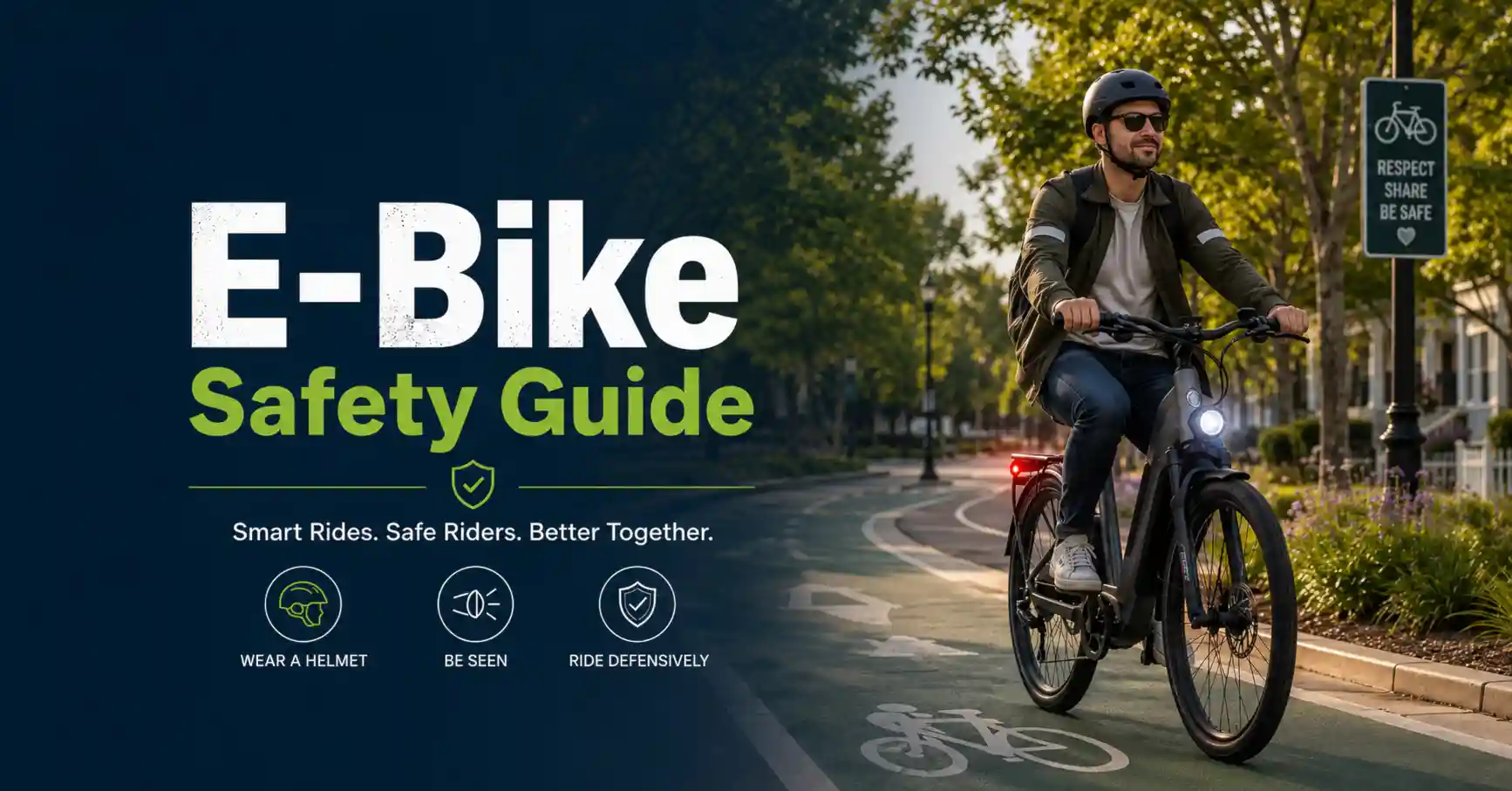
Are E-Bikes Safe? Complete E-Bike Safety Guide
Last Updated on August 25, 2026 by Kristina
Last reviewed and updated: August 2026
Are e-bikes safe? For most riders, an electric bike can be a safe and practical way to commute, exercise, run errands, and enjoy longer rides – but the motor, extra weight, higher potential speed, lithium-ion battery, and exposure to traffic create risks that deserve more attention than a conventional “just get on and ride” approach.
The safest e-bike is one that fits you, is in good mechanical condition, uses a compatible battery and charger, and is ridden at a speed that matches your skill and surroundings. If you are still choosing a bike, my complete e-bike buying guide explains fit, brakes, motor power, battery size, and other ownership basics. It also helps to understand Class 1, Class 2, and Class 3 e-bikes before deciding how much speed and power you actually need.
🔧 How This Guide Was Researched
This guide is based on current U.S. Consumer Product Safety Commission data, National Highway Traffic Safety Administration and National Transportation Safety Board guidance, UL Solutions certification information, fire-safety guidance, manufacturer instructions, and established bicycle-safety practices. I separate official data from practical recommendations and avoid presenting uncertain risk comparisons as settled facts.
Because e-bike laws and product guidance can change, check the State-by-State E-Bike Law Guide and your bike manufacturer’s current manual for requirements that apply to you.
Start Here: The Most Important E-Bike Safety Steps
If you only have a few minutes, start with these sections:
- 60-Second E-Bike Safety Check
- Your First 15 Minutes on a New E-Bike
- Stop Riding or Charging Immediately If…
- Battery Charging and Storage Checklist
- What to Do After an E-Bike Crash
- E-Bike Safety for Kids and Teens
- E-Bike Safety for Older Riders
- Master E-Bike Safety Checklist
How Safe Are E-Bikes? What the Current U.S. Data Shows
E-bike injuries have increased as e-bike use has grown, but the numbers need context. The U.S. Consumer Product Safety Commission’s April 20, 2026 micromobility report estimated 155,200 emergency-department-treated injuries involving e-bikes from 2017 through 2024. CPSC also identified 310 reported e-bike fatalities during that period. Reporting for the most recent years can continue to change as additional cases are identified.
Among the e-bike fatalities CPSC categorized by hazard pattern, motor-vehicle involvement was the largest group. Control issues, including falls and loss of control, were also important. Fire-related deaths were a smaller portion of reported e-bike fatalities, but battery fires deserve special attention because lithium-ion battery failures can escalate quickly and can threaten people who are not riding at the time.
The important takeaway is not that e-bikes are inherently unsafe. It is that the most serious risks usually come from a combination of traffic exposure, speed, rider control, equipment condition, visibility, and battery or charging problems.
Why I Do Not Give a Simple “E-Bikes Are X Times More Dangerous” Number
Comparing risk between e-bikes, conventional bikes, scooters, motorcycles, and cars is harder than it sounds. The National Transportation Safety Board has identified important gaps in consistent micromobility crash and exposure data. Without reliable information about how many miles people ride, where they ride, what type of device they use, and how crashes are classified, a single risk multiplier can be misleading.
That is why I focus this guide on hazards we can act on: traffic, speed, braking, rider skill, visibility, maintenance, battery safety, fit, and legal riding behavior.
The 60-Second E-Bike Safety Check
Do this before each ride, especially if the bike has been transported, stored for a while, ridden by someone else, or recently serviced.
- Tires: Look for obvious underinflation, cuts, embedded debris, bulges, or a tire that is not seated evenly on the rim. Use the pressure range printed on the tire or specified by the bike manufacturer.
- Wheels and axles: Make sure the wheels are fully seated and that quick-release levers, thru-axles, or axle nuts are secure.
- Brakes: Squeeze both brake levers before moving. They should feel firm and should not pull all the way to the handlebar.
- Handlebar and stem: Confirm the bar and stem do not twist or move unexpectedly.
- Battery: Make sure the battery is fully seated and latched. Do not ride with a loose battery.
- Lights and reflectors: Check front and rear lights if you may ride in low light, traffic, or poor weather.
- Chain and drivetrain: Look for a dropped chain, visible damage, or anything caught in the drivetrain.
- Low-speed function check: In a safe area, roll forward slowly and test both brakes, steering, pedal assist, and throttle behavior before entering traffic.
Your First 15 Minutes on a New E-Bike
A powerful e-bike can feel very different from a conventional bicycle. The first ride should not begin in traffic.
Minutes 1-3: Learn the Controls While Stationary
- Identify the front and rear brake levers.
- Find the assist-level controls and learn how to reduce assistance quickly.
- If the bike has a throttle, learn when it is active and whether it works from a stop.
- Check how the display shows speed, battery level, and assist mode.
- Start in the lowest practical assist setting.
Minutes 4-7: Practice Starting and Stopping
Use a flat, open area away from cars and pedestrians. Practice starting with one foot ready to support you. Accelerate gently, then stop smoothly using both brakes. Repeat until the motor response no longer surprises you.
Minutes 8-11: Practice Turns and Low-Speed Control
Ride large circles in both directions, then gradually make them smaller. Practice looking where you want to go rather than staring at the front wheel. Keep assist low so the motor does not make a tight turn harder to manage.
Minutes 12-15: Practice a Firm Controlled Stop
At a moderate practice speed, progressively apply both brakes and learn how quickly the bike slows without locking a wheel or losing balance. Increase speed only after you are comfortable with the bike’s weight and braking response.
Do Not Learn High-Speed Handling in Traffic
If your bike can assist to 28 mph, that does not mean 28 mph is an appropriate learning speed. Build skill at lower speeds first and use faster assistance only where legal and appropriate for the road, traffic, sight distance, and your experience.
Safety Settings to Check Before Your First Ride
| Setting or Adjustment | What to Check | Why It Matters |
|---|---|---|
| Saddle height | You can start, stop, and pedal without feeling unstable. | A saddle that is too high can make stopping intimidating, especially for beginners. |
| Brake-lever reach | You can comfortably reach both levers without stretching your fingers. | You need immediate access to both brakes. |
| Handlebar position | Your wrists, shoulders, and steering feel comfortable and controlled. | Poor positioning can reduce control and confidence. |
| Startup assist | Know which assist level the bike uses when powered on. | Unexpected high assistance can surprise a rider during the first pedal stroke. |
| Throttle behavior | Know whether it works from a stop and whether it is disabled in some modes. | Accidental throttle input can cause unintended movement. |
| Display units | Know whether speed is displayed in mph or km/h. | Misreading speed can affect judgment. |
| Lights | Confirm the headlight and rear light work and understand how to turn them on. | Visibility becomes critical at night and in poor weather. |
| Tire pressure | Use the manufacturer’s or tire’s recommended range. | Very low or inappropriate pressure can affect steering, braking, and tire reliability. |
E-Bike Safety by Speed
Speed changes how much time you have to see a hazard, decide what to do, and stop. It also changes how drivers and pedestrians judge your approach. These ranges are practical riding guidance, not precise injury-risk categories.
| Typical Riding Speed | What Changes | Safety Focus |
|---|---|---|
| About 10-15 mph | You generally have more time to react and maneuver. | Build balance, braking, signaling, scanning, and traffic awareness. |
| About 15-20 mph | Closing speed increases and road hazards arrive faster. | Increase following distance, scan farther ahead, and be cautious around driveways and intersections. |
| About 20-28 mph | Stopping distance, reaction demands, wind, road defects, and vehicle interactions become more consequential. | Use appropriate protective equipment, stronger anticipation, greater following distance, good brakes and tires, and ride only where that speed and class are legal. |
The Biggest E-Bike Safety Risks
| Situation | Main Risk | What Helps |
|---|---|---|
| New rider | Unexpected motor response or poor low-speed control | Practice in low assist away from traffic |
| Busy traffic | Motor-vehicle collision | Predictable riding, visibility, lane awareness, lower speed where needed |
| 20-28 mph riding | Less reaction time and more demanding braking | Skill, appropriate helmet, maintained brakes and tires, greater following distance |
| Night riding | Drivers or pedestrians may not see you soon enough | Front/rear lights, reflectivity, slower speed, careful route choice |
| Wet roads | Reduced traction and longer or less predictable braking | Reduce speed, brake earlier, avoid abrupt steering and painted/slippery surfaces |
| Steep descents | Speed buildup and brake overheating or fade | Control speed early, use both brakes properly, stop if braking changes |
| Child or teen rider | Speed, judgment, legal restrictions, peer pressure | Age-appropriate bike, supervision, clear rules, local-law check |
| Older or returning rider | Weight, balance, mounting, stopping confidence | Good fit, manageable bike weight, low assist, practice, step-through frame when helpful |
| Passenger or cargo | Changed handling, stopping, and balance | Stay within rated limits and use equipment designed for the load |
| Damaged battery | Fire or thermal event | Stop use/charging and obtain manufacturer or qualified professional guidance |
Traffic Is One of the Most Important E-Bike Safety Issues
CPSC fatality data reinforces what experienced cyclists already know: interactions with motor vehicles can have severe consequences. An e-bike rider may arrive at an intersection, driveway, or parked-car door faster than another road user expects.
How to Ride More Predictably Around Cars
- Follow traffic controls and local bicycle laws.
- Ride in a consistent, predictable line.
- Signal turns when it is safe to remove a hand from the handlebar.
- Look for drivers turning across your path at intersections and driveways.
- Watch parked vehicles for occupants who may open a door.
- Avoid passing where another road user has no reasonable opportunity to see you.
- Do not assume a driver has seen you because you have the right of way.
- Reduce speed when sight lines are poor.
For a deeper look at access and traffic rules, see my guide to where e-bikes can be ridden and the e-bike sidewalk laws guide.
Braking and Speed: Learn the Bike Before You Need an Emergency Stop
E-bikes can carry more mass and may travel faster than a rider’s previous bicycle. That makes brake condition and technique especially important.
Use Both Brakes
On most bicycles, the front brake provides a large share of available stopping force, while the rear brake contributes control and braking. Apply both progressively. Avoid grabbing one brake abruptly unless you are trained for the situation and understand how your bike responds.
Leave More Room
Give yourself additional space behind cars, bikes, pedestrians, and other riders. Your stopping distance depends on speed, tire grip, brake condition, rider technique, load, road surface, slope, and weather.
Do Not Ignore Changes in Brake Feel
If a brake lever suddenly pulls much farther than normal, braking becomes weak or inconsistent, you hear severe grinding, or the bike pulls unexpectedly during braking, stop and inspect the problem before continuing.
If you are troubleshooting a mechanical problem, start with the E-Bike Troubleshooting and Maintenance Guide.
Helmets Matter, but Use One Appropriate for Your Riding
A properly fitted helmet is one of the simplest ways to reduce the consequences of a fall or crash. The helmet should meet applicable safety requirements and be appropriate for the type and speed of riding you do.
Helmet laws vary by state, age, class, and local jurisdiction. A legal minimum should not be confused with the amount of protection you personally want. Riders regularly traveling at higher assisted speeds may choose protection designed for more demanding riding than a basic low-speed bicycle helmet.
My guide to helmets for e-bike riders explains features to compare when choosing one.
Visibility and Night Riding
Good visibility is about helping other road users detect you early enough to respond. A bright front light, rear light, reflectors, and visible clothing can help, but lighting does not replace careful positioning or speed control.
At Night
- Use a front light that lets you see and be seen without blinding others.
- Use a visible rear light and required reflectors.
- Slow down when your headlight does not illuminate far enough ahead for your speed.
- Be especially cautious at driveways, intersections, and poorly lit crossings.
- Expect road defects and debris to be harder to see.
See the nighttime e-bike lighting guide for more detail.
Wet Weather and Slippery Surfaces
Rain can reduce visibility and traction, and braking may feel different depending on the bike, tires, brake system, and conditions. Slow down and give yourself more stopping room.
Be particularly careful on painted road markings, metal plates, leaves, mud, loose gravel, and other low-traction surfaces. Avoid abrupt braking or sharp steering when traction is questionable.
Water resistance varies by bike and component. Do not assume an e-bike is waterproof. Follow the manufacturer’s limits for rain, washing, puddles, and water exposure.
Hills and Descents
Hills are not automatically dangerous, but they increase demands on both rider and equipment. On a descent, speed can build quickly and prolonged braking can heat brake components.
- Control speed before entering a steep descent.
- Use both brakes progressively rather than waiting until the last moment.
- Leave extra room before turns.
- Stop if braking performance changes noticeably.
- Use a gear that gives you control when climbing and avoid unnecessary motor strain.
Battery Charging and Storage Checklist
Battery safety deserves its own routine because charging happens away from the road and can involve people who never ride the bike.
Before Charging
- Use the battery and charger recommended by the manufacturer.
- Do not substitute a charger simply because the plug fits.
- Inspect the battery, charger, and cable for obvious damage.
- If the battery has been in a serious crash, dropped hard, submerged, swollen, overheated, or otherwise damaged, do not assume it is safe to charge.
While Charging
- Remain present and able to respond.
- Do not charge while sleeping or while away from the location.
- Keep the charging area away from combustible clutter and escape routes.
- Follow the manufacturer’s ventilation and temperature instructions.
- Stop charging if you notice unusual heat, odor, swelling, smoke, popping, hissing, sparking, or other abnormal behavior.
Storage
- Follow the manufacturer’s temperature and state-of-charge recommendations for long-term storage.
- Protect the battery from physical damage and extreme heat.
- Keep batteries and chargers where damage, tampering, and accidental short circuits are unlikely.
- Do not open or rebuild a lithium-ion battery pack yourself.
CPSC also warns consumers about incompatible “universal” chargers for micromobility products because a charger that is not compatible with a battery can create a fire hazard.
UL 2849 and UL 2271: What the Safety Standards Mean
Safety certification can be confusing because different standards cover different parts of an e-bike system.
- UL 2849 addresses the electrical system of an e-bike, including the electrical drivetrain, battery, and charger system.
- UL 2271 applies to batteries used in light electric vehicle applications.
A vague phrase such as “UL compliant” or “uses UL components” is not necessarily the same as a complete system being certified by an accredited third party to the applicable standard. When certification matters to you, look for the specific standard and confirm exactly what has been certified.
For shopping help, see my guide to UL-certified e-bikes.
⚠️ Stop Riding or Charging Immediately If…
Stop using or charging the bike and obtain manufacturer, qualified e-bike technician, fire-department, or emergency guidance as appropriate if you notice:
- Smoke, flames, sparking, or popping
- A strong unusual chemical odor
- Battery swelling or deformation
- Unusual or rapidly increasing heat
- Leaking battery material
- Exposed or badly damaged wiring
- A battery involved in a serious impact or crash
- A battery that has been submerged or seriously water damaged
- Brake failure or a sudden major change in brake performance
- A loose wheel, axle, fork, handlebar, or other critical control component
- An unexplained electrical problem that causes unexpected acceleration or motor behavior
Do not open, puncture, crush, bypass, or attempt to rebuild a lithium-ion e-bike battery pack.
What to Do After an E-Bike Crash
The first priority after a crash is people, not the bike.
- Check yourself and others for injury. Call emergency services when needed.
- Move out of traffic if it is safe to do so. Do not put yourself at greater risk trying to recover a damaged bike from an unsafe location.
- Power the bike off. If the electrical system is damaged or behaving abnormally, stop using it.
- Inspect the wheels, fork, handlebar, brakes, frame, and controls. A bike that still rolls is not necessarily safe to ride.
- Inspect the battery area without opening the pack. Look for visible deformation, cracking, impact damage, unusual heat, odor, smoke, or leaking.
- Do not immediately recharge a battery that took a significant impact. Follow the manufacturer or a qualified professional’s guidance before charging or reusing it.
- Have structural or electrical damage evaluated. Cracked frames, damaged forks, questionable wheels, braking issues, and battery damage deserve professional attention.
Are E-Bikes Safe for Kids and Teens?
E-bikes can be inappropriate for some young riders because speed, weight, judgment, traffic awareness, and local age restrictions all matter. A teen who is skilled on a conventional bicycle is not automatically ready for a high-powered or 28 mph e-bike.
Questions Parents Should Ask
- Is this class of e-bike legal for the rider’s age where we live?
- Can the rider confidently start, stop, turn, signal, and make a controlled emergency stop?
- Can the rider handle the bike’s weight if it begins to tip?
- Does the bike fit correctly?
- Does the rider understand where e-bikes are allowed and prohibited?
- Will the rider wear an appropriate helmet every time?
- Does the rider understand that a throttle and high assist level are not toys?
- Is there a family rule about passengers, phones, nighttime riding, and speed?
Before letting a young rider use an e-bike, check your state’s rules in the State-by-State E-Bike Law Guide and any city, park, trail, or school rules that apply.
Are E-Bikes Safe for Older Riders?
E-bikes can help older adults ride farther, manage hills, and stay active, but the right setup matters. Bike weight, frame access, starting behavior, balance, braking confidence, and fit may matter more than maximum motor power.
Features That May Improve Confidence
- A frame that is easy to mount and dismount
- A saddle height that allows confident starts and stops
- Predictable low-level pedal assist
- Brake levers that are easy to reach and operate
- A manageable overall bike weight
- Stable tires appropriate for the riding surface
- An upright position when that improves comfort and visibility
Practice is important for anyone returning to cycling after a long break. My e-bike guide for seniors looks at accessibility and comfort in more detail, and the e-bike size calculator can help with initial fit.
Passengers, Child Seats, and Cargo Change the Way an E-Bike Handles
Adding a passenger, child seat, groceries, or other cargo changes total weight and weight distribution. Starting, stopping, turning, parking, and low-speed balance can all feel different.
- Stay within the bike’s total payload and rack limits.
- Use passenger equipment and child seats only when the bike and accessory are designed and approved for that use.
- Secure cargo so it cannot enter a wheel, chain, brake rotor, or steering area.
- Practice at low speed before riding in traffic with a new load.
- Expect a loaded bike to require more care when stopping and parking.
- Check local rules for child passengers and required equipment.
E-Bike Maintenance Is a Safety Issue
Maintenance is not just about preventing inconvenience. Tires, wheels, brakes, steering components, fasteners, drivetrain parts, and electrical connections all affect control.
Check Frequently
- Tire pressure and visible tire condition
- Brake-pad wear and braking feel
- Wheel security and spoke condition
- Handlebar and stem security
- Battery latch and electrical connectors
- Chain or belt condition
- Lights and reflectors
After Transportation or Assembly
If an e-bike has been shipped, transported on a rack, folded, or partially assembled, inspect the critical fasteners and controls before riding. When the manufacturer specifies torque values, use them. If you are unsure how to assemble or inspect a safety-critical component, professional help is a reasonable investment.
The troubleshooting and maintenance hub can help you narrow down common problems without jumping immediately to risky electrical repairs.
Safety Questions to Ask Before Buying an E-Bike
Safety starts before the bike arrives. Ask these questions before spending money:
- What electrical safety certification does the bike have? Ask for the specific standard rather than accepting vague “tested” language.
- Can I buy the correct replacement battery and charger later?
- Who can service the bike? Find out whether local shops will work on it and what brand support is available.
- Are brake pads, tires, tubes, drivetrain parts, and other wear items easy to obtain?
- What does the complete bike weigh? Consider stairs, racks, loading, parking, and balance.
- What is the payload rating? Include your body weight, clothing, locks, bags, child seats, passengers, and cargo.
- Does the bike fit me? Do not rely only on a broad marketing height range.
- What class is it, and is that class legal where I plan to ride?
- Has this model, battery, or charger been recalled? Check current official recall information.
- What are the warranty and return policies? A safety problem is much harder to resolve when support is poor.
If you are comparing models, the Best Electric Bikes guide and Electric Bike Explorer reviews can help you evaluate the whole ownership picture rather than only speed and motor wattage.
Real-World Safety Scenarios
Scenario 1: A New Rider Buys a Powerful Fat-Tire E-Bike
The rider has not bicycled regularly in years, but the new bike has a throttle and strong acceleration. The safest approach is not to immediately test top speed. Lower the assist level, practice starts and stops in an empty area, learn the throttle behavior, and make sure the bike fits and the brake levers are easy to reach.
Scenario 2: A Parent Is Deciding Whether a Teen Is Ready
The important questions are not only age and whether the teen can pedal a bicycle. Check local law, bike class, speed, traffic judgment, helmet use, route, school rules, passenger behavior, and whether the rider can control the bike’s weight during emergency maneuvers.
Scenario 3: An Older Rider Wants Help on Hills
A very powerful motor is not automatically the safest answer. A lighter or easier-to-mount bike with predictable pedal assist, good fit, accessible brakes, and enough hill-climbing capability may inspire more confidence than a heavier bike chosen primarily for peak power.
Scenario 4: The Battery Was Dropped Hard
Even if the battery still powers the bike, visible deformation, cracking, unusual heat, odor, or other abnormal signs deserve caution. Do not open the battery to inspect the cells. Follow the manufacturer or qualified professional’s guidance before charging or reusing a battery after significant impact.
Theft and Personal Security Are Part of Safe E-Bike Ownership
A stolen e-bike is an expensive problem, and confronting a thief can create a personal-safety risk. Prevention is safer than recovery.
- Record the bike’s serial number, model, color, and identifying details.
- Keep photographs and proof of purchase.
- Use a high-quality lock appropriate to the value of the bike and the theft risk.
- Lock the frame to a secure fixed object when possible.
- Remove easily stolen accessories and displays when practical.
- Consider GPS or other tracking features, but do not personally confront a suspected thief.
- Check whether homeowners, renters, or specialized bicycle insurance actually covers your e-bike and under what conditions.
For more help, see my guide to e-bike theft and homeowners insurance, the guide to e-bikes with GPS tracking, and the Best E-Bike Accessories guide for locks, mirrors, lighting, and other safety equipment.
When Should You Stop Riding and Call a Shop or Manufacturer?
Some problems should not be diagnosed while you continue riding. Stop and get qualified help when you have:
- Brake failure or a sudden loss of braking power
- A loose wheel, fork, stem, or handlebar
- A cracked or visibly damaged frame or fork
- Repeated unexpected motor activation
- Electrical arcing, smoke, burning odor, or melted connectors
- A swollen, leaking, overheated, or seriously damaged battery
- A battery or electrical component involved in a serious crash or water submersion
- A charger that becomes damaged or behaves abnormally
Do not bypass battery protection systems, install incompatible chargers, or attempt high-risk wiring repairs merely to get the bike moving again.
Master E-Bike Safety Checklist
This is the short version you can save on your phone.
Before Every Ride
- Helmet fitted and secured
- Tires look properly inflated and undamaged
- Wheels and axles secure
- Both brakes work normally
- Handlebar and stem secure
- Battery latched
- Lights working when needed
- Nothing loose near wheels or drivetrain
- Low-speed brake and assist check completed
Before Charging
- Correct manufacturer-recommended or approved compatible charger
- No visible battery, cable, or charger damage
- Battery has not been seriously impacted or submerged
- Charging area is appropriate and not blocking an exit
- You will remain present and awake while charging
Monthly or Regularly
- Inspect brake pads and braking performance
- Check tires for wear and damage
- Check wheel/spoke condition
- Check critical fasteners according to the manual
- Inspect wiring and connectors for damage
- Clean and maintain the drivetrain
- Check lights and reflectors
- Review manufacturer safety notices or recalls when relevant
Stop Use Immediately For
- Smoke, fire, sparking, or chemical odor
- Battery swelling, leaking, or unusual heat
- Serious battery impact or submersion
- Brake failure
- Loose critical steering or wheel components
- Cracked frame or fork
- Unexpected electrical acceleration or severe wiring damage
My Take
I do not think the right question is whether e-bikes are simply “safe” or “dangerous.” They are vehicles with real advantages and real hazards. A well-fitted e-bike ridden at a sensible speed with good brakes, an appropriate helmet, proper lighting, a healthy battery, and a rider who understands the controls can be a very practical form of transportation and recreation.
What worries me most is when the bike’s capability outruns the rider’s experience – especially a heavy bike with strong acceleration being treated like an ordinary bicycle from the first minute. I would rather see a new rider spend 15 minutes practicing braking and low-speed control than spend that time learning how to unlock more speed.
Battery safety deserves the same respect. Use the correct charging equipment, pay attention to damage, and stop when something looks or smells wrong. Do not improvise around a lithium-ion battery just to save the cost of a charger or repair.
E-Bike Safety Resource Center
This pillar is meant to give you the big picture. Use these Electric Bike Explorer resources when you need to go deeper:
- Helmets for E-Bike Riders
- State-by-State E-Bike Laws
- Understanding E-Bike Classes
- E-Bike Rules of the Road
- E-Bike Sidewalk Laws
- E-Bike Troubleshooting and Maintenance Guide
- E-Bike Battery Guide
- Best E-Bike Accessories
- E-Bike Theft and Homeowners Insurance
- E-Bikes With GPS Tracking
- Free E-Bike Tools and Calculators
- E-Bikes for Seniors
- E-Bikes for Teens
- E-Bike Resource Library
Frequently Asked Questions
Are e-bikes more dangerous than regular bicycles?
There is not one reliable national number that proves a simple risk multiple. E-bikes may travel faster and can be heavier, which can change crash dynamics, but exposure and crash-reporting data are not consistent enough to reduce the comparison to one universal figure. Focus on controllable risks such as speed, traffic, skill, braking, visibility, and maintenance.
What is the safest speed to ride an e-bike?
There is no universal safest speed. The appropriate speed depends on the road, traffic, pedestrians, weather, visibility, legal limit, bike class, braking distance, and rider skill. A legal maximum is not always a safe target speed.
Should I charge my e-bike overnight?
CPSC advises consumers to be present while charging and not to charge micromobility products while sleeping or when away from home. Follow your manufacturer’s charging instructions and use the recommended compatible charger.
Can I use a different charger if the plug fits?
Do not assume compatibility based on the connector alone. CPSC has warned about fire hazards from incompatible universal micromobility chargers. Use the charger supplied or specifically recommended as compatible by the manufacturer.
What should I do if my e-bike battery gets hot?
Some temperature increase can occur during normal operation, but unusual, rapidly increasing, or concerning heat – especially with odor, swelling, smoke, hissing, or other abnormal behavior – is a reason to stop using or charging the battery and seek appropriate guidance.
Can I ride an e-bike after a crash?
Only if you have reasonably confirmed that the bike is safe. Inspect the wheels, brakes, frame, fork, handlebar, controls, and battery area. Serious impacts or questionable structural, braking, or battery damage should be evaluated before riding or charging.
Are e-bikes safe for older adults?
They can be, particularly when the bike fits well and the rider is comfortable with its weight, assist response, mounting height, and brakes. Practice in a low-risk area before riding in traffic.
Are e-bikes safe for teenagers?
That depends on rider maturity, skill, bike class, speed, local law, route, and supervision. Parents should not assume that conventional bicycle skill automatically prepares a teen for a high-speed or high-powered e-bike.
Does UL certification mean an e-bike cannot catch fire?
No safety standard eliminates all risk. Third-party certification can provide evidence that a product was evaluated to specific safety requirements, but correct use, compatible charging equipment, damage prevention, storage, maintenance, and recall awareness still matter.
Should I remove the battery after every ride?
Not necessarily. Follow the manufacturer’s storage and security recommendations. Battery removal may be useful for theft prevention, temperature control, transport, or long-term storage, but repeated removal is not required for every bike after every ride.
Are fat-tire e-bikes safer?
Wider tires can provide useful traction and comfort in some conditions, but tire width alone does not determine safety. Bike weight, geometry, tire pressure, tread, brakes, rider skill, road surface, and speed all matter.
What should I check before every ride?
At minimum, check tires, wheel security, brakes, steering, battery attachment, lights when needed, and anything loose around the drivetrain. Then perform a brief low-speed control and brake check before entering traffic.
Official and Expert Safety Sources
- U.S. Consumer Product Safety Commission – Micromobility Products-Related Deaths, Injuries, and Hazard Patterns, 2017-2024
- U.S. Consumer Product Safety Commission – Micromobility Information Center
- National Transportation Safety Board – Micromobility: Data Challenges Associated with Assessing the Prevalence and Risk of Electric Scooter and Electric Bicycle Fatalities and Injuries
- National Highway Traffic Safety Administration – Bicycle Safety
- U.S. Consumer Product Safety Commission – Bicycle Safety
- FDNY Smart – Lithium-Ion Battery Safety
- FDNY – Lithium-Ion Battery Safety
- U.S. Consumer Product Safety Commission – Universal Charger Fire Hazard Warning
- UL Solutions – E-Bike Certification and UL 2849
- UL Solutions – Battery Module and Pack Testing and UL 2271

Kristina is not just an enthusiast but a true authority on electric bikes. Nestled in the coastal beauty of Virginia, Kristina has found the perfect backdrop for her passion for electric biking. As a dedicated wife and homeschooling mom, her life revolves around family, faith, and the thrill of adventure.
Originally hailing from Ohio, Kristina's journey with electric bikes began as a curiosity and quickly evolved into a deep expertise. Her blog is a testament to her love for electric biking, combining her fascination for eco-friendly transportation with her coastal lifestyle.
When she's not cruising the beach on her electric bike, you'll find Kristina indulging in her other loves: long walks along the shore, getting lost in a good book, and cherishing moments with her loved ones. With a heart as big as her love for animals, especially cats, Kristina brings a unique perspective to the electric bike world, grounded in her strong faith in God and her dedication to a sustainable lifestyle.
Through her blog, Kristina shares her extensive knowledge of electric bikes, offering valuable insights, tips, and recommendations to fellow enthusiasts. Whether you're a seasoned rider or a newcomer to the electric bike scene, Kristina's blog is your go-to source for all things electric biking, fueled by her passion, expertise, and the scenic beauty of coastal Virginia.



my husband and I bought gas scooters. long story short I wiped out 2 times very badly on my scooter. beware of gravel and pot-holes w scooters. I am now looking for a trike type hopefully it will be safer for me.
I’m so sorry that happened to you. Gravel and potholes can be especially dangerous on scooters because the smaller wheels can lose traction or get thrown off balance so quickly. I hope you are recovering okay.
An electric trike may feel more stable, especially at lower speeds, but it is still important to slow down before turns and uneven surfaces because trikes handle differently than two-wheel bikes. I put together a guide to the best electric trikes for adults that may help you compare some safer, more comfortable options. I hope you find one that helps you feel confident riding again!