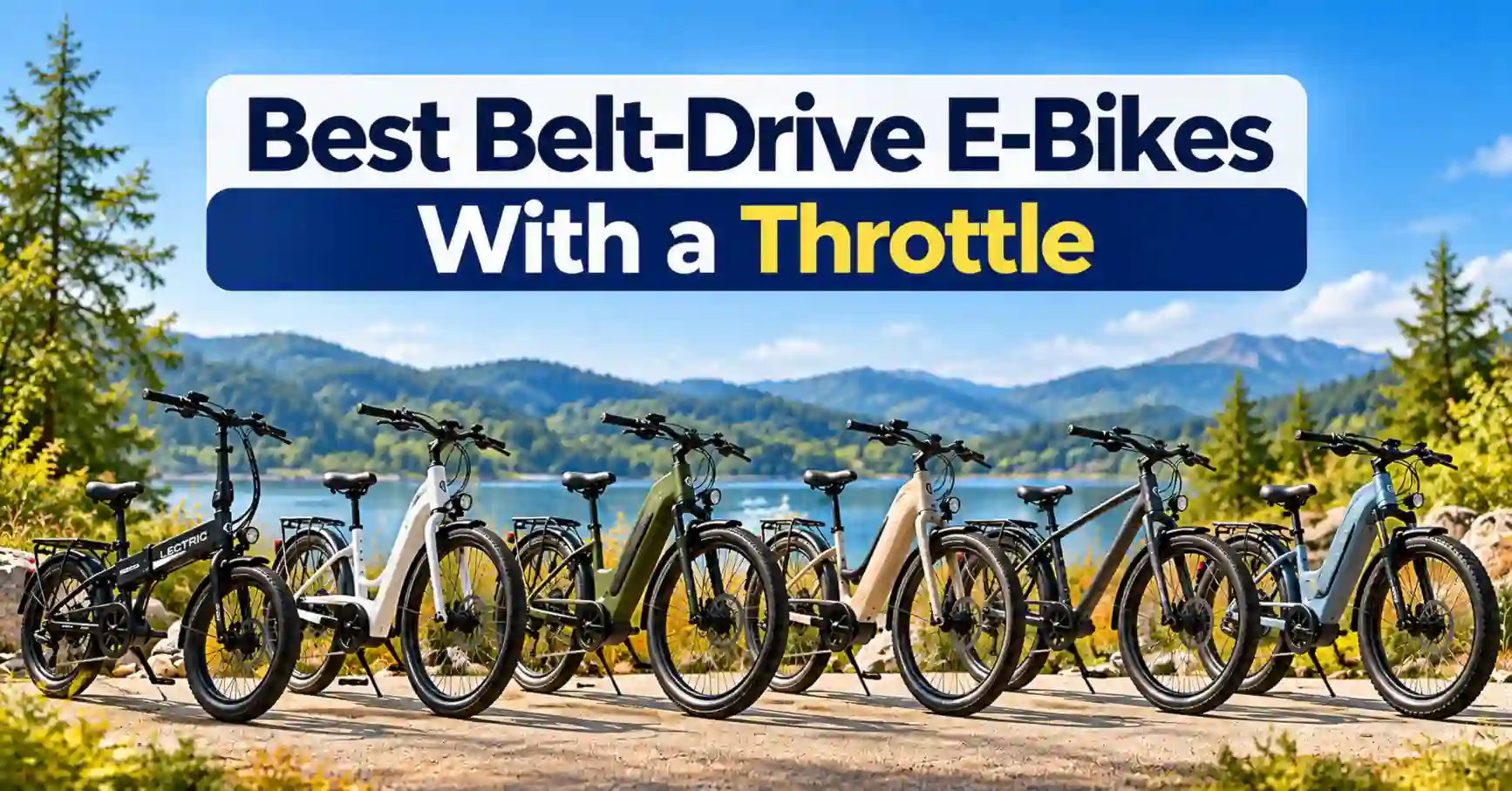
Best Belt-Drive E-Bikes With a Throttle: 6 Current Picks
Last Updated on September 29, 2026 by Kristina
📚 Research-based buying guide: I have not personally tested every bike in this guide. These recommendations are based on current manufacturer specifications, safety documentation, warranty and return policies, independent testing, service information, and available rider feedback.
Finding an electric bike with both a belt drive and a factory-supported throttle is harder than it sounds. Belt drives are increasingly common on low-maintenance commuter e-bikes, but many of those bikes are pedal-assist only. Throttles are common on other e-bikes, but those models often use a conventional chain.
This guide focuses specifically on current e-bikes that combine both features. A belt can reduce routine drivetrain cleaning and lubrication, while a throttle can help with starts, short bursts of power, and situations where you want motor assistance without pedaling.
This is a narrower category than our best belt-drive e-bikes guide, where a throttle is not required. It is also different from our best mid-drive e-bikes with a throttle guide, where a belt drive is not required.
We checked current manufacturer specifications and only included bikes for which we could verify both a belt drivetrain and manufacturer-supported throttle. Range, torque, and similar performance figures below are manufacturer claims unless otherwise noted.
⭐ Quick Picks
Best overall: Priority Current Plus
Best premium commuter: Priority Skyline Smart.Shift
Best compact step-through: EVELO Galaxy Lux
Best affordable folding option: Lectric XP Lite 2.0 JW Black
Best adaptable belt-drive commuter: Biktrix Swift CVT 2
Best for battery capacity and high payload: Zen Photon Pro
👉 Short on time?
See today’s e-bike deals and limited-time discounts, then compare top picks below.
Comparison Chart
| E-Bike | Best For | Motor | Throttle | Drivetrain | Battery | Weight |
|---|---|---|---|---|---|---|
| Priority Current Plus | Overall | 500W mid-drive, up to 140 Nm claimed | Left thumb | Gates CDX; Shimano Inter-5 or Enviolo CVT | 720Wh | 55-56.5 lb |
| Priority Skyline Smart.Shift | Premium commuting | 750W rear hub, 90 Nm claimed | Factory throttle | Gates CDX; Pinion C1.12i Smart.Shift | 720Wh | 68 lb |
| EVELO Galaxy Lux | Compact step-through | Bafang M410HD, 600W nominal, 105 Nm claimed | Handlebar throttle | Gates CDX; Enviolo Automatiq | 48V 11.6Ah | 45.4 lb plus 7 lb battery |
| Lectric XP Lite 2.0 JW Black | Affordable folding | 300W rear hub, 819W peak, 28 Nm claimed | Half-twist | Gates Carbon Drive; single-speed | 375Wh or 672Wh | 49 lb |
| Biktrix Swift CVT 2 | Adaptable commuting | Bafang M430 500W mid-drive, 120 Nm claimed | Trigger thumb | Michelin carbon belt; Enviolo CVT | 720Wh standard | About 57.8 lb without battery |
| Zen Photon Pro | Battery capacity and payload | Ananda 500W mid-drive, 160 Nm manufacturer claim | Up to 20 mph | Gates Carbon Drive; Enviolo Heavy-Duty CVT | 1040Wh | 72 lb with battery |
Specifications and configurations were checked in September 2026. Manufacturer specifications can change. Range and torque figures are manufacturer claims and can vary with rider weight, terrain, weather, assist level, tire pressure, and throttle use.
🔎 Why You Can Trust This Guide
For this guide, our first requirement was non-negotiable: every recommended configuration needed both a belt drivetrain and a manufacturer-supported throttle. We checked current manufacturer information rather than assuming that specifications from older versions or other configurations still applied.
From there, we compared the factors that matter most when choosing between these bikes, including motor type, gearing, battery capacity, braking, weight, rider fit, payload, warranty, everyday utility, and the tradeoffs of each design. We also looked for meaningful variety so the recommendations would cover different riders and uses rather than simply listing several similar bikes.
Electric Bike Explorer does not claim hands-on testing where it did not occur. Our recommendations are based on careful product research, specification verification, manufacturer documentation, and practical comparison of the features and limitations that matter to e-bike buyers. Learn more about how we research, compare, and rank electric bikes.
Priority Current Plus – Best Overall
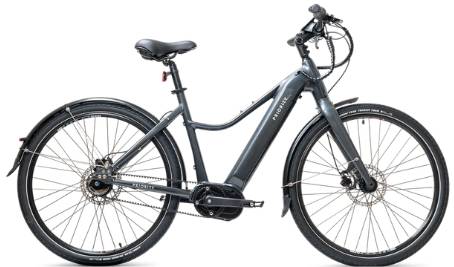
Best for: Riders who want a refined, low-maintenance commuter with a mid-drive motor, useful throttle, strong claimed torque, and a choice of internal gearing systems.
The Priority Current Plus combines a 500W torque-sensing mid-drive with a Gates CDX belt and either a Shimano Inter-5 internal gear hub or Enviolo Heavy Duty CVT. Priority lists up to 140 Nm of torque, giving it one of the stronger manufacturer torque claims in this group.
Key Specifications
- 500W torque-sensing mid-drive
- Up to 140 Nm manufacturer-claimed torque
- Left-side thumb throttle
- Gates CDX belt
- Shimano Inter-5 or Enviolo Heavy Duty CVT
- 720Wh removable battery
- Claimed range: 20-75 miles
- Weight: about 55 lb with Shimano or 56.5 lb with Enviolo
- Hydraulic disc brakes with 180mm rotors
Why It Stands Out
The combination of a mid-drive, belt, internal gearing, and throttle is still unusual. The Current Plus packages those features in a commuter-oriented platform without pushing weight as high as some of the more heavily equipped bikes here.
Tradeoffs
It is not the lightest e-bike, and riders who want suspension or very high cargo capacity may prefer another option. The choice between Shimano and Enviolo also affects how the bike feels and shifts.
Pros
- Strong mid-drive torque claim
- Two low-maintenance gearing choices
- Large 720Wh battery
- Hydraulic brakes
Cons
- No suspension fork
- More expensive than entry-level hub-drive options
Priority Skyline Smart.Shift – Best Premium Commuter
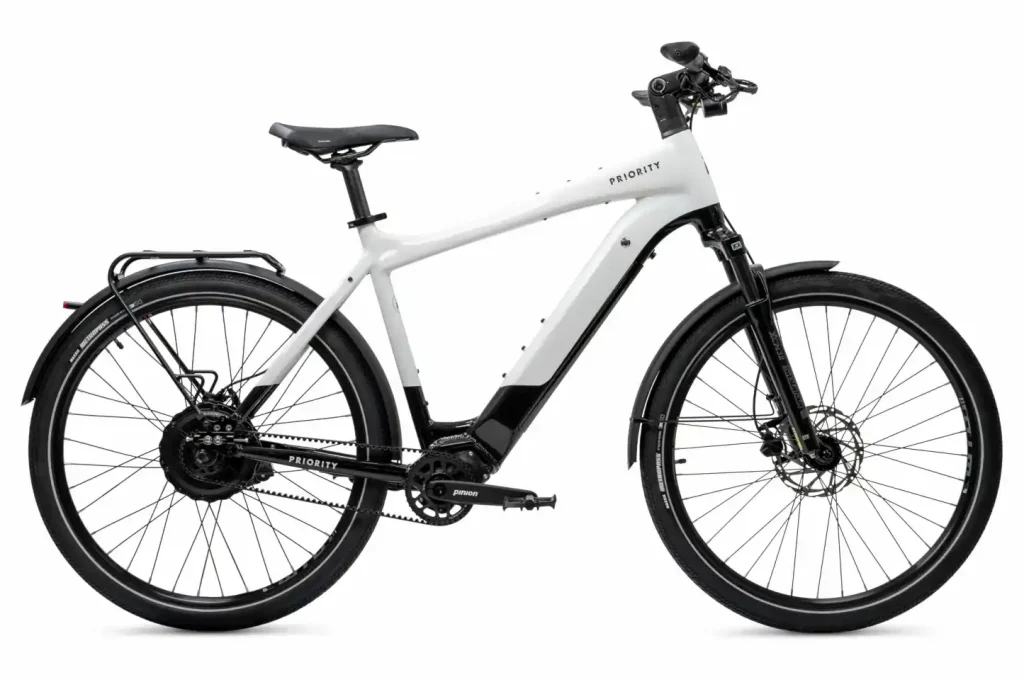
Best for: Commuters who value a sophisticated gearbox, broad gearing range, belt drive, and integrated everyday equipment.
The Skyline takes a different approach from most belt-drive e-bikes. Its 750W rear hub motor is paired with a Gates CDX belt and Pinion C1.12i Smart.Shift gearbox. The 12-speed gearbox provides a 600% gearing range without relying on an exposed derailleur.
Key Specifications
- 750W rear hub motor
- 90 Nm manufacturer-claimed torque
- Factory throttle
- Gates CDX belt
- Pinion C1.12i Smart.Shift 12-speed gearbox
- 720Wh battery
- Claimed range: 20-60 miles
- Weight: 68 lb
- 80mm suspension fork
- Hydraulic disc brakes with 180mm rotors
- 300 lb listed maximum combined weight, including bike and cargo
Why It Stands Out
The Pinion gearbox is the defining feature. It offers an unusually broad gearing range for a belt-drive commuter while keeping the shifting hardware protected inside the gearbox.
Tradeoffs
At 68 lb, the Skyline is substantially heavier than several bikes on this list. It is also a premium option, so the gearbox technology makes the most sense for riders who will actually benefit from its gearing range and commuter features.
Pros
- 12-speed Pinion Smart.Shift gearbox
- 600% gearing range
- Gates CDX belt
- Suspension fork and hydraulic brakes
Cons
- Heavy
- Premium pricing
EVELO Galaxy Lux – Best Compact Step-Through
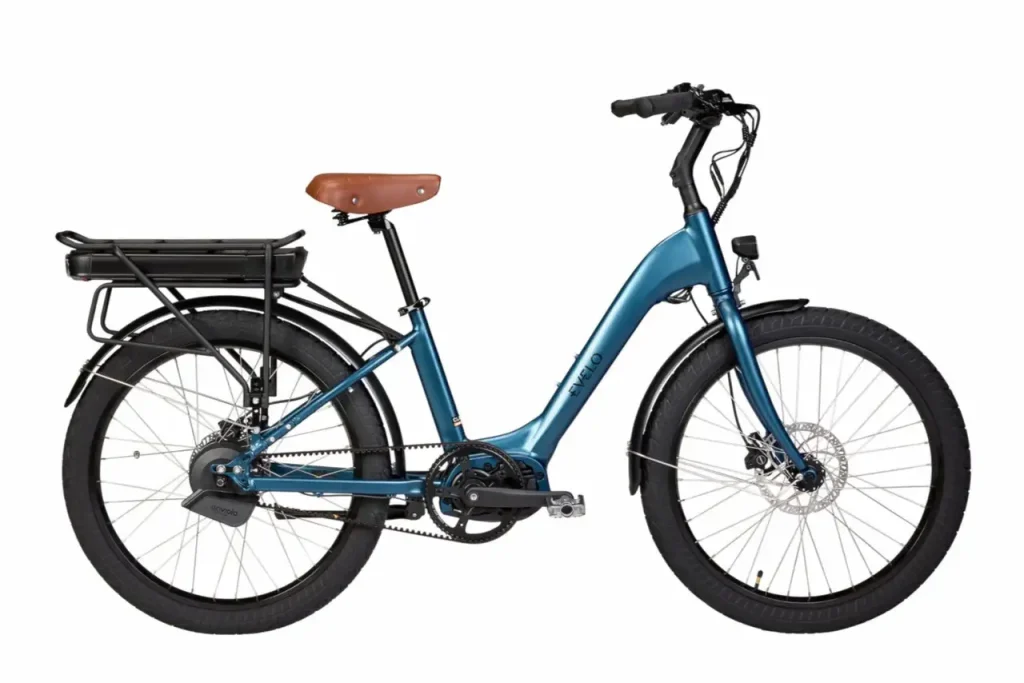
Best for: Shorter riders and anyone prioritizing an easy-to-mount frame, compact dimensions, automatic shifting, and a mid-drive with throttle.
The Galaxy Lux combines an ultra-low step-through frame with a Bafang M410HD mid-drive, Gates CDX belt, and Enviolo Automatiq shifting. EVELO lists a rider-height range of about 4 feet 10 inches to 5 feet 10 inches, making it especially relevant for riders who struggle with taller full-size e-bikes.
Key Specifications
- Bafang M410HD mid-drive
- 600W nominal, 980W peak
- 105 Nm manufacturer-claimed torque
- Handlebar throttle
- Gates CDX belt
- Enviolo Automatiq
- 48V 11.6Ah battery
- Claimed range: up to 55 miles with pedal assist or 25 miles electric-only
- Bike weight: 45.4 lb plus 7 lb battery
- Recommended maximum rider weight: 350 lb
Why It Stands Out
Its accessibility is the main advantage. The low frame, automatic shifting, belt drive, and throttle reduce several of the physical and mechanical hassles that can make an e-bike intimidating.
Tradeoffs
The compact fit is not ideal for taller riders. Its battery is also smaller than the 720Wh and 1040Wh packs on some alternatives.
Pros
- Very low step-through frame
- Automatic Enviolo shifting
- Mid-drive plus throttle
- Relatively manageable bike weight
Cons
- Limited fit for taller riders
- Smaller battery than some competitors
Lectric XP Lite 2.0 JW Black – Best Affordable Folding Option
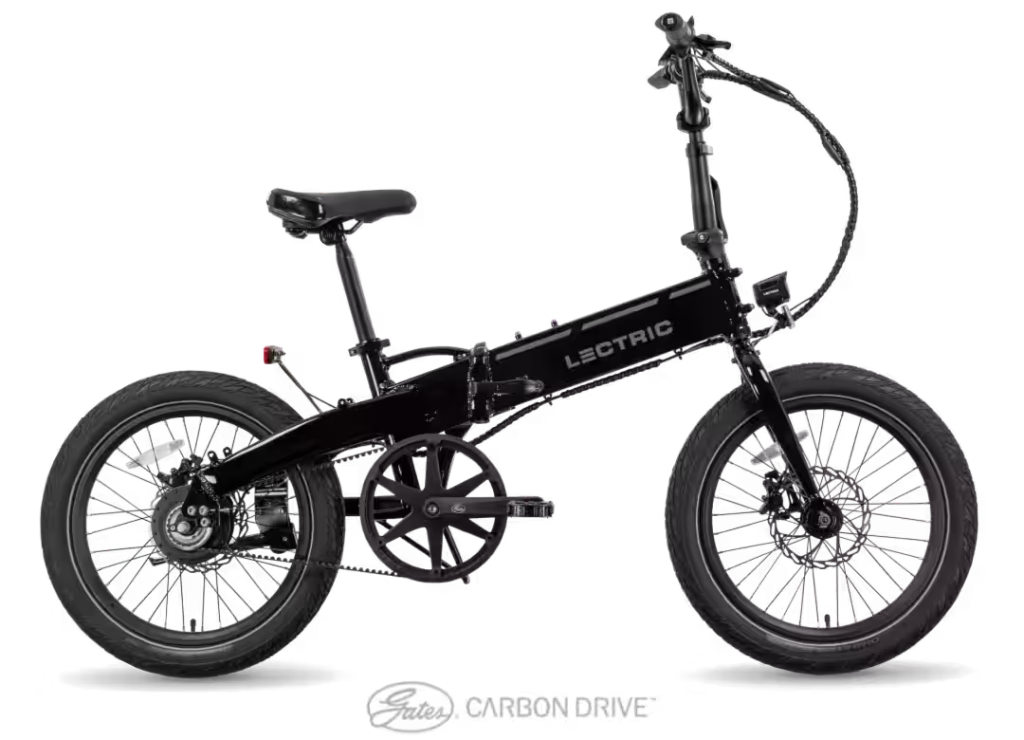
Best for: Riders who want a compact folding e-bike with a throttle and belt drive without moving into premium commuter pricing.
The important detail is the configuration: this recommendation is specifically for the XP Lite 2.0 JW Black belt-drive configuration. It uses a Gates Carbon Drive, single-speed drivetrain, 300W rear hub motor, and half-twist throttle.
Key Specifications
- 300W rear hub motor
- Up to 819W peak
- 28 Nm manufacturer-claimed torque
- Half-twist throttle
- Gates Carbon Drive on the JW Black configuration
- Single-speed drivetrain
- 375Wh standard or 672Wh long-range battery
- Manufacturer-claimed range up to 45 or 80 miles depending on battery and test conditions
- Weight: 49 lb
- 275 lb payload rating
- Hydraulic disc brakes with 180mm rotors
Why It Stands Out
Most belt-drive bikes with throttles are relatively expensive full-size commuters. The XP Lite 2.0 JW Black provides a simpler route into the category while retaining folding convenience.
Tradeoffs
The single-speed drivetrain is mechanically simple but gives you less flexibility on hills than a CVT, internal gear hub, or gearbox. Its 300W hub motor also has more modest torque than the mid-drive models here.
Pros
- Folding design
- Gates belt on the specified JW Black configuration
- Hydraulic brakes
- Two battery choices
Cons
- Single-speed gearing
- Modest torque for steep terrain
Biktrix Swift CVT 2 – Best Adaptable Belt-Drive Commuter
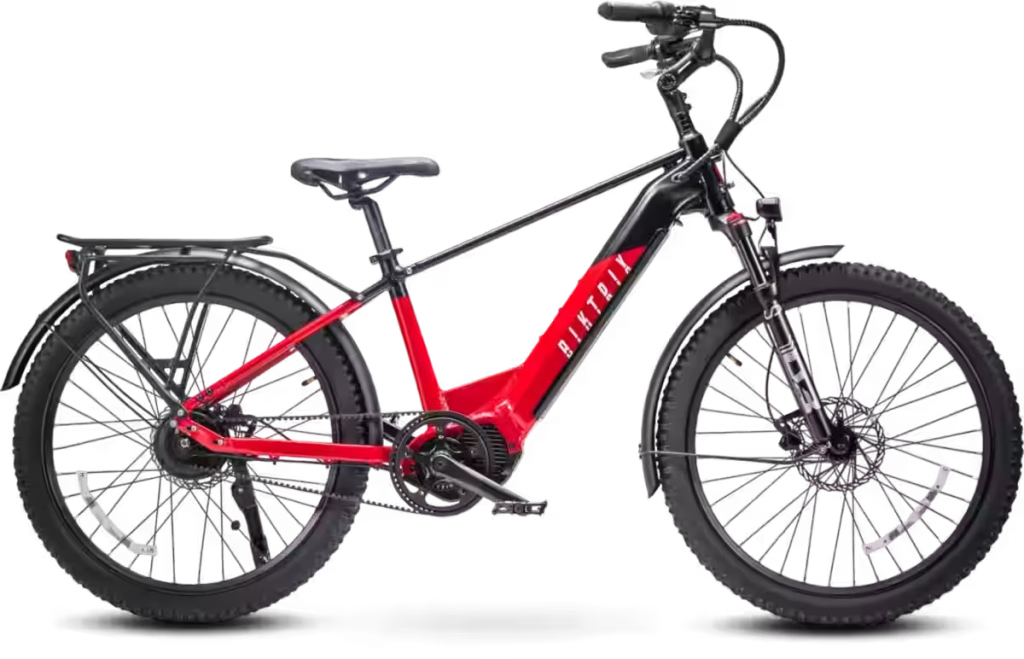
Best for: Riders who want a practical mid-drive commuter with a CVT, throttle, suspension, and the ability to add substantial battery capacity.
The Swift CVT 2 pairs a Bafang M430 mid-drive with an Enviolo CVT and Michelin carbon belt. The current detailed Biktrix product listing specifies a 500W motor, 120 Nm claimed torque, and 720Wh standard battery.
Specification note: Biktrix currently shows differing motor and battery figures across some Swift CVT 2 pages. The figures here follow the detailed current product listing, but buyers should confirm the specifications of the exact configuration before ordering.
Key Specifications
- Bafang M430 500W mid-drive
- 120 Nm manufacturer-claimed torque
- Trigger thumb throttle
- Michelin carbon belt
- Enviolo CVT
- 720Wh standard battery
- Optional second-battery configurations may be available
- Manufacturer estimate of about 40 km throttle-only with the stock battery under its stated conditions
- About 57.8 lb without battery
- 330 lb listed maximum load
- Hydraulic disc brakes with 180mm rotors
Why It Stands Out
The Swift CVT 2 brings together the features many all-weather commuters want: a belt, continuously variable gearing, mid-drive motor, throttle, fenders, rack, lights, and suspension.
Tradeoffs
The conflicting specifications across current Biktrix pages are a reason to verify the exact build before purchase. Its listed weight also excludes the battery, which makes direct weight comparisons less straightforward.
Pros
- Mid-drive and Enviolo CVT
- Practical commuter equipment
- Throttle
- Potential dual-battery flexibility
Cons
- Manufacturer pages currently show inconsistent specifications
- Listed bike weight excludes battery
Zen Photon Pro – Best for Battery Capacity and High Payload
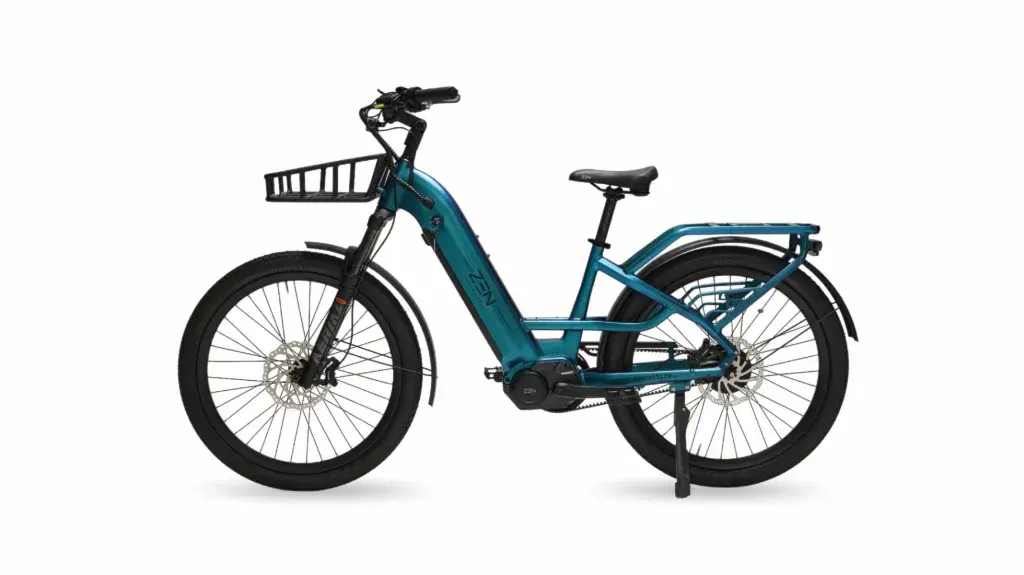
Best for: Riders prioritizing a very large battery, high manufacturer-listed load capacity, suspension, and a powerful mid-drive configuration.
The Photon Pro combines a 52V 500W Ananda mid-drive with a Gates belt, Enviolo Heavy-Duty CVT, and 1040Wh battery. Zen’s current U.S. specifications claim 160 Nm of torque and a maximum load of 551 lb.
Key Specifications
- 52V 500W Ananda mid-drive
- 160 Nm manufacturer-claimed torque
- Throttle up to 20 mph
- Gates Carbon Drive
- Enviolo Heavy-Duty CVT
- 1040Wh battery
- Manufacturer-claimed range up to 87 miles with pedal assist or 43 miles using throttle under stated conditions
- Weight: 72 lb with battery
- Manufacturer-listed maximum load: 551 lb
- Tektro four-piston hydraulic brakes
- 120mm suspension fork
Why It Stands Out
The 1040Wh battery is the largest in this comparison, and the manufacturer-listed load rating is unusually high. That makes the Photon Pro especially interesting for riders who prioritize battery reserve and carrying capacity.
Tradeoffs
The bike weighs 72 lb, so it is not a good choice if you regularly need to carry an e-bike up stairs. Zen’s regional pages have also shown differing torque figures, so we identify the 160 Nm number specifically as the current U.S. manufacturer claim rather than an independently measured result.
Pros
- Very large 1040Wh battery
- High manufacturer-listed load rating
- Enviolo Heavy-Duty CVT
- Four-piston brakes and 120mm suspension
Cons
- Heavy
- Regional manufacturer pages have shown differing torque figures
Belt Drive + Throttle: Why Would You Want Both?
A belt drive and throttle solve different problems. The belt addresses drivetrain upkeep: it does not need chain lubricant, stays relatively clean, and is resistant to corrosion. The throttle addresses convenience and accessibility by letting the motor propel the bike without continuous pedaling, subject to the bike’s programming and local rules.
Together, they can make sense for commuters, riders with stop-and-go routes, and people who want a cleaner drivetrain without giving up throttle assistance.
Belt Drive vs. Chain Drive With a Throttle
A chain is inexpensive, widely serviceable, and compatible with a huge variety of derailleurs and gearing systems. A belt is cleaner and requires less routine drivetrain attention, but it needs a compatible frame and compatible sprockets or internal gearing.
The throttle itself does not require a belt or chain. On hub-drive bikes, the motor drives the wheel independently of the bicycle drivetrain. On mid-drive bikes, motor power passes through the drivetrain, making drivetrain design and gearing more consequential.
Mid-Drive vs. Hub-Drive Belt E-Bikes With Throttles
A mid-drive places the motor at the crank and can take advantage of the bike’s gearing. That is useful for climbing and varied terrain, but it also sends motor power through the belt and gearing system. A hub motor drives the wheel directly and mechanically separates motor propulsion from the belt drivetrain.
Neither design is automatically better for every rider. For more detail, see our e-bike motor guide.
Gates Carbon Drive vs. Other Belt Systems
Gates Carbon Drive is the most recognizable belt system in this group and appears on several of our picks. Gates belts use carbon-fiber tensile cords and require compatible sprockets, frame design, and correct belt tension.
Gates is not the only option. The Biktrix Swift CVT 2, for example, is currently specified with a Michelin carbon belt. The important buying question is not the logo alone but whether replacement parts, correct tensioning information, and service support are available for the complete drivetrain.
What Kind of Gearing Works With a Belt Drive?
Because a belt cannot run through a conventional derailleur, belt-drive bikes generally use a single-speed setup, internal gear hub, continuously variable transmission, or gearbox. This guide includes examples of all but a traditional derailleur: single-speed on the Lectric, Enviolo CVTs on several bikes, Shimano internal gearing on one Current Plus configuration, and a Pinion gearbox on the Skyline.
For flatter routes, single-speed simplicity can work well. Riders facing steeper hills or varied terrain will generally benefit from a broader gearing range.
Are Belt-Drive E-Bikes With Throttles Good for Hills?
They can be, but the belt itself does not determine climbing ability. Motor torque, motor placement, gearing, total weight, wheel size, controller programming, and hill grade all matter.
A mid-drive paired with useful gearing can be especially effective because the motor can operate through lower gears. A hub-drive throttle can still be convenient on hills, but a modest hub motor combined with single-speed gearing may be less suitable for sustained steep climbs.
Are They Good for Commuting?
This combination is particularly attractive for commuting. Belt drives avoid oily chains and reduce routine drivetrain cleaning, while a throttle can make frequent starts at intersections easier. Features such as fenders, lights, racks, hydraulic brakes, and removable batteries can matter just as much in everyday use.
If you are comparing those broader factors, our electric bike buying guide covers the major decisions beyond drivetrain type.
Are Belt Drives Really Maintenance-Free?
No. They are low-maintenance, not maintenance-free. Gates says correct belt tension is important: insufficient tension can allow tooth skipping, while excessive tension can increase drag and contribute to bearing wear. Belts and sprockets should also be inspected for damage and kept properly aligned.
The rest of the e-bike still needs normal care, including tires, brakes, fasteners, battery storage, and periodic inspection of electrical components.
Throttle Laws and E-Bike Classes
Throttle rules vary by jurisdiction and by where you ride. In common U.S. class frameworks, throttle operation is closely associated with Class 2 e-bikes, while Class 3 treatment and trail access can differ by state and local rules. A bike’s ability to reach a certain speed does not guarantee that every operating mode is permitted everywhere.
Before riding, check our state-by-state e-bike laws and our explanation of electric bike classes, then confirm current local trail and road rules.
Essential E-Bike Gear (Quick Picks)
Before you choose your e-bike, these are the accessories most riders end up needing for safety and everyday use:
What to Look for Before Buying
- Verify the exact configuration. A model family may offer both belt and chain versions.
- Confirm throttle behavior. Check throttle speed limits, whether pedaling is required in certain modes, and whether settings affect classification.
- Match gearing to terrain. Single-speed is simple, while internal gearing, CVTs, and gearboxes provide more flexibility.
- Check battery size realistically. Frequent throttle use can reduce range compared with low-assist manufacturer test conditions.
- Look at total weight. A 70-plus-pound e-bike can be difficult to lift even if it rides comfortably.
- Check fit. Use our electric bike size calculator as a starting point and compare it with the manufacturer’s geometry and fit guidance.
- Consider service access. Ask whether a local shop can service the motor, brakes, internal gearing, and belt system.
- Read the warranty terms. Warranty length alone does not tell you what parts, labor, shipping, or wear items are covered.
Common Buying Mistakes
One common mistake is assuming every version of a model uses the same drivetrain. The Lectric XP Lite 2.0 is a good example of why the exact configuration matters. Another is treating manufacturer range as a guaranteed real-world number, especially when planning to use the throttle frequently.
Also avoid choosing solely by motor wattage or a headline torque figure. Gearing, controller tuning, wheel size, total system weight, and how the bike delivers power all affect the riding experience.
Alternatives If You Do Not Need Both Features
If a throttle is optional for you, the market becomes much larger. Start with our best belt-drive e-bikes for additional low-maintenance choices.
If the throttle and climbing-oriented mid-drive are more important than the belt, compare our best mid-drive e-bikes with a throttle. For a broader shortlist across drivetrain types, see our best electric bikes.
Frequently Asked Questions
Can belt-drive e-bikes have throttles?
Yes. The six bikes in this guide are current examples where we verified both a belt drivetrain and manufacturer-supported throttle. The combination is less common than either feature by itself.
What is the best belt-drive e-bike with a throttle?
The right choice depends on fit, terrain, budget, weight, and gearing needs. The Priority Current Plus offers a particularly balanced combination of mid-drive power, throttle, Gates belt, internal gearing choices, and a 720Wh battery, while the other picks emphasize different priorities such as folding, automatic shifting, gearbox range, battery size, or payload.
Does a Gates belt work with a throttle?
Yes. A throttle controls motor assistance; it does not inherently conflict with a Gates belt. The complete motor, belt, sprockets, frame, and gearing system still need to be designed to work together.
Are belt-drive e-bikes better than chain-drive e-bikes?
They are better for some priorities, especially a clean drivetrain and reduced routine lubrication. Chains remain cheaper, easier to find, and compatible with a wider range of conventional gearing and repair options.
Do belt drives need maintenance?
Yes, but generally less routine drivetrain maintenance than a chain. Correct tension and alignment matter, and the belt and sprockets should be inspected for wear or damage.
Can a belt-drive e-bike have a mid-drive motor?
Yes. Several bikes here use mid-drive motors with belts. The drivetrain components must be compatible with the motor’s output and the bike’s gearing system.
Are there step-through belt-drive e-bikes with throttles?
Yes. The EVELO Galaxy Lux is a particularly low step-through example, and other models in this guide use accessible commuter-oriented frame designs.
Are belt-drive e-bikes good for hills?
They can be. Hill performance depends more on the motor, gearing, controller, bike weight, rider weight, and grade than on whether the final drive is a belt or chain.
How long does an e-bike belt last?
There is no single mileage that applies to every rider. Belt life varies with system design, tension, alignment, contamination, riding conditions, torque loads, and maintenance. Inspect the belt according to the drivetrain manufacturer’s guidance rather than relying on a universal replacement interval.
Can you replace an e-bike belt yourself?
Possibly, if you have the correct replacement belt and can follow the manufacturer’s procedures for frame access, alignment, and tension. Riders unfamiliar with belt tensioning or internal gearing may prefer professional service.
Are belt-drive e-bikes more expensive?
Many are, partly because belt systems are commonly paired with internal gear hubs, CVTs, or gearboxes rather than inexpensive derailleur drivetrains. There are exceptions, including simpler single-speed belt-drive designs.
Are throttle e-bikes legal on bike trails?
It depends on the jurisdiction and the specific trail. Some facilities restrict throttle-equipped or Class 2/3 e-bikes even when they are legal on nearby roads. Check current state and local rules plus the trail manager’s policy before riding.
Disclosure: As an Amazon Associate, I earn from qualifying purchases. This comes at no extra cost to you and helps support the content on this site.
Like Electric Bike Explorer?
Add Electric Bike Explorer as a Preferred Source on Google to make it easier to see more of our e-bike news, guides, reviews, and troubleshooting content in Google Search.

Kristina is not just an enthusiast but a true authority on electric bikes. Nestled in the coastal beauty of Virginia, Kristina has found the perfect backdrop for her passion for electric biking. As a dedicated wife and homeschooling mom, her life revolves around family, faith, and the thrill of adventure.
Originally hailing from Ohio, Kristina's journey with electric bikes began as a curiosity and quickly evolved into a deep expertise. Her blog is a testament to her love for electric biking, combining her fascination for eco-friendly transportation with her coastal lifestyle.
When she's not cruising the beach on her electric bike, you'll find Kristina indulging in her other loves: long walks along the shore, getting lost in a good book, and cherishing moments with her loved ones. With a heart as big as her love for animals, especially cats, Kristina brings a unique perspective to the electric bike world, grounded in her strong faith in God and her dedication to a sustainable lifestyle.
Through her blog, Kristina shares her extensive knowledge of electric bikes, offering valuable insights, tips, and recommendations to fellow enthusiasts. Whether you're a seasoned rider or a newcomer to the electric bike scene, Kristina's blog is your go-to source for all things electric biking, fueled by her passion, expertise, and the scenic beauty of coastal Virginia.