Can a Folding E-Bike Fit in a Car Trunk? Measurements and Loading Tips
Last Updated on September 29, 2026 by Kristina
Quick Answer: Can a Folding E-Bike Fit in a Car Trunk?
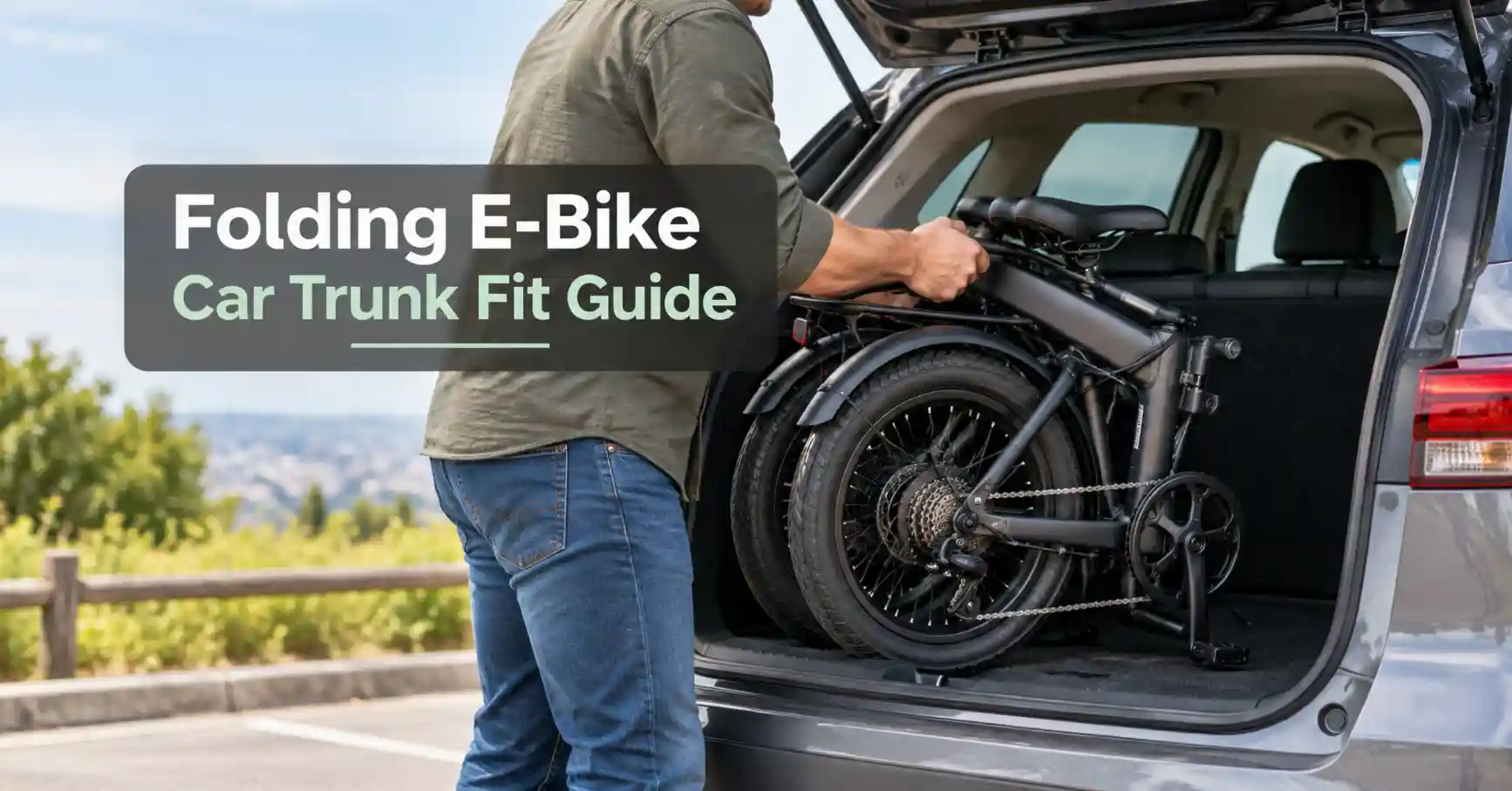
Yes, some folding e-bikes can fit inside a car trunk. But a folding frame does not guarantee that a particular e-bike will fit your vehicle.
You need to compare the bike’s folded length, width, and height with both the trunk opening and the usable space inside the trunk. Those are not the same measurement. A folded bike can technically fit inside the trunk compartment but still be impossible to rotate through a narrow opening.
Weight can also be a bigger problem than size. Some full-featured folding e-bikes weigh 60 to 75 lb, so a bike may fit dimensionally but still be awkward or impractical for its owner to lift over a high trunk lip.
If you are still deciding which folding bike to buy, start with my Best Folding E-Bikes guide. If frequent lifting is one of your biggest concerns, my Best Lightweight Folding E-Bikes guide compares models specifically with portability in mind. New riders may also want my complete E-Bike Buying Guide.
Removing a battery, lowering or removing an approved seatpost, folding the pedals, or adjusting a manufacturer-approved handlebar system may reduce the weight or folded footprint. Only remove or adjust parts the bike manufacturer identifies as removable or adjustable.
Why “Folding” Does Not Always Mean “Trunk-Friendly”
A folding hinge makes an e-bike smaller. It does not automatically make it light, easy to grip, or easy to maneuver through a sedan trunk opening.
Many folding e-bikes use 20-inch wheels with 3- or 4-inch-wide tires, large batteries, suspension forks, racks, fenders, lights, and substantial aluminum frames. Those features may be useful on the road, but they can create a bulky folded package.
The handlebar, pedals, crank, derailleur, rack, fenders, cables, display, brake levers, and other components can also stick out beyond what looks like the main folded frame.
Another issue is how well the bike stays folded. Some bikes use a strap, magnet, latch, or other retention system. Others can begin to open while you are trying to lift or rotate them. A 50-lb bike that stays compact and gives you predictable gripping points may be easier to handle than a similarly sized bike that swings apart as you move it.
Then there is the lift itself. A trunk-friendly folding electric bike is not useful to you if getting it over the trunk lip requires a lift you cannot comfortably control. Load shape, gripping points, trunk height, and the amount of twisting required all matter along with scale weight.
That is why I would never assume that “folding” means “fits any sedan” or that a bike advertised for car travel will fit your particular vehicle.
What You Need to Measure on Your Car
Do not begin with the vehicle’s advertised cargo volume in cubic feet. Cargo volume tells you how much space exists in total. It does not tell you the shape of the trunk, the dimensions of its opening, or whether a folded bike can pass through it.
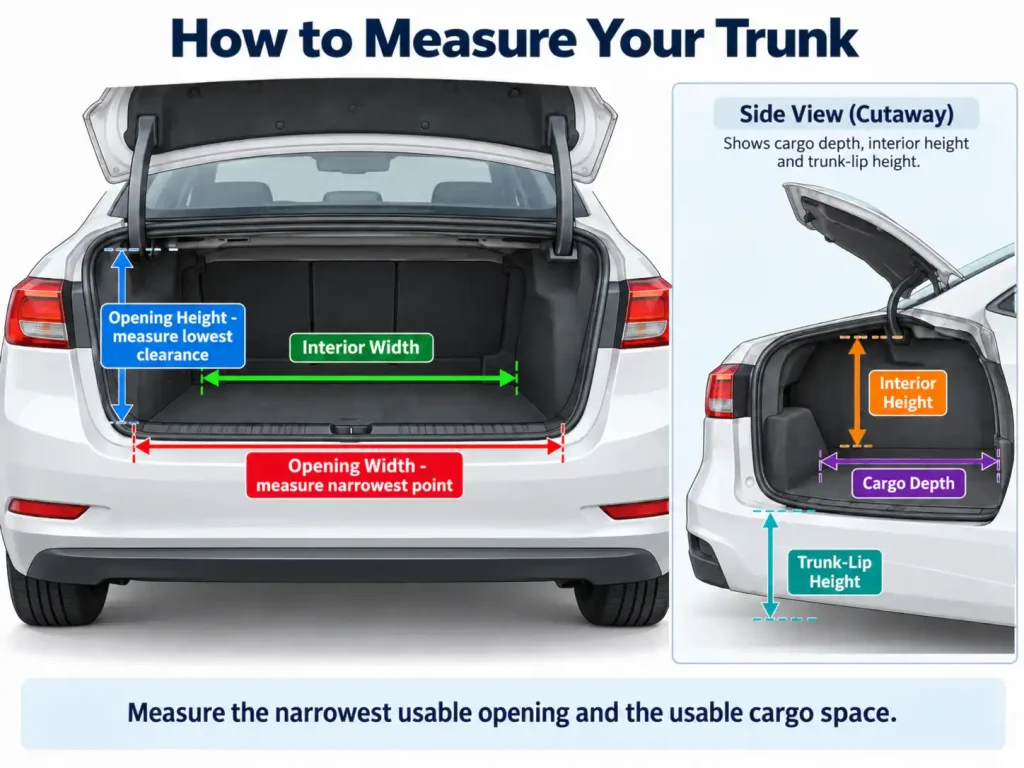
Use a tape measure and record the following dimensions in inches:
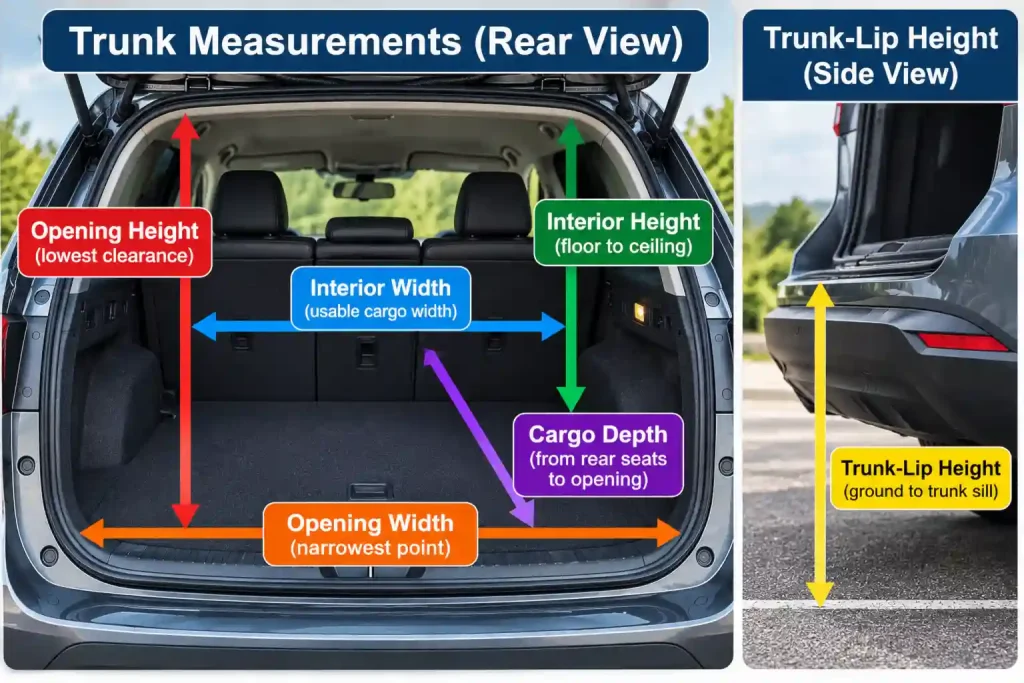
- Trunk-opening width at the narrowest point. Do not use only the widest visible section. Measure between trim, weather seals, latch hardware, or bodywork that actually limits the opening.
- Trunk-opening height at the lowest point. Measure the vertical clearance the bike must pass through, not merely the height farther inside the trunk.
- Usable interior width. Measure the space available after the bike has passed through the opening.
- Usable cargo-floor depth. Measure from the inside edge of the trunk to the farthest usable point. Account for a sloped rear seatback or other obstruction.
- Interior height. Measure the actual vertical clearance where the folded bike will sit.
- Trunk-lip height. Measure how high you must lift the bike before it can move inward instead of striking the bumper or bodywork.
- Space occupied by hinges or gooseneck arms. Some sedan trunk hinges swing down into the cargo area as the lid closes.
- Narrow areas created by wheel wells or trim. The widest part of the trunk may not be where the bike needs to sit.
- Additional room with the rear seats folded. If your vehicle allows the seats to fold, measure the new usable length and any narrow pass-through between the trunk and passenger compartment.
- The loading angle. Look at whether the folded bike can enter straight, must be tipped on an edge, or must rotate diagonally after one end enters the trunk.
The narrowest point can matter more than the largest measurement. A trunk may have plenty of room once the bike is inside but still have an opening that is several inches smaller.
I recommend writing every measurement down rather than trying to remember it while shopping. Most folding e-bike manufacturers publish folded dimensions in inches, which makes direct comparison easier.
What You Need to Measure on the Folding E-Bike
Start with the manufacturer’s current folded-dimension information, but look carefully at what those numbers actually include.
- Folded length
- Folded width
- Folded height
- Published bike weight and what that figure includes or excludes
- Battery weight, when the manufacturer publishes it consistently
- Battery-removed weight, but only when it can be verified rather than estimated
- Whether the pedals fold, detach, or remain extended
- Whether the handlebar stem folds or the bars are approved to rotate
- Whether the seatpost can be lowered or removed according to the manufacturer
- Whether a rack, basket, bag, mirror, bottle holder, phone mount, or other accessory increases the folded footprint
- Whether the frame stays securely together when folded
- Whether cables, brake levers, displays, throttles, or controls protrude
- Where the bike can be gripped without lifting from a fragile component
If you already own the bike, measure your actual setup rather than relying only on the factory number. Installed accessories can change the dimensions substantially.
I would not remove structural parts, electrical components, brake hardware, drivetrain parts, or anything else the manufacturer does not identify as removable for normal transport.
Folding E-Bike and Trunk Measurement Worksheet
| Measurement | Folding E-Bike | Car Trunk |
|---|---|---|
| Width | ||
| Height | ||
| Length/depth | ||
| Narrowest opening | N/A | |
| Weight to lift | N/A | |
| Trunk-lip height | N/A |
Important: Matching numbers do not guarantee fit. A folded e-bike may need to tilt or rotate diagonally through the opening. Handlebars, pedals, racks, brake controls, or other protruding parts can also interfere even when the basic length, width, and height look acceptable.
Folding E-Bike Trunk Fit Checker
Enter your folded e-bike dimensions and your car's measured trunk dimensions. This tool checks all 6 simple orientations to see whether the bike passes a basic dimensional screen.
This is a screening tool, not a fit guarantee. A real folded e-bike is not a rectangular box, and diagonal rotation is not calculated.
1. Folding E-Bike Measurements
Use the actual folded measurements with the accessories you plan to carry.
2. Car Trunk Measurements
Measure the narrowest opening and the usable cargo area in the seat position you plan to use.
All 6 Simple Orientations
These results assume the bike keeps the same basic orientation as it passes through the opening and into the cargo area.
How This Checker Works
A rectangular object with length, width, and height has 6 axis-aligned ways to present those dimensions to a rectangular opening. This checker tests all 6.
If the smallest theoretical clearance is under 2 inches, the tool flags the result as very tight. The 2-inch threshold is an Electric Bike Explorer caution margin, not a manufacturer standard or fit guarantee.
Diagonal rotation is deliberately not calculated because a real folded e-bike has an irregular shape and a real trunk opening may have curves, hinges, trim, and other obstructions.
Popular Folding E-Bike Size Examples
I checked current manufacturer specifications for the models below on September 26, 2026. These are examples of how dramatically folding e-bike dimensions and lifting weights can vary. They are not a promise that any bike will fit your car.
Where a manufacturer does not publish a battery weight or clean battery-removed figure, I list it as not published or not verified rather than estimating it. When a manufacturer's own pages conflict, I note that instead of choosing the more convenient number.
| Bike | Folded dimensions | Published bike weight | Battery weight | Battery-removed weight | Tire width | Pedals | Important trunk-loading concern |
|---|---|---|---|---|---|---|---|
| Lectric XP Lite 2.0 | 36 x 16 x 27 in. on current product page; Lectric support lists 36 x 16 x 28 in. | 49 lb total manufacturer-listed weight | Conflicting official figures: 8 lb in Lectric's support table and 7 lb on the product page | 41 lb | 2.5 in. | Fold | Lectric currently publishes conflicting folded-height and battery-weight figures. Confirm current specifications if clearance or lifting weight is critical. |
| Lectric XP4 750 | 37 x 17 x 29 in. | 71 lb total manufacturer-listed weight | 9 lb | 62 lb | 3.0 in. | Quick-release/removable rather than folding | The dimensions are compact for a utility e-bike, but 62 lb remains a substantial lift even after battery removal. |
| Mooncool POP | 34.7 x 16.9 x 29.5 in. | 67 lb manufacturer-listed bike weight | Not published | Not verified | 3.0 in. | Fold | Compact dimensions do not make the 67-lb bike lightweight. Confirm dimensions with Mooncool if only an inch or two of clearance is available. |
| Ride1Up Portola 02 | 36 x 19 x 29.5 in. | 61 lb with 10Ah battery; 63 lb with 15Ah battery | Not published separately | Not verified | 3.0 in. | Fold | The 19-in. width and integrated rear rack matter when rotating it through a narrow opening. Ride1Up includes a fold-retention strap. |
| Velotric Fold 1 Plus | 37.8 x 19.7 x 33.5 in. | Current product page lists 63 lb while excluding fenders, kickstand, and pedals; another current Velotric page lists 62 lb | Not published | Not verified | 3.0 in. | Fold | It is relatively tall and wide when folded, and Velotric does not currently publish one clearly defined complete assembled weight across its pages. |
| Urtopia Carbon Fold 2 | 32 x 19 x 27 in. | 36.3 lb listed bike weight; Urtopia also lists 35.2 lb net with battery, excluding accessories | Not separately published | 30.8 lb net without battery, excluding accessories | 2.0 in. | Fold | The lightweight design helps with lifting, but Urtopia publishes several weight definitions. Check what is included before comparing it directly with another bike. |
| Mokwheel Slate | 39 x 12 x 30 in. | 54 lb manufacturer-listed weight | Not published | Not verified | 3.0 in. | Current product page does not clearly specify pedal-folding status | The 12-in. folded width is unusually slim, but the 39-in. length can still determine whether it rotates through your opening. |
The comparison shows why I would not shop by one number. The Urtopia is dramatically lighter than the XP4, while the Mokwheel has a very narrow published folded width but is longer. The Mooncool folds to a relatively compact footprint but still has a manufacturer-listed weight of 67 lb.
One hands-on detail I can add about the Mooncool POP is that I have personally folded and handled it. As I explained in my Mooncool POP review, I found the folding process straightforward and the bike more manageable to reposition than I expected from the published 67-lb weight. That was not a trunk-fit test, and I am not claiming that the POP fits my car or anyone else's.
If you are deciding between some of these models, I also have a detailed Mooncool POP vs. Lectric XP4 comparison and a Lectric XP4 vs. Ride1Up Portola comparison.
🔎 Why You Can Trust This Guide
I checked folded dimensions, weights, tire sizes, folding hardware, and battery information against current official manufacturer pages and support material rather than estimating from photographs. When official pages conflict or do not provide a figure, I say so.
For loading and lithium-ion battery guidance, I also reviewed current government, safety-organization, and manufacturer information. This guide is about measuring and transportation - it is not a claim that I personally trunk-tested every bike listed here.
How to Check Fit Before Buying
If trunk transport is part of your buying decision, do more than compare a single manufacturer's dimension chart.
- Start with official folded dimensions. Use the bike manufacturer's current product page, manual, or support documentation rather than a retailer's old specification table.
- Measure your trunk at its narrowest opening. Width and height at the doorway matter before interior space does.
- Compare all three bike dimensions. Do not focus only on folded length.
- Think about rotation. Ask whether the bike can enter on one edge, rotate, and settle into the position you plan to use.
- Make a cardboard or tape template. A taped floor outline can reveal an obviously oversized footprint. For a closer check, a simple cardboard box approximating the folded length, width, and height is more useful because it also tests opening height.
- Treat the template as an approximation. A rectangular box does not reproduce handlebars, pedals, brake levers, cables, racks, tires, or an irregular folded frame.
- Ask the manufacturer when information is missing. If folded size is not published, request it instead of estimating dimensions from photographs.
- Ask an owner to measure the actual bike. This can be especially helpful when accessories change the folded package, although another owner's vehicle-fit result still does not guarantee yours.
- Check the return policy before ordering. Confirm current return shipping charges, restocking fees, and packaging requirements if trunk fit is a deciding factor.
- Use a dealer bike when possible. A real folded bike is much more informative than a specification sheet if the dealer allows you to check it against your vehicle.
If you have only a half-inch or an inch of theoretical clearance, I would treat that as a warning rather than a comfortable fit. You still need room for your hands and enough clearance to avoid forcing the bike against the vehicle.
Sedan vs. Hatchback vs. SUV Trunk Space
Sedan
A sedan can have a surprisingly large trunk once you are inside it, but the opening is often the limiting factor. The lid, rear bodywork, trunk lip, and hinge arms can create a much smaller path than the interior volume suggests.
A high trunk lip also means the bike may need to be lifted farther before you can slide it inward. Folding rear seats can add useful depth, but the pass-through between the trunk and cabin still needs to be measured.
I own a 2014 Ford Fusion, but I have not performed a documented trunk-fit test with the folding e-bikes in the comparison table. I would measure its actual opening before making any claim that a particular model fits.
Hatchback
A hatchback usually gives you a larger vertical opening than a conventional sedan trunk. That can make it easier to rotate a folded bike or keep it more upright while loading.
Folding rear seats can add substantial usable length. However, cargo-floor height, wheel-well width, hatch trim, and the shape of the rear opening still matter.
SUV or Crossover
An SUV or crossover often provides more opening height and interior cargo space, and some vehicles provide useful cargo tie-down points.
The tradeoff is that the load floor may be higher from the ground. A 60- or 70-lb bike can therefore require a higher lift even when there is plenty of room once it is inside.
No vehicle type is automatically the best choice for every folding e-bike or every rider. Measure the actual vehicle.
How to Load a Folding E-Bike Into a Trunk
- Park on a flat surface and secure the vehicle. Give yourself room behind the car to work without traffic or other obstacles around you.
- Turn the e-bike off.
- If the bike uses a removable key, remove it after the battery or lock is secured. Do not leave a loose key hanging from the bike while folding or loading it.
- Remove the battery when the manufacturer permits it and removal makes the lift easier. Follow the bike's correct battery-removal sequence.
- Remove loose accessories when appropriate. Bags, mirrors, bottles, detachable displays, phone mounts, and other loose items can fall or become unexpected contact points.
- Fold the bike exactly as the manufacturer instructs. Close and secure every frame and stem latch.
- Use the bike's approved fold-retention system. If the manufacturer supplies a locking strap, magnet, clip, or other retention method, make sure it is engaged.
- Protect the car. A blanket, cargo liner, or protective mat can help protect the bumper, trim, cargo floor, and upholstery.
- Keep the bike close to your body while lifting. Plan where your hands will go before the bike leaves the ground.
- Avoid twisting while holding the bike. Move your feet to change direction rather than trying to rotate your upper body while supporting an awkward load.
- Get help or use properly rated loading equipment when needed. If you cannot control the lift, do not force it. A second person may be appropriate. Use a ramp only if the ramp manufacturer approves it for the bike's weight, the vehicle, the loading height, and the intended setup. Do not improvise a ramp.
- Protect vulnerable bike components. Position the folded bike so the rear derailleur, brake rotors, display, throttle, brake levers, wiring, cables, and controls are not carrying its weight.
- Secure the bike against movement. Follow the vehicle manufacturer's cargo-restraint instructions and use suitable restraint points so the bike cannot slide or become a moving object during braking or turns.
OSHA's general materials-handling guidance emphasizes keeping a load close and avoiding twisting while lifting. It also recognizes that weight alone does not determine how difficult a load is to handle. A folded e-bike is a good example because it is large, irregular, and may have poor gripping points.
That guidance does not establish that any particular bike weight is safe for an individual rider to lift.
Should You Remove the Battery Before Loading?
If the manufacturer permits normal battery removal, taking the battery out can make a meaningful difference.
For example, Lectric currently lists the XP Lite 2.0 at 49 lb total and 41 lb with the battery removed. However, Lectric's own current pages conflict on the battery itself: its support table lists an 8-lb battery, while the product page lists a 7-lb battery. Because those official figures do not agree, I would confirm the current battery specification directly with Lectric if that 1-lb difference matters to your lifting decision.
The XP4 750 is more consistent. Lectric lists it at 71 lb total with a 9-lb battery, leaving 62 lb when the battery is removed.
- Reducing the weight you have to lift
- Allowing the battery to be protected separately from impacts
- Keeping the battery from becoming a load-bearing contact point while the folded bike is positioned
- Allowing a removable battery to be separately secured instead of relying on a damaged or questionable mounting latch
Battery removal is not automatically the correct procedure for every e-bike. Follow the instructions for your specific battery and bike.
Bosch's car-transport guidance recommends removing a detachable display and, when possible, the e-bike battery and stowing them in the vehicle. Bosch also specifically warns against leaving its battery exposed to strong sunlight inside a car for long periods.
When a battery is removed, protect it from movement and physical damage. Keep exposed electrical contacts away from keys, tools, coins, or other conductive metal objects. The U.S. Department of Transportation's Pipeline and Hazardous Materials Safety Administration identifies short circuits and physical damage as important lithium-battery hazards. That general hazard information is useful here, but it should not be read as a claim that commercial hazardous-material shipping rules necessarily apply to an owner's ordinary personal vehicle trip.
Do not use or charge a battery that has suffered meaningful damage or shows warning signs such as unusual heat, swelling or shape changes, leaking, smoke, unusual odor, sparks, or other abnormal behavior. UL Solutions and other recognized fire-safety guidance recommend stopping use when a lithium-ion battery shows signs of damage or abnormal operation. Follow the e-bike or battery manufacturer's instructions for handling a damaged pack, and do not open or attempt to repair the battery yourself.
Also check the sequence before folding. On some designs, accessing the battery may become more awkward after the frame is folded. Ride1Up, for example, publishes specific key-and-latch instructions for removing the Portola 02 battery.
How to Protect the Bike and Car
A folded e-bike can have many hard or sharp contact points. Padding helps, but where you place the bike matters just as much as how much padding you use.
- Use a blanket, padded cargo liner, or other clean protective surface under appropriate contact areas.
- Use suitable hook-and-loop or manufacturer-approved retention straps to keep the folded frame from reopening.
- Keep the rear derailleur and derailleur hanger free from pressure.
- Do not let a brake rotor support the bike's weight.
- Keep chain grease and drivetrain residue away from upholstery with a washable liner or cover.
- Secure removed batteries, pedals, displays, bags, and other components separately.
- Make sure the folded frame cannot swing open while driving.
- Do not put concentrated pressure on the display, throttle, brake levers, wiring, connectors, or hydraulic hoses.
- Do not run a tie-down around a brake hose, electrical cable, display, derailleur, or another fragile component.
- After tightening restraints, check the bike again to make sure the strap did not create a new pressure point.
If you expect to transport a bike on its side, my guide to laying an e-bike on its side safely goes deeper into derailleur, brake rotor, battery, wiring, and hydraulic-brake considerations.
The National Highway Traffic Safety Administration also recommends securing cargo so it cannot shift during travel. Even when the e-bike is inside the vehicle, do not assume the cargo floor alone will keep a heavy folded bike in place.
When a Folding E-Bike Will Not Work for Your Trunk
Another transportation method may make more sense when:
- The folded bike cannot pass through the narrowest part of the trunk opening.
- You cannot control the required lift.
- The trunk, hatch, or rear door cannot close completely without pressing on the bike.
- The bike interferes with safe driving or visibility when the rear seats are folded and it extends into the passenger compartment.
- There is no suitable way to prevent the bike from moving during normal driving, hard braking, or turns.
- The battery would be exposed to temperatures outside the manufacturer's recommendations.
- The only available position puts substantial weight on a derailleur, brake rotor, display, battery housing, control, cable, or other vulnerable component.
An exterior rack may be the better choice in those situations, but do not assume a regular bicycle rack will support a heavy folding e-bike.
Check the rack's per-bike capacity, not just its total capacity. You also need to verify total rack capacity, hitch and tongue-weight limits, vehicle limits, tire-width compatibility, wheelbase limits, frame compatibility, and whether the rack manufacturer approves the rack for e-bikes and your particular vehicle.
My E-Bike Rack Weight Compatibility Calculator can help with the first screening step, and my guide to transporting an e-bike safely on a vehicle rack covers the broader setup.
Common Mistakes When Putting a Folding E-Bike in a Car
- Looking only at cubic-foot cargo capacity. Volume does not tell you the dimensions of the opening.
- Measuring the trunk interior but not the opening. The bike has to get through the doorway first.
- Ignoring folded width. Width can be the dimension that prevents the bike from rotating into place.
- Forgetting handlebars, pedals, racks, and accessories. The irregular parts of a bike often cause the interference.
- Assuming a folding bike is lightweight. A folding hinge does not remove motor, battery, rack, tire, and frame weight.
- Buying before confirming the folded dimensions. If the manufacturer does not publish them, ask.
- Leaving a removable battery installed when taking it out would make the lift substantially easier. Follow the manufacturer's instructions rather than making battery removal a universal rule.
- Resting the bike on its brake rotor or derailleur.
- Allowing the bike to move freely in the trunk.
- Closing the trunk lid against the bike. If the lid has to force the bike downward, the setup is not a proper fit.
- Leaving a lithium-ion battery in excessive vehicle heat.
- Assuming another owner's fit result guarantees yours. Vehicle trim, model year, accessories, bike configuration, and loading orientation can all change the answer.
Frequently Asked Questions
Will a folding e-bike fit in a sedan trunk?
Some will, but measure the sedan's trunk opening as well as its interior. Sedans often have useful interior volume combined with a comparatively small opening and a high trunk lip. The folded bike may need to rotate through that opening.
Can a Lectric folding e-bike fit in a car trunk?
It depends on the car. The current XP Lite 2.0 product page lists a folded size of 36 x 16 x 27 in., while Lectric's current support table lists its height as 28 in. The XP4 is listed at 37 x 17 x 29 in. Compare those dimensions with your actual opening and interior rather than relying on another owner's vehicle.
Can a folding fat-tire e-bike fit in a trunk?
Possibly. A fat-tire folder can still have a compact frame, but wider tires, racks, fenders, and heavier components can increase the folded footprint and make the bike harder to rotate or lift. Measure the complete folded package.
How much trunk space does a folding e-bike need?
There is no useful universal cubic-foot number. You need enough length, width, and height inside the vehicle plus an opening large enough for the bike's actual loading orientation.
Can I put an e-bike inside my car?
In many cases, yes. Make sure it fits without forcing the vehicle closed, protect vulnerable components, and secure the bike against movement. Follow any transport instructions in the bike and vehicle manuals.
Should I remove the battery before putting an e-bike in a car?
If the battery is designed to be removed and the manufacturer permits it, removal can reduce lifting weight and allow you to secure the battery separately. Follow the manufacturer's instructions because battery designs and removal sequences differ.
Can I lay a folding e-bike on its side?
Many e-bikes can be positioned on their side temporarily, but there is no universal correct side. Inspect the derailleur, brake rotors, display, throttle, brake levers, battery, wiring, hoses, fenders, and other components before allowing the bike's weight to settle. My e-bike side-transport guide explains this in more detail.
How do I protect the derailleur and brake rotors?
Choose a loading orientation that keeps both from carrying the bike's weight. Before fully setting the bike down, look underneath and identify which parts are about to touch. Reposition the bike if the rear derailleur, hanger, or rotor would become a support point.
What if the bike fits but is too heavy for me to lift?
A dimensional fit does not make it a practical transport solution. Consider removing an approved removable battery, asking another person to help, using compatible and properly rated loading equipment, choosing a lighter folding model, or switching to another transport method.
Is a folding e-bike easier to transport than a regular e-bike?
It can be because folding reduces the bike's overall footprint. But the result depends on weight, folded shape, retention system, gripping points, accessories, and the vehicle opening. A heavy folding e-bike can still be difficult to load.
Can I use a ramp to load a folding e-bike into a car?
Potentially, but only if the ramp manufacturer approves it for the bike's weight, the vehicle, the loading height, and the intended setup. A ramp suitable for an SUV, van, or exterior carrier may not be suitable for a sedan trunk with a high lip or short loading area. Do not improvise a ramp, and follow the ramp and vehicle manufacturers' instructions.
Is it safe to leave an e-bike battery in a parked car?
Do not assume a parked car is a suitable long-term battery-storage location. Follow your battery manufacturer's temperature guidance. Bosch specifically advises against leaving its e-bike batteries exposed to strong sunlight inside a car for long periods.
My Take
The best trunk-friendly folding e-bike is not necessarily the one with the smallest published dimensions.
I would look at the whole loading routine: the narrowest trunk opening, how the folded bike has to rotate, the height of the trunk lip, the bike's real lifting weight, where you can grip it, whether it stays securely folded, and whether the battery can be removed easily.
A few extra inches may matter less than a 15- or 20-lb weight difference if you expect to load the bike frequently. On the other hand, the lightest bike in the comparison does not help if its folded width is still too large for your opening.
Measure before ordering. If regular car loading is going to be part of ownership, I would give extra weight to a lighter model with a predictable folded shape, secure retention, sensible gripping points, and a removable battery rather than choosing only by motor power or advertised range.
Sources
Official Folding E-Bike Specifications and Support
- Lectric XP Lite 2.0 official product page
- Lectric official folded-dimensions support table
- Lectric official bike and battery weight table
- Lectric XP4 750 official product page
- Mooncool POP official specifications
- Ride1Up Portola 02 official product page
- Ride1Up Portola 02 battery and assembly support
- Velotric Fold 1 Plus official product page
- Velotric official folding e-bike specifications
- Urtopia Carbon Fold 2 official product page and manual access
- Mokwheel Slate official product page
Battery, Cargo, and Loading Safety
- National Highway Traffic Safety Administration - Secure Your Load
- U.S. Consumer Product Safety Commission - Micromobility Safety
- Bosch eBike Systems - Transporting the eBike
- U.S. Department of Transportation PHMSA - Lithium Battery Safety and Transportation
- UL Solutions - E-Bike and Micromobility Battery Safety
- OSHA - Heavy Lifting and Materials Handling Guidance

Kristina is not just an enthusiast but a true authority on electric bikes. Nestled in the coastal beauty of Virginia, Kristina has found the perfect backdrop for her passion for electric biking. As a dedicated wife and homeschooling mom, her life revolves around family, faith, and the thrill of adventure.
Originally hailing from Ohio, Kristina's journey with electric bikes began as a curiosity and quickly evolved into a deep expertise. Her blog is a testament to her love for electric biking, combining her fascination for eco-friendly transportation with her coastal lifestyle.
When she's not cruising the beach on her electric bike, you'll find Kristina indulging in her other loves: long walks along the shore, getting lost in a good book, and cherishing moments with her loved ones. With a heart as big as her love for animals, especially cats, Kristina brings a unique perspective to the electric bike world, grounded in her strong faith in God and her dedication to a sustainable lifestyle.
Through her blog, Kristina shares her extensive knowledge of electric bikes, offering valuable insights, tips, and recommendations to fellow enthusiasts. Whether you're a seasoned rider or a newcomer to the electric bike scene, Kristina's blog is your go-to source for all things electric biking, fueled by her passion, expertise, and the scenic beauty of coastal Virginia.