Best Lightweight Folding E-Bikes That Are Actually Easy to Lift
Last Updated on September 24, 2026 by Kristina
📚 Research-based buying guide: I have not personally tested every bike in this guide. These recommendations are based on current manufacturer specifications, safety documentation, warranty and return policies, independent testing, service information, and available rider feedback.
Introduction
Some folding e-bikes are genuinely practical to lift into a car, RV, apartment, or storage compartment. Others fold neatly but still weigh 60 to 75 lb, which can make getting them off the ground much harder than the word “folding” suggests.
That distinction matters. A folding hinge makes a bike smaller. It does not automatically make the bike portable.
I researched current folding electric bikes with lifting in mind, not just storage. I looked at complete weight, weight with the battery removed when that could be verified, folded dimensions, battery removal, how securely the bike stays folded, whether it can roll while folded, rider fit, payload, brakes, electrical certification, warranty support, current U.S. availability, and the shape you actually have to maneuver into a trunk.
If you are still comparing folding bikes in general, my Best Folding E-Bikes guide covers a much wider range of models. If this is your first electric bike, my E-Bike Buying Guide explains motors, batteries, fit, brakes, and the other basics that matter before you buy.
This guide is specifically for riders who expect to lift their bike regularly – including RV travelers, apartment residents, shorter or smaller riders, older adults, and anyone who does not want to repeatedly hoist a 60- to 75-lb folding bike.
👉 Short on time?
See today’s e-bike deals and limited-time discounts, then compare top picks below.
Lightweight Folding E-Bike Comparison
| Bike | Best for | Complete weight | Battery removed | Folded size | Rider height | Motor | Battery | Payload | Price checked Sept. 22, 2026 | Portability advantage | Biggest drawback |
|---|---|---|---|---|---|---|---|---|---|---|---|
| Lectric XP Lite 2.0 | Best overall currently shipping | 49 lb | 41 lb | 36 x 16 x 27 in. | About 4’8″-6’2″ | 300W nominal / 819W peak claimed | 375Wh standard; long-range option available | 275-lb total payload; 220-lb max rider | $799 standard battery | Verified 8-lb removable battery reduces the lift to 41 lb | Single-speed and no suspension |
| Brompton Electric T Line | Lightest | Brompton currently publishes conflicting figures of about 29.5-31.1 lb | Conflicting manufacturer figures – see section below | About 25.4 x 23.6 x 12.6 in. | No simple current U.S. minimum-height figure verified | e-Motiq electric system | 345Wh removable | Verify current limits before purchase | $7,850 | Exceptionally compact, very light and designed to roll folded | Extremely expensive |
| Urtopia Carbon Fold 2 | Lightweight design / preorder | 36.3 lb listed bike weight | 30.8-lb manufacturer “net” figure excludes battery and certain accessories | 32 x 19 x 27 in. | 5’1″-6’1″ | 250W rated / 470W peak | 244.8Wh removable seatpost battery | 220 lb | $1,899 | Very low weight, compact fold and removable battery | First shipments listed for Nov. 1 |
| Retrospec Judd Rev 2 | Under 45 lb | 42 lb including battery | Not verified | 34 x 20 x 28 in. | 5’3″-6’3″ | 350W rear hub | 360Wh removable | 350-lb recommended weight limit | $1,099.99 | Low complete weight without a premium carbon price | Mechanical disc brakes |
| Tern Vektron P10 Gen 4 | Full-size ride / RV travel | 49.6 lb | Not verified | 16.1 x 33.9 x 26.8 in. | 4’10”-6’5″ | Bosch Performance, up to 65Nm | Bosch PowerPack 400Wh | 231.5-lb max rider; 275.6-lb max gross vehicle weight | $3,699 | Stands and rolls folded with secure magnetic retention | Premium price and nearly 50 lb |
A weight chart only works if the numbers are explained correctly.
Urtopia is a good example. The company currently lists a 36.3-lb bike weight, but it also publishes a 35.2-lb “net weight” with the battery and a 30.8-lb “net weight” without the battery. Urtopia says those net figures exclude accessories such as pedals, the kickstand, fenders, and rack.
For that reason, I would not describe 30.8 lb as a fully equipped, ready-to-ride battery-removed weight.
Brompton presents a different problem: its current U.S. pages contain conflicting published weight figures for the Electric T Line. Rather than choosing whichever number makes the bike look best, I have disclosed the conflict.
🔎 How I Chose These Bikes
I started with one question: Would the folding design actually make this bike easier for one person to move?
I checked current manufacturer specifications for weight, battery removal, folded dimensions, motor, battery, brakes, rider fit, payload, electrical certification, warranty, returns, price, and U.S. availability.
I also looked beyond the specification chart. I researched whether the folded bike stays securely together, whether it can be rolled while folded, whether there is a practical gripping point, and whether the folded shape could make the bike awkward to lift or maneuver.
When reputable independent testing was available, I used it to evaluate real-world handling, range, braking, ride quality, folding difficulty, and portability. I separate manufacturer claims from independently reported results and note specifications I could not verify rather than estimating them.
I also used Electric Bike Explorer hands-on experience only where I actually have it.
I personally tested and folded the Mooncool POP. It weighs approximately 67 lb. I found it easier to fold and reposition than some heavier folding bikes, and its folding mechanism is straightforward, but I would not put it in this lightweight guide simply because it folds well.
That bike is a useful example of the distinction I want to make: A bike can fold conveniently without being genuinely light to lift.
The same caution applies to models such as the Velotric Fold 1 Plus, Lectric XP4, and Ride1Up Portola. Those bikes may make sense for riders who prioritize motor power, larger batteries, cargo capability, wider tires, or suspension, but they are not the models I would prioritize for frequent one-person lifting.
Affiliate relationships do not determine which bikes I recommend or how they are ranked. You can read more about the process in Electric Bike Explorer’s How We Pick and Rank Electric Bikes guide.
1. Lectric XP Lite 2.0 – Best Overall Lightweight Folding E-Bike
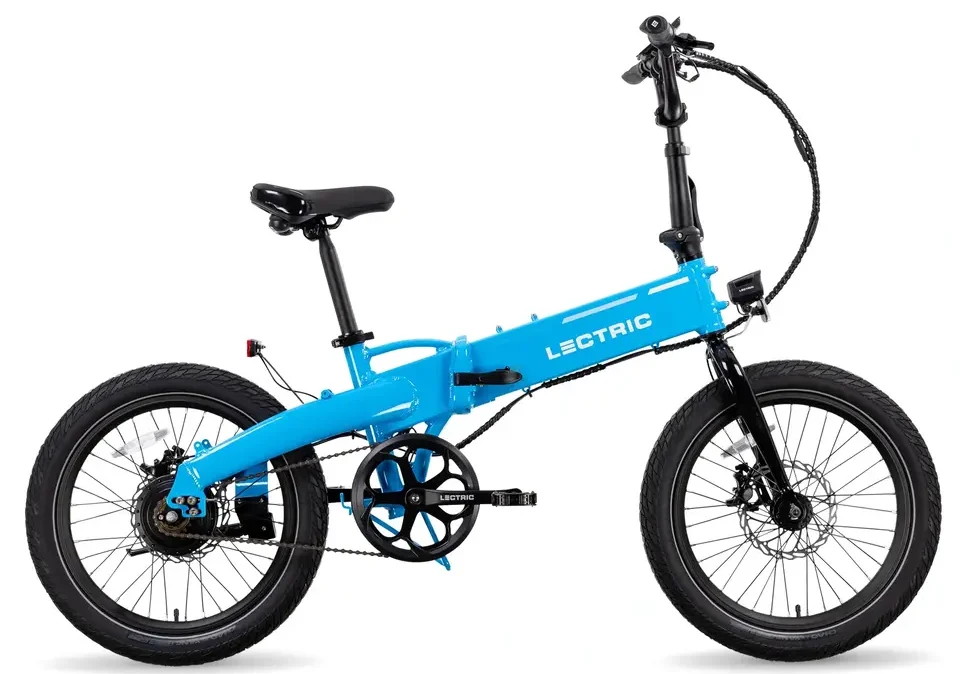
The Lectric XP Lite 2.0 is the model I would look at first if you want a folding e-bike that is substantially lighter than the typical fat-tire folder without spending several thousand dollars.
Lectric lists the complete bike at 49 lb. More importantly for this guide, Lectric separately publishes a 41-lb bike weight without the battery and an 8-lb battery weight.
That is exactly the type of information I want manufacturers to provide.
A 49-lb folded bike can still be a substantial lift. Removing 8 lb before raising it into a vehicle may make the job noticeably more manageable for some riders.
The current folded dimensions are approximately 36 x 16 x 27 in.
Key specifications
- Complete weight: 49 lb
- Battery-removed weight: 41 lb
- Battery weight: 8 lb
- Folded dimensions: 36 x 16 x 27 in.
- Rider-height range: approximately 4’8″-6’2″
- Motor: 300W nominal rear hub, 819W peak claimed
- Battery: 375Wh standard; larger long-range option available
- Brakes: hydraulic disc brakes with 180mm rotors
- Tires: 20 x 2.5 in.
- Frame: low folding step-through
- Total payload: 275 lb
- Maximum rider weight: 220 lb
- Certification: Lectric lists UL 2849 certification for the bike and UL 2271 certification for the battery
- Current standard-battery price: $799 on September 22, 2026
- Warranty: 1 year
Why it is easier to lift
The removable battery is the biggest advantage. Lectric clearly publishes all three numbers: 41 lb for the bike, 8 lb for the battery, and 49 lb complete.
Instead of trying to estimate what the bike weighs after battery removal, we have a manufacturer-supported number.
The low frame also gives you more space around the center of the bike than a tall conventional diamond frame.
I would still call the XP Lite 2.0 moderately manageable rather than ultralight. Forty-one pounds is still a meaningful object to lift, especially when it has wheels, pedals, handlebars, cables, and a folding frame sticking out in different directions.
Folding limitations
I could not verify a current manufacturer statement that the two halves positively lock together after folding. I also could not verify that Lectric specifically intends the XP Lite 2.0 to be rolled while folded.
If either feature is essential to you, confirm the current bike before purchasing rather than assuming every folder behaves like a Brompton or Tern.
Ride tradeoffs
The XP Lite 2.0 uses a single-speed drivetrain and has no suspension. Those choices reduce weight, price, and complexity, but they are noticeable on steep terrain or rough pavement.
It also uses cadence-based pedal assist rather than a torque sensor.
✅ Pros
- $799 current starting price
- 49 lb complete
- 41 lb with the battery removed
- Manufacturer publishes the 8-lb battery weight
- Fits riders down to approximately 4 ft. 8 in.
- Low folding frame
- Hydraulic disc brakes
- UL 2849 and UL 2271 certification claims
- Compact 16-in. folded width
- Much lighter than many mainstream folding e-bikes
❌ Cons
- 49 lb is still a substantial complete-bike lift
- Single-speed drivetrain
- No suspension
- Cadence sensor rather than torque sensor
- Secure folded retention was not clearly verified
- Folded rolling was not clearly verified
- Return conditions are more restrictive than a true ride-and-return trial
Best fit: Value-conscious riders, shorter riders, apartment residents, and RV travelers who want a reasonably light folder and can comfortably manage roughly 41 lb after battery removal.
Read my full review of the Lectric XP Lite 2.0
2. Brompton Electric T Line – Lightest Folding E-Bike
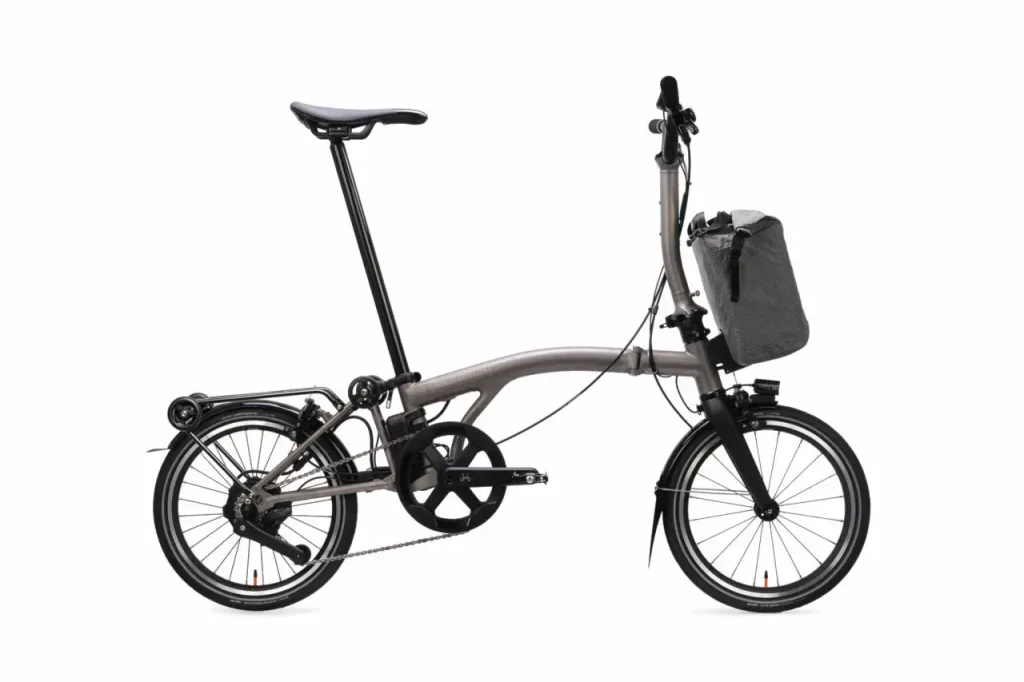
The Brompton Electric T Line sits in a very different portability category from most American-style folding e-bikes.
Its folded dimensions are approximately 25.4 x 23.6 x 12.6 in., creating an unusually narrow and compact package.
Brompton’s SuperRoll system is also designed specifically to let the folded bike be pushed or pulled instead of carried everywhere.
Important weight clarification
Brompton’s current U.S. information contains conflicting weight figures.
One current Brompton page lists approximately 29.54 lb complete and 25.7 lb without the battery.
Elsewhere on the current product information, Brompton lists approximately 31.08 lb with the battery and 24.69 lb without it.
The specification information is not internally consistent enough for me to present one battery-removed number as definitive.
What I can say confidently is that even the higher complete figure of roughly 31 lb is dramatically lighter than the typical 60- to 75-lb folding electric bike.
That makes the Electric T Line the lightest current folding e-bike among the recommendations in this guide.
Key specifications
- Published complete weight: conflicting current Brompton figures of approximately 29.5-31.1 lb
- Published battery-removed weight: conflicting current figures of approximately 24.7-25.7 lb
- Folded dimensions: approximately 25.4 x 23.6 x 12.6 in.
- Battery: 345Wh removable battery
- Tires: 16-in. format
- Brakes: dual-pivot caliper brakes
- Folding system: compact three-part Brompton fold
- Folded rolling: yes, using Brompton’s SuperRoll system
- Current price: $7,850 on September 22, 2026
- Warranty: Brompton lists extended frame coverage and separate electric-system coverage subject to its current registration and warranty terms
- Returns: current U.S. policy lists a 28-day return period subject to its conditions
I did not find sufficiently clear current documentation to support the exact T Line UL 2849 statement I previously used, so I have removed that claim rather than assume certification from another Brompton electric model.
I also could not verify one simple current minimum rider-height figure from the U.S. T Line product information.
Why it is easier to lift
The main advantage is simple: much less mass.
Even at approximately 31 lb complete, you are dealing with roughly half the weight of some popular folding e-bikes.
Its folded shape is also unusually compact and controlled rather than simply being a full-size bike folded in half. The rolling system further reduces the number of situations where you need to lift the complete bike.
Portability tradeoffs
The obvious drawback is the $7,850 price.
The 16-in. wheels also create a very different ride from a 20-in. fat-tire folding e-bike. Brompton prioritizes urban portability rather than suspension, oversized tires, a huge battery, or maximum motor output.
✅ Pros
- Extremely low complete weight even using Brompton’s higher published figure
- Removable battery
- Very compact folded package
- Designed to stay compact when folded
- SuperRoll system reduces carrying
- Excellent for multimodal travel and tight storage
- Established folding-bike design
❌ Cons
- $7,850 price
- Manufacturer currently publishes conflicting weight figures
- 16-in. wheels will not suit every rider
- Caliper rather than hydraulic disc brakes
- Smaller battery than many heavier folding e-bikes
- I could not verify a definitive T Line UL 2849 claim from the current documentation reviewed
Best fit: Someone who expects to fold, roll, carry, and store the bike frequently and places portability above purchase price.
3. Urtopia Carbon Fold 2 – Best Lightweight Design
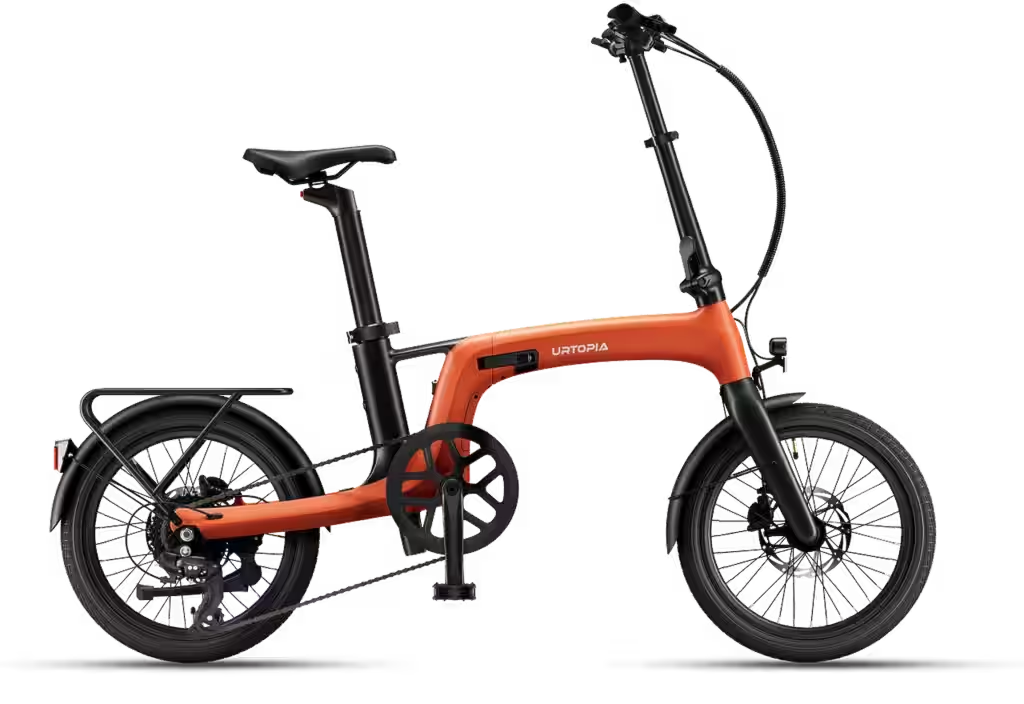
The Urtopia Carbon Fold 2 remains one of the strongest designs I found for this specific problem.
The important correction is availability.
As of September 22, 2026, Urtopia’s current U.S. page says first shipments begin November 1.
That means I would not make it the unconditional Best Overall pick for someone who needs a bike now. I consider it a preorder recommendation until normal shipping begins.
Understanding Urtopia’s weight numbers
Urtopia currently lists a 36.3-lb bike weight.
It also publishes a 35.2-lb net weight with the battery and a 30.8-lb net weight without the battery.
However, Urtopia explains that the net-weight figures exclude accessories including items such as the rack, kickstand, fenders, and pedals.
For that reason, the 30.8-lb number should not be interpreted as the weight of a fully equipped ready-to-ride Carbon Fold 2 with only the battery removed.
The correct way to report it is: 30.8 lb manufacturer-listed net weight without battery and certain accessories.
Key specifications
- Listed bike weight: 36.3 lb
- Manufacturer net weight with battery and accessory exclusions: 35.2 lb
- Manufacturer net weight without battery and with accessory exclusions: 30.8 lb
- Folded dimensions: approximately 32 x 19 x 27 in.
- Rider-height range: 5’1″-6’1″
- Motor: 250W rated / 470W peak rear hub
- Battery: 36V, 6.8Ah, 244.8Wh removable seatpost battery
- Brakes: Tektro hydraulic disc brakes
- Drivetrain: Shimano 8-speed
- Tires: 18 x 2.0 in.
- Sensor: torque sensor
- Payload: 220 lb
- Certification: Urtopia lists UL 2849 certification for the bike and UL 2271 for the battery
- Price: $1,899 when checked September 22, 2026
- Availability: orderable, with first shipments currently listed for November 1
Why it is easier to lift
Even allowing for the accessory exclusions in the net-weight figures, the Carbon Fold 2 is genuinely light compared with mainstream 60- to 75-lb folders.
The removable seatpost battery provides another way to reduce the load before lifting.
Independent testing has also reported that the folded wheels align so the bike can be rolled. A magnetic attachment helps bring the folded halves together.
Ride tradeoffs
The standard battery is only 244.8Wh. That helps keep weight low, but buyers who expect very long assisted rides should pay attention to the tradeoff.
The 220-lb payload limit is also lower than many heavier folding e-bikes.
Small 18-in. wheels create a compact package but can feel quicker in their steering response than a full-size bike. There is no suspension fork to absorb rough pavement.
✅ Pros
- Genuinely low bike weight
- Removable battery
- Compact folded dimensions
- Folded bike can be rolled
- Hydraulic disc brakes
- Torque sensor
- 8-speed drivetrain
- UL 2849 and UL 2271 certification claims
- Carbon construction keeps weight unusually low
❌ Cons
- First shipments currently listed for November 1
- 220-lb payload limit
- Small standard battery
- No suspension
- Carbon construction raises the price
- Manufacturer “net weight” excludes certain accessories and needs careful explanation
Best fit: Riders who can wait for shipping and want one of the lightest folding designs without moving into Brompton T Line pricing.
4. Retrospec Judd Rev 2 – Best Folding E-Bike Under 45 lb
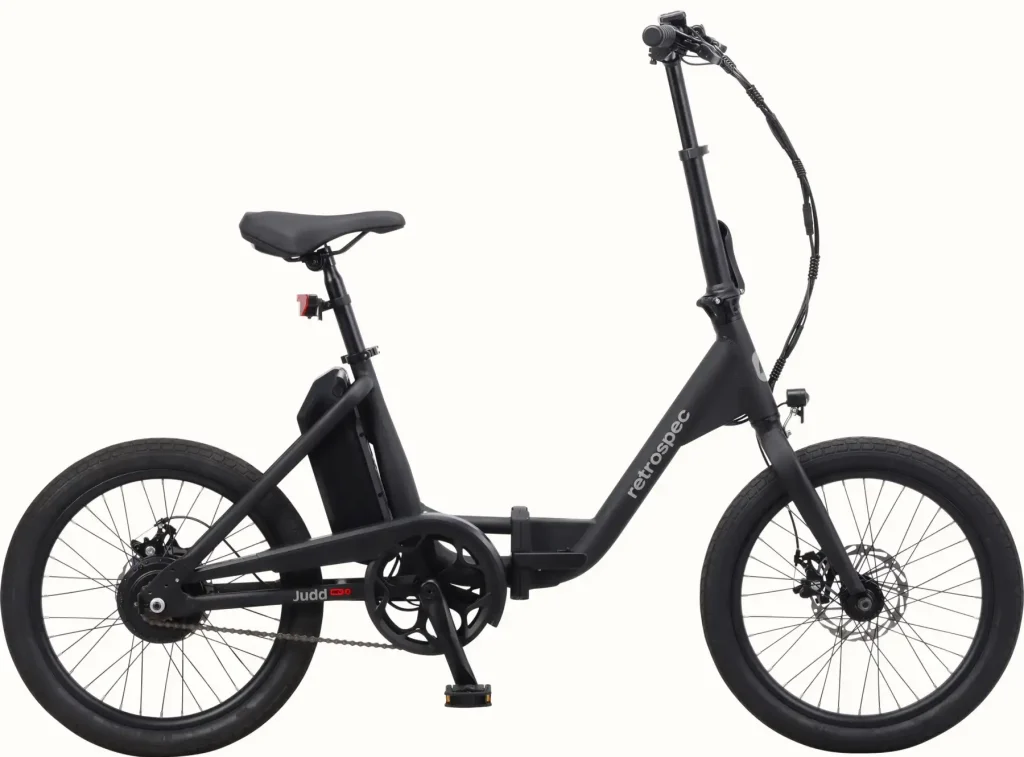
The Retrospec Judd Rev 2 is one of the more interesting choices if you want a complete folding e-bike in the low-40-lb range without paying a carbon-fiber premium.
Retrospec lists it at 42 lb including the battery. It folds to approximately 34 x 20 x 28 in.
The battery is removable and can be charged on or off the bike.
Key specifications
- Complete weight: 42 lb including battery
- Battery-removed weight: not verified
- Battery weight: not verified
- Folded dimensions: 34 x 20 x 28 in.
- Rider-height range: 5’3″-6’3″
- Motor: 350W rear hub
- Battery: 360Wh removable
- Brakes: Tektro mechanical disc brakes
- Brake rotors: 160mm
- Tires: 20 x 2.1 in.
- Frame: compact aluminum step-through
- Recommended weight limit: 350 lb
- Certification: Retrospec lists UL 2849 certification for the bike and UL 2271 for the battery
- Price: $1,099.99 when checked September 22, 2026
Retrospec’s current warranty provides limited lifetime frame coverage for the original purchaser, 2 years on the battery and electrical components, and 6 months on third-party components, subject to its current warranty terms.
The return policy is much more restrictive than a ride-and-return trial. E-bikes generally must be returned within the stated period in unused, unassembled condition and in the original packaging, with return-shipping requirements applying.
Why it is easier to lift
At 42 lb complete, the Judd Rev 2 is already lighter than the battery-removed weight of many heavier folders.
It avoids several things that commonly make folding e-bikes heavy: fat tires, large suspension components, oversized batteries, and massive integrated cargo hardware.
Retrospec does not publish a battery weight that I could verify, so I will not estimate the battery-removed bike weight.
Folding limitations
I could not verify a dedicated folded rolling system comparable with Brompton or Tern.
I also could not verify a positive locking mechanism that secures both halves together after folding.
Those are meaningful differences if you expect to move the folded bike through campgrounds, apartment buildings, airports, or train stations.
✅ Pros
- 42-lb complete weight
- $1,099.99 price
- Compact fold
- Removable battery
- Step-through frame
- 350-lb recommended weight limit
- UL 2849 and UL 2271 certification claims
- Replacement parts available from Retrospec
❌ Cons
- Battery weight not published
- Battery-removed weight not verified
- Mechanical rather than hydraulic brakes
- 160mm rotors rather than 180mm
- No suspension
- No verified folded rolling system
- Positive folded retention was not clearly verified
- Restrictive return conditions
Best fit: Riders who want a simple, relatively light step-through folder and care more about manageable weight and paved-road transportation than maximum performance.
5. Tern Vektron P10 Gen 4 – Best Full-Size Ride in a Lighter Folding Package
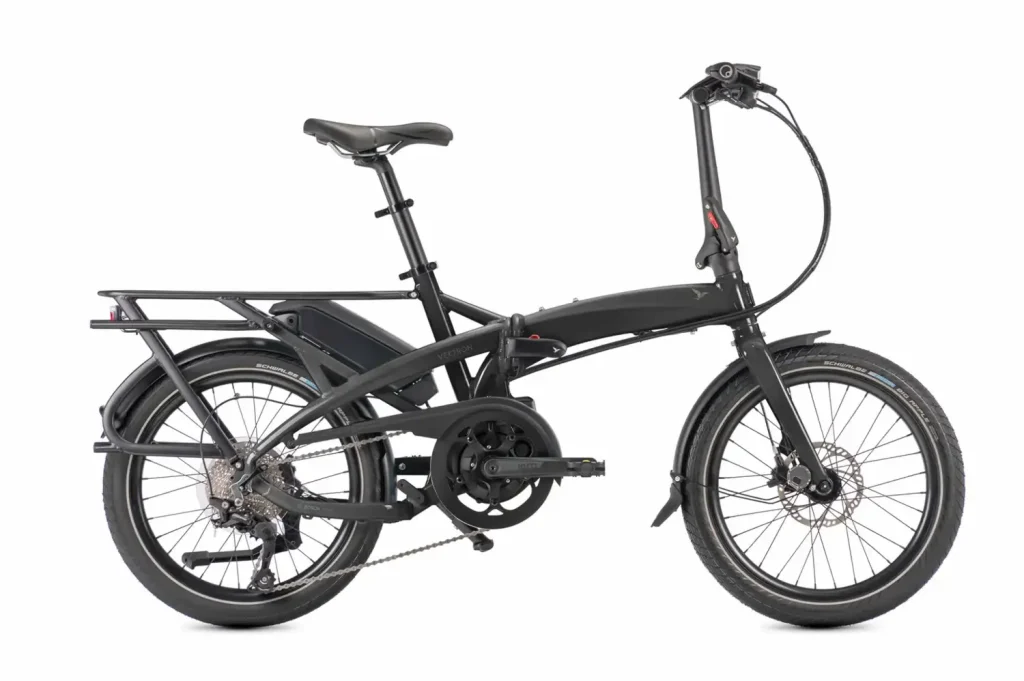
The current Tern Vektron P10 Gen 4 replaces the older Vektron S10 in this guide.
That change matters because the P10 is the current-generation model Tern is actively presenting to U.S. buyers, and its portability documentation is unusually clear.
Tern lists the P10 at 49.6 lb and $3,699. It folds to approximately 16.1 x 33.9 x 26.8 in. in about 10 seconds.
Key specifications
- Generation: Gen 4
- Complete listed weight: 49.6 lb
- Battery-removed weight: not verified
- Battery weight: not verified
- Folded dimensions: 16.1 x 33.9 x 26.8 in.
- Folding time: approximately 10 seconds
- Rider-height range: 4’10”-6’5″
- Motor: Bosch BES2 Performance, up to 65Nm
- Battery: Bosch PowerPack 400Wh
- Maximum assist speed: 20 mph for the U.S. model
- Drivetrain: Shimano Deore 1 x 10-speed
- Brakes: Magura MT4 hydraulic discs
- Tires: Schwalbe Big Apple 20-in. format
- Max rider weight: 231.5 lb
- Max gross vehicle weight: 275.6 lb
- Rear rack capacity: approximately 59.5 lb
- Folded retention: Magnetix 3.0
- Folded rolling: yes
- Folded standing: yes
- Current price: $3,699
Tern states that the Vektron’s Bosch e-bike system, including the motor, battery, and charger, is UL 2849-certified, and that the bike is third-party tested for EN 15194 compliance.
Tern also states that the bike can stand upright and roll while folded, which is particularly useful when the goal is to avoid carrying the bike for every part of a trip.
The company offers extended limited frame coverage through Tern Care registration and emphasizes long-term Bosch parts and dealer support.
Because Tern sells through dealers, return terms may depend on the retailer rather than one universal direct-to-consumer trial policy.
Why it can be easier to live with than its weight suggests
This is where scale weight does not tell the whole story.
At 49.6 lb, the P10 is not dramatically lighter than the XP Lite 2.0.
But Tern gives you several features designed specifically for handling a folded bike:
- The Magnetix 3.0 system keeps the folded package together.
- The bike rolls while folded.
- It stands upright when folded.
- The Porter+ saddle includes a GripPad intended to provide a useful contact point while maneuvering the bike.
- The folded package is only about 16.1 in. wide.
Those features can matter tremendously for someone who plans to roll the bike through an RV park, elevator, train station, garage, or hallway and lift it only for the final loading step.
Ride tradeoffs
The P10 is nearly 50 lb, so it is still a meaningful lift.
It is also substantially more expensive than the Lectric or Retrospec.
What you get for the extra money is a Bosch drive system, hydraulic brakes, dealer assembly and service, a 10-speed drivetrain, a substantial integrated rack, and a folding design intended for frequent multimodal use.
✅ Pros
- Current Gen 4 model
- 49.6 lb
- Bosch Performance motor
- 400Wh removable Bosch battery
- Hydraulic disc brakes
- Shimano 10-speed drivetrain
- Magnetix folded retention
- Rolls while folded
- Stands while folded
- Broad 4’10”-6’5″ rider-height range
- Strong rear cargo rack
- Bosch system UL 2849 certification
- Dealer-based service and parts support
❌ Cons
- Nearly 50 lb
- $3,699 price
- Battery-removed weight not verified
- Battery weight not verified
- Larger and heavier than Brompton or Urtopia
- Return terms depend on the selling dealer
Best fit: RV travelers, commuters, and apartment residents who want excellent folded handling but still want their e-bike to ride, shift, brake, and carry cargo more like a substantial everyday bicycle.
What “Easy to Lift” Really Means
I would not use one exact weight as a universal definition of an easy-to-lift folding e-bike.
As a practical comparison, I think these categories are useful:
Very lightweight folding e-bikes: Roughly 30 to 40 lb complete.
Bikes in this range can be dramatically easier to load than a typical American folding e-bike, although the number does not guarantee that a particular person can safely or comfortably lift one.
Moderately manageable folding e-bikes: Roughly 40 to 50 lb.
Battery removal can make a major difference here. A 49-lb bike that becomes 41 lb after battery removal may be much more practical than the headline number suggests.
Heavy folding e-bikes: Around 60 lb and above.
These bikes may fold very conveniently for storage but should not automatically be called lightweight.
The exact experience also depends on weight distribution, folded shape, gripping points, how securely the halves stay together, whether the wheels roll while folded, and how high you need to lift the bike.
A compact 50-lb object with a solid handle can feel very different from a 50-lb folding bicycle with pedals, wheels, cables, and handlebars moving around.
The height of the lift matters too. Raising a bike several inches onto an RV tray is different from lifting it over the high trunk lip of a sedan or SUV.
How to Lift a Folding E-Bike More Safely
Turn the bike off before folding or lifting it.
If the manufacturer permits battery removal, remove the battery first when doing so will make the bike easier to control.
Remove loose accessories such as bags, bottles, baskets, removable locks, or anything else that could swing or fall.
Fold the bike completely and engage any magnetic clip, latch, strap, or retention system supplied by the manufacturer.
Identify a strong structural gripping point before lifting. Avoid grabbing wires, displays, fenders, or other components not intended to support the bike’s weight.
Keep the load reasonably close to your body and avoid twisting while holding the bike.
If the bike feels too heavy, the cargo opening is high, or you have an injury, lifting restriction, balance problem, or mobility limitation, use another person, a ramp, or a different loading solution.
No model in this guide is guaranteed to be safe or comfortable for a particular person to lift.
Lightweight Folding E-Bike Tradeoffs
Reducing weight usually requires compromise somewhere.
Smaller batteries
Batteries are heavy. The relatively small 244.8Wh Urtopia battery is one reason the Carbon Fold 2 can remain so light.
Larger batteries may provide more range but add noticeable mass.
Smaller motors
Light folders commonly use 250W to 350W motors rather than the 750W hubs found on heavier American folding bikes.
A smaller motor can work extremely well on a light bike, but riders carrying substantial weight or tackling steep terrain should pay attention to the difference.
Narrower tires
Two-inch or 2.5-in. tires are much lighter than 4-in. fat tires.
The tradeoff is less built-in cushioning and flotation over rough surfaces.
Less suspension
Suspension forks add weight.
Most genuinely lightweight folders use rigid forks and rely on tires, frame compliance, saddle design, and riding position for comfort.
Lower payload limits
The Urtopia Carbon Fold 2, for example, has a much lower payload limit than some heavy-duty folders.
A very light bike is not automatically the right bike for a heavier rider or someone carrying substantial cargo.
Higher material costs
Carbon fiber and titanium can reduce weight without removing as many features, but they increase price.
The Brompton Electric T Line is the extreme example in this guide.
Common Buying Mistakes
Looking only at whether the bike folds
A folding hinge solves a storage problem. It does not automatically solve a lifting problem.
Believing a “net weight” without checking what it excludes
Always check whether the manufacturer excludes the battery, pedals, rack, fenders, kickstand, lights, or other components.
Forgetting to measure the vehicle opening
A folded bike may fit inside the cargo area but still be difficult or impossible to pass through the actual opening.
Ignoring folded dimensions
Width can matter just as much as length and height.
A narrow folded bike may fit beside luggage or through an RV compartment where a much wider model cannot.
Assuming the bike stays securely folded
Magnets, clips, locking mechanisms, and straps vary dramatically.
Do not assume every folding e-bike behaves like a Brompton or Tern.
Buying a heavy fat-tire folder for frequent lifting
Fat tires, suspension, racks, large batteries, and powerful motors can all be useful. They also add weight.
Choosing a light bike that does not fit
A 30-lb e-bike is not useful if the saddle, reach, handlebar position, step-over, or payload does not work for the rider.
Ignoring certification, service, and replacement parts
Battery availability, electrical certification, replacement electronics, brake parts, dealer service, warranty coverage, and long-term support still matter after you have found a light bike.
Can a Lightweight Folding E-Bike Fit in a Car Trunk?
Often, yes – but published folded dimensions do not guarantee that a bike will fit through your particular trunk opening.
Before buying, measure:
- Trunk opening width
- Trunk opening height
- Available cargo depth
- Interior width between the wheel wells
- Height of the trunk lip
Compare all of those measurements with the bike’s folded length, width, and height.
Leave room for your hands.
A bike that technically clears the opening by half an inch may be unpleasant to load without hitting the car or scraping the bike.
Also think about how the bike must be rotated.
A very compact Brompton may go through an opening in an orientation that a larger 20-in. folder cannot.
For frequent car loading, I would give extra weight to removable batteries, narrow folded packages, secure folded retention, and an obvious gripping point.
Who Should Choose a Heavier Folding E-Bike?
Lightweight is not automatically better.
A heavier folding bike may make more sense if your priorities include:
- Fat tires
- More battery capacity
- Higher payload
- Stronger throttle performance
- Front suspension
- Larger cargo racks
- More powerful motors
- Rough-road comfort
The Velotric Fold 1 Plus is a good example. It is much heavier than the bikes featured here but offers features and carrying capability a 35-lb carbon folder cannot match.
The Mooncool POP is another example.
I personally tested and folded the Mooncool POP, which weighs approximately 67 lb. Its folding mechanism is straightforward, and I found it easier to fold and reposition than some heavier folding bikes.
But I would not describe it as a lightweight e-bike.
Read my full review on the Mooncool Pop
The Lectric XP4 and Ride1Up Portola similarly emphasize performance, comfort, battery capacity, and utility more than minimum lifting weight.
Read my full comparison of the Lectric XP4 and Ride1UP Portola
Those bikes can still make excellent RV, storage, or travel bikes when the rider can roll them, use a ramp, or get help loading them.
They simply solve a different problem.
Essential E-Bike Gear (Quick Picks)
Before you choose your e-bike, these are the accessories most riders end up needing for safety and everyday use:
Frequently Asked Questions
What is considered lightweight for a folding e-bike?
I consider roughly 30 to 40 lb genuinely lightweight in today’s folding e-bike market.
Around 40 to 50 lb can still be reasonably manageable for some riders, especially when the battery can be removed.
Once a folding e-bike reaches roughly 60 lb or more, I would describe it primarily as folding for storage rather than automatically calling it lightweight.
What is the lightest practical folding e-bike?
Among the models in this guide, the Brompton Electric T Line is the lightest.
Brompton currently publishes conflicting exact weight figures, but even its higher figure is only about 31 lb complete.
Can I remove the battery before lifting a folding e-bike?
On many models, yes.
The Lectric XP Lite 2.0, Urtopia Carbon Fold 2, Brompton Electric T Line, Retrospec Judd Rev 2, and Tern Vektron P10 all use removable batteries.
Follow the manufacturer’s instructions and turn off the bike before removing the battery.
Is a 60-lb folding e-bike easy to lift?
I would not assume so.
Some riders can comfortably lift 60 lb, while others cannot.
The folded shape may also make a bicycle more awkward than another 60-lb object.
Pay attention to battery removal, gripping points, how securely the bike stays folded, the cargo-opening height, and whether a ramp or second person would be a better solution.
Can a lightweight folding e-bike fit in a sedan trunk?
Many can, but measure the opening rather than only the interior cargo space.
The published folded dimensions are a starting point, not a guarantee.
Are lightweight folding e-bikes suitable for short riders?
Some are.
The Lectric XP Lite 2.0 is recommended for riders down to approximately 4 ft. 8 in., while the Tern Vektron P10 starts around 4 ft. 10 in. and the Urtopia Carbon Fold 2 around 5 ft. 1 in.
Fit involves more than height, so check inseam, saddle height, handlebar reach, and riding position. You can also use the E-Bike Size Calculator as a starting point.
Are carbon-fiber folding e-bikes durable?
A properly engineered carbon frame can be strong and durable.
With any folding bike, hinge design, manufacturing quality, proper adjustment, inspection, and following the manufacturer’s maintenance instructions remain important.
Do lighter folding e-bikes have less range?
Often, but not always.
Using a smaller battery is one of the easiest ways to reduce bike weight.
A lighter bike can also use energy more efficiently, so battery capacity alone does not tell you exactly how far a bike will travel.
Can I roll a folding e-bike instead of carrying it?
Some are specifically designed for this.
Brompton emphasizes its folded rolling system, Tern states that the current Vektron rolls and stands while folded, and independent testing has reported that the Urtopia Carbon Fold 2 can roll on its aligned wheels.
Do not assume every folding e-bike has this capability.
What should an older rider look for in a folding e-bike?
I would look at much more than the advertised weight.
- Minimum saddle height
- Step-through access
- Handlebar adjustment
- Battery-removal weight
- Folded stability
- Whether it rolls while folded
- Secure folded retention
- Hydraulic versus mechanical brakes
- Where you can safely grip the bike
- How high you must lift it into your vehicle or storage space
A lightweight label does not guarantee that loading a particular bike will be safe or comfortable for a particular rider. Riders focused on accessibility may also find my E-Bikes for Seniors guide useful.
My Take
The most important thing I found while researching these bikes is simple: Foldable and portable are not the same thing.
If you want the lightest possible electric folder and cost is secondary, the Brompton Electric T Line is in a category of its own. Even Brompton’s higher current published weight is only about 31 lb, and the compact fold plus rolling system reduce how often you need to carry it.
For a much lower price, the Lectric XP Lite 2.0 is my best overall choice among the bikes currently shipping. Forty-nine pounds is not ultralight, but Lectric gives us something especially useful for this guide: a verified 41-lb bike weight after removing the 8-lb battery. At $799, it is also far more attainable than the carbon and premium European alternatives.
The Urtopia Carbon Fold 2 may eventually be one of the strongest overall choices in this category. Its combination of very low weight, hydraulic brakes, a torque sensor, gears, removable battery, and folded rolling is compelling. But its current page says first shipments begin November 1, so I would treat it as a preorder rather than rank it above bikes a reader can receive now.
The Retrospec Judd Rev 2 is worth considering if you want a complete 42-lb folding bike without paying carbon-fiber prices.
And the Tern Vektron P10 Gen 4 is my favorite option here for riders who care almost as much about how a bike behaves while folded as its scale weight. At 49.6 lb it is not ultralight, but its magnetic fold retention, upright folded storage, rolling capability, Bosch system, hydraulic brakes, broad fit range, and dealer support make it particularly appealing for RV and multimodal travel.
Before choosing any of them, think about the actual lift you have to perform.
Measure your vehicle opening. Check the trunk lip. Decide whether you can remove the battery before lifting. Look at where your hands will go. Consider whether the bike stays together once folded.
And make sure the bike fits your body as well as your storage space.
A bike that weighs 5 lb less on paper can still be harder to live with if the folded package is awkward.
That is why I would choose the folding e-bike that is easiest for you to control, not simply the one with the lowest number on the specification chart.
Disclosure: As an Amazon Associate, I earn from qualifying purchases. This comes at no extra cost to you and helps support the content on this site.
📚 Read Me Next
- Compare these bikes to others → Best E-bikes of 2026
- Not sure about budget? → Budget E-Bike Guide
- Want to learn first? → E-Bike Buying Guide
- See more ebike reviews → E-Bike Reviews

Kristina is not just an enthusiast but a true authority on electric bikes. Nestled in the coastal beauty of Virginia, Kristina has found the perfect backdrop for her passion for electric biking. As a dedicated wife and homeschooling mom, her life revolves around family, faith, and the thrill of adventure.
Originally hailing from Ohio, Kristina's journey with electric bikes began as a curiosity and quickly evolved into a deep expertise. Her blog is a testament to her love for electric biking, combining her fascination for eco-friendly transportation with her coastal lifestyle.
When she's not cruising the beach on her electric bike, you'll find Kristina indulging in her other loves: long walks along the shore, getting lost in a good book, and cherishing moments with her loved ones. With a heart as big as her love for animals, especially cats, Kristina brings a unique perspective to the electric bike world, grounded in her strong faith in God and her dedication to a sustainable lifestyle.
Through her blog, Kristina shares her extensive knowledge of electric bikes, offering valuable insights, tips, and recommendations to fellow enthusiasts. Whether you're a seasoned rider or a newcomer to the electric bike scene, Kristina's blog is your go-to source for all things electric biking, fueled by her passion, expertise, and the scenic beauty of coastal Virginia.