

Budget E-Bike Buying Guide: How to Choose a Reliable Affordable Electric Bike
Budget electric bikes have gotten much better, and you no longer have to spend several thousand dollars to find a useful e-bike for commuting, errands, recreation, or everyday riding.
The harder part is figuring out the difference between a good-value e-bike and one that is simply cheap.
A lower price can mean reasonable compromises, such as a simpler drivetrain, mechanical brakes, a smaller battery, or fewer premium features. What concerns me more is when the savings come from unclear battery safety information, poor replacement-parts availability, weak customer support, or specifications that do not match the way you actually plan to ride.
In this guide, I’ll explain how much you should expect to spend, which specifications really matter, how to evaluate battery safety and reliability, and what I would check before buying an affordable electric bike.
If you’re new to e-bikes in general, start with my complete e-bike buying guide. If you’re already ready to compare specific models, see my Best Budget Electric Bikes guide.
Who This Budget E-Bike Guide Is For
This guide is especially useful if you are:
- Buying your first electric bike
- Trying to stay within a limited budget
- Comparing lower-cost direct-to-consumer e-bikes
- Looking at e-bikes sold through Amazon, Walmart, or other marketplaces
- Trying to understand what is worth paying more for
- Wondering whether a cheap e-bike can still be reliable
- Comparing the purchase price with long-term ownership costs
This guide is less focused on premium mid-drive e-bikes, serious electric mountain bikes, very heavy cargo use, or riders primarily looking for maximum performance.
What Counts as a Budget Electric Bike?
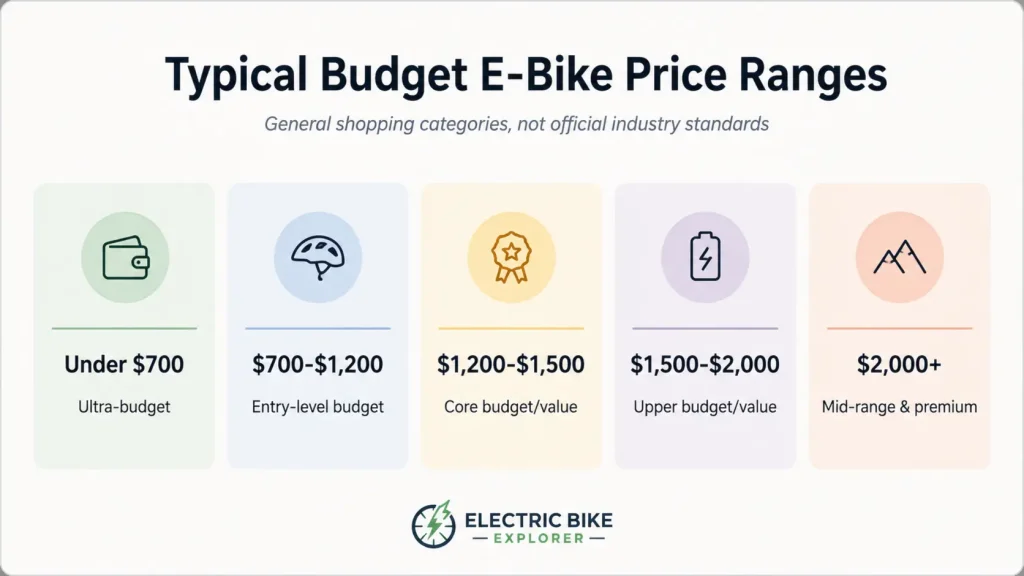
There is no official industry price where an e-bike becomes a “budget e-bike,” so I use the term as a practical shopping category.
For Electric Bike Explorer, I generally think about the market this way:
| Price Range | How I Think About It | What to Expect |
|---|---|---|
| Under $700 | Ultra-budget | Basic components and fewer extras. Safety documentation, support and replacement parts deserve extra scrutiny. |
| $700-$1,200 | Entry-level budget | Many basic commuters, folding bikes and recreational models fall here. |
| $1,200-$1,500 | Core budget/value | More room for improved brakes, batteries, sensors, accessories or support. |
| $1,500-$2,000 | Upper budget/value | Often overlaps with better-equipped commuters and more established brands. |
| Over $2,000 | Mid-range and premium territory | More sophisticated components and systems become increasingly common, although price alone does not guarantee quality. |
These are Electric Bike Explorer shopping categories, not industry standards.
I generally consider roughly $800-$1,500 the core budget range, while bikes approaching $2,000 can still make sense when comparing value-oriented models.
My Budget E-Bike Buying Checklist
I would not require every affordable e-bike to have a 500W or 750W motor or a battery larger than 400Wh.
Instead, I check whether the whole bike fits the rider and intended use.
Before buying, look at:
- Rider-height and fit recommendations
- Bike weight and whether you can handle it
- Motor type and performance for your terrain
- Battery capacity in watt-hours
- Braking system
- Electrical safety and certification information
- Replacement battery availability
- Replacement parts
- Warranty and return policy
- Manufacturer support
- Payload capacity
- Assembly requirements
- E-bike class and local riding laws
A bike doesn’t need the biggest numbers in every category to be a good value.
How I Evaluate Budget E-Bikes
When I research affordable e-bikes, I pay particular attention to the areas most likely to affect real-world ownership:
- Fit and accessibility
- Motor performance
- Battery capacity and realistic range
- Braking performance
- Electrical safety information
- Component quality
- Replacement-parts availability
- Warranty and customer support
- Bike weight
- Assembly
- Long-term ownership costs
- Price compared with competing models
I don’t consider a bike better simply because it has a larger motor or battery.
A lighter city e-bike with moderate power could be a much better choice for one rider than a heavy 750W fat-tire bike with a much larger battery.
You can learn more about my research, testing, and ranking process in How Electric Bike Explorer Reviews, Ranks, and Researches E-Bikes.
Start With Fit – Not Motor Power
Fit is easy to overlook when shopping online because specifications such as motor wattage and range get most of the attention.
But if the bike is too tall, too heavy, or uncomfortable to control, none of those other specifications matter very much.
Check:
- Recommended rider-height range
- Standover height
- Step-through height if accessibility matters
- Saddle adjustment
- Handlebar position and reach
- Bike weight
- Wheel size
- Whether you’ll need to lift the bike onto a rack or carry it up stairs
You can also use my E-Bike Size Calculator as a starting point.
How Much Motor Power Do You Really Need?
This is one place where I would not use a simple rule like “a good budget e-bike needs at least 500W.”
Motor needs depend on:
- Rider weight
- Hills
- Cargo
- Bike weight
- Wheel size
- Gearing
- Motor type
- Controller tuning
- Torque
- How much you plan to pedal
A well-designed lower-power bike may be perfectly adequate for flat urban riding. A rider carrying cargo on steep hills may need something very different.
Mid-drive motors can also use the bike’s gearing, so comparing their wattage directly with a hub motor does not tell the whole story.
If you’re trying to understand the difference between motor wattage and actual pulling ability, see my Torque vs. Wattage E-Bike Motor Guide.
Check the E-Bike’s Class and Local Laws
More motor power or a higher advertised top speed is not automatically better.
E-bike definitions, classes, helmet requirements, age rules, throttle rules, and where e-bikes can be ridden vary by state and sometimes by city or trail system.
Before buying, check my State-by-State E-Bike Laws Guide so you know how the bike you’re considering fits the rules where you plan to ride.
Compare Batteries Using Watt-Hours
One of the easiest ways to compare e-bike batteries is with watt-hours, or Wh.
If the manufacturer gives you voltage and amp-hours but not watt-hours, you can calculate it:
Voltage × amp-hours = watt-hours
For example:
48V × 10Ah = 480Wh
A larger battery generally stores more energy, but that does not guarantee a specific number of miles.
Range can change considerably depending on:
- Rider and cargo weight
- Assist level
- Throttle use
- Speed
- Hills
- Wind
- Temperature
- Tire pressure
- Stop-and-go riding
- Motor efficiency
- Battery age and condition
That’s why I would not automatically reject an e-bike because its battery is under 400Wh. A smaller battery can make sense on a lightweight bike designed for shorter city rides.
Likewise, a very large battery does not automatically make a bike better.
Don’t Buy Based on Advertised Range Alone
Manufacturer range claims are usually based on specific test conditions, and your real-world results can be different.
Instead of focusing only on an “up to” mileage number, I look at:
- Battery capacity in Wh
- The bike’s weight
- Motor and system efficiency
- Independent or reported range testing when available
- The conditions under which the range was achieved
- How the rider actually plans to use the bike
My E-Bike Range Calculator can also help you estimate how rider weight, terrain, assist level and other conditions may affect your ride.
For more background, see my guide to real-world e-bike range vs. advertised range.
Brakes Matter on a Budget E-Bike
Affordable e-bikes can be considerably heavier than traditional bicycles, and many are capable of higher assisted speeds. That makes the braking system important.
I look at:
- Mechanical vs. hydraulic disc brakes
- Rotor size
- Bike weight
- Maximum assisted speed
- Cargo and payload capacity
- Replacement brake-pad availability
- How well the braking setup matches the bike
Hydraulic disc brakes can provide easier lever effort and good modulation, but I would not automatically reject every bike with mechanical disc brakes.
The important question is whether the braking system is appropriate for the bike’s weight, speed and intended use.
Battery and Electrical Safety Are Not Where I Would Cut Corners
Electrical safety deserves extra attention when comparing inexpensive e-bikes from unfamiliar brands.
UL 2849 is the standard for electrical systems for e-bikes. It evaluates the electrical drive train, battery system and charger system as a combination. UL 2271 applies specifically to batteries used in light electric vehicle applications.
That distinction matters because vague statements such as “UL battery,” “tested to UL standards,” or “UL compliant” should not automatically be treated as proof that the complete e-bike electrical system is third-party certified.
The U.S. Consumer Product Safety Commission recommends using micromobility products and batteries designed, manufactured and certified for compliance with applicable safety standards. CPSC also advises riders to use only the charger supplied or recommended by the manufacturer and to remain present while charging rather than charging while asleep or away from home.
If electrical safety information is unclear, I would contact the manufacturer before buying rather than making assumptions.
Replacement Parts Can Matter More Than Fancy Features
A large color display or smartphone app may look impressive while you’re shopping, but those features won’t help much if a proprietary part fails and you can’t replace it.
Before purchasing a budget e-bike, check whether you can obtain:
- Replacement battery
- Charger
- Brake pads
- Tires and tubes
- Chain or belt
- Cassette or freewheel
- Display
- Controller
- Throttle
- Pedal-assist or torque sensors
Standard bicycle wear items are usually easier to find than proprietary electrical parts.
This is one reason I consider parts availability and manufacturer support when deciding whether a cheap e-bike is actually a good value.
Check the Warranty and Return Policy Before Ordering
Do this before you click Buy.
Look for:
- Warranty length
- Battery warranty
- Which parts are covered
- Exclusions
- Whether labor is included
- Return-window length
- Return shipping costs
- Restocking fees
- Shipping-damage procedures
- Customer-support contact options
- Availability of replacement parts
A long warranty number by itself isn’t enough. What matters is what is actually covered and whether the company provides a realistic way to get help.
What Usually Changes as You Spend More?
Paying more does not guarantee a better e-bike, but moving up in price can give manufacturers more room to improve certain areas.
| Area | What May Improve as Price Increases |
|---|---|
| Brakes | Hydraulic systems, larger rotors or more refined components |
| Battery | Capacity, cells, integration or certification documentation |
| Pedal assist | Torque sensors or more refined tuning |
| Drivetrain | Better-quality shifters, cassettes and derailleurs |
| Comfort | Improved geometry, suspension or contact points |
| Weight | Lighter frames and components in some categories |
| Accessories | Racks, fenders, lights or turn signals may be included |
| Support | Better documentation, dealers or replacement-parts availability |
| Warranty | Longer or more comprehensive coverage in some cases |
The important word is may.
I still compare the actual bike rather than assuming that a $1,500 model is automatically better than a $1,000 model.
For a deeper look at the differences, see my $1,000 vs. $1,500 vs. $2,000 E-Bikes comparison.
Cheap E-Bike Red Flags I Would Watch For
I would investigate further if I find:
- No clear electrical-safety information
- No replacement battery available
- No compatible replacement charger
- No owner’s manual
- Conflicting specifications on different product pages
- No identifiable manufacturer or customer-support contact
- Extremely aggressive range claims without explaining conditions
- Top speed being promoted more heavily than braking or safety
- No clear rider-weight or payload information
- Vague warranty terms
- Proprietary components with no obvious replacement path
- Repeated owner complaints about the same unresolved problem
One issue does not automatically prove a bike is unsafe or unreliable. But several together would make me much more cautious.
A small battery by itself is not a red flag. The battery should be judged against the bike’s purpose and expected riding distance.
How Reliable Are Budget E-Bikes?
Price alone doesn’t tell you how long an e-bike will last.
Reliability depends on factors such as:
- Component quality
- Electrical-system design
- Assembly quality
- Rider weight
- Terrain
- Mileage
- Storage
- Maintenance
- Weather exposure
- Availability of replacement parts
A lightly used $900 bike that is properly maintained may have a very different ownership experience from the same bike ridden hard every day.
You can read more in:
- Cheap vs. Expensive E-Bikes: Lifespan, Durability & Maintenance
- How Long Do Cheap E-Bikes Last?
- Common Problems With Budget E-Bikes
Cheap E-Bikes vs. Established Budget Brands
There is a difference between cheap and good value.
An established budget brand may still use entry-level components, but I also look at what happens after the sale.
Important advantages can include:
- Replacement parts
- Clear manuals
- Published warranty policies
- Current product support
- Better safety documentation
- A stable product lineup
- Dealer support in some cases
That can be worth paying more for, especially if you plan to depend on your e-bike for regular transportation.
See my Cheap E-Bikes vs. Name Brands comparison for a deeper look.
Don’t Forget Ownership Costs
The purchase price is only part of what an e-bike costs to own.
Depending on your bike and riding habits, you may eventually spend money on:
- Brake pads
- Tires and tubes
- Chains and drivetrain parts
- Professional adjustments
- Battery replacement
- Locks
- Helmet
- Mirrors
- Rack or bags
- Basic repair tools
- Replacement charger
- Transportation rack
I would not use one fixed annual maintenance estimate for every rider. Someone riding 200 miles per year will have very different wear costs from a daily commuter riding several thousand miles.
Instead, think about the total ownership picture.
A $700 bike that immediately needs upgrades or has difficult-to-find proprietary parts may ultimately be a worse value than a better-equipped bike that cost more initially.
For a deeper breakdown, see How Much Does It Really Cost to Own an E-Bike? and browse the E-Bike Tools Hub for calculators that can help with ownership decisions.
Which Type of Budget E-Bike Should You Choose?
Once you know what to look for, you can narrow the search by how you actually plan to ride.
Best overall affordable models
See my Best Budget Electric Bikes guide for current recommendations across several riding styles.
Staying under $1,500
See Best Budget E-Bikes Under $1,500.
Commuting
See Affordable Electric Commuter Bikes Under $1,200.
Cargo
See Top Cargo Electric Bikes Under $1,500. Pay particular attention to payload limits, braking, frame design and rack capacity rather than shopping by motor wattage alone.
Trails and gravel
See Best Budget Off-Road E-Bikes.
A fat tire and suspension fork do not automatically make an inexpensive bike a true electric mountain bike, so match the bike to the type of terrain you actually ride.
Throttle riding
See Best Budget E-Bikes With Throttle.
Remember that throttle and class rules differ by location, so check your local laws as well.
DIY E-Bike Conversion vs. Buying a Budget E-Bike
Another option is converting a bicycle you already own.
A conversion can make sense if you already have a suitable donor bike and are comfortable with the mechanical and electrical setup. Buying a complete e-bike may be simpler if you want an integrated system with one manufacturer responsible for the bike.
See my DIY E-Bike Cost vs. Buying an E-Bike comparison if you’re considering both options.
Are Cheap E-Bikes Worth It?
They can be.
A well-chosen budget e-bike can make sense for commuting, errands, recreation, shorter trips, or simply getting started with electric biking without making a premium purchase.
The key is buying for value rather than the lowest possible price.
I would rather choose a modestly equipped e-bike with clear safety information, available replacement parts, realistic specifications and usable customer support than a cheaper bike advertising enormous motor and range numbers with very little information behind them.
You can also read my hands-on perspective in Are Cheap E-Bikes Worth It? I Bought One So You Don’t Have To.
My Take
I think the growth of affordable e-bikes has been good for riders. More people can now use an electric bike for commuting, errands, recreation, or replacing some short car trips without spending several thousand dollars.
But I wouldn’t make “What’s the cheapest e-bike I can find?” the main buying question.
I think the better question is:
What’s the least I can reasonably spend while still getting the fit, safety, performance, support and replacement-parts availability I actually need?
For someone who rides occasionally on flat neighborhood streets, a relatively simple bike may be completely adequate. Someone relying on an e-bike for daily transportation, carrying cargo, or riding steep hills may be better off spending more.
Once you know what you need, head to my Best Budget Electric Bikes guide to compare the specific affordable models I currently recommend.
Budget E-Bike FAQs
Are cheap e-bikes worth it?
They can be. The best value depends on fit, electrical safety, brakes, parts availability, warranty, support and whether the bike matches the way you ride. I wouldn’t judge an e-bike by price alone.
How much should I spend on a budget e-bike?
There is no single correct amount. I generally think of roughly $800-$1,500 as the core budget range, although worthwhile models exist below and above it.
How far will a budget e-bike go?
There isn’t one reliable mileage number for all inexpensive e-bikes. Battery capacity, rider weight, terrain, speed, assist level, throttle use, temperature, wind and battery condition all affect range. Compare batteries in watt-hours and use realistic riding conditions rather than relying only on the manufacturer’s maximum claim.
Is a 500W motor enough for an e-bike?
It can be more than enough for many riders. Motor wattage alone doesn’t determine performance. Torque, motor type, controller tuning, gearing, bike weight, rider weight and terrain all matter.
Do I need a 750W motor for hills?
Not necessarily. A lower-rated mid-drive or well-designed hub-motor system may climb effectively depending on torque, gearing, total weight and hill grade. Don’t choose an e-bike for hills based only on wattage.
Is a smaller e-bike battery bad?
No. A smaller battery can be appropriate for a lightweight bike or shorter rides. Compare its capacity with your actual distance needs rather than treating one battery size as a minimum for every rider.
Should I buy a cheap e-bike from Amazon or Walmart?
Some marketplace e-bikes may be reasonable choices, while others can be difficult to support. Identify the actual manufacturer and verify the electrical-safety information, replacement battery, warranty, return policy, parts availability and customer-service options before ordering.
Should I buy the cheapest bike or save for a better model?
If spending a little more gives you substantially better fit, brakes, safety documentation, parts availability or support, the more expensive bike may provide better long-term value.
Join the Conversation
Have you owned a budget electric bike?
Share your experience in the comments. Your feedback helps other riders avoid common mistakes and choose better bikes.
If you found this guide helpful, consider sharing it with friends, local cycling groups, or on social media so more riders can learn how to choose a reliable budget e-bike.
Budget E-Bike Guides and Resources
If you’re ready to narrow down your choices, these guides can help:
- Best Budget Electric Bikes
- Best Budget E-Bikes Under $1,500
- Affordable Electric Commuter Bikes Under $1,200
- Best Budget E-Bikes With Throttle
- How to Buy an E-Bike on a Budget
- Budget E-Bike Maintenance Guide
- E-Bike Tools Hub