How Cold Weather Affects E-Bike Motors (and How to Protect Yours in Winter)
Last Updated on June 1, 2026 by Kristina
Winter rides are special—quiet streets, crisp air, beautiful light. But cold weather makes e-bikes feel weaker and shortens range. The reason is simple: lithium-ion batteries deliver less power when cold, and grease thickens, adding drag in bearings and gearboxes. Moisture and road salt also raise the risk of corrosion around your motor, harness, and connectors. This guide explains what’s happening, how much performance you can expect to lose, and practical steps—including brand-specific tips for Bosch, Shimano STEPS, and Bafang—to keep your e-bike running smoothly all winter.
Quick take: e-bike motor cold weather effects
- Lower battery output → less assist. A representative Li-ion “power cell” delivers ~92% available capacity at 0 °C and ~80% at −20 °C compared with 25 °C. Expect noticeably less punch and shorter range.
- Thicker grease → higher drag. Cold increases lubricant viscosity, raising starting torque. Poor lubrication contributes to ~36% of bearing failures in industry studies—so winter-appropriate grease matters.
- Water + salt → corrosion risk. Most systems are splash-resistant, not pressure-washer proof. Bosch explicitly advises against high-pressure cleaning and recommends winter battery care.
How cold hurts range and performance
Battery chemistry (the main reason your e-bike feels weaker)
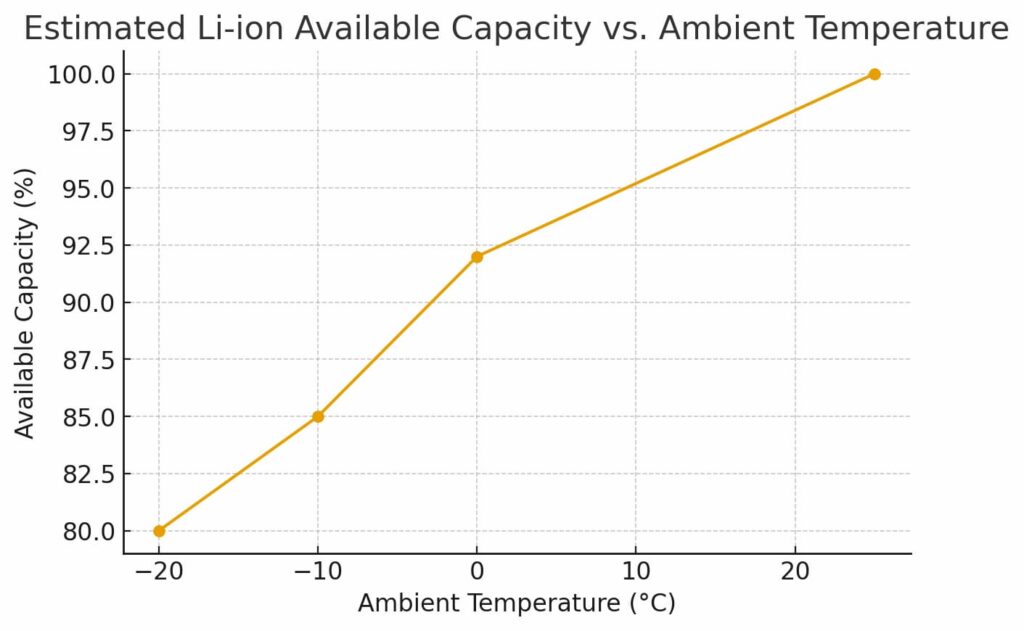
Cold raises internal resistance in lithium-ion cells. Voltage sags earlier under load, so your controller/BMS reduces power to protect the pack. In Battery University’s tests on a Li-ion power cell, available capacity trends roughly as follows: 25 °C = 100%, 0 °C ≈ 92%, −10 °C ≈ 85%, −20 °C ≈ 80%.
Chart: estimated Li-ion available capacity vs temperature
Data summarized from Battery University (representative “Power Cell” discharge).
Reality check from the EV world: independent testing by Consumer Reports finds about 25% range loss in cold on highways; e-bikes follow the same chemistry trend (just without cabin heating loads). Plan for a meaningful drop on freezing days.
Motor mechanics (why everything feels “draggy”)
Cold thickens grease in motor bearings, freehubs, and mid-drive gearboxes, raising friction and startup torque. Using a low-temperature grease prevents a lot of that drag; for example, SKF’s LGLT 2 is rated for operation down to −50 °C.
And lubrication quality matters: SKF reports around 36% of bearing failures are due to poor lubrication practices (over half when you include contamination).
Moisture, spray, and IP ratings
E-bike systems are usually IP54–IP55 (splash-resistant). They’re not designed for pressure washers. Bosch’s official battery guide: “Do not clean the battery with steam jet or high-pressure cleaner.” Keep the drive unit and connectors clean, but use a damp cloth rather than a hose.
Brand-specific cold-weather tips
Bosch eBike Systems (Smart System and earlier)
- Charging + storage: Bosch specifies charge at 0–40 °C (32–104 °F) and store at 10–40 °C (50–104 °F); avoid storage below −10 °C (14 °F). For storage, 30–60% SoC is ideal.
- Winter use: On sub-freezing days, charge and store the battery indoors and insert it just before riding; thermal covers help on long rides.
- Cleaning: No high-pressure cleaning near the drive unit/battery. Wipe and dry instead.
- Expect reduced range: Cold reduces capacity; the system may limit output to protect the pack—normal behavior.
Shimano STEPS (E6100, EP6, EP8 and family)
- Operating ranges: Discharge: −10–50 °C; Charging: 0–40 °C. (Charging below freezing is not allowed.)
- Care: Avoid direct hose/jet washing; dry the bike before charging. LCD contrast may fade when very cold but returns when warm (normal).
- Service: Ask your shop to use low-temperature grease in bottom bracket and related bearings for winter.
Bafang (hub and mid-drive; OEM + DIY)
- Battery guidance: Bafang dealer manual recommends charging at 0–45 °C (ideally ~20 °C) and storage −10–35 °C, with ~60–80% SoC for long-term storage.
- Display/controls: Several Bafang displays allow current-limit adjustments; reducing max current can soften voltage sag in deep cold (availability varies by controller/display).
- General: Keep the green waterproof plugs clean and consider a dab of dielectric grease on external connectors (check warranty guidance first).
Protecting your e-bike motor in cold weather
1) Battery care (biggest win)
- Warm to start. Store and charge indoors; install the pack right before you ride. (Bosch explicitly recommends this in winter.)
- Charging temperature rules: Avoid charging below 0 °C; many e-bike BMSs will prevent it to reduce risk of lithium plating. Best charging is in a moderate room-temperature range.
- Partial charges = longer life. Shallow cycles improve longevity; you don’t need to run to empty.
- Storage tips: For off-season storage, room-temperature storage with ~40–60% SoC is widely recommended; Bosch suggests 30–60%. Cooler rooms slow self-discharge, but don’t store below freezing.
2) Mechanical care (reduce cold drag)
- Switch to low-temperature grease in hubs/BB/gearboxes during winter service (e.g., SKF LGLT 2 to −50 °C).
- Clean/lube chain more often. Salt and grit multiply drivetrain losses.
3) Electrical & sealing
- Gently clean. Avoid high-pressure water near motor seals, BB area, and connectors. Bosch eBike
- Protect connectors. Inspect for moisture/corrosion; consider dielectric grease where permitted.
4) Ride strategy for winter range
- Start easy. Use a lower assist level for the first minutes so the pack warms a bit under light load.
- Spin faster, grind less. A slightly lower gear keeps motor rpm up and current draw down, which helps a cold battery.
Hub motor vs. mid-drive in winter
Hub motors
Fewer drivetrain parts under motor load, but axle/bearing seals sit in the spray zone—keep that area clean and serviced, and avoid pressure jets.
Mid-drives
All torque runs through the chain/cassette, so salty slush accelerates wear. Clean and re-lube more frequently; low-temp grease in the BB and jockey wheels helps.
Operating / charging / storage temperature cheat sheet (by brand)
| Brand | Discharge (riding) | Charging | Storage (typical guidance) |
|---|---|---|---|
| Bosch | Not explicitly listed; performance drops as temp falls | 0–40 °C | 10–40 °C ideal; avoid < −10 °C; store 30–60% SoC |
| Shimano STEPS | −10–50 °C | 0–40 °C | Battery storage up to −20–60 °C (see manual); keep moderate for longevity |
| Bafang | Varies by system; follow bike OEM | 0–45 °C (ideal ~20 °C) | −10–35 °C, ~60–80% SoC for long-term |
Sources: Bosch Battery Guide (charging/storage/winter use) Shimano STEPS user manual (charge/discharge ranges) Bafang battery dealer manual (charge/storage ranges)
Troubleshooting: cold-weather symptoms
| Symptom | Likely cause | Fix |
|---|---|---|
| Assist cuts on hills | Cold-induced voltage sag | Warm battery indoors; start in lower assist; consider an insulated wrap. |
| Rough/draggy feel | Thickened grease or salt in bearings/freehub | Winter service with low-temp grease; clean after rides. |
| Display flicker/dimming | LCD behavior in cold / moisture on connectors | Dry indoors; clean connectors; avoid charging until dry. |
| Big range drop (20–30%+) | Normal Li-ion performance in cold | Plan shorter routes; carry a spare; warm pack first. |
Winter e-bike upgrades for reliability
- Neoprene or thermal battery cover (slows heat loss on longer rides).
- Full-length fenders + mudflaps (keep spray off motor and connectors).
- Low-temperature synthetic grease for hubs/BB/freehub (shop service).
- Studded or winter-compound tires for traction on cold pavement and ice.
- Smart chargers that avoid charging when cells are below safe temperature (some systems/BMS already enforce this).
FAQs
Avoid charging below 0 °C. Many systems prevent it automatically to reduce plating risk; charge at room temperature for best results.
Yes—insulation slows heat loss so voltage sag is less severe on long, freezing rides. (It won’t add energy; it just keeps the pack warmer longer.)
Yes. “Power”-oriented Li-ion cells and certain chemistries tolerate cold better than high-capacity cells, but all lose output when cold.
Partly. Remove the load and some voltage recovery occurs; performance returns once warmed. (Controllers also lower cutoff at high load/low temp to compensate.
Related Reading
Want to understand how different e-bike motors perform in various riding conditions?
Check out these in-depth guides from Electric Bike Explorer:
- Hub-Drive vs. Mid-Drive E-Bike Motors: Which Is Better for Your Riding Style?
A detailed comparison of torque, efficiency, maintenance, and handling differences between hub-drive and mid-drive systems — including which type performs better in cold weather and hilly terrain. - Geared vs. Gearless Hub Motors: Comprehensive Guide to Choosing the Right E-Bike Motor
Learn how geared hub motors deliver better acceleration and hill-climbing ability, while gearless (direct-drive) motors offer smoother, quieter rides and less maintenance — ideal for commuters and long-distance riders.
🚴♂️ Want a bike built for the snow? Don’t miss our roundup of Top 5 Electric Bikes for Snow and Winter Adventures.
Conclusion
Cold weather doesn’t have to end your rides. Most winter problems come from battery chemistry and thicker lubricants, plus moisture around seals and connectors. Keep your pack warm, charge only above freezing, use low-temperature grease, avoid high-pressure cleaning, and follow the brand-specific ranges above. Expect some range loss—plan routes accordingly—and your e-bike motor will stay happy all winter long.
You May Also Like
External Resources
- Bosch eBike Battery Guide (charging 0–40 °C; storage 10–40 °C; 30–60% SoC; no high-pressure cleaning); Bosch winter battery care article. Bosch eBike+1
- Shimano STEPS User Manual (Discharge −10–50 °C; Charge 0–40 °C). Shimano
- Bafang Battery Dealer Manual (Charge 0–45 °C; Storage −10–35 °C; 60–80% SoC). Bafang
- SKF lubrication resources (low-temp greases incl. LGLT 2 to −50 °C; failure stats). SKF Media Hub+1
- Consumer Reports on EV range loss in cold (useful benchmark). Consumer Reports

Kristina is not just an enthusiast but a true authority on electric bikes. Nestled in the coastal beauty of Virginia, Kristina has found the perfect backdrop for her passion for electric biking. As a dedicated wife and homeschooling mom, her life revolves around family, faith, and the thrill of adventure.
Originally hailing from Ohio, Kristina's journey with electric bikes began as a curiosity and quickly evolved into a deep expertise. Her blog is a testament to her love for electric biking, combining her fascination for eco-friendly transportation with her coastal lifestyle.
When she's not cruising the beach on her electric bike, you'll find Kristina indulging in her other loves: long walks along the shore, getting lost in a good book, and cherishing moments with her loved ones. With a heart as big as her love for animals, especially cats, Kristina brings a unique perspective to the electric bike world, grounded in her strong faith in God and her dedication to a sustainable lifestyle.
Through her blog, Kristina shares her extensive knowledge of electric bikes, offering valuable insights, tips, and recommendations to fellow enthusiasts. Whether you're a seasoned rider or a newcomer to the electric bike scene, Kristina's blog is your go-to source for all things electric biking, fueled by her passion, expertise, and the scenic beauty of coastal Virginia.