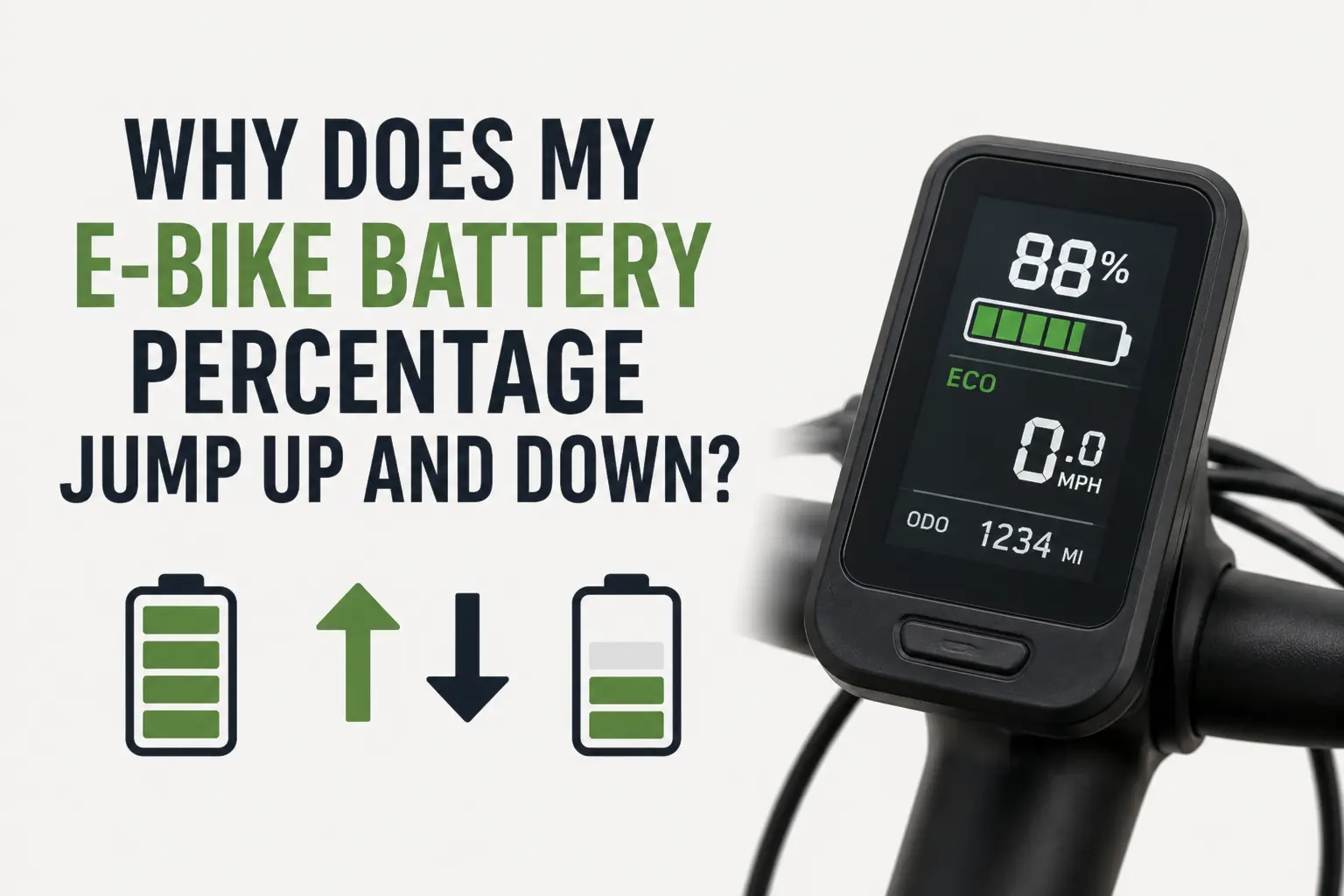
Why Does My E-Bike Battery Percentage Jump Up and Down?
Last Updated on July 20, 2026 by Kristina
When your e-bike battery percentage jumps up and down, it can be difficult to know how much riding range you actually have left. Your display might show 65%, fall to 48% while climbing a hill, and then rise again after you stop. In other cases, one or two battery bars may disappear quickly even though the battery was recently charged.
The good news is that a fluctuating e-bike battery gauge does not always mean the battery is failing. On many e-bikes, the displayed battery level changes because battery voltage temporarily drops while the motor is working hard and recovers when the electrical load decreases.
However, large or repeated battery percentage swings during ordinary riding can also point to an aging battery, a loose battery connection, dirty contacts, weak internal cells, a charger problem, Battery Management System protection, or an inaccurate display.
If the battery is also losing range, start with my guide on an e-bike battery that is not holding a charge. You can also use my free E-Bike Battery Health and Lifespan Checker or visit my complete E-Bike Troubleshooting and Maintenance Guide for help narrowing down the problem.
Why Is My E-Bike Battery Percentage Fluctuating?
On many e-bikes, especially those with a basic voltage-based battery gauge, the displayed battery percentage can change as battery voltage falls under motor load and recovers after the load is removed.
More advanced e-bike battery systems may estimate the state of charge using a combination of voltage, electrical current, temperature, battery history, and software calculations. This means that not every e-bike calculates battery percentage in exactly the same way.
Texas Instruments explains that battery fuel gauges can use voltage, current, and temperature as inputs when calculating the remaining state of charge. Simpler systems may estimate charge primarily from voltage, which is generally less precise when the electrical load is constantly changing.
When you accelerate, use the throttle, climb a hill, carry extra weight, or select a high pedal-assist level, the motor draws more current from the battery. That demand temporarily lowers the battery voltage. A voltage-based display may interpret the lower voltage as less remaining charge.
Once you stop, reduce assistance, or return to level ground, the load decreases. The battery voltage recovers and the displayed percentage may rise again.
This temporary drop and recovery is commonly called voltage sag.
A small amount of battery gauge movement under heavy load can be normal. Large changes during light riding, repeated shutdowns, new error codes, unusual heat, or worsening range deserve a closer inspection.
📖 Read Next
How to Choose the Best eBike Battery for Your Commute (With Top Picks)
Understanding E-Bike Battery Capacity: Amp Hours (Ah) Explained
5 Signs It’s Time to Replace Your E-Bike Battery
The Ultimate Guide to Electric Bike Chargers: Types, Features, and Recommendations
Why Your E-Bike Battery Loses Charge Overnight — and How to Fix It
How Long Do E-Bike Batteries Last?
E-Bike Battery Charging Mistakes
E-Bike Battery Health Checker
Quick Answer: Why E-Bike Battery Levels Go Up and Down
The most common reasons an e-bike battery percentage fluctuates include:
- Normal battery voltage sag during acceleration or hill climbing
- Voltage recovery after the motor load decreases
- A basic or imprecise battery-level estimate
- Cold weather temporarily reducing battery performance
- An aging battery with increased internal resistance
- Weak or unbalanced cell groups inside the battery
- Dirty, loose, worn, or damaged battery contacts
- A removable battery moving inside its mount
- Incomplete charging or a faulty charger
- Battery Management System protection
- Display, controller, wiring, or communication problems
- A dual-battery system switching between battery packs
A battery gauge that drops under a heavy load and rises again after resting may be showing normal voltage sag. A large or repeated percentage swing during light or moderate riding is more concerning, especially if it is accompanied by reduced range, power loss, error codes, or unexpected shutdowns.
E-Bike Battery Percentage Problems at a Glance
| What the battery gauge does | Possible explanation | What to check first |
|---|---|---|
| Drops while climbing, then rises after stopping | Voltage sag and recovery | Test the bike on flat ground in a lower assist level |
| Drops quickly during acceleration | Heavy current demand or an aging battery | Battery age, assist level, rider weight and cargo |
| Jumps when riding over bumps | Loose battery or electrical connection | Battery mount, lock, contacts and wiring |
| Shows full but falls rapidly after starting | Incomplete charge, reduced capacity or weak cells | Charger behavior, battery health and charging time |
| Drops faster in cold weather | Temporary cold-weather performance loss | Let the battery warm naturally before charging |
| Battery LEDs and handlebar display disagree | Different display scales or a communication issue | Check the manual and compare readings after resting |
| Falls to zero and the bike shuts off | Excessive voltage sag, BMS protection or battery failure | Stop riding and arrange a professional load test |
| Changes after the bike rests or sits unused | Voltage recovery, temperature change or gauge recalculation | Recheck it after resting at a stable temperature |
| Steadily loses charge while completely turned off | Standby draw, storage issue or battery problem | Confirm the bike is fully off and monitor it over several days |
| Changes when switching between batteries | Dual-battery system behavior | Check the manufacturer’s dual-battery instructions |
🔍 Why You Can Trust Electric Bike Explorer
Electric Bike Explorer is dedicated to providing honest, well-researched, and easy-to-understand information for e-bike riders. Whenever possible, I personally test the e-bikes, accessories, and products I review. When I can’t test something directly, I rely on careful research, manufacturer specifications, real-world rider feedback, official sources, and trusted industry information.
For law guides, I review state statutes, local ordinances, transportation agencies, park rules, and official government resources whenever possible. For e-bike news, I review the original reporting along with available town documents, meeting agendas, proposed ordinances, police statements, government notices, and other primary sources. I also make a clear distinction between a proposal, an approved rule, and a law that has already taken effect.
For troubleshooting and safety guides, I focus on practical explanations, common rider experiences, manufacturer guidance, and safe maintenance practices.
My goal is to help you make informed decisions, understand the rules where you ride, solve common e-bike problems, and get the most out of your electric bike safely.
Want to know how I score bikes and research my guides? Read my full review and ranking process
Want to See More Electric Bike Explorer in Google Search?
Add Electric Bike Explorer as a preferred source to see more of our e-bike law guides, safety updates, reviews, buying guides, and troubleshooting posts when they are relevant to your searches.
Your E-Bike Battery Percentage Is an Estimate
The percentage on your e-bike display is not always a direct measurement of the exact amount of energy remaining.
Depending on the system, the bike may estimate the charge level using:
- Battery voltage
- Electrical current entering and leaving the battery
- Battery temperature
- Recent motor demand
- Estimated usable battery capacity
- Battery age and condition
- Software calculations
- Information supplied by the Battery Management System
Voltage alone does not always provide a precise battery percentage because terminal voltage changes with current draw, temperature, battery chemistry, battery age, and how long the battery has been resting. A rapidly changing motor load can therefore cause errors in a basic voltage-based battery gauge.
Why Battery Bars Can Be Misleading
A five-bar battery indicator may not measure the battery in small increments. Each bar may represent a broad percentage range.
For example, the cited Shimano battery manual shows its five battery LEDs representing these ranges:
- Five LEDs: 100% to 81%
- Four LEDs: 80% to 61%
- Three LEDs: 60% to 41%
- Two LEDs: 40% to 21%
- One LED: 20% to 1%
That example applies to the LEDs on the listed Shimano batteries. It should not be treated as the exact scale used by every e-bike display or battery.
Because each LED covers a broad range, one bar disappearing does not necessarily mean the battery instantly lost 20% of its energy. The battery may simply have crossed from one indicator range into the next.
1. Battery Voltage Sag Is One of the Most Common Explanations
Voltage sag happens when the motor asks the battery to provide a large amount of electrical current.
This commonly occurs when you:
- Accelerate quickly from a stop
- Use full throttle
- Select the highest pedal-assist level
- Climb a steep hill
- Ride into a strong headwind
- Carry a passenger or heavy cargo
- Ride with low tire pressure
- Start on a hill without pedaling
- Ride with a nearly depleted battery
When current demand increases, the battery’s terminal voltage temporarily drops. A basic battery gauge may translate the lower voltage into a lower percentage.
When you release the throttle, stop climbing, or reduce assistance, the electrical demand falls. The voltage recovers, and the battery gauge may rise again.
This does not mean the battery recharged itself. It means the battery voltage changed after the motor load was reduced.
When Voltage Sag May Be Normal
A temporary percentage drop may be normal when:
- It happens mainly during hard acceleration
- It occurs on steep hills or in high assist
- The reading rises after the bike rests
- The bike does not shut off
- Normal riding range has not changed significantly
- The battery is not unusually hot
- The problem is more noticeable when the battery is already low
When Voltage Sag May Indicate a Problem
Voltage sag becomes more concerning when:
- The gauge drops dramatically during ordinary riding
- The bike shuts off under moderate load
- The behavior is getting worse
- The battery has much less range than it once did
- The problem occurs on flat ground in low assist
- The battery falls to zero and then returns after restarting
- The battery is several years old or heavily used
If your e-bike shuts off mainly while climbing, read my full guide to why an e-bike shuts off going uphill.
2. The Battery Voltage Recovers After You Stop
It is common for an e-bike battery percentage to rise slightly after the bike has been sitting for a few minutes.
While riding, the motor places the battery under load. Once you stop, the load is removed and the terminal voltage can rebound. The display reads the recovered voltage and may calculate a higher battery percentage.
For example, you might see:
- 42% while climbing
- 48% after reaching level ground
- 51% after sitting for several minutes
That pattern does not automatically mean something is wrong.
The more important questions are:
- Is the bike still delivering normal range?
- Does it shut off unexpectedly?
- Does the percentage change during easy riding?
- Is the problem getting worse?
- Does the battery become unusually hot?
A large recovery combined with power cutouts or poor range may indicate excessive battery wear, increased internal resistance, or weak cells.
3. Cold Weather Can Make the E-Bike Battery Gauge Drop Faster
Cold temperatures can temporarily reduce a lithium-ion battery’s ability to deliver power. The battery may appear to drain faster, experience greater voltage sag, or fall to zero under heavy motor demand even though some stored energy remains.
Shimano warns that using a high assistance level in temperatures of 5°C or lower while the battery charge is low can cause its indicated battery level to fall to zero. Shimano also explains that battery consumption can increase in cold conditions and may return to normal after the battery returns to a normal temperature.
Cold-weather battery symptoms may include:
- Battery bars disappearing faster than usual
- Shorter riding range
- Weaker hill-climbing performance
- A sudden percentage drop in high assist
- A battery reading that rises after bringing the battery indoors
- An early shutdown under throttle or heavy load
Do not place a cold battery next to a heater or attempt to warm it rapidly. Bring it into a dry, room-temperature location and allow it to warm naturally before charging.
Always follow the charging-temperature limits in the manual for your exact battery. Shimano, for example, lists a permitted charging range for the batteries covered by its manual, but temperature limits can vary between brands and systems.
4. An Aging E-Bike Battery May Have Higher Internal Resistance
An older e-bike battery may still reach a displayed 100% charge but no longer store or deliver the same amount of usable energy.
As lithium-ion cells age, their capacity and ability to supply current can decline. An aging battery may perform acceptably during light riding but struggle when the motor demands more power.
Common signs include:
- The percentage falls soon after starting a ride
- Several bars disappear on hills
- The reading recovers after stopping
- The battery has noticeably less range
- The battery appears to charge faster than it did when new
- The bike shuts off during acceleration
- Performance becomes weaker at lower charge levels
Shimano states that rechargeable e-bike batteries gradually lose charging capacity through repeated use and that significantly reduced operating time or riding distance can indicate the end of the battery’s useful life.
Use my E-Bike Battery Health and Lifespan Checker to compare the battery’s age, range, charging behavior, and warning signs.
5. Weak or Unbalanced Cell Groups Can Cause Sudden Battery Drops
An e-bike battery contains many individual lithium-ion cells arranged into groups. These groups need to remain within the safe voltage range established by the battery design.
If one group becomes weaker than the others, its voltage may fall faster under load. The battery’s protection system may then disconnect the output even though the display previously showed some charge remaining.
Possible signs of weak or unbalanced cell groups include:
- The battery drops sharply at a similar point during each ride
- The bike shuts off while charge still appears to remain
- The battery works again after resting or restarting
- The battery reaches a displayed full charge unusually quickly
- Range varies considerably between similar rides
- The final portion of the battery drains much faster than the first portion
- The bike works in low assist but shuts off in high assist
These symptoms can suggest an internal battery problem, but they do not prove which cell or component has failed.
A qualified dealer or battery service provider may need to perform a controlled capacity test, system diagnostic, or load test.
Do not open the battery case to inspect individual cells. Bosch states that opening a battery interferes with its certified condition and creates safety risks. Bosch recommends replacing rather than repairing or refreshing faulty, old, or worn batteries.
6. A Loose Battery Connection Can Make the Gauge Jump
A removable e-bike battery must remain securely seated against its electrical contacts.
If the battery is loose, the connection may briefly open or develop additional resistance while you ride. This can cause:
- Battery-percentage changes
- A flickering display
- Intermittent motor assistance
- Error codes
- Complete power loss
- Shutdowns over bumps
Loose battery problems may be more noticeable when:
- Riding over rough pavement
- Turning the handlebars
- Standing on the pedals
- Climbing hills
- Accelerating hard
- Carrying cargo
- Riding a folding e-bike
- Using a battery mount with worn rails or a loose lock
Turn the bike off and remove the battery before inspecting the mount.
Look for:
- Dirt or debris
- Moisture
- Corrosion
- Bent contacts
- Darkened or burned areas
- Melted plastic
- Loose mounting hardware
- Cracked rails
- A battery that rocks inside its mount
- A lock that does not fully engage
Shimano instructs riders to confirm that the battery is securely locked to the battery mount before riding. Its troubleshooting guidance also says that a rattling battery or deformed mounting area should be evaluated by the place of purchase.
For a more detailed inspection, follow my guide to finding loose electrical connections on an e-bike.
7. Dirty or Corroded Battery Contacts Can Affect the Reading
Battery contacts carry electrical current between the battery and the bike. Dirt, oxidation, moisture, corrosion, or physical wear can create an inconsistent connection.
To inspect the contacts safely:
- Turn the e-bike off.
- Remove the battery.
- Disconnect the charger from the battery and wall outlet.
- Examine the battery and mount contacts under a bright light.
- Wipe away loose, dry dust with a clean cloth.
- Use only the contact-cleaning method approved by the bike or battery manufacturer.
- Allow all cleaned surfaces to dry fully before reinstalling the battery.
Do not:
- Insert metal tools between the battery terminals
- Scrape or sand the contacts
- Bridge two terminals together
- Spray cleaner directly into the battery connector
- Pour liquid into the charging port
- Use an unapproved lubricant on the terminals
Shimano permits cleaning the terminals covered by its manual with a clean rag or cotton swab lightly dampened with ethanol. That is Shimano-specific guidance and should not automatically be applied to every e-bike battery. Always check the instructions for your exact bike first.
8. The Battery May Not Be Fully Charging
Sometimes an unstable battery reading happens because the battery never received a complete charge.
Possible causes include:
- A loose charging plug
- Dirt in the charging port
- A damaged charger cord
- A worn charging socket
- A charger that stops intermittently
- Charging outside the permitted temperature range
- A failing charger
- Battery protection interrupting the charge
- An incompatible replacement charger
Pay attention to how long the battery normally takes to charge.
If a battery that previously required several hours suddenly shows full after a very short time, it may not be reaching its previous usable capacity. However, charging time alone cannot confirm a battery failure because charge time also depends on the remaining battery level and charger output.
Use my E-Bike Charging Time Calculator to estimate how long charging may take based on battery size, charger amperage, voltage, and the amount of energy used.
You can also follow my complete Why Won’t My E-Bike Charge troubleshooting guide if the charger light, battery LEDs, or charging port are behaving strangely.
Do Not Use a Universal E-Bike Charger
Only use the charger supplied with your bike or one specifically approved for the exact battery.
The U.S. Consumer Product Safety Commission warns that chargers advertised as universal may be incompatible with some micromobility batteries and can create a fire hazard.
9. The Battery Management System May Be Protecting the Battery
The Battery Management System, usually called the BMS, monitors important battery conditions.
Depending on the battery design, the BMS may monitor:
- Cell or pack voltage
- Electrical current
- Battery temperature
- Charging conditions
- Overload conditions
- Deep discharge
- Short circuits
- Communication with other e-bike components
Depending on its design, the BMS may interrupt charging or disconnect battery output when voltage, current, or temperature limits are exceeded. The bike’s controller or drive system may also reduce motor assistance before a complete shutdown.
Bosch explains that its intelligent BMS monitors the battery, detects potential fault sources, and protects against excessive temperature, overload, and deep discharge.
A protection event is more likely when the changing battery percentage is accompanied by:
- Complete power loss
- A battery or voltage error code
- The battery refusing to turn on
- The system restarting after the charger is connected
- Shutdowns under heavy load
- Charging that starts and stops
- The battery working again after resting
Do not repeatedly force the bike to restart if it continues shutting down. The protection system may be responding to a genuine battery, temperature, current, or connection problem.
🎬 Watch: How to Check an E-Bike Battery’s Voltage
This step-by-step video from Rize Bikes demonstrates how to check the voltage of a primary or secondary e-bike battery with a multimeter. Battery terminals, connectors, and expected voltage readings vary between models, so always follow the instructions for your exact battery. Do not open the battery case or probe unfamiliar contacts.
10. A Display or Communication Problem May Show the Wrong Percentage
The battery may still be functional while the handlebar display shows inaccurate information.
The battery, controller, display, and BMS may communicate through electrical wiring or data connections. Depending on the system, a loose display connector, damaged communication wire, controller problem, display fault, or software issue can result in an incorrect battery reading.
Signs of a display or communication problem include:
- The battery LEDs show a very different level from the handlebar display
- The display flickers or restarts
- The percentage changes when the handlebars turn
- Other display information freezes
- Error codes appear
- The bike rides normally despite a strange battery reading
- The percentage changes significantly after restarting the display
Turn the bike off before checking accessible display and wiring connectors. Waterproof plugs should be aligned correctly and should never be twisted or forced together.
Use my E-Bike Error Code Finder if the display shows a code. If you are unsure whether the problem is the battery, controller, or motor, compare the symptoms in my Controller vs. Battery vs. Motor troubleshooting guide.
11. The Battery LEDs and Handlebar Display May Use Different Scales
A difference between the battery’s built-in LEDs and the handlebar display does not automatically prove that one of them is faulty.
The two indicators may:
- Use different percentage ranges
- Update at different times
- Round the remaining charge differently
- Read information from different parts of the system
- Reserve energy for lights, shifting, or system electronics
For example, the cited Shimano system shuts functions down in stages as charge becomes low. Electronic assistance stops first, followed later by electronic gear shifting and then the light. That system-specific behavior means the remaining battery indication may not correspond only to motor assistance.
Check the manual for your exact e-bike before treating a difference between the battery LEDs and handlebar display as a defect.
12. Dual-Battery E-Bikes May Recalculate the Remaining Charge
Some dual-battery e-bikes use one battery at a time. Others draw energy from both batteries or switch automatically between them.
Depending on the system, the display may:
- Show a combined percentage
- Display one battery at a time
- Recalculate when the second battery becomes active
- Rise or fall when switching between packs
- Treat two batteries of different capacities differently
Using battery packs with different ages, capacities, conditions, charge levels, or firmware may also affect how some systems estimate the combined charge.
Check the manufacturer’s instructions for your exact dual-battery system before assuming the gauge is malfunctioning.
Is It Normal for an E-Bike Battery Percentage to Go Back Up?
A small increase after stopping can be normal.
When the motor load is removed, the battery voltage can recover. The battery gauge may then update and show a somewhat higher percentage.
It is more concerning when:
- The battery jumps from nearly empty to half full
- The percentage changes constantly during easy riding
- The bike repeatedly shuts off
- The reading changes when you move the battery
- The battery becomes excessively hot
- The battery has lost substantial range
- The charger or battery makes unusual sounds
- You notice swelling, smoke, leaking, or a strange smell
Treat the percentage as one clue rather than the only measure of battery condition. Also consider actual riding range, power delivery, charging time, battery temperature, error codes, and whether the behavior is getting worse.
Step-by-Step E-Bike Battery Gauge Troubleshooting
Step 1: Record When the Battery Percentage Changes
Before replacing anything, write down exactly when the change occurs.
Record:
- Starting battery percentage
- Outdoor temperature
- Pedal-assist level
- Terrain
- Rider and cargo load
- Whether the throttle was used
- Percentage before and after the drop
- Whether it recovered after stopping
- Whether the bike shut off
- Distance traveled
- Any error codes
A repeatable pattern can help separate normal load-related voltage sag from an electrical or battery problem.
Step 2: Check for Battery Safety Warning Signs
Before charging or testing the battery, inspect it for:
- Swelling
- Cracks
- Impact damage
- Melted plastic
- Leaking fluid
- Hissing or popping
- Smoke
- A chemical or burning smell
- Unusual discoloration
- Excessive heat
- Damaged terminals or charging ports
If you notice any of these signs, stop using and charging the battery.
Battery Emergency Warning
If the battery is smoking, burning, hissing, rapidly overheating, or releasing a strong chemical odor, leave the area and call 911.
Only move the bike or battery away from flammable materials if it is clearly safe to do so. Do not remain close to an actively failing lithium-ion battery and do not attempt to fight a lithium-ion battery fire yourself.
The U.S. Fire Administration advises people to evacuate and call 911 if a lithium-ion battery fire occurs. FDNY guidance also recommends discontinuing use when a battery changes shape, leaks, develops an odor, or makes unusual sounds.
Step 3: Fully Charge the Battery at a Suitable Temperature
Allow the battery to reach a temperature permitted by the manufacturer before charging.
Use only the approved charger and observe:
- Charger light behavior
- Total charging time
- Battery indicator lights
- Whether charging stops and restarts
- Whether the battery or charger becomes unusually hot
- Whether any error lights appear
Do not leave the battery charging while you are asleep or away from home. The CPSC advises users to remain present during charging, follow the manufacturer’s instructions, and unplug the charger when charging is complete.
Step 4: Compare the Battery LEDs With the Handlebar Display
If the battery has its own indicator button:
- Turn the bike off.
- Allow the battery to rest for several minutes.
- Check the built-in battery indicator.
- Turn the bike back on.
- Compare the battery LEDs with the handlebar display.
The readings may not match exactly because they may use different scales or rounding methods. A large, repeatable difference combined with other electrical symptoms may point to a display, wiring, software, or communication problem.
Step 5: Perform a Low-Assist Flat-Road Test
Choose a safe, flat area and begin with a well-charged battery.
Ride using a low pedal-assist level without using full throttle. Watch the battery percentage for several minutes.
Then briefly select a higher assist level and compare the reading.
If the gauge remains stable in low assist but drops sharply in high assist, the problem is more likely related to voltage sag, high electrical demand, or battery wear than a display-only problem.
Step 6: Stop and Watch for Voltage Recovery
After the displayed percentage falls:
- Stop in a safe place.
- Leave the bike powered on briefly.
- Record whether the reading rises.
- Turn the bike off.
- Wait several minutes.
- Restart the system.
- Record the new reading.
A small recovery may reflect load-related voltage sag. A large recovery combined with shutdowns or reduced range may indicate excessive battery wear or an internal battery problem.
Step 7: Reseat the Battery
Turn the bike off and remove the battery.
Inspect the mount and reinstall the battery according to the manufacturer’s directions. Make sure it locks securely and does not rock, slide, or rattle.
If the battery feels loose, do not wedge cardboard, foam, tape, or other random materials near the electrical contacts. The battery latch, mounting rail, lock, hardware, or mount may need professional adjustment or replacement.
Step 8: Inspect Accessible Electrical Connections
Check accessible wiring between the:
- Battery mount
- Display
- Controller
- Main wiring harness
- Motor
- Dual-battery switch or battery combiner, when equipped
Look for:
- Partially disconnected plugs
- Bent connector pins
- Pinched wiring
- Cracked insulation
- Moisture
- Corrosion
- Melted connector housings
- Cables pulled tight near the handlebars
If the display changes when you turn the handlebars, inspect the wiring near the handlebar, stem, and head tube.
Step 9: Check for Error Codes and Software Updates
Look for battery, voltage, temperature, communication, display, or controller error codes.
Consult the manual for your exact bike, motor system, and display. Error-code meanings are not universal.
Some branded systems may also offer diagnostic software or firmware updates through an authorized dealer. Do not use a random reset or programming procedure intended for a different e-bike system.
Step 10: Have the Battery Professionally Tested
A basic resting-voltage reading does not always reveal how a battery behaves while powering the motor.
A manufacturer-authorized dealer or qualified battery service provider may be able to perform:
- A controlled load test
- A usable-capacity test
- Charger output testing
- Resting and loaded-voltage checks
- BMS or system diagnostics
- Battery error-history checks, when supported
- Communication testing between the battery and drive system
Do not open the battery case to inspect cell groups yourself. Many e-bike batteries are replaced rather than opened or rebuilt because of their stored energy, electrical complexity, fire risk, and certified construction.
Can You Recalibrate an Inaccurate E-Bike Battery Percentage?
Some e-bike battery gauges may improve after a manufacturer-approved charging or calibration procedure, but there is no universal recalibration process that works for every e-bike.
Do not repeatedly drain a lithium-ion e-bike battery until the bike shuts off in an attempt to reset it. Deep discharging will not repair:
- Damaged cells
- A loose battery connection
- A failing charger
- A display fault
- Worn battery contacts
- A defective BMS
- A communication problem
A safer approach is to:
- Charge the battery fully with the approved charger.
- Allow the normal charging cycle to finish.
- Restart the bike.
- Check for available system updates.
- Follow the calibration instructions in the owner’s manual, if provided.
- Contact the manufacturer or dealer when no procedure is listed.
When Should You Replace an E-Bike Battery?
A fluctuating e-bike battery gauge by itself does not automatically mean the battery needs to be replaced.
Replacement becomes more likely when several of these symptoms occur together:
- Riding range has dropped significantly
- The bike shuts down under moderate load
- Battery-percentage swings are becoming larger
- The battery reaches a full indication unusually quickly
- The final portion of the charge drains much faster than the first
- The battery is older and has been heavily used
- The bike repeatedly loses power on flat ground
- The battery becomes unusually hot
- A professional test confirms substantially reduced usable capacity
- The manufacturer determines that the battery or BMS has failed
Only use a replacement battery approved for your exact e-bike system. The CPSC recommends using approved replacement battery packs and warns against batteries that have been modified, rebuilt by unqualified people, or assembled from repurposed cells.
Helpful E-Bike Battery Troubleshooting Tools and Accessories
These simple tools can help you inspect the battery mount, track the symptoms, and spot a connection problem before buying expensive replacement parts.
- Rechargeable headlamp: Keeps both hands free while checking battery contacts, wiring, and connectors.
- Bright inspection flashlight: Makes it easier to spot bent pins, discoloration, dirt, moisture, or melted plastic.
- Clean microfiber cloths: Useful for removing dry dust from the battery case and mount.
- Small nylon detailing brush: Helps loosen dry dirt without placing metal against electrical terminals.
- Manufacturer-approved contact-cleaning supplies: Check the owner’s manual before using any cleaner or lubricant on the terminals.
- Battery charging-port cover: Helps protect an exposed charging port from dirt and moisture during storage and transport.
- Approved replacement charger: Use only a charger specifically approved for the exact battery model, voltage, connector, and charging requirements.
- Digital tire-pressure gauge: Low tire pressure increases rolling resistance and motor demand, which can make voltage sag more noticeable.
- Notebook or phone ride log: Record percentage changes, temperature, distance, terrain, and assist level to identify a pattern.
- Digital multimeter: Best reserved for experienced users following a manufacturer-approved test procedure. Never probe inside an enclosed battery or bridge battery terminals.
➡️ View all recommended e-bike accessories
Still Stuck After Trying These Steps?
Some electrical issues aren’t obvious and can take time to track down – especially with controllers, wiring harnesses, or battery systems.
👉 Get help from a verified e-bike expert and pinpoint the issue faster
What Not to Do When an E-Bike Battery Gauge Is Unstable
Avoid these common mistakes:
- Do not open the battery case.
- Do not bypass the Battery Management System.
- Do not bridge or short the battery terminals.
- Do not use an unapproved universal charger.
- Do not charge a swollen, cracked, leaking, smoking, or overheated battery.
- Do not repeatedly restart a battery that keeps shutting down.
- Do not spray water or cleaner into the battery mount.
- Do not pressure-wash the battery or electrical connectors.
- Do not assume that a displayed 100% proves the battery is healthy.
- Do not replace the controller before checking the battery and connections.
- Do not attempt to rebuild the battery with used or repurposed cells.
- Do not throw the battery in household trash or ordinary recycling.
The CPSC advises taking used lithium-ion batteries to an appropriate battery recycler or household hazardous-waste collection center rather than placing them in general trash or recycling.
When to Stop Riding the E-Bike
Stop riding and arrange a professional inspection when:
- The battery or battery mount becomes unusually hot
- The bike repeatedly shuts off in traffic
- The percentage falls to zero without warning
- You smell burning plastic or chemicals
- The battery is swollen or physically damaged
- Battery contacts are darkened, burned, or melted
- The battery moves or rattles inside the mount
- The display shows repeated voltage or temperature errors
- Power cuts out when riding over bumps
- The battery cannot be securely locked
- The bike only works after repeatedly restarting it
- The charger or battery makes hissing, crackling, or popping sounds
Unexpected motor shutdowns can create a riding hazard even when the battery does not show signs of fire. Suddenly losing assistance while crossing traffic, climbing, turning, or carrying cargo can affect balance and control.
FAQs
The battery voltage can recover after motor demand is removed. The display may read the recovered voltage and calculate a slightly higher percentage. A small increase can be normal. A large increase combined with shutdowns, reduced range, or error codes may indicate battery wear or another electrical problem.
The first part of the displayed charge may fall quickly because of voltage settling, an incomplete charge, an inaccurate gauge, reduced battery capacity, cold weather, or battery wear. Compare your actual riding distance and power with previous rides rather than judging battery health only by the first few percentage points.
The throttle can place a high electrical demand on the battery, especially when accelerating from a stop. That demand temporarily lowers battery voltage and may make the battery bars fall. The indicated level may rise again after you release the throttle.
A controller, display, communication wire, or electrical connection problem may cause an unstable or incorrect battery reading. However, the battery, charger, battery mount, and accessible connections should normally be checked before replacing the controller.
Battery bars provide a general estimate, but they may represent broad charge ranges rather than exact amounts. A five-bar display may be less precise than a percentage gauge, although even a percentage gauge is still an estimate.
A battery reading that changes over bumps can point to a loose battery, worn mount, dirty contacts, loose wiring, or damaged connector. Stop riding until the battery is securely mounted and the accessible electrical connections have been inspected.
Low tire pressure increases rolling resistance and makes the motor work harder. The additional electrical demand can reduce range and make voltage sag more noticeable, especially during acceleration or hill climbing.
Possible causes include reduced battery capacity, increased internal resistance, an incomplete charge, a charger problem, weak cell groups, or an inaccurate gauge. A professional load or capacity test may be needed when the battery shuts down despite showing a substantial charge.
Only if the display itself is faulty. A replacement display will not repair weak battery cells, a failing charger, high internal resistance, a loose battery mount, dirty contacts, or a BMS problem.
You may be able to continue riding if the change is small, happens only under heavy load, and the bike otherwise operates normally. Stop riding if the bike shuts off, the battery becomes hot, the reading changes over bumps, error codes appear, or you notice damage, swelling, leaking, smoke, or an unusual smell.
My Take
When an e-bike battery percentage jumps up and down, I would not immediately assume the battery is ruined. The first thing I would look at is when the change happens.
If the battery level falls while climbing or accelerating and rises again after stopping, voltage sag is one likely explanation. Some gauge movement can occur at a low charge level, in cold weather, or when using high assistance.
I become more concerned when the displayed percentage falls sharply during ordinary riding, the bike shuts off, the battery moves inside its mount, the charger behaves differently, or the bike has lost a noticeable amount of range.
Before buying a new battery, controller, charger, or display, I would fully charge the battery at a suitable temperature, compare the battery LEDs with the display, inspect the mount and contacts, test the bike on flat ground in low assist, and record exactly how the percentage behaves under load.
That process can often show whether you are seeing normal battery behavior, an inexpensive connection problem, or a battery that needs professional testing.
Disclosure: As an Amazon Associate, I earn from qualifying purchases. This comes at no extra cost to you and helps support the content on this site.
External Sources
Texas Instruments – State of Charge Estimation Using Smart Battery Charger
https://www.ti.com/lit/pdf/sluaaa1
Texas Instruments – Battery Gauging Algorithm Comparison
https://www.ti.com/lit/SLUAAR3
Shimano – Special Battery and Parts User’s Manual
https://si.shimano.com/en/pdfs/um/7GP0B/UM-7GP0B-001-ENG.pdf
Bosch eBike Systems – E-Bike Battery Safety
https://www.bosch-ebike.com/en/service/battery-safety
Bosch eBike Systems – E-Bike Battery Guide
https://www.bosch-ebike.com/fileadmin/EBC/Service/Downloads/Akku_Guide/Akku_Guide/Bosch-eBike-Battery-Guide-EN-US.pdf
U.S. Consumer Product Safety Commission – Micromobility Battery and Charging Safety
https://www.cpsc.gov/Safety-Education/Safety-Education-Centers/Micromobility-Information-Center
U.S. Consumer Product Safety Commission – Universal Charger Warning
https://www.cpsc.gov/Newsroom/News-Releases/2024/CPSC-Urges-Consumers-to-Not-Buy-or-Use-Universal-Chargers-with-Micromobility-Products-Due-to-Fire-Hazard
U.S. Fire Administration – Lithium-Ion Battery Community Education
https://www.usfa.fema.gov/a-z/lithium-ion-batteries/community-education/
FDNY Smart – Lithium-Ion Battery Safety Tips
https://www.fdnysmart.org/be-fdnysmart-when-using-any-devices-powered-by-lithium-ion-batteries/

Kristina is not just an enthusiast but a true authority on electric bikes. Nestled in the coastal beauty of Virginia, Kristina has found the perfect backdrop for her passion for electric biking. As a dedicated wife and homeschooling mom, her life revolves around family, faith, and the thrill of adventure.
Originally hailing from Ohio, Kristina's journey with electric bikes began as a curiosity and quickly evolved into a deep expertise. Her blog is a testament to her love for electric biking, combining her fascination for eco-friendly transportation with her coastal lifestyle.
When she's not cruising the beach on her electric bike, you'll find Kristina indulging in her other loves: long walks along the shore, getting lost in a good book, and cherishing moments with her loved ones. With a heart as big as her love for animals, especially cats, Kristina brings a unique perspective to the electric bike world, grounded in her strong faith in God and her dedication to a sustainable lifestyle.
Through her blog, Kristina shares her extensive knowledge of electric bikes, offering valuable insights, tips, and recommendations to fellow enthusiasts. Whether you're a seasoned rider or a newcomer to the electric bike scene, Kristina's blog is your go-to source for all things electric biking, fueled by her passion, expertise, and the scenic beauty of coastal Virginia.