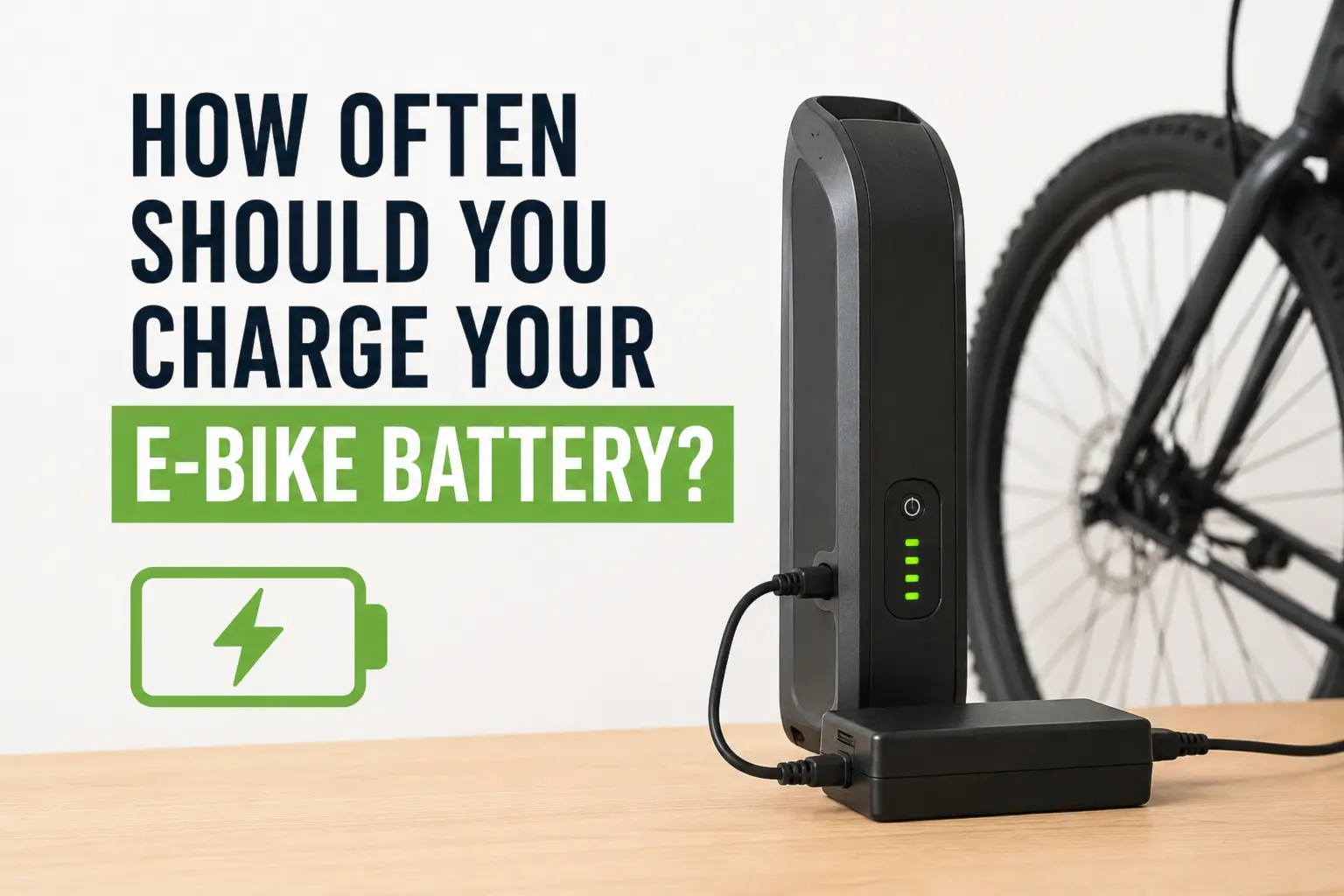
How Often Should You Charge Your E-Bike Battery?
Last Updated on June 8, 2026 by Kristina
One of the most common questions I hear from e-bike owners is: How often should I charge my e-bike battery?
The short answer is simple:
Most riders should recharge their e-bike battery when it reaches about 20% to 30% remaining charge rather than waiting until it is completely empty.
Modern e-bikes use lithium-ion batteries, and these batteries perform best when they are kept within a healthy charge range rather than being repeatedly drained to zero.
In this guide, I’ll explain how often you should charge your e-bike battery, whether daily charging is safe, how storage affects charging habits, and the best practices for extending battery lifespan.
If you’re new to e-bikes, you may also find these guides helpful:
- How Far Can an E-Bike Go?
- Start Here: Beginner’s Guide to E-Bikes
- E-Bike Battery Lifespan Guide
- Common E-Bike Battery Mistakes
- E-Bike Charging Time Calculator
- Battery Health Checker
How Often Should You Charge an E-Bike Battery?
Most riders should recharge their battery when it drops to around 20% to 30% remaining charge. Modern lithium-ion batteries prefer partial charging and generally last longer when they are not regularly drained to 0%.
Charging after every ride is usually safe, and most quality e-bike batteries can last 500 to 1,000+ charge cycles with proper care.
Battery Charging Best Practices at a Glance
Before diving deeper, here are the charging habits I recommend for maximizing battery life.
Following these simple habits can help maximize range, improve battery longevity, and delay the need for an expensive battery replacement.
🔎 How We Researched This Guide
This guide is based on recommendations from major e-bike manufacturers, battery manufacturers, transportation organizations, and battery research resources.
Sources reviewed include:
- Bosch eBike Systems
- Specialized
- Trek
- Battery University
- U.S. Department of Energy
- PeopleForBikes
As with all guides on Electric Bike Explorer, I focus on practical advice that riders can use in the real world rather than theoretical battery discussions.
How Often Should You Charge an E-Bike Battery?
The ideal charging frequency depends on how often you ride and how much battery capacity you use.
Here are some general guidelines:
| Riding Style | Recommended Charging Frequency |
|---|---|
| Daily commuter | Every day or every few rides |
| Weekend rider | After several rides as needed |
| Occasional rider | Before rides and monitor storage levels |
| Long-distance rider | After most rides |
| Seasonal rider | Maintain storage charge and check monthly |
The biggest mistake many riders make is waiting until the battery is completely empty before charging.
That advice applied to older battery technologies but does not apply to modern lithium-ion e-bike batteries.
Today’s batteries generally prefer partial charging cycles.
E-Bike Battery Charging Best Practices
The table below summarizes the recommended charging habits for most modern lithium-ion e-bike batteries.
| Situation | Recommended Charge Level |
|---|---|
| Daily riding | 80% to 100% |
| Maximum range needed | 100% |
| Long-term storage | 30% to 60% |
| Winter storage | 30% to 60% |
| Recharge point | Around 20% to 30% |
| After every ride | Safe for most riders |
| Battery reaches 0% | Avoid when possible |
Remember that modern e-bike batteries are designed for partial charging. You do not need to wait until the battery is empty before plugging it in.
Is It Okay to Charge Your E-Bike Battery After Every Ride?
Yes.
For most riders, charging after every ride is completely safe.
Modern battery management systems help protect batteries from overcharging and other charging-related issues.
Many commuters simply plug in their battery after each ride so the bike is always ready for the next trip.
For example:
- Ride 10 miles
- Battery drops from 100% to 75%
- Recharge overnight
This type of shallow charging is generally easier on lithium-ion batteries than repeatedly draining them close to empty.
Understanding Charge Cycles
One thing many riders don’t realize is that a charge cycle does not mean plugging in your battery one time.
A full charge cycle is based on total energy used.
For example:
- Ride until the battery drops from 100% to 50%
- Recharge to 100%
- Ride again until it drops from 100% to 50%
- Recharge again
Those two half-discharges equal approximately one full charge cycle.
This is one reason many quality e-bike batteries can provide years of service before noticeable capacity loss occurs.
Most modern lithium-ion e-bike batteries are rated for approximately 500 to 1,000+ full charge cycles. Depending on riding habits, storage conditions, battery quality, and usage patterns, many riders get 3 to 7 years or more from a battery before significant degradation occurs.
Should You Let an E-Bike Battery Go Completely Dead?
No.
Allowing an e-bike battery to regularly reach 0% is one of the fastest ways to shorten its lifespan.
Deep discharges place additional stress on lithium-ion cells.
Instead, I recommend recharging when the battery reaches:
- 20% to 30% remaining charge
- One battery bar left
- Low battery warning appears
Occasional deep discharges are unlikely to ruin a battery, but making it a habit can accelerate battery wear over time.
Will Charging My E-Bike Every Day Wear Out the Battery?
No.
Many riders assume daily charging damages an e-bike battery, but that’s not how modern lithium-ion batteries work.
In fact, frequent shallow charging is often easier on a battery than repeatedly draining it close to empty.
For example, a commuter who uses 20% to 40% of battery capacity each day and recharges overnight is unlikely to cause unusual battery wear simply from charging frequently.
The real factors that affect battery lifespan are:
- Excessive heat
- Frequent deep discharges
- Long-term storage at 100%
- Long-term storage at 0%
- Battery age
- Poor storage conditions
If daily charging fits your riding routine, it’s generally a safe and practical approach.
Is It Bad to Leave an E-Bike Battery Fully Charged?
For daily use, no.
For long-term storage, yes.
If you ride frequently, charging to 100% before your next ride is completely normal.
However, if the battery will sit unused for several weeks or months, storing it at full charge can accelerate long-term battery aging.
Most manufacturers recommend storing batteries partially charged rather than fully charged.
Can You Charge an E-Bike Battery in Cold Weather?
Cold weather riding is common, but charging requires extra attention.
Most lithium-ion batteries should not be charged when the battery itself is below freezing (32°F / 0°C).
If you’ve been riding in very cold temperatures:
- Remove the battery if possible.
- Bring it indoors.
- Allow it to warm to room temperature.
- Then begin charging.
Charging a frozen lithium-ion battery can damage battery cells and reduce battery lifespan.
Many manufacturers recommend charging batteries within moderate temperatures, often around 50°F to 77°F (10°C to 25°C), although exact recommendations vary by manufacturer.
If you ride year-round, proper cold-weather charging practices can make a significant difference in long-term battery health.
How Charging Habits Affect Battery Lifespan
One of the most important factors affecting e-bike battery longevity is charging behavior.
Good charging habits can help your battery last several years longer.
Habits That Help Battery Life
- Recharge before reaching 0%
- Store around 30% to 60% charge
- Avoid excessive heat
- Use the original charger
- Charge indoors when appropriate
- Keep battery contacts clean
- Avoid prolonged storage at full charge
Habits That Can Shorten Battery Life
- Frequent deep discharges
- Leaving a battery empty for weeks
- Storing a battery at 100% charge for months
- Charging in excessive heat
- Using incompatible chargers
- Leaving batteries in direct sunlight
- Charging batteries while frozen
How Often Should Different Riders Charge?
Daily Commuters
Daily commuters often charge every night.
If you’re riding 10 to 25 miles per day, nightly charging is usually the easiest and most convenient option.
Recreational Riders
Weekend riders may only need to charge once every few rides depending on battery size and riding distance.
Long-Range Riders
If you’re regularly covering 40, 50, or even 70 miles per ride, you’ll likely recharge after nearly every ride.
Seasonal Riders
If your bike sits during winter, proper battery storage becomes more important than charging frequency.
How Often Should You Charge an E-Bike Battery During Storage?
If your e-bike will be stored for several weeks or months, charging habits become even more important.
Most manufacturers recommend storing lithium-ion batteries partially charged rather than completely full or completely empty.
For long-term storage:
- Store the battery at roughly 30% to 60% charge
- Keep it in a cool, dry location
- Avoid direct sunlight
- Check charge levels every 1 to 2 months
- Recharge if the battery drops significantly
One of the most common causes of battery damage is leaving a battery completely discharged for an extended period.
A battery that remains empty for months can sometimes enter a deeply discharged state that may prevent it from charging properly.
If you store your e-bike during winter, this simple maintenance step can help preserve battery health until riding season returns.
What Percentage Should You Charge an E-Bike Battery To?
The ideal charge level depends on your situation.
For Maximum Range
Charge to 100%.
If you need every mile of range for a long ride, charging to full capacity is perfectly reasonable.
For Everyday Riding
Many riders simply charge to 100% because it’s convenient.
Others choose to stop around 80% to reduce battery stress and potentially extend long-term battery life.
For Long-Term Storage
Store the battery at approximately 30% to 60% charge.
Avoid storing batteries fully charged or fully discharged for extended periods.
Signs You May Need to Charge More Frequently
Your charging schedule may need adjustment if you notice:
- Range dropping significantly
- Battery reaching low charge quickly
- Reduced power output
- Frequent low battery warnings
- Unexpected shutdowns
Keep in mind that these symptoms can also indicate battery aging or cold-weather performance changes rather than charging habits alone.
Common E-Bike Battery Charging Myths
Myth: You Must Fully Drain the Battery Before Charging
False.
Modern lithium-ion batteries generally perform best when they are not repeatedly drained to empty.
Myth: Charging After Every Ride Damages the Battery
False.
Frequent top-offs are generally safe and often beneficial.
Myth: Leaving the Charger Plugged In Overnight Always Damages the Battery
Mostly false.
Modern chargers and battery management systems prevent overcharging.
However, keeping a battery at 100% charge for long periods can contribute to gradual capacity loss over time.
Myth: Heat Doesn’t Affect Battery Life
False.
Heat is one of the biggest factors that accelerates lithium-ion battery degradation.
What Do Major E-Bike Manufacturers Recommend?
While recommendations vary slightly by brand, most manufacturers agree on the same core battery care principles.
Bosch
Bosch recommends storing batteries in a cool, dry location and maintaining approximately 30% to 60% charge during long-term storage. The company also advises avoiding extreme temperatures whenever possible.
Specialized
Specialized recommends avoiding prolonged storage at full charge and checking battery charge levels periodically during storage.
Trek
Trek advises riders to recharge batteries before they become deeply discharged and to store batteries in moderate temperatures when not in use.
Although exact percentages vary slightly, the overall guidance remains remarkably consistent.
Avoid extreme charge levels, avoid excessive heat, and store batteries partially charged when not riding.
My Take
After researching battery technology and talking with countless e-bike owners, I’ve found that most people worry far too much about charging habits.
Modern lithium-ion batteries are designed to be used regularly. You don’t need to wait until the battery is empty before charging, and you don’t need to obsess over every percentage point.
The biggest things I focus on are avoiding deep discharges, keeping batteries out of extreme heat, and storing them properly during long periods of inactivity. Following those simple habits will have a much bigger impact on battery life than trying to maintain a perfect charge level every day.
FAQs
No. Modern lithium-ion batteries are designed to handle frequent charging. In most cases, charging more often with smaller amounts of battery usage is less stressful than repeatedly draining the battery close to empty.
Yes. If you only used a small portion of your battery during a ride, it’s perfectly fine to recharge it afterward. Lithium-ion batteries do not suffer from the “memory effect” that affected older battery technologies.
It depends on your bike and storage setup. Many batteries can be safely charged while mounted on the bike, while others can be removed and charged indoors. Follow the recommendations in your owner’s manual and ensure the charging area is dry and well ventilated.
You should only use the charger supplied by the manufacturer or an approved replacement charger. Using the wrong charger can damage the battery, reduce performance, or create a safety hazard.
Most e-bike batteries cost only a few cents to charge. For example, a 700Wh battery charged from empty to full typically uses about 0.7 kilowatt-hours of electricity. At average U.S. electricity rates, a full charge often costs less than 15 cents.
Yes, as long as temperatures remain within the manufacturer’s recommended storage range. Extremely hot garages during summer or unheated garages during freezing winter weather can negatively affect battery health.
All lithium-ion batteries experience a small amount of self-discharge over time. In addition, the battery management system may use a small amount of power even when the bike is not being ridden. This is why manufacturers recommend checking stored batteries every month or two.
Most manufacturers recommend fully charging a new battery before its first use. This helps ensure the battery is balanced and ready to deliver its expected range and performance.
Final Thoughts
Understanding how often to charge your e-bike battery is one of the easiest ways to improve battery lifespan and avoid costly replacements.
For most riders, the ideal strategy is simple:
- Recharge before reaching 0%
- Charge after rides when needed
- Store at 30% to 60% if unused
- Avoid extreme temperatures
- Check storage batteries regularly
Follow those basic guidelines and you’ll get the best combination of range, performance, and battery longevity from your e-bike.
Not sure where to go next?
Some riders are brand new. Others are fixing a problem or thinking about a new bike. Choose what fits you.
Learn & Get Comfortable
Understand how e-bikes work and what to expect when riding.
Improve Your Current Ride
If your bike isn’t performing how you want, learn what affects speed, range, and power.
Compare Better Bikes
Looking for something that fits your riding style? Start here.
- Best Electric Bikes for Beginners
- Recommended Commuter Ebikes
- Most Comfortable City E-Bikes
- Best Fat Tire Ebikes
- Top Folding Ebikes
- Best Step Through Ebikes
- Top Cargo Electric Bikes
- Best Lightweight Ebikes
- Best Long Range Ebikes
- Top Moped Style E-Bikes
- E-bike Reviews
🛒 Ready to Buy?
Top picks and current availability from trusted brands.
👉 Still deciding?
Take our E-Bike Recommendation Quiz to get matched with the right riding style in under two minute
External Sources
Battery University
https://batteryuniversity.com/article/bu-808-how-to-prolong-lithium-based-batteries
Bosch eBike Systems Battery Care Guide
https://www.bosch-ebike.com
Trek Battery Care Guide
https://www.trekbikes.com
U.S. Department of Energy Vehicle Technologies Office
https://www.energy.gov
PeopleForBikes E-Bike Resources
https://www.peopleforbikes.org

Kristina is not just an enthusiast but a true authority on electric bikes. Nestled in the coastal beauty of Virginia, Kristina has found the perfect backdrop for her passion for electric biking. As a dedicated wife and homeschooling mom, her life revolves around family, faith, and the thrill of adventure.
Originally hailing from Ohio, Kristina's journey with electric bikes began as a curiosity and quickly evolved into a deep expertise. Her blog is a testament to her love for electric biking, combining her fascination for eco-friendly transportation with her coastal lifestyle.
When she's not cruising the beach on her electric bike, you'll find Kristina indulging in her other loves: long walks along the shore, getting lost in a good book, and cherishing moments with her loved ones. With a heart as big as her love for animals, especially cats, Kristina brings a unique perspective to the electric bike world, grounded in her strong faith in God and her dedication to a sustainable lifestyle.
Through her blog, Kristina shares her extensive knowledge of electric bikes, offering valuable insights, tips, and recommendations to fellow enthusiasts. Whether you're a seasoned rider or a newcomer to the electric bike scene, Kristina's blog is your go-to source for all things electric biking, fueled by her passion, expertise, and the scenic beauty of coastal Virginia.