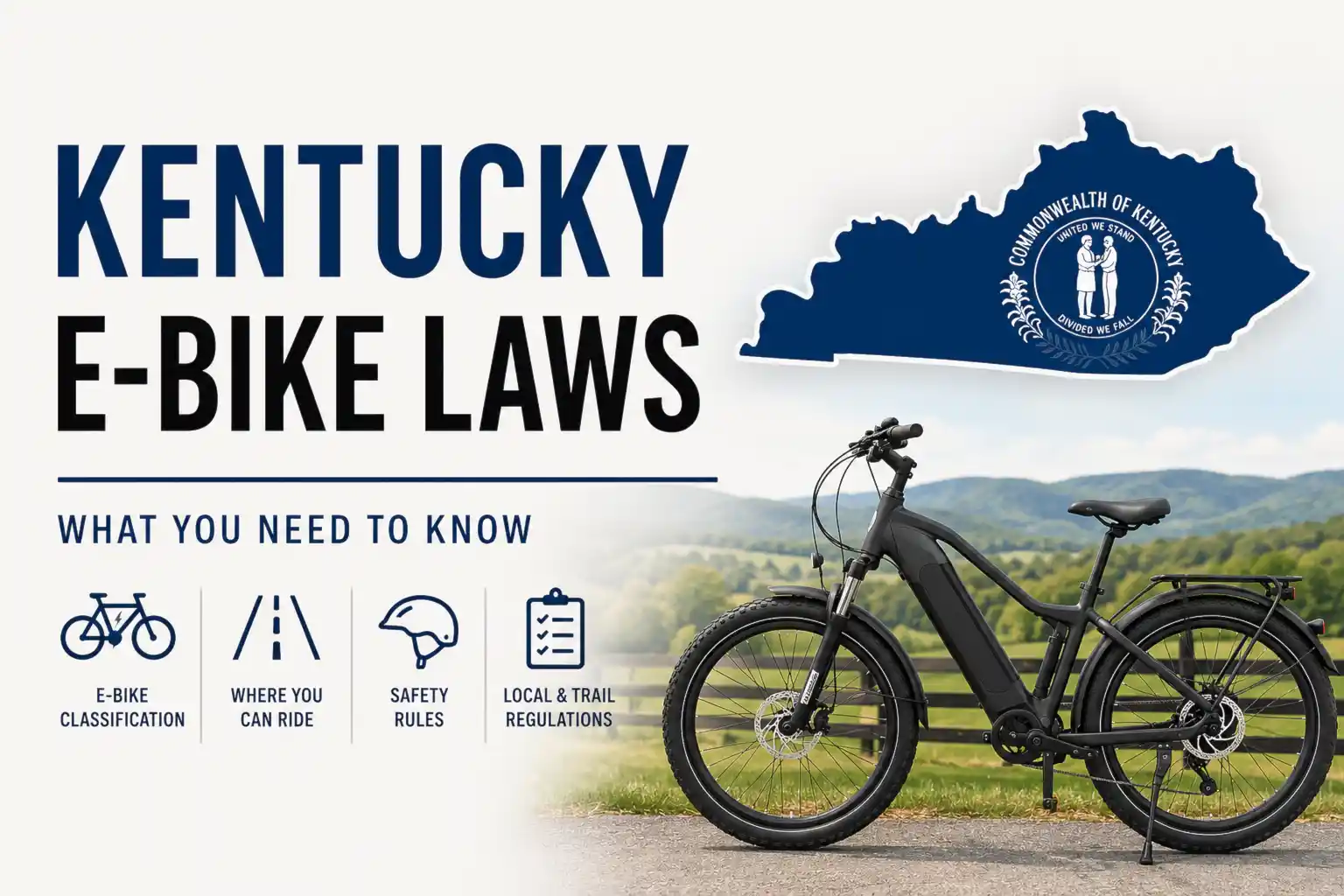
Kentucky E-Bike Laws (2026): License, Helmet, Trail, and Road Rules Explained
Last Updated on June 13, 2026 by Kristina
Last Verified: June 2026
Whether you’re commuting in Louisville, exploring Lexington’s trail network, riding around Northern Kentucky, or simply trying to understand your rights as an e-bike rider, this guide explains the current Kentucky e-bike laws in plain English.
If you’re new to electric bikes, I also recommend starting with our E-Bike Beginner’s Guide and Start Here Resource Center, which walks you through everything from choosing your first e-bike to understanding batteries, maintenance, safety, and common mistakes.
If you’re still shopping for an e-bike, be sure to read our Complete E-Bike Buying Guide, where I break down the best e-bike types, key features to look for, and how to choose the right electric bike for your riding style and budget.
You may also find these resources helpful:
⭐ Kentucky E-Bike Laws at a Glance
Kentucky generally treats electric bikes similarly to traditional bicycles.
- No driver’s license required
- No registration required
- No insurance required
- No statewide helmet law
- No statewide minimum age requirement
- Road access generally allowed
- Bike lane access generally allowed
- Sidewalk access depends on local rules
- Trail access depends on the trail manager
- Lights and reflectors are required at night
Because Kentucky has not adopted a statewide three-class e-bike law, local governments and property managers often establish their own rules.
👉 Not sure which class is right for you? See e-bike classes explained
Why Trust This Guide?
- Reviewed against current Kentucky statutes and regulations
- Includes local rules for Louisville, Lexington, and major Kentucky riding areas
- Covers university policies for the University of Kentucky and University of Louisville
- Updated for 2026 and reviewed regularly as laws change
- Written by an electric bike rider and publisher who tracks e-bike laws, regulations, safety, and trail access across all 50 states
Kentucky E-Bike Law Quick Tip
Local Rules Matter
Kentucky does not currently have a statewide Class 1, Class 2, and Class 3 e-bike law. Riders should follow Kentucky bicycle regulations as well as any applicable local ordinances, park rules, university policies, and trail regulations.
Always check local regulations before riding on sidewalks, university campuses, or public trails.
Can I Ride My E-Bike Here in Kentucky?
| Location | Generally Allowed? | Notes |
|---|---|---|
| Public Roads | ✅ Yes | Follow normal traffic laws. |
| Bike Lanes | ✅ Yes | Generally treated like bicycles. |
| Residential Streets | ✅ Yes | Follow roadway regulations. |
| Sidewalks | ⚠️ Depends | Local restrictions may apply. |
| Shared-Use Paths | ⚠️ Usually | Check local regulations. |
| Louisville Loop | ✅ Generally | Follow local trail rules. |
| Legacy Trail (Lexington) | ✅ Generally | Verify current trail regulations. |
| Kentucky State Park Roads | ✅ Yes | Follow park regulations. |
| Kentucky State Park Trails | ⚠️ Depends | Rules vary by park. |
| University Campuses | ⚠️ Usually | Subject to campus policies. |
| Daniel Boone National Forest | ⚠️ Depends | Access varies by trail designation. |
| Mammoth Cave Area Greenways | ⚠️ Depends | Check local regulations. |
How Kentucky Defines an E-Bike
Kentucky has not adopted a statewide Class 1, Class 2, and Class 3 e-bike statute like many other states.
Instead, Kentucky’s bicycle regulations generally apply to bicycles with electric assist motors, while local governments, universities, and land managers may establish additional rules.
This means many popular electric bikes from Aventon, Lectric, Ride1Up, Velotric, Trek, Specialized, Rad Power Bikes, and similar manufacturers are generally treated more like bicycles than motorcycles.
However, because Kentucky lacks a formal statewide classification system, trail managers and universities may still reference Class 1, Class 2, or Class 3 terminology when creating their own policies.
Do You Need a License for an E-Bike in Kentucky?
No.
Kentucky does not currently require:
- A driver’s license
- Vehicle registration
- License plates
- Motor vehicle insurance
for electric bicycles that are operated as bicycles.
This makes Kentucky one of the easier states for e-bike ownership and commuting.
Do You Need to Register an E-Bike?
No.
Kentucky does not require statewide registration for electric bicycles.
However, some universities and private properties may require registration for bikes used on their property.
For example, the University of Louisville requires registration for micromobility vehicles used on campus.
Do You Need Insurance for an E-Bike?
No.
Kentucky does not require insurance for electric bicycles.
That said, many riders choose to protect expensive e-bikes through:
- Homeowners insurance
- Renters insurance
- Bicycle insurance policies
especially if the bike is worth several thousand dollars.
Are Helmets Required?
Kentucky does not currently have a statewide helmet law for bicycle or e-bike riders.
However:
- Some organized events may require helmets.
- Individual property owners may establish helmet requirements.
- Helmets are strongly recommended for all riders regardless of age.
If you’re shopping for a helmet, see our guide to the Best E-Bike Helmets for Safety and Comfort.
Is There a Minimum Age Requirement?
Kentucky does not currently impose a statewide minimum age requirement for operating an electric bicycle.
However:
- Parents should carefully consider the speed and power of an e-bike before allowing younger riders to use one.
- Certain organizations and trails may establish age restrictions.
- Universities and schools may create additional policies.
Where Can You Ride an E-Bike in Kentucky?
Roads and Streets
Electric bicycles can generally be ridden anywhere traditional bicycles are allowed.
Riders must obey:
- Traffic signals
- Stop signs
- Right-of-way laws
- Lane positioning requirements
- General traffic regulations
Kentucky requires bicycle riders to follow the same basic traffic laws that apply to other roadway users.
Bike Lanes
Electric bicycles are generally allowed in bicycle lanes throughout Kentucky unless local regulations specifically state otherwise.
Most riders can use bike lanes just as they would with a traditional bicycle.
Sidewalks
Kentucky does not have a statewide prohibition on bicycle or e-bike use on sidewalks.
However, local governments may create their own rules.
This means sidewalk access can vary significantly depending on where you are riding.
When riding on sidewalks where permitted:
- Yield to pedestrians.
- Travel at safe speeds.
- Watch for driveways and intersections.
- Follow posted signage.
For more information, see our guide on Can You Ride an E-Bike on the Sidewalk?
Trails and Parks
Trail access is determined by the organization managing the trail.
Some trails welcome e-bikes while others restrict them.
Before riding, always check:
- Trailhead signs
- Park regulations
- Local ordinances
- Property-specific rules
Before You Hit the Trail
Trail access rules can change from one park, city, or state to the next. Use our E-Bike Trail Access Checker to see where e-bikes are allowed and find trail-specific regulations before your ride.
Night Riding Requirements
Kentucky requires bicycles and e-bikes ridden after dark to have proper visibility equipment.
Front Light
A white front light visible from at least 500 feet.
Rear Reflector
A red rear reflector visible from at least 100 feet.
Rear Light
A rear red light is strongly recommended and may be required depending on conditions and local regulations.
Good visibility is one of the most important safety upgrades for any e-bike rider.
You may also want to read our guide on E-Bike Visibility and Night Riding Safety.
⚠️ What You Need to Ride Legally
Depending on your e-bike class, certain safety equipment – like lights, helmets, and reflectors – may be required, especially for higher-speed bikes or road use.
Brake Requirements
Kentucky requires bicycles and electric bicycles to have brakes capable of stopping within 15 feet when traveling at 10 mph on dry, level pavement.
This requirement comes from Kentucky bicycle equipment regulations.
If your braking performance is poor, see our guides on:
- E-Bike Brake Upgrades
- E-Bike Stopping Distance
- E-Bike Maintenance Checklist
Can You Ride an E-Bike While Intoxicated?
Kentucky’s DUI laws primarily apply to motor vehicles.
However, riding an e-bike while impaired can still create significant safety risks and may result in legal consequences depending on the circumstances.
The safest approach is simple:
Never ride an e-bike while impaired by alcohol or drugs.
Kentucky Cities E-Bike Rules at a Glance
| City | E-Bikes Allowed on Roads? | Sidewalk Riding | Popular Riding Areas | Notes |
|---|---|---|---|---|
| Louisville | ✅ Yes | ❌ Restricted for most riders | Louisville Loop, Big Four Bridge, Waterfront Park | Louisville has stricter sidewalk rules than most Kentucky cities. |
| Lexington | ✅ Yes | ⚠️ Check local rules | Legacy Trail, Town Branch Trail, Veterans Park | Sidewalk regulations can vary by location. |
| Covington | ✅ Yes | ⚠️ Check local rules | Riverfront Commons, Devou Park | Growing bike infrastructure. |
| Newport | ✅ Yes | ⚠️ Check local rules | Newport Riverfront Trails | Connected to regional trail systems. |
| Bowling Green | ✅ Yes | ⚠️ Check local rules | WKU area, Greenways | Popular college-town riding. |
| Owensboro | ✅ Yes | ⚠️ Check local rules | Riverfront trails, Greenbelt | Expanding trail network. |
E-Bike Rules in Louisville
Louisville has some of the most developed bicycle infrastructure in Kentucky and continues expanding its network of bike lanes, greenways, and shared-use paths.
Popular riding locations include:
- Louisville Loop
- Waterfront Park
- The Parklands of Floyds Fork
- Beargrass Creek Greenway
- Big Four Bridge
- Ohio River Greenway
Louisville Sidewalk Rules
Louisville has some of the strictest sidewalk regulations in Kentucky.
Under Louisville Metro ordinance:
- No person age 11 or older may operate a bicycle or electric bicycle on sidewalks within Louisville Metro.
- No person of any age may operate a bicycle or electric bicycle on sidewalks within the Downtown Form District.
- Riders should use roads, bike lanes, and designated bicycle facilities whenever possible.
This is a major exception to Kentucky’s generally bicycle-friendly approach.
Louisville Commuting by E-Bike
Many riders use e-bikes to access:
- Downtown Louisville
- University of Louisville
- Louisville Waterfront
- Medical District
- NuLu District
Because pedestrian traffic can be heavy, riders should always use caution and obey local regulations.
E-Bike Rules in Lexington
Lexington has become increasingly bicycle-friendly and continues expanding its cycling infrastructure.
Popular riding destinations include:
- Legacy Trail
- Town Branch Trail
- Veterans Park
- Brighton East Rail Trail
- Coldstream Trail System
Lexington Sidewalk Rules
Lexington riders should be cautious about assuming e-bikes are permitted on sidewalks.
Various city transportation policies restrict certain vehicle types on sidewalks and pedestrian facilities.
If riding in downtown Lexington or heavily traveled pedestrian areas, always check current city regulations and posted signage before operating an e-bike on a sidewalk.
Lexington Commuting Routes
Many riders use electric bikes to commute between:
- Downtown Lexington
- University of Kentucky
- Medical campuses
- Business districts
Lexington continues expanding bicycle infrastructure throughout the city.
Northern Kentucky: Covington and Newport
Northern Kentucky communities have invested heavily in bicycle infrastructure and regional trail connections.
Popular riding locations include:
- Riverfront Commons Trail
- Devou Park
- Newport Riverfront
- Licking River Greenway
- Ohio River Trail Connections
Because many facilities cross municipal boundaries, regulations may vary depending on the exact location.
Always check local signage and trail rules before riding.
University of Kentucky E-Bike Rules
The University of Kentucky permits bicycles, e-bikes, and other personal mobility devices on campus under its transportation policies.
Students frequently use e-bikes to travel between residence halls, classrooms, athletic facilities, and downtown Lexington.
Riders Must
- Yield to pedestrians at all times.
- Follow traffic signs and signals.
- Ride with the flow of traffic.
- Use lights when riding after dark.
- Operate at safe speeds.
- Follow all campus transportation regulations.
Riders May Not
- Ride inside university buildings.
- Ride recklessly.
- Perform stunts or tricks.
- Block building entrances or walkways.
- Operate in designated dismount zones.
Parking Rules
The University requires bicycles and e-bikes to be parked at approved bicycle parking facilities.
Improperly parked bikes may be removed or impounded by the university.
Battery Safety
The University of Kentucky has adopted policies regarding battery-powered mobility devices.
Students should:
- Use manufacturer-approved chargers.
- Avoid charging damaged batteries.
- Follow campus charging guidelines.
- Follow university safety requirements regarding lithium-ion batteries.
Before bringing an e-bike to campus, students should review the latest University of Kentucky transportation policies.
University of Louisville E-Bike Rules
The University of Louisville allows e-bikes and other micromobility devices on campus under its transportation policies.
Registration Required
The University of Louisville requires registration for bicycles, e-bikes, and other micromobility vehicles used on campus.
Registration helps recover stolen bikes and assists with campus transportation management.
Students should review the current registration process before bringing an e-bike to campus.
Riders Must
- Yield to pedestrians.
- Follow campus transportation regulations.
- Ride responsibly.
- Use designated parking locations.
- Comply with local and state laws.
Riders May Use
- Designated bicycle facilities.
- Public rights-of-way.
- Approved campus pathways where permitted.
Restricted Areas
E-bikes and other micromobility vehicles are generally prohibited:
- Inside university buildings.
- Inside residence halls.
- In parking garages.
- In areas restricted by university policy or posted signage.
The University also warns students about lithium-ion battery fire risks and has restrictions regarding the storage and charging of battery-powered devices.
Always review current university policies before bringing an e-bike to campus.
Other Kentucky Universities
Many Kentucky colleges allow electric bicycles but establish their own transportation policies.
Examples include:
- Western Kentucky University
- Eastern Kentucky University
- Northern Kentucky University
- Murray State University
- Morehead State University
- Bellarmine University
- Transylvania University
Common campus regulations may include:
- Designated parking areas
- Speed restrictions
- Charging restrictions
- Sidewalk riding limitations
- Shared-use pathway rules
Students should always review campus transportation policies before riding.
Kentucky Trails and E-Bike Access
Kentucky does not have a single statewide e-bike trail policy.
Instead, access is determined by the agency, organization, city, or property owner responsible for managing the trail.
Some trails welcome e-bikes while others restrict them.
Before riding, always check:
- Trailhead signs
- Local regulations
- Park rules
- Property-specific restrictions
Popular Kentucky trail systems include:
| Trail | Access Notes |
|---|---|
| Louisville Loop | Generally follows local bicycle rules |
| Legacy Trail | Verify current Lexington regulations |
| Riverfront Commons | Check municipal policies |
| The Parklands of Floyds Fork | Special trail policies may apply |
| Mammoth Cave Greenways | Verify local regulations |
| Big Four Bridge | Generally follows bicycle regulations |
Remember that trail access rules can change over time.
Kentucky State Parks and E-Bikes
Kentucky State Parks generally allow bicycles on park roads and designated cycling routes.
However, Kentucky does not currently have a single statewide e-bike trail policy that applies to every state park.
Because rules can vary depending on the specific park and trail type, riders should always:
- Contact the individual park.
- Review current park regulations.
- Check trailhead signage.
This is especially important when riding on natural-surface trails.
Some parks may allow e-bikes on certain trails while restricting them on others.
Daniel Boone National Forest and E-Bikes
Daniel Boone National Forest is one of Kentucky’s most popular outdoor recreation destinations.
However, e-bike access is not automatically allowed on all trails.
The U.S. Forest Service generally permits e-bikes only on roads and trails where motor vehicles are allowed.
This means:
- Some roads may allow e-bikes.
- Some motorized trails may allow e-bikes.
- Non-motorized trails may prohibit e-bikes even when traditional bicycles are allowed.
Always verify current trail designations before riding in the forest.
Because regulations can vary by district and trail, checking local Forest Service information before your trip is highly recommended.
Are E-Bikes Allowed in Kentucky Wildlife Management Areas?
Many Kentucky riders use e-bikes for hunting access, fishing trips, and outdoor recreation.
Rules vary depending on the agency managing the property.
Before riding in a Wildlife Management Area, always check:
- Kentucky Department of Fish and Wildlife Resources regulations
- Property-specific rules
- Posted signage
Some areas may allow e-bikes on roads and designated routes while restricting them on trails.
Planning to Hunt with an E-Bike?
Many hunters use electric bikes to quietly access hunting locations, carry gear, and cover more ground without disturbing wildlife. If you’re considering an e-bike for hunting season, see our guide to the Best E-Bikes for Hunting for top recommendations and buying advice.
👉 See the Best Hunting E-Bikes
What About Class 1, Class 2, and Class 3 E-Bikes?
One of the most confusing aspects of Kentucky law is that the state has not formally adopted the three-class e-bike system used in many other states.
That means Kentucky does not currently have statewide definitions for:
- Class 1 e-bikes
- Class 2 e-bikes
- Class 3 e-bikes
However, you may still see these classifications referenced by:
- Manufacturers
- Parks
- Universities
- Trail managers
- Local governments
As a result, you may encounter class-specific rules even though Kentucky state law does not formally define e-bike classes.
Popular Places to Ride an E-Bike in Kentucky
Looking for somewhere to ride?
Some of Kentucky’s most popular e-bike-friendly destinations include:
Louisville Loop
A developing 100+ mile trail network connecting parks, neighborhoods, and attractions throughout Louisville.
Legacy Trail
One of Lexington’s most popular paved multi-use trails.
Big Four Bridge
A scenic Ohio River crossing connecting Louisville and Jeffersonville, Indiana.
The Parklands of Floyds Fork
A large park system offering paved paths, recreation areas, and scenic riding opportunities.
Riverfront Commons
A growing trail network connecting communities throughout Northern Kentucky.
Mammoth Cave Area Greenways
Popular paved routes near one of Kentucky’s most famous attractions.
Land Between the Lakes National Recreation Area
A favorite destination for outdoor enthusiasts with numerous roads and recreational routes.
Daniel Boone National Forest Roads
Many forest roads provide excellent opportunities for exploration where e-bike access is permitted.
Always verify local regulations before riding.
Nearby State Law Guides
Traveling outside Kentucky? Laws change quickly.Check other states:
Indiana e-bike laws
Pennsylvania e-bike laws
New York e-bike laws
Ohio e-bike laws
👉 Compare all states in the state-by-state e-bike law guide
FAQs
Kentucky does not formally define Class 3 e-bikes in state law. However, many Class 3 models are generally treated similarly to bicycles unless local regulations state otherwise.
No. Kentucky has not enacted a statewide Class 1, Class 2, and Class 3 e-bike law like many other states.
Usually yes on roads and designated cycling routes. Trail access depends on the specific park.
Sometimes. Kentucky does not have a statewide sidewalk prohibition, but local governments may establish restrictions.
Generally yes, but riders should follow local trail regulations and posted signs.
No. Kentucky does not require insurance for electric bicycles.
Kentucky does not currently have a statewide minimum age requirement. However, parents should carefully consider the speed and power of an e-bike before allowing younger riders to use one.
Possibly. E-bike access generally depends on whether the road or trail is open to motorized use.
Kentucky E-Bike Law Summary
| Law | Kentucky |
|---|---|
| License Required | No |
| Registration Required | No statewide requirement |
| Insurance Required | No |
| Helmet Required | No statewide requirement |
| Minimum Age | No statewide requirement |
| Road Access | Yes |
| Bike Lane Access | Yes |
| Sidewalk Access | Depends on local regulations |
| Trail Access | Depends on trail manager |
| Night Lights Required | Yes |
| Treated Like Bicycle | Generally Yes |
My Take
Kentucky remains one of the more welcoming states for electric bike riders.
The lack of licensing, registration, insurance, and statewide age requirements makes e-bikes highly accessible for commuting, recreation, fitness, and transportation.
The biggest thing riders need to understand is that local governments, universities, parks, and trail systems often create their own rules. Before riding on a trail, through a university campus, or in a downtown district, it’s always worth checking local regulations first.
For most riders, though, Kentucky offers a straightforward and relatively rider-friendly environment for electric bikes.
Related Reading
- State-by-State E-Bike Laws Guide
- Can You Ride an E-Bike on the Sidewalk?
- E-bike Trail Access Checker
- E-Bike Safety Tips for Beginners
- Best E-Bikes for Commuting
- Best E-Bike Helmets
- E-Bike Maintenance Checklist
- E-Bike Brake Upgrade Tool
- E-Bike Stopping Distance Guide
- Best E-bikes for Hunting
External Sources
- Kentucky Legislative Research Commission
- Kentucky Bicycle Equipment Regulations (601 KAR 14:020)
- Kentucky Transportation Cabinet Bicycle Resources
- University of Kentucky Transportation Services
- Kentucky State Parks
- PeopleForBikes State E-Bike Law Resources

Kristina is not just an enthusiast but a true authority on electric bikes. Nestled in the coastal beauty of Virginia, Kristina has found the perfect backdrop for her passion for electric biking. As a dedicated wife and homeschooling mom, her life revolves around family, faith, and the thrill of adventure.
Originally hailing from Ohio, Kristina's journey with electric bikes began as a curiosity and quickly evolved into a deep expertise. Her blog is a testament to her love for electric biking, combining her fascination for eco-friendly transportation with her coastal lifestyle.
When she's not cruising the beach on her electric bike, you'll find Kristina indulging in her other loves: long walks along the shore, getting lost in a good book, and cherishing moments with her loved ones. With a heart as big as her love for animals, especially cats, Kristina brings a unique perspective to the electric bike world, grounded in her strong faith in God and her dedication to a sustainable lifestyle.
Through her blog, Kristina shares her extensive knowledge of electric bikes, offering valuable insights, tips, and recommendations to fellow enthusiasts. Whether you're a seasoned rider or a newcomer to the electric bike scene, Kristina's blog is your go-to source for all things electric biking, fueled by her passion, expertise, and the scenic beauty of coastal Virginia.