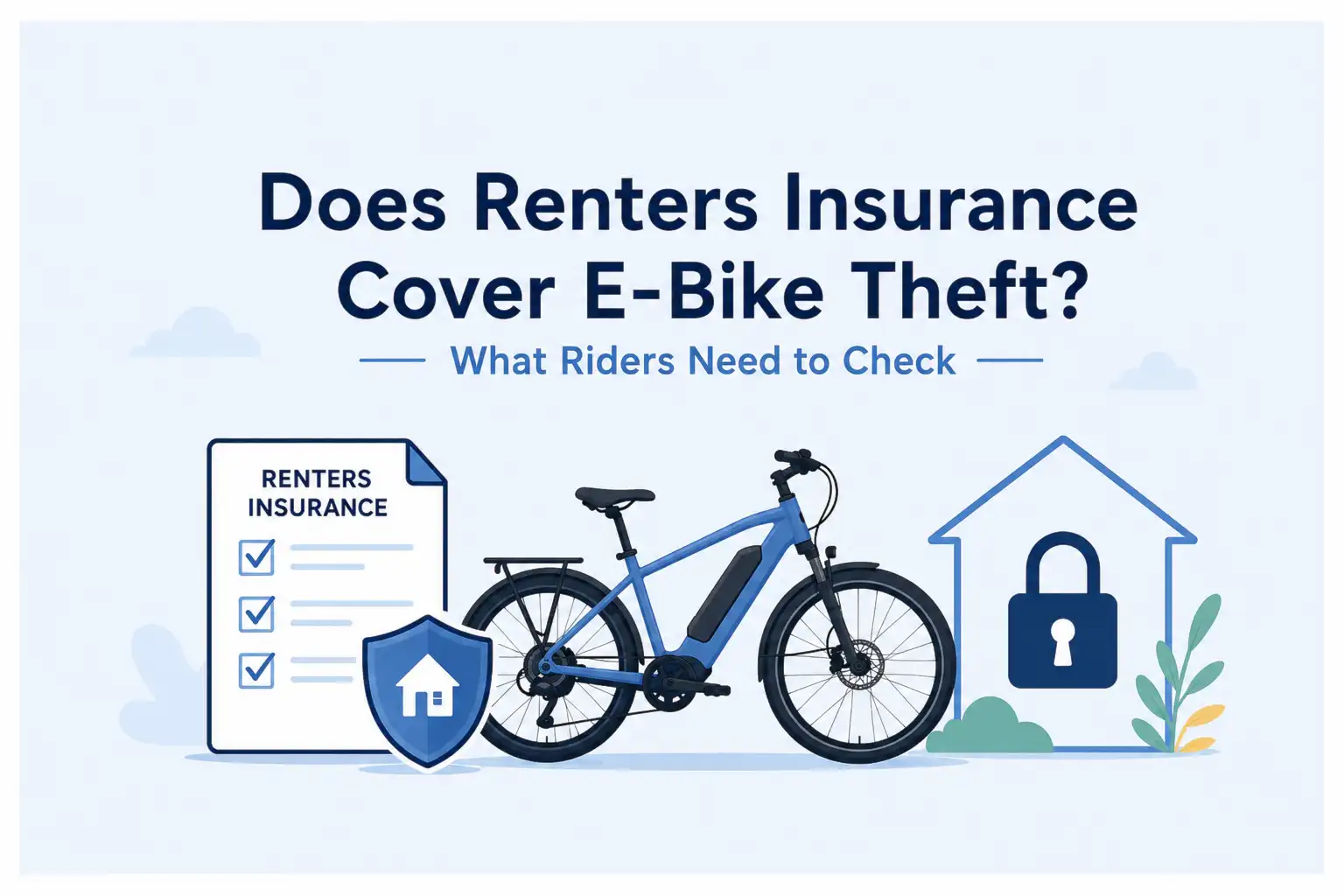
Does Renters Insurance Cover E-Bike Theft? What Riders Need to Check
Last Updated on August 4, 2026 by Kristina
Last reviewed: July 21, 2026
Renters insurance may cover a stolen e-bike, but coverage is not automatic. Standard renters insurance commonly protects personal belongings against theft, and ordinary bicycles are generally treated as personal property. An electric bike can be more complicated because its motor, assisted speed, throttle, classification, value, or intended use may trigger additional limits or exclusions.
Your coverage can depend on whether the insurer considers your e-bike a bicycle or motorized vehicle, where the theft happens, whether an off-premises limit applies, your deductible, any bicycle or e-bike sublimit, and whether the policy pays actual cash value or replacement cost.
The safest approach is to give your insurer the exact make, model, motor rating, assisted speed, throttle capability, purchase price, and intended use of the bike. Ask for written confirmation that theft is covered before relying on your renters policy.
If you own your home rather than rent, my guide to homeowners insurance and stolen e-bikes explains the similar questions homeowners should ask.
For a broader comparison of specialty policies, typical costs, coverage options, and providers, read my complete electric bike insurance guide.
Insurance Research Note
Insurance contracts, definitions, endorsements, exclusions, and claim procedures vary by insurer and state. General insurance guidance cannot override your individual policy. Confirm coverage with a licensed insurance professional and keep the written response with your policy records.
60-Second E-Bike Insurance Coverage Check
An e-bike theft claim usually depends on whether the bike qualifies as covered property, whether theft is covered at the location where it occurred, and how much remains after policy limits, depreciation, and the deductible. The questions below also address business use and riding liability, which may require separate coverage.
Open each question and compare the explanation with your current policy. This self-check cannot determine whether a future claim will be approved, but it can reveal gaps worth discussing with your insurer.
1. Has the insurer confirmed coverage for your exact e-bike?
Ask about your exact make, model, motor output, assisted speed, throttle capability, and any modifications. A general statement that “bikes are covered” may refer only to traditional bicycles.
2. Is theft covered away from your rental home?
Ask specifically about public racks, workplaces, vehicles, hotels, campgrounds, apartment bike rooms, garages, and storage units. Some policies restrict off-premises coverage or apply a lower limit.
3. Is the bicycle or e-bike sublimit high enough?
Compare any special limit with the current replacement cost of the bike, battery, charger, and permanently installed accessories.
4. Can you afford the deductible?
A $500 or $1,000 deductible can substantially reduce a claim involving a lower-priced e-bike. Ask which deductible applies specifically to theft.
5. Does the policy pay replacement cost?
Actual cash value usually subtracts depreciation. Replacement-cost procedures vary, and some insurers require receipts before releasing the full replacement-cost benefit.
6. Have you disclosed business or delivery use?
Using the e-bike for paid delivery or another business activity may trigger business-property limits or exclusions. Ask whether a business endorsement or commercial policy is required.
7. Have you separately confirmed riding liability?
Personal liability may apply to some ordinary bicycle accidents, but e-bike riding can be affected by motorized-device exclusions or other restrictions. Theft coverage does not automatically include riding liability.
How to use your answers:
- Every answer is confirmed in writing: Your renters policy may be a reasonable theft solution, although coverage still depends on the circumstances and policy terms at the time of loss.
- One or two answers are unclear: Ask for written clarification, an endorsement, or an increased limit before assuming the gap is minor.
- Several answers are unclear or unfavorable: Compare standalone bicycle or e-bike insurance before relying on the renters policy.
Important: A verbal statement from an insurance representative may not be enough. Ask the insurer to identify the relevant policy language and provide the answer by email or letter.
Renters Insurance and E-Bike Theft at a Glance
| Question | General answer |
|---|---|
| Can renters insurance cover a stolen e-bike? | Yes, if the insurer treats the e-bike as covered personal property and theft is a covered loss. |
| Is every e-bike covered? | No. Motorized-vehicle definitions, assisted speed, throttle capability, modifications, and policy exclusions may affect eligibility. |
| Does coverage apply away from the apartment? | It may, but off-premises limits, location restrictions, or e-bike-specific provisions can apply. |
| Will insurance pay the full purchase price? | Not necessarily. The deductible, depreciation, applicable sublimit, and settlement method can reduce the payment. |
| Does renters insurance cover crash damage? | Usually only when the damage results from a covered event listed in the policy. It generally does not provide the broad collision protection available through specialty e-bike insurance. |
| Does renters insurance cover riding liability? | Possibly, but e-bike liability is policy-specific. Motorized-device exclusions or limitations may apply. |
When Renters Insurance May Cover a Stolen E-Bike
Renters insurance normally includes personal-property coverage for belongings you own. Theft is commonly one of the covered causes of loss.
The National Association of Insurance Commissioners explains that renters insurance can protect personal belongings that are stolen or damaged by a covered event. The Insurance Information Institute states that ordinary bicycles are generally covered under the personal-property section of renters and homeowners policies, subject to the policy terms and deductible.
One insurer, American Family, specifically states that its renters insurance can cover a stolen bicycle or pedal-assist e-bike. That example shows that e-bike coverage is available from some insurers, but it should not be treated as a universal rule for every company or every type of e-bike.
An approved theft claim may be possible when an eligible e-bike is stolen from places such as:
- Inside your apartment or rented house
- A garage or storage area associated with the rental
- A shared apartment bicycle room
- A bike rack outside a store or workplace
- A vehicle or vehicle-mounted bike rack
- A hotel, campground, or temporary location
- A separate storage unit
The location alone does not determine coverage. The insurer must first consider the e-bike covered property under the contract, and the policy must provide coverage at the location where the theft occurred.
Why E-Bikes Are More Complicated Than Regular Bicycles
The policy may classify the e-bike as motorized property
A traditional bicycle is human-powered. An e-bike includes an electric motor and battery, which can bring it within a policy’s motorized-property or motor-vehicle language.
Some insurers expressly cover certain pedal-assist e-bikes under renters insurance. Others may classify an e-bike as a bicycle, motorcycle, motorized vehicle, or specialty item.
Throttle capability, assisted speed, motor output, and modifications may affect that classification. Modified or high-powered machines are especially important to disclose.
A device marketed as an e-bike may be treated more like a moped, motorcycle, or off-road motor vehicle if it falls outside the insurer’s definition of an electric bicycle. Do not rely only on the manufacturer’s product name or the bike’s legal classification under state traffic law. Ask how the insurance contract classifies your specific model.
Coverage away from home may be limited
Renters insurance often protects personal belongings while they are temporarily away from the insured residence. This is commonly described as off-premises coverage.
That does not guarantee that every off-premises e-bike theft is covered. Progressive’s e-bike insurance guidance states that renters or homeowners coverage for an e-bike may be limited to when the bike is at home. Other policy language may restrict the amount available for property stored elsewhere.
Ask specifically about theft from public racks, workplaces, vehicles, apartment bike rooms, storage units, hotels, campgrounds, and college campuses.
A bicycle or e-bike sublimit may apply
Your declarations page may show a large total personal-property limit, but that does not always mean the entire amount is available for one e-bike.
A policy can contain a special limit for bicycles, sporting equipment, motorized property, or property away from the insured residence. The applicable amount could be lower than the replacement cost of a premium commuter, cargo bike, electric mountain bike, or customized e-bike.
GEICO’s renters insurance guidance advises bicycle owners to consider policy limits, sublimits, and deductibles when evaluating theft coverage.
Your deductible reduces the payment
The deductible is the amount you are responsible for before the insurer pays an approved property claim.
Suppose an adjuster determines that a stolen e-bike has a covered value of $1,800 and the policy has a $500 deductible. The potential payment would be $1,300, assuming no lower sublimit, depreciation, or other restriction applies.
If the approved value is close to or below the deductible, filing a claim may produce little or no payment.
Actual cash value and replacement cost are different
An actual cash value policy generally subtracts depreciation based on the e-bike’s age, wear, condition, and expected useful life. The payment may not be enough to purchase a comparable new e-bike.
A replacement-cost policy can provide more toward purchasing a comparable replacement without the same depreciation deduction. Claim procedures vary, however. Some insurers require you to purchase the replacement and submit receipts before paying the full replacement-cost benefit.
The National Association of Insurance Commissioners recommends that consumers understand whether a renters policy uses actual cash value or replacement cost.
A battery can represent a significant part of an e-bike’s replacement cost. Keep documentation showing the battery model, capacity, age, condition, and replacement price along with information about the rest of the bike.
A Simplified E-Bike Theft Claim Calculation
A rough claim estimate starts with the lower of:
- The bike’s covered value, or
- The applicable bicycle, e-bike, sporting-equipment, or off-premises sublimit
Then subtract:
- Depreciation, when actual cash value applies
- The policy deductible
Example:
- Current covered value: $2,400
- Applicable bicycle sublimit: $2,000
- Deductible: $500
- Potential payment before any additional adjustment: $1,500
Because the $2,000 sublimit is lower than the $2,400 covered value, the calculation begins with $2,000. The $500 deductible is then subtracted.
This is only a simplified illustration. The actual calculation depends on the policy, the insurer’s valuation, depreciation, proof of ownership, attached accessories, applicable taxes, and other claim terms.
E-Bike Theft Coverage Examples
| Situation | Possible result | What to verify |
|---|---|---|
| An eligible e-bike is stolen from inside an apartment. | Personal-property theft coverage may apply. | Confirm that the e-bike is not excluded as motorized property. |
| The bike is stolen from a public rack. | Off-premises coverage may apply. | Check location restrictions, sublimits, deductibles, and required documentation. |
| The bike is stolen from a shared apartment bike room. | Coverage may apply even though the landlord does not own the bike. | Ask whether communal storage affects coverage and request relevant building records. |
| A high-powered or modified e-bike is stolen. | The claim may be excluded if the policy considers it a motor vehicle or another excluded device. | Disclose power, assisted speed, throttle capability, and modifications before a loss. |
| A delivery rider’s e-bike is stolen while working. | Business-property limits or exclusions may apply. | Ask whether commercial or delivery use requires an endorsement or separate policy. |
| The e-bike is damaged in a riding accident. | A standard renters policy may not cover the damage unless it resulted from a covered event. | Consider specialty coverage that specifically includes collision or accidental damage. |
Does Your Landlord’s Insurance Cover the E-Bike?
Usually not. A landlord’s policy generally protects the building and property owned by the landlord. It does not normally insure a tenant’s bicycle, e-bike, furniture, electronics, or other belongings.
The same distinction usually applies when an e-bike is stolen from a shared garage, basement, or bicycle room. The landlord may own the room, rack, door, or security system, but you generally need your own coverage for the bike.
Questions about building security or a landlord’s responsibility are separate from your renters insurance claim and depend on the lease, local law, and the specific facts of the theft.
Words to Search for in Your Renters Policy
Insurance policies can be long, but searching a digital copy for the following terms can help you locate the most relevant sections:
- Bicycle
- Electric bicycle or e-bike
- Motor vehicle
- Motorized land conveyance
- Personal property
- Property away from the residence
- Off-premises coverage
- Special limits or sublimits
- Sporting equipment
- Business property
- Actual cash value
- Replacement cost
- Scheduled property
- Endorsement
- Deductible
Finding one of these terms does not always provide the complete answer. Definitions, exclusions, exceptions, and endorsements may appear in different parts of the policy.
Questions to Ask Your Renters Insurance Company
Do not ask only, “Are bicycles covered?” Give the insurer enough information to classify the bike correctly.
- Does my policy cover theft of this exact e-bike make and model?
- Does the policy classify it as a bicycle, motorized bicycle, motor vehicle, sporting equipment, or another type of property?
- Do its motor output, assisted speed, throttle, or legal class affect coverage?
- Is theft covered when the e-bike is away from my rental home?
- Does coverage apply at a public rack, workplace, apartment bike room, vehicle, hotel, storage unit, or campground?
- Is there a bicycle, e-bike, sporting-equipment, motorized-property, or off-premises sublimit?
- Is the battery included in the bike’s covered value?
- Are the charger and permanently installed accessories included?
- Does the policy pay actual cash value or replacement cost?
- What deductible applies to theft?
- Can I add an endorsement, increase the limit, or schedule the e-bike separately?
- Does commuting, delivery work, racing, rental use, or other business use change the coverage?
- Does personal liability coverage apply while I am riding the e-bike?
- Does the policy require a particular type of lock, an immovable object, evidence of forcible entry, or other security precautions?
- What documentation will be required after a theft?
Ask the representative to identify the relevant policy language and send the answer by email or letter. A general verbal statement may be harder to rely on during a later claim.
How to Document Your E-Bike Before It Is Stolen
A detailed ownership record can make a theft claim easier to investigate and value.
- Save the original receipt or bill of sale.
- Keep financing or payment records.
- Photograph the entire e-bike from several angles.
- Record the frame serial number.
- Record the battery and motor serial numbers when available.
- Save the manufacturer’s model and specification page.
- Keep receipts for racks, baskets, child seats, upgraded displays, lights, locks, and other accessories.
- Photograph the bike with its installed accessories.
- Save maintenance and repair records that help establish its condition.
- Keep copies of the policy endorsement and written coverage confirmation.
- Store copies somewhere other than with the bike.
Security features do not create insurance coverage, but they can improve the chance of recovery. My guide to e-bikes with GPS tracking and theft-recovery features explains some available options.
You can also review my guide to the best e-bike accessories for locks, mirrors, lights, and other practical equipment.
What to Do After an E-Bike Is Stolen
- Confirm that the bike is missing. Check whether a building manager, property owner, police officer, or towing contractor moved it.
- Report the theft to police. Provide the serial number, model, color, photographs, approximate value, and identifying marks.
- Notify the property manager. Request relevant surveillance footage, access records, incident reports, and photographs of damaged doors or racks.
- Preserve evidence. Keep a cut lock, damaged hardware, photographs, witness information, and GPS tracking records.
- Contact the insurer promptly. Ask what forms, reports, receipts, and estimates are required.
- Provide a complete property list. Separate the e-bike, battery, charger, and accessories if the insurer requests itemized values.
- Keep a claim log. Record dates, representative names, claim numbers, requested documents, and written decisions.
- Do not confront a suspected thief. Give live tracking information to law enforcement rather than attempting recovery yourself.
If a claim is denied, request the decision and the policy language supporting it in writing. Consumers who cannot resolve a claim dispute with an insurer can contact their state department of insurance for information or assistance.
Renters Insurance vs. Standalone E-Bike Insurance
| Coverage question | Renters insurance | Specialty e-bike insurance |
|---|---|---|
| Theft from the rental home | May be covered | Commonly available |
| Theft away from home | May be restricted or subject to a lower limit | Often specifically available, subject to policy conditions |
| Crash damage to the e-bike | Usually limited to covered events listed in the policy | Collision or accidental-damage coverage may be offered |
| Riding liability | Policy-specific for e-bikes | Often available as an option |
| Medical payments | Do not assume e-bike riding injuries are covered | May be offered |
| Spare parts and riding apparel | Depends on personal-property terms and limits | May be specifically included or offered |
| Roadside assistance | Usually not part of standard renters coverage | May be offered |
| Business or delivery use | May be limited or excluded | Must still be specifically approved |
Specialty insurance is not automatically better. Compare the exclusions, covered locations, security requirements, deductibles, valuation method, liability limits, and total premium with what your renters policy already provides.
When Standalone E-Bike Insurance May Make More Sense
Specialty bicycle or e-bike insurance may be worth considering when:
- The renters policy excludes e-bikes or motorized bicycles.
- The e-bike is worth substantially more than the available sublimit.
- You want clearer theft coverage away from home.
- You want collision or accidental-damage protection.
- You want riding liability, medical payments, roadside assistance, or vehicle-contact protection.
- You own expensive permanently installed accessories or custom components.
- You travel frequently with the e-bike.
- You want a deductible designed specifically for the bike.
Specialty policies still contain definitions, conditions, exclusions, and security requirements. Confirm that your exact model, riding activity, storage arrangement, and intended use qualify before purchasing.
Progressive’s specialty e-bike insurance information and the bicycle and e-bike insurance program available through GEICO Insurance Agency illustrate some coverage types that may be available, including theft, physical damage, liability, medical payments, and roadside assistance. Availability, underwriting, and policy terms vary.
My Take
I would not assume an e-bike is protected simply because a renters policy covers ordinary bicycles. The electric motor creates enough uncertainty that a general answer from a sales representative is not sufficient for a valuable bike.
Give the insurer the exact bike details and ask for written confirmation addressing theft at home and away from home. Then compare the likely payment after the sublimit, depreciation, and deductible with the cost of replacing the bike.
For a lower-cost pedal-assist e-bike, a renters policy with confirmed replacement-cost coverage may be enough. For an expensive cargo bike, premium commuter, electric mountain bike, heavily upgraded model, or bike used for paid work, a separate e-bike policy may provide clearer and broader protection.
FAQs
You should report the theft to police as soon as reasonably possible. Insurers commonly request a police report or report number when investigating stolen-property claims, although the exact claim requirements depend on the company and policy.
Give police the frame serial number, make, model, color, photographs, identifying marks, battery information, and GPS location data when available. Keep a copy of the report for your insurer.
Possibly. A missing receipt does not necessarily prevent a claim, but you will still need to establish that you owned the bike and support its value.
Useful alternatives can include credit card statements, financing records, a bill of sale, retailer account history, warranty registration, photographs, maintenance records, emails with the seller, or the original product listing. Ask the adjuster which forms of documentation are acceptable.
You may still be able to file a claim, but identifying the bike and reporting it as stolen can be more difficult. Look for the serial number on the original receipt, warranty registration, dealer records, financing documents, manufacturer app, or photographs of the frame.
Record the frame, battery, and motor serial numbers before a theft whenever those numbers are available.
It may cover the theft of a removable battery, display, wheel, saddle, light, or another component if the item qualifies as covered personal property and no exclusion applies.
The deductible can make a partial-theft claim impractical, especially when the replacement part costs less than or only slightly more than the deductible. Ask whether the stolen component shares the bike’s sublimit.
They may be, but do not assume every accessory is included automatically. Document racks, baskets, child seats, suspension seatposts, upgraded displays, lights, mirrors, locks, and other permanently installed equipment separately.
Keep receipts and photographs showing which accessories were attached when the bike was stolen. Ask whether accessories fall under the e-bike limit, the general personal-property limit, or a separate category.
Possibly, depending on the policy and claim procedure. Ask whether the approved replacement cost includes applicable sales tax, delivery charges, professional assembly, and other reasonable costs needed to obtain a comparable replacement.
Do not incur a large expense based only on an estimate. Confirm what the insurer will recognize and what receipts it will require.
Possibly. Each e-bike must qualify as covered property, and the policy must provide enough total personal-property coverage.
Check whether the policy applies a limit to each bike, all bicycles combined, or the entire theft event. A household with several e-bikes could exceed a combined bicycle sublimit even when no single bike exceeds it.
It may be, because personal-property coverage can sometimes follow the insured item away from home. However, the borrower, location, purpose of the trip, and policy language can affect the result.
Paid rental, commercial use, or lending through a bike-sharing platform can create additional exclusions. Ask before regularly lending or renting out the bike.
This can be more complicated than a typical bike-rack theft. The insurer may examine whether the event qualifies as theft, fraud, or voluntary transfer of the property.
Record the prospective buyer’s information when safely possible, meet in a secure public location, retain a valuable form of collateral only when lawful and appropriate, and report the incident to police immediately. Ask your insurer how the policy treats theft by deception or voluntary parting.
Some renters policies temporarily protect personal property while it is being moved between residences, but the covered period, locations, and transportation conditions vary.
Ask when coverage begins at the new address, when it ends at the old address, and whether the bike is protected inside a moving truck, temporary storage facility, hotel, or vehicle during the move.
It may if the student has a renters policy that provides off-premises personal-property coverage and the e-bike qualifies as covered property.
Ask about outdoor racks, residence-hall bike rooms, campus storage, and property kept away from the insured apartment. Students relying on a parent’s policy should confirm whether they qualify as an insured person and whether a lower off-premises or student-property limit applies.
Some policies provide broad off-premises protection, while others restrict the covered territory or impose lower limits away from the residence. International travel can also create documentation, police-report, and valuation complications.
Ask about worldwide coverage before traveling and confirm whether airlines, cruise lines, tour operators, or transportation companies have separate liability limits for lost or stolen bikes.
No. A landlord may require renters insurance primarily to address personal liability and basic property protection. Meeting the lease requirement does not mean that every high-value item or motorized device is covered.
You still need to verify the e-bike’s classification, theft coverage, off-premises protection, sublimits, deductible, and settlement method.
A claim may be considered when the insurer calculates future premiums or decides whether to renew coverage, but the effect is not automatic or identical across insurers and states.
Before filing a relatively small claim, compare the likely payment after the deductible with the value of preserving a claim-free history. Do not delay reporting a loss when the policy requires prompt notice.
It may if the student has a renters policy that provides off-premises personal-property coverage and the e-bike qualifies as covered property.
Ask about outdoor racks, residence-hall bike rooms, campus storage, and property kept away from the insured apartment. Students relying on a parent’s policy should confirm whether they qualify as an insured person and whether a lower off-premises or student-property limit applies.
Notify the insurer immediately. After paying the claim, the insurer may have ownership or recovery rights under the policy.
Do not sell, discard, repair, or reclaim the recovered bike without discussing the situation with the adjuster. The insurer may allow you to repay the settlement and keep the bike, retain the recovered property, or handle the matter another way under the policy.
Usually not unless the roommate is a named insured or otherwise qualifies as an insured person under the policy. Sharing an address does not automatically combine everyone’s belongings under one person’s coverage.
Each roommate should normally have separate renters insurance or obtain written confirmation that the policy properly includes both people and their property.
No. GPS data may help document the theft or assist police with recovery, but it does not change an excluded e-bike into covered property.
Save screenshots, timestamps, device records, and communications with law enforcement. Do not confront a suspected thief or enter private property to recover the bike yourself.
It may. Removing the battery does not necessarily change whether the remaining bicycle is covered, but the insurer may value the frame and missing battery separately.
Ask how coverage applies when the frame and battery are stored in different locations or stolen during separate incidents.
Possibly. Financing does not prevent you from insuring the bike, but the lender may still require payment of the remaining loan balance after a theft.
An insurance settlement is based on the policy’s covered value and limits, not necessarily the amount you still owe. This can leave a gap when the claim payment is lower than the outstanding balance.
Important Insurance Disclaimer
This guide provides general educational information and is not legal, insurance, or financial advice. Policy forms, definitions, limits, endorsements, exclusions, state requirements, and claim decisions vary. Your insurance contract and applicable state law control your coverage. Consult a licensed insurance professional about your individual e-bike and policy.
Not sure where to go next?
Some riders are brand new. Others are fixing a problem or thinking about a new bike. Choose what fits you.
Learn & Get Comfortable
Understand how e-bikes work and what to expect when riding.
Improve Your Current Ride
If your bike isn’t performing how you want, learn what affects speed, range, and power.
Compare Better Bikes
Looking for something that fits your riding style? Start here.
- Best Electric Bikes for Beginners
- Recommended Commuter Ebikes
- Most Comfortable City E-Bikes
- Best Fat Tire Ebikes
- Top Folding Ebikes
- Best Step Through Ebikes
- Top Cargo Electric Bikes
- Best Lightweight Ebikes
- Best Long Range Ebikes
- Top Moped Style E-Bikes
- E-bike Reviews
🛒 Ready to Buy?
Top picks and current availability from trusted brands.
👉 Still deciding?
Take our E-Bike Recommendation Quiz to get matched with the right riding style in under two minute
Sources
- National Association of Insurance Commissioners – Renting Your Home? Protect Your Belongings with Renters Insurance
- National Association of Insurance Commissioners – Actual Cash Value and Replacement Cost Coverage
- Insurance Information Institute – Bicycle Safety and Insurance
- American Family Insurance – Does Renters Insurance Cover Theft?
- Progressive – Do You Need E-Bike Insurance?
- Progressive – Does Insurance Cover Bike Theft?
- Allstate – What Is E-Bike Insurance and Do You Need It?
- GEICO – Does Renters Insurance Cover Bike Theft?
- GEICO Insurance Agency – Bicycle and E-Bike Insurance
- Liberty Mutual – Renters Insurance Coverage Limits and Exclusions
- Liberty Mutual – What Does Renters Insurance Cover?

Kristina is not just an enthusiast but a true authority on electric bikes. Nestled in the coastal beauty of Virginia, Kristina has found the perfect backdrop for her passion for electric biking. As a dedicated wife and homeschooling mom, her life revolves around family, faith, and the thrill of adventure.
Originally hailing from Ohio, Kristina's journey with electric bikes began as a curiosity and quickly evolved into a deep expertise. Her blog is a testament to her love for electric biking, combining her fascination for eco-friendly transportation with her coastal lifestyle.
When she's not cruising the beach on her electric bike, you'll find Kristina indulging in her other loves: long walks along the shore, getting lost in a good book, and cherishing moments with her loved ones. With a heart as big as her love for animals, especially cats, Kristina brings a unique perspective to the electric bike world, grounded in her strong faith in God and her dedication to a sustainable lifestyle.
Through her blog, Kristina shares her extensive knowledge of electric bikes, offering valuable insights, tips, and recommendations to fellow enthusiasts. Whether you're a seasoned rider or a newcomer to the electric bike scene, Kristina's blog is your go-to source for all things electric biking, fueled by her passion, expertise, and the scenic beauty of coastal Virginia.