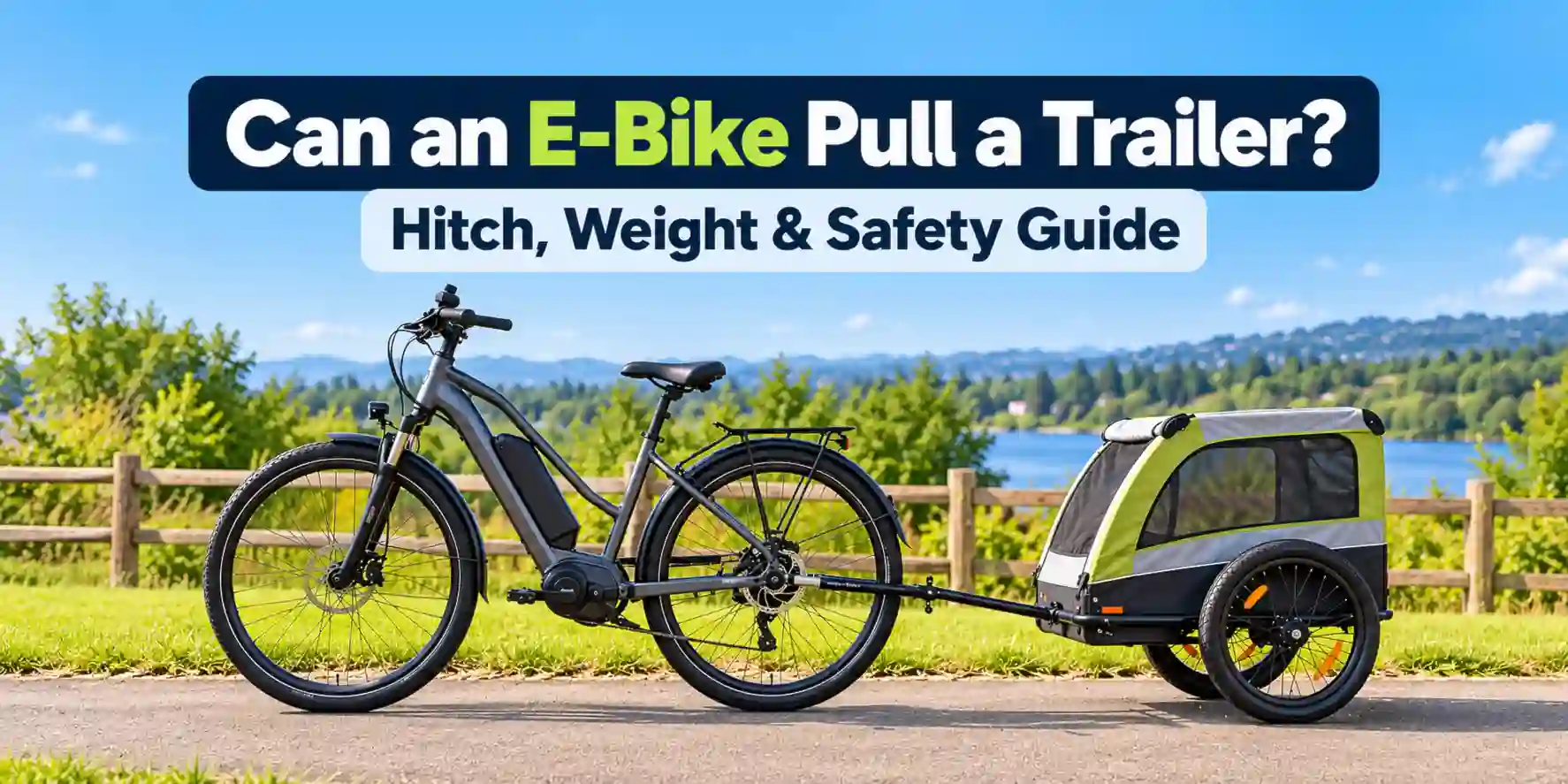
Can You Pull a Trailer With an E-Bike? Hitch Compatibility, Weight, Range & Safety
Last Updated on October 1, 2026 by Kristina
Last researched and verified: October 2026.
Yes, many electric bikes can pull a bike trailer – but motor power alone does not tell you whether your particular e-bike and trailer are a safe match. The most important questions are whether the bike manufacturer permits or provides guidance for trailer use, whether the hitch fits your rear axle correctly, whether you are within the applicable bike and trailer limits, and whether the brakes and tires are in good condition.
Axle compatibility is especially important on e-bikes because rear hub motors, thru-axles, internal gear hubs, and unusual dropouts can require specific hitch hardware. Before buying an adapter, identify exactly what is on your bike rather than assuming a universal hitch will fit.
If you are comparing motor types, my E-Bike Motor Guide explains the differences between hub and mid-drive systems. For planning battery use, you can also use the E-Bike Range Calculator.
Quick Answer: Can an Electric Bike Pull a Trailer?
Often, yes. E-bikes can be used with child, pet, and cargo trailers when the bike, axle, hitch, adapter, trailer, load, and riding conditions are compatible.
But there is no universal e-bike towing capacity that can be calculated from motor wattage or payload capacity. Check the e-bike manufacturer’s manual or support information for trailer and load guidance, then follow the trailer manufacturer’s hitch, passenger, cargo, and speed instructions.
Before towing, I would verify five things:
- The e-bike manufacturer does not prohibit the intended trailer use.
- The trailer hitch is compatible with the exact axle and dropout.
- The trailer and its passengers or cargo remain within the trailer manufacturer’s limits.
- The bike remains within any applicable manufacturer load or system-weight limits.
- The brakes, tires, wheels, and trailer connection are in good condition.
E-Bike Trailer Hitch and Axle Compatibility
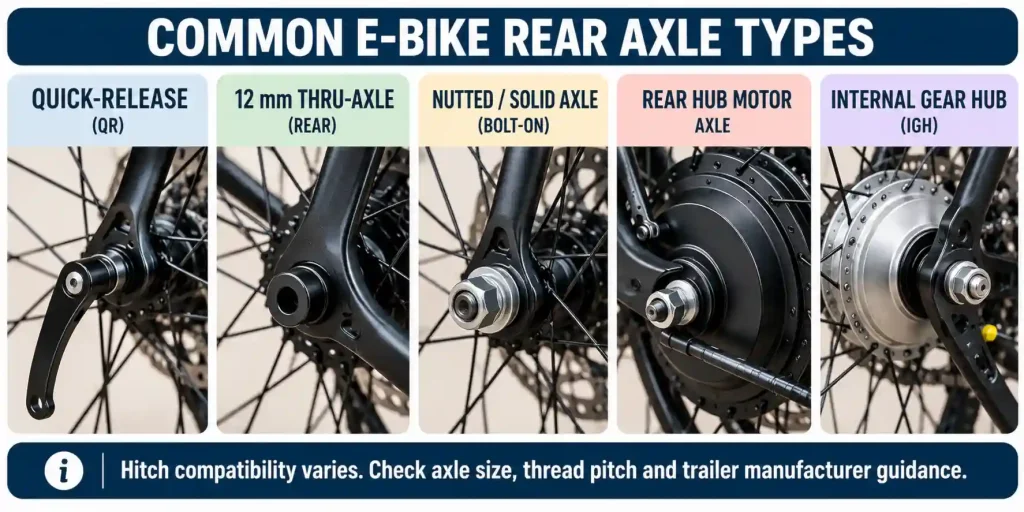
This is where many e-bike trailer installations become more complicated than they first appear. Most bicycle trailers attach near the rear axle, so you need to know how your rear wheel is secured before choosing a hitch or adapter.
Do not improvise with washers, generic hardware, modified axle nuts, or an adapter that merely looks close enough. Follow the bike and trailer manufacturers’ instructions and use a part that is intended for your axle and hitch system.
Quick Hitch Compatibility Table
| Rear Axle or Dropout Type | What It Means for a Trailer | What to Check |
|---|---|---|
| Quick-release skewer | Many conventional trailer systems are designed around this type of attachment, but the supplied hardware still has to match the trailer. | Correct hitch placement, skewer installation, clearance, and manufacturer instructions. |
| 12 mm thru-axle | Often requires a replacement trailer-compatible thru-axle. | Axle length, diameter, thread pitch, frame compatibility, and the adapter specified for the trailer. |
| Nutted or solid axle | May work directly with some systems or may require a nutted-axle adapter. | Available axle thread, axle diameter, thread pitch, nut engagement, and hitch clearance. |
| Rear hub-motor axle | Commonly uses a nutted axle and may need an e-bike or hub-motor-compatible adapter. | Manufacturer-approved attachment method, axle dimensions, torque hardware, motor cable clearance, and dropout shape. |
| Internal gear hub | May need an adapter designed for that hub or axle arrangement. | Hub manufacturer’s requirements and trailer manufacturer’s adapter guidance. |
| Hooded or unusual dropout | The hitch may not sit flat against the frame without a compatible spacer or adapter. | Whether the trailer manufacturer offers an approved solution for that dropout. |
Burley’s current hitch guide distinguishes quick-release, nutted or bolt-on, and thru-axle systems and notes that adapter selection can depend on axle diameter and thread pitch. Thule likewise identifies 12 mm thru-axles, internal gear hubs, and certain frame or dropout shapes as situations that can require additional hardware.
If you cannot positively identify the axle, contact the bicycle, hub, axle, or trailer manufacturer before ordering parts.
Rear Hub-Motor E-Bikes and Trailers
A rear hub-motor e-bike can often tow a compatible trailer, but the motor sits in the same rear wheel area where many trailer hitches attach. That makes axle compatibility more important, not less.
Many rear hub-motor e-bikes use a nutted or bolt-on axle. Burley specifically notes that this axle style is common on e-bikes with rear hub motors. Depending on the exact bike and trailer, the installation may require a compatible nutted-axle adapter.
Check the axle diameter, thread pitch, usable thread, dropout shape, motor cable location, torque hardware, and manufacturer’s instructions. Do not loosen or rearrange hub-motor axle hardware simply to make a hitch fit unless the manufacturer expressly allows that installation.
Mid-Drive E-Bikes and Trailers
A mid-drive motor is located around the crank rather than inside the rear hub, so some mid-drive bikes have a more conventional rear axle arrangement. That can make hitch compatibility simpler in some cases.
It does not make a mid-drive automatically better or safer for towing. You still need the correct hitch and axle, adequate brakes, appropriate gearing, suitable tires, and manufacturer guidance for the intended load and use.
On hills, being able to select an appropriate low gear is important because towing places additional demand on the entire bike, not just the motor.
Payload Capacity Is Not the Same as Towing Capacity
This distinction is essential. An e-bike’s payload rating generally describes weight the bicycle is designed to carry, but that does not automatically establish how much the bike may tow behind it.
For example, a bike with a listed 400 lb payload rating should not be assumed to have a 400 lb trailer rating.
Manufacturers also use terms such as maximum load, maximum system weight, gross vehicle weight, rider weight, rack capacity, and trailer limit differently. Follow the definitions and limits published for your particular bike.
The EBE Payload Calculator can help you check weight carried on the bike, such as rider, accessories, bags, and passengers. It is not a towing-capacity calculator, and its result should not be converted into a trailer allowance.
For towing, use the e-bike manufacturer’s published load and trailer guidance together with the trailer manufacturer’s own weight, passenger, and cargo limits. Do not invent a formula for adding or subtracting trailer weight unless the manufacturer provides one.
Motor Wattage Does Not Determine Safe Towing Capacity
You cannot reliably say that a 250W e-bike can tow one amount, a 500W bike another amount, and a 750W bike a larger amount.
Motor wattage is only one part of how an e-bike performs under load. Relevant factors include:
- Motor type and power delivery
- Torque
- Available gearing
- Terrain and gradient
- Total rider and cargo load
- Bike weight
- Brake performance
- Tire condition and traction
- Rear axle and dropout design
- Hitch compatibility
- Battery capacity and condition
- The e-bike manufacturer’s trailer and load guidance
A motor that feels powerful on a flat solo ride does not establish that the frame, axle, brakes, hitch, wheels, or other components are approved for a particular trailer load.
How Much Does a Trailer Reduce E-Bike Range?
Expect towing to use more energy than riding the same route without a trailer. More mass requires additional energy during acceleration and climbing, while wind and the trailer’s shape can add aerodynamic resistance.
Burley’s current e-bike trailer guidance says riders may sometimes see roughly a 20% to 50% reduction in range, depending on trailer and load weight, terrain, assist level, and wind. I would treat that as Burley’s manufacturer estimate – not a universal rule for every e-bike and trailer.
Your actual change could be smaller or larger. Cold temperatures, tire pressure, frequent stops, steep hills, throttle use, battery condition, and riding speed can all change the result.
For trip planning, use the E-Bike Range Calculator as a starting estimate and leave a sensible battery reserve rather than planning to arrive at 0%.
Towing Changes Braking
A trailer adds mass that your bike must slow down. Manufacturers including Burley, Thule, and Trek warn that a trailer or child carrier can increase stopping distance or change braking and handling.
When towing:
- Brake earlier than you would when riding solo.
- Leave more room behind traffic, cyclists, and pedestrians.
- Reduce speed before descents and corners.
- Check brake response before starting the ride.
- Do not tow if the brakes already feel weak, inconsistent, contaminated, damaged, or poorly adjusted.
- Follow the brake-use instructions in your e-bike owner’s manual.
My e-bike stopping-distance guide explains how speed, weight, traction, and reaction time affect the space required to stop.
Do not rely on regenerative braking unless your particular e-bike manufacturer specifically says the bike provides it and explains how it should be used. Use the bike’s normal braking system according to the manufacturer’s instructions.
How Fast Should You Ride With an E-Bike Trailer?
There is no single universal trailer speed limit that applies to every trailer, e-bike, and jurisdiction. Follow the instructions for your equipment and any local speed rules.
Burley’s March 2026 e-bike trailer guidance recommends keeping towing speeds closer to roughly 10-15 mph for improved control and stability.
Current instructions for applicable Thule trailers specify a 15 mph maximum and call for substantially lower speed around corners and on rough roads. Those figures are manufacturer instructions for the applicable products, not universal legal speed limits for every trailer.
Whatever the published maximum, conditions may require riding more slowly. Reduce speed for turns, descents, rough surfaces, narrow paths, poor visibility, pedestrians, traffic, and a load that can move.
Practice Before Carrying a Child, Pet, or Heavy Load
Do not make your first trailer ride a loaded trip through traffic. Start in a quiet, flat area with the trailer empty or lightly loaded and learn how the bike feels.
Practice:
- Starting smoothly
- Applying electric assistance gradually
- Normal braking
- Progressively firmer braking from low speed
- Wide turns
- Low-speed maneuvering
- Stopping and restarting on gentle grades if the manufacturer permits it
The goal is to understand how the additional length and mass change the ride. You do not need to perform intentional emergency stops to practice.
Trailer Width and Turning
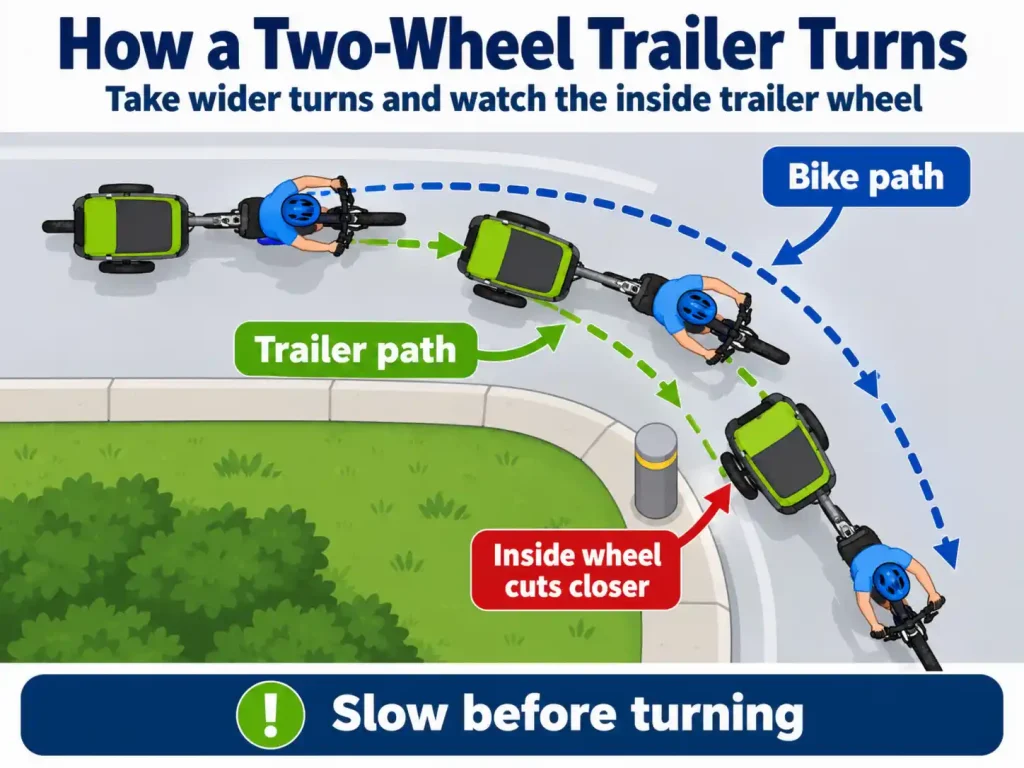
A two-wheel trailer does not follow exactly the same path as the bicycle. The inside trailer wheel can pass closer to a curb, post, bollard, gate, or other obstacle than the bike itself.
When turning:
- Slow down before the turn.
- Take a wider path than you would without the trailer.
- Keep track of the inside trailer wheel.
- Leave extra room around curbs and parked vehicles.
- Watch for bollards, signposts, and gate hardware.
- Approach narrow trail barriers and access gates cautiously.
Remember the overall width when passing pedestrians or other riders. If a gap looks marginal, stop rather than trying to squeeze the trailer through.
How to Load a Bike Trailer
Follow the loading instructions for your specific trailer. As a general principle supported by Burley’s current guidance, heavier cargo should be kept low and centered around the trailer’s intended load area rather than stacked high or concentrated at the rear.
Avoid excessive rear-heavy loading. Burley warns that loading too far back can contribute to fishtailing and can reduce traction at the bicycle’s rear wheel.
Secure cargo so it cannot:
- Shift suddenly during braking or turns
- Fall out
- Contact the trailer’s wheels
- Drag on the ground
- Interfere with the hitch or safety strap
- Block lights, reflectors, or reflective material
Weight is only one consideration. Large or tall cargo can also affect wind resistance, visibility, clearance, and how the trailer handles.
What to Do if the Trailer Sways or Fishtails
If the trailer begins to sway or fishtail, slow down safely and stop where you can inspect the setup.
Check:
- Load distribution
- Total trailer load
- Whether cargo has shifted
- The hitch and any backup safety connection
- Trailer tire pressure
- Trailer wheel attachment
- The bicycle’s rear wheel and axle attachment
Do not continue at the same speed and hope the sway disappears. Correct the cause before resuming the ride.
Trailer Visibility Matters
A low trailer can be less conspicuous than the bicycle itself, especially around parked vehicles, driveways, and intersections.
Use the visibility equipment specified by the trailer manufacturer. Depending on the trailer and riding conditions, that may include:
- A safety flag
- Rear and side reflectors
- Reflective material
- Approved rear lighting
- Bright or reflective clothing for the rider
Keep lights and reflectors unobstructed by bags, blankets, cargo, covers, or loose straps.
Trek’s current Bicycle Owner’s Manual tells riders using an attached child trailer to make sure the bicycle is suitable for it and to use the flag supplied with the trailer. Current Thule instructions for applicable trailers likewise call for a safety flag and appropriate reflectors or lighting.
Using an E-Bike With a Child Trailer
Before carrying a child, verify more than just whether the hitch physically attaches.
Check:
- That the bicycle manufacturer permits or provides guidance for trailer use
- That the child trailer is compatible with the bicycle
- The exact axle, hitch, and adapter required
- Passenger age, height, and weight requirements
- The trailer’s total load and passenger limits
- Correct harness fit and adjustment
- Required helmet guidance
- Safety flag, reflectors, lights, and other visibility equipment
- Maximum-speed and cornering instructions
- The trailer connection before every ride
Do not assume that a bike rated for a high payload automatically accepts a child trailer. The trailer system and the bicycle each have their own instructions and limits.
If family transport is a major part of your riding, you may also want to compare purpose-built options in my guide to the Best Cargo E-Bikes for Families.
Using an E-Bike With a Dog Trailer
A dog trailer introduces a different challenge because the passenger can shift position during the ride.
Choose a trailer rated for your dog’s size and weight and make sure the animal has enough space and ventilation. Introduce the trailer gradually while it is stationary, then progress to short, slow rides before attempting longer trips.
Use only the restraint arrangement specified by the trailer manufacturer. Do not assume an ordinary leash should be tied inside the trailer – some manufacturers specifically warn against that setup.
While riding:
- Accelerate smoothly.
- Brake earlier and progressively.
- Slow before turns.
- Pay attention to sudden changes in the dog’s position.
- Check ventilation and your dog’s comfort during longer rides.
Using an E-Bike With a Cargo Trailer
Cargo trailers can be useful for groceries, camping equipment, tools, packages, and bulky items that do not fit comfortably on the bike.
Think about both weight and dimensions. A load can be within the trailer’s weight limit and still be unsuitable if it is too tall, too wide, poorly secured, or positioned where it interferes with the wheels, hitch, lights, or safe handling.
Keep dense items low, balance the load according to the trailer manufacturer’s instructions, and secure everything before moving.
Child, Dog, and Cargo Trailer Comparison
| Trailer Type | Biggest Compatibility Concern | Biggest Riding Change | What to Check |
|---|---|---|---|
| Child trailer | Axle and hitch compatibility | More stopping distance and careful cornering | Passenger limits, harness, hitch, flag, visibility, speed instructions |
| Dog trailer | Pet and trailer size/weight match | Passenger weight can shift | Rating, ventilation, manufacturer-specified restraint, hitch, tires |
| Two-wheel cargo trailer | Hitch and load distribution | Wider turning path | Load balance, dimensions, cargo restraint, lights and reflectors |
| Single-wheel cargo trailer | Axle-specific attachment | Narrower trailer profile | Correct hitch hardware, attachment instructions, load limit |
Single-Wheel vs Two-Wheel Bike Trailers
Single-wheel cargo trailers have a narrower profile and can track closely behind the bike. Their attachment systems can be more axle-specific, so verify compatibility carefully.
Two-wheel trailers have a wider footprint and remain supported by their own two wheels when stopped. That can be useful for child, pet, or broad cargo compartments, but you need additional clearance through turns, gates, posts, and narrow paths.
Neither design is automatically the right choice for every e-bike. Start with manufacturer compatibility and the load you actually need to carry.
Towing a Trailer on Hills
Climbing with a trailer increases demand on the motor, battery, drivetrain, and rider. Use appropriate gearing, contribute pedal effort where possible, and avoid repeatedly forcing the bike to climb at a speed or assist setting it cannot sustain comfortably.
Descending deserves at least as much attention. The additional mass can increase braking demand and heat. Slow before the grade becomes difficult to control, leave additional stopping space, and avoid a route with long or steep descents if your brakes already feel marginal.
If the bike develops unusual motor noise, brake fade, repeated power cut-outs, wheel movement, or another mechanical problem under load, stop riding and inspect it. The E-Bike Troubleshooting & Maintenance Guide can help you identify safe first checks.
Can Pulling a Trailer Damage an E-Bike?
Normal trailer use within the bicycle and trailer manufacturers’ instructions should not be confused with overloading or an incompatible hitch installation. Damage becomes more plausible when a rider exceeds published limits, installs the wrong axle hardware, alters critical wheel hardware, overloads a trailer, runs underinflated tires, rides with weak brakes, or repeatedly subjects the bike to loads it was not designed to handle.
Pay particular attention to:
- Rear axle and dropout security
- Wheel attachment
- Brake pads and rotors
- Tire pressure and tire condition
- Spokes and wheels
- Hitch and adapter hardware
- Frame or rack areas identified by the manufacturer
- Drivetrain wear on bikes frequently used under heavy load
Will Pulling a Trailer Void the E-Bike Warranty?
Not automatically. Warranty coverage depends on the manufacturer’s terms and the circumstances of a particular claim.
Potential issues can include:
- A manufacturer restriction on trailer use
- Exceeding published load limits
- An incompatible hitch
- Improper axle or adapter hardware
- Unauthorized modifications
- Damage caused by incorrect installation or use
Burley currently advises e-bike owners to consult their bicycle manufacturer about warranty concerns and notes that incompatible hitch use or exceeding restrictions could affect coverage.
Before installing the trailer, read the bicycle warranty and owner’s manual. If the wording is unclear, ask the bike manufacturer to confirm compatibility in writing.
Are E-Bike Trailers Legal?
E-bike and trailer rules are not identical everywhere. Attaching a trailer does not automatically mean your e-bike suddenly requires licensing, registration, or insurance.
Instead, check the rules that apply where you plan to ride. Depending on the jurisdiction or property, relevant rules may include:
- State e-bike classifications and operating rules
- City or county requirements
- Child-passenger rules
- Bike-trailer requirements
- Road, sidewalk, and shared-path restrictions
- Park and trail rules
- Speed restrictions
- Lighting or visibility requirements
Start with the State-by-State E-Bike Law Guide, then confirm any city, park, trail, campus, or property-specific rules for the place you plan to ride.
Before You Attach the Trailer
- Confirm bike suitability: Check the bicycle manual or manufacturer support information for trailer guidance or restrictions.
- Identify the rear axle: Determine whether it is quick-release, thru-axle, nutted/solid, hub-motor, internal-hub, or another design.
- Verify the hitch and adapter: Use the exact hardware intended for the axle, dropout, and trailer.
- Check trailer limits: Verify passenger, pet, cargo, and total load limits.
- Review bike load guidance: Do not treat payload capacity as an automatic towing allowance.
- Inspect the brakes: They should feel strong, consistent, and properly adjusted.
- Check tire pressure: Use the bicycle and trailer manufacturers’ recommendations.
- Do a practice ride: Start empty or lightly loaded in a quiet, flat area.
Before Every Trailer Ride
- Check that the hitch is fully connected and locked.
- Attach the backup safety strap or secondary connection when the trailer manufacturer requires one.
- Inspect the axle, adapter, and hitch hardware.
- Confirm the bicycle rear wheel is properly secured.
- Check trailer wheels and wheel-retention mechanisms.
- Check bike and trailer tire pressure.
- Secure cargo so it cannot shift, drag, or contact a wheel.
- Check the passenger harness before carrying a child.
- Verify the manufacturer-specified restraint setup for a pet.
- Install and uncover the required flag, lights, reflectors, and reflective material.
- Test the brakes before entering traffic or starting a descent.
- Confirm enough battery reserve for the planned route and added towing demand.
Why You Can Trust Electric Bike Explorer
This guide was researched against current Burley e-bike towing and hitch guidance, Thule bike-trailer compatibility information and trailer instructions, and Trek’s current Bicycle Owner’s Manual. I also cross-checked the advice against Electric Bike Explorer’s current motor, range, braking, cargo, maintenance, and e-bike law resources.
This is a research-based educational guide. It does not claim that I personally tested every trailer, adapter, or e-bike combination discussed here.
FAQs
Can you pull a bike trailer with an e-bike?
Often, yes. First confirm that the bicycle is suitable for trailer use, that the hitch matches the rear axle and dropout, and that you remain within the bike and trailer manufacturers’ applicable limits.
How much weight can an e-bike tow?
There is no reliable universal number. Use the e-bike manufacturer’s trailer and load guidance and the trailer manufacturer’s limits. Do not calculate towing capacity from motor wattage or assume it equals the bike’s payload rating.
Can a rear hub-motor e-bike pull a trailer?
Many can, but compatibility is not universal. Rear hub-motor e-bikes commonly use nutted axles, and some trailer systems require a compatible axle adapter. Check axle diameter, thread pitch, usable thread, dropout shape, cable clearance, and manufacturer instructions.
Can a mid-drive e-bike tow a trailer?
Potentially. Because the motor is not in the rear hub, some mid-drive bikes have a relatively conventional rear axle, but the bike still needs a compatible hitch, adequate brakes, appropriate gearing, and manufacturer approval or guidance for the intended use.
Does a 750W motor mean an e-bike can tow more weight?
Not by itself. Motor wattage does not establish a safe towing limit. Torque, gearing, terrain, brakes, axle design, frame and wheel limits, hitch compatibility, total load, and manufacturer instructions all matter.
How much does a bike trailer reduce e-bike range?
Burley currently says towing can sometimes reduce e-bike range by roughly 20%-50%, depending on load, terrain, assist level, and wind. That is a manufacturer estimate rather than a universal rule, and your result can be better or worse.
Do e-bike trailers need a special hitch?
Sometimes. A conventional quick-release setup may work with the trailer’s normal hitch, while thru-axles, solid or nutted axles, internal gear hubs, rear hub motors, and unusual dropouts can require specific replacement axles or adapters.
Can I tow a child trailer at 20 or 28 mph because my e-bike can go that fast?
Do not assume the bike’s assisted top speed is an appropriate trailer speed. Follow the trailer manufacturer’s instructions. Burley currently recommends more conservative speeds around 10-15 mph, while applicable Thule instructions specify a 15 mph maximum and slower speeds for corners and rough roads.
Should I use regenerative braking while towing?
Do not rely on regenerative braking unless your e-bike manufacturer specifically confirms that your bike has it and explains how it should be used. Use the normal braking system according to the bicycle manufacturer’s instructions.
My Take
The biggest mistake I would avoid is shopping for an e-bike trailer by asking only whether the motor is powerful enough. A secure hitch and axle match, realistic load limits, dependable braking, proper loading, and conservative riding matter more than an impressive wattage number.
If you already own the e-bike, identify the rear axle before buying a trailer or adapter. If you are buying both the bike and trailer, confirm compatibility with both manufacturers first. A few minutes spent checking the axle, thread specification, trailer instructions, and bike manual can prevent buying hardware that does not actually fit the bike.
Sources
- Burley – Electric Bikes & Trailers: Safety & Compatibility, updated March 2, 2026.
- Burley – Bike Trailer Hitch Guide.
- Thule – Bike Trailer and Bike Compatibility.
- Thule – Current Bike Trailer Instructions and Safety Guidance.
- Trek – Bicycle Owner’s Manual, Rev. 6, April 2026.
Legal Disclaimer
This guide is for general informational purposes and is not legal advice. State, city, campus, park, trail, and property rules can change or differ, and trailer or child-passenger requirements may vary by jurisdiction. Confirm current requirements with the authority responsible for the place where you plan to ride.

Kristina is not just an enthusiast but a true authority on electric bikes. Nestled in the coastal beauty of Virginia, Kristina has found the perfect backdrop for her passion for electric biking. As a dedicated wife and homeschooling mom, her life revolves around family, faith, and the thrill of adventure.
Originally hailing from Ohio, Kristina's journey with electric bikes began as a curiosity and quickly evolved into a deep expertise. Her blog is a testament to her love for electric biking, combining her fascination for eco-friendly transportation with her coastal lifestyle.
When she's not cruising the beach on her electric bike, you'll find Kristina indulging in her other loves: long walks along the shore, getting lost in a good book, and cherishing moments with her loved ones. With a heart as big as her love for animals, especially cats, Kristina brings a unique perspective to the electric bike world, grounded in her strong faith in God and her dedication to a sustainable lifestyle.
Through her blog, Kristina shares her extensive knowledge of electric bikes, offering valuable insights, tips, and recommendations to fellow enthusiasts. Whether you're a seasoned rider or a newcomer to the electric bike scene, Kristina's blog is your go-to source for all things electric biking, fueled by her passion, expertise, and the scenic beauty of coastal Virginia.