Amazon and UL Win Lawsuit Over False E-Bike UL Certification Claims
Last Updated on July 20, 2026 by Kristina
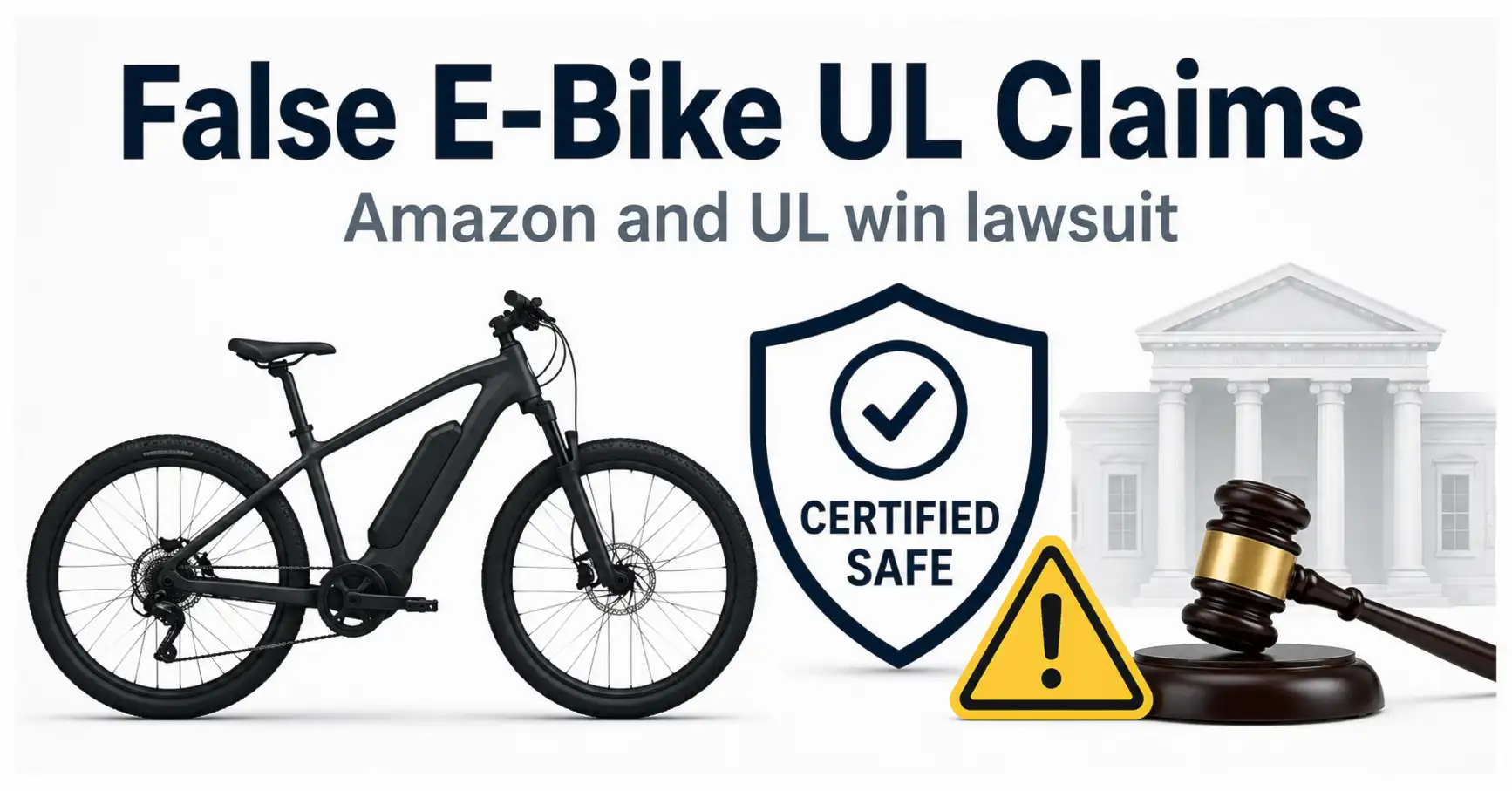
Amazon and UL have obtained a consent judgment and permanent injunction in a lawsuit involving alleged false UL certification claims on certain e-bikes and e-scooters sold online.
According to Bicycle Retailer and Industry News, the case ended with a court order signed by U.S. District Judge Jamal N. Whitehead in the U.S. District Court for the Western District of Washington. The order resolved claims of trademark counterfeiting, trademark infringement, and false designation of origin in favor of Amazon and UL. Other claims were dismissed with prejudice.
This is an important e-bike safety story because UL certification has become one of the biggest trust signals shoppers look for when buying an electric bike, especially with lithium-ion battery fire concerns, online marketplace listings, and low-cost imported e-bikes.
If you are shopping for an electric bike, this is also a good reminder to read my guide on How to Tell if an E-Bike Is UL Certified and my list of Best UL-Certified E-Bikes before trusting a product listing.
What This Means for E-Bike Shoppers
Amazon and UL won a consent judgment and permanent injunction in a lawsuit involving alleged false UL certification claims on certain e-bikes and e-scooters. The court order bars the defendants from using counterfeit, copied, simulated, or confusing versions of UL certification marks or service marks.
This was not a CPSC recall. It was a trademark and false certification-mark case. That distinction matters because the court order does not automatically mean every product connected to the brands is unsafe. But it does show why shoppers should verify UL certification instead of relying only on an Amazon title, product photo, sticker, or marketing claim.
Update – July 20, 2026: New Questions About Aipas Ads and Safety Certificates
New reporting from WIRED has added important information to this story.
WIRED reported that Facebook advertisements associated with Aipas Ebike continued displaying the UL logo after the defendants had agreed to the permanent injunction. A reporter was reportedly shown one of the advertisements in mid-July, while another advertisement containing the UL mark had been active in Meta’s Ad Library since April. One advertisement appeared to be removed after WIRED contacted Aipas and UL for comment.
A UL spokesperson told WIRED that the organization was aware of the Facebook advertising issue and was working to address it. Aipas and the attorney representing the defendants reportedly did not respond to the publication’s requests for comment.
The investigation also reviewed safety certificates issued by SGS, an OSHA-recognized testing laboratory authorized to certify products to standards such as UL 2849. According to WIRED, three SGS e-bike certificates connected to certain Aipas M1, M2, A2, and F3 model variants were listed as inactive, even though Aipas reportedly continued linking to them on its website.
An SGS certificate covering one specific Aipas battery remained active. However, the battery certificate applies only to a particular battery model and contains limitations concerning its testing and intended application. It should not be interpreted as proof that every Aipas e-bike, battery, charger, or complete electrical system is currently certified.
An inactive certificate does not automatically mean that a product is unsafe. Certification can become inactive because a product was changed, required follow-up inspections were not completed, or the certificate was not renewed. However, shoppers should verify that a certificate is active and applies to the exact model and electrical configuration they are considering.
The federal court formally entered the stipulated consent judgment and permanent injunction on July 15, 2026. The order prohibits the defendants from using counterfeit or confusing versions of UL’s marks or falsely representing that products were tested, certified, approved, or authorized by UL. The defendants agreed to the judgment without admitting liability or wrongdoing.
The updated takeaway for shoppers is to look beyond a product listing or certification logo. Check which laboratory issued the certification, the exact standard involved, whether the certificate is still active, and whether it applies to the specific e-bike, battery, and charger combination being sold.
What Happened?
Amazon and UL originally filed the lawsuit on January 23, 2026. The public docket lists Amazon.com Services LLC, Amazon.com Inc., and UL LLC as the plaintiffs. The defendants listed in the case include Jiangmen Meijiasheng Bicycle Co. LTD, Shenzhen Aibosi Sport Technology Co. LTD, Guangzhou Aierfeile Sport Technology Co. LTD, Hong Kong Manchester International Trading Co. LTD, Tang Shuhui, and Does 1-10.
Bicycle Retailer reported that the lawsuit involved alleged false UL certification claims on e-bikes and e-scooters. The complaint listed seven specific models offered for sale on Amazon under the Aipas and A4 brands, and it also alleged that some models bearing improper UL trademarks were sold through aipasbike.com.
The case ended with a consent judgment and permanent injunction. In plain English, that means the defendants are now barred by court order from continuing to use UL certification marks in a false, copied, counterfeit, or confusing way.
What the Court Order Says
According to Bicycle Retailer, the injunction bars the defendants from importing, manufacturing, producing, distributing, circulating, offering to sell, promoting, or displaying products or services using counterfeit, copied, simulated, or confusing versions of UL’s certification marks or service marks. It also bars them from helping another person or business do the same.
The settlement also calls for each side to pay its own legal fees and costs.
For regular e-bike shoppers, the big takeaway is simple: UL marks are not just marketing graphics. They are protected certification marks, and sellers or manufacturers can face legal action if they misuse them.
Why This Matters for E-Bike Shoppers
This case matters because many e-bike buyers are now looking for UL-certified electric bikes. That is a good thing, but it also means some listings may try to use UL language as a selling point.
A product title might say “UL certified.” A listing photo might show a UL-style mark. A battery description might mention UL. But that does not always prove the exact e-bike model you are buying is properly certified.
That distinction matters.
UL 2849 is the Standard for Electrical Systems for eBikes. UL says the standard evaluates electrical and fire safety by examining the e-bike’s electrical drive train system, battery system, and charger system combination. UL also notes that UL 2849 does not evaluate the rider’s ability to maintain control while riding.
So when shoppers see “UL certified,” they need to ask a more specific question:
Is the e-bike’s electrical system certified to UL 2849?
That is more accurate than saying the “whole bike” is UL certified, because UL 2849 is about the electrical system, not every mechanical part of the bicycle.
UL 2849 vs. UL 2271: What Riders Should Know
There are two UL standards e-bike shoppers commonly see.
UL 2849 applies to the e-bike electrical system. This includes the electrical drive system, battery system, and charger system combination.
UL 2271 applies to batteries for light electric vehicle applications, including certain e-bike and micromobility battery packs.
For buyers, the most helpful question is not just “Is this UL certified?” It is:
What exactly is certified, and to which standard?
A charger being certified is not the same as the e-bike electrical system being certified. A battery cell being from a reputable supplier is not the same as the battery pack or electrical system being certified. A product description that says “meets UL standards” is not always the same as third-party certification from an accredited testing laboratory.
That is why I would be careful with vague phrases like:
“UL approved”
“UL compliant”
“Meets UL standards”
“UL certified battery cells”
“Tested to UL standards”
“UL certified style”
Those phrases can mean very different things, and some may not mean what a regular shopper thinks they mean.
This Is Not Just a Labeling Problem
At first, false UL certification claims may sound like a paperwork issue. But for e-bike shoppers, certification claims affect real-world safety decisions.
The U.S. Consumer Product Safety Commission has called on manufacturers of e-scooters, hoverboards, e-bicycles, and e-unicycles to review their product lines and make sure they comply with established voluntary safety standards. CPSC also said failure to follow applicable UL standards may pose an unreasonable risk of fire, serious injury, or death.
CPSC also called on manufacturers to demonstrate compliance through certification from an accredited testing laboratory.
That is why certification language matters. It is not just a fancy badge. It can influence whether a shopper believes a battery, charger, and electrical system have been properly evaluated.
Why Amazon’s Role Is Important
Amazon is one of the biggest places people shop for budget e-bikes and e-scooters. A lot of shoppers see a low price, check the reviews, skim the listing, and assume the safety claims are accurate.
That is why this lawsuit matters.
When a major marketplace and UL take legal action over alleged false certification claims, it sends a message to sellers that e-bike safety claims need to be accurate and verifiable.
It also reminds buyers that marketplace listings are not enough by themselves. I would still check the brand’s official page, the exact model number, the battery and charger details, and whether the certification can be verified.
What This Means for Budget E-Bikes
This does not mean every affordable e-bike is bad. There are budget-friendly e-bikes that are improving their safety testing, battery quality, and certification transparency.
But it does mean shoppers need to be careful with very low-cost e-bikes sold mostly through online marketplace listings.
An e-bike is not just a regular bicycle. It has a lithium-ion battery, charger, controller, wiring, motor, display, sensors, and other electrical parts. When those parts are not designed, tested, and matched correctly, the risk can go up.
CPSC is also moving toward stronger federal rules for lithium-ion batteries and micromobility electrical systems. A proposed rule published in the Federal Register in June 2026 discusses UL 2849-20, UL 2272-24, and UL 2271-23 and proposes additional requirements to address battery and electrical hazards.
That is important because this topic is not going away. E-bike battery safety, charger compatibility, electrical system testing, and certification claims are likely to remain major issues for riders, retailers, manufacturers, and regulators.
How to Check an E-Bike’s UL Certification
Before buying an e-bike, I would check more than one place.
First, look at the brand’s official product page. The page should clearly say what is certified and which standard applies. Look for specific wording such as UL 2849 certified electrical system or battery certified to UL 2271.
Second, make sure the certification applies to the exact model you are buying. A brand may have one UL-certified model while another model is not certified.
Third, check the battery and charger information. The safest practice is to use the charger that came with the e-bike and avoid random aftermarket chargers unless the manufacturer specifically approves them.
Fourth, use UL’s Product iQ database or the certifying lab’s official database when possible. UL describes Product iQ as a tool to search UL-certified products, components, and materials.
Fifth, watch for vague wording. A real certification claim should name the specific standard, such as UL 2849 for the e-bike electrical system or UL 2271 for the battery, and it should be verifiable through UL or the certifying body.
Helpful internal link: Before you buy, read my E-Bike Battery Safety Guide and my guide on How to Tell if an E-Bike Is UL Certified.
What Riders Should Do Now
If you already own an e-bike and you are unsure about the UL certification claim, do not panic. This lawsuit is not the same as a recall notice.
But I would take a few basic steps.
Check your bike’s exact model number. Look up the official product page. Search for specific UL 2849 or UL 2271 wording. If the brand only says “UL certified” without naming the standard, ask customer support for documentation.
Also inspect your charger. Make sure you are using the original charger that came with the bike. Do not charge your e-bike near exits, beds, couches, curtains, or anything that can easily catch fire.
If your battery is swollen, damaged, overheating, smells strange, makes unusual noises, or acts abnormal while charging, stop using it and contact the manufacturer. You can also report unsafe products to the CPSC through SaferProducts.gov.
What This Means for E-Bike Brands and Sellers
For e-bike brands, this case is a warning that certification claims need to be clear, specific, and supportable.
It is not enough to throw a UL-looking logo on a listing or use loose wording that makes a product sound certified when it is not. If the e-bike electrical system is certified to UL 2849, say that clearly. If only the battery is certified to UL 2271, say that clearly. If the product is “tested to” a standard but not certified, that should not be presented as full certification.
For shoppers, the same rule applies in reverse: do not assume. Verify.
🎥 Helpful Video: Understanding UL Certification Claims
This video gives a helpful breakdown of confusing e-bike safety language, including the difference between a true UL certification claim and wording like “UL compliant” or “tested to UL standards.” It fits well with this topic because the Amazon and UL lawsuit shows why shoppers should verify safety claims before trusting a product listing.
My Take
My take is that this is a good win for e-bike shoppers, but it also shows why buyers have to be careful.
I do not think every rider needs to become a battery expert. Most people just want a safe, reliable e-bike that gets them around town, helps them commute, or lets them enjoy riding more. But when sellers or manufacturers use safety marks in a misleading way, it makes it harder for regular buyers to know who to trust.
A real UL certification claim should be specific and verifiable. It should not be hidden in vague wording or used as a marketing trick.
I also think this is why e-bike websites, reviewers, and buyers need to stop treating UL certification like a small spec buried at the bottom of a product page. For many riders, especially people charging indoors, storing bikes in apartments, or buying online, battery and electrical safety should be one of the first things checked.
This lawsuit does not mean shoppers should avoid every budget e-bike. But it does mean we should ask better questions:
Is the e-bike’s electrical system certified to UL 2849?
Is the battery certified to UL 2271?
Can the certification be verified?
Does the brand clearly support the bike after purchase?
Does the charger match the battery system?
For me, the biggest lesson is simple: do not trust a safety claim just because it appears in a product title, sticker, or listing photo. Verify it before you buy.
For more news on electric bikes click here

Kristina is not just an enthusiast but a true authority on electric bikes. Nestled in the coastal beauty of Virginia, Kristina has found the perfect backdrop for her passion for electric biking. As a dedicated wife and homeschooling mom, her life revolves around family, faith, and the thrill of adventure.
Originally hailing from Ohio, Kristina's journey with electric bikes began as a curiosity and quickly evolved into a deep expertise. Her blog is a testament to her love for electric biking, combining her fascination for eco-friendly transportation with her coastal lifestyle.
When she's not cruising the beach on her electric bike, you'll find Kristina indulging in her other loves: long walks along the shore, getting lost in a good book, and cherishing moments with her loved ones. With a heart as big as her love for animals, especially cats, Kristina brings a unique perspective to the electric bike world, grounded in her strong faith in God and her dedication to a sustainable lifestyle.
Through her blog, Kristina shares her extensive knowledge of electric bikes, offering valuable insights, tips, and recommendations to fellow enthusiasts. Whether you're a seasoned rider or a newcomer to the electric bike scene, Kristina's blog is your go-to source for all things electric biking, fueled by her passion, expertise, and the scenic beauty of coastal Virginia.