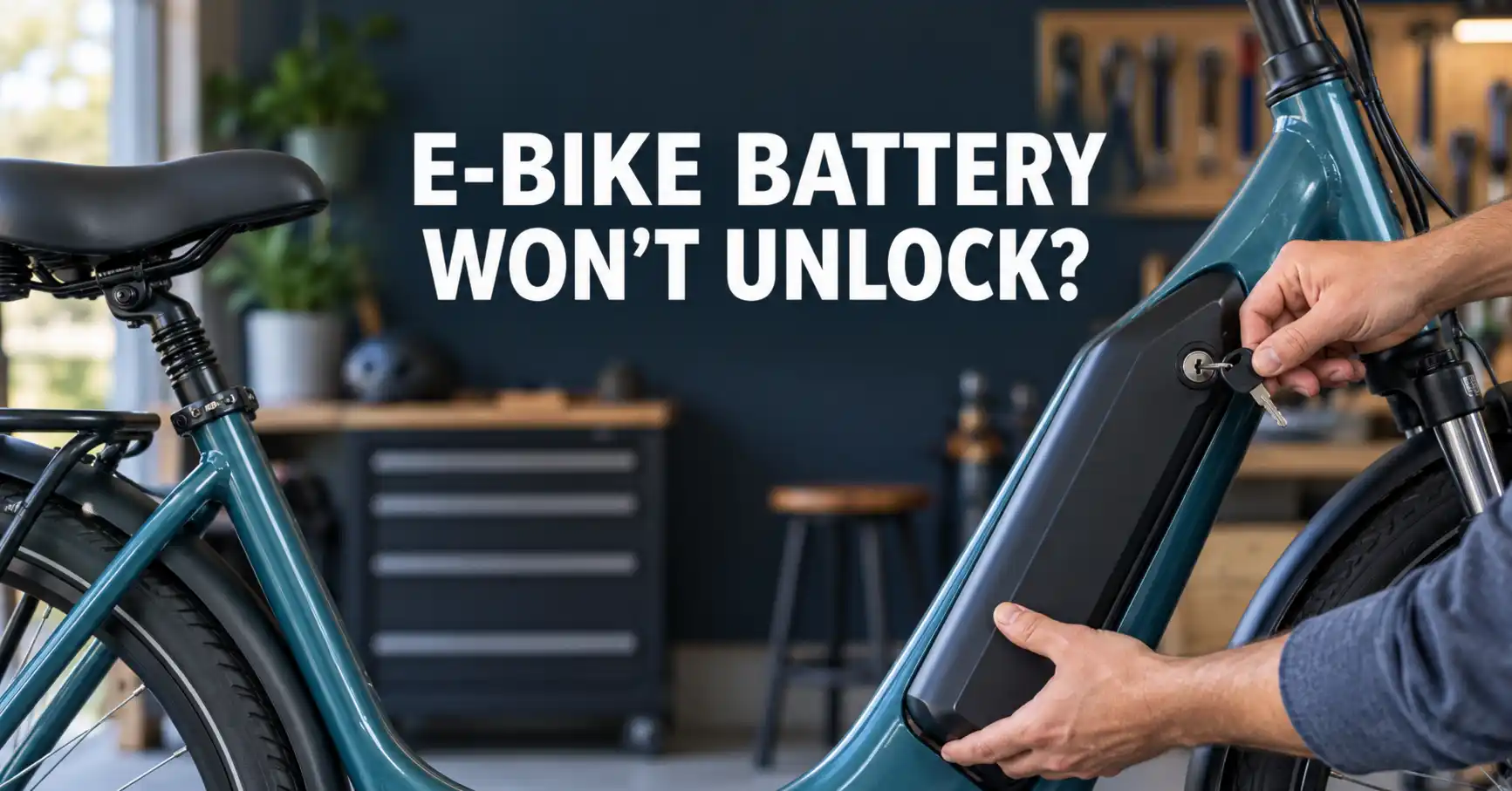
E-Bike Battery Won’t Unlock? How to Free a Battery Stuck in the Frame Safely
Last Updated on September 5, 2026 by Kristina
An e-bike battery that will not unlock or come out of the frame is frustrating, but forcing it is usually the wrong first move. The problem may be as simple as pressure on the latch, a battery cover that has not been removed, a stiff lock cylinder, or a second retention mechanism that still needs to be released.
Start with the low-risk checks below. If you are dealing with a battery that is swollen, unusually hot, leaking, smoking, sparking, badly damaged, or giving off a strong chemical odor, stop using and charging the bike. For other e-bike problems, see my E-Bike Troubleshooting and Maintenance Guide. If you want a better understanding of battery size and terminology, my e-bike battery capacity guide explains Ah and Wh in plain English.
Quick Answer: What to Do When an E-Bike Battery Won’t Unlock
- Turn the e-bike completely off.
- Support the battery with one hand so its weight is not pulling on the lock.
- Make sure you are using the correct key and that it is fully inserted.
- Check for a battery cover, release button, secondary latch, or safety catch.
- Use only gentle pressure. Do not pry, hammer, twist, or yank the pack.
- Follow the removal direction shown in your bike or battery manual. Some batteries slide, some pivot, and some drop slightly before they can be removed.
- Stop immediately if the battery is swollen, hot, leaking, smoking, sparking, badly damaged, or has a strong chemical odor.
Safety First
Stop using or charging the e-bike if you notice smoke, unusual heat, swelling, leaking, a strong chemical odor, damaged wiring, sparks, or a battery that has been submerged or seriously impacted. Do not open, puncture, drill, crush, pry against, or attempt to rebuild a lithium-ion battery pack.
The U.S. Consumer Product Safety Commission recommends following the manufacturer’s charging instructions, using the charger supplied or recommended by the manufacturer, and using only replacement battery packs approved for the device. See the CPSC micromobility safety guidance.
30-Second Stuck Battery Checklist
Power off – support the battery – confirm the correct key – remove any battery cover – turn the key without forcing it – check for a secondary latch – follow the manufacturer’s removal direction – stop if the battery is damaged or requires significant force.
Which Battery Problem Do You Have?
| Symptom | Likely cause | Safest first check |
|---|---|---|
| Key will not go into the lock | Wrong key, debris, damaged key, obstructed cylinder | Confirm the key and inspect the keyway without forcing it |
| Key goes in but will not turn | Latch under pressure, dirty or stiff cylinder, bent key, wrong key position | Support the battery and try the key gently in the manufacturer-specified direction |
| Key turns but battery stays locked | Secondary latch, cover, release button, loaded locking pin | Check the owner’s manual for the full release sequence |
| Battery unlocks but will not come out | Wrong removal direction, tight rail, misalignment, debris, retaining catch | Identify whether the pack slides, pivots, lifts, or drops before applying more force |
| Battery is bulging, unusually tight, hot, or deformed | Possible battery damage or swelling | Stop using and charging it and contact the manufacturer or a qualified e-bike technician |
First, Identify How Your Battery Is Supposed to Come Out
Not every removable e-bike battery uses the same motion. Before assuming the battery is stuck, look at your manual, battery label, or manufacturer support page and confirm the intended removal sequence.
| Battery style | Typical removal pattern | What can fool you |
|---|---|---|
| External rail-mounted battery | Usually slides along a mounting rail after unlocking | Pulling straight outward when the pack is supposed to slide |
| Side-removal battery | May pivot or slide out from the side | A cover or latch can make it look fully released when it is not |
| Top or vertical-removal battery | Often lifts or slides upward after the lock releases | Rack, saddle, frame, or accessory interference |
| Bottom or downtube-integrated battery | May lower, pivot, or drop slightly before removal | The pack can suddenly move when the final restraint releases, so support it firmly |
| Integrated battery with secondary retention | Main lock releases first, followed by a second safety catch or latch | Assuming a turned key means the battery should immediately fall free |
For example, Shimano documents integrated battery systems in which the lock releases first but a double-latch plate still retains the battery until the next removal step. That is a good reminder that an unlocked battery is not necessarily ready to be pulled out. See the Shimano battery user manual for one manufacturer-specific example.
If the E-Bike Battery Key Will Not Turn
1. Support the battery before turning the key
A heavy battery can put pressure on the locking mechanism. Hold the battery securely so its weight is not hanging on the latch, then try the key again using only gentle pressure.
Do not use pliers on the key or force it past its normal travel. A broken key or damaged lock cylinder can turn a simple problem into a much more expensive repair.
2. Make sure the key is fully inserted
Check that you have the correct battery key and that it is inserted to its normal depth. If your bike came with a spare key, compare them. Stop if the working end of the key is visibly bent, cracked, or badly worn.
3. Look for dirt or corrosion around the cylinder
Dust, dried grime, road salt, or moisture can make a lock feel stiff. Wipe the area around the keyway gently. Do not jam tools, metal picks, or compressed debris deeper into the cylinder.
4. Use only an appropriate lock-cylinder product
Do not assume that household oil, grease, graphite, or a general-purpose penetrating product is suitable for your battery lock. Follow the bike or lock manufacturer’s instructions. ABUS, for example, says products containing oil or graphite are not suitable for its precision cylinders and recommends a purpose-made cylinder lubricant. See the ABUS lock-cylinder maintenance guidance.
5. If the lock may be frozen, do not apply high heat
If the bike has been stored in freezing or wet conditions, move it to a dry, moderate-temperature location and let it warm naturally when practical. Do not use an open flame, heat gun, or other concentrated heat source near the battery.
If the Key Turns but the Battery Still Will Not Come Out
1. Check for a second latch or safety catch
This is one of the easiest things to miss. Some integrated battery systems intentionally keep the pack retained after the main lock is released. Look for a release lever, safety catch, push plate, button, or other mechanism described in the owner’s manual.
2. Check for a battery cover
Some fully or semi-integrated batteries sit behind a frame cover. Make sure the cover has been released or removed in the correct order before you pull on the battery itself.
3. Confirm the correct removal direction
Do not assume the battery pulls straight away from the frame. It may need to slide along a rail, pivot outward, lift upward, or drop slightly first. The correct motion should come from the manual for your specific bike.
4. Relieve latch pressure gently
If the pack appears normal and undamaged, support it and try very light pressure toward its fully seated position while operating the key or release mechanism. The goal is only to take weight or tension off the latch – not to compress the battery into the frame.
If the key still requires significant force or the battery does not release easily, stop. A loaded latch, bent mount, damaged lock, or swollen pack needs a closer inspection.
5. Check for accessory interference
A rack, bottle cage, frame bag, child-seat mount, fender hardware, saddle, or other accessory can sometimes block the battery’s intended removal path. Remove only ordinary accessories that are clearly in the way and that can be taken off without touching battery wiring or opening the pack.
If the Battery Releases but Feels Stuck in the Frame
Once the lock is genuinely released, a pack can still bind because of dirt on the rail, a misaligned mount, a damaged housing, or a frame component pressing against it. Look along the visible edges for an obvious obstruction.
Use only your hands and the manufacturer’s normal removal motion. If you feel metal-on-metal binding, hear cracking, see the battery case flex, or need leverage from a screwdriver or pry bar, stop.
What If the E-Bike Battery Is Swollen or Deformed?
A battery that suddenly fits more tightly than it used to deserves extra caution. If the case is bulging, bowed, cracked, separating at a seam, unusually hot, leaking, or producing an unusual odor, do not treat it as an ordinary lock problem.
Do not try to force a swollen battery through a tight frame opening. Do not charge it, puncture it, squeeze it, or attempt to disassemble it. Move people away from an actively smoking, sparking, or overheating battery and contact emergency services when appropriate. For a damaged but stable battery, contact the bike or battery manufacturer and a qualified e-bike technician for instructions on safe handling and disposal.
Lost E-Bike Battery Key or Broken Key
If the key is lost, check the paperwork that came with the bike for a key number, key card, lock code, or replacement-key instructions. Your bike manufacturer or dealer may be able to order a replacement using that information and may request proof of ownership.
If a key has broken in the cylinder or the lock itself is damaged, a dealer or qualified locksmith is the safer route. I do not recommend drilling the lock, picking it, or prying the battery from the bike. Those methods can damage the frame, battery case, wiring, or locking hardware.
🎬 Watch: How to Remove a Stuck E-Bike Battery
This video demonstrates a simple way to release a frame-mounted battery that remains stuck after the lock has been opened. Battery mounts and locking mechanisms vary, so use gentle pressure only and follow your bike manufacturer’s removal instructions. Never pry against the battery case, puncture it, or force the key.
What Not to Do With a Battery Stuck in the Frame
- Do not pry between the battery case and frame with a screwdriver, tire lever, or pry bar.
- Do not hammer the battery, key, lock cylinder, or mounting rail.
- Do not use pliers to force the key.
- Do not drill, pick, or bypass the lock unless a qualified professional is handling the repair.
- Do not puncture, open, crush, or disassemble the battery case.
- Do not apply a heat gun, torch, open flame, or concentrated heat to the battery or lock.
- Do not keep charging a battery that is swollen, unusually hot, leaking, damaged, or behaving abnormally.
- Do not substitute an unapproved battery or charger just because the original pack is stuck or unusable.
When to Call the Bike Shop or Manufacturer
Stop the DIY troubleshooting and contact the manufacturer, dealer, or a qualified e-bike technician if:
- The battery shows swelling, deformation, leaking, unusual heat, odor, smoke, sparks, or serious impact damage.
- The lock cylinder spins, jams, or needs excessive force.
- The key is bent, broken, or stuck in the cylinder.
- The battery has clearly unlocked but binds hard enough that removal would require tools or leverage.
- The mount or locking pin looks bent or damaged.
- There are damaged wires, exposed terminals, melted plastic, or signs of electrical arcing.
- You cannot identify the correct release sequence for the specific bike.
When contacting support, have the bike model, battery model, serial number, photos of the battery mount, and your key or lock number available when possible. That can make it easier for support to identify the correct removal procedure and replacement parts.
How to Prevent an E-Bike Battery From Getting Stuck Again
- Remove and reinstall the battery periodically if the manufacturer intends it to be routinely removable.
- Keep the mounting rail, latch area, and battery contacts clean and dry according to the manufacturer’s instructions.
- Do not let bags, straps, accessories, or loose hardware interfere with the battery’s release path.
- Keep spare keys in a safe place and record the key number if your manufacturer provides one.
- If the lock maker specifies a maintenance product or interval, follow those instructions rather than improvising with household lubricants.
- If the battery starts becoming noticeably harder to install or remove, investigate the cause early instead of waiting until it jams completely.
- Inspect the battery case for damage or changing shape before charging.
You can also use the free E-Bike Tools Hub for battery, charging, range, fit, and troubleshooting resources.
Helpful Tools to Keep on Hand
If your e-bike battery is getting harder to remove, a few simple tools can make troubleshooting safer and easier:
- Lock-cylinder lubricant – useful for a stiff battery lock when your lock or bike manufacturer allows it. Use a product made specifically for lock cylinders, not household oil or grease.
- Metric hex wrench set (1.5-6 mm) – helpful for removing an approved battery cover or an accessory that is blocking the battery’s removal path. Never use it to open the battery case.
- Small LED inspection light or headlamp – makes it easier to see a hidden secondary latch, locking pin, rail obstruction, or damaged mounting hardware.
- Soft nylon detailing brush – useful for gently cleaning dirt and grit from exposed battery rails and the area around the lock.
- Microfiber cloth – handy for cleaning and inspecting the battery case, mounting surfaces, and visible contacts without using metal tools.
For a compact bike tool option, the Park Tool AWS-10 folding hex set covers common 1.5, 2, 2.5, 3, 4, 5, and 6 mm fasteners. Whatever tools you use, stop if the battery requires prying, hammering, or significant force.
Frequently Asked Questions
Why does my e-bike battery key turn but the battery won’t come out?
The main lock may have released while a secondary latch, cover, or safety catch is still holding the battery. The pack may also need to move in a particular direction rather than pull straight out. Support the battery and check the manufacturer’s removal sequence before applying more force.
Can I use WD-40 on an e-bike battery lock?
Do not assume a general-purpose spray is approved for your lock cylinder. Use the maintenance product recommended by the bike or lock manufacturer. Some lock makers specifically warn against oil- or graphite-based products because residue can interfere with precision cylinder parts.
Can an e-bike battery swell and get stuck in the frame?
A damaged lithium-ion battery can deform or swell, and a change in the battery’s shape can make a tight frame fit even tighter. If the case is bulging or deformed, or if you notice unusual heat, leaking, odor, smoke, or other abnormal behavior, stop using and charging the battery and do not force it out.
What should I do if I lost my e-bike battery key?
Look for the key number or key card that came with the bike, then contact the manufacturer or dealer about a replacement. If the lock must be serviced, use an authorized shop or qualified locksmith rather than drilling or prying the battery lock yourself.
Why is my e-bike battery harder to remove than it used to be?
Common possibilities include dirt on the rail, a stiff lock cylinder, latch pressure, an accessory blocking the removal path, loose or misaligned mounting hardware, or damage to the battery case or mount. A battery that suddenly becomes much tighter should also be inspected for deformation before you continue using or charging it.
Should I pull harder if the battery is unlocked?
No. An unlocked battery may still be held by a secondary restraint or may need to slide or pivot in a specific direction. If normal hand pressure is not enough, stop and confirm the exact removal procedure.
🔧 How This Guide Was Researched
This guide is based on manufacturer instructions, established safety guidance, technical references, and common rider experiences. Stop using or charging the bike if you notice smoke, swelling, unusual heat, damaged wiring, sparks, or a strong chemical odor.
Disclosure: As an Amazon Associate, I earn from qualifying purchases. This comes at no extra cost to you and helps support the content on this site.
Sources and Safety References
- U.S. Consumer Product Safety Commission – Micromobility Information Center
- CPSC – Universal charger fire-hazard warning
- Shimano – E-bike battery user manual and removal guidance
- ABUS – Lock-cylinder maintenance guidance

Kristina is not just an enthusiast but a true authority on electric bikes. Nestled in the coastal beauty of Virginia, Kristina has found the perfect backdrop for her passion for electric biking. As a dedicated wife and homeschooling mom, her life revolves around family, faith, and the thrill of adventure.
Originally hailing from Ohio, Kristina's journey with electric bikes began as a curiosity and quickly evolved into a deep expertise. Her blog is a testament to her love for electric biking, combining her fascination for eco-friendly transportation with her coastal lifestyle.
When she's not cruising the beach on her electric bike, you'll find Kristina indulging in her other loves: long walks along the shore, getting lost in a good book, and cherishing moments with her loved ones. With a heart as big as her love for animals, especially cats, Kristina brings a unique perspective to the electric bike world, grounded in her strong faith in God and her dedication to a sustainable lifestyle.
Through her blog, Kristina shares her extensive knowledge of electric bikes, offering valuable insights, tips, and recommendations to fellow enthusiasts. Whether you're a seasoned rider or a newcomer to the electric bike scene, Kristina's blog is your go-to source for all things electric biking, fueled by her passion, expertise, and the scenic beauty of coastal Virginia.