How to Transport an E-Bike on a Car Rack in Winter: Salt, Slush & Battery Protection
Last Updated on September 30, 2026 by Kristina
Transporting an e-bike on a car rack in winter takes more planning than hauling it on a dry summer day. The bike is not just exposed to cold air. It can sit directly in road spray containing water, grit, slush, and deicing salt for hours at highway speeds.
The safest approach is to use a rack that is properly rated for your e-bike, follow your bike and drive-system manufacturer’s transport instructions, remove the battery and detachable display when the manufacturer recommends or allows it, and clean winter road grime off the bike and rack after the trip.
Before loading, I recommend checking your setup with the E-Bike Rack Weight Compatibility Calculator. If your bike is difficult to lift, my guide to loading a heavy e-bike onto a bike rack covers ramps, removable weight, and safer loading options.
Winter road salt deserves special attention because salty road spray can contribute to corrosion on the rack, drivetrain, fasteners, and exposed bike components. My guide to preventing road-salt damage on an e-bike explains the cleaning side in more detail.
Quick Answer: How Should You Transport an E-Bike on a Car Rack in Winter?
Before a winter trip, I would work through these checks:
- Confirm the rack’s per-bike weight limit and total bike capacity.
- Check the vehicle, hitch or receiver, and rack instructions for applicable load limits.
- Confirm tire width, wheelbase, frame, and fender compatibility.
- Follow the e-bike or drive-system manufacturer’s instructions about battery removal.
- Remove a detachable display when the manufacturer recommends it.
- Remove panniers, bottles, removable lights, bags, bike covers, and other loose accessories.
- Check that the bike and rack do not block required lights or the license plate.
- Make sure the rack and bike have safe clearance from the vehicle exhaust.
- Secure every wheel strap, arm, clamp, and other restraint required by the rack manufacturer.
- Recheck the rack and bikes after the first part of the trip and periodically afterward.
- After traveling on treated winter roads, clean salt and grime from both the bike and rack.
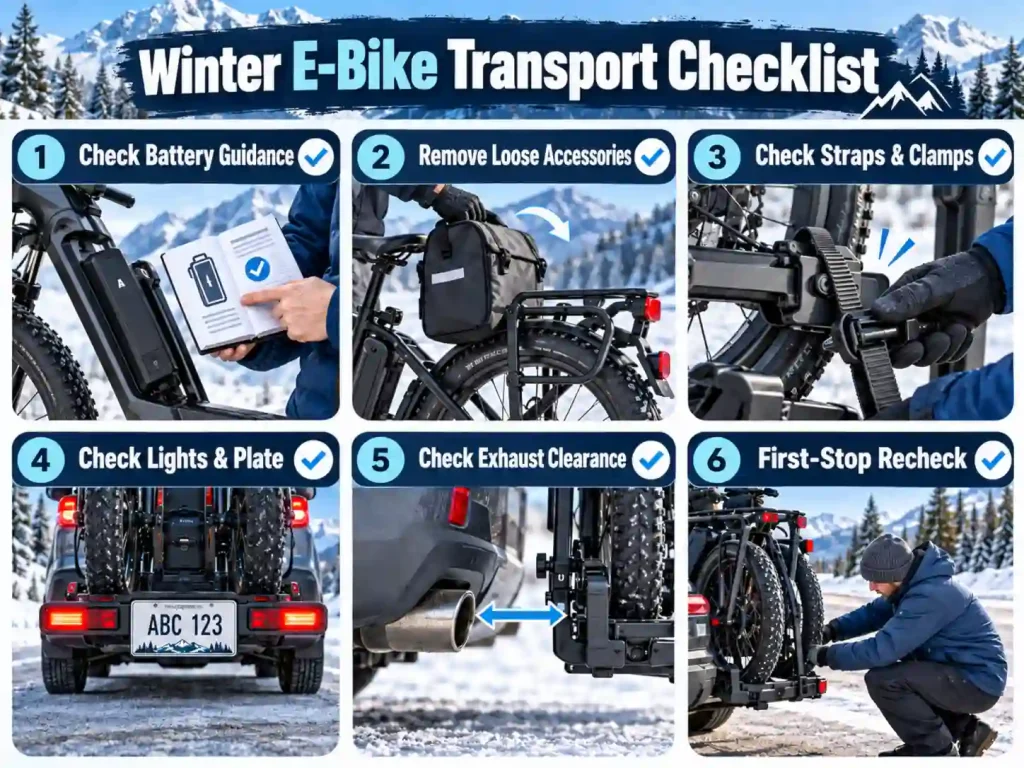
A quick winter e-bike transport checklist to review before and during your trip.Why Winter Car-Rack Transport Is Harder on an E-Bike
An e-bike on an exterior rack is exposed differently than it is during an ordinary ride. At road speed, water and road spray can reach the bike from several directions, carrying grit, dirt, and deicing chemicals with it.
There are four main winter concerns:
| Winter problem | Why it matters | What to do |
|---|---|---|
| Road salt | Salt and road grime can contribute to corrosion on the rack, drivetrain, fasteners, and exposed components. | Clean the bike and rack promptly after salty trips. |
| Slush and spray | Water, grit, and grime can reach the battery area, connectors, brakes, and drivetrain. | Follow the bike and drive-system manufacturer’s wet-weather transport guidance. |
| Cold battery temperatures | Battery operating, charging, and storage temperature limits vary by system. | Follow the limits published for your exact battery and avoid charging outside its permitted range. |
| Heavy e-bike weight | Many e-bikes exceed the capacity of racks designed for conventional bicycles. | Verify the bike’s actual transport weight and every applicable rack, receiver, and vehicle limit. |
Should You Remove the E-Bike Battery Before Putting the Bike on the Rack?
Do not assume the answer is identical for every e-bike. Check the instructions for your bike and drive system.
Bosch currently recommends removing the detachable display and, if possible, the battery for car transport. Bosch also recommends avoiding exterior transport on a roof or hitch rack in rain or wet conditions when possible.
Current Shimano Gen. 2 battery documentation instructs users to remove the battery from the e-bike when transporting it inside a vehicle or on a roof rack and similar situations.
Trek takes a somewhat different approach. Trek says removing an easily removable battery is not required for its e-bikes on a car rack, but recommends doing so to reduce the bike’s weight and make loading easier.
Those differences are exactly why I would follow the instructions for the actual bike and drive system rather than turning one brand’s recommendation into a rule for every e-bike.
Why Battery Removal Can Still Be Helpful
When battery removal is allowed or recommended, it can:
- Reduce the weight carried by the bike rack.
- Make a heavy e-bike easier to load and unload.
- Keep the battery away from direct salt spray and slush.
- Allow you to keep the battery in a more controlled environment inside the vehicle.
What About an Integrated Battery?
Some e-bike batteries are not designed for routine owner removal. Do not disassemble an integrated battery system simply to prepare for a road trip.
If the battery is not normally user-removable, check the bike manufacturer’s transport instructions. A dealer can also tell you whether your particular model has a transport procedure you should follow.
Important: Do Not Transport a Damaged Battery Like Normal Luggage
If an e-bike battery is swollen, leaking, badly dented, cracked, unusually hot, giving off a strong odor, or otherwise visibly damaged, stop and get guidance before transporting or charging it.
Shimano’s current battery guidance specifically says not to transport damaged or nonfunctional batteries. Lithium-ion batteries can also be subject to special transport and disposal requirements.
Do not put a damaged battery in household trash or an ordinary retail battery-recycling box. Contact the battery manufacturer, an authorized dealer, or the appropriate local hazardous-waste or battery-recycling program for instructions.
Do Not Forget the Rack’s Weight Limit
Winter protection does not matter if the rack is overloaded.
Use the actual weight of the e-bike as it will sit on the rack. If a removable battery is taken off before transport, the rack is carrying the bike without that battery. If panniers, heavy locks, baskets, or other equipment stay attached, their weight still counts.
Check all of these before leaving:
- Rack per-bike weight limit
- Rack total bike capacity
- Rack weight itself
- Vehicle and receiver limits
- Hitch or towbar requirements
- Tire-width compatibility
- Wheelbase compatibility
- Fender compatibility
- Frame-contact restrictions
- Whether the rack is approved for your type and weight of e-bike
Use the lowest applicable limit. A rack with a high advertised capacity does not override a lower limit published for the vehicle, receiver, hitch, or another part of the system.
Platform Rack or Hanging Rack for Winter E-Bike Transport?
A platform-style hitch rack is often a good match for a heavy e-bike because the bike sits in wheel trays instead of hanging entirely from the frame. Current Thule guidance describes platform hitch racks as minimizing bike sway and being well suited to heavier models such as e-bikes.
That does not mean every e-bike requires a platform rack. What matters is whether the exact rack is approved for your bike’s weight, frame, tires, wheelbase, and other dimensions.
A hanging rack with an insufficient per-bike rating is not safe simply because the bike physically fits. Likewise, a platform rack is not automatically compatible just because the product page mentions e-bikes.
For particularly heavy bikes, a platform rack with a compatible loading ramp can also make loading much easier.
Protect the Battery Mount and Electrical Areas From Winter Spray
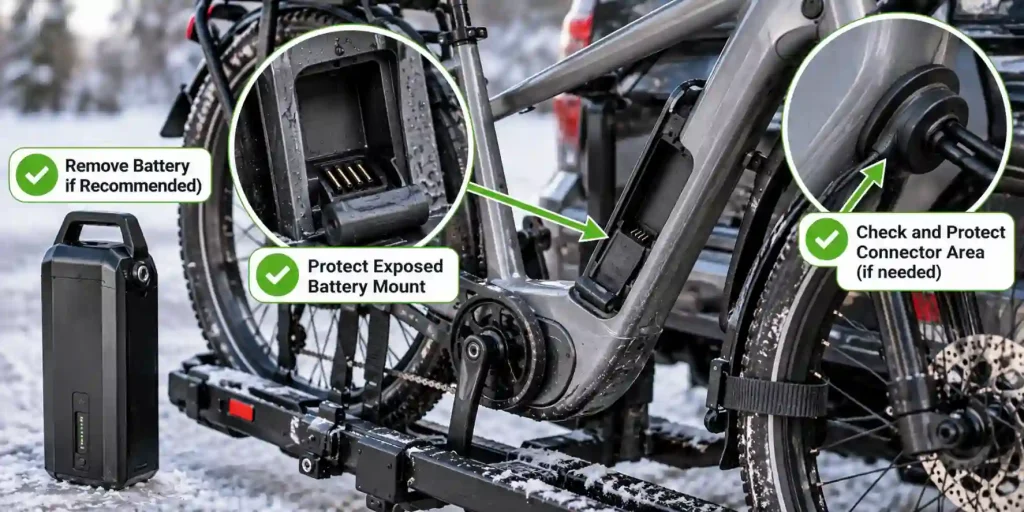
If your battery is removed for transport, check manufacturer guidance for protecting the exposed battery mount and connector area from winter road spray.If you remove a battery, the battery mount or interface may be left exposed. Check your bike or drive-system manufacturer’s instructions for how that area should be handled during transport.
Do not improvise by packing electrical connections with tape, plastic, grease, or another material unless the manufacturer recommends it.
Before reinstalling the battery after the trip, check that the battery interface is clean and dry and that there is no obvious accumulation of water, salt, or dirt.
Shimano’s current guidance, for example, tells users to make sure the battery connection area is dry and not dirty before connecting the battery.
Helpful Winter E-Bike Transport Accessories
A few simple accessories can make winter e-bike transport easier, especially when you remove the battery before putting the bike on a car rack. Always check the dimensions and compatibility with your exact battery before ordering.
BiKase E-Bike Battery Bag
The BiKase E-Bike Battery Bag is designed to carry and store removable e-bike batteries.
Why it may help: A dedicated battery bag gives a removed battery its own protected space inside the vehicle. The bag still needs to be secured so the battery cannot slide, fall, or become a projectile during sudden braking.
Check before buying: Measure your battery first. Battery sizes and shapes vary, so do not assume a bag will fit just because it is marketed for e-bikes.
FLASLD E-Bike Battery Safe Bag
The FLASLD E-Bike Battery Safe Bag is another option for storing and carrying a removable e-bike battery.
Why it may help: It provides a separate enclosure for the battery inside the vehicle and helps keep it separated from other luggage and road-trip gear.
Important: A battery bag does not make a damaged lithium-ion battery safe to transport. Do not transport a battery that is swollen, leaking, unusually hot, badly damaged, or giving off a strong odor as ordinary luggage.
Compatibility reminder: Battery bags and transport accessories are not universal. Check your battery dimensions and your e-bike manufacturer’s transport instructions before buying or using one.
Should You Put a Cover Over the Whole E-Bike?
I would not assume a normal bicycle cover belongs on a bike traveling at highway speed.
A cover used on a parked bicycle and a cover used during vehicle transport have very different requirements. Wind resistance and vibration can turn a loose cover into a problem.
Thule’s current general safety instructions for rear-mounted bike carriers specifically list bike covers among easily removable items that should be removed before transportation.
If you want to use any transport-specific cover or protector, confirm that both the rack and cover manufacturers approve that use. It must not interfere with straps, clamps, lights, the license plate, vehicle visibility, or the safe operation of the rack.
Remove Loose Accessories Before Driving
Winter bikes often carry more equipment than summer bikes. Before driving, remove anything that could loosen, flap, bounce, or fall off.
That can include:
- Panniers and rack bags
- Water bottles
- Removable headlights and taillights
- Bike covers
- Baskets or child seats when the manufacturer requires or permits removal
- Portable pumps
- Phone mounts or accessories not designed for vehicle transport
- Loose battery covers
- Heavy removable locks and chains
- Gloves or clothing strapped to the bike
Thule’s current safety guidance similarly instructs users to remove easily detachable items because air resistance and vibration can cause them to come loose during transportation.
Check Your Taillights, Brake Lights, and License Plate
Once a large e-bike is sitting behind an SUV, crossover, truck, or car, step behind the vehicle and look at the whole setup.
Make sure the rack and bikes do not improperly obscure required vehicle lighting or the license plate. Requirements differ by jurisdiction, so check the rules where you will be driving.
Some racks have integrated lights or accept a separate lighting and license-plate kit. Thule’s current safety instructions note that rear-mounted carriers can obstruct vehicle taillights and that an external light board may be required in that situation. They also note that an additional number plate may be required under local law.
If your rack has electrical lighting, test the running lights, brake lights, and turn signals before leaving.
Check Exhaust Clearance
This is easy to overlook when fitting a hitch rack.
Make sure the bike tires, rack trays, straps, and other components have adequate clearance from the vehicle’s exhaust outlet. Hot exhaust gases can damage rack or bicycle components.
Thule specifically tells users to maintain safe clearance between the carrier, bikes, and exhaust pipe, and notes that some vehicles may require an exhaust extension.
Follow the rack and vehicle manufacturer’s guidance for your particular setup.
Keep the Battery Secure Inside the Vehicle
Removing the battery from the bike only solves part of the transport problem. A heavy lithium-ion battery should not be left loose on a seat or rolling around in the cargo area.
Follow the battery manufacturer’s transport instructions and position it so it cannot fall, slide, be crushed by luggage, or become a projectile during sudden braking.
Keep metal objects away from exposed battery terminals.
If the battery or its case has been damaged, do not treat it as ordinary cargo.
Do Not Leave the Battery in a Very Cold Parked Vehicle Longer Than Necessary
A drive through cold weather is different from storing the battery in a freezing parked vehicle for an extended period.
Battery operating, charging, and storage temperature limits vary by manufacturer and battery generation. Check the documentation for your exact battery rather than relying on one universal temperature number.
For example, current Shimano Gen. 2 documentation lists separate limits for discharge, charging, and recommended storage. Other manufacturers publish their own ranges.
If you are parking overnight or leaving the vehicle for an extended period, bring a removable battery into an appropriate dry storage environment when the manufacturer recommends it.
For longer seasonal storage, see my winter e-bike battery storage guide.
Be Careful About Charging a Cold Battery After the Trip
Do not assume a battery that just spent hours in freezing air is immediately ready to charge.
Follow the charging-temperature range specified by the battery manufacturer. If the battery is outside that range, let it reach an appropriate temperature before charging.
Also check the battery, charging connection, and battery interface for water, salt, dirt, or damage first. Do not connect a charger to a wet or contaminated charging port.
Current Shimano guidance says its applicable Gen. 2 battery charger operates from 0°C to 45°C and instructs users to make sure there is no water on the charging connection. Those numbers should not automatically be applied to batteries from another manufacturer.
The U.S. Consumer Product Safety Commission recommends using only the charger supplied or approved for the device, following the manufacturer’s charging instructions, and being present while charging.
Inspect the Bike Rack Before Winter Trips Too
It is easy to focus entirely on protecting the e-bike and forget that the rack itself spends the winter directly behind the vehicle.
Before the season and periodically during it, inspect:
- Wheel straps
- Frame or wheel arms
- Bolts and fasteners
- Hitch or receiver connection
- Locks
- Tilting or folding mechanisms
- Moving joints and pivots
- Electrical connectors on racks with lights
- Loading ramps and their attachment points
Replace worn or damaged straps or hardware according to the rack manufacturer’s instructions.
Thule specifically recommends regular carrier cleaning during periods when road salt is being used and periodic inspection of straps. 1UP USA similarly recommends removing salt and road debris and periodically inspecting rack hardware.
Do a First-Stop Rack Check
Do not make the initial driveway inspection your only check on a long trip.
After driving the first part of the route, stop somewhere safe and inspect the rack and bikes again. Look for:
- Loose wheel straps
- A bike that shifted in its tray
- Movement at the hitch or receiver
- Loose clamps or arms
- Snow or ice buildup around moving parts
- A protector or accessory that has come loose
- Unexpected contact between two bikes
Then continue checking the rack periodically during longer trips.
Your rack’s manual should determine the exact interval. As one current example, Thule instructs users to check the carrier after driving approximately 30 miles or 50 km and then at regular intervals.
How to Drive With an E-Bike on the Rack in Winter
A loaded bike rack can change the vehicle’s handling, dimensions, and vulnerability to crosswinds. Winter conditions add snow, ice, potholes, reduced visibility, and longer stopping distances to that equation.
Follow any maximum-speed or driving restrictions in your rack manual and adjust your speed to the weather and road conditions.
Also remember that the vehicle may now be longer and, depending on the bike arrangement, wider than usual. Be especially careful when reversing, parking, entering garages, or maneuvering in tight spaces.
If the rack has a tilt mechanism, make sure it is fully locked in its transport position before driving.
What About Hotel Stops or Overnight Parking?
If you are stopping overnight, do not assume the lock built into a bike rack makes the bicycle theft-proof.
Rack locks can reduce theft risk, but manufacturers themselves generally do not describe them as a complete guarantee against theft. Thule, for example, says its integrated locking systems reduce theft risk but are not a total guarantee.
When practical:
- Bring the removable battery and detachable display inside.
- Remove panniers and other valuables.
- Use an additional quality lock if it can be used without interfering with the rack.
- Choose a well-lit, visible parking location.
- Do not leave keys in rack locks or battery locks.
- Recheck the bikes and rack before driving again the next morning.
If the bike has a connected alarm system, check whether the manufacturer provides a vehicle-transport mode. Bosch, for example, recommends Transport mode for compatible eBike Alarm systems to prevent false alarms during transport.
What to Do If the Bike Arrives Covered in Frozen Slush
If the bike is coated in frozen slush, road grime, or ice, I would not immediately force frozen controls, connectors, rack mechanisms, or battery locks.
Move the bike to an appropriate place where ice can thaw naturally. Then clean and dry the bicycle according to the bike and component manufacturers’ instructions.
Do not use boiling water, a pressure washer, or aggressive heat directly on the battery or electrical components.
Large temperature changes can also cause condensation. Before reconnecting or charging the battery, check that the relevant connections are clean and dry.
If the display fogs after a large temperature change, check its manufacturer’s guidance. Bosch notes that temperature fluctuations can cause temporary condensation inside some displays and recommends allowing affected equipment to dry in a suitable indoor environment.
What to Do When You Arrive
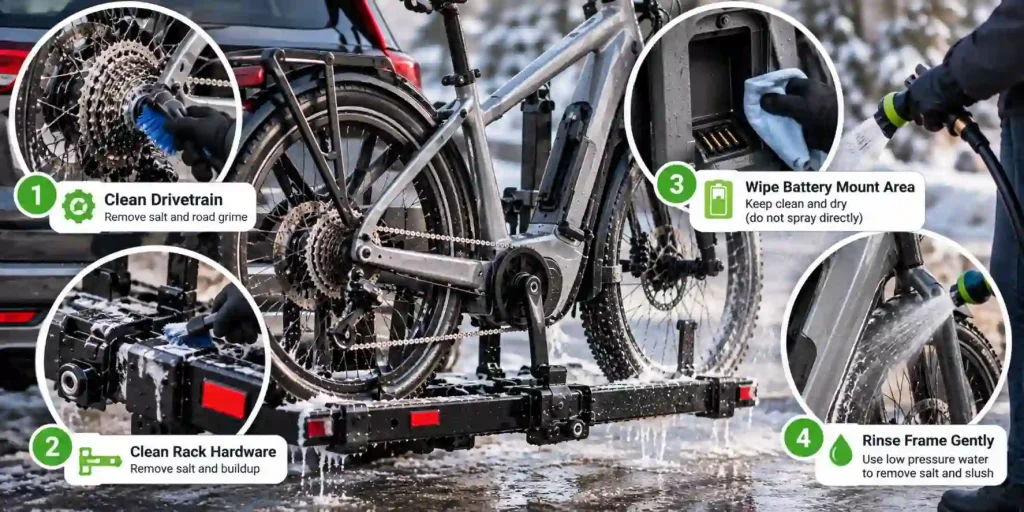
After winter transport, clean salt and slush from the bike and rack, wipe the battery mount area, and use only gentle low-pressure water on the frame.1. Inspect Before Unloading
Look for loose restraints, ice buildup, or anything that shifted during the drive before releasing the bike.
2. Remove Road Salt and Grime
Clean the frame, wheels, drivetrain, rack hardware, and other exposed surfaces according to the manufacturers’ instructions.
Avoid forcing high-pressure water into electrical areas. Bosch specifically advises against high-pressure or steam cleaning because water can penetrate sensitive components.
3. Dry the Bike
Pay particular attention to the battery area, connectors, charging port, fasteners, chain, and places where salty water can collect.
4. Clean the Bike Rack Too
The rack is exposed to the same road spray as the bicycle.
Thule recommends cleaning its carriers regularly with warm water or car shampoo, especially during periods when salt is applied to winter roads. 1UP USA also recommends removing salt and road debris from rack hardware.
5. Re-Lubricate Where Needed
After cleaning a conventional chain drivetrain, check whether it needs appropriate lubrication.
Keep chain lubricant, corrosion treatments, and other oily products away from brake rotors and brake pads.
6. Inspect Before the Next Ride
Check the brakes, drivetrain, tires, battery fit, electrical areas, lights, and controls before riding.
If the e-bike develops an electrical issue after wet transport or cleaning, my guide to an e-bike not working after rain or washing explains the safest first checks.
Winter E-Bike Car-Rack Checklist
Before You Leave
- Confirm the rack’s per-bike weight rating.
- Confirm total bike capacity.
- Check applicable vehicle, hitch, and receiver limits.
- Confirm tire width, wheelbase, frame, and fender compatibility.
- Follow your e-bike manufacturer’s battery transport instructions.
- Remove the detachable display when recommended.
- Remove loose accessories and ordinary bike covers.
- Secure the battery safely inside the vehicle if removed.
- Check all straps, arms, clamps, bolts, and locking mechanisms.
- Check clearance from the exhaust.
- Make sure required lights and the license plate remain compliant and visible.
- Test rack lighting if equipped.
At the First Safe Stop
- Check the rack-to-vehicle connection.
- Check every bike restraint.
- Look for bike movement or shifting.
- Check for snow or ice buildup.
- Make sure nothing is loose or flapping.
- Listen for unusual rack noise or movement.
- Repeat inspections periodically on long trips.
When You Arrive
- Inspect the rack before releasing the bike.
- Bring the removable battery into an appropriate environment when needed.
- Allow frozen slush or ice to thaw without forcing components.
- Remove salt, slush, and road grime.
- Dry the battery area and electrical connections.
- Clean the bike rack.
- Check the drivetrain and lubricate when needed.
- Inspect brakes and tires before riding.
- Check the manufacturer’s permitted battery temperature before charging.
- Make sure the charging connection is clean and dry.
Frequently Asked Questions
Can I transport an e-bike on a hitch rack in snow?
It may be possible, but check the bike, drive-system, rack, hitch, receiver, and vehicle instructions first. Some manufacturers caution against exterior transport in wet conditions. Winter road spray can also contain corrosive salt and grit, so cleaning afterward is important.
Should I remove my e-bike battery for winter car-rack transport?
Follow the instructions for your e-bike and battery system. Bosch recommends removing the battery if possible for car transport, while current Shimano Gen. 2 documentation instructs users to remove the battery for vehicle transport. Trek says battery removal is not required for its easily removable systems but recommends it to reduce bike weight. The correct answer therefore depends on the bike.
Can I leave my e-bike battery in the car while I drive?
A removable battery can be carried inside a vehicle when the manufacturer permits it, but it should be secured so it cannot slide, fall, be crushed, or contact metal objects at its terminals. Follow the battery manufacturer’s temperature and transport instructions.
Can I leave an e-bike battery in the car overnight in winter?
Check the storage-temperature limits for your exact battery. A parked vehicle can become much colder than it was during the drive. When the manufacturer calls for indoor or temperature-controlled storage, bring the removable battery inside.
Will road salt damage an e-bike?
Salt and moisture can contribute to corrosion on metal hardware, drivetrain parts, connectors, and other exposed components. Clean salty winter grime off the bike and rack promptly and dry them thoroughly.
Should I cover my e-bike while it is on the car rack?
Do not assume an ordinary bike cover is suitable for highway transport. Thule’s current general rear-carrier instructions specifically tell users to remove easily removable bike covers before transportation. If you use a transport-specific cover, confirm that the cover and rack manufacturers approve the setup.
When should I check my bike rack during a road trip?
Follow the rack manufacturer’s instructions. A good practice is to inspect it after the first part of the drive and periodically during longer trips. Thule currently specifies a check after approximately 30 miles or 50 km and regular checks afterward for its covered carrier guidance.
Do I need a platform rack for an e-bike?
Not universally. Platform racks are often well suited to heavy e-bikes and can reduce bike sway, but the important factors are the rack’s actual weight rating, bike compatibility, wheelbase, tire width, frame or wheel contact method, and the limits of the vehicle and receiver.
What if my bike rack blocks the license plate or taillights?
Check the laws where you drive and the rack manufacturer’s instructions. Depending on the setup and jurisdiction, an external lighting board or additional license-plate mounting solution may be needed.
Should I wash my e-bike after transporting it on salted winter roads?
If the bike is coated in salt or slush, clean it according to the manufacturer’s instructions and dry it thoroughly. Avoid pressure-washing sensitive electrical areas, and keep lubricant away from brake pads and rotors.
Can I charge the battery immediately after a freezing winter drive?
Not necessarily. Check your battery manufacturer’s permitted charging-temperature range. If the battery is outside that range, allow it to reach an appropriate temperature first. Make sure the battery and charging connection are clean, dry, and undamaged before plugging it in.
My Take
The biggest mistake with winter e-bike transport is treating it exactly like a summer drive with a regular bicycle.
I would think about a winter trip in four parts: the rack has to safely carry the weight, the battery and electrical system need to be handled according to the manufacturer’s instructions, the vehicle and rack still need clear lights and safe exhaust clearance, and winter salt and slush need to come off both the bike and the rack after the trip.
The first-stop inspection is also worth making a habit. A bike that seemed perfectly secure in the driveway may settle slightly once the rack has experienced highway vibration, bumps, wind, and winter road conditions.
If your bike or drive-system manufacturer recommends removing the battery or avoiding exterior wet-weather transport, I would take that guidance seriously. A little extra preparation is much easier than dealing with an overloaded rack, corroded hardware, damaged electrical connection, or bike that shifts during the trip.
Disclosure: As an Amazon Associate, I earn from qualifying purchases. This comes at no extra cost to you and helps support the content on this site.
Sources
- Bosch eBike Systems – Transporting the eBike
- Shimano – E-Bike Systems Special Battery and Parts Manual, Gen. 2
- Trek – Electric Bike FAQ
- Thule – Rear Bike Carrier Safety Instructions
- 1UP USA – Bike Rack Maintenance Guidance
- U.S. Consumer Product Safety Commission – Micromobility Safety

Kristina is not just an enthusiast but a true authority on electric bikes. Nestled in the coastal beauty of Virginia, Kristina has found the perfect backdrop for her passion for electric biking. As a dedicated wife and homeschooling mom, her life revolves around family, faith, and the thrill of adventure.
Originally hailing from Ohio, Kristina's journey with electric bikes began as a curiosity and quickly evolved into a deep expertise. Her blog is a testament to her love for electric biking, combining her fascination for eco-friendly transportation with her coastal lifestyle.
When she's not cruising the beach on her electric bike, you'll find Kristina indulging in her other loves: long walks along the shore, getting lost in a good book, and cherishing moments with her loved ones. With a heart as big as her love for animals, especially cats, Kristina brings a unique perspective to the electric bike world, grounded in her strong faith in God and her dedication to a sustainable lifestyle.
Through her blog, Kristina shares her extensive knowledge of electric bikes, offering valuable insights, tips, and recommendations to fellow enthusiasts. Whether you're a seasoned rider or a newcomer to the electric bike scene, Kristina's blog is your go-to source for all things electric biking, fueled by her passion, expertise, and the scenic beauty of coastal Virginia.