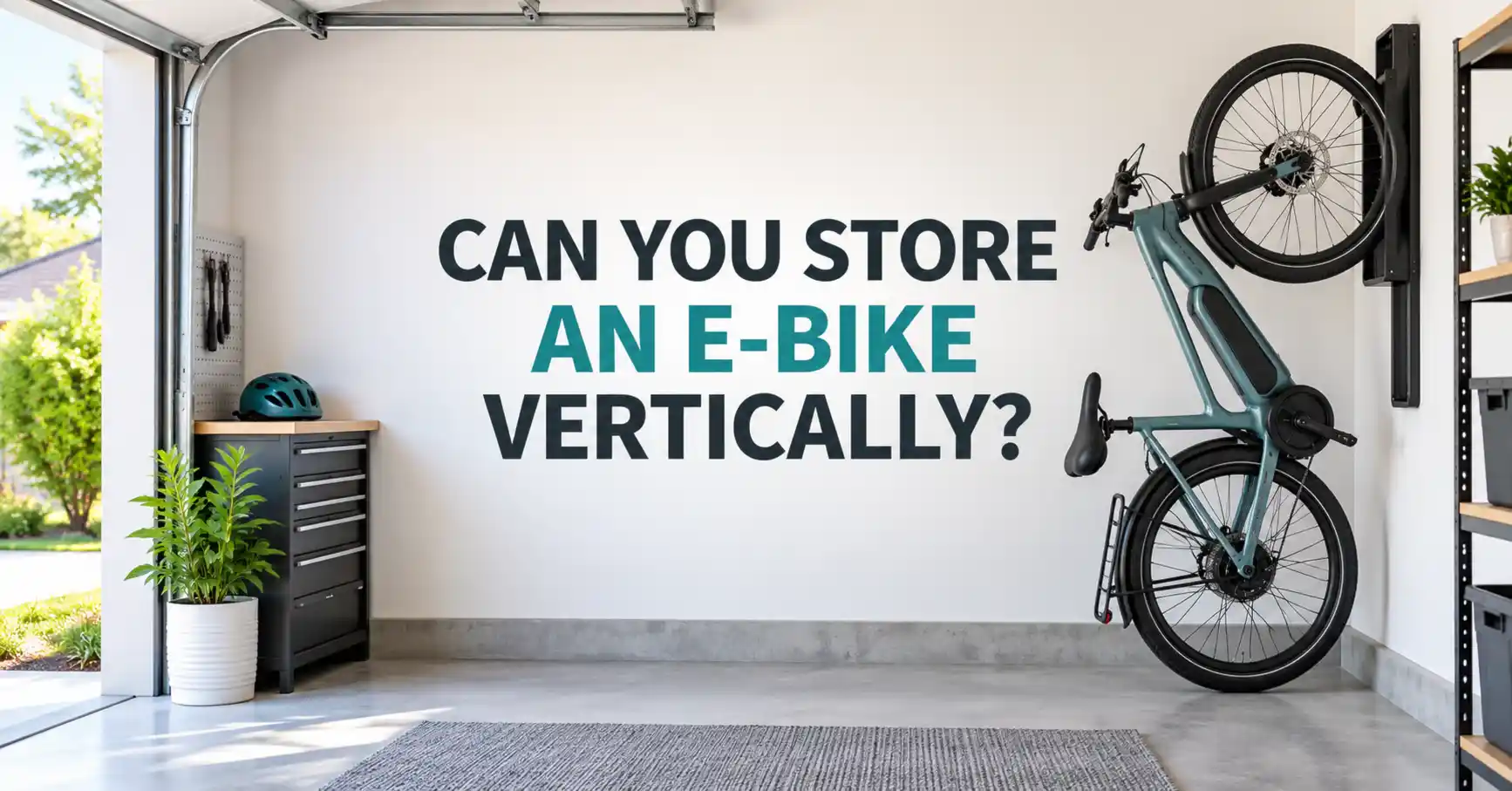
Can You Store an E-Bike Vertically? Safe Vertical E-Bike Storage Guide
Last Updated on September 7, 2026 by Kristina
Yes, you can often store an e-bike vertically, but it is not automatically safe for every bike, brake system, wheel, or storage rack. The rack needs to support the bike’s actual weight, the mounting surface needs to be structurally sound, and you need to check wheel, tire, fender, brake, battery, and accessory compatibility before hanging the bike.
For me, the biggest difference between storing a regular bicycle and storing an e-bike vertically is weight. A rack that is perfectly adequate for a lightweight bicycle may be completely wrong for a 65 or 75 lb electric bike.
I also pay special attention to hydraulic brakes. Some brake manufacturers have specific instructions about storing a bicycle on a wheel, on its side, or upside down, so I would check the brake manufacturer’s manual instead of assuming that every hydraulic system behaves the same way.
If you’re setting up a garage, apartment, shed, or other storage area, my e-bike troubleshooting and maintenance guide covers the routine checks that help keep a stored bike ready to ride. You can also read my guide to e-bike battery capacity and battery basics if you’re planning longer-term storage.
Quick Answer: Is Vertical E-Bike Storage Safe?
Vertical e-bike storage can be safe when all of the following are true:
- The rack is rated for the complete weight of the bike.
- The rack is compatible with your tire, wheel, rim, and fenders.
- The rack is installed into an appropriate structural surface according to its instructions.
- Your brake manufacturer allows the storage position you plan to use.
- No brake rotor, cable, hose, display, light, fender, or other component is being crushed or used as a support point.
- You can raise and lower the bike without losing control of it.
- Your bike and battery manufacturers do not specify a different storage method.
I would not screw a generic bicycle hook into drywall and then hang a heavy e-bike from it. The hook may be strong enough while the wall attachment is not.
Before You Buy a Vertical E-Bike Rack: Check These 8 Things
This is the checklist I would use before buying a vertical electric bike rack.
- Bike weight: Check the bike’s actual weight, including anything that will remain attached while it is stored.
- Rack weight capacity: Do not assume a rack marketed for bicycles is automatically suitable for an e-bike.
- Tire width: Fat tires, plus-size tires, and some wider mountain bike tires require larger hooks or specialized racks.
- Wheel and rim compatibility: Check the rack instructions if you have carbon wheels, deep-section rims, unusual spokes, wheel covers, or another nonstandard wheel.
- Fender clearance: Some vertical racks specifically exclude bikes with front fenders or mudguards.
- Wall construction: Determine whether you have wood studs, masonry, concrete, steel framing, or another wall type and use the mounting method specified by the rack manufacturer.
- Brake compatibility: Check the storage guidance for your particular hydraulic brake system.
- Your ability to lift the bike: A technically compatible rack still isn’t useful if getting the bike onto it feels unsafe.
Rack specifications can vary more than people expect. Some popular bicycle wall racks are rated for only around 50 lb, while heavy-duty systems designed with e-bikes in mind can support considerably more. Tire-width limits, fender compatibility, and mounting requirements also vary. I would always check the current specifications for the exact rack instead of shopping by appearance alone.
3 Vertical E-Bike Storage Options Worth Considering
I have not personally tested these three storage systems, so I am not ranking them or calling one the best. I included them because they show three very different approaches to vertical bike storage and, more importantly, why you need to compare weight, tire, fender, and mounting requirements before buying.
| Storage Option | Style | Published Weight Limit | Best Fit | Important Limitation |
|---|---|---|---|---|
| Steadyrack ProFlex | Wall-mounted pivoting vertical rack | 121 lb | Heavy e-bikes, fat tires, fender-equipped bikes | Requires a structurally suitable wall and correct size selection |
| StoreYourBoard CycleStand Pro | Freestanding vertical floor stand | 65 lb | Renters and riders who do not want to drill into a wall | Not compatible with fenders and too light-duty for many heavy e-bikes |
| Feedback Sports Velo Hinge 2.0 | Wall-mounted pivoting wheel hook | 50 lb | Lightweight e-bikes and conventional bikes | 50 lb limit excludes many full-size e-bikes |
Steadyrack ProFlex: A Heavy-Duty Wall Option
The Steadyrack ProFlex is the example I would look at first if bike weight is the main concern. Steadyrack currently rates all three ProFlex sizes for bikes up to 121 lb.
The Narrow version is designed for tires up to 2.1 in., the Wide version covers 2.1 to 2.8 in. tires, and the Fat version covers 2.8 to 4.5 in. tires. Wheel-diameter compatibility varies by version. Steadyrack also lists the ProFlex as compatible with fenders or mudguards when there is at least 3/4 in. of clearance between the tire and the stays.
The rack pivots sideways after the bike is parked, which can help when several bikes share one garage wall.
Why I included it: A 121 lb published capacity puts it in a very different category from standard 50 or 65 lb bicycle racks. That makes it much more relevant to owners of heavier commuter, fat-tire, cruiser, and other full-size e-bikes.
Watch for: You still need the correct ProFlex size for your tire and wheel, enough fender clearance, and a structurally suitable mounting surface. The manufacturer’s weight rating does not make an inadequate wall installation safe.
StoreYourBoard CycleStand Pro: A No-Drill Vertical Stand
The StoreYourBoard CycleStand Pro takes a different approach. It is freestanding, so you do not have to attach a rack to the wall.
The manufacturer rates it for bikes up to 65 lb, wheels 24 in. or larger, and tires up to 3.5 in. wide. The bike rolls onto its rear tire and into the stand rather than being lifted onto a wall hook.
Why I included it: This is the kind of vertical storage option I would consider for an apartment, rental home, finished garage, or any other place where drilling into the wall isn’t practical. The roll-in design can also make vertical storage more manageable for riders who don’t want to lift the entire bike.
Watch for: The 65 lb limit rules out many heavier e-bikes, and the manufacturer says the CycleStand Pro does not work with bikes equipped with fenders. Measure and weigh your bike before ordering.
Feedback Sports Velo Hinge 2.0: Good Example of Why Weight Matters
The Feedback Sports Velo Hinge 2.0 is a compact wall-mounted rack that lets the stored bicycle pivot to either side. It accommodates wheel and tire combinations from 700C x 23 mm up to 29 x 3.0 in., according to Feedback Sports.
However, its published load capacity is only 50 lb when properly stud-mounted.
Why I included it: It demonstrates an important point. A well-made bicycle rack can still be the wrong rack for your e-bike. The Velo Hinge may work well for a lightweight electric bike, but I would immediately rule it out for a 60, 70, or 80 lb model.
Watch for: Weigh your complete bike rather than relying on a guess. If it exceeds 50 lb, choose another storage system.
One more reminder: These specifications were checked in September 2026 and manufacturers can change designs and compatibility. Confirm the current product specifications before buying. I also would not choose any of these racks until checking the storage guidance for your particular hydraulic brakes.
I plan to keep a separate buying guide for comparing the best vertical e-bike racks and stands in more detail. This guide is focused on whether vertical storage is appropriate for your bike and how to do it safely.
How Much Space Do You Need to Store an E-Bike Vertically?
Before drilling holes, measure the bike and the room.
I would check:
- Floor-to-ceiling height.
- The bike’s overall length.
- Handlebar width.
- Tire width and wheel diameter.
- How far the handlebars, pedals, rack, baskets, mirrors, or pannier hardware project from the wall.
- Clearance needed to roll, tilt, or lift the bike into the rack.
Don’t rely on wheelbase alone to calculate mounting height. The final position depends on the rack’s geometry, where it captures the wheel, and the angle of the bike.
The safest approach is to follow the rack manufacturer’s mounting-height instructions or template. If possible, have someone help you stand the bike on its rear wheel in approximately the intended position before installation. That gives you a much better idea of whether the ceiling, handlebars, pedals, or accessories will interfere.
I would leave some extra clearance rather than trying to make the bike fit within an inch of the ceiling.
Vertical E-Bike Storage vs. Floor Storage
| Situation | Vertical Storage | Floor Storage |
|---|---|---|
| Small apartment | Excellent for saving floor space if mounting is permitted | Takes more usable floor space |
| Standard commuter e-bike | Often practical with a properly rated rack | Easy and simple |
| Very heavy e-bike | Can be difficult to raise safely | Often easier to manage |
| Fat-tire e-bike | Requires a rack that fits the tire | Usually simpler if the stand fits the tire |
| Bike with front fender | Rack compatibility needs extra attention | Usually fewer fender conflicts |
| Long cargo e-bike | May be impractical because of size and weight | Often the better choice |
| Rider with limited lifting ability | A roll-in or assisted design may work | Usually easier |
| Rental property | Freestanding vertical storage avoids permanent wall mounting | No permanent wall installation required |
Saving floor space is useful, but I would not make vertical storage the goal at any cost. If you dread lifting the bike every time you want to ride, a sturdy floor stand may be the more practical solution.
What Counts as Vertical E-Bike Storage?
“Vertical storage” can describe several different setups, and the distinction matters.
| Storage Method | How It Supports the Bike | Main Concern |
|---|---|---|
| Wheel hook | Bike hangs from one wheel | Weight rating, wheel compatibility, mounting strength |
| Pivoting vertical rack | Wheel is captured and bike pivots toward the wall | Weight, tire width, fenders, lifting effort |
| Freestanding vertical stand | Bike rests vertically without permanent wall attachment | Weight limit, stability, tire and fender compatibility |
| Frame-support rack | Bike is supported by its frame | Frame shape and contact points |
| Horizontal wall rack | Bike is held by the frame with both wheels off the floor | Frame compatibility and wall strength |
| Standard floor stand | Bike remains in its normal riding orientation | Uses more floor space |
Will Hanging an E-Bike Vertically Damage the Wheel?
A properly designed bicycle storage hook can support a bicycle by the wheel. Park Tool, for example, makes storage hooks specifically intended for hanging bicycles and wheels, including oversized versions for larger tires.
That doesn’t mean every wheel belongs on every hook.
If you have carbon rims, deep-section rims, very wide tires, unusual spokes, wheel covers, or another specialized wheel, check both the rack instructions and any applicable wheel-manufacturer guidance.
The hook should contact the tire or wheel where the rack manufacturer intends. It should never bear against the brake rotor, valve stem, electrical wiring, fender, or another delicate component.
Does the Rack’s Weight Rating Really Matter?
Absolutely.
This is one area where I would rather have more capacity than barely enough. Don’t forget that accessories can add weight. A rear rack, basket, lock, child-seat mount, panniers, tools, and other equipment can push the stored weight higher than the bike’s published bare-bike weight.
The mounting surface matters just as much. Park Tool specifies that its storage hooks must be secured into material capable of carrying the load. Steadyrack likewise requires installation into an appropriate solid wall or structural mounting point using the correct hardware.
A 75 lb rack capacity does not mean you can safely hang a 75 lb bike from any wall.
Should You Remove the Battery Before Storing an E-Bike Vertically?
You do not necessarily have to remove a healthy battery every time you put an e-bike into vertical storage unless your bike, battery, or rack instructions require it.
Personally, I would remove a removable battery before lifting a particularly heavy e-bike when doing so is easy and the manufacturer permits normal battery removal. Taking several pounds off the bike can make it noticeably easier to control.
Long-term battery storage is a separate issue. There is no single charge percentage or storage temperature that I would apply to every e-bike battery. Follow the battery manufacturer’s instructions for your specific system.
For example, Bosch recommends storing its e-bike batteries at approximately 30% to 60% charge during longer periods of storage. That is a Bosch-specific recommendation, not a universal rule for every lithium-ion e-bike battery.
See my e-bike battery guide for more information about capacity and battery terminology.
What Direction Should an E-Bike Battery Be Stored?
I would follow the battery manufacturer’s instructions rather than making a universal rule about battery orientation. Battery designs, mounting systems, vents, connectors, and manufacturer recommendations differ.
If your manual gives a required storage orientation, use it. If it does not, don’t assume that advice for another brand automatically applies to yours.
Do Not Leave the Battery Permanently Charging in Storage
The U.S. Consumer Product Safety Commission recommends following the manufacturer’s charging instructions, using the charger supplied with or recommended for the device, remaining present while charging, and unplugging the device when charging is complete.
CPSC also advises against charging micromobility products while sleeping or when you are away from home.
I would treat the charging setup as part of the storage plan. Don’t arrange a vertical rack in a location where the charging cord creates a trip hazard or where the bike blocks an exit.
If a battery overheats, leaks, changes shape, gives off an unusual odor, makes unusual noises, or shows other signs of damage, stop using and charging it. Do not open or attempt to rebuild a lithium-ion battery pack yourself.
Hydraulic Brakes Are the Biggest Reason to Check Your Manual
This is the part of vertical e-bike storage where I think overly simple advice can be misleading.
Different brake manufacturers give different instructions.
Shimano warns that when certain hydraulic disc-brake systems are turned upside down or onto their side, air that may be present in the reservoir can migrate through the system. Shimano says the brake levers should be operated several times to confirm normal braking before riding afterward.
Tektro also warns that its hydraulic disc brakes are not designed to operate with the bicycle upside down and instructs riders to check brake operation afterward.
MAGURA gives more conservative storage guidance for its open MT hydraulic disc-brake systems. MAGURA explains that residual air may move through the hydraulic system when a bike is stored on its rear wheel, on its side, or upside down. Because you cannot confirm from the outside that absolutely no residual air is present, MAGURA recommends normal upright storage for these systems unless its alternative instructions are followed.
That means I would not say that every hydraulic-brake e-bike can safely live front-wheel-up on a wall indefinitely.
Instead:
- Identify the brake brand and model.
- Check the manufacturer’s storage instructions.
- Follow any orientation restrictions.
- After taking the bike down, squeeze both brake levers before riding.
- If a lever feels spongy, unusually soft, or has significantly more travel than normal, do not ride until the braking system is working correctly.
If you aren’t sure what brake system you have, a bicycle shop can identify it quickly.
Can You Store an E-Bike Vertically With the Front Wheel Up?
Sometimes, yes. Many vertical storage racks are designed around a front-wheel-up position.
However, rack compatibility and brake-manufacturer guidance both take priority. As noted above, some hydraulic brake manufacturers are more restrictive about prolonged non-upright storage than others.
If your brakes allow the position, front-wheel-up racks can be convenient because many designs let you roll the bike onto its rear wheel and guide the front wheel into the rack instead of lifting the entire bike straight into the air.
Check that the front tire fits correctly and that the rack does not interfere with a fender, front light, brake rotor, brake hose, cable, or other accessory.
Can You Store an E-Bike With the Rear Wheel Up?
Only if the storage system and your bike’s components are compatible with that orientation.
I would not assume that a rack designed to capture the front wheel can simply be used backward. Follow the rack manufacturer’s instructions about which wheel should be placed in the holder.
Brake-system guidance matters here too, so check your brake manual before choosing either wheel-up orientation for long-term storage.
How to Store an E-Bike Vertically Safely
- Check the bike’s weight. Include accessories that will remain attached.
- Check the rack capacity. Make sure the rating comfortably covers your setup.
- Check tire, rim, and fender compatibility. Don’t assume a fat tire or front fender will fit.
- Identify your brakes. Confirm whether the brake manufacturer allows your planned storage orientation.
- Measure the space. Check ceiling height, handlebar clearance, wall clearance, and loading room.
- Mount the rack correctly. Follow the manufacturer’s instructions for wood studs, masonry, concrete, or another approved structural surface.
- Remove unnecessary weight. Take off loaded panniers, heavy locks, cargo, and a removable battery when appropriate.
- Inspect contact points. Make sure the rack isn’t pressing on a rotor, cable, hose, valve stem, light, display, fender, or electrical connector.
- Load the bike slowly. Keep control of the bike throughout the movement.
- Secure any retaining mechanism. Use straps, wheel retainers, or locking arms supplied with the rack.
- Check stability. Gently confirm that the bike and rack are secure before walking away.
- Check the brakes before riding. This is especially important after nonstandard storage positions.
Don’t Forget the Derailleur, Display, and Accessories
The wheel isn’t the only part that needs clearance.
I would look at everything that could touch the wall or another bike when the bike pivots or hangs vertically:
- Rear derailleur.
- Brake rotors.
- Handlebar display.
- Control buttons.
- Throttle.
- Mirrors.
- Phone mount.
- Front and rear lights.
- Pannier rails.
- Baskets.
- Fenders.
- Child-seat hardware.
Pivoting racks are particularly useful for saving wall space, but the bike needs enough room to swing without components banging into the wall, another bicycle, a car, or shelving.
Where Is the Best Place to Store an E-Bike Vertically?
Garage
A garage can work very well for vertical e-bike storage because there is often access to structural framing and enough room to load the bike.
Battery temperature requirements deserve separate attention. An unconditioned garage can become much hotter or colder than the house, so check the battery manufacturer’s permitted storage-temperature range.
Apartment or Condo
Vertical storage can be a huge space saver in a small apartment.
Before drilling, check your lease, condominium rules, or property-management requirements. Buildings may also have separate rules covering e-bike batteries, charging, hallways, exits, or shared storage spaces.
If permanent mounting isn’t allowed, a freestanding vertical stand may be worth considering as long as your bike is within its weight and fit limits.
Shed
A shed may keep the bike out of your living space, but temperature and humidity can vary considerably. If your battery is removable, follow its manufacturer’s instructions for long-term storage and temperature rather than assuming the shed is appropriate year-round.
Inside the Home
Indoor storage protects the bike from weather, but make sure there is enough room to raise and lower it safely. I would avoid positioning a heavy hanging bike where a fall could injure someone or block a doorway.
What About Security?
A wall rack is a storage device, not automatically a security device.
If you’re keeping an e-bike in a shared garage, apartment bike room, shed, or another accessible area, I would use a separate bike lock and appropriate secure anchor rather than assuming the storage hook prevents theft.
My guide to the best e-bike accessories covers locks and other useful ownership gear.
When I Would Not Store an E-Bike Vertically
I like the space-saving idea of vertical storage, but there are situations where I would choose something else.
- The bike is heavier than the rack allows.
- The wall or mounting surface cannot support the installation.
- The brake manufacturer advises against the intended position.
- The tire or wheel does not fit the storage system correctly.
- A front fender conflicts with the rack.
- You cannot lift or lower the bike comfortably.
- The bike is unusually long, heavy, or difficult to balance.
- The manufacturer gives storage instructions that conflict with the rack setup.
- The battery or bike is damaged and needs inspection before normal storage or use.
A cargo e-bike, moped-style e-bike, or particularly heavy fat-tire model may simply be easier and safer to keep on the floor.
Common Vertical E-Bike Storage Mistakes
- Buying a rack without checking its weight limit.
- Assuming drywall alone can support a heavy e-bike.
- Forgetting the weight of accessories.
- Ignoring tire-width limits.
- Ignoring front-fender compatibility.
- Letting a hook contact a brake rotor or cable.
- Assuming all hydraulic brake systems have identical storage rules.
- Assuming all batteries have identical long-term storage requirements.
- Leaving the battery charging unattended.
- Hanging the bike somewhere that blocks an exit or creates a trip hazard.
- Forcing yourself to lift a bike that you cannot comfortably control.
- Getting on the bike without checking the brakes after storage.
🔎 Why You Can Trust This Guide
I checked current guidance from the U.S. Consumer Product Safety Commission, Bosch eBike Systems, Shimano, MAGURA, and bicycle-storage manufacturers while researching this guide. Where manufacturers give different instructions, I have kept those differences clear instead of treating one brand’s recommendation as a rule for every e-bike.
Because bikes, batteries, brakes, wheels, and storage racks vary, your own manufacturer manuals should always take priority over general storage advice.
Frequently Asked Questions About Vertical E-Bike Storage
Can you hang an electric bike vertically?
Often, yes. Use a vertical rack that is rated for the bike’s weight and compatible with its wheel and tire. Also check your hydraulic brake manufacturer’s storage instructions before committing to a wheel-up position.
Can you hang an e-bike by the front wheel?
Yes, if the rack is specifically designed to support a bicycle by the wheel and is compatible with your bike. Check the rack’s weight, tire, rim, and fender limitations and any brake-system storage restrictions.
Can hanging an e-bike vertically damage hydraulic brakes?
It depends on the brake system and storage orientation. Shimano and Tektro caution against upside-down positioning, while MAGURA gives additional guidance about wheel-up storage for some open hydraulic disc-brake systems. Check the instructions for your exact brakes.
Should I remove the e-bike battery before hanging the bike?
Not always. If the battery is designed to be removable and your manufacturer permits normal removal, taking it off can make a heavy bike easier to lift. For long-term battery storage, follow the battery manufacturer’s charge and temperature recommendations.
Can an e-bike battery be stored vertically?
I would not apply a universal orientation rule to every battery. Check the manufacturer’s manual for your specific battery and mounting system.
Will vertical storage damage an e-bike motor?
I did not find a general industry rule saying an e-bike motor is damaged simply because the bicycle is stored vertically. However, the bike and drive-system manufacturer’s instructions should take priority if they specify an approved storage orientation.
Can I store my e-bike vertically all winter?
Potentially, if the bike, rack, brakes, and storage environment are suitable. Pay particular attention to the battery manufacturer’s long-term charge and temperature recommendations and inspect the bike before returning it to regular use.
Can I hang a 70 lb e-bike on the wall?
Possibly, but only with a storage system rated for at least that load and installed into an appropriate structural surface according to the manufacturer’s instructions. Tire, wheel, fender, and brake compatibility still matter even when the weight rating is sufficient.
Are vertical e-bike racks safe for fat tires?
Some are and some are not. Check the rack’s maximum tire width and wheel-diameter specifications. Several manufacturers offer versions specifically intended for fat tires.
Is a vertical rack better than a floor stand?
Vertical storage saves more floor space. A conventional floor stand is usually easier if the bike is very heavy, unusually long, difficult to lift, or incompatible with a wheel-up position. A freestanding vertical stand can provide a middle ground when wall mounting isn’t practical.
My Take
I think vertical e-bike storage can be a great solution, especially when garage or apartment floor space is tight. But I wouldn’t choose a rack simply because the product photo shows a bicycle hanging from a wall.
I would start with the bike’s weight, tire size, fenders, brakes, wall construction, and my own ability to lift the bike. Then I would choose the storage system around those facts.
The three storage examples above also show why I don’t like blanket recommendations. A 121 lb heavy-duty wall rack, a 65 lb freestanding stand, and a 50 lb bicycle wall hook may all be good products for their intended bikes, but they are not interchangeable.
The brake issue is the part I would pay the most attention to. Manufacturer guidance is not identical, so there really isn’t one blanket answer that applies to every hydraulic disc brake.
If my e-bike weighed 70 lb and getting it vertical felt like a wrestling match every evening, I would use a floor-supported rack instead. Saving a few square feet isn’t worth dropping a heavy bike or avoiding rides because taking the bike down has become a chore.
For the right bike and the right rack, though, vertical e-bike storage can be a practical way to reclaim a surprising amount of room.
Disclosure: As an Amazon Associate, I earn from qualifying purchases. This comes at no extra cost to you and helps support the content on this site.
Sources
Sources checked September 5, 2026.
- U.S. Consumer Product Safety Commission – Micromobility Safety and Charging Guidance
- Bosch eBike Systems – Long-Term Battery Storage Guidance
- Shimano – Hydraulic Disc Brake Safety Guidance
- MAGURA – Hydraulic Brake Service and Storage Guidance
- Park Tool – Large Bicycle Storage Hook Specifications
- Steadyrack – ProFlex Vertical Bike Rack Specifications
- StoreYourBoard – CycleStand Pro Specifications
- Feedback Sports – Velo Hinge 2.0 Specifications

Kristina is not just an enthusiast but a true authority on electric bikes. Nestled in the coastal beauty of Virginia, Kristina has found the perfect backdrop for her passion for electric biking. As a dedicated wife and homeschooling mom, her life revolves around family, faith, and the thrill of adventure.
Originally hailing from Ohio, Kristina's journey with electric bikes began as a curiosity and quickly evolved into a deep expertise. Her blog is a testament to her love for electric biking, combining her fascination for eco-friendly transportation with her coastal lifestyle.
When she's not cruising the beach on her electric bike, you'll find Kristina indulging in her other loves: long walks along the shore, getting lost in a good book, and cherishing moments with her loved ones. With a heart as big as her love for animals, especially cats, Kristina brings a unique perspective to the electric bike world, grounded in her strong faith in God and her dedication to a sustainable lifestyle.
Through her blog, Kristina shares her extensive knowledge of electric bikes, offering valuable insights, tips, and recommendations to fellow enthusiasts. Whether you're a seasoned rider or a newcomer to the electric bike scene, Kristina's blog is your go-to source for all things electric biking, fueled by her passion, expertise, and the scenic beauty of coastal Virginia.