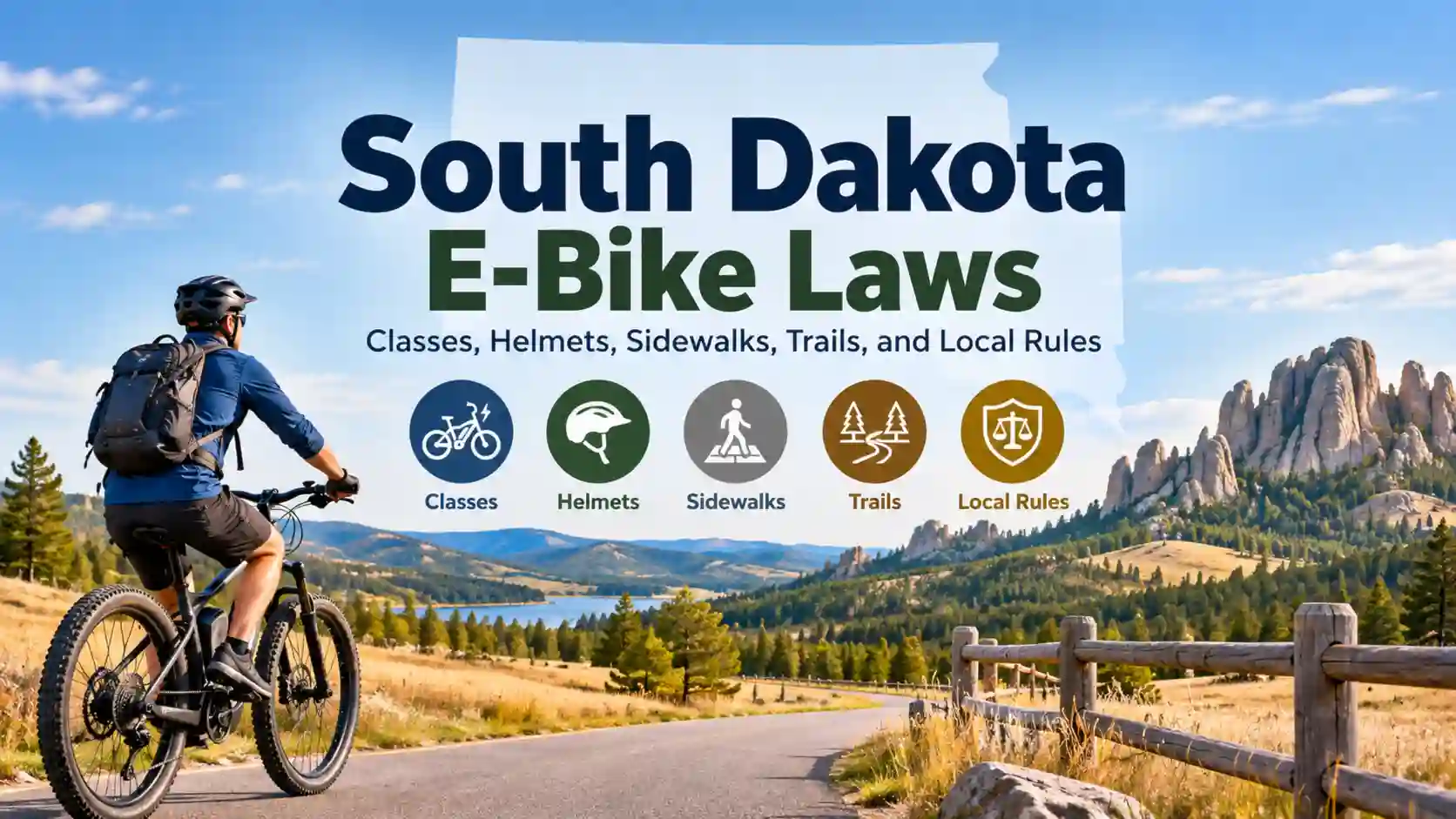
South Dakota E-Bike Laws: Classes, Helmets, Sidewalks, Trails, and Local Rules
Last Updated on September 24, 2026 by Kristina
Last researched and verified: September 2026.
South Dakota recognizes Class 1, Class 2, and Class 3 electric bicycles, but where you can ride depends on the class, the type of path or trail, and sometimes the city, campus, park, or land manager. This guide explains the statewide rules first, then breaks down important local examples including Sioux Falls, Spearfish, Sturgis, Pierre, the George S. Mickelson Trail, Badlands National Park, and major South Dakota universities.
If you are comparing another state, start with the State-by-State E-Bike Law Guide. If you are unsure what Class 1, Class 2, and Class 3 mean, see my guide to e-bike classes before reading the access rules below.
⚖️ Law Research Note
I reviewed current South Dakota statutes, agency guidance, and available local rules when this guide was updated. E-bike laws can change, and cities, parks, trails, campuses, and property managers may impose additional restrictions. Confirm current requirements before riding.
South Dakota E-Bike Laws at a Glance
| Question | South Dakota rule |
|---|---|
| Does South Dakota use the 3-class system? | Yes. State law defines Class 1, Class 2, and Class 3 electric bicycles. |
| Maximum motor power | 750W or less for a bike to fit the statutory electric-bicycle definition. |
| Class 1 | Pedal assist only. Assistance stops at 20 mph. |
| Class 2 | May use a throttle or other motor-powered propulsion. Motor assistance stops at 20 mph. |
| Class 3 | Pedal assist only. Assistance stops at 28 mph. |
| Minimum age for Class 3 operator | 16. |
| Helmet rule for Class 3 | Operators under 18 must wear a helmet. Class 3 passengers must wear a helmet regardless of age. |
| Class 3 speedometer | Required. |
| Title and vehicle registration | Qualifying electric bicycles are exempt from South Dakota motor-vehicle title and registration requirements. |
| Motor-vehicle financial responsibility | South Dakota’s financial-responsibility chapter excludes qualifying electric bicycles from its definition of motor vehicle. |
| Class label | Required. The label must identify the class, maximum assisted speed, and motor wattage. |
What Counts as an Electric Bicycle in South Dakota?
South Dakota’s electric-bicycle law applies to a bicycle with a seat or saddle, operable pedals, and an electric motor of no more than 750W. The class then depends on how the motor operates and the speed at which assistance stops.
That distinction matters. A pedal-less electric motorcycle-style vehicle, a bike with a motor above 750W, or a machine modified so that it no longer fits one of the statutory class definitions may fall outside the electric-bicycle rules in this guide. Do not assume that a vehicle is legally an e-bike simply because it has pedals or because a manufacturer markets it that way.
South Dakota’s Three E-Bike Classes
| Class | Motor operation | Assistance cutoff | Important South Dakota rule |
|---|---|---|---|
| Class 1 | Pedal assist | 20 mph | Generally receives the broadest path access with Class 2. |
| Class 2 | Throttle or motor propulsion allowed | 20 mph | Generally treated like Class 1 on bicycle and multi-use paths unless restricted by the land manager. |
| Class 3 | Pedal assist | 28 mph | Operator must be at least 16, and access to paths is more restricted. |
License, Title, Registration, Plate, and Insurance
South Dakota does not treat a qualifying electric bicycle like a registered motor vehicle. State law exempts electric bicycles from the motor-vehicle title and registration chapters, so a qualifying e-bike does not need a South Dakota motor-vehicle title, registration, or license plate.
The electric-bicycle chapter does not create a driver’s-license requirement for operating a qualifying e-bike. South Dakota’s motor-vehicle financial-responsibility law also excludes a qualifying electric bicycle from its definition of a motor vehicle. That means the state’s motor-vehicle financial-responsibility requirement does not apply to the qualifying e-bike itself.
That does not mean insurance is never useful. Homeowners, renters, bicycle, or specialty e-bike insurance may cover theft, liability, or damage depending on the policy. Coverage is separate from the question of whether the state requires motor-vehicle insurance.
Helmet and Age Rules
The strongest statewide age and helmet rules apply to Class 3 e-bikes. A person must be at least 16 to operate a Class 3 electric bicycle. A younger person may ride as a passenger if the bicycle is designed to carry a passenger.
A Class 3 operator under 18 must wear a properly fitted and fastened bicycle helmet. A passenger on a Class 3 e-bike must wear a helmet regardless of age.
For Class 1 and Class 2 bikes, local governments, parks, trails, schools, events, or property managers may impose additional helmet rules. Wearing a helmet is still the safer choice even where it is not required by statewide law.
Required Labels, Speedometers, and Modified E-Bikes
South Dakota requires an electric bicycle to carry a permanent label identifying its classification, maximum assisted speed, and motor wattage. Class 3 electric bicycles also need a speedometer.
If someone modifies an electric bicycle in a way that changes its maximum speed or motor-powered propulsion, South Dakota requires the classification label to be replaced or amended to reflect the change. Violating the labeling provision is a Class 2 misdemeanor.
There is a second issue with major modifications: if a bike is altered beyond the legal electric-bicycle definition, changing the sticker does not automatically make it a legal Class 1, 2, or 3 e-bike. For example, a 1,000W machine or one modified to provide motor assistance at 35 mph may fall outside the rules discussed on this page.
Where Can You Ride an E-Bike in South Dakota?
| Location | General rule | What to check |
|---|---|---|
| Public roads and streets | Qualifying e-bikes generally follow bicycle operating rules unless a more specific restriction applies. | Highway restrictions, local traffic ordinances, and posted rules. |
| Bike lanes | Generally available under the bicycle framework. | Local restrictions and roadway signage. |
| Sidewalks | State bicycle rules address sidewalk riding, pedestrian right-of-way, audible passing signals, and entering a roadway from a sidewalk. | City-specific sidewalk restrictions and business-district rules. |
| Bicycle and multi-use paths | Class 1 and 2 e-bikes are generally allowed unless the responsible government prohibits them. | Class 3 restrictions and any park, city, or trail-manager rule. |
| Natural-surface trails | No blanket statewide right of access. | The rule of the specific state, federal, local, or private land manager. |
| State parks and GFP-managed lands | Access varies by property and trail. | Property-specific signs and current South Dakota Game, Fish and Parks rules. |
| Federal lands | Depends on the federal agency and specific property. | National Park Service, Forest Service, refuge, or other manager rules. |
| College campuses | Campus policies can impose lower speeds and strict storage or charging rules. | Current transportation, housing, and fire-safety policies. |
For more background on pedestrian areas, see my guide to e-bike sidewalk laws. The broader e-bike rules of the road guide explains how roads, paths, bike lanes, and local restrictions fit together.
South Dakota Sidewalk Rules
South Dakota bicycle law gives a person riding on a sidewalk the rights and duties applicable to a pedestrian in that setting. A rider must yield to pedestrians, give an audible signal before overtaking and passing a pedestrian, and stop before entering a crosswalk or roadway from a sidewalk.
That statewide framework is not a promise that every sidewalk in every South Dakota city is open to every e-bike. Cities can have additional rules, and posted restrictions still matter. In busy downtown or pedestrian areas, check the local ordinance rather than relying on the state rule alone.
City Comparison: Sioux Falls, Spearfish, Sturgis, Rapid City, and Pierre
| City | Current e-bike guidance | Important detail |
|---|---|---|
| Sioux Falls | Class 1 and Class 2 e-bikes are allowed on the Recreation Trail. | The Recreation Trail has a 15 mph speed limit, and Class 3 e-bikes are prohibited on the trail. |
| Spearfish | Current city guidance allows Class 1 and Class 2 e-bikes in listed city recreation areas, recreation trails, and sidewalks. | Higher-powered or nonqualifying devices can be treated differently, so the legal classification matters. |
| Sturgis | Police guidance issued June 29, 2026 says qualifying e-bikes may use roads, streets, and sidewalks where bicycles are allowed. | Traffic rules and pedestrian right-of-way still apply. |
| Rapid City | I did not find a sufficiently clear current official e-bike-specific path rule to state a broad citywide access rule. | Use the statewide baseline, obey posted rules, and verify current Parks and Recreation guidance for the specific path or property. |
| Pierre | City officials discussed possible e-bike ordinance updates in September 2026. | The City Commission took no formal action at the September 15, 2026 meeting. Treat the proposal as under review, not current law. |
Sioux Falls Recreation Trail
Sioux Falls gives riders a particularly clear local rule. Class 1 and Class 2 e-bikes may use the Recreation Trail, but Class 3 e-bikes are prohibited. The trail speed limit is 15 mph, so even a legal Class 1 or Class 2 rider needs to stay below the bike’s full assisted-speed capability while using the trail.
Spearfish
Spearfish publishes guidance distinguishing e-bikes from mopeds, scooters, motorcycles, and other motorized devices. Its current guidance allows Class 1 and Class 2 e-bikes in specified city recreation areas, on recreation trails, and on sidewalks. Riders with faster or more powerful machines should not assume those same permissions apply.
Sturgis
Sturgis Police published updated guidance on June 29, 2026 addressing increased e-bike use. The guidance says qualifying e-bikes may operate on roads, streets, and sidewalks where bicycles are permitted, subject to traffic laws and pedestrian right-of-way.
Rapid City
Rapid City has an extensive bicycle and recreation network, but I am not treating ordinary bicycle access as proof that every path is open to every class of e-bike. For a specific Rapid City greenway, park, or trail, check the current posted rules or Parks and Recreation guidance before riding.
Pierre: Proposed Changes, Not Current Law
Current status as of September 2026: Pierre officials are discussing possible updates to local e-bike rules. At the September 15, 2026 City Commission meeting, the commission discussed proposed ordinance language and public feedback but took no formal action. Until a measure is finally adopted and effective, riders should follow the current rules rather than treating the proposal as law.
George S. Mickelson Trail E-Bike Rules
The George S. Mickelson Trail is one of the most important e-bike destinations in South Dakota, and its rules deserve separate treatment. Current South Dakota Game, Fish and Parks information permits Class 1 e-bikes on the trail.
Do not assume that permission extends to Class 2 or Class 3 simply because those bikes are legal elsewhere in the state. The trail’s current e-bike permission is specifically tied to Class 1.
Trail users age 12 and older generally need a Mickelson Trail pass except when using the trail within city limits. Current Game, Fish and Parks information lists a $5 daily pass and a $20 annual pass. Fees and policies can change, so check the current GFP page before a trip.
State Parks, Wildlife Lands, and Other GFP-Managed Property
Statewide road and multi-use-path rules do not create blanket e-bike access across every property managed by South Dakota Game, Fish and Parks. GFP restricts motor-propelled vehicles, including e-bikes, on certain managed lands except on designated roads, parking areas, or trails where use is authorized.
The practical rule is simple: identify the specific park, recreation area, wildlife property, or trail and check that property’s current motorized-vehicle and bicycle rules. The Mickelson Trail’s Class 1 policy is a useful example of why the land manager’s rule matters.
Federal Lands: Badlands National Park and Jewel Cave
Badlands National Park
Badlands National Park generally allows e-bikes in the same locations where traditional bicycles are permitted, subject to National Park Service rules and the superintendent’s compendium. E-bikes are not allowed on hiking trails or in Sage Creek Wilderness. Riders should also pay attention to rules governing motor-only operation in areas not open to public motor vehicles.
Jewel Cave National Monument
The 2026 Jewel Cave superintendent’s compendium allows traditional bicycles and e-bikes on paved or gravel roads and parking areas that are open to public motor vehicles. That is narrower than saying e-bikes may use any trail in the monument.
Federal land policies can change independently of South Dakota law. Always check the current rule for the specific National Park Service, Forest Service, refuge, or other federal property you plan to visit.
South Dakota College and University E-Bike Rules
| Campus | Riding rule | Storage and charging | Key takeaway |
|---|---|---|---|
| University of South Dakota | Bicycles and personal electric vehicles are limited to 10 mph on university property and may not be operated inside buildings. | Indoor storage and other building rules are restricted by university policy. | Campus speed can be much lower than the e-bike’s legal road capability. |
| South Dakota State University | E-bikes are covered by the university’s personal transportation device policy. | Use, storage, and charging inside university-owned or leased buildings, including residence halls, are prohibited subject to listed exceptions. Exterior charging is also restricted except at designated locations. | Do not assume a removable battery makes dorm charging acceptable. |
| South Dakota Mines | I did not verify a campus-wide e-bike-specific operating policy clear enough to summarize as a definitive rule. | Residence-life and public-safety rules may still restrict devices and storage. | Check current campus Public Safety and residence-life guidance before bringing an e-bike into university housing. |
University of South Dakota
USD’s personal electric vehicle and bicycle policy is stricter than ordinary roadway law in several ways. The university limits bicycles and personal electric vehicles to 10 mph on university property and prohibits operating them inside buildings. Students should also review current housing and storage rules before bringing a bike into a residence hall.
South Dakota State University
SDSU specifically includes e-bikes within its personal transportation device policy. The university prohibits their use, storage, and charging inside university-owned or leased buildings, including residence halls, subject to the policy’s stated exceptions. Exterior charging is also restricted except at designated locations.
South Dakota Mines
I found bicycle registration, public-safety, and residence-life information, but not a current university-wide e-bike rule clear enough to turn into a definitive campus access statement. Students should verify the latest policy directly with Public Safety or Residence Life, especially for indoor storage and charging.
Real-World South Dakota E-Bike Scenarios
Can a 15-year-old ride a Class 3 e-bike?
No. South Dakota requires a Class 3 operator to be at least 16 years old. A person under 16 may be a passenger if the bike is designed to carry a passenger.
Can I ride a Class 2 throttle e-bike on the Sioux Falls Recreation Trail?
Yes, under the current city trail rule, but you must follow the 15 mph trail speed limit and other trail-safety requirements.
Can I ride a Class 3 e-bike on the Sioux Falls Recreation Trail?
No. Sioux Falls specifically prohibits Class 3 e-bikes on the Recreation Trail.
Can I take a Class 2 throttle e-bike on the Mickelson Trail?
Not under the current Class 1-only e-bike permission. A legal Class 2 bike may be allowed on other South Dakota paths, but that does not override the Mickelson Trail’s specific policy.
Can I ride a Class 3 e-bike on the Mickelson Trail?
Do not assume so. The current GFP policy specifically permits Class 1 e-bikes.
Can an SDSU student charge an e-bike in a dorm room?
No under the current SDSU personal transportation device policy. E-bike use, storage, and charging inside university-owned or leased buildings, including residence halls, are prohibited subject to the policy’s listed exceptions.
What if my e-bike has a 1,000W motor?
A 1,000W machine does not fit South Dakota’s statutory electric-bicycle definition, which is limited to 750W or less. Different vehicle rules may apply.
What if I unlock my e-bike so the motor assists to 35 mph?
That modification can take the bike outside South Dakota’s Class 1, Class 2, or Class 3 definitions. South Dakota also requires the classification label to be updated when a modification changes maximum speed or motor-powered propulsion. Do not assume the machine remains a legal electric bicycle after a speed modification.
Can I ride on any sidewalk because state law has sidewalk bicycle rules?
No. State law provides a baseline for sidewalk operation and pedestrian right-of-way, but local ordinances and posted restrictions can be more specific. Check the city or property rule for the sidewalk you plan to use.
Helpful Gear for Riding
These items help you stay safe and follow the rules:
Common South Dakota E-Bike Mistakes
- Assuming every bike sold as an e-bike legally fits South Dakota’s 750W and class definitions.
- Assuming Class 3 bikes have the same path access as Class 1 and Class 2.
- Ignoring the 15 mph limit on the Sioux Falls Recreation Trail because the bike itself can legally assist faster elsewhere.
- Assuming a Class 2 bike is allowed on the Mickelson Trail because Class 2 is legal on many other multi-use paths.
- Applying state road rules to a university campus, state wildlife property, or national park without checking the land manager’s policy.
- Treating Pierre’s September 2026 discussion as an adopted ordinance when no formal action was taken at the meeting.
Nearby State Law Guides
Traveling outside South Dakota? Laws change quickly.Check other states:
North Dakota e-bike laws
Oregon e-bike laws
New York e-bike laws
Nebraska e-bike laws
👉 Compare all states in the state-by-state e-bike law guide
South Dakota E-Bike Law FAQs
Does South Dakota require e-bike registration?
No for a qualifying electric bicycle. South Dakota exempts electric bicycles from the state’s motor-vehicle title and registration requirements.
Do I need a driver’s license for a South Dakota e-bike?
The South Dakota electric-bicycle chapter does not create a driver’s-license requirement for a qualifying e-bike.
Does South Dakota require e-bike insurance?
South Dakota’s motor-vehicle financial-responsibility chapter excludes a qualifying electric bicycle from its definition of a motor vehicle. Optional insurance may still be useful for theft, damage, or liability.
How old do you have to be to ride a Class 3 e-bike in South Dakota?
You must be at least 16 to operate a Class 3 e-bike.
Do adults need helmets on Class 3 e-bikes?
An adult Class 3 operator is not subject to the under-18 operator helmet requirement in the state e-bike statute, but every passenger on a Class 3 e-bike must wear a helmet regardless of age. Local or property rules can add requirements.
Are Class 2 e-bikes legal on South Dakota bike paths?
Generally yes on bicycle and multi-use paths unless the responsible government or land manager prohibits them. A specific trail can impose a different rule, as the Mickelson Trail does.
Are e-bikes allowed on South Dakota sidewalks?
State bicycle rules provide a sidewalk-operating framework, including yielding to pedestrians and giving an audible signal when passing. Local ordinances may impose additional restrictions, so check the city where you plan to ride.
My Take
South Dakota’s statewide e-bike framework is relatively easy to understand once you know the three classes, but the practical riding rules become more complicated at the local level. The biggest distinction for most riders is that Class 1 and Class 2 e-bikes generally receive broader path access, while Class 3 bikes face additional age, helmet, equipment, and path restrictions.
The other important lesson is that destination rules matter. Sioux Falls has a 15 mph Recreation Trail limit and excludes Class 3 bikes, the Mickelson Trail specifically allows Class 1 e-bikes, and university policies can be far stricter about speed, indoor storage, and charging than state road law. Before a trip, check the rule for the exact trail, campus, park, or city rather than relying only on the statewide definition.
Like Electric Bike Explorer?
Add Electric Bike Explorer as a Preferred Source on Google to make it easier to see more of our e-bike news, guides, reviews, and troubleshooting content in Google Search.
Legal Disclaimer
This guide is for general informational purposes and is not legal advice. State, city, campus, park, trail, and property rules can change or differ. Confirm current requirements with the agency or authority responsible for the place where you plan to ride.
Official Sources
- South Dakota Codified Laws Chapter 32-20B – bicycles and electric bicycles
- South Dakota electric-bicycle label and modification requirements
- South Dakota electric-bicycle path access rules
- South Dakota Class 3 age rules
- South Dakota title and registration exemption for electric bicycles
- South Dakota financial-responsibility statutes
- City of Sioux Falls Recreation Trail safety and e-bike rules
- City of Spearfish guidance for e-bikes and motorized devices
- City of Sturgis Police e-bike guidance, June 29, 2026
- City of Pierre September 2026 e-bike ordinance discussion
- South Dakota Game, Fish and Parks George S. Mickelson Trail information
- South Dakota Game, Fish and Parks rules for motor-propelled vehicles on managed lands
- Badlands National Park superintendent’s compendium
- Jewel Cave National Monument superintendent’s compendium
- University of South Dakota personal electric vehicle and bicycle policy
- South Dakota State University personal transportation device storage and safety policy

Kristina is not just an enthusiast but a true authority on electric bikes. Nestled in the coastal beauty of Virginia, Kristina has found the perfect backdrop for her passion for electric biking. As a dedicated wife and homeschooling mom, her life revolves around family, faith, and the thrill of adventure.
Originally hailing from Ohio, Kristina's journey with electric bikes began as a curiosity and quickly evolved into a deep expertise. Her blog is a testament to her love for electric biking, combining her fascination for eco-friendly transportation with her coastal lifestyle.
When she's not cruising the beach on her electric bike, you'll find Kristina indulging in her other loves: long walks along the shore, getting lost in a good book, and cherishing moments with her loved ones. With a heart as big as her love for animals, especially cats, Kristina brings a unique perspective to the electric bike world, grounded in her strong faith in God and her dedication to a sustainable lifestyle.
Through her blog, Kristina shares her extensive knowledge of electric bikes, offering valuable insights, tips, and recommendations to fellow enthusiasts. Whether you're a seasoned rider or a newcomer to the electric bike scene, Kristina's blog is your go-to source for all things electric biking, fueled by her passion, expertise, and the scenic beauty of coastal Virginia.