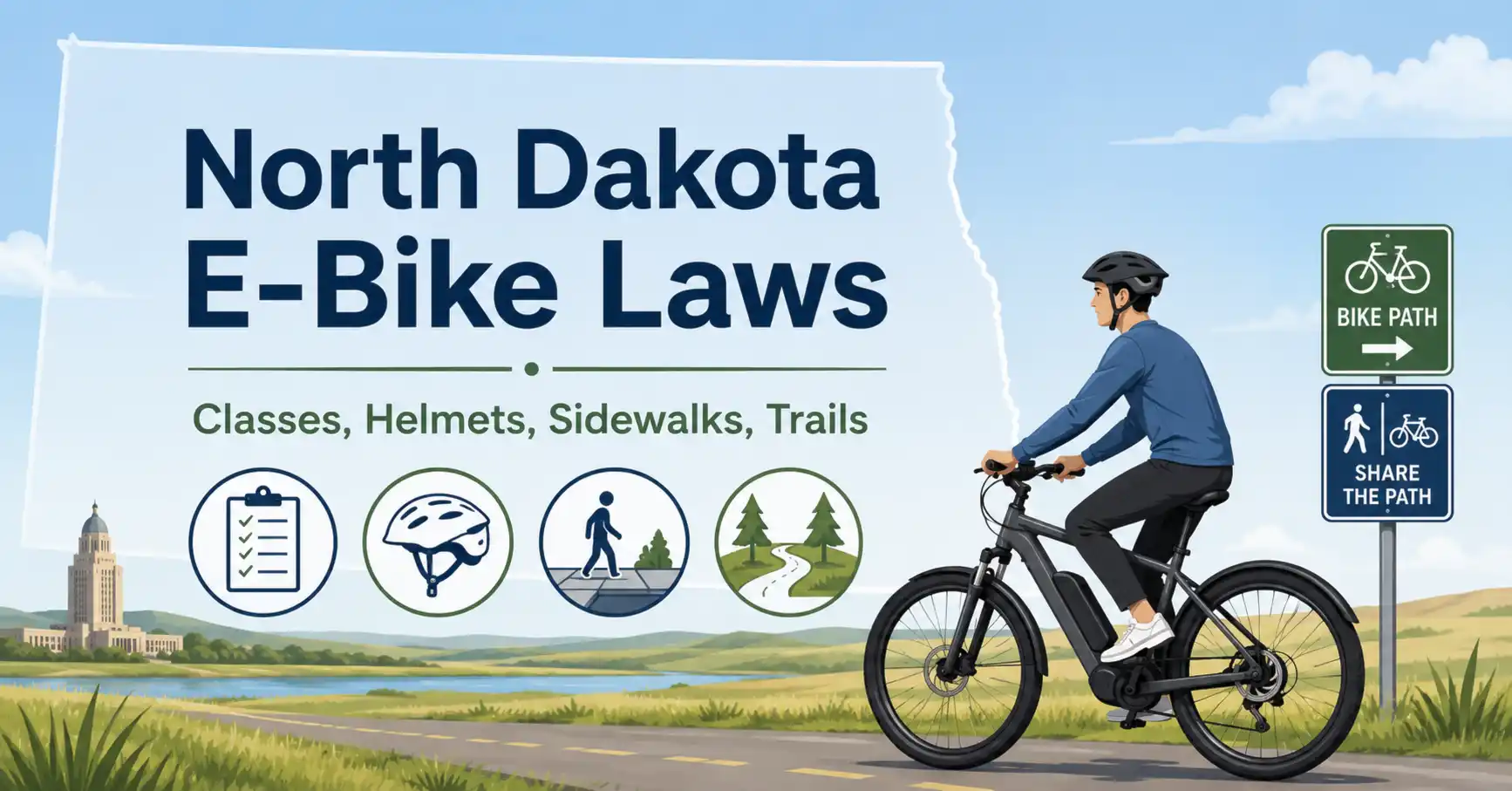
North Dakota E-Bike Laws: Classes, Helmets, Sidewalks, Trails, and Local Rules
Last Updated on July 21, 2026 by Kristina
Last researched and verified: July 2026
North Dakota e-bike laws are generally friendly toward riders, but several important rules are easy to overlook.
The state recognizes Class 1, Class 2, and Class 3 electric bicycles. Qualifying e-bikes do not require a driver’s license, motor vehicle registration, a certificate of title, a license plate, or motor vehicle liability insurance.
North Dakota also generally allows electric bikes on bicycle paths and multi-use paths unless the government agency managing the path prohibits them. However, local sidewalk ordinances, federal trail restrictions, Class 3 helmet requirements, equipment rules, and North Dakota’s unusual stop-sign law can all affect where and how you ride.
In this North Dakota electric bike law guide, I explain:
- North Dakota’s three e-bike classes
- Motor wattage and assisted speed limits
- License, registration, title, and insurance requirements
- Helmet and minimum-age rules
- Road, bike lane, sidewalk, and trail access
- Fargo, Bismarck, Grand Forks, and Minot e-bike rules
- North Dakota state park policies
- Maah Daah Hey Trail restrictions
- Theodore Roosevelt National Park e-bike rules
- University of North Dakota and North Dakota State University policies
- What happens when an e-bike is modified or exceeds the legal limits
New to electric bikes? My Start Here E-Bike Guide explains the basics, while my E-Bike Classes Explained Guide can help you determine whether your bike is Class 1, Class 2, or Class 3.
You can also compare North Dakota with other states in my State-by-State E-Bike Laws Guide.
Quick Answer: North Dakota recognizes Class 1, Class 2, and Class 3 e-bikes with motors rated at 750 watts or fewer. A qualifying e-bike does not require a driver’s license, registration, title, license plate, or motor vehicle liability insurance. Riders under 18 must wear a helmet on a Class 3 e-bike, and Class 3 bikes must have a functioning speedometer. E-bikes are generally allowed on bicycle and multi-use paths unless the managing government agency prohibits them. Local sidewalk and federal trail rules can be stricter.
North Dakota E-Bike Laws at a Glance
| North Dakota e-bike requirement | State rule |
|---|---|
| Maximum motor power | 750 watts or fewer |
| Class 1 maximum motor-assisted speed | 20 mph |
| Class 1 motor operation | Pedal assist only |
| Class 2 maximum motor-assisted speed | 20 mph |
| Class 2 throttle | Permitted |
| Class 3 maximum motor-assisted speed | 28 mph |
| Class 3 motor operation | Pedal assist only |
| Driver’s license | Not required for a qualifying e-bike |
| Motor vehicle registration | Not required |
| Certificate of title | Not required |
| License plate | Not required |
| Motor vehicle insurance | Not required |
| Statewide minimum operating age | No specific statewide minimum age found |
| Helmet requirement | Riders under 18 operating Class 3 |
| Class 3 speedometer | Required |
| Bicycle and multi-use paths | Generally allowed unless prohibited by the managing government agency |
| Sidewalks | Controlled mainly by local ordinances and posted restrictions |
| Nighttime front light | White light visible from at least 500 feet |
| Nighttime rear equipment | Approved red reflector required |
| Safe passing distance | At least three feet |
| Manufacturer label | Must show class, maximum assisted speed, and motor wattage |
| Modified e-bike | Classification label must be replaced after certain speed or engagement changes |
These rules apply to a vehicle that meets North Dakota’s legal definition of an electric bicycle. A high-powered electric motorcycle or modified e-bike may be classified differently.
🔍 Why You Can Trust Electric Bike Explorer
Electric Bike Explorer is dedicated to providing honest, well-researched, and easy-to-understand information for e-bike riders. Whenever possible, I personally test the e-bikes, accessories, and products I review. When I can’t test something directly, I rely on careful research, manufacturer specifications, real-world rider feedback, official sources, and trusted industry information.
For law guides, I review state statutes, local ordinances, transportation agencies, park rules, and official government resources whenever possible. For e-bike news, I review the original reporting along with available town documents, meeting agendas, proposed ordinances, police statements, government notices, and other primary sources. I also make a clear distinction between a proposal, an approved rule, and a law that has already taken effect.
For troubleshooting and safety guides, I focus on practical explanations, common rider experiences, manufacturer guidance, and safe maintenance practices.
My goal is to help you make informed decisions, understand the rules where you ride, solve common e-bike problems, and get the most out of your electric bike safely.
Want to know how I score bikes and research my guides? Read my full review and ranking process
Want to See More Electric Bike Explorer in Google Search?
Add Electric Bike Explorer as a preferred source to see more of our e-bike law guides, safety updates, reviews, buying guides, and troubleshooting posts when they are relevant to your searches.
Are E-Bikes Legal in North Dakota?
Yes. Electric bicycles are legal in North Dakota.
North Dakota includes qualifying electric bicycles within its general definition of a bicycle. The state also excludes qualifying e-bikes from its definitions of motor vehicle, motorcycle, motorized bicycle, and motor-powered recreational vehicle.
That means a legal Class 1, Class 2, or Class 3 e-bike is generally treated more like a traditional bicycle than a motorcycle or motor vehicle.
However, the vehicle must actually meet North Dakota’s electric bicycle definition. Calling a high-powered electric motorbike an “e-bike” does not automatically give it the same legal status.
How North Dakota Defines an Electric Bicycle
Under North Dakota law, an electric bicycle must have:
- Fully operable pedals
- A saddle or seat for the rider
- An electric motor rated at 750 watts or fewer
- Motor operation that fits within one of the state’s three e-bike classes
North Dakota’s law uses the wording “seven hundred fifty or fewer watts.” This means a motor rated at exactly 750 watts can meet the state definition, provided the bike also satisfies the other class requirements.
A bike may fall outside the legal electric bicycle definition if it:
- Has a motor rated above 750 watts
- Does not have fully operable pedals
- Continues providing motor assistance beyond its class limit
- Has been modified so it no longer meets a recognized class
- Functions more like an electric dirt bike or motorcycle
The legal classification of a vehicle outside the e-bike definition depends on its power, speed, equipment, design, and how it is operated.
North Dakota’s Three Electric Bike Classes
North Dakota follows the common three-class electric bicycle system.
Class 1 E-Bikes in North Dakota
A Class 1 electric bicycle provides motor assistance only while the rider is pedaling.
The motor must stop providing assistance when the bike reaches 20 mph.
A North Dakota Class 1 e-bike:
- Has fully operable pedals
- Uses pedal assistance
- Does not use throttle-only propulsion
- Stops providing motor assistance at 20 mph
Class 1 e-bikes are often a practical choice for commuting, recreational riding, and shared-use paths, although the agency managing a particular path or trail can still prohibit them.
Class 2 E-Bikes in North Dakota
A Class 2 electric bicycle can propel the bike without the rider pedaling.
This normally means the e-bike can be operated with a throttle. Motor assistance must stop when the bike reaches 20 mph.
A North Dakota Class 2 e-bike:
- Has fully operable pedals
- May use a throttle
- Can move under motor power without pedaling
- Stops providing motor assistance at 20 mph
Many folding, cruiser, commuter, cargo, and fat tire e-bikes sold in the United States are configured as Class 2 models.
Class 3 E-Bikes in North Dakota
A Class 3 electric bicycle provides assistance only while the rider is pedaling.
The motor must stop providing assistance when the bike reaches 28 mph.
A North Dakota Class 3 e-bike:
- Has fully operable pedals
- Uses pedal assistance
- Stops providing motor assistance at 28 mph
- Must have a functioning speedometer
- Requires riders under 18 to wear a safety helmet
North Dakota’s statutory Class 3 definition is pedal-assist only. Riders should not assume that a bike offering both a throttle and 28 mph pedal assistance automatically fits North Dakota’s Class 3 definition. Check the manufacturer’s label, operating modes, and actual configuration.
My E-Bike Classes Explained Guide provides a more detailed comparison of Class 1, Class 2, and Class 3 electric bikes.
Do You Need a Driver’s License for an E-Bike in North Dakota?
No. You do not need a driver’s license to operate a qualifying Class 1, Class 2, or Class 3 e-bike in North Dakota.
North Dakota excludes electric bicycles from the motor vehicle definition used for motor vehicle registration, title registration, and operator licensing. It also separately excludes electric bicycles from the state definitions of motorcycle and motorized bicycle.
This exemption applies only when the vehicle continues to qualify as an electric bicycle.
A high-powered electric motorcycle, e-moto, electric dirt bike, or modified vehicle that exceeds North Dakota’s e-bike limits should not automatically be treated as a license-free electric bicycle.
Do E-Bikes Need Registration in North Dakota?
No. North Dakota does not require a qualifying electric bicycle to be registered as a motor vehicle.
Because qualifying electric bicycles are excluded from the state’s motor vehicle definition for registration purposes, they do not need standard motor vehicle registration or a motor vehicle license plate.
A university or local organization may still require separate bicycle registration for identification, parking, or theft recovery. That type of bicycle registration is different from registering a motor vehicle with the state.
Do Electric Bikes Need a Title in North Dakota?
No. North Dakota expressly excludes electric bicycles from the state’s certificate-of-title requirement.
This means the owner of a qualifying Class 1, Class 2, or Class 3 e-bike does not need to apply for a North Dakota motor vehicle title.
Official source:
https://ndlegis.gov/cencode/t39c05.pdf
Is E-Bike Insurance Required in North Dakota?
No. North Dakota does not require motor vehicle liability insurance for a qualifying Class 1, Class 2, or Class 3 electric bicycle.
The state’s financial responsibility law specifically excludes electric bicycles from its definition of a motor vehicle.
Although insurance is not required, optional e-bike or bicycle coverage may help with:
- Theft
- Accidental damage
- Liability claims
- Expensive batteries and components
- Roadside assistance
- Transportation after a breakdown
Homeowners or renters insurance may provide some coverage, but limits, exclusions, and deductibles vary.
North Dakota E-Bike Helmet Laws
North Dakota does not require every e-bike rider to wear a helmet.
The statewide electric bicycle law specifically requires a helmet when:
- The rider is under 18
- The rider is operating a Class 3 electric bicycle
I did not find a statewide e-bike helmet requirement applying to riders of all ages on Class 1 or Class 2 e-bikes. The Class 3 requirement also does not apply to riders age 18 or older.
A city, school, university, rental company, park, or organized event may impose a stricter helmet policy.
Even when a helmet is not legally required, I recommend wearing one. Electric bikes are generally heavier than traditional bicycles and can maintain higher average speeds.
Is There a Minimum Age for Riding an E-Bike in North Dakota?
I did not find a specific statewide minimum operating age for Class 1, Class 2, or Class 3 electric bicycles in North Dakota’s current e-bike statutes.
The primary statewide youth restriction requires a rider under 18 to wear a helmet while operating a Class 3 electric bicycle.
North Dakota also states that a parent or guardian may not authorize or knowingly permit a child or ward to violate the state bicycle chapter.
The absence of a minimum age does not mean every e-bike is suitable for a child.
Parents should consider:
- The weight of the bike
- Maximum motor-assisted speed
- Throttle sensitivity
- Acceleration strength
- Brake quality
- Rider maturity
- Traffic conditions
- Whether the child can safely control and stop the bike
- Local school, park, and trail rules
For a younger or inexperienced rider, a properly sized Class 1 or lower-powered Class 2 e-bike may be more appropriate than a 28 mph Class 3 model.
Can Visitors Ride an E-Bike in North Dakota?
Visitors can generally ride a qualifying e-bike in North Dakota under the same electric bicycle laws that apply to residents.
A visitor does not need to obtain a North Dakota driver’s license, vehicle registration, title, or license plate for a qualifying e-bike.
Visitors must still follow:
- North Dakota traffic laws
- Local sidewalk ordinances
- Park and trail restrictions
- Federal land policies
- Posted signs and closures
- The Class 3 helmet requirement for riders under 18
This is especially important for riders visiting the Maah Daah Hey Trail or Theodore Roosevelt National Park, where federal rules are more restrictive than North Dakota’s general path-access law.
Do E-Bikes Have the Same Rights as Bicycles in North Dakota?
North Dakota includes electric bicycles within its general definition of a bicycle.
A person riding a bicycle on a roadway receives the rights and is subject to the duties that generally apply to a vehicle driver, except for provisions that cannot reasonably apply to a bicycle or where a special bicycle rule controls.
This means North Dakota e-bike riders must follow applicable:
- Traffic signs
- Traffic signals
- Right-of-way rules
- Lane-direction rules
- Road closures
- Yield requirements
Drivers must also respect the legal right of qualifying e-bikes to use roads where bicycles are allowed.
North Dakota Rules of the Road for E-Bikes
Where Should E-Bikes Ride on the Road?
A person operating a bicycle on a roadway in North Dakota must ride as near to the right side as practicable while exercising due care when passing a parked vehicle or another vehicle traveling in the same direction.
The phrase “as practicable” is important.
It does not mean a rider must stay dangerously close to the curb when the edge of the road contains:
- Broken pavement
- Gravel
- Snow or ice
- Drainage grates
- Parked vehicles
- Opening car doors
- Road debris
- Other hazards
Riders should use a predictable road position while moving far enough from hazards to ride safely.
Can E-Bikes Ride Two Abreast?
North Dakota allows bicycle riders to travel no more than two abreast on a roadway.
This restriction does not apply in the same way on paths or portions of roadways set aside exclusively for bicycle use.
Even where riding two abreast is legal, moving into single file may be safer when:
- Traffic is heavy
- The road is narrow
- Visibility is limited
- A driver is waiting to pass
- Road or weather conditions are poor
Do North Dakota Drivers Have to Give E-Bikes Three Feet?
Yes. A driver overtaking a bicycle traveling in the same direction must leave a safe passing distance of at least three feet and maintain that clearance until safely past the bicycle.
Because qualifying electric bicycles are included within North Dakota’s bicycle definition, the three-foot passing protection applies to legal e-bike riders.
Can You Carry Packages While Riding?
A person operating a bicycle may not carry a package, bundle, or other item that prevents the rider from keeping at least one hand on the handlebars.
Use a basket, cargo rack, backpack, panniers, or trailer rather than attempting to carry a large item with both hands.
Does North Dakota Have an Idaho Stop Law for E-Bikes?
North Dakota has a conditional stop-sign rule for bicycles. It is sometimes compared with an Idaho stop, but it does not allow riders to roll through every stop sign.
Because qualifying e-bikes are included within the state’s bicycle definition, the rule applies to legal electric bicycles.
When a Full Stop Is Required
A rider must come to a complete stop when:
- The stop sign controls an intersection with a roadway having three or more lanes for moving traffic
- Another vehicle is stopped in the roadway at the same stop sign
- A full stop is necessary for safety
- Another applicable traffic rule requires a stop
When a Rider May Proceed Without a Full Stop
At a stop sign intersecting a roadway with two or fewer lanes for moving traffic, a rider may:
- Reduce speed to a reasonable speed
- Stop if necessary for safety
- Yield to traffic already in or approaching the intersection
- Cautiously turn or proceed after yielding
A rider must yield to a vehicle already in the intersection.
When a bicycle and another vehicle enter an intersection from different roadways at approximately the same time, the person on the left must yield to the person on the right.
If a bicyclist proceeds past a stop sign without stopping and becomes involved in a collision, the collision can be treated as initial evidence that the rider failed to yield.
North Dakota’s special rule for certain stop signs should not be interpreted as permission to ride through a steady red traffic signal.
When the lane count, visibility, traffic, or intersection design is unclear, making a complete stop is the safer choice.
North Dakota E-Bike Lighting and Brake Requirements
Front Light Requirement
When riding at night, a bicycle must have a front lamp that emits white light visible from at least 500 feet.
Rear Reflector Requirement
A bicycle must have an approved red reflector on the rear.
A red rear lamp visible from at least 500 feet may be used in addition to the reflector. The wording of the statute makes the reflector required equipment, so a rider should not rely on a rear light as a replacement for the reflector.
Brake Requirement
Every bicycle must have a brake capable of making the braked wheels skid on dry, level, clean pavement.
The practical concern is whether the brakes can safely stop the combined weight and speed of the e-bike, rider, passenger, and cargo.
Check:
- Brake pad thickness
- Rotor condition
- Cable tension
- Hydraulic fluid pressure
- Brake lever response
- Tire condition
- Stopping distance
- Performance when carrying cargo
Brake maintenance is especially important on Class 3 e-bikes because of their higher assisted speed.
Are Bells, Mirrors, or Turn Signals Required?
I did not find a statewide requirement in North Dakota’s bicycle chapter requiring every electric bicycle to have:
- A bell
- A horn
- A mirror
- Electronic turn signals
These accessories can still improve safety.
A mirror can be helpful on rural roads, while a bell or horn can help alert pedestrians before passing on a shared-use path.
Electronic turn signals should not replace clear communication, awareness, or any applicable hand-signal requirements.
North Dakota E-Bike Labeling Requirements
Beginning January 1, 2022, a person manufacturing or distributing an electric bicycle in North Dakota must attach a permanent label showing:
- The designated electric bicycle class
- The maximum assisted speed
- The motor wattage
The information must appear in at least nine-point Arial font.
This direct labeling requirement applies to manufacturers and distributors.
I would not automatically describe an older e-bike as illegal solely because the original classification sticker is missing. However, a missing or inaccurate label can make it more difficult to prove that the bike fits North Dakota’s legal definition.
Motor Cutoff and Manufacturing Requirements
North Dakota requires electric bicycle equipment and manufacturing to comply with the federal bicycle requirements found in 16 CFR Part 1512.
An e-bike must also be equipped so the electric motor can be disengaged or cease operating when the rider stops pedaling or when the brakes are applied.
Before riding, confirm that the motor disengagement system works as designed.
If the bike has electronic brake cutoff sensors, test them periodically to make sure motor power stops when the brakes are applied.
Also check that:
- Pedal assistance stops at the proper class limit
- A throttle returns to its resting position
- The motor does not continue running unexpectedly
- The controller and display respond normally
- Safety systems have not been bypassed
What Happens If You Modify an E-Bike in North Dakota?
North Dakota law directly addresses modifications that change an electric bicycle’s motor-powered speed capability or the way the motor engages.
A person may not tamper with or modify an e-bike to change those features unless the required classification label is replaced after the modification.
Examples may include:
- Unlocking the motor-assisted speed
- Removing a factory speed limiter
- Changing controller programming
- Installing a different motor
- Altering throttle operation
- Changing when the motor engages
- Bypassing a motor cutoff system
Replacing the label does not automatically make every modification legal.
The finished bike must still meet North Dakota’s definition of a Class 1, Class 2, or Class 3 electric bicycle. A bike with a motor above 750 watts or assistance beyond the state’s class limits may no longer qualify as an e-bike.
High-Powered E-Bikes and Electric Motorcycles
A growing number of motorcycle-style electric vehicles are marketed using the word “e-bike,” even though they may not meet North Dakota’s electric bicycle definition.
Be careful with a vehicle advertised as:
- Having a 1,000-watt, 2,000-watt, or larger motor
- Capable of 35, 40, or 50 mph under motor power
- Having decorative or nonfunctional pedals
- An electric dirt bike
- An e-moto
- “Off-road only”
- Legal without a license in every state
North Dakota’s electric bicycle definition limits the motor to 750 watts or fewer and requires the vehicle to fit within one of the state’s three recognized classes.
A vehicle outside those limits may be subject to different licensing, registration, insurance, equipment, road-access, or off-highway vehicle rules.
The exact classification depends on how the vehicle is designed, equipped, modified, and operated.
A seller calling something an e-bike does not make it a legal electric bicycle.
Are E-Bikes Allowed on North Dakota Roads?
Qualifying electric bicycles can generally be ridden on North Dakota roads where traditional bicycles are permitted.
E-bike riders receive the rights and duties that generally apply to vehicle drivers, subject to North Dakota’s special bicycle rules.
Riders should:
- Travel in the same direction as traffic
- Obey traffic signs and signals
- Yield when required
- Ride predictably
- Use lights at night
- Avoid sudden lane movements
- Watch for opening vehicle doors
- Follow local restrictions and posted signs
Controlled-access highways or specially posted roads may restrict bicycle use. Always follow current signs.
Are E-Bikes Allowed in North Dakota Bike Lanes?
Because North Dakota includes qualifying e-bikes within its bicycle definition, legal e-bikes can generally use bicycle lanes where bicycles are allowed.
Local ordinances may add more specific requirements.
For example, Bismarck requires bicycle riders to use designated bicycle lanes when traveling on a roadway, except when leaving the lane to make a left turn or avoid an obstruction.
Class 3 riders should reduce their speed when a bike lane is:
- Narrow
- Crowded
- Beside parked cars
- Approaching an intersection
- Shared with turning traffic
- Covered with snow, gravel, or debris
A 28 mph assisted limit does not mean 28 mph is safe in every bicycle lane.
Are E-Bikes Allowed on Sidewalks in North Dakota?
North Dakota does not have one simple statewide sidewalk rule that applies identically in every city.
Sidewalk access can depend on:
- City ordinances
- Downtown or business district restrictions
- Posted signs
- Park rules
- Campus policies
- Pedestrian conditions
Fargo, Bismarck, and Grand Forks have different local rules.
Before riding in an unfamiliar city, check my E-Bike Sidewalk Laws Guide and review the current local ordinance.
Even where sidewalk riding is allowed:
- Travel slowly
- Yield to pedestrians
- Give warning before passing
- Watch for vehicles entering driveways
- Slow before entering a crosswalk
- Do not assume drivers can see you
Drivers may not expect a bicycle to enter a crossing at e-bike speed.
Are E-Bikes Allowed on Bicycle Paths and Multi-Use Paths?
North Dakota law says a person may operate an electric bicycle on a bicycle path or multi-use path unless a governmental entity with jurisdiction prohibits it.
The statute does not limit this general permission only to Class 1 e-bikes.
However, this does not guarantee access to every path or trail.
A city, county, park district, university, state agency, National Park Service unit, or federal land manager may establish more restrictive rules for the property it manages.
Before riding, check:
- Trailhead signs
- E-bike class restrictions
- Motorized and nonmotorized designations
- Local speed limits
- Seasonal closures
- Wet-weather closures
- Park-specific regulations
My E-Bike Trail Access Checker can help riders understand which rules to verify.
Are E-Bikes Allowed on Natural-Surface Trails?
North Dakota’s general path law does not guarantee access to every mountain bike or natural-surface trail.
Access depends heavily on who manages the property.
A North Dakota trail may be controlled by:
- North Dakota Parks and Recreation
- A city or county park district
- The USDA Forest Service
- The National Park Service
- A university
- A private landowner
- A nonprofit trail organization
The land manager’s designation can be more important than the general state law.
This is especially important on the Maah Daah Hey Trail and within Dakota Prairie Grasslands, where the Forest Service treats e-bikes as motorized vehicles.
Can North Dakota Cities Restrict E-Bikes?
Yes. Local governments and other government agencies can regulate e-bike use on property under their control.
North Dakota’s path-access law specifically allows a government entity with jurisdiction to prohibit electric bicycles on a bicycle or multi-use path.
Local rules may regulate:
- Sidewalk riding
- Downtown pedestrian areas
- Bike lane use
- Parks
- Trails
- Parking
- Speed
- Campus storage
- Battery charging
- Special events
An e-bike can be legal under North Dakota state law but prohibited on a particular sidewalk, trail, path, or campus.
North Dakota City E-Bike Rules Comparison
| Location | Streets | Sidewalks | Paths and trails | Important local rule |
|---|---|---|---|---|
| Fargo | Generally allowed outside posted restrictions | Allowed on certain alternate routes, but verify signs | Check current signs and agency rules | Bikes must be walked throughout the Broadway Bicycle/Pedestrian Safety Zone |
| Bismarck | Allowed under bicycle rules | Prohibited in business districts unless designated as a bicycle route | Follow posted restrictions | E-bikes are expressly covered by the city bicycle chapter |
| Grand Forks | Allowed | Official police guidance permits pedal bikes and e-bikes | Shared-use paths, bike paths, and the Greenway are listed as allowed | Riders must follow traffic laws and signs |
| Minot | State bicycle rules provide the baseline | Verify current local ordinance and signs | Verify the managing agency’s rules | No clear current official city e-bike summary was found |
Local ordinances can change. Use this chart as a starting point and follow posted restrictions.
Fargo E-Bike Laws
Qualifying e-bikes are treated as bicycles under North Dakota law, so Fargo’s bicycle guidance is relevant to legal electric bicycles.
Downtown Fargo Broadway Bicycle and Pedestrian Safety Zone
Fargo has designated Broadway from NP Avenue North to 6th Avenue North as a Bicycle/Pedestrian Safety Zone.
The city’s official guidance says the zone includes both:
- Broadway’s street
- Broadway’s sidewalks
Bicyclists must walk their bikes throughout the designated safety zone and obey pedestrian rules.
This is an important correction because the restriction is not limited to riding on the sidewalk.
Riders who want to continue riding rather than walking can use nearby alternate routes such as:
- Roberts Street North
- 5th Street North
Fargo says bicycles may be ridden in the street or on the sidewalk along those alternate routes. The city advises riders to be courteous to pedestrians, walk bicycles across crosswalks, and watch for turning vehicles.
What Fargo Riders Should Know
The Broadway zone is the local rule most likely to surprise visitors.
If you enter the designated area between NP Avenue North and 6th Avenue North, dismount and walk your e-bike. Use Roberts Street North or 5th Street North when you want to remain on the bike.
Watch for posted signs because downtown boundaries and traffic rules can change.
Bismarck E-Bike Laws
Bismarck’s traffic code expressly states that its bicycle regulations apply to electric bicycles as defined under North Dakota law.
This makes Bismarck’s local e-bike rules clearer than those of cities that only use the general word “bicycle.”
Bismarck Sidewalk Rules
A person may not ride a bicycle or qualifying e-bike on a sidewalk within a business district unless the sidewalk has been designated as a bicycle route.
Bicycle riding is also prohibited on public or private property where signs prohibit it.
Where sidewalk riding is permitted, the rider must yield the right-of-way to pedestrians.
Bismarck Road and Bike Lane Rules
Bismarck requires bicycle and e-bike riders to:
- Ride as near to the right side of the road as practicable
- Use care when passing parked or moving vehicles
- Ride single file in designated bike lanes except when passing
- Use a designated bicycle lane when one is provided
- Leave the bike lane when necessary to turn left
- Leave the lane when necessary to avoid an obstruction
- Travel in the same direction as traffic
Bismarck’s code also requires a slower rider delaying traffic to move as far toward the appropriate side of the traveled roadway as is safe when following traffic cannot legally or safely pass. The rider is not required to make that movement within 50 feet of an intersection until after passing through the intersection.
What Bismarck Riders Should Know
The main rule to remember is the business district sidewalk restriction.
If you are unsure whether you are in a business district or whether a sidewalk is a designated bicycle route, dismount and walk or use an appropriate road or bicycle lane.
Grand Forks E-Bike Laws
The Grand Forks Police Department provides direct guidance for pedal bicycles and electric bicycles.
The city says pedal bikes and e-bikes may be ridden on:
- Sidewalks
- Streets
- Shared-use paths
- Bike paths
- The Greenway
Riders must follow the rules of the road and obey traffic signs.
What Grand Forks Riders Should Know
Grand Forks currently provides broader sidewalk access than Bismarck’s business district rule or Fargo’s Broadway restriction.
This does not give e-bike riders priority over pedestrians.
Slow down on sidewalks and shared-use paths, provide warning before passing, and be prepared for children, pets, and pedestrians to change direction unexpectedly.
The city also distinguishes pedal bikes and e-bikes from “motorized bikes.” A vehicle that does not meet North Dakota’s electric bicycle definition may be subject to different rules.
🎥 Watch: Dickinson E-Bike Ordinance Updates
This May 2026 video from the Dickinson Police Department explains the city’s updated e-bike rules and where riders are allowed to ride
Minot E-Bike Laws
I did not find a current official Minot page that clearly summarizes Class 1, Class 2, and Class 3 e-bike access on streets, sidewalks, and local trails.
Because of that, riders should use North Dakota state law as the starting point while also checking:
- Current Minot city ordinances
- Downtown sidewalk signs
- Minot Park District policies
- Individual trail rules
- School policies
- Campus rules
- Posted restrictions
The absence of a simple city e-bike webpage does not mean there are no local restrictions.
Do not assume that Fargo, Bismarck, or Grand Forks sidewalk rules also apply in Minot.
North Dakota State Park E-Bike Rules
North Dakota Parks and Recreation manages more than 100 miles of bicycle trails, including paved routes and natural-surface mountain biking trails.
The department lists bicycle opportunities at locations including:
- Beaver Lake State Park
- Cross Ranch State Park
- Fort Abraham Lincoln State Park
- Fort Ransom State Park
- Fort Stevenson State Park
- Grahams Island State Park
- Icelandic State Park
- Lake Metigoshe State Park
- Lake Sakakawea State Park
- Lewis and Clark State Park
- Pembina Gorge
- Roughrider Trail
- Turtle River State Park
- Turtle Mountain State Recreation Area
North Dakota law generally allows e-bikes on bicycle paths and multi-use paths unless the agency with jurisdiction prohibits them.
However, the North Dakota Parks and Recreation biking page does not currently provide one statewide class-by-class e-bike policy for every natural-surface trail.
A trail being listed for traditional mountain biking does not automatically confirm that every e-bike class is permitted.
Before riding in a state park or recreation area, check:
- The individual park page
- Current trail maps
- Trailhead signs
- Motorized-use restrictions
- E-bike class restrictions
- Temporary or seasonal closures
- Wet trail conditions
- Whether the route enters federal or private property
Are E-Bikes Allowed on the Maah Daah Hey Trail?
No. The USDA Forest Service currently prohibits e-bikes on the Maah Daah Hey Trail.
The Forest Service’s official trail page says the trails are intended for nonmotorized travel only. It specifically includes e-bikes among the motorized vehicles that are prohibited.
This restriction applies even though traditional mountain bikes are allowed.
North Dakota’s general e-bike path law does not override the rules established by the federal agency managing the trail.
Riders should verify the current Forest Service page before visiting because trail designations can change. Under the policy posted as of July 2026, e-bikes are not permitted on the Maah Daah Hey Trail.
Theodore Roosevelt National Park E-Bike Rules
Theodore Roosevelt National Park allows e-bikes where traditional bicycles are permitted and prohibits them where traditional bicycles are prohibited.
The park’s rules state that:
- E-bikes are allowed where traditional bicycles are allowed
- E-bikes are prohibited where traditional bicycles are prohibited
- Outside areas where public motor vehicle use is permitted, the motor may not move the e-bike without the rider pedaling
- State e-bike law applies unless the park has established a more specific rule
The park’s e-bike definition requires fully operable pedals and an electric motor of less than 750 watts.
Important Difference Between State and Park Definitions
North Dakota’s state law allows an e-bike motor rated at 750 watts or fewer.
Theodore Roosevelt National Park’s current compendium uses the narrower wording “less than 750 watts.”
A rider with a motor labeled exactly 750 watts should contact the park for confirmation before riding.
Where Can You Ride?
The National Park Service allows bicycles on public park roads, including paved and dirt roads open to bicycle use.
Bicycles and e-bikes are not permitted on hiking trails, off-road areas, or backcountry trails.
Throttle-only propulsion is also restricted outside areas where public motor vehicle use is allowed. In those areas, the electric motor may assist the rider only while pedaling.
Use extra caution around:
- Bison and other wildlife
- Recreational vehicles
- Blind curves
- Steep grades
- Roads without shoulders
- Loose gravel
- Changing weather
Never approach or attempt to ride through a group of bison blocking the road.
University of North Dakota E-Bike Rules
The University of North Dakota permits bicycles and personal electric vehicles, including e-bikes, when operated safely and in accordance with applicable laws and university rules.
UND has strict storage and charging policies.
The university requires:
- Bicycles and personal electric vehicles to be registered
- E-bikes to be operated only in appropriate areas
- Devices to be parked at designated racks
- Riders not to block sidewalks, building entrances, or accessible routes
- E-bikes and e-bike batteries to remain outside university-owned or leased buildings
- No charging of an e-bike or other personal electric vehicle battery anywhere on campus
UND states that these restrictions apply regardless of battery size or type.
Violations may result in disciplinary action, fines, impoundment, or removal at the owner’s expense.
What UND Students Should Know
The most important rule is that an e-bike or e-bike battery may not be stored inside a residence hall, university apartment, classroom, office, or other university-owned or leased building.
Students who depend on indoor battery charging should plan carefully before bringing an e-bike to UND because campus charging is prohibited.
North Dakota State University E-Bike and Bicycle Rules
North Dakota State University welcomes bicyclists but requires riders to obey applicable traffic regulations while using campus streets.
NDSU states that:
- Bicycles must be parked in outdoor bicycle racks
- Bicycles brought inside may be impounded
- Bicycles attached to unauthorized objects may be impounded
- Bicycles blocking or endangering pedestrian or vehicle traffic may be impounded
The public NDSU biking page does not provide the same detailed e-bike battery and charging summary found in UND’s policy.
Students should confirm current e-bike and battery rules with NDSU Parking and Transportation Services or Residence Life before:
- Taking an e-bike into a residence hall
- Removing and charging the battery indoors
- Storing an e-bike during winter
- Parking overnight
- Bringing a high-powered electric vehicle to campus
E-Bikes at North Dakota Schools
North Dakota does not provide one statewide e-bike policy covering every public or private K-12 school.
Individual school districts may establish rules involving:
- Riding on school property
- Student age
- Parking locations
- Indoor storage
- Battery charging
- Helmet use
- Arrival and dismissal periods
- High-powered e-bikes
- Athletic paths and school trails
Parents should check the school handbook or contact the school before allowing a student to commute by e-bike.
North Dakota law also says a parent or guardian may not knowingly permit a child or ward to violate the state bicycle chapter. A rider under 18 must wear a helmet while operating a Class 3 electric bicycle.
Safer E-Bike Choices for Student Riders
For a younger or inexperienced student, look for:
- A properly sized Class 1 or Class 2 e-bike
- Predictable acceleration
- A manageable bike weight
- Quality brakes
- Front and rear lights
- A properly fitted helmet
- Reflective clothing or accessories
- A route avoiding high-speed roads
- A secure parking location
- A strong bicycle lock
A 28 mph Class 3 e-bike may be legal for a rider under 18 who wears a helmet, but legal does not always mean appropriate for the rider’s experience or route.
Can You Ride an E-Bike While Impaired in North Dakota?
No rider should operate an e-bike while impaired.
North Dakota specifically prohibits a person from operating a bicycle on a roadway or in an area open to the public while under the influence of alcohol or drugs to a degree that makes the person a hazard to themselves or the public.
A violation carries a $200 fee.
Using an e-bike instead of a car does not make impaired travel safe or lawful.
Can an E-Bike Violation Add Points to Your Driver’s License?
North Dakota states that a bicycle or electric bicycle violation under the bicycle chapter is not grounds for adding points to the rider’s driving record.
Other legally authorized criminal or noncriminal traffic penalties may still apply.
Most violations of North Dakota’s bicycle chapter may carry a fee of up to $5. The impaired-riding provision is separate and carries a $200 fee.
Local ordinance violations and other traffic offenses may have different penalties.
Can Police Stop an E-Bike Rider in North Dakota?
Yes. Police can stop an e-bike rider who appears to be violating an applicable traffic, equipment, sidewalk, path, or local law.
Examples may include:
- Ignoring a traffic signal
- Failing to yield
- Riding without required nighttime equipment
- Operating Class 3 without a functioning speedometer
- A rider under 18 operating Class 3 without a helmet
- Riding on a prohibited sidewalk or trail
- Operating an electric vehicle that does not qualify as an e-bike
- Riding while impaired
- Endangering pedestrians
- Violating a posted restriction
A qualifying e-bike does not require a driver’s license, but the rider remains subject to applicable traffic laws.
Read my guide on whether police can pull over an e-bike rider for more information.
Practical Safety Tips for North Dakota E-Bike Riders
Prepare for Strong Wind
North Dakota’s open roads and trails can expose riders to strong headwinds and crosswinds.
A headwind can substantially reduce battery range. A crosswind can affect stability, especially on an e-bike with:
- Large cargo bags
- A front basket
- A child seat
- Wide body panels
- A trailer
- A tall rider position
Plan extra battery capacity when riding into the wind.
Expect Changing Weather
North Dakota weather can change quickly.
Carry appropriate layers and check conditions before leaving. Cold temperatures can reduce battery performance, while snow and ice can make braking and steering unpredictable.
Protect the Battery From Extreme Cold
Do not charge a lithium-ion e-bike battery when the battery itself is below the manufacturer’s permitted charging temperature.
Allow a cold battery to gradually reach an appropriate indoor temperature before charging.
Always follow the battery and e-bike manufacturer’s instructions.
Use Lights During the Day
North Dakota requires a front light at night, but daytime lighting can also improve visibility on:
- Rural roads
- Cloudy days
- Dawn and dusk rides
- Roads with limited shoulders
- Areas with blowing snow or dust
Plan Range Conservatively
Real-world e-bike range can be reduced by:
- Wind
- Cold weather
- Hills
- Low tire pressure
- Rider weight
- Cargo
- High pedal-assist levels
- Throttle use
- Frequent stops
- Poor road surfaces
Do not plan a remote ride based only on the manufacturer’s maximum advertised range.
Slow Down Around Pedestrians
Legal access to a multi-use path does not mean riders should travel at the e-bike’s maximum assisted speed.
Slow down before passing, provide an audible warning, leave enough room, and be prepared for pedestrians, pets, or children to move unexpectedly.
Nearby State Law Guides
Traveling outside North Dakota? Laws change quickly. Check other states:
Colorado e-bike laws
New Mexico e-bike laws
Oregon e-bike laws
California e-bike laws
👉 Compare all states in the state-by-state e-bike law guide
FAQs
Yes. North Dakota recognizes Class 1, Class 2, and Class 3 electric bicycles. A qualifying e-bike must have fully operable pedals, a saddle or seat, a motor rated at 750 watts or fewer, and motor operation that fits one of the three classes.
No. A qualifying electric bicycle is excluded from North Dakota’s motor vehicle definition for operator licensing purposes.
No. A qualifying Class 1, Class 2, or Class 3 e-bike does not require motor vehicle registration or a motor vehicle license plate.
Yes. A qualifying three-wheel electric bicycle can be legal in North Dakota. The state’s bicycle definition includes a device with two parallel wheels and one forward or rear wheel. The electric tricycle must still have fully operable pedals, a seat or saddle, a motor rated at 750 watts or fewer, and operating characteristics that fit Class 1, Class 2, or Class 3.
Yes, but only when the e-bike is designed and properly equipped to carry that number of people. North Dakota law says a bicycle may not carry more people than the number for which it was designed and equipped. A child seat, passenger package, or cargo-bike seating system should be installed and used according to the bike and accessory manufacturers’ instructions.
Not unless the e-bike and rack are specifically designed and equipped for passenger use. An ordinary cargo rack should not be treated as a passenger seat simply because someone can sit on it. North Dakota limits a bicycle to the number of riders it was designed and equipped to carry.
The Class 1, Class 2, and Class 3 limits control when the motor must stop providing assistance. They are not written as absolute limits on speed produced by gravity or the rider’s own pedaling. A Class 1 or Class 2 motor must stop assisting at 20 mph, while a Class 3 motor must stop assisting at 28 mph. Riders must still obey applicable speed limits and travel at a safe speed for the conditions.
E-bike riders using a roadway are generally subject to the same turning and signaling duties that apply to other vehicle operators. North Dakota’s hand signals are a left arm extended horizontally for a left turn, extended upward for a right turn, and extended downward to signal stopping or slowing. Riders should signal only when they can maintain safe control of the bike.
Generally, no. North Dakota’s regular bicycle definition covers two-wheel bicycles and certain three-wheel configurations. The state separately defines a multipassenger bicycle as a commercial vehicle with at least four wheels and five passenger seats that may receive power from passengers or a motor. A homemade or personal four-wheel pedal vehicle would not automatically qualify as a Class 1, Class 2, or Class 3 e-bike. Its legal classification would depend on its design and use.
Not by default. North Dakota says a multipassenger bicycle may not be operated on a bicycle path or multi-use path unless the government entity with jurisdiction specifically allows it. This rule applies to the large commercial vehicles sometimes called pedal pubs or party bikes rather than ordinary two- or three-wheel e-bikes.
No. Electric bicycles are expressly excluded from North Dakota’s certificate-of-title requirement.
No. North Dakota’s financial responsibility law excludes electric bicycles from its motor vehicle definition. Optional coverage for theft, damage, or personal liability may still be useful.
Yes. A Class 2 e-bike may propel the bicycle without the rider pedaling, but motor assistance must stop when the bike reaches 20 mph.
A rider under 18 must wear a helmet while operating a Class 3 electric bicycle. I did not find a statewide helmet requirement for every rider using a Class 1 or Class 2 e-bike.
Only in limited circumstances. At a stop sign intersecting a road with two or fewer moving lanes, a rider may slow, yield, and cautiously proceed without making a complete stop when it is safe. A complete stop is required at intersections with three or more moving lanes, when another vehicle is stopped at the same sign, or whenever safety requires it.
A person may not operate a bicycle in a public area while under the influence of alcohol or drugs to a degree that makes the person a hazard. A violation carries a $200 fee.
My Take on North Dakota E-Bike Laws
North Dakota is generally an e-bike-friendly state for riders using a legal Class 1, Class 2, or Class 3 electric bicycle.
The state uses a clear three-class system, permits motors rated at 750 watts or fewer, and does not require a driver’s license, motor vehicle registration, title, license plate, or motor vehicle liability insurance.
North Dakota also generally permits e-bikes on bicycle paths and multi-use paths unless the government agency managing the property prohibits them.
I also appreciate that North Dakota provides meaningful roadway protections for riders. Drivers must provide at least three feet of clearance when passing, and qualifying e-bikes receive the same basic roadway rights and responsibilities as traditional bicycles.
The biggest source of confusion is not the statewide electric bicycle law. It is the difference between state, local, federal, park, trail, and university rules.
Sidewalk access varies between Fargo, Bismarck, and Grand Forks. Fargo requires bikes to be walked throughout the Broadway Bicycle/Pedestrian Safety Zone. Bismarck prohibits sidewalk riding in business districts unless the sidewalk is a designated bicycle route. Grand Forks currently permits qualifying e-bikes on sidewalks, streets, shared-use paths, bike paths, and the Greenway.
Federal land rules are more restrictive. E-bikes are currently prohibited on the Maah Daah Hey Trail because the Forest Service treats them as motorized vehicles. Theodore Roosevelt National Park allows e-bikes only where traditional bicycles are permitted and uses a motor definition of less than 750 watts.
North Dakota’s conditional stop-sign rule also deserves careful attention. It allows riders to slow, yield, and cautiously proceed at certain intersections with two or fewer moving lanes. It does not give riders permission to roll through every stop sign, ignore a traffic signal, or enter an intersection without yielding.
Before riding, I recommend checking that your e-bike:
- Has fully operable pedals
- Has a motor rated at 750 watts or fewer
- Fits the speed and motor-operation requirements of its labeled class
- Has working brakes and nighttime equipment
- Has a functioning speedometer if it is Class 3
- Has not been modified beyond North Dakota’s legal limits
- Is permitted on the specific road, sidewalk, path, trail, park, or campus you plan to use
For most riders using a properly labeled, factory-configured e-bike, North Dakota’s state laws are relatively straightforward. The most important step is checking the rules for the exact location where you plan to ride.
External Sources
North Dakota State Laws
North Dakota Century Code Chapter 39-01 – Definitions
https://ndlegis.gov/cencode/t39c01.pdf
North Dakota Century Code Chapter 39-05 – Title Registration
https://ndlegis.gov/cencode/t39c05.pdf
North Dakota Century Code Chapter 39-10 – Rules of the Road and Safe Passing
https://ndlegis.gov/cencode/t39c10.pdf
North Dakota Century Code Chapter 39-10.1 – Bicycles and Electric Bicycles
https://ndlegis.gov/cencode/t39c10-1.pdf
North Dakota Century Code Chapter 39-16 – Financial Responsibility
https://ndlegis.gov/cencode/t39c16.pdf
City Sources
City of Fargo – Bicycling Downtown
https://fargond.gov/city-government/departments/police/safety-prevention/bike-safety/bicycling-downtown
City of Bismarck – Title 12 Traffic Code
https://www.bismarcknd.gov/DocumentView.aspx?DID=160
Grand Forks Police Department – ATV, UTV, Scooter, and Bike Rules
https://www.grandforksgov.com/government/city-departments/police-department/news-info/atv-utv-scooters
Parks, Trails, and Federal Land
North Dakota Parks and Recreation – Biking
https://www.parkrec.nd.gov/biking
USDA Forest Service – Maah Daah Hey Trail
https://www.fs.usda.gov/r01/dpg/recreation/trails/maah-daah-hey-trail
USDA Forest Service – Dakota Prairie Grasslands Biking
https://www.fs.usda.gov/r01/dpg/recreation/opportunities/biking
Theodore Roosevelt National Park – Superintendent’s Compendium
https://www.nps.gov/thro/learn/management/superintendent-s-compendium.htm
Theodore Roosevelt National Park – Bicycling
https://www.nps.gov/thro/planyourvisit/bicycling.htm
College and University Sources
University of North Dakota Housing Policies
https://und.edu/student-life/housing/about/policies.html
North Dakota State University Biking Options
https://www.ndsu.edu/parking/students/biking

Kristina is not just an enthusiast but a true authority on electric bikes. Nestled in the coastal beauty of Virginia, Kristina has found the perfect backdrop for her passion for electric biking. As a dedicated wife and homeschooling mom, her life revolves around family, faith, and the thrill of adventure.
Originally hailing from Ohio, Kristina's journey with electric bikes began as a curiosity and quickly evolved into a deep expertise. Her blog is a testament to her love for electric biking, combining her fascination for eco-friendly transportation with her coastal lifestyle.
When she's not cruising the beach on her electric bike, you'll find Kristina indulging in her other loves: long walks along the shore, getting lost in a good book, and cherishing moments with her loved ones. With a heart as big as her love for animals, especially cats, Kristina brings a unique perspective to the electric bike world, grounded in her strong faith in God and her dedication to a sustainable lifestyle.
Through her blog, Kristina shares her extensive knowledge of electric bikes, offering valuable insights, tips, and recommendations to fellow enthusiasts. Whether you're a seasoned rider or a newcomer to the electric bike scene, Kristina's blog is your go-to source for all things electric biking, fueled by her passion, expertise, and the scenic beauty of coastal Virginia.