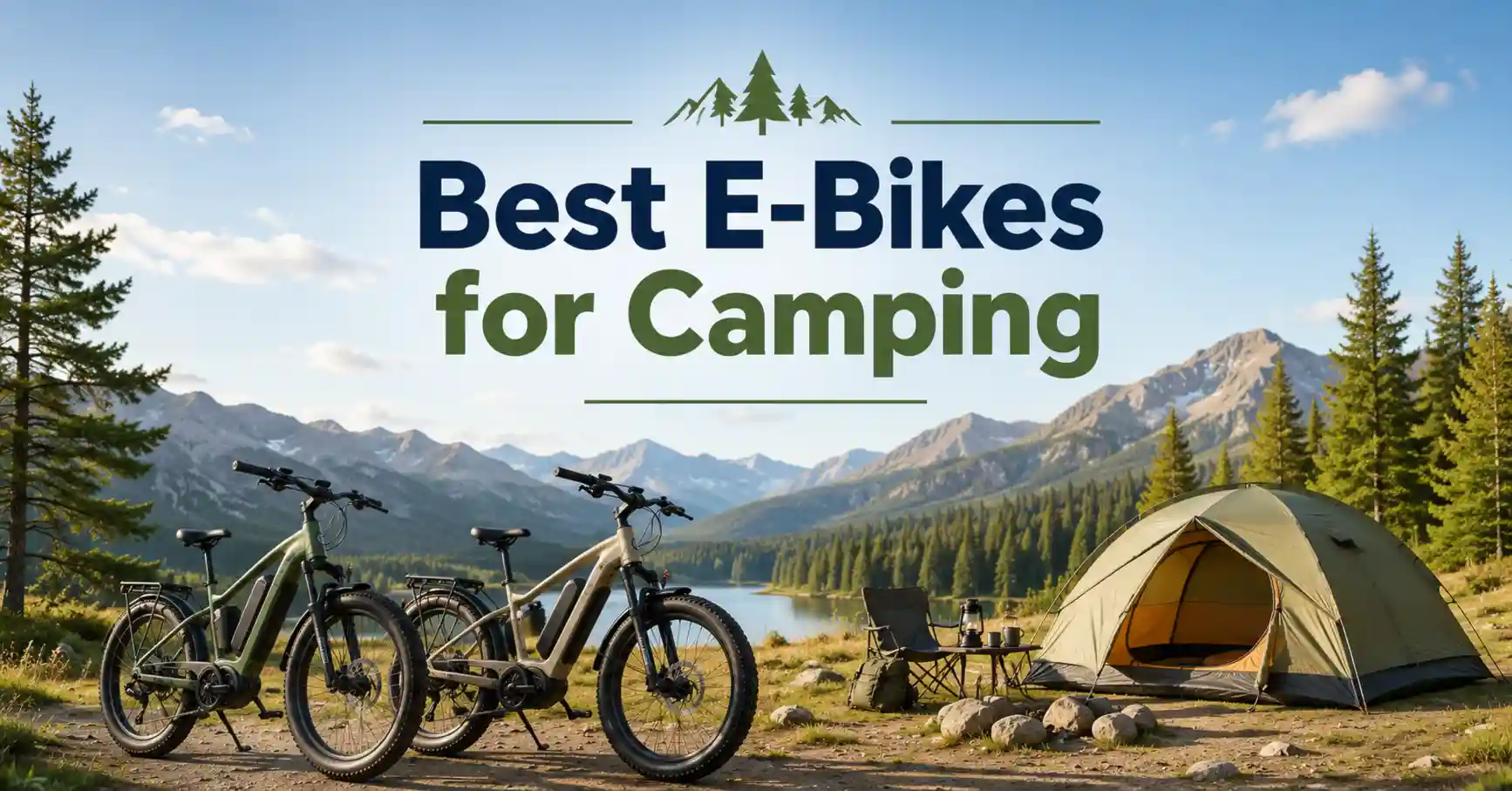
Best E-Bikes for Camping: 8 Picks for Campgrounds and Trails
Last Updated on July 30, 2026 by Kristina
📚 Research-based buying guide: I have not personally tested every bike in this guide. These recommendations are based on current manufacturer specifications, safety documentation, warranty and return policies, independent testing, service information, and available rider feedback.
Introduction
A good camping e-bike should do more than look rugged. It needs to match the terrain around your campsite, carry the gear you actually bring, fit your transportation setup, and give you a realistic way to recharge safely.
For most campers, my best overall pick is the Aventon Aventure 3 because it balances all-terrain tires, a large battery, useful included equipment, and a 400 lb total weight limit. Campers with different priorities may be better served by a folding bike, a lighter trail bike, or a high-capacity cargo model. New riders can use my complete e-bike buying guide to understand motors, batteries, fit, brakes, and classes before comparing the picks below.
Camping often overlaps with other outdoor travel. Riders carrying field equipment should also compare my guide to the best e-bikes for hunting. Campers transporting bikes with a motorhome or travel trailer should read the guide to the best e-bikes for RV travel, where storage, rack limits, battery transport, and campground use become especially important.
⭐ Quick Picks: Best E-Bikes for Camping
- Best overall: Aventon Aventure 3
- Best value for rough campground roads: Lectric XPeak 2.0
- Best for heavier riders and more gear: Velotric Nomad 2
- Best off-grid accessory ecosystem: Mokwheel Basalt 2.0
- Best folding camping e-bike: Ride1Up Portola
- Best expedition cargo e-bike: Tern Orox S12
- Best lighter full-size trail bike: Trek Marlin+ 8
- Best premium technical-trail option: Cannondale Moterra 4
👉 Short on time?
See today’s e-bike deals and limited-time discounts, then compare top picks below.
Camping E-Bike Comparison Chart
| Model | Best for | Motor | Battery | Listed weight | Load information | Main tradeoff |
|---|---|---|---|---|---|---|
| Aventon Aventure 3 | Best overall | 750W hub, 80 Nm | 733Wh | 76 lb | 400 lb total weight limit | Large and heavy to transport |
| Lectric XPeak 2.0 | Value and rough roads | 750W hub, 85 Nm | 720Wh | 64.5 lb without battery, about 75 lb complete | 330 lb maximum payload | Bulky for a hitch rack or small vehicle |
| Velotric Nomad 2 | Heavy riders and gear | 750W hub, 90 Nm | 705.6Wh | 75 lb | 505 lb maximum bike load; 66 lb rear rack rating | Weight and size make lifting difficult |
| Mokwheel Basalt 2.0 | Optional off-grid accessories | 750W continuous, 1,100W peak | 940Wh | 80 lb | 450 lb listed payload | Solar and inverter equipment cost extra |
| Ride1Up Portola | Folding and compact storage | 750W hub, 65 Nm | 643Wh | 59 lb | 342 lb weight capacity; 150 lb-rated rack | Small wheels are less suited to technical trails |
| Tern Orox S12 | Expedition cargo and bikepacking | Bosch Performance Line CX, 85 Nm | 725Wh, dual-battery ready | 81.8 lb | 463 lb gross vehicle weight on pavement; 397 lb off-road | Premium price and very high transport weight |
| Trek Marlin+ 8 | Lighter trail handling | Bosch Active Line Plus, 50 Nm | 400Wh | 47.38 lb in size M | Confirm current size-specific limit with Trek | Smaller battery and no stock cargo rack |
| Cannondale Moterra 4 | Technical mountain-bike trails | Bosch Performance Line CX | 600Wh | Varies by frame size | Confirm current rider and equipment limit with dealer | Requires separate cargo solutions and skilled trail riding |
Battery capacity and range are not the same thing. Manufacturer range estimates are usually based on favorable conditions. Hills, loose surfaces, cold weather, soft tires, higher assist levels, rider weight, and camping cargo can reduce real-world range substantially.
How I Chose These Camping E-Bikes
I looked for bikes that solve different camping problems instead of filling the list with eight similar fat-tire models. The main criteria were terrain capability, battery capacity, bike weight, payload information, cargo compatibility, braking, rider fit, electrical safety information, service access, and how realistically the bike can be transported to a campsite.
I also considered the difference between riding around a developed campground and riding technical singletrack. A comfortable 80 lb fat-tire bike may be excellent on gravel roads but frustrating to lift onto a rack. A lighter electric mountain bike may handle trails better but provide little built-in cargo capacity.
🔎 Why You Can Trust This Guide
I compare official specifications, safety information, independent testing, support policies, and real-world rider feedback. Affiliate relationships do not determine which products I recommend or how they are ranked. You can read more about how Electric Bike Explorer reviews and ranks e-bikes.
Want to See More Electric Bike Explorer in Google Search?
Add Electric Bike Explorer as a preferred source to see more of our e-bike law guides, safety updates, reviews, buying guides, and troubleshooting posts when they are relevant to your searches.
1. Aventon Aventure 3 – Best Overall Camping E-Bike

The Aventon Aventure 3 is my best overall choice for campers who want one bike for campground roads, gravel, pavement, and moderate unpaved routes. Aventon lists a 750W hub motor, 80 Nm of torque, a 733Wh battery, 26 x 4 in. tires, hydraulic disc brakes, and a 400 lb total weight limit.
The official range claim is up to 65 miles, but Aventon bases that estimate on a 165 lb rider on flat pavement in Eco mode. Camping cargo, hills, loose dirt, cold mornings, and lower tire pressure can shorten that figure. The included rack and fenders are more useful for camping than a bare mountain-bike setup, and the listed rider range covers approximately 5 ft. 3 in. to 6 ft. 4 in., depending on frame size.
Why it stands out
It offers a practical middle ground. It is more cargo-ready than a trail eMTB, more stable on rough surfaces than a narrow-tire commuter, and less specialized than an expedition cargo bike.
Main tradeoffs
At 76 lb, it may exceed some vehicle rack limits once a second bike is added. Confirm the rack’s total and per-bike ratings, and remove the battery before lifting when the manufacturer permits it.
Read my full review of the Aventon Aventure 3
2. Lectric XPeak 2.0 – Best Value for Rough Campground Roads

The Lectric XPeak 2.0 combines a 750W rear hub motor, 85 Nm of listed torque, a 720Wh removable battery, fat tires, and a 330 lb payload limit. Lectric lists the bike at 64.5 lb without its 10.5 lb battery, putting the complete weight at about 75 lb.
This is a strong value choice for campers who expect washboard roads, gravel loops, grass, and moderate dirt paths. Lectric states that the battery is certified to UL 2271 and the complete e-bike system is certified to UL 2849, which gives the XPeak an advantage over models with vague or incomplete certification language.
Why it stands out
It offers a large battery, hydraulic brakes, useful torque, and current electrical certification claims at a lower price tier than premium dealer-brand eMTBs.
Main tradeoffs
Its complete weight and fat-tire footprint still make it awkward in small vehicles. It is an all-terrain utility bike, not a substitute for a lighter full-suspension mountain bike on difficult singletrack.
Read my full review of the Lectric Xpeak 2
3. Velotric Nomad 2 – Best for Heavier Riders and More Gear
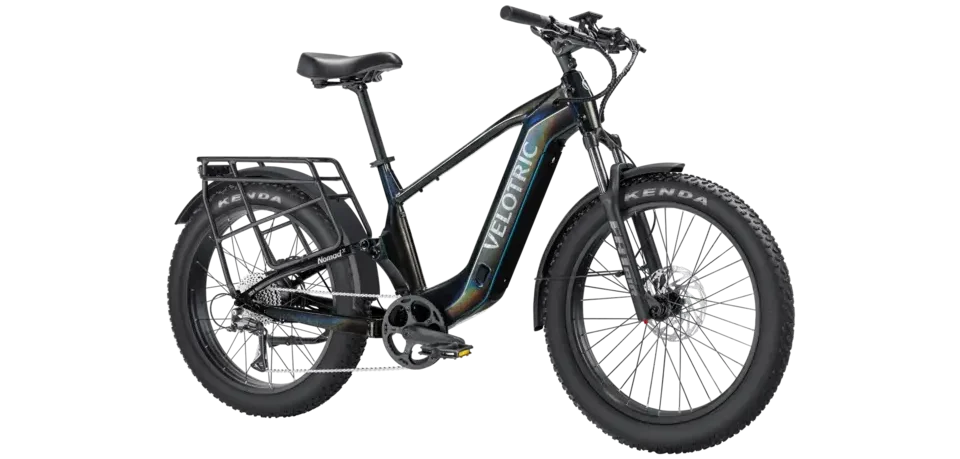
The Velotric Nomad 2 stands out for its published 505 lb maximum bike load and 66 lb rear-rack rating. Velotric also lists a 750W motor, 90 Nm of torque, a 705.6Wh battery, a 75 lb bike weight, hydraulic disc brakes, 26 x 4 in. tires, and UL 2849 certification.
That capacity can be useful when the rider, clothing, water, lock, bags, tools, and camp supplies add up. It does not mean all 505 lb can be placed on the rack, and it does not remove the need to balance cargo carefully.
Why it stands out
The combination of a high total load rating, sturdy rack rating, broad listed fit range, and fat tires makes it one of the most practical options for larger riders and gear-heavy campground use.
Main tradeoffs
A high load rating does not make the bike easy to transport. At 75 lb before adding accessories and cargo, many riders will need a ramp, a heavy-duty hitch rack, or help lifting it.
Read my full review of the Velotric Nomad 2
4. Mokwheel Basalt 2.0 – Best Off-Grid Accessory Ecosystem

The Mokwheel Basalt 2.0 is the most camping-focused option for riders interested in the brand’s optional inverter and solar-compatible accessory system. The bike itself has a 940Wh battery, a 750W continuous and 1,100W peak motor rating, 90 Nm or more of listed torque, an 80 lb bike weight, a 450 lb payload claim, hydraulic brakes, and 4 in. fat tires.
Mokwheel claims 60 to 80 miles of range. Treat that as a best-case manufacturer estimate, especially when riding hills or carrying gear. The inverter and solar equipment are optional and should not be mistaken for included accessories. Solar charging performance depends on panel output, sunlight, temperature, positioning, conversion losses, and the specific approved equipment.
Why it stands out
The large battery and optional power accessories create an interesting system for base-camp use where riders understand the cost and limitations.
Main tradeoffs
The 80 lb bike is difficult to lift, and the off-grid accessories add cost, bulk, and setup complexity. Only use charging equipment approved for the battery and follow the manufacturer’s instructions.
Read my full review of the Mokwheel Basalt 2
5. Ride1Up Portola – Best Folding Camping E-Bike
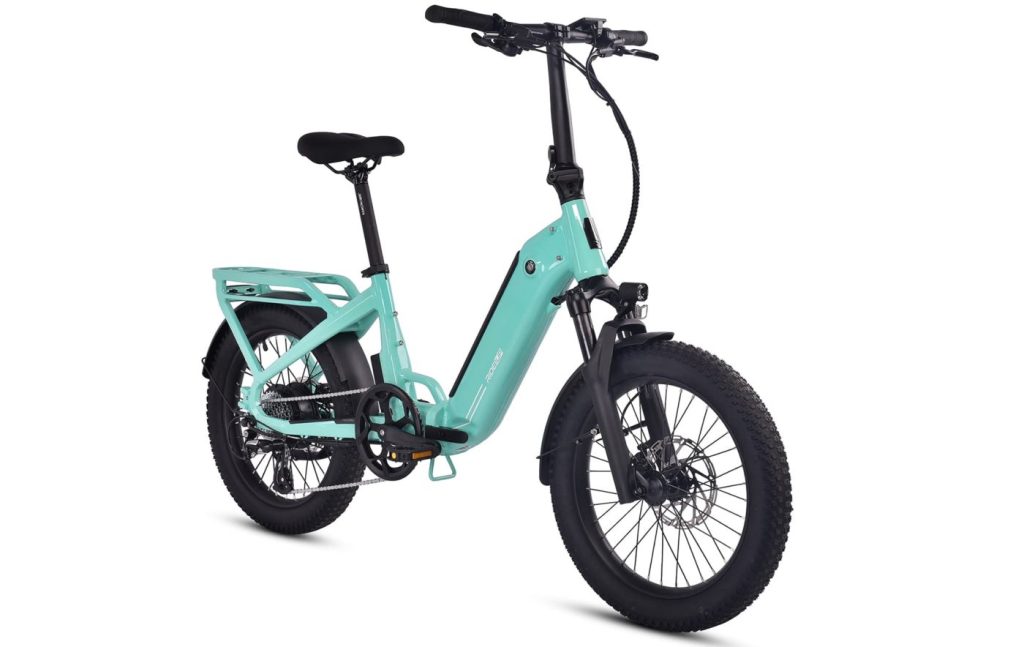
The Ride1Up Portola is the best choice here for campers who need a bike to fold into a vehicle, camper storage compartment, or other limited space. The current Class 1 version lists a 750W motor, a 13.4Ah battery of about 643Wh, a 59 lb bike weight, a 342 lb weight capacity, hydraulic brakes, and a welded rear rack rated for 150 lb.
Ride1Up lists folded dimensions of approximately 19 x 29.5 x 33 in. and a rider-height range from about 4 ft. 10 in. to 6 ft. 4 in. The smaller 20 x 3 in. tires help keep the package compact, but they do not roll over deep ruts and rocks as smoothly as larger mountain-bike wheels.
Why it stands out
It solves the storage problem better than the full-size bikes in this guide while retaining useful cargo capacity and a comparatively large battery.
Main tradeoffs
At 59 lb it is lighter than the fat-tire picks, but it is not a lightweight folding bike. Its small wheels and folding frame are better for campground roads and mild paths than technical trail riding.
Read my full review of the Ride1UP Portola
6. Tern Orox S12 – Best Expedition Cargo E-Bike
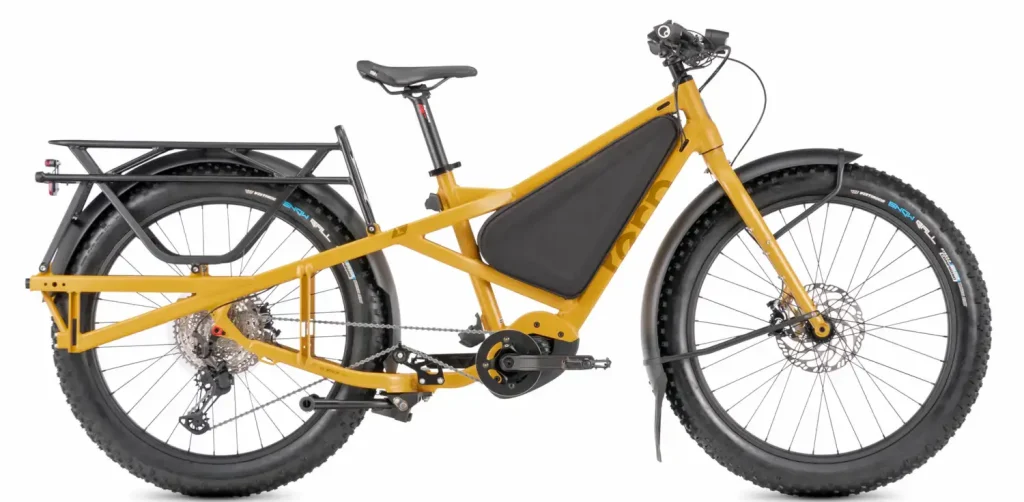
The Tern Orox S12 is the serious expedition and cargo choice. Tern lists a Bosch Performance Line CX motor with 85 Nm of torque, a 725Wh battery, dual-battery compatibility, 27.5 x 4 in. tires, four-piston hydraulic brakes, an 81.8 lb bike weight, and a rear rack rated for 220 lb.
The maximum gross vehicle weight is listed at 463 lb on pavement and 397 lb off-road. Those figures include the bike, rider, cargo, and accessories. Tern lists frame options covering riders from approximately 5 ft. 1 in. to 6 ft. 5 in.
Why it stands out
Few e-bikes combine this level of cargo engineering, all-terrain tires, dealer-supported Bosch electronics, and dual-battery capability. It is the strongest choice for loaded bikepacking and expedition-style trips where the price and weight are justified.
Main tradeoffs
It is expensive, long, and heavier than many motorcycle-style hitch racks are designed to carry. It is also a rigid bike, so riders should not expect full-suspension comfort on technical trails.
7. Trek Marlin+ 8 – Best Lighter Full-Size Trail Bike
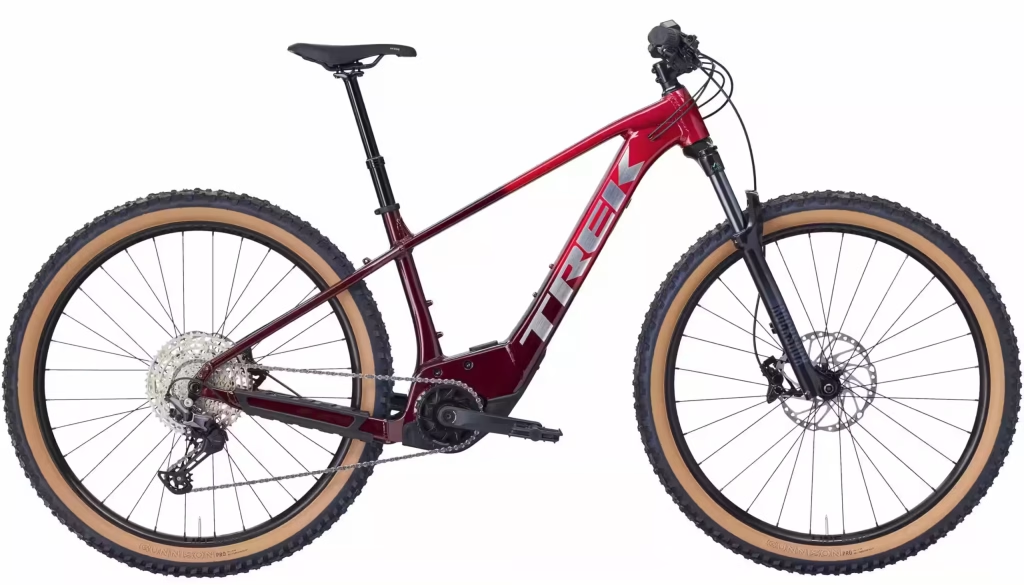
The Trek Marlin+ 8 is a better match for riders who value manageable weight and natural trail handling over a huge battery or built-in cargo capacity. Trek lists a Bosch Active Line Plus motor with 50 Nm of torque, a 400Wh battery, 120mm front suspension, and a weight of 47.38 lb for a size-medium bike.
That weight is still substantial, but it is far easier to manage than an 80 lb fat-tire or cargo bike. The 400Wh battery is the smallest in this guide, so route planning matters. Campers should carry only compatible rack and bag systems and avoid exceeding Trek’s current size-specific limits.
Why it stands out
It feels more like a conventional hardtail mountain bike and is easier to load, maneuver, and ride on narrower trails than the utility-oriented fat-tire picks.
Main tradeoffs
The smaller battery and lower-torque motor are not designed for hauling very heavy loads. It also needs separate cargo accessories for camping gear.
8. Cannondale Moterra 4 – Best Premium Technical-Trail Option
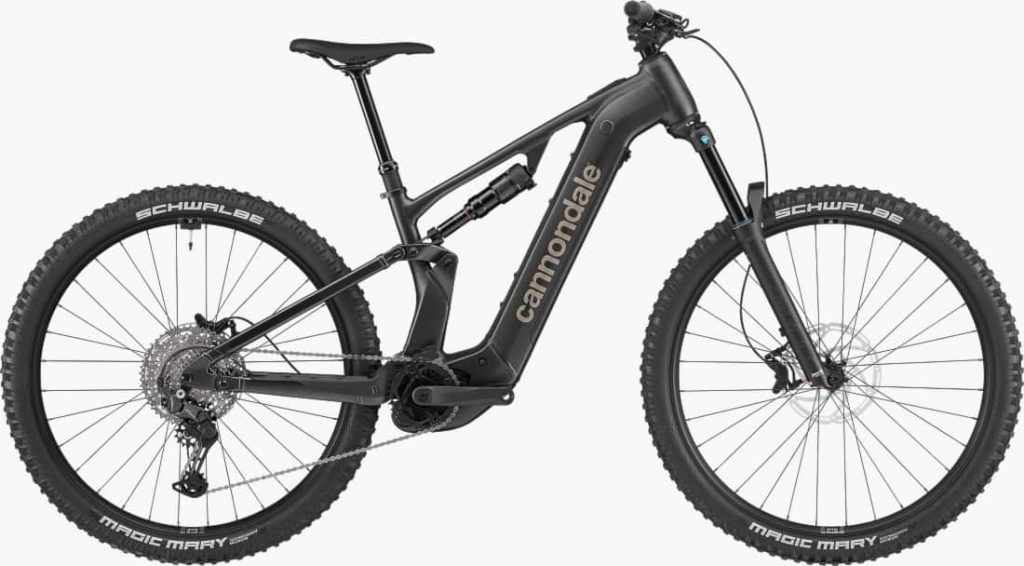
The current Cannondale Moterra 4 is the most trail-focused bike in this guide. Cannondale lists a Bosch Performance Line CX motor, a removable 600Wh battery, 150mm rear suspension, a 160mm suspension fork, an 11-speed Shimano CUES drivetrain, and four-piston hydraulic brakes with 203mm rotors.
This is for campers who are bringing an eMTB because mountain biking is a central part of the trip. Full suspension and trail geometry make it more capable on roots, rocks, drops, and steep terrain than the comfort-focused fat-tire bikes.
Why it stands out
It provides the suspension, braking, geometry, and dealer-supported drive system expected from a purpose-built electric mountain bike.
Main tradeoffs
It does not include the cargo equipment most campground riders need, and its capabilities require appropriate skill, protective equipment, and legal trail access. Confirm the exact frame-size weight, rider limit, battery, and regional specification with the dealer before purchase.
How to Choose an E-Bike for Camping
Match the bike to the terrain
Developed campground loops and paved roads do not require a full-suspension eMTB. Gravel and rough forest roads may justify wider tires and more battery capacity. Technical singletrack calls for trail geometry, appropriate suspension, strong brakes, and a bike that is permitted on that specific trail.
Count every pound you will carry
Payload or load capacity may include the rider, bike accessories, lock, water, clothing, bags, tools, child seat, and cargo. A rack rating is separate from the bike’s total limit. Never assume a high total payload means the rear rack can carry the same amount.
Check your vehicle rack before buying
Add the actual weight of every bike, including racks and accessories. Check the hitch rack’s per-bike limit, total limit, tire-width compatibility, wheelbase limit, and whether the rack is approved for an RV or trailer. A rack rated for use behind a passenger vehicle may not be approved for the extra movement behind a travel trailer.
Choose battery capacity with a reserve
Do not plan around the highest advertised range. I prefer to leave a meaningful battery reserve for hills, detours, headwinds, cold temperatures, and a return trip. My guide to e-bike battery capacity and watt-hours explains why Wh is more useful than Ah alone when comparing batteries.
Prioritize braking and service
Camping loads increase stopping distance and brake heat. Hydraulic disc brakes and appropriately sized rotors are especially valuable on long descents. Also consider whether a local dealer can service the motor system and whether replacement batteries, displays, controllers, and proprietary parts are available.
Charging an E-Bike Safely at a Campsite
Ask the campground before plugging in. Do not assume a pedestal, restroom outlet, RV outlet, or shared building circuit permits e-bike charging. Use only the charger supplied or approved by the manufacturer, keep the charger dry and ventilated, protect cables from traffic, and unplug the battery when charging is complete.
The U.S. Consumer Product Safety Commission advises riders to remain present while charging and never charge a micromobility product while sleeping or away from home. Stop charging and move away from the battery if you notice smoke, swelling, unusual heat, leaking, sparks, damaged wiring, or a strong chemical odor. Do not open a lithium-ion battery pack.
Check Campground and Trail Rules Before Riding
E-bike access is not consistent across campgrounds, parks, forests, and trail systems. The National Park Service allows park superintendents to designate where e-bikes may be used, and individual parks can restrict classes, throttle use, roads, or trails. The Bureau of Land Management also uses site-specific decisions, and its national rule did not automatically open every non-motorized trail.
Before leaving home, check the managing agency’s current map and rules for the exact route. Also review the state-by-state e-bike law guide. Posted campground rules and local land-manager decisions can be more restrictive than state road law.
Essential E-Bike Gear (Quick Picks)
Before you choose your e-bike, these are the accessories most riders end up needing for safety and everyday use:
Common Camping E-Bike Buying Mistakes
- Buying only for maximum range: Advertised range can fall sharply with hills, cargo, cold weather, and high assist.
- Ignoring bike-rack limits: Two heavy e-bikes can exceed a rack or hitch rating quickly.
- Assuming fat tires make a bike a mountain bike: Fat tires add stability and flotation, but they do not replace proper geometry, suspension, brakes, or trail skills.
- Confusing total payload with rack capacity: Both limits must be followed.
- Planning to charge anywhere: Campgrounds may restrict charging, and shared circuits may not be suitable.
- Assuming every trail allows e-bikes: Verify the exact route, class, and land manager before riding.
- Skipping fit checks: A powerful bike is still a poor choice when the standover, reach, saddle height, or mounting height does not suit the rider.
Camping E-Bike FAQs
Are fat-tire e-bikes best for camping?
They are useful for gravel, grass, sand, loose dirt, and rough campground roads, but they are heavy. A folding bike may be better for limited storage, while a lighter eMTB is better for technical trails.
How much battery capacity do I need?
A 600Wh to 750Wh battery is a practical starting range for many campground rides, but terrain and cargo matter more than one number. A smaller battery can work well for short trail loops, while longer remote trips may justify a larger or dual-battery system.
Can I charge an e-bike from an RV?
Possibly, but the electrical system, inverter, battery bank, outlet, and campsite rules must support the charger’s load. Follow the RV and e-bike manufacturers’ instructions and do not improvise adapters or use an incompatible charger.
Should I remove the battery during transport?
Removing the battery can reduce lifting weight and protect it from road debris, but follow the bike and rack manufacturers’ instructions. Cover exposed electrical contacts appropriately and transport the battery in a secure, dry location.
What accessories are most useful for camping?
A properly rated rack, waterproof panniers, bright lights, a mirror, a quality lock, tire-repair supplies, a pump, spare tube or plug kit, first-aid supplies, and an approved charger are practical starting points. My guide to the best e-bike accessories covers safety, security, comfort, and repair gear.
My Take
The Aventon Aventure 3 is the best all-around choice for most car campers because it offers a useful balance of battery capacity, comfort, all-terrain stability, cargo equipment, and total load capacity. The Lectric XPeak 2.0 is the value choice, while the Velotric Nomad 2 is the stronger fit for riders who need more published load capacity.
The correct exception matters more than the overall winner. Choose the Ride1Up Portola when storage is the main problem, the Tern Orox S12 for serious cargo and expedition use, the Trek Marlin+ 8 for lighter trail handling, and the Cannondale Moterra 4 when technical mountain biking is the purpose of the trip. The Mokwheel Basalt 2.0 is worth considering when its optional off-grid accessory system fits a carefully planned charging setup.
Before buying, confirm the current price, exact frame fit, complete bike weight, rack compatibility, battery certification documentation, return policy, replacement-battery availability, and rules for the places you plan to ride.
Disclosure: As an Amazon Associate, I earn from qualifying purchases. This comes at no extra cost to you and helps support the content on this site.
Sources
- Aventon Aventure 3 official product specifications
- Lectric XPeak 2.0 official product specifications
- Velotric Nomad 2 official product specifications
- Mokwheel Basalt 2.0 official product specifications
- Ride1Up Portola official product specifications
- Tern Orox S12 official product specifications
- Trek Marlin+ 8 official product specifications
- Cannondale Moterra 4 official product specifications
- National Park Service e-bike guidance
- Bureau of Land Management e-bike guidance
- U.S. Consumer Product Safety Commission micromobility safety guidance

Kristina is not just an enthusiast but a true authority on electric bikes. Nestled in the coastal beauty of Virginia, Kristina has found the perfect backdrop for her passion for electric biking. As a dedicated wife and homeschooling mom, her life revolves around family, faith, and the thrill of adventure.
Originally hailing from Ohio, Kristina's journey with electric bikes began as a curiosity and quickly evolved into a deep expertise. Her blog is a testament to her love for electric biking, combining her fascination for eco-friendly transportation with her coastal lifestyle.
When she's not cruising the beach on her electric bike, you'll find Kristina indulging in her other loves: long walks along the shore, getting lost in a good book, and cherishing moments with her loved ones. With a heart as big as her love for animals, especially cats, Kristina brings a unique perspective to the electric bike world, grounded in her strong faith in God and her dedication to a sustainable lifestyle.
Through her blog, Kristina shares her extensive knowledge of electric bikes, offering valuable insights, tips, and recommendations to fellow enthusiasts. Whether you're a seasoned rider or a newcomer to the electric bike scene, Kristina's blog is your go-to source for all things electric biking, fueled by her passion, expertise, and the scenic beauty of coastal Virginia.