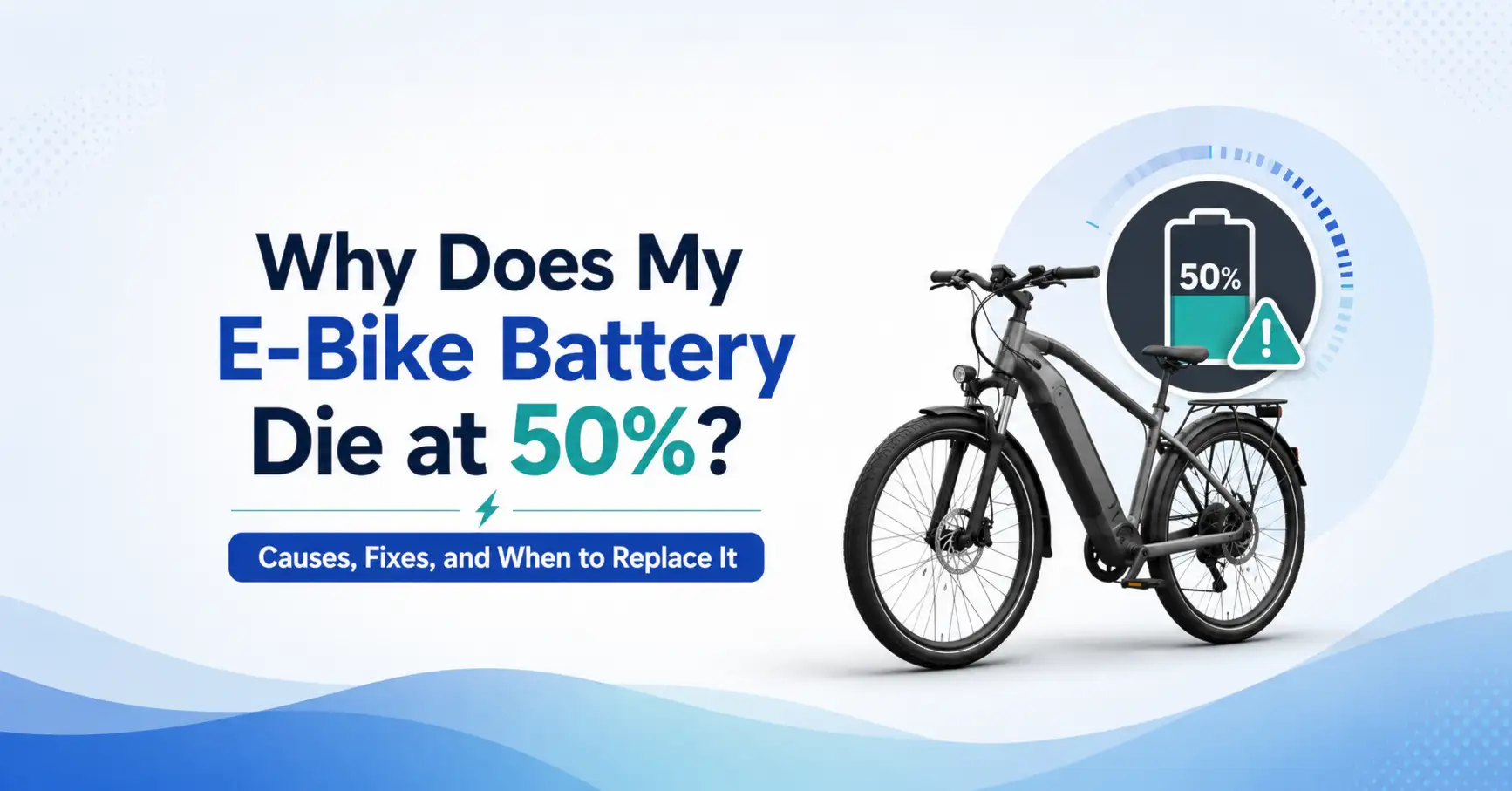
Why Does My E-Bike Battery Die at 50%? Causes, Fixes, and When to Replace It
Last Updated on August 21, 2026 by Kristina
If your e-bike battery dies at 50%, the display may still show substantial charge even though the battery can no longer deliver enough usable power under the conditions you are riding in. Common explanations include voltage sag under load, reduced battery capacity, a weak cell group reaching a protection limit, an inaccurate battery gauge, a poor battery connection, cold temperatures, or a charging problem.
The important symptom is not the exact number 50%. If your bike repeatedly loses power while the display still shows roughly 40% to 60% remaining, especially during ordinary riding, I would treat it as a battery or electrical problem worth diagnosing rather than assuming the gauge is simply quirky.
If your percentage also jumps up and down while you ride, start with my guide to an e-bike battery percentage that fluctuates. For broader electrical problems, my E-Bike Troubleshooting and Maintenance Guide can help you narrow down the system involved.
Why an E-Bike Battery Can Die at 50%
The most likely reasons an e-bike battery shuts off while the display still shows a large amount of charge are:
- Voltage sag during acceleration, hill climbing, throttle use, or high pedal assist
- Reduced usable battery capacity
- Elevated internal resistance that causes a larger voltage drop under load
- A weak or unbalanced cell group reaching the battery’s low-voltage protection limit early
- An inaccurate battery percentage or bar display
- Loose, dirty, worn, or damaged battery contacts or a loose battery mount
- A charger or charging problem that prevents a complete charge
- Cold temperatures making battery performance and voltage sag worse
- The battery management system entering a protective shutdown
- A compatibility or low-voltage-cutoff problem after an electrical component has been replaced
If the bike comes back on after you stop, lower the assist level, or reconnect the charger, that does not prove the battery is healthy. Battery voltage can recover after the motor load is removed, and some battery protection systems reset after the condition that triggered them is gone.
First, What Does “Dies at 50%” Actually Mean?
This is one of the most useful distinctions you can make before replacing anything.
| What shuts off? | What it may point to | What to notice next |
|---|---|---|
| The display, motor, and lights all go black | Battery output interruption, BMS protection, loose battery connection, wiring problem, or another main-power fault | Does it happen under load, over bumps, or at the same battery level every ride? |
| The display stays on but motor assistance stops | Assist-system fault, drive-unit protection, controller issue, temperature condition, sensor issue, or system-specific low-battery behavior | Look for an error code and check the bike manufacturer’s troubleshooting instructions |
| Power gets weak but returns when you reduce assist | Voltage sag or a battery that is struggling under higher current demand | Compare low assist with high assist on the same safe route |
| Power cuts out mainly over bumps | Loose battery mount, worn contacts, or another intermittent connection | Check whether the removable battery rocks or shifts in its mount |
Do not assume that a light or display staying on means the traction battery is healthy. Some systems reserve a small amount of battery capacity for accessories after motor assistance can no longer be provided. Shimano, for example, documents this behavior on certain STEPS systems. See the Shimano STEPS cycle-computer manual for one manufacturer-specific example.
Safety First
Stop using or charging the battery if you notice unusual heat, swelling, leaking, a strong chemical or burning odor, smoke, sparks, melted connectors, a cracked case, serious impact damage, or signs of water intrusion. Move away from a smoking or burning battery and contact emergency services when appropriate.
Do not open the battery pack, bypass the BMS, replace individual cells yourself, bridge terminals, or experiment with a charger that was not approved for that battery. The U.S. Consumer Product Safety Commission recommends using the charger supplied with or recommended for the product and using only replacement battery packs confirmed suitable for the device. See the CPSC micromobility battery safety guidance.
🎬 Watch: How E-Bike Batteries Are Tested for Safety
Is 50% Really 50%?
Not necessarily. The number or bars on an e-bike display are an estimate of state of charge, not a direct measurement of exactly how many usable watt-hours remain under every riding condition.
Some battery systems use voltage, current, temperature, battery history, and software calculations to estimate state of charge. Simpler systems may rely more heavily on voltage. Texas Instruments’ battery-management reference designs illustrate why accurate state-of-charge estimation requires more than a simple voltage reading. Its 48 V lithium-ion battery reference design monitors cell voltage, pack current, and temperature and includes state-of-charge gauging and protection.
Battery bars can also cover broad ranges. In one current Shimano manual, a five-LED battery indicator uses ranges of 100% to 81%, 80% to 61%, 60% to 41%, 40% to 21%, and 20% to 1%. That does not mean every e-bike uses Shimano’s scale, but it shows why a “half battery” indication can be much less precise than it looks. See the Shimano STEPS battery manual.
The practical takeaway is simple: focus less on whether the cutoff happens at exactly 50% and more on whether the bike repeatedly loses usable power while the display still indicates substantial charge.
Why Does My E-Bike Battery Die at 40%, 50%, or 60%?
The same diagnostic principles apply whether the shutdown happens at 40%, 50%, 55%, or 60%. A repeatable cutoff with a large amount of displayed charge remaining can be caused by a gauge that overestimates the remaining charge, excessive voltage sag, a weak cell group, a connection problem, temperature, or another protection event.
If the shutdown point keeps moving around, note what changed. A cutoff at 55% on a cold uphill ride and 35% on a warm flat ride may point more strongly toward load and temperature than a battery that shuts off at almost exactly 48% during every ride.
Symptoms That Can Help Narrow Down the Cause
| What happens | Possible cause | First safe check |
|---|---|---|
| Bike shuts off near half charge mainly on hills or hard acceleration | Voltage sag, reduced battery performance, or weak cells | Try a safe flat route in a lower assist level |
| Bike shuts off at roughly the same displayed percentage every ride | Weak cell group, protection cutoff, inaccurate gauge, or system-specific cutoff issue | Record the percentage, terrain, temperature, and whether it restarts |
| Battery percentage drops sharply, then rises after stopping | Voltage sag and recovery | Compare behavior under light and heavier motor load |
| Bike loses all power when you hit bumps | Loose battery mount, worn contacts, or intermittent wiring connection | Inspect the battery fit and accessible contacts with the bike powered off |
| Charging finishes much sooner than it used to and range is shorter | Reduced battery capacity, charging problem, or battery fault | Confirm the correct charger and compare charging behavior with the manual |
| Problem is much worse in cold weather | Temperature-related reduction in battery performance | Retest after the battery has warmed naturally to a manufacturer-approved temperature |
| Battery becomes unusually hot, swollen, smells unusual, or shows damage | Potential battery safety failure | Stop using and charging it |
1. Voltage Sag Under Load Is a Common Explanation
Voltage sag happens when battery voltage temporarily drops while the motor is demanding current. You are more likely to notice it while climbing a hill, accelerating from a stop, using the throttle heavily, riding in a high assist level, carrying extra cargo, or riding into a strong headwind.
If the battery voltage drops far enough, the bike’s protection system may stop motor output or disconnect the battery. When the load is removed, the voltage can recover. That is why a bike may restart after you stop even though it shut down moments earlier.
A small amount of gauge movement under heavy load can be normal. Repeated complete shutdowns during ordinary riding are more concerning, especially if the behavior is getting worse or the bike’s real-world range has fallen.
2. Reduced Battery Capacity or Elevated Internal Resistance Can Cause Early Cutoff
Lithium-ion batteries gradually lose capacity with use and time. Shimano and Bosch both state that rechargeable e-bike batteries lose capacity as they age or are repeatedly used. The exact rate varies with the battery, storage, temperature, charging habits, and riding conditions.
Some degraded batteries can also have elevated internal resistance. High internal resistance causes a larger voltage drop when current demand increases, which can make stored energy difficult to deliver under load and can trigger an early shutdown. Battery University explains this load-related voltage-drop effect.
I would be suspicious of battery degradation if your battery used to run well below 50% but now cuts out earlier, has noticeably less range, or struggles under normal motor load more than it once did.
3. A Weak or Unbalanced Cell Group Can Trigger Protection Early
An e-bike battery contains many lithium-ion cells arranged into groups. Those groups do not always age identically. If one group has less usable capacity than the others, it can reach a low-voltage protection limit while other cells still contain energy.
Analog Devices explains that in a multi-cell pack, the lowest-charged or weakest cell can reach the undervoltage protection threshold first. At that point, the system may stop even though energy remains elsewhere in the pack. See its explanation of cell monitoring, balancing, and undervoltage protection.
This is a plausible explanation for a battery that repeatedly shuts down while the display still shows substantial charge. But symptoms alone cannot prove that one cell group is bad.
Diagnosing individual cell groups requires proper battery diagnostic equipment and should be handled by the manufacturer or a qualified battery technician. Do not open the pack to check the cells yourself.
4. The Display May Be Reporting More Charge Than You Can Actually Use
Battery percentage is an estimate, and different e-bike systems calculate it differently. A basic gauge may react strongly to changing battery voltage. A more sophisticated system may use a fuel-gauge algorithm and information from the BMS.
If the battery percentage drops under load and rises again after you stop, the display may be reflecting voltage changes. If the reading remains implausible after the battery has rested, there may be a gauge, display, controller, communication, or battery-reporting issue.
If you want a deeper explanation of battery ratings, see my guide to e-bike battery capacity, amp-hours, and watt-hours.
5. Loose or Worn Battery Contacts Can Mimic a Dead Battery
A removable battery must remain securely seated against its electrical contacts. Dirt, corrosion, physical wear, a loose lock, a damaged mount, or an intermittent connection can cause sudden power loss.
This cause moves higher on the list if the bike cuts out over bumps, rough pavement, or when the battery shifts in its cradle.
With the bike powered off, remove the battery if the manufacturer allows it and inspect the mount and accessible terminals. Look for dirt, discoloration, looseness, pitting, melting, damaged plastic, or a battery that rocks in the mount.
Use only the cleaning method approved for your bike or battery. Do not scrape terminals with metal tools, bridge contacts, or spray liquid into the connector.
6. A Charging Problem Can Leave You With Less Energy Than You Think
If charging finishes much sooner than it used to, the battery has much less range, or the charger behaves differently, the battery may not be receiving or storing the expected amount of energy. Those symptoms can come from the charger, battery, charging port, temperature limits, or an internal battery problem.
Do not diagnose a charger solely by the color of its indicator light because charger behavior varies by brand and model. Compare the charge time and indicator pattern with the manual for your exact system.
Use only the charger supplied with the bike or a replacement specifically approved for it. CPSC has warned that so-called universal micromobility chargers can be incompatible even when the plug fits. See the CPSC warning about universal micromobility chargers.
If your main symptom is reduced range or rapid drain rather than a sudden cutoff, see my guide to an e-bike battery that is not holding a charge.
7. Cold Weather Can Make a Marginal Battery Problem More Noticeable
Cold temperatures can temporarily reduce lithium-ion battery performance. A battery that behaves acceptably in mild weather may show more voltage sag or reduced range when cold, especially under high motor load.
Shimano states in current e-bike documentation that battery consumption can increase in low temperatures and that using high assistance with a low battery in cold conditions can make the indicated level fall to 0%. Bosch recommends storing and charging its e-bike batteries at room temperature for winter use and inserting the battery shortly before riding. These are manufacturer-specific examples, so always follow the temperature limits in the manual for your exact battery.
You can review Bosch’s e-bike battery care and winter-use guidance.
Do not use a heater, hair dryer, heating pad, or other artificial heat source to warm a lithium-ion battery. Let it warm naturally in a dry indoor location and follow the manufacturer’s charging-temperature limits.
8. The BMS May Be Protecting the Battery
The battery management system is designed to protect the pack from electrical or temperature conditions outside its permitted operating range. Depending on the battery design, protection can include cell undervoltage, overvoltage, overcurrent, short-circuit, and temperature limits.
Texas Instruments’ 48 V lithium-ion battery reference design, for example, monitors each cell voltage, pack current, and temperature and includes protection against cell undervoltage, overvoltage, overcurrent, and temperature conditions. That does not mean every e-bike battery uses the same hardware or thresholds, but it illustrates the kinds of protections a lithium-ion battery system can employ.
A protective shutdown does not automatically mean the BMS itself is defective. The BMS may be responding correctly to a weak cell group, excessive voltage sag, overcurrent, temperature, or another problem.
If the battery repeatedly enters protection, requires a charger connection before it will work again, or produces an error code, record the behavior and contact the manufacturer or a qualified shop.
9. A Replacement Battery, Controller, or Display Can Create Compatibility Problems
This is less likely on a completely stock e-bike. It becomes more relevant if the problem started immediately after a battery, controller, display, wiring harness, or other electrical part was replaced.
Parts that appear compatible physically may still differ in system voltage, communication, current limits, firmware, or protection behavior. If the cutoff began after an electrical component change, confirm exact compatibility with the bike or component manufacturer instead of changing settings by trial and error.
Quick Decision Tree: What Should You Check Next?
- Does the whole bike shut off? If yes, battery output, BMS protection, battery contacts, the battery mount, or another main-power connection move higher on the list.
- Does the display stay on while assist stops? Check for an error code and follow the manufacturer’s drive-system troubleshooting. Do not assume the battery alone is responsible.
- Does the cutoff happen mainly on hills or hard acceleration? Voltage sag or reduced battery performance becomes more likely.
- Does the bike cut out over bumps? Inspect the battery fit, mount, lock, and accessible contacts with the bike powered off.
- Is the problem much worse in cold weather? Temperature may be contributing to reduced battery performance or exposing a marginal battery.
- Does it shut off at almost the same displayed percentage on every ride? Record the pattern and ask the manufacturer or shop about battery capacity, cell imbalance, battery diagnostics, and system cutoff behavior.
- Is the battery hot, swollen, leaking, damaged, smoking, sparking, or giving off a strong chemical odor? Stop using and charging it immediately.
Step-by-Step: What to Check Before Replacing the Battery
- Write down exactly when the shutdown happens. Note the displayed percentage, assist level, terrain, outside temperature, rider and cargo load, and any error code.
- Identify what actually shuts off. Record whether the display, motor, lights, and accessories all lose power or only motor assistance stops.
- Charge the battery with the correct charger. Follow the manufacturer instructions and watch for unusual charge time, heat, warning lights, or charging that stops unexpectedly.
- Compare available battery indicators. If the removable battery has its own LEDs, compare them with the handlebar display after the battery has rested. Check the manual because the two indicators may use different scales.
- Inspect the battery mount and accessible contacts. Power the bike off first. Look for movement, dirt, corrosion, worn terminals, darkening, melting, or loose hardware.
- Try a low-load ride. On a safe, familiar, flat route, use a lower assist level and avoid hard throttle starts. If the bike runs much farther before cutting out, load-related voltage sag or battery weakness becomes more plausible.
- Do not repeatedly force the battery into shutdown. One or two careful observations are enough. Repeated hard-cutoff testing is not a useful maintenance routine.
- Retest at a moderate battery temperature. If the problem occurs in cold weather, let the battery warm naturally and follow the manufacturer’s temperature guidance before charging or testing again.
- Check the manual and error-code guidance. Some drive systems record faults that can separate a battery problem from a drive-unit, controller, sensor, or communication problem.
- Ask about professional diagnostics. Depending on the brand and shop, this may include system diagnostics, a battery capacity test, or testing how the battery behaves under load. Bosch, for example, states that a specialist dealer can measure current battery energy content with its CapacityTester.
Before You Call the Shop or Manufacturer
Having this information ready can make troubleshooting much faster:
- E-bike brand and model
- Battery model or part number
- Approximate battery age
- Approximate mileage or charge-cycle history, if known
- Displayed percentage when the cutoff occurs
- Whether the whole bike turns off or only motor assist stops
- Whether the bike restarts immediately
- Whether the battery must be connected to the charger before it will restart
- Terrain and assist level when the shutdown occurs
- Outside temperature
- Any error code or warning light
- Whether the battery was recently dropped, crashed, exposed to water, or replaced
- Whether the controller, display, charger, or wiring has been replaced
- Whether charging time or charger behavior has changed
- Whether the battery is loose in its mount
If possible, take a photo of the error code or a short video of the display when the problem occurs, but only if you can do so safely while stopped.
What Not to Do
- Do not open a lithium-ion e-bike battery pack.
- Do not bypass or defeat the BMS.
- Do not keep riding until the battery repeatedly hard-cuts off.
- Do not repeatedly deep-discharge the battery to force “recalibration” unless the manufacturer specifically instructs you to do so.
- Do not use a universal or unapproved charger just because the plug fits.
- Do not bridge, scrape, or probe battery terminals with metal objects.
- Do not charge a swollen, leaking, overheated, impact-damaged, or water-damaged battery.
- Do not buy a random replacement battery based only on voltage and connector shape.
- Do not change controller cutoff settings unless the manufacturer or qualified technician specifically directs you to.
When to Call the Manufacturer or an E-Bike Shop
I would stop the at-home troubleshooting and contact the manufacturer or a qualified e-bike shop if:
- The battery repeatedly shuts off while the display still shows substantial charge
- The cutoff happens during normal flat-ground riding
- The behavior is getting worse
- The battery has much less range than it used to
- The battery is getting noticeably hotter than it used to
- The bike shows battery, BMS, voltage, drive-system, or communication error codes
- The charger has become inconsistent or unusually hot
- The battery terminals show pitting, melting, arcing, or burn marks
- The battery is loose in its mount even when locked
- The problem began after electrical parts were replaced
- The battery has suffered a crash, hard impact, or water intrusion
A resting voltage reading by itself may not reveal a problem that only appears under motor load. Depending on the battery system, a manufacturer or qualified dealer may have better diagnostic tools for capacity, stored fault codes, or load-related behavior.
When Is It Time to Replace the Battery?
A battery that repeatedly shuts down while the display still shows substantial charge may need replacement if manufacturer or shop testing confirms reduced usable capacity, a weak cell group, excessive voltage drop under load, an internal fault, or another battery condition that cannot be safely corrected through an approved service process.
Replacement also becomes more likely when the battery has lost a large amount of real-world range, cuts out earlier than it used to, struggles under ordinary motor load, or has persistent charging problems.
Before buying a replacement, confirm the exact battery model, voltage, connector, mounting system, communication requirements, charger compatibility, and manufacturer approval. My guide to signs it may be time to replace an e-bike battery can help with that decision.
How to Help Prevent Early Battery Cutoffs
- Use the manufacturer-approved charger.
- Keep battery contacts and the battery mount clean and dry according to the manufacturer’s instructions.
- Make sure a removable battery locks securely into its mount.
- Avoid storing the battery fully depleted for long periods.
- Follow the manufacturer’s temperature limits for riding, storage, and charging.
- Avoid excessive heat and direct sun when the manufacturer advises against it.
- Pay attention to a sudden change in range, power, charging time, or battery temperature.
- Address repeated shutdowns early instead of treating them as normal.
Helpful E-Bike Battery Care Accessories
E-Bike Battery Cover
Helps protect an external battery from dirt, road spray, scratches, and cold weather. Choose one that fits your battery securely without blocking the mount or lock.
Microfiber Cleaning Cloths
Useful for gently cleaning around the battery, mount, and frame. Avoid spraying cleaners directly into electrical contacts.
Compact Bicycle Multi-Tool
Handy for checking normal bike and battery-mount hardware. Use it for accessible fasteners only, not for opening the battery pack.
Battery Contact Cover
A compatible protective cap can help keep dirt and moisture away from exposed battery contacts when the battery is removed.
Safety reminder: Stop using or charging the battery if you notice swelling, unusual heat, leaking, smoke, sparks, or a strong chemical odor.
Related E-Bike Battery and Troubleshooting Guides
- Why Does My E-Bike Battery Percentage Jump Up and Down?
- E-Bike Not Holding Charge? Causes, Fixes and When to Replace the Battery
- E-Bike Troubleshooting and Maintenance Guide
- Understanding E-Bike Battery Capacity: Amp Hours Explained
- E-Bike Tools Hub
Bottom Line: Don’t Ignore a Battery That Dies at 50%
If your e-bike repeatedly shuts off while the display still shows 40% to 60% charge, the exact percentage matters less than the pattern. Voltage sag, battery aging, weak cells, poor connections, cold temperatures, or charging problems can all cause an early cutoff.
Start with the safe checks in this guide, record when the problem happens, and contact the manufacturer or a qualified e-bike shop if the shutdown keeps returning. Avoid opening the battery or experimenting with unapproved chargers or electrical modifications.
FAQs
Why does my e-bike shut off at 50% but turn back on later?
The battery voltage may be dropping below a protection threshold while the motor is under load and then recovering after you stop. Reduced battery capacity, elevated internal resistance, a weak cell group, cold temperatures, or heavy current demand can contribute. A repeated complete shutdown while substantial charge is displayed deserves further diagnosis.
Can a bad e-bike battery still show 50%?
Yes. The displayed percentage is an estimate. A battery can show substantial remaining charge yet be unable to supply the required current under load, or one weak cell group can reach a protection threshold before the rest of the pack is empty.
Why does my e-bike die at 40% or 60% instead of 50%?
The exact number is less important than the pattern. Battery gauges are estimates, and the cutoff point can move with temperature, motor load, battery condition, and how the system calculates state of charge. A repeatable shutdown with significant displayed charge remaining is the key symptom to investigate.
Does an e-bike battery need recalibration if it dies at 50%?
Possibly, if the manufacturer documents a specific gauge-calibration procedure. But I would not assume calibration is the only problem when the bike is actually shutting off. Do not repeatedly deep-discharge a lithium-ion battery unless the manufacturer specifically instructs you to do so.
Why does my e-bike battery die near 50% only when going uphill?
Hills increase motor current demand. That extra load can cause more voltage sag, especially in a cold, degraded, or otherwise marginal battery. If the bike runs normally on flat ground but repeatedly shuts off on climbs, load-related battery behavior should be high on the diagnostic list.
Can a loose battery connection cause a shutdown at half charge?
Yes. A poor or intermittent connection can cut power regardless of the displayed percentage. If the shutdown happens over bumps or when the battery moves in its mount, inspect the mount and accessible contacts with the bike powered off.
Why does the display stay on when motor assist stops?
That can happen for reasons other than a complete battery disconnect. Depending on the e-bike system, assist may stop because of a drive-system fault, protection condition, temperature, sensor issue, or low-battery behavior while some accessory power remains available. Check for an error code and follow the manual for your exact system.
Should I keep riding if the battery turns back on?
I would not treat repeated shutdowns as normal. A one-time event under unusual conditions may have a simple explanation, but recurring cutoffs can point to battery wear, a connection problem, protection behavior, or another electrical issue that should be diagnosed.
🔎 Why You Can Trust This Guide
I use manufacturer instructions, established safety guidance, technical references, and common rider-reported symptoms to help identify likely e-bike problems and the safest checks to try first. I separate simple owner checks from advanced electrical diagnosis and avoid treating one symptom as proof that a specific part has failed. You can read more about how Electric Bike Explorer researches and verifies its information, including troubleshooting guides, e-bike reviews, buying guides, safety information, and e-bike laws.
Like Electric Bike Explorer?
Add Electric Bike Explorer as a Preferred Source on Google to make it easier to see more of our e-bike news, guides, reviews, and troubleshooting content in Google Search.
Disclosure: As an Amazon Associate, I earn from qualifying purchases. This comes at no extra cost to you and helps support the content on this site.
External Sources
- U.S. Consumer Product Safety Commission – Micromobility Battery Safety
- U.S. Consumer Product Safety Commission – Universal Charger Warning
- Texas Instruments – 48 V Lithium-Ion Battery Pack Reference Design
- Analog Devices – Battery Stack Monitoring, Cell Balancing and Protection
- Battery University – How Internal Resistance Affects Battery Performance
- Shimano STEPS – Battery User Manual
- Shimano STEPS – Cycle Computer User Manual
- Bosch eBike Systems – Battery Care and Maintenance

Kristina is not just an enthusiast but a true authority on electric bikes. Nestled in the coastal beauty of Virginia, Kristina has found the perfect backdrop for her passion for electric biking. As a dedicated wife and homeschooling mom, her life revolves around family, faith, and the thrill of adventure.
Originally hailing from Ohio, Kristina's journey with electric bikes began as a curiosity and quickly evolved into a deep expertise. Her blog is a testament to her love for electric biking, combining her fascination for eco-friendly transportation with her coastal lifestyle.
When she's not cruising the beach on her electric bike, you'll find Kristina indulging in her other loves: long walks along the shore, getting lost in a good book, and cherishing moments with her loved ones. With a heart as big as her love for animals, especially cats, Kristina brings a unique perspective to the electric bike world, grounded in her strong faith in God and her dedication to a sustainable lifestyle.
Through her blog, Kristina shares her extensive knowledge of electric bikes, offering valuable insights, tips, and recommendations to fellow enthusiasts. Whether you're a seasoned rider or a newcomer to the electric bike scene, Kristina's blog is your go-to source for all things electric biking, fueled by her passion, expertise, and the scenic beauty of coastal Virginia.