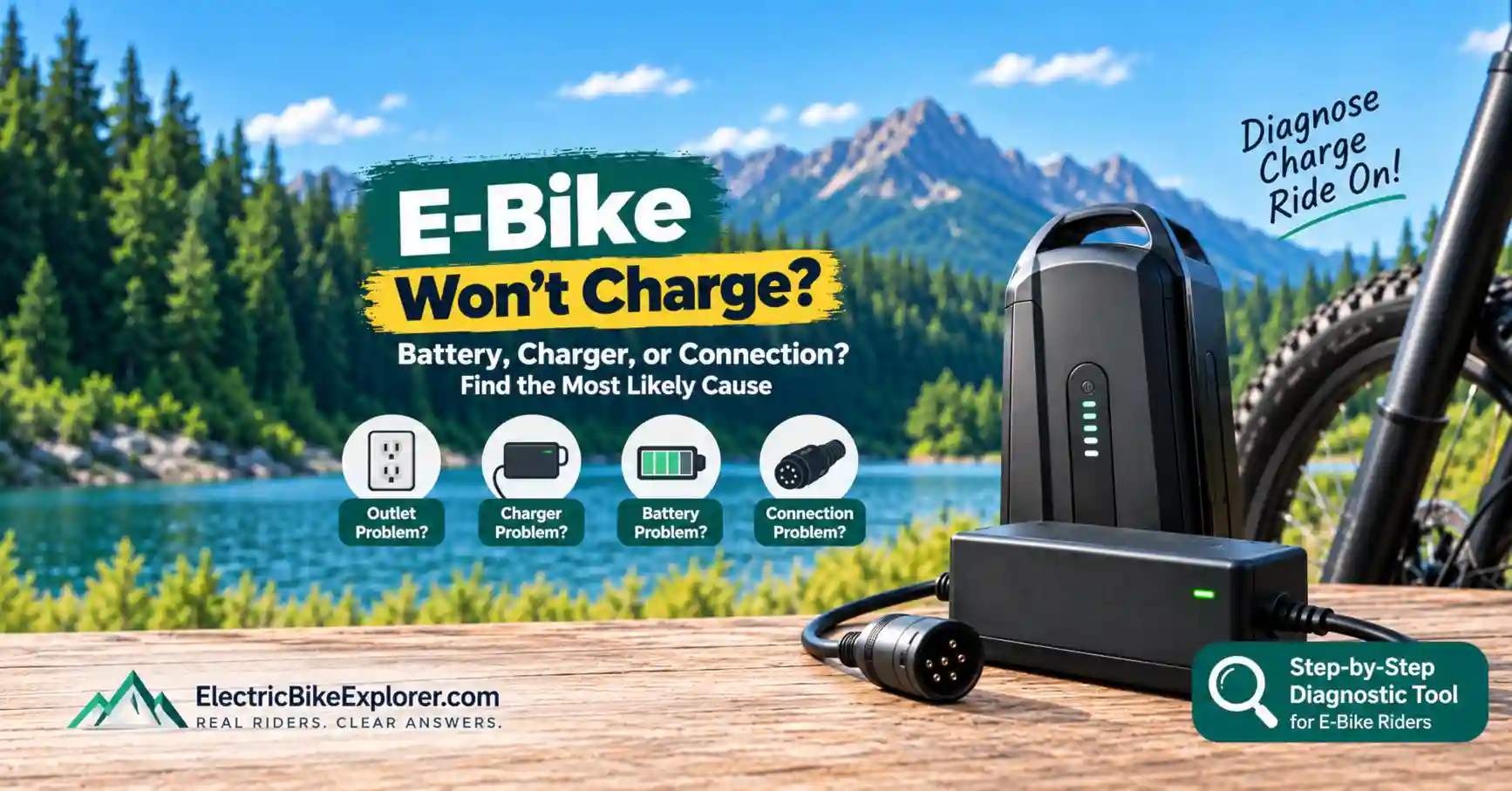
E-Bike Won’t Charge Diagnostic Tool: Battery, Charger, or Connection?
Last Updated on September 22, 2026 by Kristina
If your e-bike will not charge, the battery is only one possible cause. A dead outlet, damaged charger, wet or dirty charging port, battery seating problem, temperature protection, long storage, or a bike-side connection can create similar symptoms.
This interactive E-Bike Won’t Charge Diagnostic Tool helps you narrow the problem to the most likely area to investigate without pretending that a questionnaire can confirm an electrical failure. If you want the full background behind each check, read Why Won’t My E-Bike Charge? or use the broader E-Bike Troubleshooting Tool.
Stop using or charging the affected equipment if you notice swelling, a cracked or punctured battery, smoke, leaking fluid, a burning or chemical odor, extreme heat, melted or blackened connectors, sparking, exposed wiring, or visible water inside a battery, charger, connector, or charging port. Disconnect power only if that can be done safely. Keep people away from the area and contact the manufacturer or a qualified e-bike battery professional. Call emergency services for smoke, fire, active sparking, or immediate danger.
Do not open, rebuild, jump-start, bypass, or internally test a lithium-ion battery pack.
E-Bike Won’t Charge Diagnostic Tool
Start with the safety screen, then answer the questions you can. “Unsure” answers are allowed. The result identifies a most likely area to investigate, not a definitive failed part.
How to Use the Tool
Begin with the safety screen. If no immediate hazard is present, work through the questions in order. The tool starts with the outlet and charger because simple incoming-power problems are cheaper and safer to rule out before anyone assumes the battery needs replacement.
If you are unsure about a question, choose “Unsure.” The result becomes more cautious when important details are missing or conflict. When your bike or charger manual gives a model-specific instruction, follow that instruction instead of a general rule on this page.
Before anything else: do you see any danger signs?
Select every sign you can see or smell. Any selected warning sign stops the normal questionnaire.
Please select “None of these” or at least one warning sign.
What is the main charging problem?
What does the charger do?
Charger-light meanings vary by manufacturer. Compare the behavior with the manual for your exact charger. This tool does not assign universal meanings to colors or flash patterns.
Is charge increasing, and how is the charger behaving?
A charger does not have to become warm to be working. Unusual heat, odor, crackling, buzzing, or visible damage is treated as a stop-use condition.
What happened before the charging problem?
Permitted charging temperatures vary by battery system. Check the manual. Do not use heaters, hair dryers, heating pads, ovens, direct sunlight, freezers, or other forced temperature changes.
Inspect only what you can see safely
Power the system off and follow manufacturer instructions. Do not insert metal objects, probe pins, spray liquids into the port, or modify wiring.
Does the approved charging method change the symptom?
Do not try a charging method your manufacturer does not support.
Battery history and cross-checks
Do not experiment with a charger just because its plug fits. Voltage, current, polarity, connector wiring, communication requirements, and battery chemistry must match the manufacturer’s requirements.
What the Charger Light Can – and Cannot – Tell You
A charger indicator can be useful only when you know what your manufacturer says that indication means. Different chargers use different colors, flashing patterns, and sequences. This tool therefore asks whether the charger is showing its manufacturer-documented normal ready, charging, or unusual state instead of treating “green,” “red,” or any other color as universal.
A charger light also cannot prove by itself that the battery is healthy. A normal-looking indication may coexist with a poor connection, a battery that is not accepting charge, a temperature-related protection condition, or a system-specific fault. An unfamiliar flashing pattern is a reason to check the manual or manufacturer support, not a reason to guess at an error meaning.
Why a Battery That Will Not Charge Is Not Automatically a Failed Battery
Charging depends on a chain of components: the outlet, charger, charger cable, connector, charging port, battery electronics, battery cells, and – on some designs – bike-side wiring or communication. A problem anywhere in that chain can look like a “dead battery.” That is why this tool deliberately checks lower-cost and lower-risk possibilities before battery replacement.
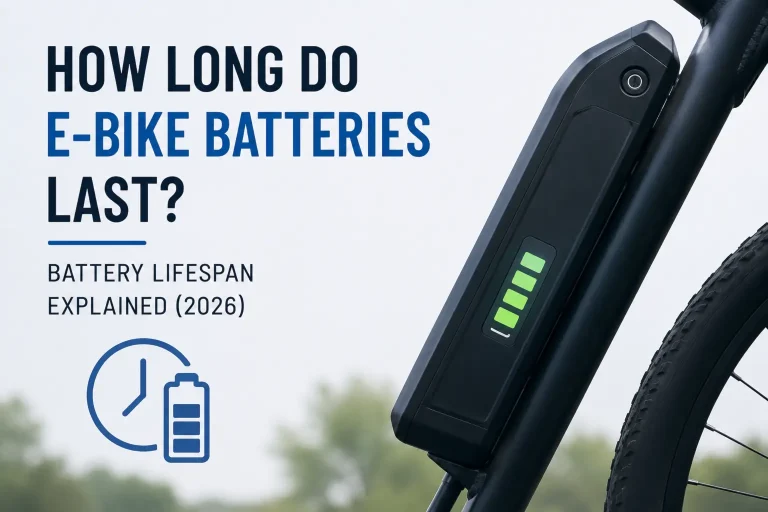
If the battery still works but range or performance has declined, use the E-Bike Battery Health Checker. If a battery stopped responding after long storage or deep discharge is suspected, the E-Bike Battery Revival Checker is the more focused next step. Neither tool is a substitute for manufacturer diagnostics.
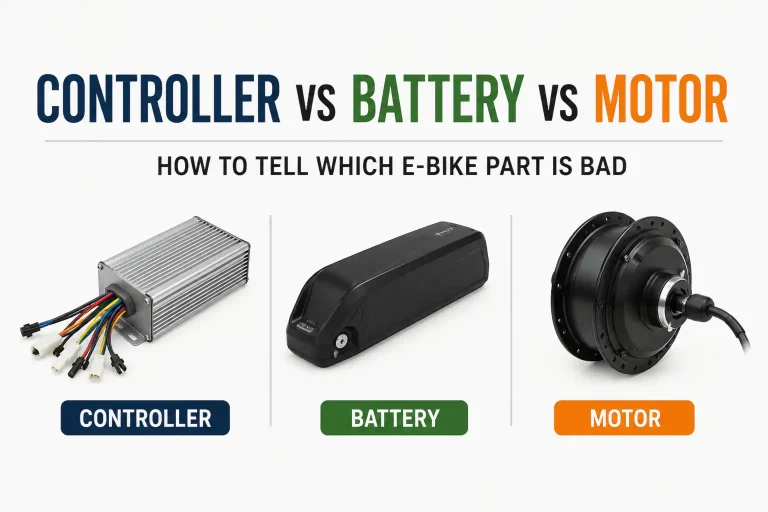
Charger Problem vs. Battery Problem vs. Connection Problem
Signs that can point toward the charger
If a verified working outlet powers other devices but the charger has no normal wall-power indication, the charger or its cable deserves attention. If a known-compatible, manufacturer-approved charger works when the original charger does not, that is useful evidence pointing toward the original charger. The tool still avoids calling it definitively failed without direct testing.
Signs that can point toward the connection
Visible dry dirt, looseness, corrosion, bending, or charging behavior that changes when the connection moves can point toward the charging plug or port. Minor dry dirt is different from corrosion, melting, exposed wiring, or visible water. Damage or moisture moves the situation out of normal DIY troubleshooting.
Signs that can point toward the battery
Long storage at a very low charge, an older battery with substantial previous range loss, repeated early charge termination, or a battery that no longer powers the bike can make battery condition more plausible. Those symptoms can still overlap with charger, connection, temperature, or bike-side problems, so replacement should not be the first step when simpler causes have not been ruled out.
Signs that can point toward the bike side
Some e-bikes support charging through a port on the bike while others use a different arrangement. If the manufacturer explicitly permits both on-bike and off-bike charging and the battery charges normally off the bike but not through the bike, the bike-side port, wiring, or communication path becomes more relevant. Do not try an unsupported charging method just to compare.
Temperature and Storage Can Change Charging Behavior
Battery systems can restrict charging outside their permitted temperature range. The exact range is not universal. For example, Bosch documents a charging range for its system and Shimano documents charging-temperature limits for its batteries, but the correct limit for your e-bike is the one in your own manual. Bosch battery care guidance and Shimano battery safety information are useful examples of manufacturer-specific documentation.
If the battery was just used hard, left in high heat, or stored in freezing conditions, let it return naturally to the manufacturer’s allowed charging range in a dry location. Never force a temperature change with a hair dryer, space heater, heating pad, oven, direct sunlight, freezer, or another improvised method.
A battery stored for months at very low charge may be deeply discharged or in a system-specific protection state. Follow only the exact manufacturer procedure. Do not jump-start it, connect another battery, bypass the BMS, use an improvised trickle charger, or open the pack.
What Not to Do
- Do not use an unverified charger merely because the connector fits.
- Do not assume charger-light colors have universal meanings.
- Do not probe charging pins with metal objects or short contacts together.
- Do not spray cleaners or liquids into a charging port unless the manufacturer specifically approves the method and product.
- Do not bend damaged electrical contacts back into shape by trial and error.
- Do not open, rebuild, jump-start, or bypass a lithium-ion battery or its BMS.
- Do not keep charging equipment that is unusually hot, smells abnormal, makes crackling or unusual buzzing sounds, sparks, melts, or shows water intrusion.
The U.S. Consumer Product Safety Commission specifically warns that chargers sold as “universal” can physically fit and still be incompatible. Use the charger supplied with the device or a replacement tested and approved for the specific system. See the CPSC universal-charger safety warning.
When to Stop Troubleshooting
Stop charging and using the affected equipment immediately for swelling, a misshapen or punctured case, smoke, leaking, a chemical or burning odor, extreme heat, melting or blackening, active sparking, exposed wiring, or visible water inside the battery, charger, connector, or port.
If there is smoke, fire, active sparking, or immediate danger, move away and contact emergency services. For non-emergency hazards, contact the manufacturer or a qualified e-bike battery professional. CPSC also recommends being present while charging and following the manufacturer’s charging instructions. See the CPSC Micromobility Information Center.
When to Contact the Manufacturer or an E-Bike Technician
Manufacturer support is the right next step when the charger shows a model-specific unfamiliar pattern, the manual provides a wake-up or reset procedure, the battery may still be under warranty, an approved charger produces the same unexplained symptom, or the tool cannot distinguish among the battery, charger, and charging system.
A qualified e-bike technician or battery professional is appropriate when there is corrosion, physical connector damage, recurring intermittent charging, suspected bike-side wiring trouble, or diagnosis would require specialized electrical testing. If the bike displays an error code, use the E-Bike Error Code Finder as a starting point, then verify the code in the manufacturer’s documentation.
How to Prevent Future Charging Problems
- Use the supplied charger or a replacement specifically approved for the battery system.
- Follow the manufacturer’s charging-temperature and storage instructions.
- Keep the charging port protected, clean, and dry.
- Inspect the charger cable, connector, and port for visible damage before use.
- Do not charge while sleeping or while you are away from home.
- Unplug after the manufacturer’s normal charge cycle is complete.
- Before long storage, follow the battery manufacturer’s recommended storage charge and check schedule.
For broader battery care, see the E-Bike Battery Guide and common e-bike charging mistakes to avoid. If a battery charges but drains too quickly, use the battery not holding charge guide. If it charges but will not power the bike, see what to check when a charged battery provides no bike power.
Why You Can Trust Electric Bike Explorer
This diagnostic tool is based on manufacturer and component documentation, established troubleshooting principles, CPSC battery-safety guidance, and carefully reviewed rider symptom patterns where they help identify what questions are worth asking. It does not treat rider reports as proof that a component failed and does not imply that every diagnostic scenario or repair was personally tested.
You can read more about the Electric Bike Explorer research, review, and editorial process.
Use Electric Bike Explorer often? When Google offers preferred-source controls in your Search experience, you can choose Electric Bike Explorer as a preferred source for more of its e-bike coverage.
FAQs
Does a charger that stays in standby mean the battery is bad?
No. That symptom can point to a connection problem, charger problem, temperature or battery-protection condition, a deeply discharged battery, or another system-specific issue. Check the manual’s indicator meaning before drawing a conclusion.
Can I try another charger to see if the battery works?
Only if the charger is known to be compatible and approved for your exact battery system. Do not experiment with a charger because the plug fits. CPSC warns that physically compatible “universal” chargers can still be electrically incompatible.
What if the battery was left in a cold garage?
Do not use one universal temperature threshold. Move the battery to a dry location and let it return naturally to the charging range allowed by its manufacturer before attempting to charge it.
What if the battery stopped charging after months of storage?
Long low-charge storage can make deep discharge or a protection state more plausible, but the safe recovery procedure depends on the battery system. Follow the manufacturer’s exact procedure or contact support. Do not jump-start, bypass, or open the battery.
Should I replace the battery if it will not charge?
Not before simpler causes have been reasonably ruled out. Check the outlet, approved charger behavior, charging connection, battery seating, temperature, and manufacturer guidance first. If battery deterioration becomes plausible, the E-Bike Battery Replacement Cost Calculator can help with planning after diagnosis.
What if everything appears to be charging normally but it feels slow?
If the charger is in the manufacturer’s normal charging state and the battery percentage is increasing, the charging process may be normal. Use the E-Bike Charging Time Calculator for a rough planning estimate, then compare the result with your manufacturer’s specifications.
Sources
- U.S. Consumer Product Safety Commission – Micromobility: E-Bikes, E-Scooters and Hoverboards
- U.S. Consumer Product Safety Commission – Universal charger fire-hazard warning
- Bosch eBike Systems – Battery care and maintenance
- Shimano – E-bike battery and charger safety information

Kristina is not just an enthusiast but a true authority on electric bikes. Nestled in the coastal beauty of Virginia, Kristina has found the perfect backdrop for her passion for electric biking. As a dedicated wife and homeschooling mom, her life revolves around family, faith, and the thrill of adventure.
Originally hailing from Ohio, Kristina's journey with electric bikes began as a curiosity and quickly evolved into a deep expertise. Her blog is a testament to her love for electric biking, combining her fascination for eco-friendly transportation with her coastal lifestyle.
When she's not cruising the beach on her electric bike, you'll find Kristina indulging in her other loves: long walks along the shore, getting lost in a good book, and cherishing moments with her loved ones. With a heart as big as her love for animals, especially cats, Kristina brings a unique perspective to the electric bike world, grounded in her strong faith in God and her dedication to a sustainable lifestyle.
Through her blog, Kristina shares her extensive knowledge of electric bikes, offering valuable insights, tips, and recommendations to fellow enthusiasts. Whether you're a seasoned rider or a newcomer to the electric bike scene, Kristina's blog is your go-to source for all things electric biking, fueled by her passion, expertise, and the scenic beauty of coastal Virginia.