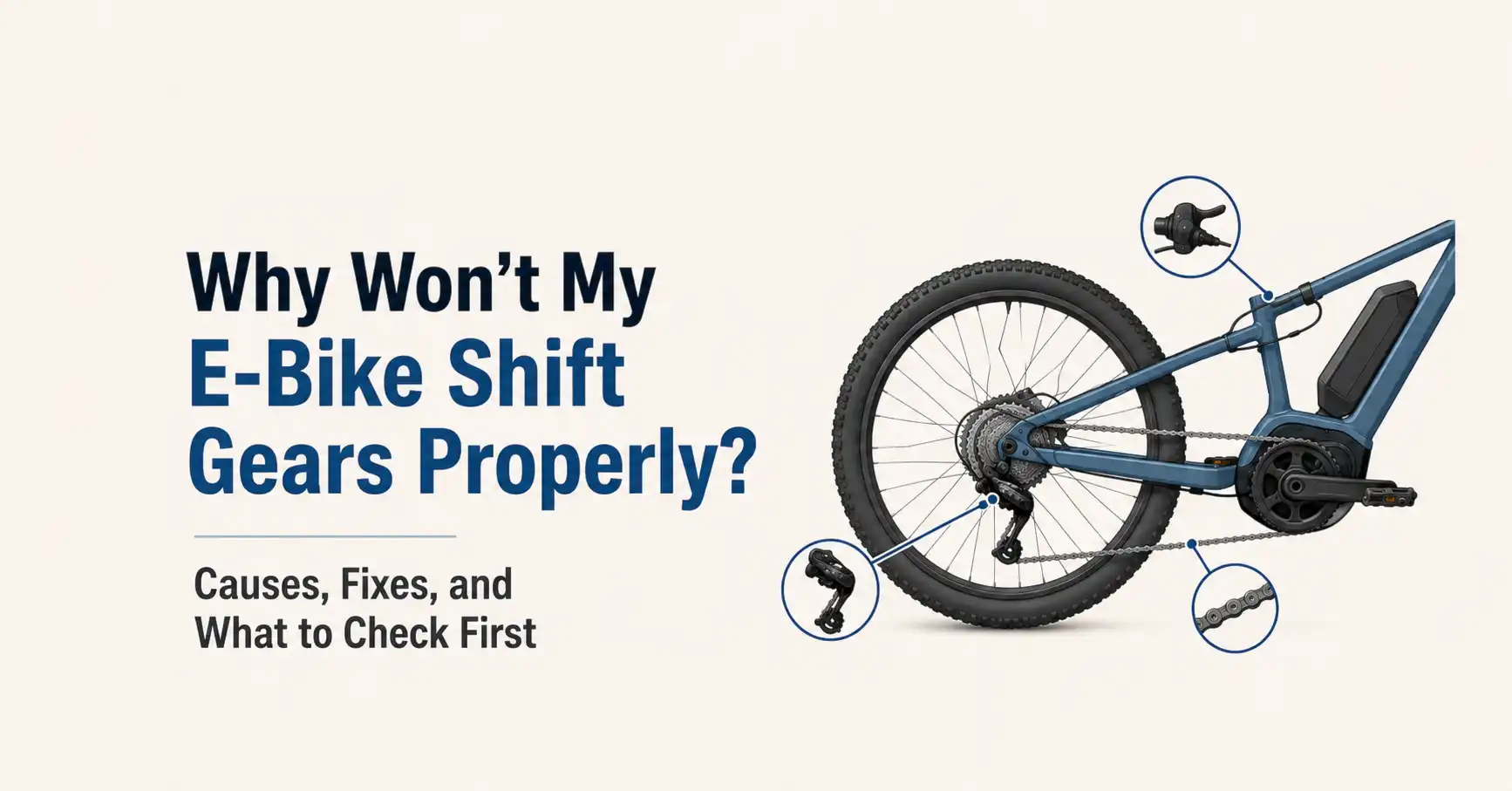
Why Won’t My E-Bike Shift Gears Properly? Causes, Fixes, and What to Check First
Last Updated on August 28, 2026 by Kristina
If your e-bike will not shift gears properly, shifts slowly, skips past a gear, refuses to reach certain gears, or needs two or three shifter clicks before anything happens, the problem is usually somewhere in the drivetrain rather than the motor.
Common causes include incorrect derailleur indexing, cable friction or slack, a dirty or worn drivetrain, a bent derailleur hanger, and worn rear cogs. On an e-bike, especially a mid-drive, motor torque can make a small drivetrain problem much more noticeable.
If you are dealing with several problems at once, start with my E-Bike Troubleshooting and Maintenance Guide. If your chain specifically jumps when you pedal hard, I also have a separate guide explaining why an e-bike chain skips under load.
Quick Answer: What Should You Check First?
Before touching derailleur screws, start with the simple checks.
- Turn the motor assistance off.
- Make sure the rear wheel and axle are secure.
- Look at the rear derailleur from behind for obvious bending or damage.
- Inspect the chain for dirt, rust, stiff links, or visible damage.
- Shift through the gears one click at a time using light pedal pressure.
- Notice whether the problem affects one gear, several gears, or only the largest or smallest cog.
- For a cable-operated derailleur, inspect the cable and housing for fraying, kinks, corrosion, or excess friction.
Do not begin by randomly turning the H and L limit screws. Those screws control how far the derailleur can travel at the ends of the cassette. Incorrect adjustment can allow the chain to move toward the spokes or frame.
2-Minute E-Bike Shifting Diagnosis
If you want the fastest starting point, match what the bike is doing to the symptom below.
| What the bike is doing | Check this first |
|---|---|
| Needs two or more clicks before it shifts | Indexing, cable tension, cable housing friction |
| Hesitates when shifting to a larger rear cog | Cable tension, friction, indexing |
| Hesitates when shifting to a smaller rear cog | Cable friction, excessive cable tension, indexing |
| Shifts well in some gears but poorly in others | Derailleur hanger alignment, worn cogs |
| Will not reach the largest rear cog | Hanger alignment, cable adjustment, low limit, derailleur gap |
| Will not reach the smallest rear cog | Hanger alignment, cable tension, high limit |
| Skips only when pedaling hard | Chain wear, cassette or freewheel wear, damaged teeth |
| Started shifting badly after a fall or transport | Bent derailleur hanger or derailleur damage |
| Started after removing the rear wheel | Wheel seating, axle security, cassette or freewheel position |
| Brand-new e-bike shifts poorly | Indexing, cable-system settling, hanger alignment, wheel installation |
| Electronic shifter is completely unresponsive | System power, shifting battery where applicable, connections, pairing, or a system-specific fault |
Try the E-Bike Gear Shifting Troubleshooter
Not sure which problem matches what your bike is doing? Answer 6 quick questions about your shifting system, symptoms, when the problem started, and when it happens. The tool will narrow down what to check first, flag problems that may make the bike unsafe to ride, and help you decide whether it is a reasonable DIY check or something better handled by a bike shop.
You do not need to know much about bike components to use it. Just choose the answers that best describe what you are experiencing.
Why Won’t My E-Bike Shift?
Answer 6 quick questions to narrow down what to check first when your e-bike shifts slowly, skips, misses gears, needs extra clicks, or will not shift at all.
This tool matches symptoms to common troubleshooting areas. It cannot confirm a mechanical or electrical failure without inspecting the bike. Follow the instructions for your exact drivetrain and e-bike system.
🔧 How This Guide Was Researched
This guide is based on manufacturer instructions, established safety guidance, technical references, and common rider experiences. Stop using or charging the bike if you notice smoke, swelling, unusual heat, damaged wiring, sparks, or a strong chemical odor.
Safety First
Turn the e-bike off before putting your hands near the chain, cassette, chainring, derailleur, or rear wheel. If the battery is designed for routine removal and the manufacturer’s instructions allow it, remove it while performing mechanical inspection work.
Never activate the motor while your fingers, clothing, cleaning tools, or adjustment tools are near the drivetrain.
Stop riding and have the bike inspected if:
- The derailleur or chain is moving toward the rear-wheel spokes.
- The derailleur hanger or derailleur appears visibly bent.
- The chain repeatedly jumps or loses engagement under load.
- The chain jams between the cassette and spokes or frame.
- The rear wheel or axle is loose.
- A chain link, derailleur component, cassette tooth, or chainring is visibly broken.
- An electronic shifting system shows a persistent fault that remains after the manufacturer’s approved basic checks.
Did the Shifting Problem Start Suddenly or Gradually?
This is one of the most useful clues when diagnosing an e-bike that will not shift correctly.
If the Problem Started Suddenly
Think about what happened immediately before the problem appeared.
A sudden change is more likely after:
- The bike fell onto the derailleur side.
- The derailleur was bumped while the bike was transported.
- The rear wheel was removed for a tire repair.
- The bike was recently assembled.
- A stick, rock, or other object struck the drivetrain.
- A shift cable slipped or broke.
- A chain link was damaged.
- A new drivetrain part was installed.
If the bike shifted perfectly yesterday and suddenly will not use half of the cassette today, I would look for physical movement or damage before assuming ordinary wear is responsible.
If the Problem Has Been Getting Worse Gradually
Gradual deterioration points more toward maintenance and wear.
Common possibilities include:
- Dirt accumulating in the cable housing.
- Chain wear.
- Cassette or freewheel wear.
- A dry or contaminated chain.
- Slowly developing cable slack.
- Worn derailleur pivots or shifter components.
A gradual problem is still worth fixing early. Poor shifting can increase drivetrain wear, and repeated skipping under load can become a safety problem.
What Does the Shifting Noise Mean?
Many riders notice a sound before they can identify the mechanical problem. The noise can help narrow the diagnosis.
| Noise or feeling | Possible cause |
|---|---|
| Continuous clicking while pedaling | Indexing slightly out of alignment or chain rubbing between neighboring cogs |
| Rattling that stops after one extra shifter click | Indexing or cable-tension problem |
| Grinding during a shift | Heavy drivetrain load, poor indexing, worn parts, or a slow or incomplete shift |
| Loud clunk under hard acceleration | Chain or cog wear, poor engagement, or drivetrain shifting under excessive load |
| Rhythmic click once per chain revolution | Stiff, damaged, dry, or incorrectly connected chain link |
| Noise only in one rear gear | Individual cog wear, damage, or alignment issue |
A noise does not identify a failed part by itself, but it can tell you where to inspect first.
Why Won’t My E-Bike Shift Gears Properly?
1. The Chain and Cassette Are Dirty
Start here because dirt is common and easy to see. A chain covered with dried lubricant, grit, mud, or road debris cannot articulate as freely as a clean chain. Dirt also accumulates on the cassette and derailleur pulleys.
Clean the drivetrain with a bicycle-safe drivetrain cleaner, allow the chain to dry, apply an appropriate bicycle chain lubricant, and wipe away the excess.
Keep cleaners and lubricants away from brake pads and disc rotors.
For a deeper walkthrough, see my e-bike chain maintenance guide.
2. The Rear Derailleur Indexing Is Slightly Off
Indexing determines where the derailleur sits for each shifter click. When indexing is correct, one click should move the chain cleanly from one rear cog to the next.
When it is slightly off, you may hear clicking before a shift, need an extra shifter click, or find the chain hesitating between two cogs.
Park Tool’s rear-derailleur adjustment guide explains the relationship between derailleur indexing, cable tension, limit screws, and pulley position.
3. The Shift Cable Does Not Have the Correct Tension
Most conventional mechanical derailleurs use an inner cable running through outer housing. A small change in cable tension can move the derailleur’s indexed positions enough to cause slow or incomplete shifts.
On many conventional mechanical systems:
- Slow shifting from smaller rear cogs toward larger cogs can indicate too little cable tension.
- Slow shifting from larger rear cogs toward smaller cogs can indicate excessive cable tension or cable friction.
For many standard barrel adjusters, turning counterclockwise increases effective cable tension and turning clockwise reduces it. Make very small changes, such as about one-quarter turn, and test the result before adjusting again.
Always follow the instructions for your exact drivetrain because procedures can differ.
4. The Shift Cable or Housing Is Dirty, Frayed, Kinked, or Corroded
If cable tension seems close but shifts remain slow or inconsistent, friction becomes a strong suspect.
Look for:
- Frayed cable strands
- Rust or corrosion
- Cracked housing
- Sharp housing bends
- Kinks caused by transport or assembly
- Housing that is not fully seated in its stops or ferrules
- A cable that does not move smoothly when the shifter is operated
Park Tool identifies cable-system friction as a common cause of inconsistent shifting because the derailleur cannot respond predictably as the cable is pulled and released.
A badly frayed or corroded cable should be replaced rather than repeatedly adjusted.
5. The Derailleur Hanger Is Bent or Misaligned
A bent or misaligned derailleur hanger is one of the most important problems to recognize because normal indexing adjustments cannot fully compensate for a derailleur that is no longer aligned with the cassette.
The hanger can be knocked out of alignment when an e-bike:
- Falls on its derailleur side.
- Is bumped in a garage.
- Is damaged during shipping.
- Is loaded into a car or bike rack.
- Hits a rock, curb, branch, or other obstacle.
A common clue is shifting that works correctly on one part of the cassette but becomes progressively worse as you move across the gears.
Park Tool identifies hanger misalignment as a common cause of shifting problems, and SRAM’s rear-gear troubleshooting guidance also recommends checking hanger alignment before trying to compensate with repeated adjustment.
A severe bend may be visible from behind the bike, but accurate alignment requires a derailleur-hanger alignment gauge. This is one repair I generally recommend leaving to a qualified bicycle technician unless you have the correct tool and experience.
6. The Chain Is Worn
A bicycle chain wears internally around its pins, rollers, and contact surfaces. As wear increases, the chain no longer meshes with the cassette as precisely as it once did.
That can contribute to:
- Slow shifts
- Excess drivetrain noise
- Skipping under load
- Poor engagement on certain cogs
Park Tool recommends measuring chain wear rather than judging it by appearance alone.
Use a chain checker appropriate for your drivetrain and follow the wear limit recommended for the chain and drivetrain you use.
7. One or More Rear Cogs Are Worn
If your e-bike skips or shifts poorly in the same one or two gears while the rest of the cassette works normally, inspect those cogs closely.
Favorite gears can wear faster because riders spend much more time using them. A new chain installed on significantly worn rear cogs may also skip because the old cassette or freewheel has worn together with the previous chain.
If skipping under hard pedaling is the main symptom, use my dedicated guide to diagnosing an e-bike chain that skips under load.
8. The Limit Screws Are Incorrectly Set
The H and L screws do not fine-tune every gear. Their main job is to limit derailleur travel at the two ends of the cassette.
An incorrect limit setting may prevent the chain from reaching the largest or smallest cog. More seriously, an unsafe low-limit setting combined with other alignment problems can allow the chain to move toward the spokes.
If the middle gears work but the chain cannot safely reach one end of the cassette, follow the manufacturer’s exact derailleur-adjustment procedure rather than turning the screws experimentally.
9. The Derailleur Chain Gap or B-Gap Is Wrong
The distance between the derailleur’s upper guide pulley and the cassette affects shift quality. Depending on the drivetrain, this may be called the B-gap, chain gap, or derailleur gap.
There is no universal measurement that applies to every derailleur. Modern drivetrains can have very specific setup requirements and may include a dedicated measurement tool.
If the gap is significantly wrong, shifting can become slow, vague, noisy, or inconsistent, particularly around the largest cogs.
10. The Rear Wheel Is Mis-Seated or There Is Play in the Cassette or Freehub
If the problem appeared immediately after a tire repair or rear-wheel removal, make sure the wheel is seated correctly and the axle or quick-release mechanism is secured according to the bike manufacturer’s instructions.
Also check for obvious unwanted movement in the cassette, freewheel, freehub, or wheel bearings. SRAM’s drivetrain troubleshooting guidance includes checking the rear-wheel axle, cassette, freehub, wheel bearings, and derailleur attachment when investigating poor shifting.
If anything in the rear wheel, hub, freewheel, or cassette assembly feels loose or shows obvious unwanted movement, stop riding and have the bike inspected.
11. The Shifter Itself Is Worn or Damaged
If the shifter clicks but the cable does not move consistently, the problem may be inside the shifter.
Mechanical shifters use internal ratcheting parts that can become contaminated or worn. A broken cable can also fail inside the shifter body where the damage is difficult to see externally.
If the derailleur does not respond and the external cable looks intact, a shop may need to inspect the shifter and cable connection.
My New E-Bike Won’t Shift Properly – Is Something Wrong?
A brand-new e-bike can still need drivetrain adjustment. Poor shifting on a new bike does not automatically mean the derailleur or drivetrain is defective.
The Derailleur Hanger May Need Alignment
An e-bike can experience handling during shipping, assembly, storage, or transport that affects derailleur-hanger alignment. SRAM recommends checking hanger alignment even when working with a new bike or a newly installed hanger.
If shifting is good on one part of the cassette but increasingly poor on another, hanger alignment deserves attention.
The Cable System May Have Settled
Mechanical shifting systems sometimes need a small indexing correction after initial use. What riders commonly call “cable stretch” is often the cable housing, ferrules, and other parts of the system settling into place and creating a small amount of additional slack.
A minor barrel-adjuster correction may be all that is needed if the bike otherwise appears undamaged.
The Rear Wheel May Need to Be Reseated
If the bike required assembly or the rear wheel was removed during shipping or setup, confirm that the wheel and axle are installed correctly before adjusting the derailleur around a wheel that is not properly positioned.
Do Not Assume a New Bike Needs Major Adjustment
If a new e-bike will not reach multiple gears, the derailleur sits visibly crooked, or the chain approaches the spokes, stop and contact the seller, manufacturer, or a qualified shop rather than making extensive changes.
My step-by-step new e-bike setup guide covers additional checks worth making before your first rides.
Why Shifting Often Gets Worse on Hills
If your bike shifts acceptably on flat ground but sounds terrible or refuses to change gears while climbing, drivetrain load is an important clue.
Climbing puts much higher tension through the chain. On a mid-drive e-bike, both your pedaling force and motor assistance are transmitted through the bicycle drivetrain. A marginal adjustment, worn chain, worn cog, or alignment problem can therefore become much more obvious on a hill.
Shimano identifies higher drivetrain loads as an important consideration for e-bikes and designed its LINKGLIDE system with increased drivetrain durability in mind.
For a conventional mechanical drivetrain, try to select the easier gear before you are deep into the steepest part of the climb. Briefly ease your pedal pressure as the chain changes cogs rather than forcing a shift while both you and the motor are applying maximum torque.
Some newer electronic and integrated drivetrains are designed to shift more effectively under load, so follow the instructions for your exact system rather than assuming every drivetrain should be operated the same way.
Why E-Bikes Can Be Harder on Gears and Chains
Motor type matters when diagnosing shifting problems.
A front or rear hub motor drives the wheel independently of the bicycle’s chain-driven gearing. A mid-drive motor sends motor power through the chain, chainring, cassette or freewheel, and related drivetrain components.
That is why mid-drive e-bikes deserve particularly close attention to chain condition, cassette wear, gear choice, and shifting technique.
My E-Bike Motor Guide explains the practical differences between hub motors and mid-drives.
If you are new to selecting gears, my guide to changing gears on an e-bike explains when to shift and how to reduce unnecessary drivetrain stress.
Basic Tools That Can Help Diagnose Shifting Problems
You do not need a professional workshop to perform the basic checks in this guide.
Useful Beginner Tools
- Clean shop rag
- Bicycle-safe drivetrain cleaner
- Appropriate bicycle chain lubricant
- Metric hex-key set
- Chain-wear gauge compatible with your drivetrain
- Work gloves
- Flashlight
- Repair stand, if available
- The manual for your exact derailleur, shifter, or shifting system
Tools Better Suited to Experienced Mechanics
- Derailleur-hanger alignment gauge
- Quality cable and housing cutters
- Torque wrench
- Cassette or freewheel removal tools
- Freehub service tools
- Manufacturer-specific electronic diagnostic tools when required
Buying a specialized tool does not necessarily make a repair a good beginner project. Hanger alignment and internal hub or electronic system work are good examples where professional service can make more sense.
Step-by-Step: Diagnose an E-Bike That Will Not Shift Correctly
Step 1: Identify the Type of Shifting System
Before making adjustments, determine what type of drivetrain you actually have.
- Mechanical derailleur: A physical shift cable operates the derailleur.
- Electronic derailleur: Shifts are commanded electronically.
- Internal gear hub: Most of the gearing mechanism is inside the rear hub.
- Automatic or integrated e-bike shifting: The e-bike drive system may communicate directly with the transmission.
The correct troubleshooting process depends on the system.
Step 2: Turn Off Motor Assistance and Inspect the Bike
With the bike on stable ground or properly supported, turn motor assistance off and inspect:
- Rear wheel position
- Axle security
- Derailleur position
- Chain condition
- Cassette or freewheel
- Chainring
- Shift cable and housing
If the derailleur appears to lean toward the wheel or sits unusually close to the spokes, stop there and arrange professional inspection.
Step 3: Test One Shifter Click at a Time
Rotate the pedals gently and shift exactly one click.
A correctly adjusted indexed derailleur should move the chain to the neighboring cog. Continue one gear at a time and note exactly where the problem occurs.
If the same problem exists across the cassette, indexing or the cable system becomes more likely. If shifting becomes progressively better or worse across the cassette, investigate hanger alignment. If only one or two cogs misbehave under load, inspect drivetrain wear.
Step 4: Make Only Small Indexing Adjustments
For a conventional cable-operated derailleur, make small barrel-adjuster corrections and retest after each change.
Do not continue turning the barrel adjuster farther and farther if the bike only shifts properly on part of the cassette. That often indicates another problem such as hanger alignment, cable friction, wear, wheel position, or derailleur gap.
🎬 Watch: How to Adjust a Rear Derailleur
Prefer to see the adjustment process? Park Tool’s rear derailleur video walks through limit screws, indexing, and B-screw adjustment step by step. Use it as a general guide, but always check the instructions for your exact derailleur because setup procedures can vary.
Step 5: Inspect the Cable and Housing
If adjustments do not produce predictable results, look for friction, poor routing, or damage in the cable system.
Replace frayed, corroded, sharply kinked, or badly contaminated cable and housing rather than trying to compensate with more adjustment.
Step 6: Check Chain and Cog Wear
Measure the chain with an appropriate wear gauge. Look for damaged links, stiff links, rust, bent side plates, and problems around the connecting link.
Then inspect the cassette or freewheel and chainring. Remember that many modern cogs intentionally use different tooth shapes and ramps to improve shifting, so an unusual-looking tooth is not automatically evidence of damage.
Step 7: Test the Bike Gently
After basic maintenance or adjustment, test the e-bike in a flat, low-traffic area using low motor assistance.
Shift one gear at a time using smooth pedal pressure. If the chain still jumps, the derailleur approaches the spokes, or the shifting remains inconsistent after reasonable adjustment, stop testing and have the bike professionally inspected.
What If My E-Bike Has Electronic or Automatic Shifting?
Do not troubleshoot an electronic derailleur as though it were a conventional cable-operated derailleur.
Depending on the exact shifting system, possible checks may include:
- The shifting-system battery charge, if it uses a separate battery
- The main e-bike battery when the shifting system is powered through the e-bike
- Electrical or wireless connections
- Pairing or communication status
- Manual versus automatic shift mode
- Manufacturer error messages
- Firmware or app requirements specified by the manufacturer
The correct procedure varies considerably by drivetrain. Always use the troubleshooting instructions for the exact electronic shifting system installed on your bike.
For example, Bosch provides connection troubleshooting specifically for compatible Bosch eShift with TRP systems. Riders using that setup can see the manufacturer’s Bosch eShift with TRP troubleshooting guidance.
That Bosch procedure should not be assumed to apply to every Bosch-compatible transmission. For Shimano components, use the official Shimano manuals and technical documents for your exact drivetrain.
What About an Internally Geared Hub?
If your e-bike uses an internally geared hub, do not assume conventional derailleur instructions apply. Adjustment procedures and acceptable shifting behavior vary substantially by hub model.
Some internal hubs use a mechanical cable and alignment marks, while others use electronic or automatic controls. Some systems may also respond differently to shifting under high pedal or motor torque.
For example, Enviolo’s technical guidance explains that excessive input torque can interfere with shifting on certain manually controlled systems and provides separate troubleshooting procedures for slipping or skipping behavior.
If you use an Enviolo hub, see the manufacturer’s guidance for slipping or skipping hub behavior and use the documentation for your exact model.
Grinding, repeated loss of engagement, inability to select certain ratios, or slipping inside an internally geared hub may require model-specific adjustment or professional internal service.
If the pedals move but the rear wheel intermittently fails to engage while the chain stays in place, stop riding. That is different from ordinary derailleur indexing and may indicate a freehub, freewheel, or internal-hub engagement problem.
Can I Fix This Myself or Should I Take It to a Shop?
| Problem or task | Reasonable beginner check? | Shop recommended? |
|---|---|---|
| Dirty chain or cassette | Yes | Usually no |
| Chain lubrication | Yes | Usually no |
| Visual inspection for damage | Yes | If damage is found |
| Very small barrel-adjuster correction | Often | If shifting remains inconsistent |
| Measuring chain wear | Yes | No, unless replacement is needed and you are unsure |
| Replacing shift cable and housing | Intermediate | Helpful for inexperienced riders |
| Derailleur hanger alignment | No for most beginners | Yes |
| Derailleur or hanger visibly bent | No | Yes |
| Chain moving toward spokes | Stop riding | Yes |
| Freehub, cassette, or wheel has unwanted play | Inspection only | Yes |
| Internal gear hub slipping | Model-specific basic checks only | Usually |
| Persistent electronic shifting fault | Manufacturer-approved power, pairing, or connection checks | Yes if unresolved |
The goal is not to avoid the bike shop at all costs. The goal is to identify easy owner-maintenance problems without turning a small adjustment into a damaged drivetrain.
What Not to Do
- Do not keep shifting under maximum motor and pedal load when the drivetrain is already grinding or skipping.
- Do not randomly turn the high- and low-limit screws to cure ordinary indexing problems.
- Do not try to straighten a derailleur hanger by eye.
- Do not keep riding if the derailleur or chain can enter the spokes.
- Do not spray lubricant where it can contaminate disc brake pads or rotors.
- Do not assume the derailleur needs replacement before checking the hanger, cable, chain, cassette, and wheel position.
- Do not open an electronic shifting unit or internally geared hub unless its manufacturer specifically provides an appropriate service procedure.
- Do not put your hands near the drivetrain while the motor is capable of activating.
When to Call a Bike Shop or the Manufacturer
Basic cleaning, visual inspection, and minor indexing corrections can be reasonable home-maintenance jobs. Other problems deserve professional attention.
Get help if:
- The derailleur hanger needs alignment.
- The derailleur is bent or damaged.
- The chain moves toward the spokes.
- The rear wheel, freehub, freewheel, or cassette has unwanted movement.
- A shift cable has broken inside the shifter.
- A new chain skips on worn rear cogs.
- The bike repeatedly loses drivetrain engagement.
- An internal gear hub grinds, slips, or refuses to engage.
- An electronic shifting fault remains after the manufacturer’s approved charging, restart, pairing, or connection checks.
- You cannot achieve consistent shifting after checking indexing, cables, drivetrain cleanliness, and obvious wear.
How to Prevent E-Bike Shifting Problems
- Keep the chain and cassette clean.
- Use an appropriate bicycle chain lubricant.
- Measure chain wear periodically rather than waiting for severe skipping.
- Pay extra attention to drivetrain wear on mid-drive e-bikes.
- Inspect the derailleur after a fall, impact, or transport incident.
- Do not store or transport the bike with pressure against the rear derailleur.
- Shift into an easier gear before you are applying maximum force on a climb.
- Use smooth pedal pressure during conventional shifts unless your drivetrain is specifically designed for shifting under heavier load.
- Address persistent cable friction, hanger alignment, or electronic faults before they become larger problems.
For broader diagnostic help, use the E-Bike Troubleshooting Tool.
Frequently Asked Questions
Why does my e-bike need two clicks before it shifts?
Repeated clicks often point to incorrect derailleur indexing, cable slack, cable friction, damaged housing, or a shifter that is not moving the cable consistently. Watch the derailleur while operating the shifter. If it barely moves on the first click and then catches up, inspect the cable system and indexing.
Why does my e-bike shift fine in some gears but not others?
A misaligned derailleur hanger is an important possibility, especially when shifting becomes progressively worse as you move across the cassette. Individual cog wear can produce a similar symptom.
Why won’t my e-bike shift into the largest rear gear?
Possible causes include cable adjustment, a restrictive low-limit setting, incorrect derailleur gap, wheel position, or hanger misalignment. Do not simply loosen the low-limit screw without checking the rest of the system because that screw helps prevent excessive inward derailleur travel.
Why won’t my e-bike shift into the smallest rear gear?
The high-limit setting, excessive cable tension, cable friction, or hanger alignment may prevent the derailleur from moving fully outward. Follow the setup procedure for your exact derailleur.
Why does it shift correctly in a repair stand but skip while riding?
Riding puts much more force through the drivetrain than gently turning the pedals in a stand. A worn chain or cassette, small indexing error, loose component, or alignment problem can therefore become much more noticeable under rider and motor load.
Why is my e-bike harder to shift when climbing?
The chain is under greater tension on a climb. A conventional drivetrain may shift more slowly or noisily when you try to change gears under maximum pedal and motor torque. Shift earlier and briefly reduce pedal pressure unless your drivetrain is specifically designed to shift under heavier load.
Why does my brand-new e-bike already need a gear adjustment?
New bikes can still need indexing or alignment checks after shipping and assembly. Mechanical cable systems can also settle during initial use, creating a small amount of slack. A new bike that shifts poorly is not necessarily defective, but obvious derailleur damage or severe shifting problems should be reported to the seller or manufacturer.
Can the e-bike battery cause gear-shifting problems?
Not on a conventional cable-operated derailleur. Its basic shifting mechanism is mechanical. Electronic and integrated automatic shifting systems, however, may depend on a dedicated battery, the main e-bike electrical system, wiring, wireless communication, or electronic controls.
Does a bad motor cause an e-bike not to shift?
Usually not. Mechanical gear-shifting problems are normally caused by the shifter, cable, derailleur, chain, rear cogs, hanger, or related drivetrain parts. Loss of motor assistance can sometimes feel like a drivetrain problem, but it generally does not stop a mechanical derailleur from moving between gears.
Do I need a new derailleur if my e-bike will not shift?
Not necessarily. Check cleanliness, cable condition, indexing, hanger alignment, chain wear, cassette wear, wheel position, and derailleur gap first. Replacing a derailleur will not fix a bent hanger or worn cassette.
Is it safe to ride an e-bike that is shifting badly?
A small amount of hesitation does not automatically mean a component is about to fail, but stop riding if the chain skips violently, approaches the spokes, jams, drops repeatedly, or causes the pedals to suddenly lose engagement.
Disclosure: As an Amazon Associate, I earn from qualifying purchases. This comes at no extra cost to you and helps support the content on this site.
Sources and Technical References
- Park Tool – Rear Derailleur Adjustment
- Park Tool – Rear Derailleur Advanced Troubleshooting
- Park Tool – Rear Derailleur Hanger Alignment
- Park Tool – When to Replace a Worn Chain
- Park Tool – Troubleshooting a Noisy Drivetrain
- SRAM – Rear Gear Adjustment
- Shimano – LINKGLIDE Drivetrain Technology
- Shimano – Manuals and Technical Documents
- Bosch eBike Systems – eShift With TRP Troubleshooting
- Enviolo – Slipping or Skipping Hub Troubleshooting
- U.S. Consumer Product Safety Commission – Micromobility Safety Information

Kristina is not just an enthusiast but a true authority on electric bikes. Nestled in the coastal beauty of Virginia, Kristina has found the perfect backdrop for her passion for electric biking. As a dedicated wife and homeschooling mom, her life revolves around family, faith, and the thrill of adventure.
Originally hailing from Ohio, Kristina's journey with electric bikes began as a curiosity and quickly evolved into a deep expertise. Her blog is a testament to her love for electric biking, combining her fascination for eco-friendly transportation with her coastal lifestyle.
When she's not cruising the beach on her electric bike, you'll find Kristina indulging in her other loves: long walks along the shore, getting lost in a good book, and cherishing moments with her loved ones. With a heart as big as her love for animals, especially cats, Kristina brings a unique perspective to the electric bike world, grounded in her strong faith in God and her dedication to a sustainable lifestyle.
Through her blog, Kristina shares her extensive knowledge of electric bikes, offering valuable insights, tips, and recommendations to fellow enthusiasts. Whether you're a seasoned rider or a newcomer to the electric bike scene, Kristina's blog is your go-to source for all things electric biking, fueled by her passion, expertise, and the scenic beauty of coastal Virginia.