Hardtail vs. Full-Suspension Electric Mountain Bikes: Which Is Better for Weekend Trails?
Last Updated on September 7, 2026 by Kristina
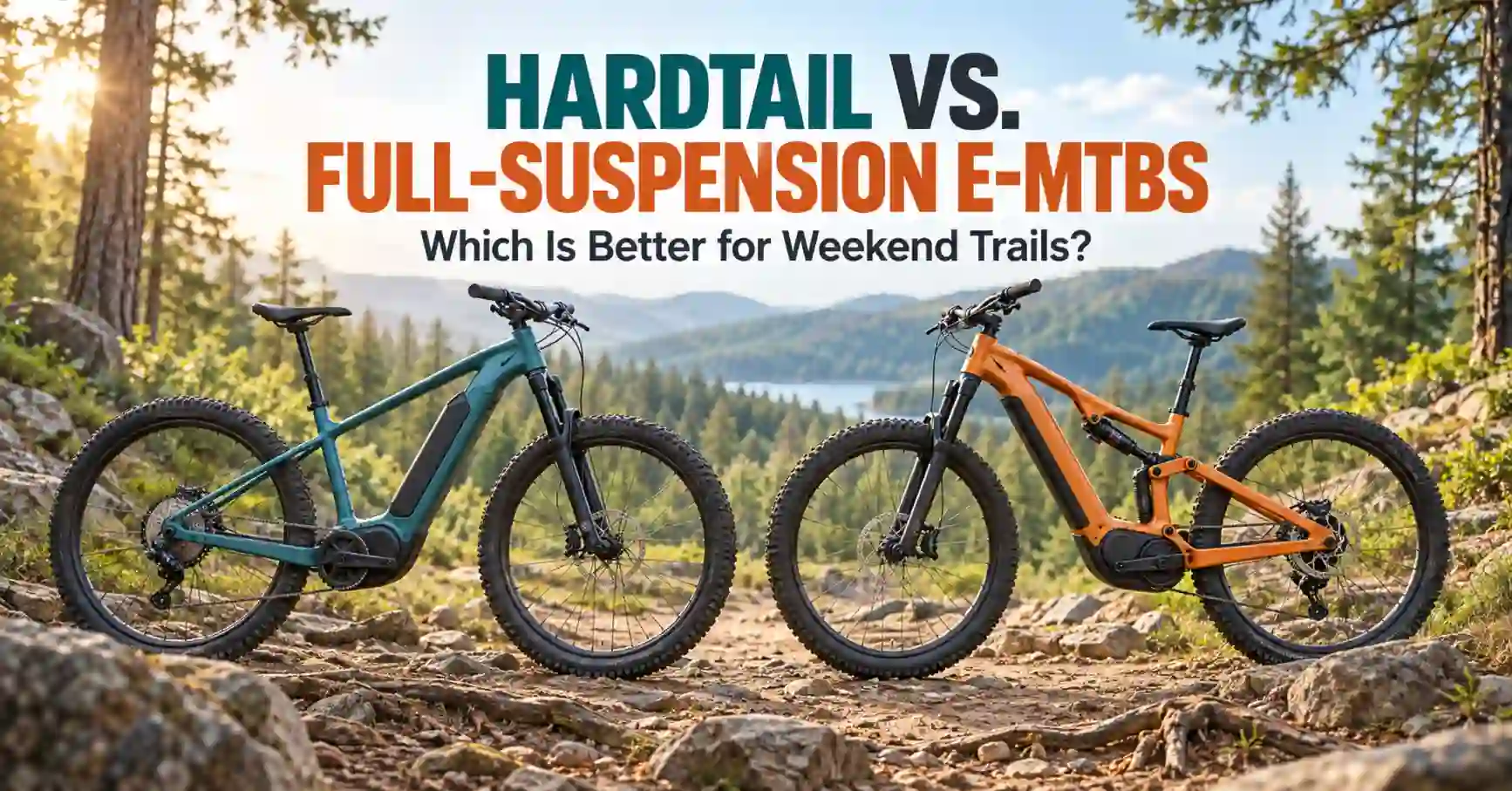
If you are choosing an electric mountain bike for weekend trails, the biggest question is usually simple: hardtail or full suspension? For smoother singletrack, forest roads, rolling cross-country trails, and riders who value lower cost and simpler maintenance, a hardtail is often the better choice. For rocky, root-filled, steeper, or more technical trails, a full-suspension eMTB usually gives you more comfort, traction, and control.
If you are still comparing actual models, see my Best Electric Mountain Bikes for Every Trail and Budget guide for current recommendations. You can also use the E-Bike Size Calculator if fit is part of your decision.
Quick Answer: Choose Hardtail or Full Suspension?
Choose a hardtail eMTB if most of your weekend riding is on smoother dirt trails, flowy singletrack, gravel connectors, forest roads, or moderate climbs, and you want a lighter, simpler, less expensive bike.
Choose a full-suspension eMTB if your local trails have frequent rocks, roots, drops, braking bumps, rough descents, or technical sections where extra rear-wheel traction and comfort matter more than simplicity and lower cost.
| Category | Hardtail eMTB | Full-Suspension eMTB |
|---|---|---|
| Best terrain | Smoother singletrack, forest roads, XC-style trails | Rocky, rooty, steep, technical trails |
| Comfort | More trail feedback through the rear wheel | Better impact absorption front and rear |
| Traction | Good on smoother surfaces | Better rear-wheel contact on rough terrain |
| Climbing feel | Direct and efficient on smoother climbs | More composed when climbs are rough or loose |
| Weight | Usually lighter | Usually heavier |
| Maintenance | Simpler, with fewer suspension components | More suspension pivots and service points |
| Price | Usually lower | Usually higher |
| Best for | Value-focused riders and less technical weekend trails | Riders prioritizing control and comfort on rough terrain |
What Is the Difference Between a Hardtail and Full-Suspension eMTB?
A hardtail electric mountain bike has a suspension fork at the front and a rigid rear triangle. A full-suspension electric mountain bike has suspension at both the front and rear.
That rear suspension is the main difference you feel on the trail. On a hardtail, impacts from rocks, roots, and braking bumps travel more directly through the rear wheel and frame. On a full-suspension bike, the rear shock allows the wheel to move more independently over uneven terrain, helping the tire stay in contact with the ground.
When a Hardtail eMTB Makes More Sense
Hardtails are often the better value for riders whose trails are not consistently rough or technical. They can handle much more than flat dirt paths, especially when they have modern mountain-bike geometry, capable tires, strong brakes, and a quality suspension fork.
Hardtail advantages
- Lower purchase price: You are not paying for a rear shock, linkage, and additional frame complexity.
- Less maintenance: There are fewer suspension components and pivot bearings to service.
- Usually lower weight: This can make the bike easier to handle, transport, and maneuver.
- Direct pedaling feel: On smoother climbs and flow trails, a hardtail can feel responsive and efficient.
- Good for developing line choice: A hardtail encourages you to pick smoother lines instead of relying on rear suspension to absorb every impact.
Hardtail drawbacks
- Less comfort on repeated rocks, roots, and braking bumps.
- Less rear-wheel traction on very rough or loose terrain.
- More fatigue during longer technical rides.
- Less forgiving if your local trails are steep and consistently rough.
When a Full-Suspension eMTB Is Worth the Extra Cost
Full suspension becomes easier to justify as the terrain gets rougher. Rear suspension can help the back tire follow the ground through roots, rocks, ruts, and uneven descents instead of bouncing or skipping across them.
Full-suspension advantages
- Better comfort: The rear shock reduces repeated impacts through the bike and rider.
- More traction: The rear wheel can stay in contact with rough terrain more consistently.
- More control on descents: The bike is generally more composed through technical sections and braking bumps.
- Less fatigue: On rough trails, suspension can reduce the amount of impact your body has to absorb.
- More capability: A full-suspension eMTB gives you more margin as trails become faster, steeper, and more technical.
Full-suspension drawbacks
- Higher purchase price.
- More weight.
- More maintenance, including rear-shock and pivot service.
- More setup variables, such as sag, rebound, and suspension pressure.
Current Hardtail and Full-Suspension eMTB Examples
Prices checked: August 31, 2026. Prices and availability can change, so confirm the current information on the official product page before buying.
| Bike | Type | Current Price | Suspension | Motor / Torque | Battery |
|---|---|---|---|---|---|
| Aventon Ramblas ADV | Hardtail | $2,899 | 130mm front | Aventon A100 mid-drive, 100Nm | 708Wh |
| Giant Talon E+ | Hardtail | $2,950 | 100mm front | SyncDrive Sport 2, 75Nm | 430Wh |
| Aventon Current ADV | Full suspension | $3,999 | 150mm front / 140mm rear | 110Nm, up to 120Nm in Boost | 800Wh |
| Specialized Turbo Levo 4 Alloy | Full suspension | $4,999.99 | 160mm front / 150mm rear | Specialized 3.1, 105Nm / 810W | 840Wh |
These bikes are examples of the category, not a ranking. If you want a broader model-by-model comparison, use the current electric mountain bike buying guide.
What Matters More Than Suspension Alone?
Suspension is important, but it should not be the only thing you compare. A poorly fitted full-suspension bike can be a worse choice than a well-fitted hardtail.
Fit and geometry
Check the manufacturer’s rider-height guidance, reach, standover height, wheel size, and intended riding style. Mountain-bike fit affects climbing position, confidence on descents, and low-speed control. The E-Bike Size Calculator can help you narrow down the starting point, but manufacturer geometry charts still matter.
Brakes and tires
For trail riding, good hydraulic disc brakes and appropriate mountain-bike tires can matter as much as suspension travel. Tire compound, tread pattern, casing, pressure, and width all affect traction and control.
Motor behavior
Most dedicated eMTBs use mid-drive motors because they work through the bicycle drivetrain and allow the motor to benefit from the bike’s gearing. This is especially useful on slow, steep, technical climbs. It is more accurate to think in terms of how a motor performs for a particular trail use than to assume one motor layout is always more efficient in every situation.
If you want the deeper explanation, see the E-Bike Motor Guide.
Battery capacity
A larger battery stores more energy and can support longer rides, all else being equal, but watt-hours alone do not determine real-world range. Elevation gain, assist level, rider weight, temperature, tire pressure, surface conditions, motor efficiency, and riding speed all affect how far you can ride.
Which Is Better for Weekend Trails?
For many recreational riders, the answer depends more on the roughness of the trail than on how often they ride.
If your weekends usually mean smooth or moderately rough singletrack, rail-trail connectors, forest roads, and rolling terrain, a capable hardtail can give you plenty of performance without the added price and maintenance of rear suspension.
If your rides regularly include chunky rock gardens, repeated roots, rough descents, technical switchbacks, or loose climbing sections, full suspension is much easier to justify. The added rear-wheel control can improve both confidence and comfort.
Common Mistakes When Choosing Between Hardtail and Full Suspension
- Assuming full suspension is automatically better: It is more capable on rough terrain, but you may be paying for weight, complexity, and travel you do not need.
- Assuming hardtails are only for beginner trails: Modern hardtails can be very capable on real singletrack.
- Buying based on battery size alone: Range matters, but fit, brakes, tires, geometry, motor behavior, and local terrain matter too.
- Ignoring bike weight: eMTBs are heavy. Think about loading the bike onto a rack, lifting it, and handling it if the battery runs out.
- Not checking local trail rules: E-bike access can vary by trail system, land manager, and e-bike class.
Frequently Asked Questions
Is a hardtail eMTB enough for weekend trail riding?
Yes, for many riders. If your local trails are mostly smooth to moderately rough, a capable hardtail with good tires, brakes, and geometry can be an excellent weekend-trail bike. Full suspension becomes more valuable as rocks, roots, drops, and rough descents become a regular part of the ride.
Is full suspension worth the extra money on an electric mountain bike?
It is usually worth paying for when your terrain is consistently rough or technical, or when comfort and traction are higher priorities than weight, price, and maintenance. On smoother trails, the benefit may be smaller.
Does full suspension help on climbs?
It can help on rough, loose, or root-filled climbs by allowing the rear wheel to track the terrain more consistently. On smooth climbs, a hardtail often feels more direct and simple.
Does a hardtail get better range?
Not automatically. A hardtail is often lighter and mechanically simpler, which can help efficiency, but real-world range depends on many variables including battery capacity, motor system, assist level, elevation, tires, rider weight, temperature, and riding speed.
How much suspension travel do I need for weekend trails?
There is no single correct number. Around 100-130mm of front travel is common on cross-country and trail-oriented hardtails, while many full-suspension trail eMTBs use roughly 140-160mm of front travel with rear travel in a similar general range. More travel is not automatically better if your terrain does not require it.
🔎 Why You Can Trust This Guide
I compare official specifications, safety information, independent technical guidance, and current product information. Affiliate relationships do not determine which products I recommend or how they are discussed.
My Take
For the rider Bing is already sending to this page – someone comparing a hardtail and full-suspension eMTB for weekend trails – I would start with the terrain, not the price tag or the amount of suspension travel.
If your trails are mostly smooth, rolling, or moderately rough, I would lean toward a good hardtail. You will generally spend less, have less suspension maintenance, and still get a very capable trail bike. If your local riding is rocky, rooty, steep, or technical enough that the rear wheel is regularly getting knocked around, I would choose full suspension.
The important point is that neither design is universally better. The better eMTB is the one that matches the trails you actually ride. If you are ready to compare specific bikes, continue with my Best Electric Mountain Bikes for Every Trail and Budget guide.
Sources
- Aventon – Ramblas ADV official product page
- Aventon – Current ADV official product page
- Giant – Talon E+ official product page
- Specialized – Turbo Levo 4 Alloy official product page
- Trek – Mountain Bike Buyer’s Guide

Kristina is not just an enthusiast but a true authority on electric bikes. Nestled in the coastal beauty of Virginia, Kristina has found the perfect backdrop for her passion for electric biking. As a dedicated wife and homeschooling mom, her life revolves around family, faith, and the thrill of adventure.
Originally hailing from Ohio, Kristina's journey with electric bikes began as a curiosity and quickly evolved into a deep expertise. Her blog is a testament to her love for electric biking, combining her fascination for eco-friendly transportation with her coastal lifestyle.
When she's not cruising the beach on her electric bike, you'll find Kristina indulging in her other loves: long walks along the shore, getting lost in a good book, and cherishing moments with her loved ones. With a heart as big as her love for animals, especially cats, Kristina brings a unique perspective to the electric bike world, grounded in her strong faith in God and her dedication to a sustainable lifestyle.
Through her blog, Kristina shares her extensive knowledge of electric bikes, offering valuable insights, tips, and recommendations to fellow enthusiasts. Whether you're a seasoned rider or a newcomer to the electric bike scene, Kristina's blog is your go-to source for all things electric biking, fueled by her passion, expertise, and the scenic beauty of coastal Virginia.