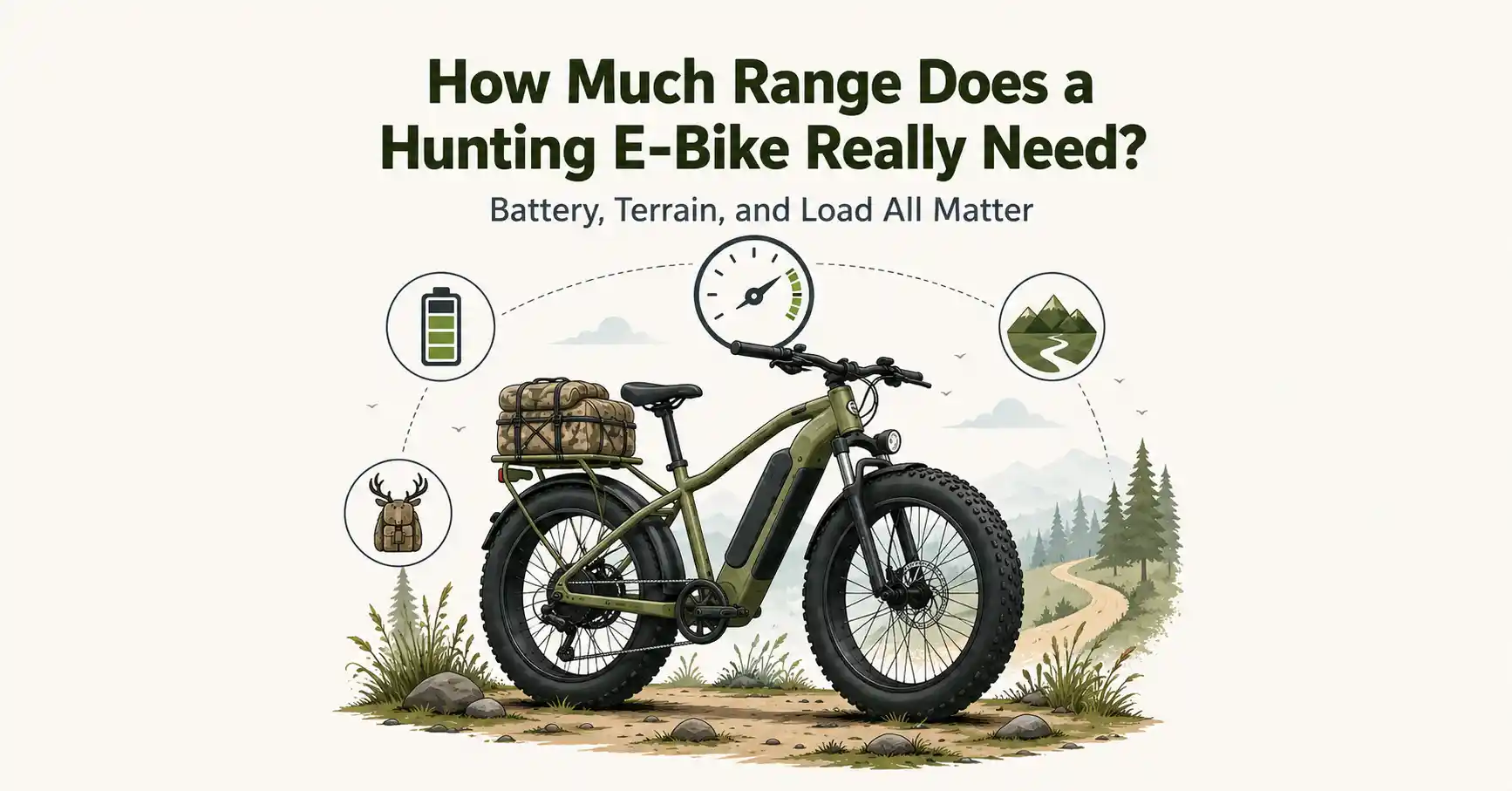
How Much Range Does a Hunting E-Bike Really Need?
Introduction
Hunting e-bike range is not about buying the bike with the biggest advertised mileage number. The range you really need is enough to cover your entire round trip under the conditions you expect to face, while still finishing with a useful battery reserve.
For remote, cold, steep, muddy, or heavily loaded trips, I recommend planning to return with roughly 25% to 30% of the battery remaining. That is conservative editorial guidance rather than a universal industry standard, but it gives you room for wrong turns, soft ground, stronger winds, extra climbing, and a heavier return load.
If you are still comparing models, start with my guide to the best hunting e-bikes. It also helps to understand e-bike battery capacity in amp-hours and watt-hours before comparing claimed range figures.
How Much Range Should You Plan For?
A hunting e-bike needs enough real-world range to complete the planned route, including side trips and the return journey, with a reserve for harder-than-expected conditions. The correct number may be modest for a short ride on a maintained access road or much larger for a long, cold, hilly route with gear and a trailer.
Do not choose a bike only because the product page says it can travel 60, 80, or 100 miles. Range calculators and manufacturer estimates can help with initial comparisons, but actual results depend on total weight, terrain, surface, wind, temperature, tire setup, speed, motor assistance, and rider effort. Bosch, for example, describes its range-calculator results as estimates that can vary with real riding conditions.
🔎 Why You Can Trust This Guide
This guide is based on standard battery-energy calculations, manufacturer guidance, official safety information, and practical range factors such as terrain, temperature, assist level, total load, and battery reserve. The calculator uses the information you enter to create a planning estimate, not a guaranteed range.
I separate advertised range claims from measured and estimated results, explain the limits of each calculation, and prioritize safe, realistic guidance over marketing numbers. Learn more about how Electric Bike Explorer researches reviews, rankings, buying guides, and troubleshooting content.
Want to See More Electric Bike Explorer in Google Search?
Add Electric Bike Explorer as a preferred source to see more of our e-bike law guides, safety updates, reviews, buying guides, and troubleshooting posts when they are relevant to your searches.
Why Advertised Range Is a Weak Hunting Number
A claimed range figure usually represents a particular set of test assumptions. Your hunt may include a heavier bike, low tire pressure, loose dirt, repeated starts, sustained climbing, cold temperatures, and high assistance. Any of those can increase energy use.
Hunting also creates an uneven trip. The outbound ride might be relatively light, while the return ride may include more gear, a trailer, or harvested game. Planning both legs as though they will use the same amount of energy can leave you with too little battery when the bike is carrying its heaviest load.
The better question is not, “How far does this bike claim to go?” It is, “How much battery does my route use under similar conditions?”
Start With Watt-Hours, Not Amp-Hours Alone
Watt-hours, abbreviated Wh, provide a more useful comparison of stored battery energy than amp-hours alone. Two batteries can both be rated at 20Ah but hold different amounts of energy if they operate at different voltages.
Battery watt-hours = nominal voltage × amp-hours
A nominal 48V, 20Ah battery is approximately 960Wh. A nominal 52V, 20Ah battery is approximately 1,040Wh. These numbers describe energy capacity, not guaranteed miles.
Battery displays and percentage readings are not laboratory instruments, and some gauges fall faster near the top or bottom of the charge. Treat calculations based on the display as practical estimates and build in a margin.
The Best Method: Measure Your Own Wh per Mile
The most useful range number comes from riding the bike under conditions that resemble the planned hunt. Use similar tires, pressure, gear weight, assist level, surface, and elevation whenever possible.
- Begin with a fully charged battery and record its rated watt-hours.
- Ride a representative route without intentionally draining the battery to an unsafe level.
- Record the distance and the approximate percentage of battery used.
- Estimate the watt-hours consumed.
- Divide the estimated watt-hours used by the miles ridden.
Observed Wh per mile = estimated battery energy used ÷ miles ridden
For example, suppose a 960Wh battery uses about 50% of its charge during a 20-mile test ride. The estimated energy used is 480Wh, or approximately 24Wh per mile. That is a useful starting point for similar conditions, but it should not be treated as a guaranteed consumption rate.
How to Calculate the Battery Capacity You Need
Once you have an observed Wh-per-mile figure, multiply it by the full planned distance. Then account for the battery reserve you want to keep.
Required battery Wh = planned miles × observed Wh per mile ÷ (1 – reserve percentage)
If the full route is 18 miles, your test ride used about 25Wh per mile, and you want a 25% reserve:
18 × 25 ÷ 0.75 = 600Wh
That result suggests a battery with at least 600Wh of usable planning capacity for comparable conditions. If the hunt is colder, steeper, softer, or more heavily loaded than the test ride, use a more demanding test result or add more capacity. Do not simply assume the formula accounts for every change.
Hunting E-Bike Battery Capacity Calculator
Use a representative test ride to estimate the battery capacity needed for your complete hunting route. The calculator follows the same measured Wh-per-mile method explained above.
Your planning estimate
Planning note: This is an estimate based on the information you enter. It cannot predict every change in terrain, temperature, wind, battery condition, load, detours, or riding behavior. Test the bike under comparable conditions and keep a non-electric return plan for remote trips.
Example Hunting E-Bike Range Scenarios
The examples below show how route distance, measured energy use, and reserve change the battery estimate. They are mathematical examples, not universal consumption claims.
| Example trip | Observed use | Reserve | Estimated battery need |
|---|---|---|---|
| 10-mile round trip on firm terrain | 20Wh per mile | 25% | About 267Wh |
| 20-mile mixed-terrain round trip | 25Wh per mile | 25% | About 667Wh |
| 30-mile demanding route | 30Wh per mile | 30% | About 1,286Wh |
The third example may require a large single battery, a manufacturer-approved dual-battery system, or a shorter route. It may also be a sign that the trip needs a different transportation plan rather than relying on one e-bike.
Plan the Return Ride for the Heavier Load
Range planning should reflect the heaviest expected portion of the trip. Include the rider, clothing, backpack, firearm or bow, racks, panniers, tools, food, water, trailer tongue weight, and anything you may carry back.
A heavier load can increase energy use and change braking, traction, steering, and stability. Before attaching a trailer or loading a rack, verify all of the following:
- The e-bike’s total payload rating
- The rear-rack rating
- The trailer’s rated load
- The hitch and attachment limits
- Tire and wheel limits
- Brake condition and suitability for the combined weight
Do not assume that a powerful motor makes the frame, rack, wheels, hitch, or brakes capable of carrying any load.
Terrain Can Matter More Than Distance
A short, steep route can use more battery than a longer ride on firm, level ground. Long climbs require sustained motor output, while loose dirt, mud, snow, sand, and deep gravel increase rolling resistance. Repeated stops and starts can also raise consumption.
Low gearing can help the motor operate more efficiently on climbs, especially with a mid-drive system. Riders comparing motor layouts can review my e-bike motor guide for an explanation of hub motors, mid-drives, torque, and climbing behavior.
Route planning should include total elevation gain, not only the highest point. A route with repeated climbs may be more demanding than one steady ascent followed by a long descent.
Cold Weather Requires More Conservative Planning
Cold conditions can temporarily reduce lithium-ion battery performance and available range. The size of the effect varies with the battery, pack temperature, load, and riding conditions, so a fixed statement such as “cold always reduces range by 20%” is not dependable.
Follow the bike and battery manufacturer’s instructions for operating, storing, and charging the pack. Do not charge a battery outside its approved temperature range. When practical, keep the battery at an appropriate indoor temperature before the ride rather than leaving it in a freezing vehicle overnight.
Bosch advises that cold weather reduces battery performance and recommends bringing the battery indoors when the e-bike is stored in cold conditions. Manufacturer instructions for your exact system should take priority.
Assist Level and Throttle Use Change the Answer
High assistance and frequent throttle use can shorten range substantially compared with lower assistance and steady pedaling. That does not mean a hunter should always use the lowest setting. Technical terrain, a heavy load, or a steep climb may require more support.
The practical strategy is to use the assistance needed for control and safety while avoiding unnecessary high-power riding on easier sections. Start the day with the route, battery state, and return reserve in mind rather than waiting until the display is nearly empty.
Tires, Pressure, and Maintenance Affect Range
Fat tires can provide flotation, traction, and comfort on rough surfaces, but pressure and tread matter. Pressure that is too low for the terrain and load increases rolling resistance and can raise the risk of rim damage or pinch-related problems. Pressure that is too high can reduce traction and comfort.
Use the tire and bike manufacturer’s limits, then adjust within those limits for the surface and total load. Check pressure before the hunt with a gauge rather than relying on a squeeze test.
Dragging brakes, a poorly lubricated drivetrain, damaged bearings, loose connections, and an aging battery can also reduce usable range. The e-bike troubleshooting and maintenance guide can help you identify common problems before a remote trip.
Should You Carry a Spare Battery?
A spare battery can be useful for long or multi-day hunts, but it is not automatically a safe or compatible solution. The U.S. Consumer Product Safety Commission advises using only a replacement or secondary battery pack that has been tested and approved to work safely with the device and confirmed as suitable by the manufacturer.
Do not use a pack simply because the voltage and connector appear to match. The battery, battery-management system, controller, mount, wiring, and charger must be compatible with the specific bike.
A spare battery also adds weight. Secure it against movement and impact, protect it from moisture, and follow the manufacturer’s transportation and temperature instructions. Never use a damaged, swollen, leaking, unusually hot, modified, or rebuilt pack.
Do Not Confuse Range With Legal Access
A bike may have enough battery for a route and still not be allowed there. Access can depend on the land manager, route designation, e-bike class, season, local order, and posted restrictions.
The U.S. Forest Service states that Class 1, 2, and 3 e-bikes are allowed on National Forest System roads and trails designated for motorized use. Individual forests may authorize additional opportunities through their planning processes, so riders should check the current forest map, Motor Vehicle Use Map, and local notices.
The Bureau of Land Management allows e-bikes on roads and trails open to off-highway vehicle use. On BLM routes limited to bicycles or non-motorized travel, e-bike use requires a written authorization decision from the responsible BLM manager.
Review the State-by-State E-Bike Law Guide, but always confirm the specific property and route with the responsible agency before riding.
Riding Permission Does Not Automatically Allow Game Retrieval
Permission to ride an e-bike on a road or trail does not automatically allow off-route travel or motorized retrieval of harvested game. Those rules may be controlled by a wildlife agency, park, forest, BLM office, private landowner, or another property manager.
Some locations establish narrow exceptions. Colorado’s State Forest State Park, for example, lists specific times and a particular road where electric and motorized transportation may be used for big-game retrieval. That example shows why a general statement about e-bike access is not enough.
Before the hunt, verify these questions separately:
- Are e-bikes allowed on the property?
- Which e-bike classes are allowed?
- Which roads or trails are open?
- Are there seasonal or time-of-day restrictions?
- Is motorized game retrieval allowed?
- Must the bike remain on a designated route?
Public-land access sources in this guide were checked on August 4, 2026. Rules can change, and posted local restrictions control.
A Practical Pre-Hunt Range Test
Do not make the first fully loaded ride the actual hunt. A representative test gives you more useful information than a product-page range claim.
- Inspect the battery, tires, brakes, drivetrain, wheels, racks, hitch, and electrical connections.
- Load the bike with the gear you expect to carry.
- Use the same tire setup and assist habits you expect on the hunt.
- Choose a route with similar surface and elevation.
- Record distance, battery used, temperature, load, elevation, and assist level.
- Repeat the test when conditions change significantly.
- Set a turnaround point based on the reserve needed for the return trip.
One test is better than none, but several rides provide a more dependable picture. Battery condition and capacity can also change over time.
Range Planning Checklist
- Map the complete round trip, including likely side trips.
- Check total elevation gain and surface conditions.
- Estimate the heaviest return load.
- Verify bike, rack, trailer, hitch, wheel, tire, and brake limits.
- Measure Wh per mile on a representative ride.
- Plan a conservative reserve for remote or difficult routes.
- Account for cold, mud, snow, sand, wind, and repeated climbing.
- Use only manufacturer-approved batteries and chargers.
- Confirm e-bike class and route access with the land manager.
- Confirm game-retrieval rules separately.
- Carry navigation, communication, basic repair supplies, water, and a plan for returning without motor assistance.
The free E-Bike Tools Hub can also help with battery, range, charging, fit, and other planning questions.
Common Hunting E-Bike Range Mistakes
Buying by the largest claimed mileage
A large advertised number does not explain the test conditions or how the bike performs under your load, terrain, and temperature.
Measuring only the outbound trip
The return leg may be heavier and more demanding. Plan for the full route and the heaviest likely load.
Using one fixed Wh-per-mile number
Energy consumption changes with conditions. Use your own representative tests and treat the result as an estimate.
Planning to arrive at 0%
A zero-reserve plan leaves no room for a wrong turn, detour, weather change, soft ground, or battery-display error.
Assuming a spare battery is compatible
A connector that fits does not prove the battery is safe for the bike. Confirm compatibility with the manufacturer.
Ignoring route and retrieval rules
Battery capacity does not override land-management restrictions, hunting regulations, closures, or route designations.
Frequently Asked Questions
Is 40 miles of range enough for a hunting e-bike?
It may be enough for a route that is well under 40 real-world miles, but the answer depends on the conditions behind that number. Use measured Wh per mile, include the entire round trip, account for the heaviest return load, and keep a reserve.
Is a 750Wh battery enough for hunting?
A 750Wh battery may be sufficient for many routes, but battery size alone cannot answer the question. Divide the usable planning capacity by your observed Wh per mile, then preserve the reserve you need for the route.
Do hunting trailers reduce e-bike range?
They can. The trailer, cargo, terrain, tires, wind, and riding speed can increase energy use. A trailer can also affect braking, steering, traction, and component loads.
Can I put a larger battery on my hunting e-bike?
Only use a battery the manufacturer confirms is compatible and approved for the bike. Matching voltage or connectors is not enough to establish safe compatibility.
Can I ride a hunting e-bike anywhere bicycles are allowed?
No. Some land managers treat e-bikes differently from non-electric bicycles, and access can vary by route and e-bike class. Confirm the rule for the exact property and route.
My Take
For a hunting e-bike, I would rather have a realistic route calculation and a dependable reserve than an impressive claimed range number. Measure the bike under a representative load, plan the return ride for the harder conditions, and keep enough battery available for the unexpected.
The right hunting e-bike range is not one number for every rider. It is the capacity that covers your route, terrain, temperature, assist use, and heaviest load without requiring you to gamble on the final battery bar.
External Sources
- Bosch eBike Range Calculator
- Bosch: 12 Questions About the eBike Battery
- U.S. Forest Service: Electric Bicycle Use
- Bureau of Land Management: E-Bike Rule Questions and Answers
- U.S. Consumer Product Safety Commission: Micromobility Safety Information
- Colorado Parks and Wildlife: State Forest State Park

Kristina is not just an enthusiast but a true authority on electric bikes. Nestled in the coastal beauty of Virginia, Kristina has found the perfect backdrop for her passion for electric biking. As a dedicated wife and homeschooling mom, her life revolves around family, faith, and the thrill of adventure.
Originally hailing from Ohio, Kristina's journey with electric bikes began as a curiosity and quickly evolved into a deep expertise. Her blog is a testament to her love for electric biking, combining her fascination for eco-friendly transportation with her coastal lifestyle.
When she's not cruising the beach on her electric bike, you'll find Kristina indulging in her other loves: long walks along the shore, getting lost in a good book, and cherishing moments with her loved ones. With a heart as big as her love for animals, especially cats, Kristina brings a unique perspective to the electric bike world, grounded in her strong faith in God and her dedication to a sustainable lifestyle.
Through her blog, Kristina shares her extensive knowledge of electric bikes, offering valuable insights, tips, and recommendations to fellow enthusiasts. Whether you're a seasoned rider or a newcomer to the electric bike scene, Kristina's blog is your go-to source for all things electric biking, fueled by her passion, expertise, and the scenic beauty of coastal Virginia.