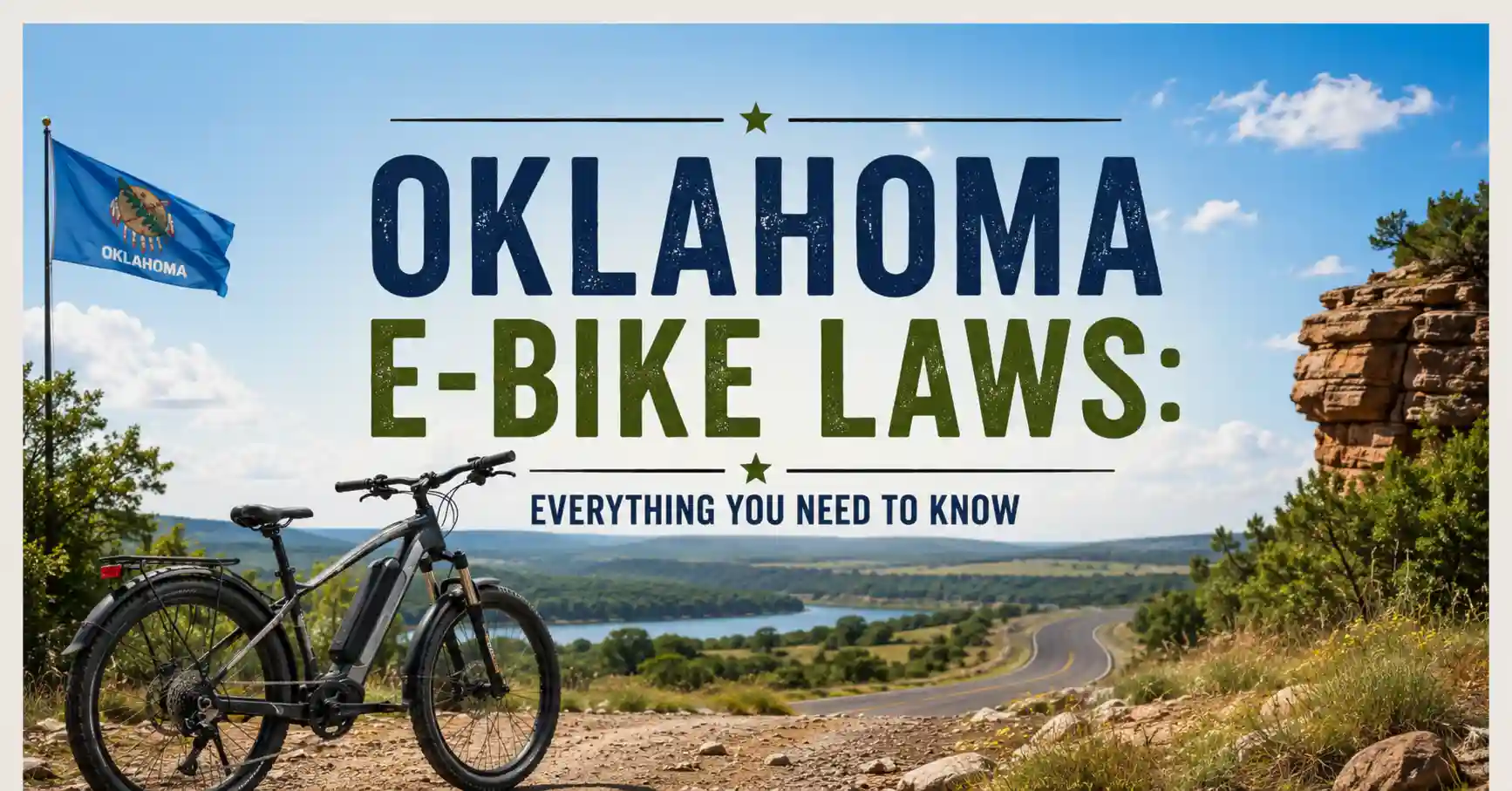
Oklahoma E-Bike Laws: Classes, Helmets, Sidewalks, Trails, and Local Rules
Last Updated on July 31, 2026 by Kristina
Last researched and verified: July 30, 2026
Introduction
Oklahoma recognizes Class 1, Class 2, and Class 3 electric bikes with motors rated at no more than 750W. A compliant e-bike generally receives the same rights and responsibilities as a bicycle, and Oklahoma does not require a driver license, motorcycle endorsement, vehicle registration, title, license plate, or state-mandated motor-vehicle insurance.
The statewide rules are only the starting point. Cities, park authorities, trail managers, universities, schools, federal agencies, transit systems, and private property owners can impose additional restrictions. Sidewalk access, trail use, campus registration, and battery-storage rules can change from one location to another.
You can compare Oklahoma with other states in the State-by-State E-Bike Law Guide. Riders who are unsure whether their bike is Class 1, Class 2, or Class 3 can review my guide to electric bike classes.
🔎 Why You Can Trust Electric Bike Explorer
I reviewed current state statutes, transportation agency guidance, and available local rules when this guide was updated. When relevant, I also check city ordinances, park and trail policies, school or campus rules, and other official government sources.
E-bike laws can change, and local governments, parks, trails, and campuses may impose additional restrictions. Always confirm the latest requirements with the appropriate agency before riding.
Learn more about how Electric Bike Explorer researches law guides, buying guides, troubleshooting information, and e-bike recommendations.
Want to See More Electric Bike Explorer in Google Search?
Add Electric Bike Explorer as a preferred source to see more of our e-bike law guides, safety updates, reviews, buying guides, and troubleshooting posts when they are relevant to your searches.
Oklahoma E-Bike Laws at a Glance
- Maximum motor rating: No more than 750W.
- Required pedals: The bike must have fully operative pedals for human propulsion.
- Class 1: Pedal assistance that stops at 20 mph.
- Class 2: The motor may propel the bike without pedaling but cannot provide assistance at 20 mph or above.
- Class 3: Pedal assistance that stops at 28 mph.
- Driver license or motorcycle endorsement: Not required for a compliant e-bike.
- Registration, title, and license plate: Not required.
- State-mandated vehicle insurance: Not required.
- Class 3 minimum age: The operator must be at least 16.
- Class 3 equipment: A speedometer displaying mph is required.
- Statewide helmet rule: There is no current general statewide e-bike helmet requirement. Some cities impose local requirements.
- Bicycle and multiuse paths: All three classes are permitted by the statewide baseline where bicycles are allowed, unless the managing authority restricts a class.
- Natural-surface nonmotorized trails: The agency or authority managing the trail decides whether e-bikes are permitted.
- Sidewalks: Local ordinances and posted restrictions control.
Quick Oklahoma E-Bike Access Chart
| Location | Statewide Starting Point | What to Check |
|---|---|---|
| Public roads | Compliant e-bikes generally receive bicycle rights and duties. | Traffic controls, controlled-access restrictions, and local rules. |
| Bike lanes | Generally permitted where bicycles are allowed. | Posted closures and local traffic regulations. |
| Paved bicycle or multiuse paths | Class 1, Class 2, and Class 3 are permitted by default. | The managing city, park, or agency may restrict one or more classes. |
| Natural-surface nonmotorized trails | No automatic statewide access right. | Check the actual trail manager’s rule. |
| Sidewalks | No single statewide permission or prohibition. | City ordinances, business-district rules, and posted signs. |
| State parks | Rules depend on the road, path, trail, and individual park. | Park rules use terminology that does not align perfectly with the current three-class statute. |
| Federal land | Property-specific federal rules apply. | Check the current superintendent’s compendium or refuge policy. |
| University campuses | State law still applies, but campuses may add operating and storage rules. | Registration, speed, parking, housing, and charging policies. |
| Public transit | Transit agencies establish their own equipment rules. | Rack weight, battery type, dimensions, folding, and onboard restrictions. |
| Interstates and turnpikes | Controlled-access authorities may prohibit bicycle traffic. | ODOT advises cyclists not to use interstates or turnpikes. |
Who This Oklahoma E-Bike Law Guide Covers
This guide covers electric-assisted bicycles that meet Oklahoma’s statutory definition. The vehicle must have two or three wheels, fully operative pedals, a motor rated at no more than 750W, and powered assistance that operates within one of the state’s three class definitions.
A high-powered e-moto, electric dirt bike, modified minibike, or throttle-equipped vehicle operating outside those limits may not qualify as an electric-assisted bicycle. A vehicle does not automatically receive bicycle status merely because a seller calls it an e-bike or attaches pedals.
How Oklahoma Defines Class 1, Class 2, and Class 3 E-Bikes
| Class | How the Motor Works | Assisted-Speed Limit |
|---|---|---|
| Class 1 | The motor assists only while the rider is pedaling. | Assistance stops at 20 mph. |
| Class 2 | The motor may be used to propel the bike without pedaling. | Assistance stops at 20 mph. |
| Class 3 | The motor assists only while the rider is pedaling. | Assistance stops at 28 mph. |
Class 2 is the Oklahoma class that permits motor-only propulsion, which normally means a throttle. Class 3 is defined as pedal assist rather than throttle-only operation.
The definition section also says the motor must disengage or cease functioning when the rider stops pedaling or applies the brakes. That wording does not fit neatly with the separate Class 2 provision allowing motor-only propulsion. Riders should use the bike in its compliant manufacturer configuration and should not assume a control modification is legal merely because the resulting speed remains below 20 mph.
Do Oklahoma E-Bikes Need a License, Registration, Title, Plate, or Insurance?
No. Oklahoma expressly exempts compliant electric-assisted bicycles and their operators from state motor-vehicle requirements covering financial responsibility, vehicle insurance, driver licenses, registration, and certificates of title.
| Requirement | Rule for a Compliant Oklahoma E-Bike |
|---|---|
| Driver license | Not required |
| Motorcycle endorsement | Not required |
| Vehicle registration | Not required |
| Certificate of title | Not required |
| License plate | Not required |
| State-mandated vehicle insurance | Not required |
A university, rental operator, employer, or private property manager may still require local bicycle registration. Optional insurance may also be worth considering for theft, liability, collision damage, medical expenses, or a costly replacement battery.
Oklahoma E-Bike Age and Helmet Rules
Class 3 riders must be at least 16
A person under 16 may not operate a Class 3 e-bike in Oklahoma. A person under 16 may ride as a passenger on a Class 3 e-bike if the bicycle is designed and properly equipped to carry a passenger.
The statewide e-bike statute does not establish a minimum operating age for Class 1 or Class 2. A city, park, school, property manager, rental company, or organized event may impose a stricter age rule.
There is no current general statewide helmet requirement
Oklahoma’s current e-bike statute does not impose a general statewide helmet requirement. Local ordinances can be stricter.
Enid requires an e-bike rider under 18 to wear a bicycle helmet. Yukon requires anyone under 18 who operates or rides a bicycle to wear one. Because Oklahoma generally includes electric-assisted bicycles within the term “bicycle,” the Yukon requirement should be treated as applying to a compliant e-bike unless the city provides contrary guidance.
I recommend a properly fitted helmet on every ride, particularly when riding a Class 3 e-bike. My guide to helmets for e-bike riders explains useful safety features and fit considerations.
Where Can You Ride an E-Bike on Oklahoma Roads?
A compliant e-bike rider generally receives the rights and duties that apply to a bicycle rider. Follow traffic lights, stop signs, lane directions, right-of-way rules, and other applicable traffic laws.
When traveling more slowly than traffic, ride as close to the right side as is safe. Oklahoma recognizes exceptions for passing, preparing for a left turn, avoiding parked vehicles or other hazards, and staying out of a right-turn-only lane.
On a one-way road with two or more marked lanes, a cyclist may ride near the left side. Riders may not pass between lanes of traffic moving in the same direction. Two cyclists may ride abreast, but they must not unnecessarily impede traffic and must remain within one lane on a striped roadway.
Oklahoma’s bicycle-passing rule
When more than one lane travels in the same direction, a motorist approaching a bicycle must move into the immediately adjacent left lane when that lane is available and the movement can be made safely.
On a road with only one lane traveling in the same direction, the driver must leave at least 3 feet between the vehicle and the bicycle or rider. A driver may cross the center or no-passing line when the maneuver is otherwise legal and can be completed safely.
Do not ride on an interstate or turnpike
Oklahoma law authorizes the Department of Transportation, the Oklahoma Turnpike Authority, and local authorities to prohibit bicycle and other nonmotorized traffic on controlled-access highways. Signs must be placed when such a restriction is imposed.
ODOT’s current bicycle guidance tells cyclists and pedestrians not to attempt to travel on controlled-access highways such as interstates and turnpikes. Plan an alternate route rather than trying to use one.
Oklahoma E-Bike Labels, Lights, Reflectors, and Brakes
Permanent class label
Manufacturers and distributors must permanently label an e-bike with its class number, top assisted speed, and motor wattage. Oklahoma specifies that the label use Arial type in a size of at least 9 points.
A person who modifies the bike’s motor-powered speed capability or the way motor assistance engages must replace the label when appropriate. Replacing a label does not make an otherwise noncompliant vehicle legal.
Class 3 speedometer
A Class 3 e-bike must have a speedometer capable of displaying the bike’s speed in mph.
Lights and reflectors
Oklahoma’s bicycle-equipment provisions expressly include electric-assisted bicycles. During the times when vehicle lighting is required, a bicycle must have a white front light and red rear light visible from at least 1,000 feet.
It must also have a rear red reflector visible from 600 feet and reflective material or other equipment providing side visibility from 600 feet. The front- and rear-lamp sections contain an exception for streets or highways posted at 25 mph or less, but using working lights after dark is still the safer choice.
Brake requirement
The bike must have a brake or brakes capable of stopping it within 25 feet from 10 mph on dry, level, clean pavement.
Helpful Legal and Safety Accessories for E-Bike Riders
E-bike equipment requirements vary by state and city, but a few basic accessories can help you ride more safely, remain visible, and comply with local laws.
- Helmet – Protect your head with a properly fitted, CPSC-certified bicycle helmet, even if you’re not legally required to wear one.
- Front & Rear Bike Lights – Improve your visibility during early morning rides, evening commutes, and low-light conditions.
- Phone Mount – A sturdy handlebar phone mount can make it easier to follow maps, check your route, or use trail apps without having to stop and dig through a bag.
- Rear View Mirror – A handlebar or helmet-mounted mirror can help you keep an eye on traffic behind you, which is especially helpful when riding on roads, bike lanes, or narrow shoulders.
- Panniers or Rear Rack Bags – Panniers and bike bags are useful for carrying groceries, work items, jackets, tools, chargers, or extra layers without wearing a heavy backpack.
- Small Handlebar or Frame Bag – A compact bag gives you quick access to smaller items like keys, wallet, snacks, sunglasses, tire levers, or a portable charger.
- Heavy-Duty Bike Lock – Help protect your investment when stopping at stores, trailheads, or other public places.
- Mini Tire Pump & Flat Repair Kit – Be prepared for unexpected flats, especially if you’re riding longer distances.
- Compact Multi-Tool – Quickly tighten loose bolts or make minor adjustments while you’re away from home.
- High-Visibility Reflective Gear – Reflective vests, ankle bands, or jackets can help drivers see you sooner, especially at dawn, dusk, or in poor weather.
Are E-Bikes Allowed on Oklahoma Sidewalks?
There is no single statewide sidewalk answer for every Oklahoma community. Local ordinances often prohibit bicycle riding on sidewalks in business districts, downtown areas, or locations marked with signs.
Because Oklahoma generally includes electric-assisted bicycles within the legal definition of “bicycle,” local bicycle sidewalk rules normally apply to compliant e-bikes unless the local rule says otherwise.
Where sidewalk riding is allowed, slow down around pedestrians, yield the right-of-way, give an audible warning before passing, and use extra care at driveways and intersections. For a broader explanation, see my guide to e-bike sidewalk laws.
Bike Paths, Shared-Use Paths, and Natural-Surface Trails
Paved bicycle and multiuse paths
Oklahoma’s statewide baseline permits Class 1, Class 2, and Class 3 e-bikes on bicycle and multiuse paths where bicycles are permitted. The responsible city, state agency, park authority, or other government body may prohibit one or more classes on a path under its jurisdiction.
Natural-surface nonmotorized trails
The automatic path permission does not apply to a trail designated as nonmotorized when it has a natural tread made from native soil without an added surface. The government agency or other authority managing that trail decides whether an e-bike class may be used.
Permission on a paved greenway does not establish the rule for a nearby mountain bike trail, singletrack route, wildlife property, or dirt path.
Oklahoma City E-Bike Rules Comparison
This chart highlights verified local differences. Temporary closures, signs, event restrictions, and property-specific rules can still apply.
| City | Verified Local Information | Practical Takeaway |
|---|---|---|
| Oklahoma City | OKC Parks currently lists Class 1, Class 2, and Class 3 e-bikes as permitted on city park trails. The page includes both paved trails and off-road cycling facilities and does not publish a Class 1-only natural-trail restriction. The Lake Stanley Draper mountain bike trail requires a permit. Cyclists may not ride on sidewalks within business districts. Martin Park Nature Center prohibits bicycles. | All three legal classes are listed as permitted under the current general OKC Parks trail rules. Follow facility signs, obtain the Draper permit when required, and avoid business-district sidewalks. |
| Tulsa | The city’s official bicycle guidance tells cyclists not to use sidewalks within the downtown Inner Dispersal Loop, on Cherry Street between Peoria and Utica, or on Brookside between 33rd and 36th. Tulsa River Parks has a separate e-bike policy. | Use the street or an appropriate bicycle facility in these districts and check separate park-authority rules. |
| Norman | Norman’s 2022 ordinance prohibits riding a bicycle, motorized scooter, or skateboard on a sidewalk where signs specifically prohibit it. A person using a bicycle or scooter in a crosswalk must walk it and receive pedestrian rights and duties. | Sidewalk riding is not prohibited citywide, but obey all posted no-riding areas and walk through crosswalks. |
| Edmond | Edmond recognizes the three Oklahoma e-bike classes and permits all three on bicycle and multiuse paths where bicycles are allowed. Class 3 riders must be at least 16 and the bike must have a speedometer. | City rules largely follow the statewide system, but individual parks and natural-surface trails may add restrictions. |
| Stillwater | Stillwater expressly includes electric-assisted bicycles within its bicycle provisions. Riding a bicycle is prohibited on sidewalks in the commercial business district and on sidewalks marked with no-bicycle signs. | Use streets or appropriate bicycle facilities in the commercial business district and follow Oklahoma State University’s separate campus rules. |
| Enid | Enid requires an e-bike rider under 18 to wear a bicycle helmet and prohibits anyone under 16 from operating a Class 3 e-bike. The municipal code also prohibits bicycle riding on sidewalks. | Enid has a stricter youth helmet rule and a broader sidewalk restriction than many Oklahoma cities. |
| Yukon | Bicycle riding is prohibited on sidewalks within the business district. Anyone under 18 operating or riding a bicycle must wear a helmet. | Young riders need a helmet, and all riders should avoid business-district sidewalks. |
| Midwest City | Bicycle riding is prohibited on sidewalks within a business district. | Use a roadway or appropriate bicycle facility in business districts and follow additional posted restrictions. |
Oklahoma Parks, Trails, and Major Destinations
| Location or System | Verified Rule or Limitation | What Riders Should Do |
|---|---|---|
| Tulsa River Parks | River Parks says e-bikes must be pedal assist, have pedals, fit what it calls Class 1 or Class 2, and be regulated to a maximum of 20 mph unless otherwise posted. | The published wording is internally confusing because Oklahoma Class 2 permits motor-only propulsion. Throttle-equipped riders should confirm the current interpretation with River Parks. |
| Turkey Mountain | River Parks identifies Turkey Mountain as a mountain biking destination, but its public e-bike rule does not clearly state which e-bike classes may use every natural-surface trail. | Confirm motor-assistance access with River Parks before riding. |
| Arcadia Lake | Arcadia Lake’s rules state that motorized vehicles are not allowed on any trail. The page does not explain whether a compliant electric-assisted bicycle is treated as a prohibited motorized vehicle. | Ask Arcadia Lake management before using electric assistance on a trail. |
| Creekside Bike Park in Norman | The City of Norman identifies Creekside as a bicycle park, but I did not find a current official rule expressly allowing or prohibiting e-bike motor assistance. | Confirm with Norman Parks and Recreation before using an e-bike on the park’s natural-surface features. |
| Oklahoma state parks | State park regulations grant bicycle riders roadway rights and duties and require riders to use an adjacent usable bicycle path when one is provided. The administrative definition of bicycle includes some motor-assisted devices up to 1,000W and 20 mph, which does not align perfectly with Oklahoma’s current 750W three-class statute. | Do not treat the older administrative definition as permission to ride a bike that fails the statewide e-bike definition. Ask the individual park about Class 2, Class 3, and natural-surface trail access. |
| Chickasaw National Recreation Area | The National Park Service permits e-bikes with fully operable pedals and motors of less than 750W where traditional bicycles are allowed. Bromide Hill Trail and areas east of the Travertine Nature Center are closed to bicycles. Outside areas open to public motor vehicles, riders may not use the motor to move an e-bike without pedaling. | Note that the federal definition says less than 750W, while Oklahoma permits no more than 750W. Do not use throttle-only propulsion outside areas open to public motor vehicles. |
| Wichita Mountains Wildlife Refuge | Bicycles are allowed only on paved roads, Mt. Scott Service Road, Lake Elmer Thomas Service Road, and the LETRA Trail. The refuge’s public rules do not separately explain whether or where e-bike motor assistance is permitted. | Confirm e-bike motor use with refuge staff rather than assuming bicycle permission answers the e-bike question. |
Oklahoma College and University E-Bike Rules
A state-legal e-bike can still be subject to campus transportation, registration, parking, housing, fire-safety, and student-conduct policies.
| Campus | Verified Policy Information | Before You Arrive |
|---|---|---|
| University of Oklahoma | OU asks riders to register bicycles, e-bikes, and electric scooters with Parking and Transportation Services. The campus operating limit is 10 mph. Lithium-ion e-bikes may not be stored or charged inside university buildings. Bikes must use designated racks or scooter-parking areas. | Register the bike, plan for permitted outdoor parking, and do not bring the e-bike or battery inside a university building. |
| Oklahoma State University | Bicycle registration is mandatory and free. Bikes must be parked at approved racks, and improperly parked or abandoned bikes may be impounded. Indoor bicycle storage in university housing requires approval from housing officials. The current parking policy does not publish a separate e-bike battery-charging rule. | Register through Parking Services and ask Housing specifically about e-bike batteries, indoor storage, and charging. |
| University of Central Oklahoma | UCO requires any bicycle operated on campus to be registered for free. Bikes must be placed in designated racks, and unregistered or improperly parked bicycles may be impounded. UCO publishes indoor-charging restrictions for rental e-scooters, but its current bicycle page does not clearly state an e-bike battery-charging policy. | Register the bike and ask Transportation and Parking Services or Housing about e-bike storage and charging. |
| University of Tulsa | Students, faculty, and staff must register bicycles and electric micromobility devices. E-bikes may not be used inside university buildings. Charging is restricted to residential rooms or apartments and must follow rules including no unattended or overnight charging and use of the manufacturer’s charger. | Register the bike, follow the residential charging conditions, and note that charging-rule violations can lead to fines. |
What About Oklahoma K-12 Schools?
Oklahoma does not provide one statewide rule guaranteeing that a student may ride, park, store, or charge an e-bike on school property. School districts, charter schools, private schools, and individual campuses may establish arrival procedures, bicycle parking rules, powered-riding restrictions, and battery policies.
Before a student rides an e-bike to school, check:
- The student handbook and transportation rules.
- Whether powered riding is permitted on campus sidewalks.
- Where the bike may be locked.
- Whether the e-bike or removable battery may enter a building.
- Whether charging is prohibited.
- Whether registration or a parking permit is required.
- The city’s helmet and sidewalk rules.
- Whether the rider is old enough to operate a Class 3 e-bike.
A school’s silence about e-bikes should not be treated as permission to store or charge one indoors. Ask the principal, transportation office, or district safety office when the written policy is unclear.
Can You Take an E-Bike on Oklahoma Public Transit?
EMBARK in Oklahoma City
EMBARK permits qualifying e-bikes on exterior racks on EMBARK and RAPID buses. Homemade e-bikes are not accepted, the battery must be sealed and in good condition, and the bike must fit the rack. The limit is 55 lb per rack position.
Lead-acid batteries are not allowed inside a bus. A heavy fat-tire or cargo e-bike may exceed the rack limit even when it fits the legal e-bike definition.
MetroLink Tulsa
MetroLink permits battery-powered folding bikes and scooters onboard when they are folded, safely secured, and do not block an aisle, door, or emergency exit window.
The policy specifically addresses folding devices. Riders with a full-size e-bike should confirm current rack availability and dimensions before traveling.
Modified, Unlocked, and High-Powered Electric Bikes
A product name does not determine legal status. An electric dirt bike, Surron-style e-moto, minibike, or other high-powered vehicle may not qualify as an electric-assisted bicycle even when it has pedals or is marketed as an e-bike.
A vehicle can fall outside Oklahoma’s e-bike definition when it:
- Has a motor rated above 750W.
- Does not have fully operative pedals.
- Provides powered assistance beyond the applicable class cutoff.
- Uses motor-only propulsion at or above 20 mph.
- Is described as Class 3 but provides throttle-only propulsion.
- Has been modified so it no longer fits Class 1, Class 2, or Class 3.
A noncompliant vehicle may fall under a different vehicle category depending on its actual construction and capabilities. That can trigger different licensing, equipment, registration, roadway, or insurance requirements.
Pay particular attention to an unlockable or “off-road” mode. Changing a software setting can affect legal classification and trail access even when the original factory label says Class 2 or Class 3.
Real-World Oklahoma E-Bike Scenarios
Commuting on an Oklahoma City street
A compliant Class 2 commuter e-bike may generally use the roadway and bike lanes without state motor-vehicle registration or a driver license. Follow traffic controls, do not pass between traffic lanes, and avoid controlled-access highways.
Riding a Class 3 bike on an Oklahoma City trail
OKC Parks currently lists Class 3 e-bikes as permitted on its trail system. The rider must be at least 16, and the bike must have a speedometer. Facility signs, permits, and temporary closures still apply.
Taking a Class 3 bike to Tulsa River Parks
Do not rely solely on the statewide path baseline. River Parks publishes a local rule identifying Class 1 and Class 2 e-bikes and a 20 mph maximum unless otherwise posted.
Using a throttle-equipped Class 2 bike at River Parks
River Parks refers to Class 2 e-bikes but also says allowed e-bikes must be pedal assist. Because those descriptions do not fit together cleanly, confirm throttle use with the authority before riding.
Riding an eMTB on a state park dirt trail
Check with the individual park. Oklahoma’s statewide paved-path permission and the State Parks administrative definition do not provide a clear universal answer for every natural-surface trail.
Bringing an e-bike into an OU building
OU prohibits lithium-ion e-bikes from being stored or charged inside university buildings. Register the bike and plan for permitted outdoor parking.
A 15-year-old riding a Class 3 e-bike
The rider may not legally operate the Class 3 bike in Oklahoma. The statewide minimum operating age is 16.
A 17-year-old riding in Enid or Yukon
A helmet is required under the applicable local ordinance even though Oklahoma has no current general statewide e-bike helmet requirement.
Before Riding an E-Bike in Oklahoma
- Confirm the bike has fully operative pedals.
- Verify that its motor rating is no more than 750W.
- Check the permanent class, assisted-speed, and wattage label.
- Make sure a Class 3 rider is at least 16.
- Confirm that a Class 3 bike has a working speedometer.
- Inspect the brakes, tires, lights, and reflectors.
- Check the city’s sidewalk ordinance.
- Identify the actual manager of every trail or park.
- Do not assume a paved-path rule applies to a dirt trail.
- Review campus registration, storage, and charging policies.
- Check transit rack dimensions and weight limits.
- Follow posted closures, speed limits, and class restrictions.
- Recheck classification after modifying speed, power, or throttle operation.
Nearby State Law Guides
Traveling outside Oklahoma? Laws change quickly.Check other states:
Louisiana e-bike laws
Arkansas e-bike laws
Texas e-bike laws
Kansas e-bike laws
👉 Compare all states in the state-by-state e-bike law guide
Oklahoma E-Bike Law FAQs
Are electric bikes street legal in Oklahoma?
Yes. Class 1, Class 2, and Class 3 e-bikes that meet Oklahoma’s definition may generally be ridden where bicycles are permitted.
What is the maximum legal e-bike motor rating?
The statewide e-bike limit is no more than 750W.
Do I need a driver license for an e-bike?
No. A compliant electric-assisted bicycle and its operator are exempt from Oklahoma’s driver-license provisions.
Does an Oklahoma e-bike need registration or a license plate?
No state vehicle registration, title, or license plate is required. A campus or other property manager may still require local bicycle registration.
Do I need e-bike insurance?
Oklahoma does not require motor-vehicle insurance or statutory financial responsibility for a compliant e-bike. Optional theft, liability, or damage coverage may still be useful.
How old must you be to ride a Class 3 e-bike?
You must be at least 16 to operate a Class 3 e-bike in Oklahoma.
Are helmets required?
There is no current general statewide e-bike helmet requirement. Enid and Yukon have verified local under-18 requirements, and campuses, parks, or events may add their own rules.
Can a Class 3 e-bike use an Oklahoma bike path?
Yes, under the statewide baseline, where bicycles are permitted. The managing city, park, or agency may prohibit Class 3 or another class.
Can you ride an e-bike on an Oklahoma sidewalk?
It depends on the city and location. Some cities prohibit bicycle riding in business districts, on signed sidewalks, or throughout the city.
Are e-bikes allowed on mountain bike trails?
Only when the trail manager permits them. Natural-surface nonmotorized trails are not covered by Oklahoma’s automatic path-access provision.
Can I ride an e-bike on an interstate or turnpike?
Do not do so. Controlled-access authorities may prohibit bicycle traffic, and ODOT advises cyclists not to travel on interstates or turnpikes.
Can I unlock my e-bike above its labeled class?
A modification that changes powered speed, motor rating, or throttle operation can change the bike’s legal classification. Replacing the label does not make an otherwise noncompliant bike legal.
Can I charge an e-bike in a college residence hall?
It depends on the institution. OU prohibits indoor storage and charging of lithium-ion e-bikes. The University of Tulsa permits residential charging only under specific safety conditions. OSU and UCO riders should obtain direct confirmation when the published policy does not answer the e-bike battery question.
My Take
Oklahoma’s statewide framework is fairly straightforward once a bike meets the legal definition. The state recognizes all three classes, does not require motor-vehicle licensing or registration, and gives all three classes a broad starting point for road and paved-path access.
The practical challenge is local control and inconsistent terminology. Oklahoma City currently lists all three classes on its trails, while Tulsa River Parks publishes a narrower rule. State park regulations use a motor-assisted bicycle definition that does not align cleanly with the statewide three-class system.
I would not plan an unfamiliar ride based solely on the statewide statute. Check the actual city, park, trail manager, campus, refuge, or transit agency responsible for the location.
Disclosure: As an Amazon Associate, I earn from qualifying purchases. This comes at no extra cost to you and helps support the content on this site.
Legal Disclaimer
This guide is for general informational purposes and is not legal advice. State, city, campus, school, park, trail, federal-property, transit, and private-property rules can change or differ. Confirm current requirements with the authority responsible for the place where you plan to ride.
See something that may have changed? Please use the Electric Bike Explorer error-reporting form so I can review it.
Official and Primary Sources
- Oklahoma Statutes, Title 47 – Motor Vehicles
- Oklahoma City Parks trail and e-bike rules
- Oklahoma City safe-cycling and sidewalk guidance
- Martin Park Nature Center rules
- City of Tulsa bicycle and sidewalk guidance
- City of Norman Ordinance O-2122
- City of Edmond electric-assisted bicycle ordinance
- Stillwater bicycle and electric-assisted bicycle code
- Enid electric-assisted bicycle ordinance
- Enid sidewalk-riding ordinance
- Yukon bicycle, sidewalk, and helmet ordinance
- Midwest City bicycle ordinance
- Tulsa River Parks e-bike rules
- Arcadia Lake trail rules
- Oklahoma Administrative Code – Division of State Parks
- Chickasaw National Recreation Area superintendent’s compendium
- Wichita Mountains Wildlife Refuge rules and policies
- University of Oklahoma bicycle and e-bike policies
- Oklahoma State University bicycle registration and parking policies
- University of Central Oklahoma bicycle registration and parking policies
- University of Tulsa e-bike, charging, and parking regulations
- EMBARK e-bike transport rules
- MetroLink Tulsa code of conduct

Kristina is not just an enthusiast but a true authority on electric bikes. Nestled in the coastal beauty of Virginia, Kristina has found the perfect backdrop for her passion for electric biking. As a dedicated wife and homeschooling mom, her life revolves around family, faith, and the thrill of adventure.
Originally hailing from Ohio, Kristina's journey with electric bikes began as a curiosity and quickly evolved into a deep expertise. Her blog is a testament to her love for electric biking, combining her fascination for eco-friendly transportation with her coastal lifestyle.
When she's not cruising the beach on her electric bike, you'll find Kristina indulging in her other loves: long walks along the shore, getting lost in a good book, and cherishing moments with her loved ones. With a heart as big as her love for animals, especially cats, Kristina brings a unique perspective to the electric bike world, grounded in her strong faith in God and her dedication to a sustainable lifestyle.
Through her blog, Kristina shares her extensive knowledge of electric bikes, offering valuable insights, tips, and recommendations to fellow enthusiasts. Whether you're a seasoned rider or a newcomer to the electric bike scene, Kristina's blog is your go-to source for all things electric biking, fueled by her passion, expertise, and the scenic beauty of coastal Virginia.