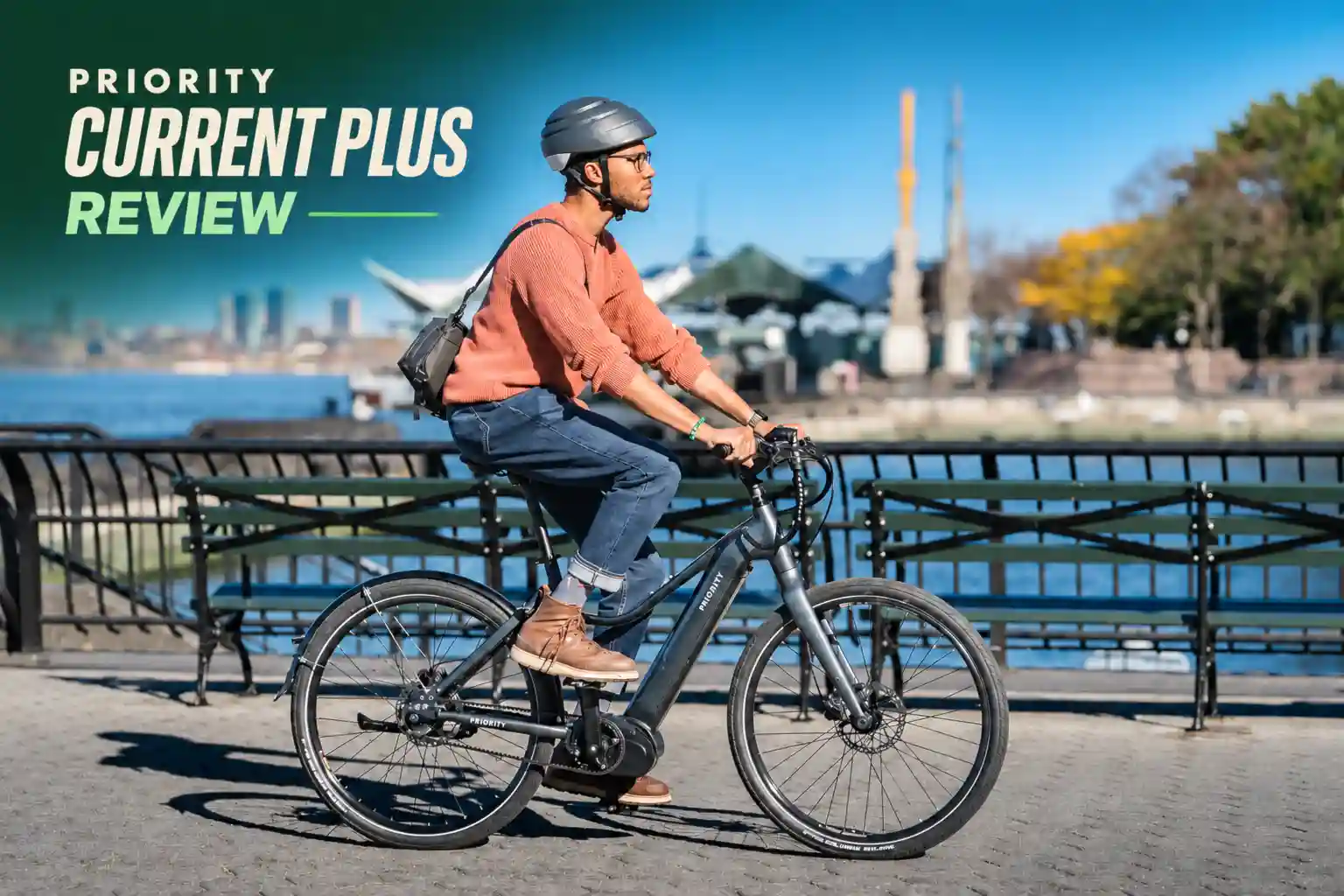
Priority Current Plus Review: Is This Belt-Drive E-Bike Worth $3,299?
Last Updated on November 24, 2026 by Kristina
📚 Research-Based Review – Built from independent sources, specs, and user reports

Introduction
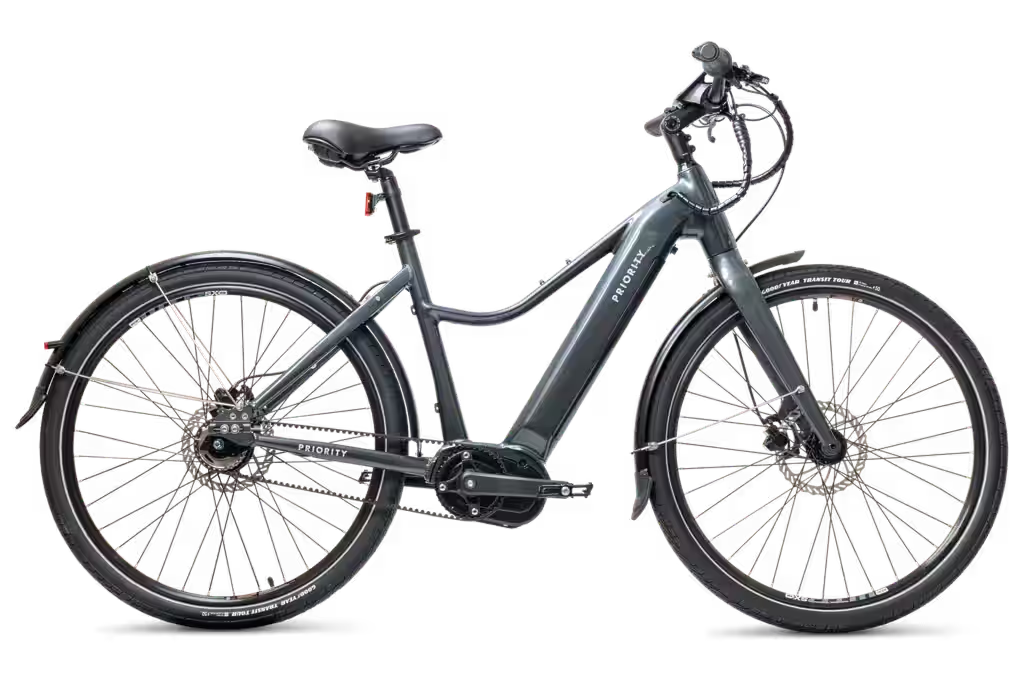
The Priority Current Plus is a mid-drive commuter for riders who want strong help on hills and less drivetrain upkeep. It pairs a Gates belt with internal gearing, adds a thumb throttle, and gets a 720 Wh removable battery. In one independent test, it covered 57 miles on a full charge with a mix of higher assist and throttle use. That makes it interesting for longer commutes, especially if you want to go a few days between charges.
The $3,299 starting list price is the bigger question. I’d pay particular attention to your pavement, where you’ll store it, and who can service it locally. The rigid fork lets you feel potholes, a rear rack costs extra, and even the lighter Shimano version weighs 55 pounds. The Current Plus is one of the options in my belt-drive e-bikes with a throttle guide.
Quick Verdict
Electric Bike Explorer Score: 8.3/10 – Very Good
I’d shortlist the Shimano Current Plus for paved commutes with regular climbs. It makes the most sense if you can roll it into storage, prefer a bike that responds to how hard you pedal, and want a throttle for occasional use. For daily stair carries, rough roads, or long stretches on throttle alone, I’d keep shopping.
Best for: Riders who pedal most of the time and want hill assistance, a removable battery, and a drivetrain that doesn’t need chain oil.
Which version I’d pick: Shimano Inter-5 for five distinct gears and the lower price. Enviolo if you’ve tried its stepless shifter and prefer the feel enough to pay $300 more.
Biggest drawback: You still get a rigid fork at this price. Add the cost of a rack and professional assembly if you need both.
Review confidence: Moderate for Shimano ride behavior and range under the published conditions. Lower for Enviolo performance, standardized stopping distances, and long-term ownership costs.
🔎 Why You Can Trust This Guide
I compared Priority’s specs and written policies with published rides from Bikerumor, T3, and WIRED. I gave more weight to rides that reported assist settings and battery use, and I kept partial-battery estimates separate from full-charge results. The EBE score is my editorial assessment. How I research and score e-bikes.
Priority Current Plus Specifications
| Feature | Priority Current Plus |
|---|---|
| U.S. list price | $3,299 Shimano Inter-5. $3,599 Enviolo Heavy Duty CVT. Check the selected configuration at checkout. |
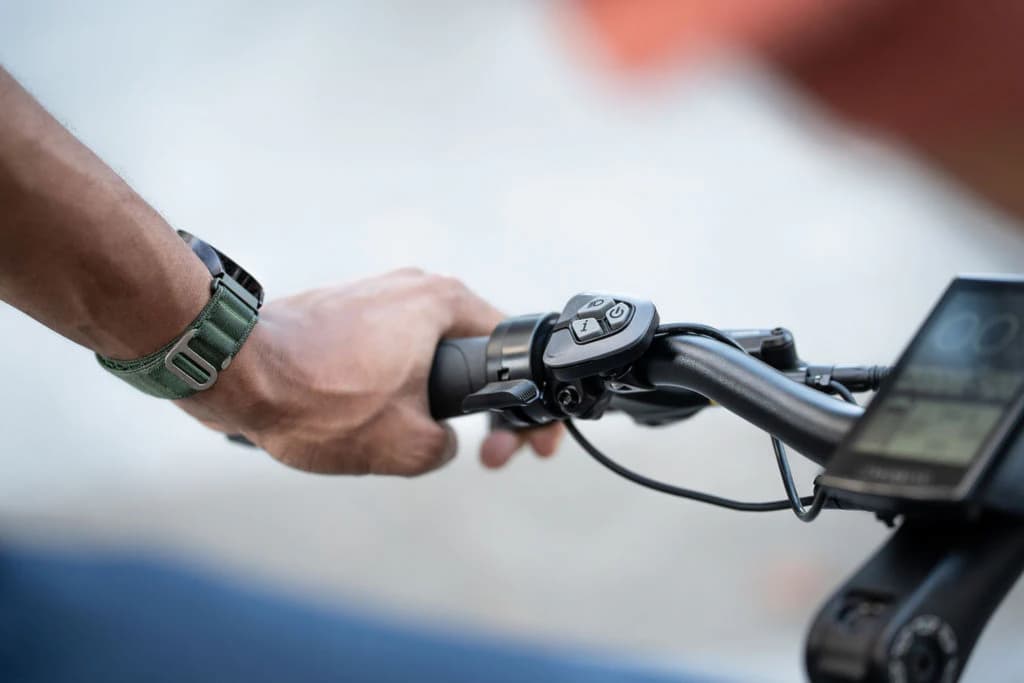
| Motor and assist | 500W torque-sensing mid-drive. Priority claims up to 140 Nm. Five assist levels and a left thumb throttle. |
| Assisted speed | Ships in the 20 mph Class 2 setting. Adjustable up to 28 mph with pedal assist. Check your local rules and the throttle behavior of the selected setting. |
| Battery and listed range | Removable 720 Wh battery. Priority lists 20–75 miles. Battery weighs 8 lb 9 oz. |
| Drivetrain | Gates Carbon Drive CDX belt with Shimano Inter-5 internal gearing or Enviolo Heavy Duty stepless gearing. |
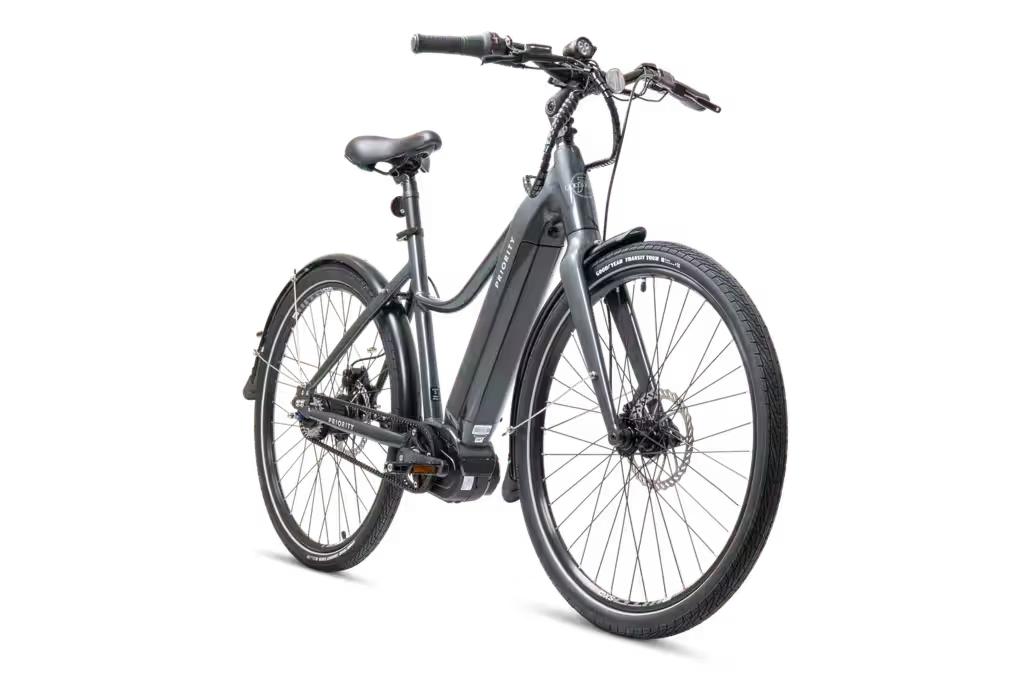
| Frame, fork, and tires | 6061 aluminum mid-step frame and rigid fork. 650b × 50 mm tires. |
| Assembled weight | 55 lb Shimano or 56.5 lb Enviolo with battery, pedals, and fenders installed. |
| Brakes | Dual-piston hydraulic discs, 180 mm rotors, and motor cutoff. |
| Commuter equipment | Automatic front and rear lights, 600-lumen headlight, composite fenders, kickstand, and front and rear accessory mounts. Rear rack sold separately. |
✅ Pros
- Torque-sensing mid-drive delivered smooth assistance in published rides and could use the lower gears on climbs.
- Quiet belt drive and internal gearing reduce regular drivetrain cleanup.
- Removable battery makes indoor charging possible. Bikerumor reported 57 miles on one full charge in its mixed Class 2 riding.
- Three frame sizes, adjustable stem, integrated lights, and full fenders suit everyday commuting.
❌ Cons
- Premium price once you add a rack, assembly, and a lock.
- Rigid fork transmits pothole hits and rough-surface vibration.
- 55–56.5 lb assembled can be awkward on stairs or vehicle racks.
- Battery warranty cycle limits differ between Priority’s product FAQ and its written policy.
Features That Matter in Everyday Use
Gates belt and two kinds of internal gearing
The Gates CDX belt eliminates the regular oiling and degreasing a chain needs. Both rear hubs tuck the gearing inside the wheel hub. Plan on ordinary brake, tire, and wheel service, and identify a shop that can check belt tension and alignment or reinstall the rear wheel correctly after a flat. Those are the jobs I’d ask about before buying a direct-to-consumer belt bike.
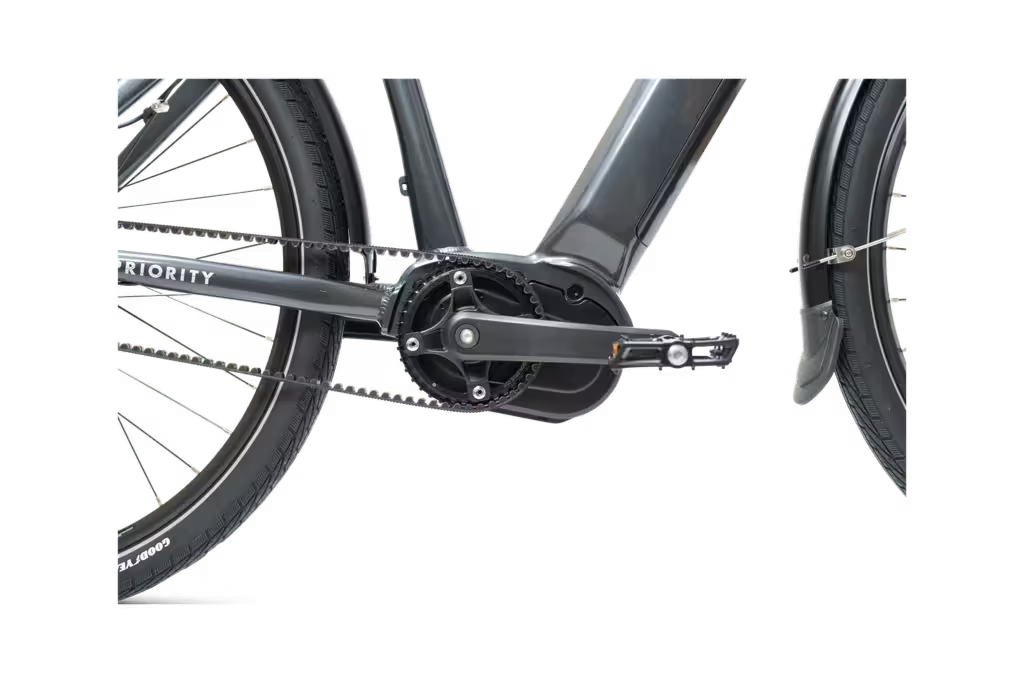
The Shimano Inter-5 gives you five indexed gears. That makes it easy to return to the same gear for a familiar hill or intersection. The Enviolo uses a twist shifter to move continuously through its ratio range. You can fine-tune your cadence without stepping through fixed gears, but you still choose the ratio manually. Most of the detailed road testing I found was on Shimano, so I wouldn’t assume the two builds feel identical under load.
Lights, fenders, and cargo setup
Full fenders and integrated lighting are included, which saves two purchases for commuting. Front and rear mounts let you add carrying capacity. If you plan to use panniers, confirm rack fit, heel clearance, bag attachment, and the rack’s own weight rating. I’d price the bike with the rack and bags I actually need before comparing it with a commuter that includes a rack.
Ride Quality, Comfort, and Fit
The gel saddle, swept bar, ergonomic grips, and height-adjustable stem support an upright position. The 50 mm tires give some cushioning on pavement and packed paths. T3 reported that bigger impacts still came through the rigid frame and fork. Bikerumor noticed the fenders rattling on rougher surfaces and curb drops. If your regular route is patched pavement with sharp potholes, try that kind of surface before deciding.
| Frame | Approximate height | Stepover | Minimum saddle height from ground |
|---|---|---|---|
| Small | 5′0″–5′6″ | 22.5 in. | 30.5 in. |
| Medium | 5′6″–5′10″ | 23.5 in. | 32.5 in. |
| Large | 5′10″–6′3″ | 24.5 in. | 34.5 in. |
At 5′4″, I’d start with the Small and check how easily I could step across it, reach the brake levers, and put a foot down at a stop. Priority’s geometry table and its FAQ show different suggested inseams, so I’d send them my barefoot measurement and ask for a size recommendation before ordering. If you plan to haul it by car, compare the bike’s actual transport weight, wheelbase, and frame shape with your rack. Check your rack’s weight limit.
Motor Power, Acceleration, and Hill Climbing
Priority rates the mid-drive at 500W and claims a maximum of 140 Nm. Because the motor drives through the gearing, a lower gear gives it a better working ratio at low road speed. The torque sensor adjusts pedal assistance to your effort. That combination is appealing on a commute with repeated climbs and stops, where smooth starts matter more to me than the biggest torque number on paper.
Bikerumor described steady assistance and could ride its local steep hill in third gear with assist set to level 4 or 5. The reviewer found starts labored in fourth or fifth and preferred third or lower from a stop. At faster speeds, the same rider needed level 4 or 5 to reach 28 mph and would have liked a taller gear for extended riding at that pace. There’s no published gradient or timed hill result for that ride, so use it as a description of how the bike responds to gearing and assist.
The throttle is a left-hand thumb lever. I generally prefer a twist throttle, especially if I’ll be holding it down for longer stretches. Here I’d see the lever as a short burst of help while getting moving. Bikerumor saw about 20–21 mph on throttle alone after raising the pedal-assist limit. That describes its test bike’s behavior. Where Class 3 requires pedal-only assistance, a 28 mph pedal-assist setting alone does not establish that the configured bike qualifies. Verify whether the throttle can be disabled and check the rules for your route.
Battery, Charging, and Real-World Range
Priority lists 20–75 miles from the removable 720 Wh battery. The big variables are assist level, speed, hill climbing, and throttle use. Based on the published rides, I’d expect a careful rider on a paved route to get more miles by pedaling in the lower settings than by leaning on the throttle. A windy ride home uphill at high assist can change the calculation, so I’d start with a conservative round trip and see how much charge is left before extending it.
The pack charges on or off the bike. T3 reported a 2.8A charger and estimated about five to six hours from empty, with a potentially slower finish near full. At 8 lb 9 oz, the pack is manageable to bring indoors, but I’d still leave room to remove it wherever I park.
Display and Technology
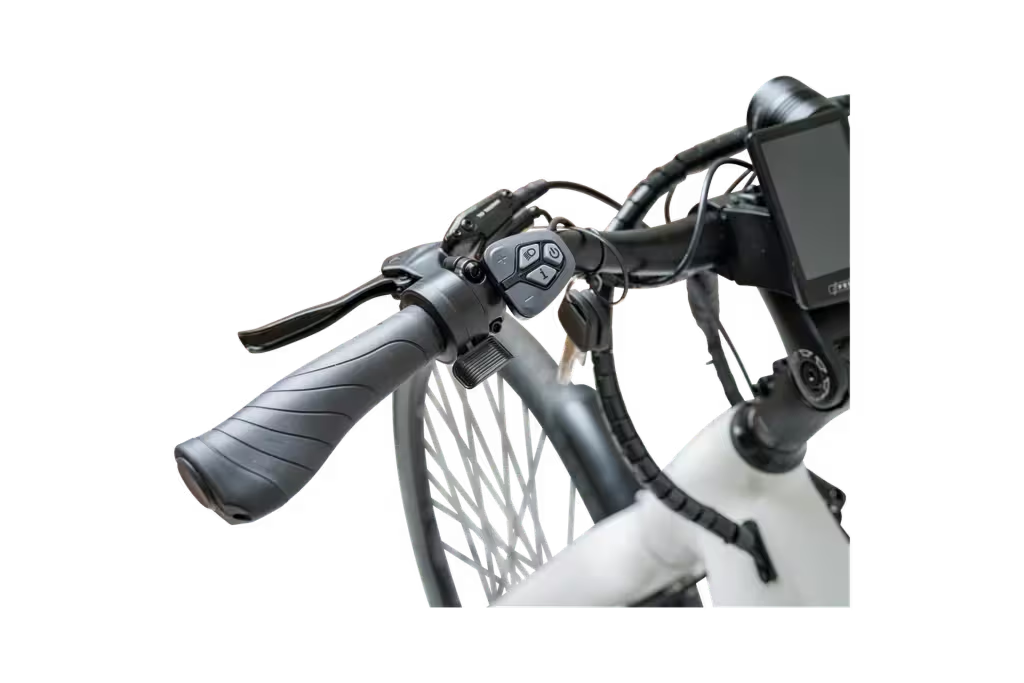
The center display gives you speed, assist setting, battery level, trip mileage, and total distance. The handlebar control lets you change assist, access trip data and settings, and operate the lights. Bikerumor found the display legible in daylight and at night, but the buttons themselves were difficult to see in darkness. That’s a small thing I’d try with gloves if most of my winter commute happened after sunset.
Brakes and Electrical Safety
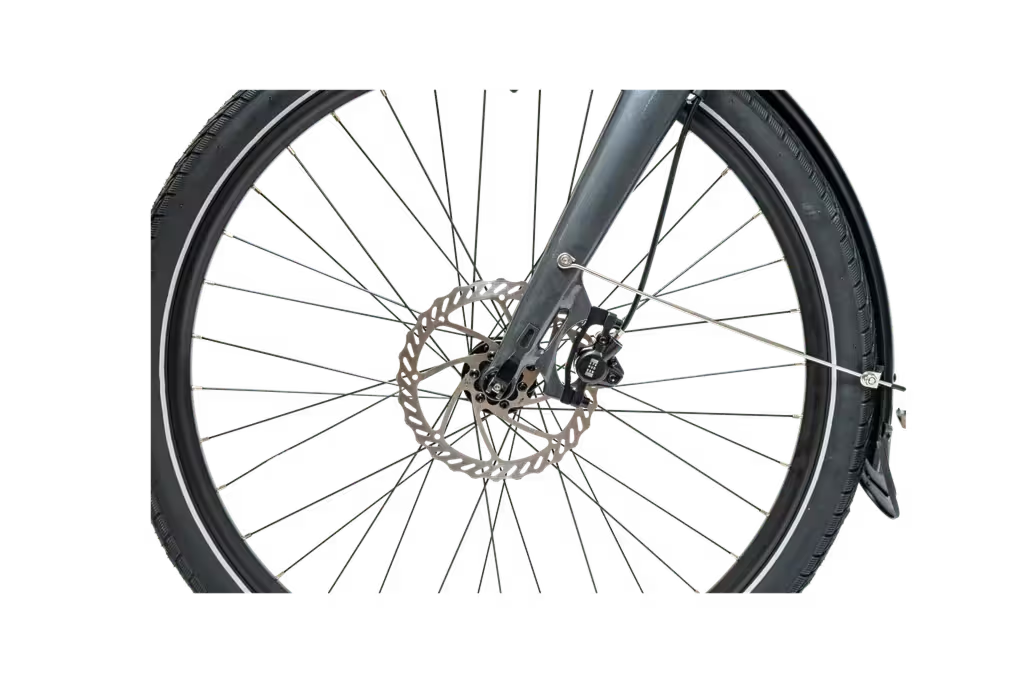
The dual-piston hydraulic discs use 180 mm rotors and cut motor assistance when the brakes are applied. T3 found the braking easy to modulate. WIRED described smooth braking overall, but its test bike’s front brake sometimes stuck and made noise on longer descents. I found no comparable published stopping-distance measurement for the Current Plus.
Priority advertises a UL-certified battery. Its product listing does not give enough detail for me to independently verify a model-matched whole-bike UL 2849 certification. If a building or insurer requires a specific standard, ask Priority for the documentation for the exact bike and battery before ordering.
Reported Independent Testing
| Source and ride | Reported result | How I’d use it |
|---|---|---|
| Bikerumor’s Shimano test | 57 miles of riding across several outings from a fresh full charge to depletion. Class 2, mostly assist 3–5, with repeated throttle use and some climbing in a generally flat area. | The clearest full-charge result I found for mixed use. Sustained fast riding or frequent climbs could push mileage lower. |
| T3’s Shimano test | 47.6 miles in a mix of assist 1 and 2 used 72% of the battery. About 66 miles was the reviewer’s projection. A separate throttle-only run exceeded 28.5 miles with charge left. | Shows how much the riding style matters. Both rides ended before the battery was empty. |
| WIRED’s Shimano road rides | Around 60 miles per charge, by the reviewer’s estimate, over weeks of riding around hilly southeast Portland. The reviewer rarely used above the middle assist level. | A practical reference for mixed city riding. The report gives an approximate figure and no controlled discharge protocol. |
Speed and handling: Bikerumor’s rider found fifth gear comfortable around 20 mph, with a faster cadence near the top of the higher speed setting. T3 reported quick acceleration up to 20 mph and easy brake modulation, along with noticeable jolts on rough surfaces. WIRED found the bike sluggish with the motor off and heard a clicking sound during some throttle use. I found no directly comparable Enviolo range or hill trial in these sources.
Unboxing and Assembly
The bike arrives needing some assembly. If you order home delivery, budget for a shop to assemble it or book an assembly option if offered at checkout. Ask the shop to confirm brake alignment, cockpit fit, shifting and belt tracking before your first commute. Keep the assembly receipt and the shipping carton. Priority’s paperwork ties some warranty eligibility to professional assembly and requires original packaging for eligible returns.
Customer Service, Warranty, and Financing
Priority advertises support seven days a week. Its written terms list five years for covered frame and fork defects and two years for electrical components for eligible original owners in the contiguous United States. Labor can be excluded. For a direct purchase, I’d confirm who handles diagnostics, which shop can work on the hub, and how long replacement batteries and electrical parts typically take to ship.
Battery warranty discrepancy: Priority’s general written policy specifies two years or 500 full cycles, whichever comes first, with a 70% capacity threshold. The Current Plus product FAQ gives two years or 700 cycles at the same threshold. Ask Priority to confirm in writing which terms apply to the specific bike and order. I used the more conservative 500-cycle written policy for the score. For more context, see the EBE e-bike warranty comparison.
Priority’s product page displays Afterpay. If financing is offered for your order, compare the total repayment, APR, and any fees with the cash price. Availability and terms can depend on the buyer and order.
Returns and Cancellations
Priority’s direct return policy gives eligible non-final-sale orders in the contiguous U.S. 30 days from purchase, with the bike in like-new condition and in the original packaging. For a change-of-mind return, the buyer generally covers actual outbound shipping, return shipping, and reboxing. Assembly and adjustment fees are nonrefundable. Ask for an estimate of those costs if you’re ordering without a test ride. Priority allows cancellations or item removals before the order ships. Once it ships, you’ll need to use the return process after delivery. A dealer or marketplace purchase can have different terms.
Essential E-Bike Gear (Quick Picks)
Before you choose your e-bike, these are the accessories most riders end up needing for safety and everyday use:
Price and Value
The Shimano version is where I see the strongest value. At a $3,299 list price, the case for buying it rests on the belt drivetrain, the motor’s behavior on climbs, and the removable battery. If your trip is short and flat, you could spend less on a simpler commuter and still get the lights, fenders, and everyday comfort you need. The $300 Enviolo upgrade is worth considering after a test ride if you prefer small, continuous changes in pedal cadence.
Priority Current Plus vs. the Original Current
The Plus adds a thumb throttle, revised motor firmware, and a 720 Wh pack in place of the original’s 500 Wh battery. That’s 44% more nominal battery capacity. Actual ride time still depends on how you use the added power and throttle. If you already have a Current and regularly finish rides with battery to spare, I’d keep it unless the throttle or longer trips would change how you ride.
What Riders Are Saying
Front light and support: In an October 2026 r/PriorityBicycles discussion, a Current Plus owner reported that the front light cut out when turning the handlebars. They said Priority offered to arrange and pay for a local shop visit. The owner had yet to report the repair outcome.
Enviolo shifter: Another Current Plus owner in the thread reported wear on the shifter’s visual indicator. The shifter continued to work.
These are individual owner reports. I excluded mileage and service reports from owners of the original Current when scoring the Current Plus.
Electric Bike Explorer Score
Overall score: 8.3/10 – Very Good. The Current Plus earns its highest marks for motor response, usable range, and drivetrain practicality. The premium price, rigid ride, and support questions hold the overall score down. The nine category scores are averaged and rounded to one decimal.
Score Breakdown
| Evaluation area | Score | Why |
|---|---|---|
| Ride quality and handling | 8.0/10 | Upright cockpit and comfortable paved cruising. Sharp bumps carry through the rigid fork. |
| Motor and performance | 9.0/10 | Published rides describe smooth, strong help and useful climbing gears. Upper speed requires more assist. |
| Battery and range | 9.0/10 | Removable pack, a documented 57-mile full-charge run, and useful low-assist evidence. |
| Fit and accessibility | 8.0/10 | Three sizes and an adjustable stem. Weight can complicate stairs and lifting. |
| Brakes and safety | 8.0/10 | Hydraulic discs, motor cutoff, and integrated lights. Limited measured braking and certification evidence. |
| Features and practicality | 8.5/10 | Belt drive, internal gears, fenders, and equipment mounts. Rear rack is extra. |
| Build and serviceability | 8.5/10 | Useful drivetrain hardware. Confirm a local shop can service the belt and hub. |
| Support and warranty | 7.5/10 | Five-year frame and fork terms, with conflicting battery cycle limits and potentially costly returns. |
| Value | 8.0/10 | Worth considering for routine hills and high mileage if you value the belt enough to pay the premium. |
Should You Buy the Priority Current Plus? My Take
I’d pick the Shimano Current Plus for a longer paved commute where I could ride most of the way in low or medium assist and turn it up for hills. The belt is what makes the bike interesting to me. After a wet ride, I’d appreciate having fewer drivetrain chores before I put it away. I’d want a local shop lined up and a clear answer on the battery warranty first.
If I had rough pavement every day, I’d take a test ride on that same kind of street before paying this much for a rigid bike. If I needed to lift it up stairs daily or expected to spend much of the ride holding the throttle, I’d look for a lighter commuter or try a bike with a throttle I prefer.
Alternative Commuter E-Bikes to Consider
- Aventon Level.3. Compare it if you’d prefer a suspension fork, an included rear rack, and a more conventional chain drivetrain. Read my Aventon Level.3 review.
- Priority Skyline Smart.Shift. Compare it if you want to keep a Gates belt, throttle, and 720 Wh battery but prefer a 12-speed electronic gearbox with a wider gearing range. Its rear hub motor assists independently of the gears, and at 68 lb it’s heavier to move or lift than the Current Plus. See the Skyline in my belt-drive guide.
- Vvolt Alpha 2.1. I’d consider this 44 lb commuter if I had stairs to deal with or mostly rode short, flatter routes. It has a Gates belt, a removable throttle, and a 350W rear hub motor. Its single gear gives you fewer options on long, steep climbs.
Frequently Asked Questions
Does the Current Plus shift automatically?
Both versions shift manually. The Shimano hub offers five indexed gears, and the Enviolo Heavy Duty hub uses a stepless twist shifter. Priority’s Skyline Smart.Shift is a separate model.
Can the Current Plus reach 28 mph on throttle alone?
Priority lists up to 28 mph with pedal assist in the higher-speed setting. Bikerumor observed roughly 20–21 mph on throttle alone on its test bike.
How far can it go on throttle alone?
T3 rode more than 28.5 miles using only the throttle and still had charge left. That result came from one test and will vary with speed, rider weight, hills, and temperature.
Disclosure: As an Amazon Associate, I earn from qualifying purchases. This comes at no extra cost to you and helps support the content on this site.
Explore More E-Bikes Before You Buy
Still deciding which electric bike is right for you? Electric Bike Explorer has more resources to help you compare your options and make a confident decision.
🔍 Compare E-Bikes Side by Side
Use our free side by side e-bikes comparison tool to explore different electric bikes and compare their motor power, battery capacity, weight, and features.
⭐ Explore More Electric Bike Reviews
Want to see how other e-bikes stack up? Browse our Electric Bike Reviews hub for detailed reviews organized by brand and riding style, including commuter, cruiser, step-through, and fat-tire models.

Kristina is not just an enthusiast but a true authority on electric bikes. Nestled in the coastal beauty of Virginia, Kristina has found the perfect backdrop for her passion for electric biking. As a dedicated wife and homeschooling mom, her life revolves around family, faith, and the thrill of adventure.
Originally hailing from Ohio, Kristina's journey with electric bikes began as a curiosity and quickly evolved into a deep expertise. Her blog is a testament to her love for electric biking, combining her fascination for eco-friendly transportation with her coastal lifestyle.
When she's not cruising the beach on her electric bike, you'll find Kristina indulging in her other loves: long walks along the shore, getting lost in a good book, and cherishing moments with her loved ones. With a heart as big as her love for animals, especially cats, Kristina brings a unique perspective to the electric bike world, grounded in her strong faith in God and her dedication to a sustainable lifestyle.
Through her blog, Kristina shares her extensive knowledge of electric bikes, offering valuable insights, tips, and recommendations to fellow enthusiasts. Whether you're a seasoned rider or a newcomer to the electric bike scene, Kristina's blog is your go-to source for all things electric biking, fueled by her passion, expertise, and the scenic beauty of coastal Virginia.