
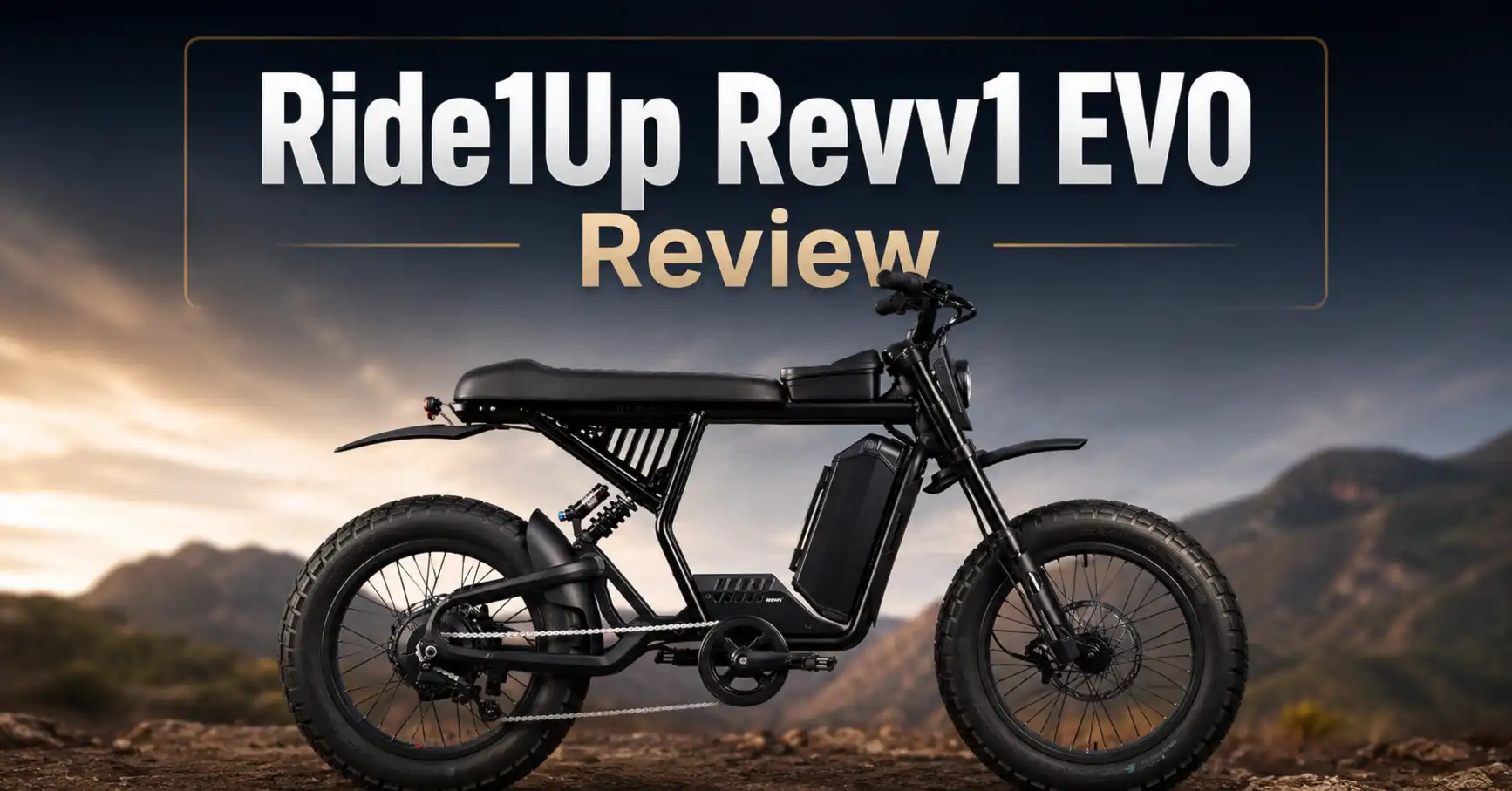
Ride1Up Revv1 EVO Review: Exciting Battery Tech, but Should You Buy It Yet?
Last Updated on August 16, 2026 by Kristina
🆕 Early-Look Review – First-look based on limited early information (not hands-on)
Introduction
Important research note: As of August 15, 2026, I could not find a completed independent hands-on performance test of the Revv1 EVO itself. Independent publications have covered the launch and previous Revv1 models, but the EVO-specific battery life, range, acceleration, braking, and ride-quality claims still need real-world validation.
Availability checked August 15, 2026: The Ride1UP Revv1 EVO is currently listed for pre-order. Ride1Up’s main product-page banner says shipping is expected in early October 2026, although older conflicting availability and shipping language still appears elsewhere on the same page. I recommend confirming the latest estimated ship date directly with Ride1Up before ordering.
The Ride1Up Revv1 EVO is one of the more interesting moped-style e-bikes I have researched this year. Its headline feature is a 52V 20Ah semi-solid-state battery that Ride1Up says can charge from empty in about 2 hours, deliver more than 1,200 charge cycles before falling to 80% capacity, and perform better in extreme temperatures than a conventional lithium-ion pack.
But I would not buy the EVO based on the battery headlines alone. At $2,395, it also has a 750W Bafang rear-hub motor, 100 Nm of claimed torque, full suspension, 4-piston hydraulic brakes, 20 x 4 in. tires, a 400 lb payload rating, and multi-class speed settings. On paper, that is a very strong package. The problem is that the most interesting claims are also the ones that have not yet been independently proven on production bikes.
If you want to compare it with other models before deciding, you can also browse my Electric Bike Explorer reviews.
Quick Verdict
Provisional Overall Rating: 7.9 out of 10 – Good with Tradeoffs
Best for: Riders who want a powerful, full-suspension, throttle-friendly moped-style e-bike and are especially interested in faster charging and longer battery life.
Strongest reason to buy: The 1,040Wh semi-solid-state battery could substantially improve charging time and long-term ownership if Ride1Up’s claims hold up in real-world use.
Biggest tradeoff: The EVO is still largely unproven in independent testing, weighs 90 lb, and comes with restrictive published Revv1 cancellation and return terms.
Review type: Research-Based Review
Evidence confidence: Limited
Price checked: August 15, 2026 – $2,395
Availability checked: August 15, 2026 – Pre-order, with Ride1Up’s main banner stating early October 2026 shipping
🔎 Why You Can Trust This Review
This is a research-based review. I have not personally tested this ebike. I reviewed the official specifications, manual, warranty, return policy, certification documents, and independent performance tests.
I clearly separate manufacturer claims from reported test results and note any specifications I could not verify. Affiliate relationships do not influence the rating or conclusion.
Learn more about how I research, review, and score electric bikes.
Want to See More Electric Bike Explorer in Google Search?
Add Electric Bike Explorer as a preferred source to see more of our e-bike law guides, safety updates, reviews, buying guides, and troubleshooting posts when they are relevant to your searches.
Who the Ride1Up Revv1 EVO Is Good For – and Who Should Skip It
The EVO makes the most sense for: riders who enjoy the motorcycle-inspired Revv1 format, use the throttle frequently, want full suspension, have secure ground-level storage, and value rapid charging enough to pay more for a new battery platform.
It is also interesting for frequent riders who put enough miles on an e-bike to care about battery cycle life. If Ride1Up’s 1,200-plus-cycle claim proves accurate, the battery could be a meaningful long-term advantage rather than just another specification.
I would skip it for: apartment riders who need to carry a bike upstairs, cyclists who want a light and natural pedal feel, anyone uncomfortable with a 90 lb machine, buyers who need a bike immediately, or shoppers who want extensive independent test data before spending more than $2,000.
I would also think carefully before ordering if cancellation or return flexibility matters to you. Ride1Up’s published Revv1-specific cancellation and return terms are stricter than the general return language that appears elsewhere on its website.
Ride1Up Revv1 EVO Specifications
| Specification | Ride1Up Revv1 EVO |
|---|---|
| Price | $2,395 checked August 15, 2026 |
| Current availability | Pre-order; main product-page banner says shipping early October 2026 |
| Motor | 52V 750W Bafang rear-hub motor |
| Claimed torque | 100 Nm |
| Controller | 52V 40A CAN bus controller |
| Battery | 52V 20Ah semi-solid-state battery |
| Battery capacity | 1,040Wh |
| Claimed range | 30-60 miles depending on conditions |
| Independent EVO range result | Not yet available when researched |
| Claimed charge time | About 2 hours with included 9A charger |
| Speed configuration | Ships configured as Class 2; Class 3 and off-road settings available |
| Pedal-assist sensor | Ride1Up R1CBC current-based cadence system |
| Throttle | Right-hand twist throttle |
| Drivetrain | Single-speed chain drive; Ride1Up lists a 38T chainring and BMX-style chain, with no derailleur listed |
| Brakes | 4-piston hydraulic discs with motor cutoff |
| Brake rotor size | Not listed on the current EVO product page |
| Front suspension | 160mm double-crown fork with preload and rebound |
| Rear suspension | Spring shock with 90mm travel |
| Tires | 20 x 4 in. Vee Huntsman all-terrain tires |
| Bike weight | 90 lb |
| Payload | 400 lb total |
| Recommended rider height | 5 ft. 2 in. to 6 ft. 4 in. |
| Frame | Full suspension, moped-style |
| Colors listed | Black-Out |
| Lighting | Moto-style front light, integrated brake light and turn signals |
| Fenders | Moto-style fenders included |
| Rack | Optional |
| Water protection | Described by Ride1Up as water-resistant; no EVO-specific IP rating listed |
| Safety-standard wording | Ride1Up states “TUV ANSI/CAN/UL 2849 & 2271 Compliant” |
| Warranty | 1-year limited warranty against manufacturing defects; labor coverage is more limited than parts coverage |
| Published Revv1 return policy | 14 days, unopened and unused, with $350 restocking fee after approval |
| Pre-order cancellation | Ride1Up states that pre-shipment cancellations may incur a 3% payment-processing charge; Revv1 orders that enter warehouse processing may incur a $350 cancellation fee |
✅ Pros
- Large 52V 20Ah, 1,040Wh battery
- Semi-solid-state battery technology could improve long-term ownership
- Claimed 2-hour charging is unusually fast for a battery this large
- 750W Bafang hub motor with 100 Nm claimed torque
- 160mm front and 90mm rear suspension travel
- 4-piston hydraulic brakes
- 400 lb total payload rating
- Two-passenger-capable saddle and frame
- Integrated brake light and turn signals
- Color display and smart battery-management diagnostics
- Replacement EVO battery already appears in Ride1Up’s parts catalog
- Ships in a conventional Class 2 configuration before optional higher-speed modes are enabled
❌ Cons
- 90 lb bike weight makes transport and storage more difficult
- No complete independent EVO range, brake, hill, or acceleration test was available when researched
- Major battery longevity and cold-weather claims still depend heavily on manufacturer data
- Current-based cadence system will not appeal to riders seeking torque-sensor pedal feel
- Single-speed drivetrain provides fewer pedaling gear choices
- Published Revv1 cancellation and return policies are restrictive
- Only a 1-year standard manufacturing-defect warranty
- Warranty labor coverage becomes more limited after the first 30 days
- Current product page contains conflicting shipping and availability language in different sections
- Only Black-Out was listed as an EVO color when checked
- No EVO-specific IP water-resistance rating was listed
- Brake rotor diameter is not clearly specified on the current EVO page
The Semi-Solid-State Battery Is the Big Story
The EVO’s 1,040Wh battery is why this model deserves attention. Ride1Up describes it as a semi-solid-state design using a gel-like electrolyte rather than the more conventional liquid-electrolyte approach.
Ride1Up claims more than 1,200 charge cycles before capacity falls to about 80%, a roughly 2-hour full charge using the included 9A charger, and approximately 70% capacity retention at -20°C. The company also says the battery passed puncture, crush, thermal, and short-circuit testing without incident.
Those are impressive claims, but they remain manufacturer claims in this review. I have not seen independent long-term cycle testing of the production EVO battery, and a test of 1,200 charging cycles obviously cannot be recreated by a reviewer over a few weekend rides.
Ride1Up currently lists a replacement EVO battery for $495, although it was shown as backordered when I checked. I like seeing a replacement pack in the parts catalog this early because battery availability matters over the life of an e-bike, but actual future inventory is something owners will need to watch.
Ride Quality and Comfort
I cannot tell you that the EVO rides smoothly from personal experience because I have not ridden it. What I can say is that the hardware strongly favors comfort and stability over lightweight bicycle handling.
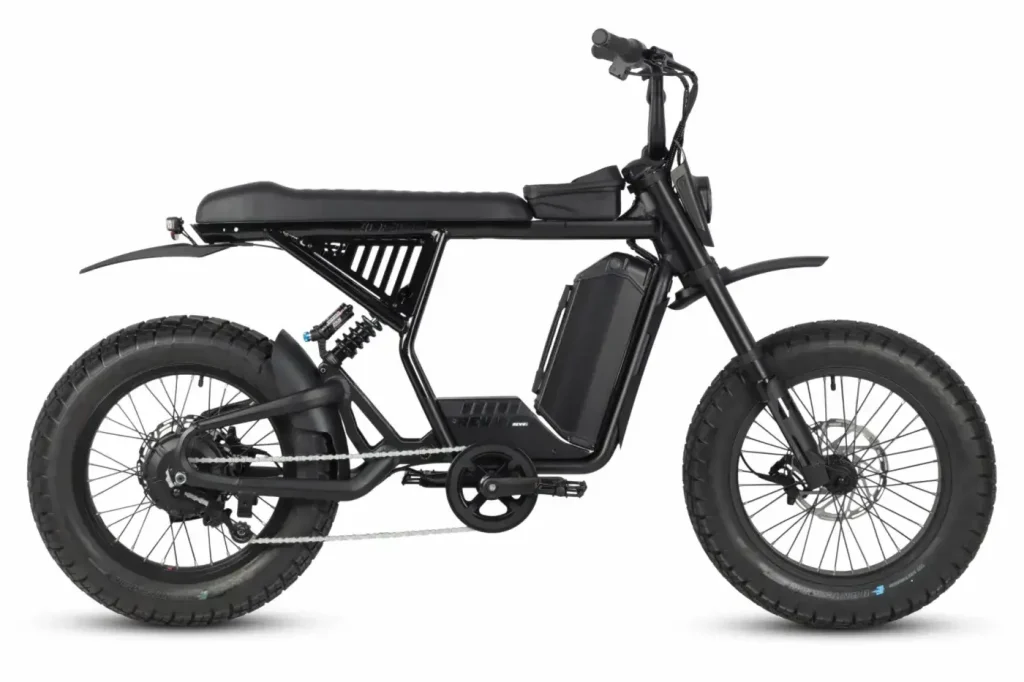
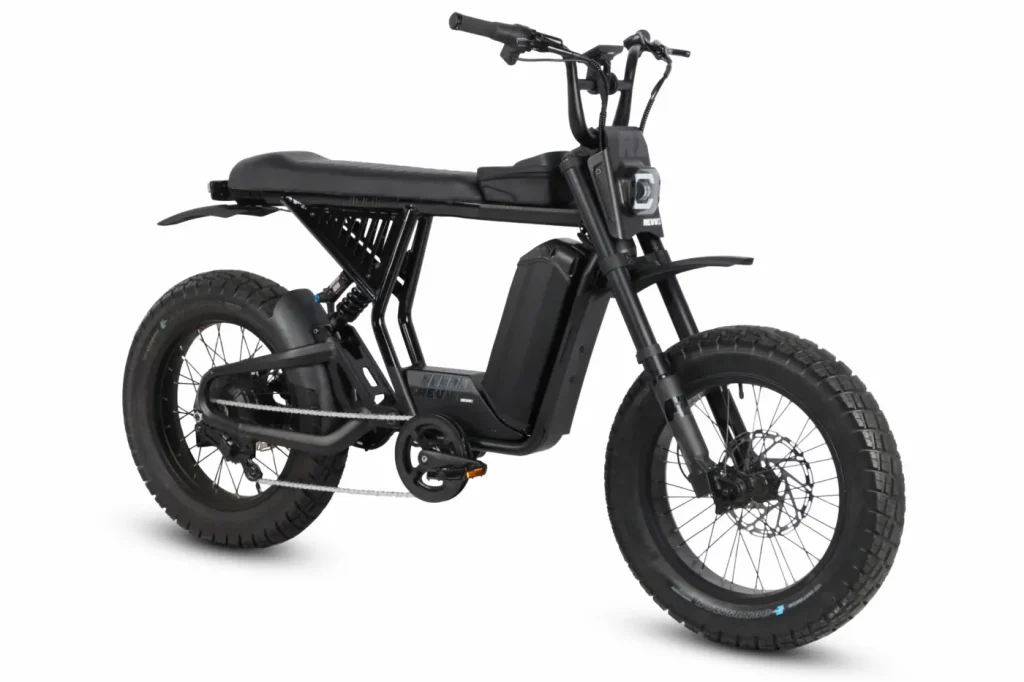
The 160mm double-crown fork is paired with 90mm of rear travel and large 20 x 4 in. Vee Huntsman tires. That combination should help isolate the rider from potholes, broken pavement, gravel, and rougher surfaces. The long bench-style saddle and upright cockpit also reinforce the moped-like riding position.
The flip side is the 90 lb weight. That is heavy enough that moving the EVO around a garage, loading it onto a vehicle, lifting it over steps, or dealing with a flat tire away from home may be a very different experience from owning a 50 or 60 lb commuter.
If you specifically like this type of riding position, my moped-style e-bike buying guide explains the major advantages and compromises of this category.
Motor, Throttle, and Performance
Ride1Up lists a 52V 750W Bafang hub motor with 100 Nm of torque and a 52V 40A controller. That is substantial hardware for a nominally 750W e-bike, but I would wait for instrumented hill and acceleration testing before drawing conclusions about how the EVO compares with the DRT or other high-performance moped-style bikes.
The EVO uses Ride1Up’s current-based cadence pedal-assist system rather than a torque sensor. That suits a throttle-forward moped-style bike, but riders looking for a traditional bicycle feel should understand the difference. A torque sensor responds to how hard you push the pedals, while a cadence-oriented system is generally more concerned with detecting that you are pedaling and delivering a programmed level of assistance.
The EVO also uses a single-speed chain-drive setup rather than a multi-speed derailleur drivetrain. That keeps the mechanical system relatively simple, but it gives the rider fewer gearing choices when pedaling without strong motor assistance.
I would therefore expect the EVO to appeal more to riders who enjoy powered cruising than cyclists looking for an especially natural fitness-oriented pedal experience.
Speed Modes and Street Legality
Ride1Up says the EVO ships configured as a Class 2 e-bike. Its multi-class programming can also provide Class 3 operation and an unlocked off-road mode intended for private-property use.
This distinction matters. A bike’s ability to reach a particular speed does not mean that speed or configuration is legal everywhere. State and local rules can treat throttle operation, Class 3 bikes, bike paths, sidewalks, trails, and vehicles capable of exceeding standard e-bike limits differently.
Before changing the factory configuration, review my guide to Class 1, Class 2, and Class 3 e-bikes and check the current e-bike laws in your state.
Battery Range and Charging
Ride1Up claims 30-60 miles per charge. I would treat that as a broad manufacturer estimate rather than an expectation for every rider.
A 1,040Wh battery is large, but the EVO also has a heavy frame, wide tires, strong motor, throttle, and higher-speed operating modes. Rider weight, passenger weight, tire pressure, hills, temperature, wind, speed, and throttle use can all pull real-world range toward the lower end.
The most interesting specification is the claimed 2-hour full charge. For riders who commute twice in one day, make deliveries, or simply forget to charge overnight, cutting recharge time can matter as much as adding a few miles of range.
But until independent testers run the production bike from full to empty and verify charging under controlled conditions, I consider both the range and charging advantage promising rather than proven.
Brakes and Safety
The EVO has 4-piston hydraulic disc brakes front and rear with motor cutoff. That is the type of braking hardware I want to see on a heavy moped-style bike capable of higher speeds.
The current EVO specification page does not clearly list brake rotor diameter, so I am not going to invent one based on previous Revv1 versions.
Lighting includes a large moto-style front light along with an integrated rear brake light and turn signals. Those features improve conspicuity, but riders should still use appropriate protective equipment and adjust their speed to conditions.
For electrical safety, Ride1Up’s EVO page currently uses the wording “TUV ANSI/CAN/UL 2849 & 2271 Compliant.” I am preserving Ride1Up’s exact published wording rather than describing the EVO as independently “UL certified” without a model-specific third-party certification record that I can independently verify.
Reported Testing: What Has Actually Been Proven?
This is currently the weakest part of an EVO review because meaningful EVO testing is not yet available.
Electric Bike Report covered the launch but specifically noted that the battery headlines still need hands-on testing to validate or refute the claims. RiderGuide has extensive experience with earlier Revv1 versions but likewise described the EVO as a model it was still waiting to test.
Previous Revv1 models have generated useful range, speed, braking, and hill-climb data, but I do not consider those numbers EVO test results. The EVO changes the motor specification, controller, battery chemistry, display, and battery-management system, so simply copying DRT or FS results into this review would create false confidence.
I also found specification-based EVO coverage that assigns ratings without hands-on laboratory testing. I do not treat those scores as independent real-world performance results.
If you want to see what independent and owner feedback has shown on the more established dirt-focused version, read my Ride1Up Revv1 DRT review.
What Riders Are Saying
There is not yet enough EVO owner history for me to identify meaningful reliability or ride-quality patterns. Ride1Up’s EVO product page showed no customer reviews when I researched it.
I found pre-order discussion and plenty of interest in the new battery, but anticipation before delivery is not the same as owner experience. I would rather leave this section short than manufacture a consensus from people who have not actually lived with the bike.
This is a section worth revisiting once production bikes have been delivered and owners have accumulated real mileage.
Unboxing and Assembly
Ride1Up says the EVO arrives about 90% assembled with the electronics already assembled. The shipping box is listed at approximately 110 lb, while the finished bike weighs 90 lb.
That box weight alone makes this a bike I would prefer to unpack with another person. If you are not comfortable installing and adjusting bicycle components correctly, professional assembly is a reasonable expense on a heavy, fast e-bike.
One limitation is that Ride1Up’s EVO-specific assembly support page still says that more information is coming. I would like to see complete model-specific instructions available before large numbers of bikes reach customers.
Customer Service, Warranty, Returns, Cancellations, and Financing
Ride1Up provides a 1-year limited warranty against manufacturing defects for the original purchaser. Its current warranty terms indicate that labor and parts coverage is most comprehensive during the first 30 days. After that initial period, approved replacement parts may still be provided during the warranty term, but the owner can be responsible for labor costs.
The cancellation and return policies deserve special attention because the EVO is currently a pre-order model.
Ride1Up states that cancellations made before shipment, including new-model pre-orders, may be subject to a 3% payment-processing charge. Ride1Up’s policy also says that once a Revv1 order has entered warehouse processing, cancellation can be subject to a $350 fee.
If the bike has already been delivered, Ride1Up’s detailed policy includes a separate Revv1 14 Day Return Policy. That section says Revv1 returns must be reported within 14 days and are limited to unopened and unused shipments, subject to approval and a $350 restocking fee.
Because Ride1Up also publishes broader 30-day return language for some other e-bikes, I would not assume those general terms apply to the EVO. Confirm the exact cancellation and return policy for your order with Ride1Up before paying, especially while the EVO remains a pre-order.
Ride1Up currently lists Affirm financing with several term options and also describes a SplitIt option that divides eligible purchases into 3 installments using an existing credit card. Financing terms and eligibility can change, so check the actual checkout offer instead of buying based on an old monthly-payment example.
Price and Value
At $2,395, the Revv1 EVO sits in an interesting position. It is not inexpensive, but the specification sheet includes a lot of hardware for the money: a 1,040Wh battery, full suspension, 4-piston brakes, 20 x 4 in. tires, integrated lighting, a large payload rating, passenger capability, and sophisticated battery-management features.
If the semi-solid-state battery really provides the claimed cycle life and can repeatedly charge in about 2 hours without an unusual degradation penalty, the EVO could become one of the better long-term values in the moped-style category.
That “if” matters. I am not comfortable giving the EVO a “Very Good” or “Excellent” recommendation until its most important new technology has accumulated independent testing and meaningful owner mileage.
That is why the current 7.9 out of 10 score is provisional. The score can be revisited when independent production-bike range, charging, hill, braking, durability, and owner-reliability information becomes available.
The currently listed $495 replacement EVO battery is another positive signal for ownership cost, although it was backordered when checked. Replacement-part availability several years from now will ultimately matter more than a catalog listing at launch.
Should You Buy the Ride1Up Revv1 EVO?
The Ride1Up Revv1 EVO has the potential to be one of the more important moped-style e-bikes of 2026 because the battery upgrade addresses problems riders actually care about: charging time, cycle life, temperature performance, safety, and replacement cost.
The rest of the bike looks strong too. You get serious suspension travel, a 750W Bafang motor, a high-capacity battery, 4-piston hydraulic brakes, a 400 lb payload rating, passenger capability, integrated signals, and the distinctive Revv1 riding position.
Its biggest weaknesses are just as clear. It weighs 90 lb. Pedal assist is cadence-based rather than torque-based. The drivetrain is single-speed. The published Revv1 cancellation and return terms are unusually restrictive. The normal warranty is only 1 year, with more limited labor coverage after the first 30 days. Most importantly, the EVO’s defining battery technology and real-world performance have not yet built the independent evidence I want to see before calling it an outstanding buy.
You should buy this bike if you specifically want a powerful, throttle-friendly moped-style e-bike, have suitable storage, expect to ride frequently enough to benefit from fast charging, and are comfortable being an early adopter of the semi-solid-state battery system.
You should skip this bike if you need something lightweight, want a natural torque-sensor cycling experience, need immediate delivery, depend on a flexible cancellation or return policy, or prefer to wait until independent reviewers and long-term owners have verified the new battery claims.
Provisional Electric Bike Explorer Score: 7.9 out of 10 – Good with Tradeoffs.
My recommendation is to consider it, but not rush into the purchase purely because of the battery headlines. If independent testing confirms the promised charging performance, range, durability, and ride quality, the EVO has room to move into “Very Good” territory.
Alternative #1: Ride1Up Revv1 DRT
Choose the DRT instead if off-road ability is your priority and you would rather buy a more established version of the Revv1 platform. It has already accumulated independent performance testing and substantially more rider history than the EVO.
The tradeoff is giving up the EVO’s semi-solid-state battery, faster claimed charging, and newer battery-management system. Read my full Ride1Up Revv1 DRT review for a closer look.
Alternative #2: Ride1Up Revv1 FS
Choose the standard Revv1 FS if you primarily want the full-suspension moped experience and would rather save money than pay for the EVO’s new battery technology. It is the more established street-oriented choice in the family and has a much larger pool of owner and reviewer experience.
You can read my Ride1Up Revv1 review or compare it with other options in my best moped-style e-bikes guide.
Before you buy: Confirm the actual ship date, current $2,395 price, pre-order cancellation terms, return policy, warranty and labor coverage, replacement-battery availability, rider fit, current safety-standard documentation, and legal speed configuration for the places where you intend to ride. Ride1Up’s live page currently contains conflicting availability wording in different sections, so I would not base an important purchase decision on an “In Stock” label alone.
📚 Read Me Next
- Compare this bike to others → Best Moped Style E-Bikes
- Not sure about budget? → Budget E-Bike Guide
- Want to learn first? → E-Bike Buying Guide
- See more ebike reviews → E-Bike Reviews
External Sources
- Ride1Up Revv1 EVO official product page
- Ride1Up – Introducing the Revv1 EVO and semi-solid-state battery
- Ride1Up warranty information
- Ride1Up return and pre-order policy
- Ride1Up Revv1 EVO assembly support page
- Ride1Up Affirm financing information
- Ride1Up SplitIt payment information
- Ride1Up Revv1 replacement parts
- Electric Bike Report – Revv1 EVO launch coverage
- RiderGuide – Revv1 EVO preview

Kristina is not just an enthusiast but a true authority on electric bikes. Nestled in the coastal beauty of Virginia, Kristina has found the perfect backdrop for her passion for electric biking. As a dedicated wife and homeschooling mom, her life revolves around family, faith, and the thrill of adventure.
Originally hailing from Ohio, Kristina's journey with electric bikes began as a curiosity and quickly evolved into a deep expertise. Her blog is a testament to her love for electric biking, combining her fascination for eco-friendly transportation with her coastal lifestyle.
When she's not cruising the beach on her electric bike, you'll find Kristina indulging in her other loves: long walks along the shore, getting lost in a good book, and cherishing moments with her loved ones. With a heart as big as her love for animals, especially cats, Kristina brings a unique perspective to the electric bike world, grounded in her strong faith in God and her dedication to a sustainable lifestyle.
Through her blog, Kristina shares her extensive knowledge of electric bikes, offering valuable insights, tips, and recommendations to fellow enthusiasts. Whether you're a seasoned rider or a newcomer to the electric bike scene, Kristina's blog is your go-to source for all things electric biking, fueled by her passion, expertise, and the scenic beauty of coastal Virginia.