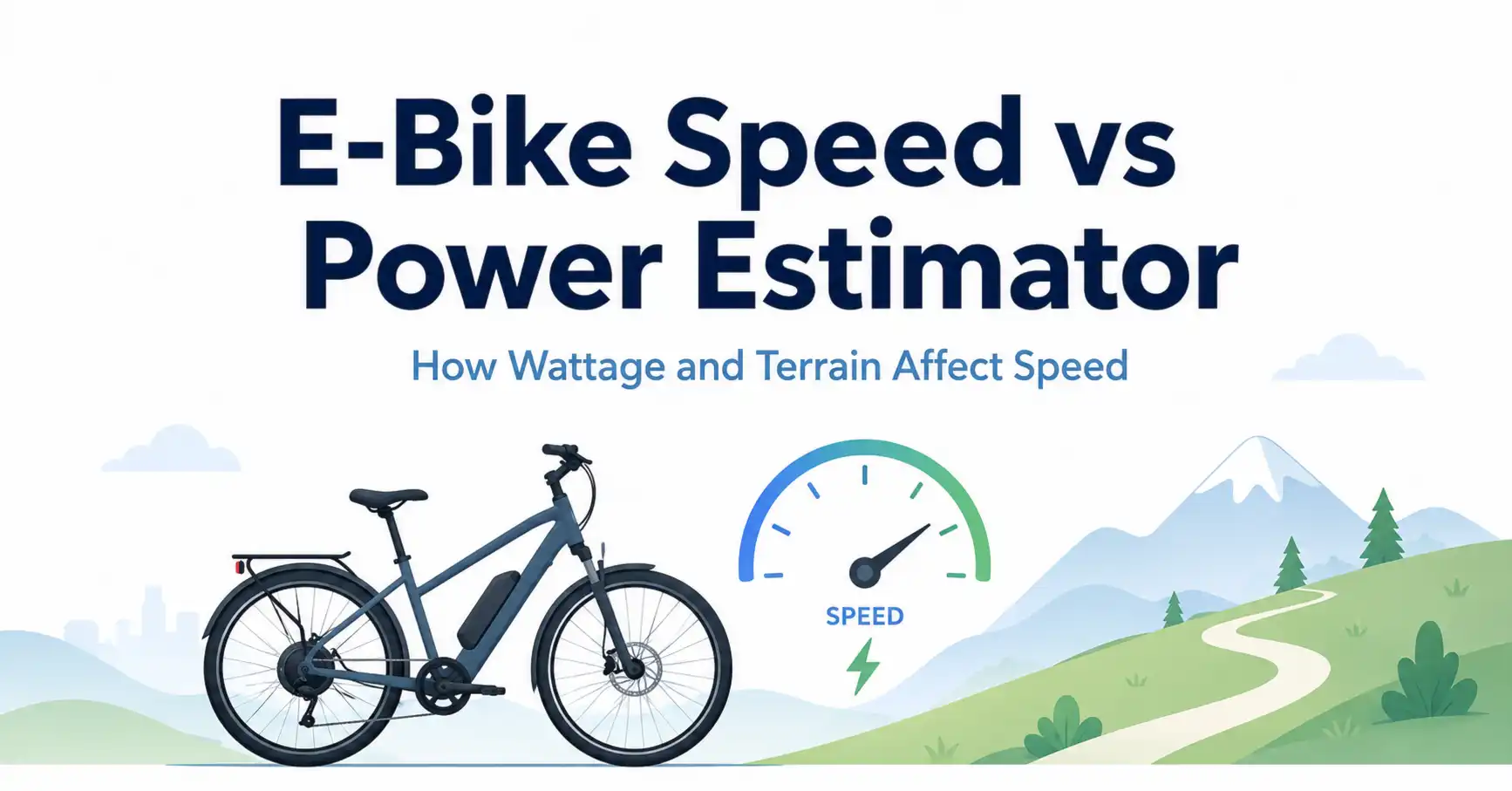
E-Bike Speed vs Power Estimator: How Wattage and Terrain Affect Speed
Last Updated on August 15, 2026 by Kristina
Motor wattage can give you a general idea of an e-bike’s performance, but it does not tell you exactly how fast that bike will go.
A 750W e-bike carrying a lighter rider on flat pavement can face very different power demands than a 750W bike climbing a hill with a heavier rider and cargo. Riding position, pedaling effort, terrain, wind resistance, and the bike’s electrical system can all affect the result.
This E-Bike Speed vs Power Estimator helps you see how some of those factors can change real-world speed potential. If you are trying to determine how much motor power you actually need rather than how fast a certain wattage may go, try my E-Bike Motor Power Calculator. You can also read the E-Bike Motor Guide for a deeper explanation of motor types, power, and torque.
E-Bike Speed vs Power Estimator
How to Use the Speed vs Power Estimator
Start by entering the motor wattage you want to compare. Then adjust the other inputs to better match the riding conditions you expect.
The estimator considers:
- Motor wattage – the power level you want to evaluate.
- Total riding weight – including the rider, e-bike, and anything being carried.
- Riding position – an upright rider generally creates more aerodynamic resistance than someone in a more streamlined position.
- Pedaling effort – your legs can contribute additional power instead of leaving all of the work to the motor.
- Terrain – flat pavement requires much less climbing effort than rolling terrain or a steep hill.
After selecting your inputs, choose Estimate Speed Potential to see the estimated speed and likely range.
The result is meant to help you compare scenarios. It is not a guarantee that a particular e-bike will reach the displayed speed.
Speed vs Power Estimator
See how motor wattage, terrain, weight, and riding position can affect real-world e-bike speed potential.
Why E-Bike Wattage Does Not Equal a Specific Speed
It is tempting to look at a motor rating and assume there should be a corresponding top speed.
For example, you might expect every 500W motor to have one typical speed and every 750W motor to have another. Real e-bikes do not work that way.
Motor wattage is only one part of the system.
Two e-bikes with similar wattage ratings can perform differently because of differences in the motor design, controller, battery, gearing, wheel and tire setup, total weight, programming, and other factors.
This is also why I would not choose an e-bike based on wattage alone.
Terrain Makes a Big Difference
On flat pavement, much of the power needed at higher speeds goes toward overcoming air resistance and rolling resistance.
Once the road starts climbing, the motor also has to move the combined weight of the rider and bike uphill. As the grade becomes steeper, maintaining the same speed requires substantially more power.
That is why a bike that feels strong on a flat road can slow noticeably on a steep climb.
If hills are one of your biggest concerns, motor wattage should not be the only specification you compare. Motor type, torque, gearing, rider weight, cooling, and the severity of the climb can all matter.
Rider, Bike, and Cargo Weight Matter
The estimator uses total riding weight rather than rider weight alone because the motor is moving more than just the person on the saddle.
The e-bike itself, racks, baskets, locks, groceries, camping equipment, child seats, passengers, or other cargo all add to the load.
Added weight is especially noticeable when accelerating and climbing.
If you are unsure whether a bike can carry your planned load, use my E-Bike Payload Calculator to compare your combined load with the manufacturer’s published payload and rack limits.
Riding Position Changes the Power Needed
Riding position becomes increasingly important as speed rises because the rider has to push through the air.
A relaxed upright position is comfortable, but it normally presents more frontal area to the wind. A more forward riding position can reduce some of that resistance.
This does not mean you should choose an uncomfortable riding position just to gain speed. The setting is included so the estimator can better reflect the differences between an upright cruiser, everyday commuter, and a more performance-oriented riding position.
Pedaling Can Add Meaningful Power
Your motor does not necessarily have to provide all of the power needed to keep the bike moving.
If you are pedaling, your own effort contributes to the total power available. Someone pedaling strongly may therefore see a different speed estimate than someone relying primarily on motor assistance.
This is one reason two riders can have very different experiences on the same e-bike.
How to Read Your Results
The calculator gives you a best estimate and a likely speed range rather than presenting one exact number as guaranteed.
I think the range is more useful because real-world e-bike performance changes constantly.
A result might change because of:
- Headwinds or tailwinds
- Tire pressure
- Road or trail surface
- Battery state of charge
- Temperature
- Motor efficiency
- Controller output
- Wheel and tire size
- Mechanical drag
- Built-in speed limits
- Changes in rider effort
Use the result to compare different scenarios rather than treating it as a predicted GPS top speed.
For example, try keeping the wattage the same and changing only the terrain. Then change the total riding weight. This makes it much easier to see which conditions place the greatest demands on the motor.
Speed Potential Is Not the Same as Your E-Bike’s Top Speed
There is an important distinction between power-based speed potential and the speed a particular electric bike will actually allow.
An e-bike may have enough theoretical power to travel faster while still being electronically limited by its controller or programming. Motor RPM, battery voltage, gearing, wheel size, and other system characteristics can also place practical limits on speed.
The estimator does not attempt to bypass those limits or predict the exact programming of a particular model.
If your e-bike seems unusually slow compared with how it normally performs, that is also a different issue than estimating theoretical speed potential. Reduced performance can sometimes point to battery condition, tire pressure, settings, mechanical resistance, or another problem rather than insufficient motor wattage.
What About E-Bike Speed Limits and Classes?
A speed estimate should never be interpreted as permission to ride at that speed.
E-bike definitions and assisted-speed limits depend on the laws that apply where you ride. Many places use Class 1, Class 2, and Class 3 classifications, but the rules are not identical everywhere.
My guide to Class 1, Class 2, and Class 3 e-bikes explains how the common classification system works.
You should also check the E-Bike Laws by State guide before riding because state and local rules can affect speed, equipment requirements, and where different types of e-bikes are allowed.
Speed and Range Are Connected Too
Higher speed does not come without a cost.
As speed increases, the motor may need substantially more power to overcome aerodynamic resistance. Hills, added weight, frequent acceleration, and higher assist levels can also increase energy use.
So if you are comparing e-bikes for a longer commute or recreational ride, do not look at speed without also considering battery capacity and range.
Use the E-Bike Range Calculator to estimate how far your setup may travel based on your riding conditions.
What This Estimator Cannot Predict
No online calculator can perfectly predict the speed of every e-bike.
This estimator does not know the exact motor efficiency curve, controller programming, battery condition, gearing, tire pressure, speed limiter, or mechanical condition of the bike you are considering.
It also cannot predict sudden wind changes, loose terrain, stop-and-go riding, or how much power an individual rider actually contributes through the pedals.
That is why the result is presented as an estimate of speed potential rather than a guaranteed top speed.
For a specific e-bike, compare the estimate with the manufacturer’s specifications and credible real-world testing.
Why You Can Trust Electric Bike Explorer
Electric Bike Explorer tools are designed to help make complicated e-bike specifications easier to understand without pretending an estimate is more precise than it really is.
For this estimator, I account for several factors that affect power demand rather than assigning one fixed speed to each motor wattage. I also clearly identify the limitations so you can use the result as a comparison and planning tool rather than a promise of actual performance.
My goal is to give riders practical information they can use to make better buying and riding decisions.
More Free E-Bike Calculators and Tools
Trying to figure out more than speed?
You can use the Motor Power Calculator to estimate how much motor power may fit your riding needs, the Range Calculator to estimate riding distance, or the Payload Calculator to check rider and cargo load.
You can also browse the complete Electric Bike Explorer Tools Hub for more calculators, estimators, buying tools, and troubleshooting helpers.
Want to See More Electric Bike Explorer in Google Search?
Add Electric Bike Explorer as a preferred source to see more of our e-bike law guides, safety updates, reviews, buying guides, and troubleshooting posts when they are relevant to your searches.
E-Bike Speed vs Power FAQs
Does a higher-watt e-bike always go faster?
No. Higher available power can increase performance potential, but wattage alone does not determine top speed. Controller limits, motor design, battery voltage, gearing, wheel size, total load, terrain, aerodynamics, and programmed speed limits can all affect actual speed.
Why does an e-bike slow down so much on hills?
Climbing requires additional power to move the combined weight of the rider and bike uphill. The steeper the hill and the heavier the total load, the harder the motor has to work to maintain speed.
Can two e-bikes with the same wattage have different top speeds?
Yes. Two motors with the same published wattage can be part of very different electrical and mechanical systems. Controller output, battery setup, motor characteristics, gearing, wheel size, programming, and other factors can produce different real-world results.
Is the estimated speed guaranteed?
No. The calculator provides an estimated speed range based on the information you enter and several modeled assumptions. Actual speed may be higher or lower.
Can I use the result to determine whether an e-bike is legal?
No. The estimator measures power-based speed potential, not legal status. Check the classification and laws that apply to your bike and the place where you plan to ride.

Kristina is not just an enthusiast but a true authority on electric bikes. Nestled in the coastal beauty of Virginia, Kristina has found the perfect backdrop for her passion for electric biking. As a dedicated wife and homeschooling mom, her life revolves around family, faith, and the thrill of adventure.
Originally hailing from Ohio, Kristina's journey with electric bikes began as a curiosity and quickly evolved into a deep expertise. Her blog is a testament to her love for electric biking, combining her fascination for eco-friendly transportation with her coastal lifestyle.
When she's not cruising the beach on her electric bike, you'll find Kristina indulging in her other loves: long walks along the shore, getting lost in a good book, and cherishing moments with her loved ones. With a heart as big as her love for animals, especially cats, Kristina brings a unique perspective to the electric bike world, grounded in her strong faith in God and her dedication to a sustainable lifestyle.
Through her blog, Kristina shares her extensive knowledge of electric bikes, offering valuable insights, tips, and recommendations to fellow enthusiasts. Whether you're a seasoned rider or a newcomer to the electric bike scene, Kristina's blog is your go-to source for all things electric biking, fueled by her passion, expertise, and the scenic beauty of coastal Virginia.