Utah Cracks Down on High-Powered E-Bikes as Enforcement Increases in 2026
Last Updated on April 7, 2026 by Kristina
New law targets high-power electric bikes that blur the line between bicycles and motorcycles
Utah is taking a major step toward tightening e-bike regulations – and it could change how some riders legally use higher-powered models.
A new bill moving through the state legislature would require motorcycle licenses for certain high-speed electric bikes, especially those that no longer fit within traditional e-bike classifications.
👉 Not sure how your e-bike is classified or what rules apply where you live? Start with the e-bike buying guide for a full breakdown of classes, speeds, and legal limits.
👉 You can also check your state’s specific rules in the State-by-State E-Bike Laws Guide to see how Utah compares to other states.
⚠️ Enforcement Is Increasing Starting May 2026
Utah officials have confirmed that enforcement will significantly increase following the passage of HB 381—and this is where things really change for riders.
In the past, law enforcement focused more on education and warnings. But going forward, that approach is shifting.
Riders can now expect:
- Citations for illegal or misclassified bikes
- Possible impoundment of high-powered e-motorcycles
- Increased enforcement in areas where complaints and safety concerns have risen
Officials also emphasized that many riders—especially younger ones—may be unknowingly riding vehicles that no longer qualify as legal e-bikes.
👉 In other words: this isn’t just a law change—it’s an enforcement shift.
Do You Need a License for an E-Bike in Utah?
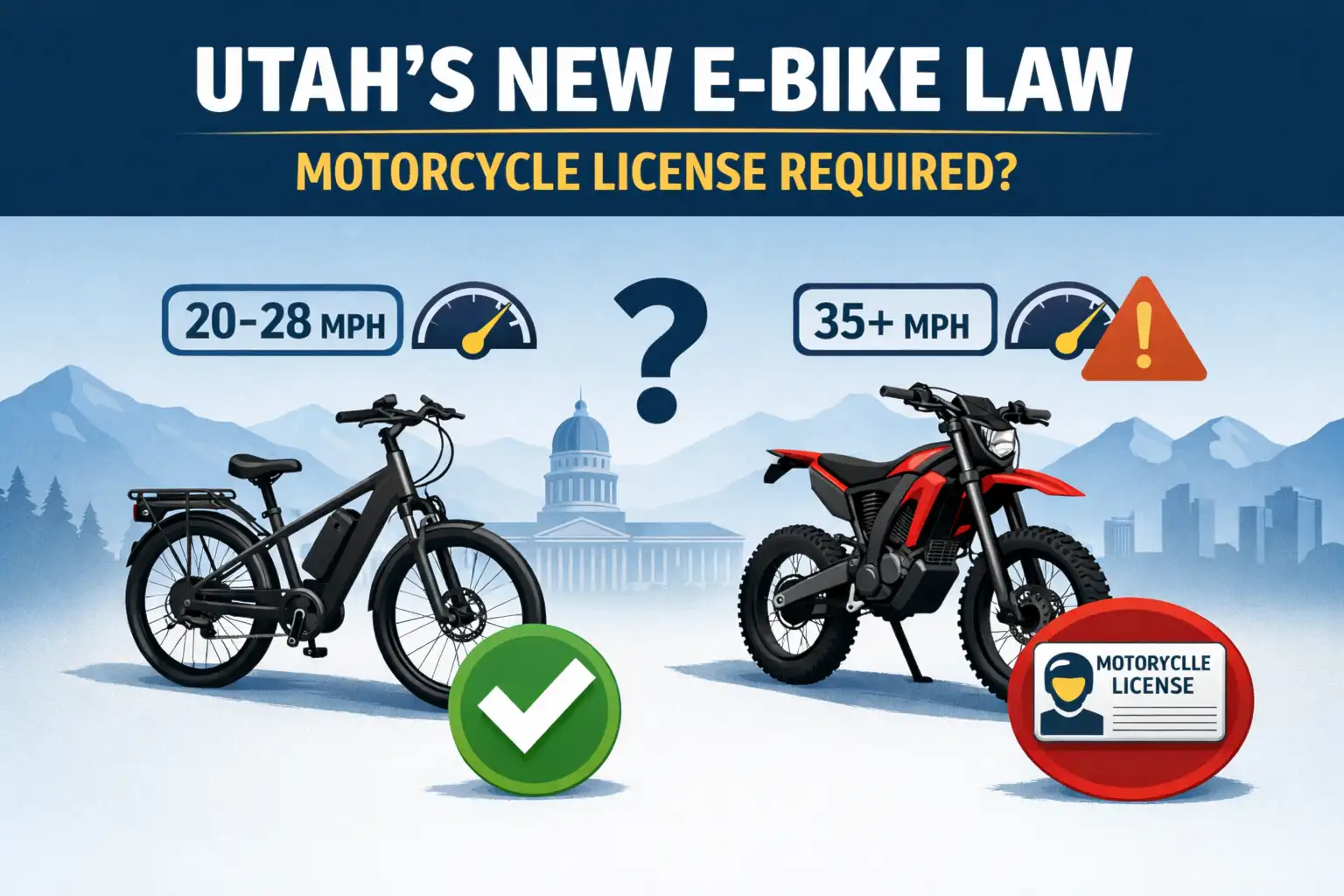
No – most e-bikes in Utah do NOT require a license.
However, under the proposed law, some high-powered or modified e-bikes could be reclassified as motorcycles, meaning riders would need a motorcycle endorsement to legally operate them.
What’s Changing in Utah?
The legislation, known as HB 381 (Electric Mobility Device Amendments), aims to modernize Utah’s laws as faster and more powerful electric bikes become more common.
Under the proposal:
- Some electric bikes that exceed legal limits could be reclassified as motorcycles
- Riders of these vehicles would need a motorcycle license or endorsement
- New categories like “high-power electric devices” would be introduced
- Additional safety rules and enforcement tools would be added
Local reporting indicates lawmakers are trying to create clearer distinctions between traditional e-bikes and higher-speed electric vehicles that behave more like motorcycles.
🎥 Watch: What This New Utah E-Bike Law Means for Riders
Why This Law Is Being Proposed
The biggest issue?
Not all “e-bikes” are actually e-bikes anymore.
Utah currently recognizes the standard 3-class system:
- Class 1: Pedal assist up to 20 mph
- Class 2: Throttle up to 20 mph
- Class 3: Pedal assist up to 28 mph
These do not require a license and are treated like bicycles under current law.
According to the Utah Department of Public Safety, these classifications are designed to keep low-speed electric bikes aligned with traditional bicycle rules.
But newer, high-powered models – especially throttle-heavy or dirt bike-style builds – can:
- Exceed 20 mph without pedaling
- Operate more like motorcycles than bicycles
- Fall outside existing legal definitions
That’s where the new law comes in.
👉 If you’re unsure how these classes actually work, see the full breakdown of e-bike classes (Class 1, 2, and 3 explained).
Legal & Safety Reminder for Riders
Even if your e-bike is legal today, modifying it can quickly change its classification.
Common changes that can make your bike illegal:
- Removing speed limiters
- Increasing motor output beyond 750W
- Using throttle-only riding at high speeds
Once your bike exceeds legal limits, it may no longer be considered an e-bike – and you could be subject to motorcycle laws.
For official guidance, Utah riders can review current definitions and safety rules through the Utah Department of Public Safety and related transportation resources.
What Counts as a “Motorcycle” Now?
Under the proposed changes:
- E-bikes that exceed legal speed or power limits may no longer qualify as bicycles
- Devices capable of higher speeds (especially without pedaling) could be classified as:
- Electric motorcycles
- Or high-power electric devices
In those cases:
- Riders 16+ would need a motorcycle endorsement
- Younger riders could be restricted entirely
- Local governments could limit where these vehicles are allowed
Coverage from KPCW notes that the bill is specifically targeting vehicles that blur the line between bicycles and motorized vehicles.
👉 Not sure where the line is between e-bikes, mopeds, and scooters? See this breakdown of e-bikes vs mopeds vs scooters and the laws that can get you fined fast.
What This Means for Riders
For most riders, nothing changes – as long as your bike fits within standard e-bike limits.
You’re still fine if your bike:
- Is 750W or less
- Stays within 20–28 mph limits
- Fits Class 1, 2, or 3 definitions
👉 Want to see how speed limits affect real riding? Check out how fast e-bikes are legally allowed to go.
But you may be affected if:
- Your bike is modified or “unlocked”
- It behaves more like a dirt bike or moped
- It can exceed 20 mph without pedaling
In those cases, you could now be required to:
- Register the vehicle
- Carry a motorcycle license
- Follow motor vehicle laws instead of bicycle rules
Is Your E-Bike Affected by This Law?
Use this quick checklist to see where you stand:
You’re likely NOT affected if your e-bike:
- Is 750W or less
- Has a top speed of 20–28 mph
- Uses pedal assist (or limited throttle up to 20 mph)
- Fits Class 1, 2, or 3 definitions
If that sounds like your bike, you’re still treated like a bicycle.
You MAY be affected if your e-bike:
- Exceeds 28 mph
- Has been modified or “unlocked”
- Has a high-powered motor (often 1000W+)
- Works more like a dirt bike or moped
- Can go fast without pedaling
In these cases, Utah may treat your bike as a motorcycle under the new law.
Common Mistakes Riders Make With E-Bike Laws
Many riders accidentally break the law without realizing it.
Here are some of the most common mistakes:
- Thinking all electric bikes are treated the same
- Unlocking speed limits without understanding legal impact
- Assuming throttle-only riding is always allowed
- Letting kids ride high-powered bikes meant for adults
The biggest mistake?
Assuming “if it’s sold as an e-bike, it must be legal everywhere.”
Why This Matters Beyond Utah
Utah isn’t the only state dealing with this issue.
Across the U.S., lawmakers are starting to respond to the rise of:
- High-speed throttle e-bikes
- Off-road style electric bikes used on public streets
- Modified bikes that exceed legal limits
We’re already seeing:
- Stricter enforcement in places like California and New York
- Local crackdowns on reckless riding
- New discussions about licensing and registration
👉 If you travel or commute across states, it’s worth reviewing your local rules in the State-by-State E-Bike Laws Guide.
My Take
This update changes the story more than the law itself.
The law was always coming—but enforcement is what actually impacts riders.
For a while, a lot of these high-powered “e-bikes” existed in a gray area. Riders could get away with using them like bicycles, even when they clearly functioned more like electric motorcycles.
That window is closing.
What stands out to me isn’t just the classification changes—it’s the shift in how seriously this is going to be enforced.
We’re moving from:
- “Let’s educate riders”
to - “We’re issuing tickets and taking bikes”
And that’s where people are going to get caught off guard.
Especially parents.
A lot of these bikes are being marketed as e-bikes, sold online, and given to kids without anyone realizing they may actually fall into motorcycle territory legally.
That’s a problem—and this law is trying to correct it.
From a bigger-picture standpoint, this is likely just the beginning.
Utah is one of the first states to clearly say:
“If it rides like a motorcycle, we’re going to treat it like one.”
And I fully expect more states to follow.
Bottom line:
This isn’t a crackdown on normal e-bikes.
It’s a crackdown on misclassified, high-speed electric bikes that were never really bicycles to begin with.
FAQs About Utah’s E-Bike Law
No. Standard Class 1, 2, and 3 e-bikes do not require a license.
High-powered or modified e-bikes that exceed legal limits may be classified as motorcycles.
Yes, if it meets standard e-bike classifications. Higher-powered bikes may be restricted.
Possibly. The law may introduce age restrictions for higher-powered devices.
External Sources
- KPCW – Utah Legislature proposal on e-bike classification changes
- Utah Department of Public Safety – Current e-bike definitions and safety guidance
- TownLift – Coverage of HB 381 and electric mobility updates

Kristina is not just an enthusiast but a true authority on electric bikes. Nestled in the coastal beauty of Virginia, Kristina has found the perfect backdrop for her passion for electric biking. As a dedicated wife and homeschooling mom, her life revolves around family, faith, and the thrill of adventure.
Originally hailing from Ohio, Kristina's journey with electric bikes began as a curiosity and quickly evolved into a deep expertise. Her blog is a testament to her love for electric biking, combining her fascination for eco-friendly transportation with her coastal lifestyle.
When she's not cruising the beach on her electric bike, you'll find Kristina indulging in her other loves: long walks along the shore, getting lost in a good book, and cherishing moments with her loved ones. With a heart as big as her love for animals, especially cats, Kristina brings a unique perspective to the electric bike world, grounded in her strong faith in God and her dedication to a sustainable lifestyle.
Through her blog, Kristina shares her extensive knowledge of electric bikes, offering valuable insights, tips, and recommendations to fellow enthusiasts. Whether you're a seasoned rider or a newcomer to the electric bike scene, Kristina's blog is your go-to source for all things electric biking, fueled by her passion, expertise, and the scenic beauty of coastal Virginia.