What is a Throttle on an E-Bike? A Beginner’s Guide
Last Updated on May 21, 2026 by Kristina
Last updated: May 2026
Electric bikes have changed the way many people commute, exercise, and travel. One feature that often separates e-bikes from traditional bicycles is the throttle. If you are new to e-bikes, understanding how a throttle works can help you choose the right bike and use it more confidently.
Many first-time riders ask:
Can an e-bike move without pedaling?
The answer is: sometimes, yes.
A throttle allows you to activate the motor and receive assistance without needing to pedal first. Depending on the bike and throttle design, this can make starts easier, reduce effort on hills, and help riders who want occasional assistance during longer rides.
➡ If you’re still learning the basics of e-bikes, you may also want to read our Electric Bike Buying Guide, which explains motor types, battery range, classes, and features that matter before buying.
➡ Seeing delayed acceleration, random power cutouts, or strange motor behavior? Learn the warning signs in our guide: How to Tell If Your E-Bike Controller Is Bad
This guide explains what an e-bike throttle is, how it works, different throttle types, how throttle systems compare to pedal assist, and common things beginners should know before riding.
What Does an E-Bike Throttle Actually Do?
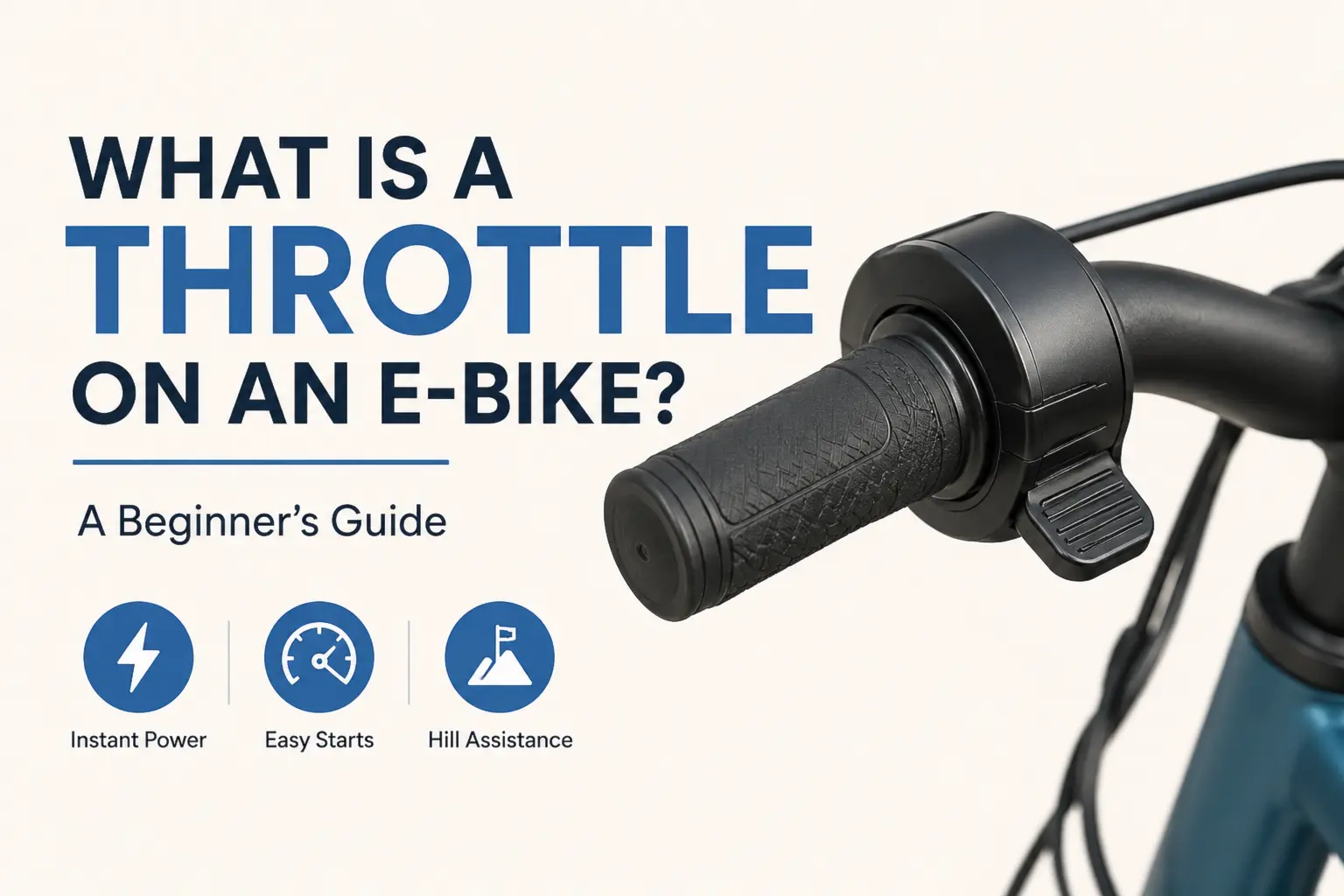
An e-bike throttle allows you to activate the motor without pedaling. Depending on the bike, this may use a thumb lever, twist grip, or another control that sends a signal to the motor system.
Throttle systems are commonly used for:
✔ Easier starts from stops
✔ Hill assistance
✔ Reduced rider effort
✔ Short bursts of additional power
Who This Guide Is For (and Who It’s Not)
This guide is for:
- New e-bike riders learning terminology
- Buyers deciding between throttle and pedal assist
- Commuters wanting easier starts at intersections
- Riders with mobility limitations
- Anyone confused about Class 1, Class 2, and Class 3 rules
- Riders trying to understand how motor assistance actually works
This guide may not be for:
- Advanced motor modification projects
- Detailed controller wiring diagrams
- E-bike conversion kit installation instructions
- Riders looking only for troubleshooting help
How We Evaluate E-Bike Features
This guide combines manufacturer specifications, rider experiences, current e-bike classifications, safety recommendations, and real-world riding situations to explain how throttle systems work and where they make the biggest difference.
What Is a Throttle on an E-Bike?
A throttle on an e-bike is a control mechanism that allows you to engage the motor without requiring pedal movement.
Think of a throttle as a shortcut to motor power.
Instead of needing to pedal before assistance activates, a throttle lets you request power directly from the bike’s electrical system.
Depending on the bike, you may control the throttle by:
- Pressing a thumb lever
- Twisting part of the handlebar grip
- Using a half-twist design
- Pressing a button (less common)
Once activated, the bike’s motor supplies power and helps move the bike forward.
How Does an E-Bike Throttle Work?
Many riders assume the throttle directly powers the motor.
That is not exactly what happens.
The throttle actually sends an electronic signal through the bike’s controller, which then tells the motor how much power to deliver.
Here is a simplified breakdown:
| Step | What Happens |
|---|---|
| 1 | Rider presses or twists the throttle |
| 2 | Throttle sends signal to controller |
| 3 | Controller processes power request |
| 4 | Controller sends instructions to motor |
| 5 | Motor delivers power |
| 6 | Bike accelerates |
The controller acts like the brain of the e-bike, deciding how much power reaches the motor.
➡ Related: Learn more in our E-Bike Controller Guide
How the Controller Affects Your Throttle
Many riders think a throttle creates power by itself.
It doesn’t.
The throttle simply requests assistance.
The controller receives that request and determines how the motor responds.
If a controller begins failing, you may notice symptoms such as:
- Delayed throttle response
- Sudden power loss
- Inconsistent acceleration
- Power cutting in and out
- Unexpected motor behavior
Sometimes riders think the throttle itself is broken when the actual issue is the controller.
➡ Related: Learn how to tell if your e-bike controller may be failing
➡ Want both natural pedal feel and throttle convenience? Explore Throttle-Controlled E-Bikes with Torque Sensor: A Buyer’s Guide
Different Types of E-Bike Throttles
Not every e-bike uses the same throttle design. Different styles can affect comfort, control, and riding feel.
While most riders quickly adapt to any design, understanding the differences can help when choosing an e-bike.
Thumb Throttle
A thumb throttle uses a small lever near the handlebar grip that you press with your thumb.
Pros
- Good control over acceleration
- Less accidental activation
- Common on commuter e-bikes
- Keeps a stable hand position on the bars
Cons
- Can create thumb fatigue on longer rides for some riders
Best for:
- Daily commuting
- Beginner riders
- Urban riding
Twist Throttle
A twist throttle works similarly to a motorcycle throttle.
The rider twists part of the handlebar grip to activate motor power.
Pros
- Familiar feel for motorcycle riders
- Easy to apply varying levels of power
- Quick acceleration response
Cons
- Can accidentally activate while mounting or repositioning hands
- Some riders experience wrist fatigue on longer rides
Best for:
- Riders familiar with motorcycles
- Recreational riding
- Riders wanting quick power access
Half-Twist Throttle
A half-twist throttle combines elements of thumb and full-twist designs.
Only part of the grip rotates.
Pros
- Better control than full twist
- Reduces accidental activation
- Allows stable hand positioning
Cons
- Less common than thumb throttles
Best for:
- Mixed riding styles
- Riders wanting more control
Push-Button Throttle
Push-button throttles exist on some e-bikes and mobility-oriented designs but are less common on mainstream commuter and recreational e-bikes.
Pros
- Simple operation
- Easy to understand
Cons
- Less precise control
- Rare on most modern e-bikes
Throttle vs Pedal Assist: What’s the Difference?
Most modern e-bikes include pedal assist, a throttle, or both.
The two systems work differently.
| Feature | Throttle | Pedal Assist |
|---|---|---|
| Requires pedaling | No | Yes |
| Battery use | Higher | Lower |
| Ride feel | Instant power | More natural |
| Range impact | Usually lower range | Better efficiency |
| Best use | Starts, hills, quick boosts | Longer rides |
Many riders use both together.
For example:
- A throttle can help when starting from intersections
- Pedal assist can help maximize range during longer rides
- Some riders switch between both during commutes
➡ Related: Read our guide on How Far Can an E-Bike Go?
Does Using a Throttle Drain the Battery Faster?
Usually, yes.
Throttle-only riding generally consumes more power than pedal assist because the motor does more of the work.
General examples:
| Riding Style | Typical Battery Efficiency |
|---|---|
| Mostly pedal assist | Higher efficiency |
| Mixed throttle + pedal assist | Moderate efficiency |
| Mostly throttle only | Lower efficiency |
Actual range can vary based on:
- Rider weight
- Terrain
- Hills
- Wind
- Tire pressure
- Speed
- Assist settings
- Battery size
This does not mean you should avoid using a throttle.
Many riders simply use it strategically when needed.
Real Riding Situations Where a Throttle Helps
Starting at an Intersection
Starting from a stop can sometimes feel awkward, especially for new riders.
A throttle can help riders begin moving smoothly without immediately needing pedal force.
Climbing Short Hills
Many riders use throttle assistance for short climbs to reduce strain.
Long steep hills may still benefit from combining throttle use with pedaling.
Carrying Groceries or Cargo
Heavy loads often make starts more difficult.
Some riders appreciate extra motor assistance when carrying:
- Groceries
- Work bags
- Child seats
- Cargo loads
Riders With Knee or Mobility Limitations
Some riders appreciate occasional assistance during more physically demanding sections.
A throttle can help reduce strain during starts and difficult terrain.
E-Bike Classes and Throttle Rules
Many new riders are surprised to learn that throttle rules can vary depending on e-bike class.
| Class | Throttle Allowed? |
|---|---|
| Class 1 | No |
| Class 2 | Yes |
| Class 3 | Depends on state and manufacturer configuration |
State and local trail rules may also vary.
Some areas allow throttle-equipped bikes on roads but not on certain paths or trails.
➡ Related: See our State-by-State E-Bike Laws Guide
Common E-Bike Throttle Problems
Like any electronic component, throttle systems can occasionally develop problems. The good news is that many issues are relatively simple to diagnose.
| Problem | Possible Cause | Quick Fix |
|---|---|---|
| Throttle not responding | Loose connector | Check wiring connections |
| Delayed response | Controller issue | Inspect controller behavior |
| Works intermittently | Dirty or loose contacts | Clean and reconnect |
| Motor cuts in and out | Battery issue | Check battery charge and connections |
| Throttle suddenly stops working | Brake cutoff sensor activated | Check brake levers |
| Bike powers on but no throttle response | Display or controller settings | Verify settings |
Sometimes the throttle itself is not actually the problem.
For example:
- A low battery can mimic throttle issues
- Brake cutoff sensors can disable motor output
- Loose wiring connections can interrupt signals
- A failing controller can create inconsistent behavior
➡ Related: Read our E-Bike Throttle Not Working? Causes & Fixes
➡ Related: See our E-Bike Troubleshooting Guide
Common Beginner Throttle Mistakes
Many new riders accidentally make simple mistakes while learning how e-bike throttles work.
Using full throttle immediately from a stop
Applying maximum power immediately can feel jerky, especially on more powerful bikes.
Instead:
✔ Apply power gradually
Forgetting throttle use affects battery range
Heavy throttle use often reduces range compared to pedal assist riding.
Instead:
✔ Use throttle strategically
Accidentally activating a twist throttle
Some riders unintentionally twist the grip while mounting or adjusting hand position.
Instead:
✔ Keep a steady grip and become familiar with throttle placement
Assuming every e-bike includes a throttle
Not all e-bikes have throttle systems.
Many Class 1 bikes use pedal assist only.
Instead:
✔ Verify bike specifications before purchasing
Ignoring local laws
Throttle rules can vary by class and location.
Instead:
✔ Check state and local regulations
Safety Tips for Using an E-Bike Throttle
Throttle systems are convenient, but responsible use helps keep riding predictable and safe.
Keep these tips in mind:
- Start gently from stops
- Keep both hands firmly on the handlebars
- Avoid sudden full-power acceleration on wet or loose surfaces
- Use pedal assist when possible to conserve battery
- Become familiar with throttle response before riding in traffic
- Check throttle operation periodically
- Avoid distractions while using motor assistance
FAQs
No.
Many Class 1 e-bikes use pedal assist only and do not include a throttle.
Many Class 2 e-bikes allow throttle-only riding.
However, range may decrease compared to using pedal assist.
Neither is universally better.
Throttle systems are useful for quick starts and occasional assistance, while pedal assist usually improves battery efficiency and creates a more natural riding experience.
No.
Rules can vary depending on:
E-bike class
State laws
Trail rules
Local regulations
Not necessarily.
Maximum speed depends more on:
Motor design
Controller settings
E-bike class
Local speed limits
Sometimes.
Compatibility depends on the bike’s controller and electrical system.
Some bikes can disable or remove throttle functionality while others are designed around integrated systems.
Usually yes.
Throttle-only riding generally uses more energy because the motor performs more of the work.
It depends on the trail and location.
Some trails restrict certain classes of e-bikes or throttle-equipped bikes.
Final Thoughts
An e-bike throttle is one of the features that makes electric bikes feel approachable and flexible for many riders.
For some people, a throttle provides occasional assistance when starting from stops, climbing short hills, or reducing effort during longer rides. For others, it can make riding more accessible and enjoyable.
The most important thing is understanding how throttles work, when they help most, and how they fit into your overall riding style.
For many riders, the best experience comes from combining both throttle use and pedal assist rather than relying entirely on one system.

Kristina is not just an enthusiast but a true authority on electric bikes. Nestled in the coastal beauty of Virginia, Kristina has found the perfect backdrop for her passion for electric biking. As a dedicated wife and homeschooling mom, her life revolves around family, faith, and the thrill of adventure.
Originally hailing from Ohio, Kristina's journey with electric bikes began as a curiosity and quickly evolved into a deep expertise. Her blog is a testament to her love for electric biking, combining her fascination for eco-friendly transportation with her coastal lifestyle.
When she's not cruising the beach on her electric bike, you'll find Kristina indulging in her other loves: long walks along the shore, getting lost in a good book, and cherishing moments with her loved ones. With a heart as big as her love for animals, especially cats, Kristina brings a unique perspective to the electric bike world, grounded in her strong faith in God and her dedication to a sustainable lifestyle.
Through her blog, Kristina shares her extensive knowledge of electric bikes, offering valuable insights, tips, and recommendations to fellow enthusiasts. Whether you're a seasoned rider or a newcomer to the electric bike scene, Kristina's blog is your go-to source for all things electric biking, fueled by her passion, expertise, and the scenic beauty of coastal Virginia.